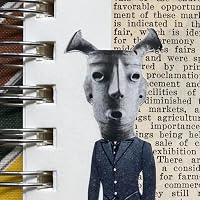
1969. No Edition Stated. 176 pages. Paperback book. Mild brown staining to pages on occasion. Notable tanning to pages throughout. Mild wear to spine, cover edges and corners, with soiling and creasing to covers and spine.
Polly Toynbee (born Mary Louisa Toynbee, 27 December 1946) is a British journalist and writer, and has been a columnist for The Guardian newspaper since 1998. She is a social democrat and broadly supports the Labour Party, while urging it in many areas to be more left-wing, though during the 2010 general election she urged a tactical vote in support of the Liberal Democrats in an attempt to bring about a Lab-Lib coalition in support of proportional representation. She was appointed President of the British Humanist Association in July 2007. In 2007 she was named 'Columnist of the Year' at the British Press Awards.
"After reading a monograph on the history of science fiction I inevitably find a handful of works that I must track down (more as an act of data collection than a quest for literary genius). Andrew Hammond’s Cold War Stories: British Dystopian Fiction, 1945-1990 (2017) contained a wealth of lesser-known works that immediately dented my pocketbook. Polly Toynbee’s Leftovers (1966) fits into Hammond’s analysis of a British Empire irrevocably weakened by the WWII and growing US power [...]"
I found this book by accident in a charity shop - I took it off the shelf thinking it was a cookery book but was surprised to see it was a novel by that grand old lady of left-wing politics and Tuscan holiday home owner, Polly Toynbee. Even more surprisingly, it was written when she was only 20.
Initially it seems to be a standard end-0f-the-world novel in the John Christopher/John Wyndham mould, but as the book progresses it becomes a little more like a French new wave movie. A group of narcissicistic, spoilt middle class teenagers and a slightly older, more conservative married couple are seemingly the only survivors of a Soviet neutron-bomb attack which seems to have killed off the rest of the world's population.
At first the group live an abandoned hedonistic lifestyle, looting luxury stores, living in Buckingham Palace and racing sports cars down Oxford Street, but as time goes by they feebly attempt a 'back to the land' community in Suffolk which ends in failure, and then begin to descend into a lotus-eating existence of faux-domesticity, clinging to the advertising slogans and brand-snobbery they knew before the Fall.
Toynbee is presumably attempting something of a satire on modern lifestyles, as the book fails on many practical post-apocalyptic points. For example, the group survive the bomb attack because they are stuck on a London tube train; if this was the only reason for their survival there would be hundreds, if not thousands, of Londoners who would have survived. It is also highly unlikely that nobody else from anywhere in the world would have survived and tried to make contact.
Toynbee also exerts far too much effort on the endless bed-hopping and partner-swapping of the youths, giving us not a love triangle but a love-dodecahedron. I got the impression she may have lifted this theme from that classic post-apocalyptic work by Mary Shelley, 'The Last Man' which goes into similarly tedious detail about the characters' love lives. The language is painfully hip, using dialogue that even Austin Powers would probably find hackneyed, making it very much of its time.
All in all it's an interesting little off-beat novel of the genre, which can be easily read in one sitting, but essentially it is a juvenalia curiosity rather than a great work. I enjoyed it but found it ultimately rather unsatisfying.