Much of what we know about the first millennium comes from a book written around 1020 called The Julius Work Calendar. It is the earliest surviving example of the English daily routine, "the schedule of the earth, and the life of the spirit." The ink used to put the characters on paper is interesting in itself. It was tapped from oak trees boils, created by wasps that had gnawed at the bark to lay eggs. In self defense, the tree formed a gall that was filled with a clear acid. The ink was called encaustum from the Latin caustere, meaning "to bite," because the ink literally "bit into the parchment." The parchment was made from the skin of a lamb or kid; the ink was finished with iron salts to provide black or brown color and thickened with gum arabic. Treated appropriately, the document lasts for centuries. Life was short, but the skeletons unearthed reveal people of stature similar to our own. It was only later that malnourishment and overcrowding created the shorter people of the middle ages and Victorian era. Life was simple and work hard.
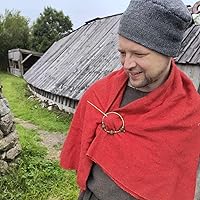
Buttons had yet to be invented, so clasps or thongs were used to hold simple sacklike tunics together. Children of age twelve were considered old enough to swear allegiance to the king, and marriage between early teenage girls to older men was the norm. The wheeled plough was crucial to their existence, for it enabled two men and an ox to open up acres. England supported about a million people at this time. It would not have been possible without this invention, which was available as early as the first century, according to Pliny. Slavery was a fact of life and prevalent. In 1066, the Normans introduced the feudal system, but, prior to their invasion, slavery, was introduced by Germanic tribes who made war on their Slavic neighbors — slave derives from the fact that most slaves were "Slavs." Anglo- Saxons raided Wales for slaves, also. Dublin operated the largest slave market in western Europe. It was not uncommon for slavery to be an alternative to prison and it became the penalty for numerous offenses ranging from adultery to theft. Almost everyone was in bondage of one form or another, and often families were forced to place themselves in bondage during times of famine in order to eat. Famine was frequent, especially during July when supplies from the previous year were running low and the new harvest was not yet ripe. Infanticide was not a crime; the law recognized the horrible pressure placed on families by another mouth to feed. Children under the age of seven could legally be sold into slavery to relieve the pressure. The authors have an interesting and plausible explanation for rural frenzies that erupted during the early summer months (see Breughel's famous tableaux of crazed festivals). Lightheadedness was inevitable from lack of food, and the poor had to subsist on whatever they could find during the lean month of July. Rye that has gone moldy is a source of lysergic acid: LSD. " Poppies, hemp, and darnel were scavenged, dried and ground up to produce a medieval hash brownie known as 'crazy bread.'“ According to one modern historian, entire communities became virtually somnolent from the stuff. Taxes were collected in an interesting fashion. Mints were scattered throughout the kingdom, licensed by the crown and strictly watched to make sure that the percentage of silver to alloy was not adulterated. Coin was soft metal (to get a half-penny, one simply cut a penny in half) and to prevent it from becoming debased, it was good for only a relatively short period, two to three years. It then had to be turned in for new coins, exchanged at ten coins for eight or nine, depending on the level of taxation, the difference being kept for the king.
Clinton's peccadilloes were not unknown in the eleventh century. When King Eadwig failed to show up on time for his coronation in 955 C. E., a search party went looking for him. He was discovered in bed with a pretty young lass and her mother. Top that one, Bill. This bucolic picture becomes tainted with the evidence that while today’s air is polluted with gasoline fumes, the first millennium was pervaded with the odor of excrement. The toilet was behind the house and animals went just about everywhere. Parasites were a terrible problem, especially the maw-worm, which might reach 30 centimeters in length and had the disconcerting practice of migrating throughout the body and emerging unexpectedly from any orifice, sometimes from the corner of the eye. Despite their ignorance of elementary hygiene — if food fell to the floor, one made the sign of the cross and ate it anyway — they had extensive anatomical knowledge. A ninth century book still extant displays profound knowledge of the body’s interior mechanisms, and another describes the various fetal development stages in detail, even indicating that the soul was not present until after the third month, which suggests a tolerance of abortion.
Skulls dug up in ancient cemeteries of the time reveal evidence of trepanning, a technique still used today to relieve pressure in the brain following head trauma (except that we prefer Black & Decker to a bow drill). They were able to grow grapes for wine in England during this period because the climate was much warmer than today — even warmer than with “global warming.” The period 950 to 1300 A.D. is known as the “Little Optimum.” Archaeologists estimate the climate of the world was at least 4 degrees warmer than today, and the retreating arctic ice may have helped make possible Leif Erikson’s discovery of the New World and the vines he found growing there.