

What do you think?

The Roman Invasion of Britain
First Published in 2004. The span of time, when most of Britain was under Roman influence, stretched from 55 BC to c. AD 500, when control had passed into the hands of Germanic peoples, many of whom had been living here already for over a century as troops or allies of the Roman army. Five and a half centuries is a considerable portion of our national history. If one counts back from today, it brings one to about 1440, at the end of the Middle Ages, a period totally remote from our present world. This revised edition takes into account aerial archaeology and major rescue excavations.
244 pages, Paperback
First published January 5, 1993
About the author
Graham Webster
55 books3 followersLecturer in Romano-British Archaeology, then Senior Lecturer, then Reader, Extra-Mural Department, Birmingham University 1954-80; President, Shropshire Archaeological Society 1975-2001; OBE 1982.
An expert in the field of the Roman army, Webster can also lay a claim to have been one of the modern founders of the study of Roman pottery in Britain and to have done pioneering studies in many of the more obscure areas of Romano-British studies, ranging from his early work on the use of coal in Roman Britain through to his last major work, on Romano-Celtic religion.
An expert in the field of the Roman army, Webster can also lay a claim to have been one of the modern founders of the study of Roman pottery in Britain and to have done pioneering studies in many of the more obscure areas of Romano-British studies, ranging from his early work on the use of coal in Roman Britain through to his last major work, on Romano-Celtic religion.
Ratings & Reviews
Friends & Following
Create a free account to discover what your friends think of this book!
Community Reviews
Displaying 1 - 6 of 6 reviews

March 2, 2018
Webster provides an introduction to the Roman Invasion of Britain (Julius Caesar: 55 BC – 54 BC; Claudius: AD 43) through the analysis of archaeological finds. Namely, Webster explores the tribes of South-East Britain through where coins are found.
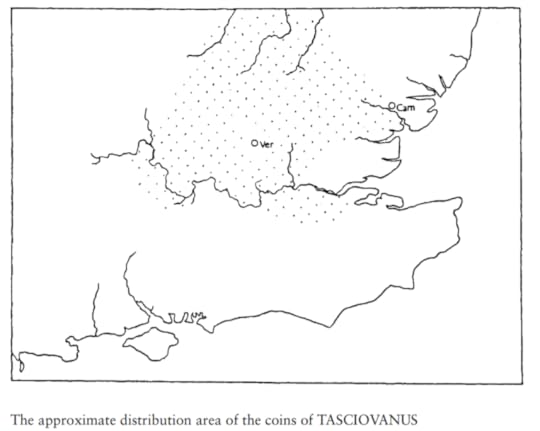
Furthermore, the development of the Roman conquest is seen through the eyes of archaeological knowledge, rather than Cassius Dio.
Furthermore, the development of the Roman conquest is seen through the eyes of archaeological knowledge, rather than Cassius Dio.

April 27, 2013
A very informative yet fairly accessible account of the invasion of the British Isles by the Roman Empire in 43AD. Rather than fall into the trap of pretending to be absolutely definitive in what happened, this book intertwines the narrative with the facts and archaeological discoveries behind the main theories. This way you feel that not only are you getting an easy to grasp idea of what happened and when but also what physical or academically postulated reasons we have to back up that idea.
I'll be honest at times it does bog itself down a bit in the minutiae of the details - such as what the distribution of specific coins tell us about the locations of the tribes - rather than balancing evenly with the narrative, so based on that I would say, as accesible as this book is, it's probably best suited to someone studying this subject matter or looking for more academic reading than the casual reader looking to drop in and out.
Overall, highly informative, engaging read packed full of facts.
Quality-wise, for it's depth of detail, this book probably deserves a 4 out of 5 but I'm giving it a 3 based on my own personal enjoyment of it.
I'll be honest at times it does bog itself down a bit in the minutiae of the details - such as what the distribution of specific coins tell us about the locations of the tribes - rather than balancing evenly with the narrative, so based on that I would say, as accesible as this book is, it's probably best suited to someone studying this subject matter or looking for more academic reading than the casual reader looking to drop in and out.
Overall, highly informative, engaging read packed full of facts.
Quality-wise, for it's depth of detail, this book probably deserves a 4 out of 5 but I'm giving it a 3 based on my own personal enjoyment of it.

October 26, 2019
An excellent book that explores the Roman presence in Britain following Claudius' conquest. The book can at times feel heavy to read at times as a result of its methodical and academic examination. This may also be an issue for readers unfamiliar with Britain's geography when Webster discusses fort locations. Overall, it is a good starter for studying Rome's contribution to British nation building as it brought the island into Europe's fold.
November 4, 2016
Muy interesante historia sobre la dominación romana en gran bretaña, desde la llegada con el emperador Claudio (julio César en realidad fue el primero en intentarlo) hasta la retirada en 410 DC. Se detallan muy bien las distintas etapas de un proceso de casi 4 siglos en que las islas británicas exigieron y pusieron a prueba a los romanos.
May 2, 2008
Invaluable resource for the campaigns of Agricola.

November 15, 2012
Can be tedious at times but helpful to those studying Roman Britain.
Displaying 1 - 6 of 6 reviews