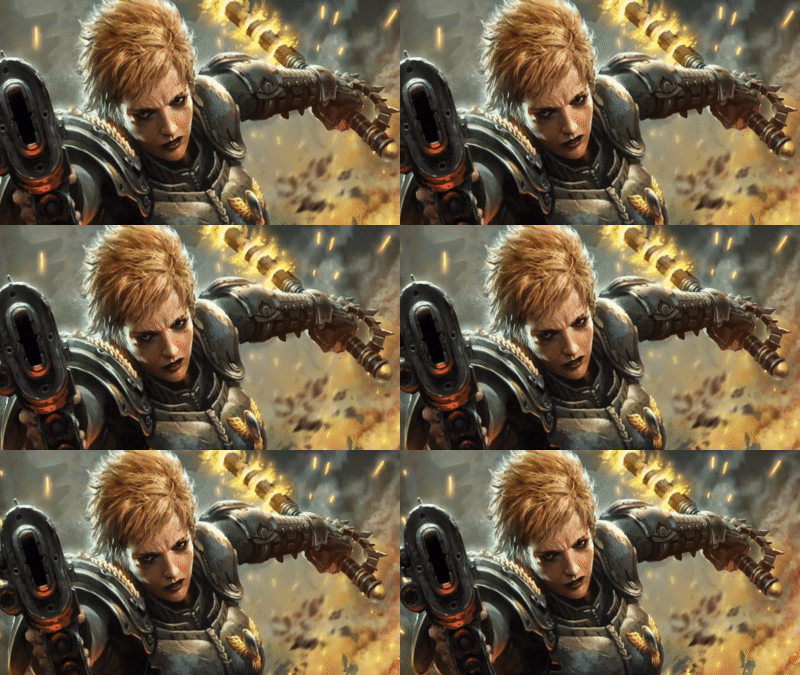
Newly promoted Adeptus Arbites officer Shira Calpurnia tackles assassinations, psykers, family legacies and more in the classic Warhammer 40,000 trilogy.
READ IT BECAUSE These three novels give an unparalleled look at a unique and fascinating facet of the Warhammer 40,000 universe, and are rightly considered among the greatest of all tales from the 41st Millennium.
THE STORY The Adeptus Arbites are responsible for enforcing law and order across the vast reaches of the human Imperium. Newly promoted officer Shira Calpurnia is assigned to the fortresssystem of Hydraphur, home of the vast Imperial warfleets that dock, rearm and repair in an endless cycle of conflict. But Shira soon finds herself in the thick of the action as her investigations embroil her in the corruption behind multiple assassination attempts, the vicious greed over an ancient charter, and encounters with psykers and murderers. The Shira Calpurnia novels present a unique and original view of the Warhammer 40,00 universe from the pen of acclaimed science fiction author Matthew Farrer.
Overall, I thought that this was a great read. The first book was great, the second okay and the third was enjoyable. The ending was a good way to end the series.
I'm a huge fan of these Warhammer 40k omnibus as the size of the omnibus tend to allow for a lot of character development and interesting situations.
This omnibus deals with the Adeptus Arbites which is pretty much the law enforcement branch of the galactic empire. Now I would normally find this to be a really interesting subject as the Arbites are barely touched on in other novels but Enforcer fell a little short of the mark as far as its potential.
The omnibus follows the Adeptus General Shira Calpurnia and focuses on her career in a heavily goverment focused world. They three stories in the omnibus basically involves some case that Calpurnia is involved in. While the character of Calpurnia is interesting, she isn't featured that heavily in most of the stories. Also the mystery of the case somehow manages to be miraculously solved by the end by some random fluke that they turned a potential sci-fi/mystery hybrid story into something that just feels inadequate.
A quick note to say: the extra content in the omnibus is really very cool. Aside from the quality of the novels themselves, the style and care taken in adding something 'a little different' is very successful. Though I love Farrer's shorts, seeing inventive, themed pieces in the style of case-notes and such is something special indeed amongst Black Library's omnibus extras.
Омнибус состоит из трёх романов про Ширу Кальпурнию - адептус арбитрес, которая после получения повышения была отправлена начальством на систему-крепость Гидрафур. С автором романов до этой книги я знаком не был, но ждал, как обычно, вахоэкшена и ваходрайва. У этой книги есть один, как мне кажется, безапелляционный плюс - в нём нет космодесантников. Вообще никаких. Почему это плюс? Потому что возьми любую книгу по Вархаммеру 40к, и они там обязательно будут. А тут их нету. И вообще книга про другое - про будни арбитрес где-то у чёрта на куличках. Арбитрес выполняют функции полицейских. Расследуют убийства, наводят порядок в системах. Скажем, если арбитрес - это полиция, то инквизиция - это ФБР. И они друг другу не нравятся по понятным причинам. "Арбитр" будет свежим глотком для тех, кому Астартес жуть как надоели, а хочется чего-то совсем иного, но про Вархаммер. На этом плюсы для меня закончились. Наверное, основной затык с романами был в том, что это детектив, а у меня с ними не очень. В каждом из трёх романов случается какое-то преступление или сговор, разобраться с которыми предстоит главной героине Шире. Правда, уже со второго романа главной её немного сложно назвать, т.к. она уступает место другим персонажам. В первом романе на Ширу происходит покушение. И даже не одно. Все вокруг уверяют, что это случайность, что это некий заговор, и что на самом деле Шире все желают добра. Во втором романе происходит заваруха у Вольных Торговцев (главный Торговец мёртв, кто из его сынов станет преемником?). В третьем романе убит псайкер. Причём убит в комнате, к которой ни у кого, кроме хозяина, нет доступа. Читается всё немного странно, потому что от Вахи ждёшь Вахи, а тут другое. Иногда казалось, что автор написал всё раньше, а потом подписал договор с Чёрной Библиотекой и изменил сеттинг. Интересно было посмотреть, как живут миры обычных (ну как обычных, не с двумя сердцами которые, в общем) людей. Как оказалось, всё так же - зависть, коррупция, месть, махинаторство. Кальпурния по чуть-чуть раскрывает сюжет, чаще всего это делается в диалогахс другими персонажами. Про Ширу не написано почти ничего. Ни что она за человек, ни чем занимается, чем увлекается. Только работа, больше ничего. Как будто вся её жизнь состоит из работы. Даже выпить после работы не с кем. А порой казалось, что дела сами по себе как-то раскрывались, особых дедуктивных методов не надо. В общем, книга показалась странной. С одной стороны, для Вахи это свежо и необычно. С другой - ну скучно же, ужас просто. Есть интересные моменты, да. Но их мало на 850 страниц. Имхо, сделай всё на уровне повестей, было бы лучше. Хотя это возможно из-за того, что я не особо детективы жалую. И что ещё странно - русскоязычные читатели довольно высоко оценили обмнибус, а вот оценки на гудридс мне показались более честными (3,73/5). Имхо, явно не шедевр. Читать можно, но только чтобы отвлечься от спэйс маринов. 6/10, ожидал большего.
When I enjoy a good book, I usually give a four-star rating, but this omnibus actually deserves five stars.
I first began reading this book ten years, got halfway through, and gave up on it. That was because I was early on in my journey through Black Library's catalogue and so was still in my 'bolter-pr0n' phase. This trilogy of books is not about brain-dead action, it's all about the average daily life of Imperial citizens... and I LOVED IT!
Book one - Crossfire
The author did an amazing job detailing the daily life within an Imperial hive city and the job of the Adeptus Arbites. The lead character, Shira Calpurnia, has recently arrived from the Ullanor sector and right from the start of the first book, it begins with her going to get her inoculations from an Adeptus Mechanicus Biologist. How cool is that? I thought that was genius writing! That makes sense when you think about it. Then right after leaving, Shira comes under an assassination attack and sets the plot for the first book. All I can say about the ending is that I still don't fully understand why the antagonist/s attacked her, but still a great start.
Book two - Legacy
Shira Calpurnia disappears for huge chunks of this novel and only shows up right at the end. The plot deals with the succession of a Rogue Trader who dies at the book's opening. So Shira has to make way as the author now has to introduce and deal with nearly a dozen crew and family of the Rogue Trader fleet as they all plan to put their competing heirs in the role as head of the family. There is also a wonderful plot point around the actual physical copy of the Rogue Trader's charter. Gives me goose-bumps just thinking about it again.
As a side note, after the book ends, there is a fantastic short epilogue which is written as a collection of 'spiritual offences' committed by Imperial citizens, detailing the minor crimes they have committed and what they had to do as penance. It was great imagination from the author and once again adds life to the Imperium with such great strokes of ingenuity.
Book three - Blind
Not trying to give anything away, but poor old Shira is back and is in trouble. She has to arrive at a remote Astra Telepathica relay station where the station commander has recently been murdered. This is where this omnibus went from a four-star to a five-star. That opening chapter is one of the BEST openings in all of the WH40k literature I've read. It details in a wonderous form, how the Astra Telepathica actually works with regards to psychic messaging. It still blows me away thinking about the opening chapter, just wow! I believe it may have turned me into an astropath, it's THAT powerful.
So, overall a truly amazing collection of stories by Matthew Farrer and I can't recommend this omnibus enough. If you're into WH40K and want something different from all the non-stop, pew pew pew, stories then give this trilogy a go.
This is a omnibus covering a police officer named Shira Calpurnia; the setting is a nice change of pace, giving a interesting, ground-level view of the setting with nary a Space Marine in sight. This omnibus collects three books - Crossfire, Legacy, and Blind, and I'm going to run them down one by one.
Crossfire: The omnibus kicks off with our heroine arriving in the Hydraphur system and almost immediately being targeted for assassination. It's pretty good; there are some slow-moving parts where we see more about the characters and setting that I assumed would be put to good use in future novels, and the author introduces too many characters and doesn't give them much to do. That said, the book mostly held my attention, and I was genuinely interested to see the outcome. I'm not sure the eventual bad guy really makes a lot of sense, but this is a solid entry.
Legacy: This, unfortunately, is where the series goes rogjt off the rails. Legacy is about a succession dispute, with two groups fighting over who's going to inherit an ancient and very valuable rouge trader writ. This is fine, but it reduces Shira from hero and protagonist to the role of, at best, guest star in her own book. She has nothing to do until the climax, and even then the focus is on all the other groups fighting each other. Most of the book is a slog; like the previous book the author introduces too many characters and doesn't give them enough to do. It perks up slightly at the finish with an exciting climax, but the ending that follows kind of makes the entire book pointless in my view. Skip this one.
Blind: This is better than Legacy, but only just; at least it has our heroine in it, even if she ends up not really doing much. This time the action takes place on a space station full of psychics, and the mystery is how a man in a locked room was killed. Sadly, it's not very good; once again, a ton of characters are introduced and most of them are giving nothing to do, and the eventual resolution is enough of a letdown that if I still cared about this book I probably would have been annoyed.
Overall, I'm gonna have to say pass on this collection; It's tedious, and two bad books that are a chore to read adds up to a omnibus that is mostly bad and usually chore to read. I'm tempted to recommend picking up the first novel, Crossfire, but even then, a lot of it is taken up in world and character building that never pays off - the second book has nothing to do with the setting, and the third book takes place on a space station far away from anywhere else. This is kind of a mess, and I really can't recommend it to anyone, unless you need a heavy book to hold something down.
I was recommended this book due to the fact that my character for the Dark Heresy RPG (Fantasy Flight Games) is an arbiter.
So far I am enjoying this book quite a bit. It is far better writing than I was expecting for fiction belonging to a game world. The main character is a bit "fish out of water" as she settles into a new position on a new world, and this makes the explanations given by her "guide" fitting and not jarring in the least.
Ok, this book is kind of on hold because it's paper.
The first book is the best by far, but the next two really fall flat. The second one it feels like you're barely with Shira, instead it focuses on the heirs to a Rogue Trader house. The third book is a murder mystery, but with no real clues given the whole time and the surprise ending of whodunit feels very out of the blue.
I liked Shira a lot as a character and want more arbiter books, just a shame the direction this series went with her and how little focus it felt like there was on the arbiters as a whole.
I almost let the midling reviews put me off on reading this series but I am glad I didn't which is a big reason why I am writing my own review here. If you enjoy detective stories and like reading about the 40k universe give this book a shot and you will not be disappointed.
Arbites, Sororitas, Tech Priests, Ecclisiarchs, Noble Houses, Navigators, Rogue Traders, Navy, Comissars, Astropaths and the Inquisition this series covers a surprisingly huge swathe of the world of 40k and features two great murder mysteries and a wild rogue trader succession plot to keep you turning the pages as you soak in the lore.
The only criticism I would level at it is that the main character is a bit one note but her job is to be judge dredd more or less so I was forgiving of her matching personality.
I enjoyed the supporting characters a lot more which is important for a series with a bland protagonist like this one, i especially enjoyed the rogue trader flotilla in the second book, their mallicious scheming was absolutely delightful and reading it all unfold at the end was pure catharsis.
I will warn prospective readers that the lore here is thick and if you do not have a strong reference point to the world of 40k then you might find some of it confusing though i'm sure its nothing a quick trip to the wiki won't fix.
Read this awhile ago, just got around to reviewing it. Enforcer was a decent read, it hit's upon a rather minor aspect of the greater 40k universe, Adeptus Arbites (Space Police). This is one of the few books to deal with the subject matter. Just enough cop drama blended with the Grim Darkness of the 40k verse.
I wish so much I could've given this five stars because the world-building is incredible and unlike anything else Black Library has published. But damn, Farrer is such a dry writer who gets too bogged down in details to do much else. Shira Calpurnia herself is practically a non-entity in the second book and the third one was just plain confusing.
My introduction to 40k novels was with D. Abnett and I was blown away, my second book was the Enforcer and it felt like a nine to four work, I just quit reading it.
Enforcer by Matthew Farrer – Crime, Order, and the Illusion of Justice in a Dystopian Empire Introduction
What does law mean in a universe where human life is expendable, and the state is a theocratic machine of repression? Enforcer by Matthew Farrer dares to explore this question through the eyes of Shira Calpurnia, an Arbites officer charged with maintaining the emperor’s justice on a corrupt hive world.
Unlike much of the Warhammer 40K universe, which often prioritizes grand battles and superhuman feats, Enforcer offers a grittier, procedural view of life under authoritarian rule. But does the machinery of law offer any hope of real justice—or is it just another weapon of control?
Summary of Core Ideas The Enforcer omnibus includes three novels: 1. Crossfire 2. Legacy 3. Blind
Throughout, Shira Calpurnia serves as our lens into the Adeptus Arbites, the interstellar police force tasked with enforcing the Imperium's iron-fisted laws. Her work involves unravelling assassination plots, investigating familial conspiracies among the noble houses, and navigating the treacherous politics of a hive world.
Core themes include: • Bureaucratic oppression: Law is not about fairness but survival within layers of ritual, hierarchy, and brutal punishment. • Loyalty and duty: Shira's unwavering faith in the emperor and the law provides a fascinating study in personal integrity amid systemic decay. • Corruption: Noble houses, merchant guilds, and even ecclesiastical authorities are compromised, forcing us to ask whether any justice can thrive in such soil.
The books operate like crime procedurals transplanted into a dystopian theocracy, with rich world-building around the rituals of law enforcement in the 41st millennium. Philosophical Reflections Philosophically, Enforcer invites us to consider the nature of justice within systems designed for control rather than liberation. Is law meaningful when it exists solely to perpetuate authoritarian power?
Shira Calpurnia believes deeply in the emperor’s law, and yet everywhere she turns, the law seems twisted to serve wealth and entrenched power. Is her faith in duty admirable or tragically naive? In a way, Calpurnia reflects the existential tension of being a moral agent in an immoral system: • Do we play our part, upholding the law as best we can? • Or do we recognize the futility and either rebel or disengage? These are not merely fictional questions; they resonate in any society were institutions drift from justice toward self-preservation.
Religious Perspectives Religion in Enforcer is ever-present. The Imperium of Man is a deeply religious state, and Farrer's work shows how theological orthodoxy underpins legal authority. The emperor is both God and lawgiver, and faith is weaponized to legitimize the harshest punishments. In a modern context, the book echoes how religious structures can sometimes blend seamlessly with systems of power, transforming faith from a source of hope into a tool of oppression. One could read Enforcer as a dark parody of theocratic rule, where divine justice is inseparable from state violence.
Non-Fiction Insights While fictional, Enforcer recalls real-world insights from sociology and political theory: • Max Weber’s concept of bureaucratic authority: rigid systems of procedure and hierarchy that maintain control regardless of morality. • Michel Foucault’s ideas on surveillance and discipline: the Arbites are omnipresent, using fear and ritual to maintain order. Fans of real-world studies on authoritarian regimes, state policing, and legal philosophy might find unexpected depth in how Enforcer portrays law as both shield and sword. Connections and Implications
While Enforcer may feel mid-tier within the vastness of Warhammer 40K, its thematic ambition stands out. It connects surprisingly well with other works that interrogate law and power: • Think Philip K. Dick’s paranoia about systems controlling individuals. • Or Franz Kafka’s depiction of bureaucratic absurdity and inescapable judgment. • Even Orwell’s dread of authoritarian permanence whispers through the hive spires. For readers, the question lingers: In our own world, when do law and order cease to serve the people and instead serve only themselves?
Final Thought Three stars feels right. The pacing can lag, the intrigue is sometimes more convoluted than compelling, and Shira herself, while admirable, can feel distant. But there’s something commendable about Farrer's choice to write Warhammer noir—to show that even in a universe built on endless war, the small, grinding machinery of law continues to crush people one by one. If you've ever wondered what it feels like to be a police officer in a fascist nightmare, Enforcer has you covered.
While I think there's a sizable wealth of detail in both Hydraphean culture, Arbites inner workings, and the Ministorium/Ecclesiarchy politics, the book itself doesn't FLOW for me. It's written well, it just seems like maybe a bit overwhelming trying to provide a grounded setting while also touch on the nuances between all the different factions showcased. This coming from a 40k lore nerd; I still generally enjoyed it, made better by the timely release of playable Arbites in both Darktide and Rogue Trader.
Three book omnibus of Warhammer 40,000 novels. Crossfire Introduces Shira Calpurnia as she is assigned to Hydraphur as an Arbitor Senioris. As the planet builds up to a holy procession, Shira finds herself under attack. Unsure if it directed at her personally or the Arbites in general, or as a plan to disrupt events, she is caught up in the politics of major and minor families. A lot of action leading to a satisfying finish.
Legacy Less focused on Shira, this mostly follows the line of succession of a Rogue Trader with a writ signed by the Emperor himself back in the pre-Heresy days. Multiple factions want their person named as the heir to the title, while the Ecclisiarchy want to get their hands on a sacred relic. There's lots going on in multiple places and this does eventually come back round to Shira as the overall judge of who gets what.
Blind Shira finds herself sent to the "witchroost" to investigate a closed-door murder mystery, which isn't helped by being the location of the most powerful Psykers' in the segment. Mostly character driven, and it dragged along in places. Would have liked a more definite ending to this one (without giving any spoilers away).
Being an omnibus edition, it has some extra content in the form of personal letters between various people and excerpts from texts supposedly written by the different forms of government. These don't really add anything to any of the stories.
Overall, a good collection of 40K fiction that isn't obsessing over Space Marines or Imperial Guard for a change.
Space marines bore me, so if I’m going to read a Warhammer 40K book, I usually go for the stories featuring other kinds of characters. This trilogy omnibus features Shira Calpurnia, an “adeptus arbites” – basically a combination of detective, SWAT, and judge. For me, the main interest in these stories came from their exploration of the inner workings and politics of groups like rogue traders, the ecclesiarchy, and the arbites themselves. At times Shira Calpurnia all but disappears from the stories as the scheming going on around her is far more interesting than anything she does in response to it. I never expect Warhammer 40,000 books to be anything more than pulp-y escapist sci-fi, and by that standard this was a decent read.
What do you get when you mix a mystery novel with warhamer 40k? Crap. Seriously, this was a long slow slog.
As a mystery novel I never felt like I had any clues until near the end when there was a dead giveaway. Even then I guessed the bad guy but not the motive. Mostly because the badguys motive was stupid.
As a 40k book it was interesting and it was fun to get a deeper view of the 40k universe. The problem was there wasn't much variety. I was hoping to see some space marines or tyranids or something but it was just a mix of imperials.
As a story with characters it was meh. I didn't like the main character but she was reasonably fleshed out. What was lacking was something to challenge her. The author continually has her being perfectly correct in ever situation. It was tiring to have this annoying character bombarded with compliments for the length of the story.
*Note* I only read the first story of this book. I won't be reading anymore.
Good series of books about Imperium law enforcement in the grim darkness of the far future. The first book is clearly setting up Shira Calpurnia's world and is kinda boring. As a whodunit? it is ver weak as the reader will know who the mastermind is within 50 pages. The second book is much, much better. The parts that deal with the secondary characters, that is. This is another recurring problem in Black Library books when the background characters clearly overshadow the protagonists. The third book was, again, very weak as a whodunit and I have the impression that we have not seen the last of this character. Overall, good bus ride reading.
The three books contained in Enforcer take a fresh look at the Warhammer 40,000 universe, though the perspective of Shira Calpurnia. Not a soldier, as we've seen in so many 40K books, but a police officer and detective. It's a unique take and I found the exploration of the civilian side of the 41st Millennium fascinating. These books tread a difficult line, having to work as space opera and as crime, and for the most part do this well.
This Omnibus took me quite a while to get through. I normally devour WH40k books. They are my literary guilty pleasure. This one was a lot tougher to get through. What I enjoyed the most was seeing how the Arbites are in action, and getting a much better look at the operation of the empire from a non-war standpoint. You get to see a lot of interaction with different aspects of the Imperium, from Astropaths, to Arbites, to Rouge Traders.
This is the best writing quality and storytelling that I have encountered in the WH40k universe, equalled only by the Commisar Raine books IMHO. Very well developed storylines, wide range of characters, and well imagined worlds. Will not list any spoilers here, but will say that the first and third books are the strongest, hope to have more books about this character appear! Good stuff!
be glad this police force doesn't exist. They define military state. The main protagonist takes no guff, using her shock maul to remind the criminal who's in charge. Like Eisenhorn, it's a journey from strict adherent of an unforgiving government institution to near rebel against the corruption within the very structure the protagonist is sworn to protect.
This entire review has been hidden because of spoilers.