Richard Horatio Edgar Wallace (1875-1932) was a prolific British crime writer, journalist and playwright, who wrote 175 novels, 24 plays, and countless articles in newspapers and journals.
Over 160 films have been made of his novels, more than any other author. In the 1920s, one of Wallace's publishers claimed that a quarter of all books read in England were written by him.
He is most famous today as the co-creator of "King Kong", writing the early screenplay and story for the movie, as well as a short story "King Kong" (1933) credited to him and Draycott Dell. He was known for the J. G. Reeder detective stories, The Four Just Men, the Ringer, and for creating the Green Archer character during his lifetime.
The Melody of Death is a novel written by Edgar Wallace and published in 1915. Edgar Wallace was an English writer born into poverty to a single mother. I haven't the slightest idea of where his father was. Wallace's birth mother found him a foster family that later adopted him, and Wallace grew very close to the family, especially the mother, Clara Freeman. After joining the military at age 21, he started his literary career by writing serialized short stories. His career quickly grew from there, and Wallace went on to write eighteen plays, forty short story collections, and over one hundred novels. After a failed political bid in London, Wallace moved to Hollywood to begin a film career equally impressive to his literary works. Wallace is credited for one-hundred and sixty films. He was working on the film King Kong when he passed away in 1932, leaving five children and his massive collection of work behind. And I am about to talk about one of them.
The Melody of Death tells the story of Gilbert Standerton. When we begin Gilbert is sitting in a coach when he hears something:
THERE it was again! Above the babel of sound, the low roar of voices, soft and sorrowful, now heard, now lost, a vagrant thread of gold caught in the drab woof of shoddy life gleaming and vanishing. . . Gilbert Standerton sat tensely straining to locate the sound.
It was the "Melody in F" that the unseen musician played.
"There's going to be a storm."
Gilbert did not hear the voice. He sat on the box-seat of the coach, clasping his knees, the perspiration streaming from his face.
There was something tragic, something a little terrifying in his pose. The profile turned to his exasperated friend was a perfect one—forehead high and well-shaped, the nose a little long, perhaps, the chin strong and resolute.
Leslie Frankfort, looking up at the unconscious dreamer, was reminded of the Dante of convention, though Dante never wore a top-hat or found a Derby Day crowd so entirely absorbing.
"There's going to be a storm." Leslie climbed up the short step-ladder, and swung himself into the seat by Gilbert's side.
The other awoke from his reverie with a start.
"Is there?" he asked, and wiped his forehead. Yet as he looked around it was not the murky clouds banking up over Banstead that held his eye; it was this packed mass of men and women, these gay placards extolling loudly the honesty and the establishment of "the old firm," the booths on the hill, the long succession of canvas screens which had been erected to advertise somebody's whisky, the flimsy-looking stands on the far side of the course, the bustle, the pandemonium and the vitality of that vast, uncountable throng made such things as June thunderstorms of little importance.
The Melody in F, remember that, I didn't. Next, we pick up a couple of people who have been caught in a rain storm:
"There's an old chap there," said Gilbert, speaking over his shoulder, "would you mind taking him into the car? I'll tell you why after." He pointed to two woe-begone figures that stood on the side of the road. They were of an old man and a girl; Leslie could not see their faces distinctly. They stood with their backs to the storm, one thin coat spread about them both.
Gilbert shouted something, and at his voice the old man turned. He had a beautiful face, thin, refined, intellectual: it was the face of an artist. His grey hair straggled over his collar, and under the cloak he clutched something, the care of which seemed to concern him more than his protection from the merciless downpour.
The girl at his side might have been seventeen, a solemn child, with great fearless eyes that surveyed the occupants of the car gravely. The old man hesitated at Gilbert's invitation, but as he beckoned impatiently he brought the girl down to the road and Leslie opened the door.
"Jump in quickly," he said. "My word, you're wet!"
The girl is the old man's granddaughter. They are both musicians, they had been playing on the Downs, and had reaped a profitable harvest. They don't usually go to the great crowds, but it means more money and they weren't in a position to turn it down. Gilbert knows them well and calls them his private band. They often play for him, the melody of F, of course. But now the rain is over, and the musicians are home again, and Gilbert and his friend Leslie are alone. Leslie seems to think there is something wrong, Gilbert is to be married in a few days, does he want to run away? Gilbert tells him he did the next worst thing, he wanted the wedding postponed. Leslie tells him that Mrs. Cathcart told him about it and that she wouldn't hear of postponing the wedding. Mrs. Cathcart luckily for Gilbert is not the bride to be, unluckily for Gilbert, she's the mother of the bride. You can't win either way.
But Leslie tells him he should take the gifts the gods have given him, he has a Foreign Office appointment, a charming and beautiful bride, a rich uncle, but Gilbert interrupts him here to tell him that he is no long his uncle's heir:
"I wish you wouldn't say that," said Gilbert sharply. "The idea is abroad all over London. Beyond my pay I have no money whatever. This car," he said, as he saw the other's questioning face, "is certainly mine—at least, it was a present from my uncle, and I don't suppose he'll want it returned before I sell it. Thank God it makes no difference to you," he went on with that note of hardness still in his voice, "but I am half inclined to think that two-thirds of the friendships I have, and all the kindness which is from time to time shown to me, is based upon that delusion of riches. People think that I am my uncle's heir."
His uncle has recently decided to leave the whole of his fortune to that admirable institution which is rendering such excellent service to the canine world - the Battersea Dogs' Home. I guess his uncle likes dogs. Leslie, who is amazed at what he's hearing asks if he has told Mrs. Cathcart, and Gilbert replies no he hasn't, he doesn't think it's necessary, Edith isn't marrying him for his money. No, maybe not, but her mother certainly is. Besides, Edith has her own money, not that he's marrying her for her money. Of course not, it's definitely love.
But now Leslie put some doubt into his mind and he decides he is going to tell Edith's mother about his loss of his wealth. He is sure she doesn't care about it. She is having a dinner party that night so he goes early to speak to her. He asks if he could speak to her for ten minutes and she says yes, after the dinner. Then she says this:
"I almost wish you were poor, Gilbert," she had said. "I think riches are an awful handicap to young people circumstanced as you and Edith will be." She had conveyed this suspicion of his wealth more than once. And yet, at a chance word from Leslie, he had doubted the purity of her motives! He remembered with a growing irritation that it had been Mrs. Cathcart who had made the marriage possible; the vulgar-minded might even have gone further and suggested that she had thrown Edith at his head. There was plenty of groundwork for Leslie's suspicion, he thought, as he looked at the tall, stylish woman before him. Only he felt ashamed that he had listened to the insidious suggestion.
See? Leslie was wrong, it's not his money she's after. We don't know what Edith wants, she almost never speaks. Then she goes on to say there are quite a number of nice people coming, some he doesn't know and she very much wants him to meet. She is sure he will like dear Dr. Cassylis. Then there is this:
A smothered exclamation caught her ear, and she looked up sharply. Gilbert's face was set: it was void of all expression. The girl saw the mask and wondered.
"What is it?" asked Mrs. Cathcart.
"Nothing," said Gilbert steadily; "you were talking about your guests."
"I was saying that you must meet Dr. Barclay-Seymour—he is a most charming man. I don't think you know him?"
Gilbert shook his head.
"Well, you ought to," she said. "He's a dear friend of mine, and why on earth he practise in Leeds instead of maintaining an establishment in Harley Street I haven't the slightest idea. The ways of men are beyond finding out. Then there is. . . "
She reeled off a list of names, some of which Gilbert knew.
And off she goes to meet her guests. Gilbert however, turns to Edith and asks her to make excuses for him, he must go. He has very good reasons, but he can't meet those people. She agrees to help him and leads him to a door that went into the small library and from there he can get out to the back of the yard. Why? Who is it he can't see? It must be the doctor, that's when he suddenly changed. Of course her mother explodes over this and accuses her of sending him away. Edith replies that she has done all her mother has asked, she is going to marry a man who, though she know is a kind and charming man, she doesn't love, and is making this sacrifice for her mother. And then her mother says those things people should never say in anger, you're just like your father, he was always worthless, I hated him, kind of things and with that lost control of her daughter, and knew she did. But the wedding went on probably so she could get away from her mother.
The wedding is over, the guests went home, the couple is alone when Edith tells Gilbert the truth, she doesn't love him, has never loved him, considers him a dear friend, but married him for his money. She should have said her crazy mother made her, but she didn't. Then this happens:
He settled her in the corner of the settee, pushed a cushion almost viciously behind her, and walked back to the fireplace.
"So you married me for my money," he said, and laughed.
It was not without its amusing side, this situation.
"By heaven, what a comedy—what a comedy!" He laughed again. "My poor child," he said, with unaccustomed irony, "I am sorry for you, for you have secured neither husband nor money!"
She looked up at him quickly.
"Nor money," she repeated.
There was only interest that he saw in her eyes. There was no hint of disappointment. He knew the truth, more than she had told him: it was not she who desired a fortune, it was this mother of hers, this domineering, worldly woman.
"No husband and no money," he repeated savagely, in spite of the almost yearning desire which was in him to spare her. "And worse than that"—with two rapid strides he was at the desk which separated them, and bent across it, leaning heavily—"not only have you no husband, and not only is there no money, but—"
He stopped as if he had been shot.
The girl, looking at him, saw his face go drawn and grey, saw the eyes starting wildly past her, the mouth open in tragic dismay. She got up quickly.
"What is it? What is it?" she whispered in alarm.
"My God!"
His voice was cracked; it was the voice of a man in terror. She half bent her head, listening. From somewhere beneath the window arose the soft, melancholy strains of a violin. The music rose and fell, sobbing and pulsating with passion beneath the magic of the player's fingers. She stepped to a window and looked out. On the edge of the pavement a girl was playing, a girl whose poverty of dress did not hide her singular beauty.
The light from the street lamp fell upon her pale face, her eyes were fixed on the window where Gilbert was standing. Edith looked at her husband. He was shaking like a man with fever.
"The 'Melody in F,' " he whispered. "My God! The 'Melody in F'—and on my wedding day!"
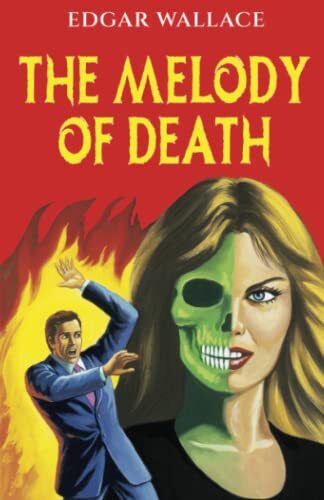
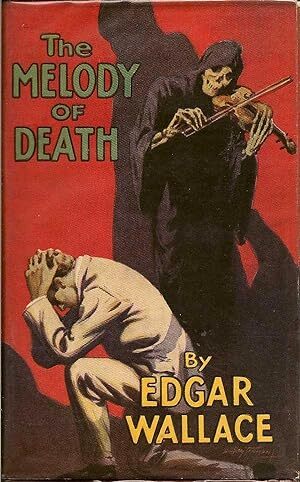
By this point I had forgotten all about the Melody in F, I hadn't given it a thought for pages and pages. I hadn't even given a thought to the grandfather and his granddaughter for pages and pages. And what is it about the Melody in F that is causing this in Gilbert? Suddenly none of us, the three of us that is, care about the money anymore. Why? That is all you are getting out of me. Read the book for the answer. Read the book for what Gilbert does about hearing that Melody in F. I had an amazing amount of fun reading this, I almost always do reading Edgar Wallace books, not much deep thinking, just fun. Oh, and there are some interesting book covers too.
A mediocre effort on EW's part. The title promises more than it delivers. It meanders until the final few pages where everything is hurriedly explained. This is one of those 'the debt collector is at the door' things where EW needed quick cash. Not to discourage you from reading EW; just to say he's done much better that this.
An odd one, and not my favourite of the Wallaces I've read.
There's a significant amount of relationship drama, which is a bit unusual for Wallace. A controlling mother pushes her daughter to marry a man who she believes is wealthy, or at least the heir to wealth, and neither of these things is true (his eccentric uncle having disinherited him on a whim). In turn, he believes that his bride-to-be has money of her own and that money has nothing to do with her wanting to marry him, and neither of these things is true either. He doesn't pick up on the clear signs that she doesn't love him whatsoever and is probably (reading between the lines) mainly marrying him to escape from her awful mother. They do talk honestly, after rather than before the wedding, and set up a household in which they live as, basically, flatmates with a growing non-romantic friendship, but it's still awkward, because they each feel they've let the other down.
Also, on the evening of their wedding, a violinist plays a tune outside, and he turns pale and won't say why.
Meanwhile, he's going out a lot at night and, again, not explaining why. And there's a rash of safecracking burglaries going on. And he's given up his job, but now has money. Coincidence? We think not!
But also not what it looks like. There's a gang of safecrackers who are cleverly avoiding the police, but we know he's not one of them.
The explanation turns out to be far-fetched.
There's a diamond necklace McGuffin, there are armed confrontations and a shoot-out, all of the machinery is there, but because the explanation for the odd events is just so unlikely I felt let down by the reveals. Still enjoyable, but not up to the usual standard for Wallace.
În seara de 27 mai 1911, biroul Gilderheim, Pascoe et C-nie, bijutieri în Little Hatton Garden, nu dădu nimic de bănuit agentului de serviciu care încearcă încuietoarea şi împinge puţin uşa, aşa cum avea obiceiul. Până la ora 9 seara, biroul fusese ocupat de domnul Gilderheim şi funcţionarul lui de încredere. Un inspector civil, însărcinat cu observarea cazurilor suspecte, socotise că lumina care se vedea la o fereastră a primului etaj intra în această categorie, şi urcase să-i determine motivul. Era într-o sâmbătă şi birourile din Hatton Garden sunt de obicei părăsite, în această zi, cel mai târziu la orele 3, de către funcţionari şi patronii lor.
D. Gilderheim, om simpatic, auzind bătăi în uşă, venise să deschidă, înarmat ca precauţie, cu un revolver. El se bucură constatând că incidentul se mărginea doar la o scurtă conversaţie cu un inspector de poliţie cunoscut. Explică faptul că primise chiar în ziua aceea un pachet cu diamante de la o casă din Amsterdam, şi că el clasa pietrele înainte de plecare. După câteva glume asupra tentaţiei oferite de diamantele în valoare de şaizeci de mii de lire, inspectorul plecă.
La nouă şi patruzeci, d. Gilderheim închise bijuteriile în casa de bani, în faţa căreia ardea zi şi noapte o lampă, şi întovărăşit de funcţionarul său, părăsi birourile din Little Hatton Garden 33, luând-o spre Holborn.
Agentul de serviciu le ură noapte bună, şi inspectorul civil, care se găsea la capătul străzii, spre Holborn, schimbă câteva cuvinte cu ei.
― O să fii de serviciu toată noaptea? întreabă d. Gilderheim, în timp ce secretarul lui oprea o maşină.
― Da, domnule, răspunse inspectorul.
― Bine, făcu negustorul. Aş dori să observi în mod deosebit biroul meu. Am lăsat o sumă mare în casa de bani şi sunt îngrijorat.
Inspectorul surâse.
― Nu cred să aveţi motive de îngrijorare ― adăugă el. Şi după plecarea maşinii, care-l ducea pe d. Gilderheim, el reveni la nr. 33.
Dar multe lucruri se petrecuseră în scurtul răstimp dintre plecarea bijutierului şi înapoierea detectivului. Doi oameni soseau în stradă din partea opusă, tocmai când Gilderheim ajunsese lângă inspector. Ei mergeau repede. Primul se îndreptă, fără şovăială, spre nr. 33, deschise uşa cu o cheie şi intră. Al doilea îl urmă. Nicio pregetare, nimic ascuns în mişcările lor. S-ar fi putut crede că locuiseră în acea casă toată viaţa lor, atât de naturale le erau gesturile.
Abia intrase al doilea, când apăru un al treilea personaj, din aceeaşi direcţie. El deschise uşa şi intră, la rândul său, cu aceeaşi siguranţă şi încredere de care dăduseră dovadă şi ceilalţi doi.
Trei minute mai târziu, doi din cei trei oameni erau la etajul întâi al clădirii.
Cu o extraordinară promptitudine, unul din ei scoase din buzunare două sticluţe de fier, fixă cu îndemânare tuburile de cauciuc şi anexă nişte foale, în timp ce al doilea expunea pe duşumea o trusă cu instrumente bine călite şi perfect executate.
Entertaining listening 🎶🔰 Another will written British 🏰 romantic relationship between wife and husband, robbers, a family, and death short story by Edgar Wallace. A novella with interesting characters that are not connect expect by crime as they interact with criminals. I would recommend this novella to readers of British mystery novels. Enjoy the adventure of reading 👓 or listening 🎶 to Alexa as I do because of eye damage and health issues. 2022 👒😊💑
This one kept me guessing to the end, which is a good thing in a mystery. Good, clean read. The resolution didn't feel like it came out of left field. Not as action-packed or suspenseful as some of Wallace's, but I'm not looking for suspense in my mystery novels.
An excellent read. It reminded me a bit of a Sherlock Holmes read (which I love) and it was all tied up so nicely. The characters were likeable and I love that this book was made into a silent film, which I will be watching.
This is the first work I read from Edgar walless. I loved it. The plot was interesting and I couldn't put the book down until I finished it! Absolutelly loved the F-dur melody secret.
first published in 1915. once you get into the cadence of the written word of the time I found this rather enjoyable if a trifle naive. all's well that ends well.
Frau heiratet Mann, der möglicherweise in zwielichtige Geschäfte verwickelt ist. Oder nicht? Warum ist er so bestürzt wenn eine gewisse Melodie vor seinem Fenster erklingt. Sehr unterhaltsamer Wallace mit starker Pointe, die auf den Titel anspielt.
An enjoyable short Edgar Wallace novel. A young man goes to pieces when he hears a certain melody and starts behaving mysteriously... Not perhaps as many thrills and action as some other Wallace novels, but I found it a very easy read, which and read it very quickly.