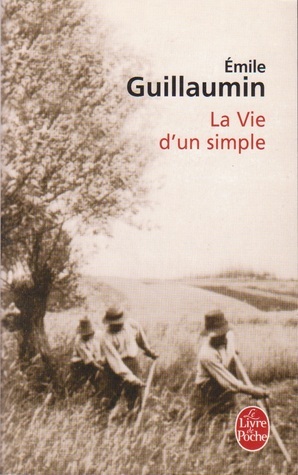
L a Vie d’un simple est un livre qui vient du fond du peuple, chose bien rare, et du fond du peuple paysan, chose unique... D’un grand-père conteur d’histoires Guillaumin tint le goût de conter, et il eut le courage d’ajouter au labeur paysan un labeur d’écrivain. Le plus bel exemple d’homme de lettres pratiquant le deuxième métier, c’est Émile Guillaumin qui le donne... Le Bourbonnais est loin, et la rumeur parisienne nous distrait d’y connaître et d’y entendre un juste. Mais la rumeur est chose passagère, la valeur ne passe pas, et Émile Guillaumin est sûr d’occuper, dans l’histoire de notre peuple, une place où il est indispensable et seul. Daniel Halévy.
I read this book in a Revolutionary Europe (1789-1871) history course in college and thought it complimented our textbook perfectly. The very simple biography highlights so many key components of the peasant class during this time period: how they considered developments, how long it took those developments to reach them, and the pattern they were virtually stuck in despite any advances in the middle and noble classes. Their overall treatment is horrendous by current standards, but they were not always trapped in complete misery. I'm not sure I would have picked up this book on my own, outside of class, but nevertheless I think it was a worthwhile read!
I would have to re-read this book to give it a proper review (read: this is my first review and I'm really nervous!)... but would just like to quickly take the chance to say that this is one of those books I return to time and again. I remember being struck by one of the notes (in the intro, or somewhere near) about how this self-taught writer, who had achieved a certain success, continued to write "farmer" when filling out documents (in which one's profession was queried). He truly was "A Simple Man".
Véritable trésor sociologique de la France bourbonnaise du 19e. Emile Guillaumin raconte finement son époque, les changements sociaux et le mode de vie paysan, mouvant lui aussi. Les idées politiques sont percutantes et on peut parfois remettre les écrits d’Emile Guillaumin au goût du jour…
An interesting book from a sociological point of view, and to some extent also from a literary point of view, for its thoroughly unromantic and unspectacular view of peasant life in 19th century France. Not really a ‘forgotten’ literary masterpiece, in my view. The story and the style are a little too ordinary.
This is presumably the best edition in English available right now, and worth it certainly for the extensive and (or so it seems) very well-informed introduction by Eugen Weber.
However, the translation and the exact status of this text are a little problematic. Judging from the translator’s note, there are at least three different versions of this novel: the first French edition published in 1904 (1), a version revised by the author (3), and a version called 'the definitive edition' (in fact, it's simply the last edition published during the author's lifetime) from 1943 (4). In addition to these, the only French version freely available online (on Gutenberg) is from 1922, which, according to the author's preface, also already contains revisions (2). For lack of a digital version of this first edition, it's impossible to say exactly what changes the author made in his text in these four editions.
Now the translation in this edition is 'based on' the first English translation published in 1919, hence based on the first French edition of 1904. According to both Eugen Weber and the new translator, Margaret Crossland, that first translation was not good enough and had to be 'corrected'. In addition, " in the main the text here presented now follows the definitive edition of 1943; however we have been unable to resist the temptation to follow Guillaumin’s example and, because we found them so fresh and vivid, we have left in some passages which he had decided to leave out in 1943."
Now I haven't done an extensive comparison of both translations. Doing a spot check, I did indeed see one or two minor improvements. (The 1919 edition of the original translation by Margaret Holden is available online at archive.org.)
Take this sentence from the end of chapter XVI, when the protagonist has announced he will leave the family to start out on his own. J'avais la larme à l'œil en dénouant l'étreinte de leurs menottes, mais ma décision n'en fut pas ébranlée. In the old Holden translation: I could not help weeping as I freed myself from the clasp of their little hands, but I remained obdurate. In the new translation this becomes: I almost wept as I freed myself from the clasp of their little hands, but I remained obdurate.
‘I almost wept’ is probably more correct as a translation for the idiom ‘avoir l'arme a l'oeil’.
Then take the start of the next chapter: Il est nécessaire de changer pour apprécier justement les bons côtés de sa vie ancienne; dans la monotonie de l'existence journalière, les meilleures choses semblent tellement naturelles qu'on ne conçoit pas qu'elles puissent ne plus être; seuls, les ennuis frappent qu'on s'imagine être moindres ailleurs. Le changement de milieu fait ressortir les avantages qu'on n'appréciait pas et il montre que les embêtements se retrouvent partout, sous une forme ou sous une autre.
In the new translation: You have to make a change to appreciate fairly the good aspects of your former life; in the monotony of daily existence you enjoy the best things unconsciously; they seem so natural that you can’t imagine they no longer exist; only the tiresome things strike you, and you think they must be less in evidence elsewhere. Changing your way of life brings out the advantages you didn’t appreciate and proves that troubles, in one form or another, exist everywhere.
The old Holden translation had this: We have to change our way of living to appreciate at their true value the good things in the old way : for, in the monotony of daily existence we enjoy the better things unconsciously : they seem so much a matter of course that it never occurs to us that they may not continue. Only the annoyances make an impression because we do not realize that they exist everywhere. Change of environment, in depriving us of the good things that we have not appreciated, enhances their importance, and shows us that the unpleasant ones are always there : they indeed hardly change their form.
Although the new translation hews closer to the punctuation of the original and is less verbose, I'm not entirely sure it is an improvement in all respects. ‘Only the annoyances make an impression because we do not realize that they exist everywhere’ strikes me as a more elegant solution than the (to my ears) slightly awkward sounding ‘only the tiresome things strike you, and you think they must be less in evidence elsewhere.’
In addition, I found at least one egregious mistake in the old translation that wasn’t corrected at all. Chapter LIV starts with this ‘I had a lease of six years; when it expired in 1890, I hesitated a good deal about renewing it, because I was seventy years old and felt it.’ Holden's old translation differs slightly in the wording, but here the narrator also says he was seventy years old. That's impossible, since in the second sentence of the novel he announces he was ‘born in October 1823’. The mistake here is not the novelist's but both translators': in the French edition Étienne correctly says he's 67.
It's a minor mistake, but one best avoided if one is so set on improving a faulty translation.
It is true that verbosity is Holden's major fault. Near the end of chapter XVII there was an entire sentence in her English translation that simply wasn't there in the French text, at least not that of the 1922 edition: she apparently felt the need to explain things a little to her English reader. (Unnecessarily, in this case.)
This brings me back to the sentence I started with, and the main problem with this new English edition. The sentence with ‘I almost wept’ concludes chapter XV... but only in this new translation! In both the French text and the 1919 translation, there are a further three paragraphs in the chapter. And rightly so, because they explain that the narrator goes to 'the fair at Souvigny' and there finds a job at a farm in 'Fontbonnet', where he will go to work. In the new translation, we find the narrator suddenly at this farm in Fontbonnet, without any explanation as to how he's come there.
It's exactly in this passage that we see Holden's urge to explain things getting the better of her again. E.g. where the French has this single sentence: D'ailleurs, un peu plus tôt, un peu plus tard la situation imposait ma sortie. Nous devenions trop nombreux pour ne former qu'un seul groupe communautaire.
Holden translates: To, tell the truth, in addition to my resentment at my parents' injustice, I had another motive for going. I realized that when the little ones grew up, there would be too many of us for one household. It was very necessary therefore that I should earn my living somewhere else. I preferred to begin. before I was any older.
That's a lot of extra words! But the new translation leaves out this and the following two paragraphs altogether, simply eliding the fact of the narrator finding a job at Fontbonnet. A simple error perhaps, but rather a large one. Especially if one is bent on 'improving' a faulty older translation.
Now I have to admit that most of what I'm saying here is guesswork. Is it true that Holden added explanations of her own? Or are those sentences in her text that I can't find in the 1922 French edition simply sentences that were present in the 1904 edition, and had the author cut them himself? The same goes for the missing paragraphs in this new (well... 1982) translation: is it simply an error? Or were they cut in the 1932 and/or 1943 edition? And anyway, when they decided to 'leave in some passages' which the author had cut in 1943 or earlier -- which passages were they?
What one feels the lack of, here, is a thorough editorial account of which versions of the text there are, and what has been added and left out where. It's often a bad idea to take an existing translation and start 'correcting' it or 'brushing it up', since what is actually a better translation is often also simply a matter of taste rather than simply objective errors (which in this case weren't always corrected, viz. the narrator's age).
So... probably better than the old edition available for free at archive.org, this e-book. (In which, by the way, in my Kindle version at least, the chapters weren't indexed at all, so the entirety of the text was to all intents and purposes just one big long 'chapter'. Annoying and rather hard to navigate.) But mainly for the introduction, not for the new and 'improved' translation per se.
Un compte-rendu très intéressant de la vie d'un paysan du 19° siècle très utile pour comprendre le sort des plus pauvres et le statut difficile de métayer. Je pensais que l'impôt sur le sel avait été aboli bien longtemps auparavant (que nenni) et j'y ai appris avec effroi comment se passait le service militaire. On prend conscience si ce n'était déjà fait que nous sommes choyés et que nous avons bien de la chance de vivre au 21° siècle malgré ses travers.
"Onze stappen klonken onheilspellend in de stilte van de nacht op de door de strenge vorst hard geworden wegen. Tegen tien uur kwamen we gelukkig aan en klopten aan de deur van de genezer die opendeed in onderbroek en met een slaapmuts op. Hij was een kleine, al oude man, met grijzende haren en een onaantrekkelijk gezicht. Hij mompelde gebeden en maakte tekens boven het lichaam van ons kind, wreef zijn hals in met een soort grijze zalf en blies hem drie keer in de mond. Een rokerige olielamp verlichtte dit gebeuren."
Als je denkt dat het kapitalisme in Nederland nu erg is, moet je dit boek lezen over het leven van een boer in het Frankrijk van 1823 tot 1902. Ik las de Nederlandse vertaling "Het landelijk leven" die alleen 2e-hands nog te krijgen is. Het is tegelijk minder dan een roman en veel meer dan een roman. Een onthullend boek voor iedereen die romantische ideeën heeft over het zelfvoorzienende plattelandsleven van weleer. Dit boek is in 1902 geschreven door een jonge boer met 5 jaar lagere school en een missie. Hij vond dat de boer slecht werd gerepresenteerd in de Franse literatuur tot die tijd, en tekende het levensverhaal op van zijn buurman, de oude boer Etienne Bertin, die geboren werd in 1823. In het boek is het Bertin die spreekt. Het is een boek dat de geschiedenis van zijn tijd laat zien vanuit een uniek perspectief, dat nog steeds zeldzaam is in de literatuur; het perspectief van een gewone man. De armoede van die tijd is onvoorstelbaar. Bertin kwam uit een familie van pachtboeren. Vanaf zijn 7e moest hij aan de bak op de boerderij, 's ochtends om vijf uur op, op pad, om in eentje urenlang geiten en daarna varkens te hoeden. Kind zijn is er niet bij. Eten is karig. Van school is geen sprake. Vanaf zijn 12e moet hij volledig in het bedrijf meedraaien. De diensttijd is nog acht jaar. Wie grond pacht, is een halve slaaf van de eigenaar. Bertin vertelt zijn hele leven in hoofdstukken die chronologisch zijn maar belicht ondertussen telkens andere thema's. Opgroeien, eerste liefde, geloof en bijgeloof op het platteland, huwelijk, vreemdgaan, politieke verandering, de omgangsvormen van de tijd, de omgang tussen mensen van verschillende standen, de komst van de trein en de auto, oud worden, versleten zijn, alles komt voorbij in het levensverhaal. Rode draad is het keiharde werken om te overleven, het gebrek aan zekerheid en veiligheid, de uitbuiting door de bourgoisie, de soberheid van het leven. Dit boek toont het volle leven van die tijd zonder het goede te romantiseren en zonder het slechte te overdrijven. De vertaling uit 1976 is niet slecht, geloof ik, maar misschien ook niet geweldig. De titel "Het landelijk leven" is wel een vlakke vertaling van de oorspronkelijke titel, "La vie d'un simple". Ik kwam ook "kaas met suiker" tegen als vertaling van wat ongetwijfeld "kwark met suiker" moet zijn. Na het lezen van dit boek stelde ik me voor hoe verbijsterd Bertin zou zijn geweest als hij in deze tijd had kunnen rondkijken: de onvoorstelbare rijkdom en het comfort van boeren en burgers in deze tijd.
Tiennon! Read this for HIST 263 From Farm to Fork, verdict: Tiennon's life is not so simple. It's sad and compelling, but he is also not a great person? This is/was reality though, and paints an accurate picture of French agricultural history.
It's very interesting and I can see where its helpful to a good understanding of European history (note I had to read this for a college course), but it just really wasn't my cup of tea.
This may be “fiction” because of the second-hand telling, but I can’t imagine a better, more honest representation of the lives of peasants in 1800s Europe.