

What do you think?

An Angel at my Table
This is the second volume in Janet Frame's autobiography, in which New Zealand's most distinguished novelist tells of how she left the close-knit family home in Oamaru for teacher training college in Dunedin.
Paperback
Published January 1, 1985
About the author
Janet Frame
77 books505 followersThe fate befalling the young woman who wanted "to be a poet" has been well documented. Desperately unhappy because of family tragedies and finding herself trapped in the wrong vocation (as a schoolteacher) her only escape appeared to be in submission to society's judgement of her as abnormal. She spent four and a half years out of eight years, incarcerated in mental hospitals. The story of her almost miraculous survival of the horrors and brutalising treatment in unenlightened institutions has become well known. She continued to write throughout her troubled years, and her first book (The Lagoon and Other Stories) won a prestigious literary prize, thus convincing her doctors not to carry out a planned lobotomy.
She returned to society, but not the one which had labelled her a misfit. She sought the support and company of fellow writers and set out single-mindedly and courageously to achieve her goal of being a writer. She wrote her first novel (Owls Do Cry) while staying with her mentor Frank Sargeson, and then left New Zealand, not to return for seven years.
She returned to society, but not the one which had labelled her a misfit. She sought the support and company of fellow writers and set out single-mindedly and courageously to achieve her goal of being a writer. She wrote her first novel (Owls Do Cry) while staying with her mentor Frank Sargeson, and then left New Zealand, not to return for seven years.
Ratings & Reviews
Friends & Following
Create a free account to discover what your friends think of this book!
Community Reviews
Displaying 1 - 18 of 18 reviews

September 10, 2026
I have had a pretty horrible couple of weeks. Well I thought I had - until I read this book, which is the second part of Janet Frame's memoirs.
It is hard to write anything about Janet Frame's really tough life which doesn't contain massive spoilers. But as she is considered NZ's greatest novelist & she is almost painfully honest, even when the truth is not flattering (like her lack of contact with her sweet & loving mother towards the end of her mother's life) to her good self. So most of Janet's often tragic life is well known to NZ bookworms.
But poverty, constant (often well intentioned) criticism of her appearance, including her rotten teeth, her shyness & a misinterpretation of her personality in a time of great conformity in NZ, which lead to her being committed a number of times to different mental institutions. This includes the most notorious of them all, Seacliff.
This quite beautiful exterior hid a poorly designed & utilitarian interior.
A quote from Janet about her time there;
Although the text about being dragged by her hair when she was reluctant to sit down for a meal horrified me even more!
Janet experienced Electric Shock Treatment & was saved from having a One of NZ's greatest writers came terrifyingly close to never reaching her full potential.
After moving to Auckland, Janet was mentored by another NZ literary great Frank Sargeson & lived in an old army hut on Frank's land. He encouraged & helped her to travel overseas & this book ends with Janet leaving NZ on an ocean liner, bound for Europe.
I'm actually reading The Complete Autobiography. Goodreads search is being it's usual wayward self so I'll just link to it.
https://www.goodreads.com/book/show/2... which also has an introduction by Jane Campion After several spoiler filled experiences with other intoductions, I'm going to read this after I have completed the third part
& I will be taking a little break from this book, even though I'm not expecting 'Envoy' to be as harrowing. It just couldn't be.
It is hard to write anything about Janet Frame's really tough life which doesn't contain massive spoilers. But as she is considered NZ's greatest novelist & she is almost painfully honest, even when the truth is not flattering (like her lack of contact with her sweet & loving mother towards the end of her mother's life) to her good self. So most of Janet's often tragic life is well known to NZ bookworms.
But poverty, constant (often well intentioned) criticism of her appearance, including her rotten teeth, her shyness & a misinterpretation of her personality in a time of great conformity in NZ, which lead to her being committed a number of times to different mental institutions. This includes the most notorious of them all, Seacliff.
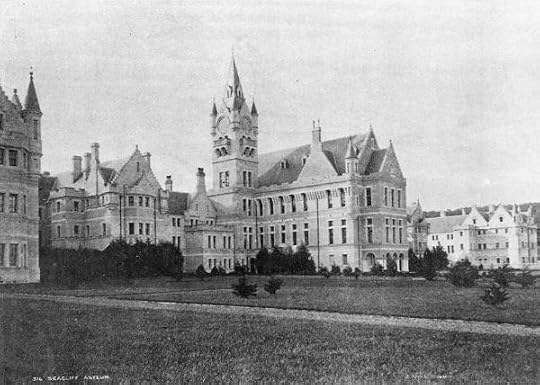
Image from Wikipedia. In the Public Domain
This quite beautiful exterior hid a poorly designed & utilitarian interior.
A quote from Janet about her time there;
The attitude of those in charge, who unfortunately wrote the reports and influenced the treatment, was that of reprimand and punishment, with certain forms of medical treatment being threatened as punishment for failure to 'co-operate' and where 'not co-operate' might mean a refusal to obey an order, say, to go to the doorless lavatories with six others and urinate in public while suffering verbal abuse by the nurse for being unwilling. 'Too fussy are we? Well, Miss Educated, you’ll learn a thing or two here.
Although the text about being dragged by her hair when she was reluctant to sit down for a meal horrified me even more!
Janet experienced Electric Shock Treatment & was saved from having a One of NZ's greatest writers came terrifyingly close to never reaching her full potential.
After moving to Auckland, Janet was mentored by another NZ literary great Frank Sargeson & lived in an old army hut on Frank's land. He encouraged & helped her to travel overseas & this book ends with Janet leaving NZ on an ocean liner, bound for Europe.
The lights of Wellington now shone in the distance. I leaned over the deck rail and felt like weeping with fear and delight. Then suddenly the motion of the ship changed to a steeper rise and fall and rolling from side to side: we were on the open sea. My voyage had begun.
I'm actually reading The Complete Autobiography. Goodreads search is being it's usual wayward self so I'll just link to it.
https://www.goodreads.com/book/show/2... which also has an introduction by Jane Campion After several spoiler filled experiences with other intoductions, I'm going to read this after I have completed the third part
& I will be taking a little break from this book, even though I'm not expecting 'Envoy' to be as harrowing. It just couldn't be.


February 8, 2022
This was so much easier and much more interesting to read than volume one - and I think I can indicate why. The voice is confidant. In volume two Frame "relaxes" - she has dropped the defensive stance of volume one. Frame writes frequently that she believes her memory to have been affected by the electric shock treatments she received, and I think this helps - in part - to explain the difficulty of reading volume one. Volume one covers those years of her childhood, before the hospitals; she revives memories from her earliest years which she believes have been affected and disturbed by E.S.T.
The main reason, I would suggest for the 'difficulty' of Volume one, was that is was written from a defensive stance, of trying to prove that her background - her 'working-class' childhood, was capable of providing the roots for her writing - and not as her critics liked to focus on, her experiences of 'madness'. Volume one is in the style that it is because of her need to assert her own views and is a continuation of her battle against 'people - deciding for her'.
I like this statement which comes near the end of volume two:
... he [Frank Sargeson] and I planned my next "move" which according to Frank, was for me to 'travel overseas' to 'broaden my experience', a convenient way, both he and I realised, of saying that I was 'better out of New Zealand before someone decided I should be in a mental hospital.' We both knew that in a conformist society there are a surprising number of 'deciders' upon the lives and fate of others. Frank even suggested that he become my next of kin in a marriage of convenience which I then found insulting, and he, on overnight reflection, decided against.
Frank Sargeson was a recognized and established New Zealand writer and he literally took Janet Frame 'under his wing' when yet again she had no where to go. He is the person, who finally recognizes Frame's talent to write and on a practical level offers her a small cabin, in his garden, where she will have peace and time to work undisturbed and without the pressure to earn money. He also helps her to apply for social assistance and she receives 3 pounds a week, one of which she gives to Sargeson, as he also is struggling financially -his books are out of print.
Frank's offer to marry can only really be understood, when you know Frame's history, for example it was her mother who signed the agreement forms, after bullying by the authorities, for Frame's leucotomy (lobotomy) operation. I should explain that a literary award saves her from this "operation", and finally she is released from almost 8 years in and out of mental institutes.
The illness of her mother was the crisis which provoked Frame's return to the awful Seacliff institution. In my reading of 'Faces in the Water' and like most modern readers, I found it very difficult to understand why Frame spent so many years in mental hospitals. When you know some of the details of her family's poverty and that her first year of teaching is interrupted by a crisis - you start to understand the downward spiral of no work, no money, no accommodation.
Frame completed 3 years of teacher training plus taking extra courses of English and French literature at Dunedin University and then after a term of teaching in a primary school - she suffered a mental breakdown. On her release from Seacliff (3 years) she tried to find work as a teacher only to discover that the teaching college/university had listed her as "Failed". She worked in hotels, as a waitress and cleaner, as a live-in-carer, as a working boarder etc. And between jobs she stayed with her family at the cottage in Willowglen, Oamaru. Frame found it difficult to be there; the lack of space and the need to contribute income - only her father had work - made it difficult to live and work there.
Faced with the family anguish I made my usual escape, the route now perfected, and once again I was in Seacliff Hospital. I knew as soon as I arrived there that the days of practising that form of escape were over. I would go away somewhere, live on my own, earn enough money to live on, write my books; it was no use: I now had what was know as a 'history', and ways of dealing with those with a 'history' were stereotyped, without investigation. Very quickly, in my panic, I was removed to the back ward, the Brick Building where I became one of the forgotten people. When mother recovered her health, she and Bruddie and Dad would visit me for Christmas and my birthday and on one or two occasions during the year. It was recognized that I was now in hospital 'for life'. What I have described in Istina Mavet is my sense of hopelessness as the months passed, my fear of having to endure that constant state of physical capture where I was indeed at the mercy of those who made judgements and decisions without even talking at length to me or trying to know me or even submitting me to the standard tests which are available to psychiatrists.
Read that last sentence again - fellow Goodreaders. No one bothered to re-evalute over the course of 8, almost 9 years that initial diagnosis of schizophrenia. Not one medical person thought to re-evaluate that first diagnosis!
Volume Two covers the years from her arrival in Dunedin as a student, and progresses through her twenties, to the point where she is finally declared sane - the point at which she is awarded 'The Hubert Church Award' for her book 'The Lagoon and Other Stories', up to her stay with Frank Sargeson; to her 31st birthday when she boards a ship on her first voyage away from New Zealand.
Volume two is immensely readable - she recounts very little about her incarceration in the mental institutes and refers the reader to her novel 'Faces in the Water'. So most of this volume is about her struggles as a young person, wanting to make her living as a writer. She recounts those jobs, where she tries to work to support herself, and yet reserve some time for her writing - it's very, very difficult. It is only when she meets Sargeson, that she hears for the first time that writers need
- privacy, quiet and solitude - and of course the means to live - whilst they work at their writing.
'An Angel at My Table' is foremost a personal memoir of a writer's struggle to become a writer, but I think most importantly a valid documentation of New Zealand society - the conformist society - where space, support, encouragement, allowance, the permission to be different and to express individuality is heavily suppressed.
The main reason, I would suggest for the 'difficulty' of Volume one, was that is was written from a defensive stance, of trying to prove that her background - her 'working-class' childhood, was capable of providing the roots for her writing - and not as her critics liked to focus on, her experiences of 'madness'. Volume one is in the style that it is because of her need to assert her own views and is a continuation of her battle against 'people - deciding for her'.
I like this statement which comes near the end of volume two:
... he [Frank Sargeson] and I planned my next "move" which according to Frank, was for me to 'travel overseas' to 'broaden my experience', a convenient way, both he and I realised, of saying that I was 'better out of New Zealand before someone decided I should be in a mental hospital.' We both knew that in a conformist society there are a surprising number of 'deciders' upon the lives and fate of others. Frank even suggested that he become my next of kin in a marriage of convenience which I then found insulting, and he, on overnight reflection, decided against.
Frank Sargeson was a recognized and established New Zealand writer and he literally took Janet Frame 'under his wing' when yet again she had no where to go. He is the person, who finally recognizes Frame's talent to write and on a practical level offers her a small cabin, in his garden, where she will have peace and time to work undisturbed and without the pressure to earn money. He also helps her to apply for social assistance and she receives 3 pounds a week, one of which she gives to Sargeson, as he also is struggling financially -his books are out of print.
Frank's offer to marry can only really be understood, when you know Frame's history, for example it was her mother who signed the agreement forms, after bullying by the authorities, for Frame's leucotomy (lobotomy) operation. I should explain that a literary award saves her from this "operation", and finally she is released from almost 8 years in and out of mental institutes.
The illness of her mother was the crisis which provoked Frame's return to the awful Seacliff institution. In my reading of 'Faces in the Water' and like most modern readers, I found it very difficult to understand why Frame spent so many years in mental hospitals. When you know some of the details of her family's poverty and that her first year of teaching is interrupted by a crisis - you start to understand the downward spiral of no work, no money, no accommodation.
Frame completed 3 years of teacher training plus taking extra courses of English and French literature at Dunedin University and then after a term of teaching in a primary school - she suffered a mental breakdown. On her release from Seacliff (3 years) she tried to find work as a teacher only to discover that the teaching college/university had listed her as "Failed". She worked in hotels, as a waitress and cleaner, as a live-in-carer, as a working boarder etc. And between jobs she stayed with her family at the cottage in Willowglen, Oamaru. Frame found it difficult to be there; the lack of space and the need to contribute income - only her father had work - made it difficult to live and work there.
Faced with the family anguish I made my usual escape, the route now perfected, and once again I was in Seacliff Hospital. I knew as soon as I arrived there that the days of practising that form of escape were over. I would go away somewhere, live on my own, earn enough money to live on, write my books; it was no use: I now had what was know as a 'history', and ways of dealing with those with a 'history' were stereotyped, without investigation. Very quickly, in my panic, I was removed to the back ward, the Brick Building where I became one of the forgotten people. When mother recovered her health, she and Bruddie and Dad would visit me for Christmas and my birthday and on one or two occasions during the year. It was recognized that I was now in hospital 'for life'. What I have described in Istina Mavet is my sense of hopelessness as the months passed, my fear of having to endure that constant state of physical capture where I was indeed at the mercy of those who made judgements and decisions without even talking at length to me or trying to know me or even submitting me to the standard tests which are available to psychiatrists.
Read that last sentence again - fellow Goodreaders. No one bothered to re-evalute over the course of 8, almost 9 years that initial diagnosis of schizophrenia. Not one medical person thought to re-evaluate that first diagnosis!
Volume Two covers the years from her arrival in Dunedin as a student, and progresses through her twenties, to the point where she is finally declared sane - the point at which she is awarded 'The Hubert Church Award' for her book 'The Lagoon and Other Stories', up to her stay with Frank Sargeson; to her 31st birthday when she boards a ship on her first voyage away from New Zealand.
Volume two is immensely readable - she recounts very little about her incarceration in the mental institutes and refers the reader to her novel 'Faces in the Water'. So most of this volume is about her struggles as a young person, wanting to make her living as a writer. She recounts those jobs, where she tries to work to support herself, and yet reserve some time for her writing - it's very, very difficult. It is only when she meets Sargeson, that she hears for the first time that writers need
- privacy, quiet and solitude - and of course the means to live - whilst they work at their writing.
'An Angel at My Table' is foremost a personal memoir of a writer's struggle to become a writer, but I think most importantly a valid documentation of New Zealand society - the conformist society - where space, support, encouragement, allowance, the permission to be different and to express individuality is heavily suppressed.

August 7, 2019
I’m amazed by how much Janet Frame packs into her books: most people with lives this eventful would have let the story sprawl to nearly 400 pages, but here in fewer than 200 she captures the years when she was roughly aged 18 to 31 – eight of which were spent off and on in mental hospitals. Frame travelled to Dunedin to live with her aunt and uncle (who was dying of cancer) while she attended teacher training college. A year later her younger sister Isabel joined her. A random incident that will stick with me from the book is when the sisters eat all the chocolates in the commemorative boxes their aunt keeps on display in the living room, thinking she’ll never find out. (She does.)
After her probationary teaching year, Frame walked out of the inspection appointment and never went back, asking for a doctor’s note for a few weeks off. The day before she was due to return, she resolved to commit suicide – the only way she could see to get out of teaching – and swallowed a whole packet of aspirins. She’s startlingly matter-of-fact about the whole thing. Of course, we know that she woke up the following day – vomiting and with a nosebleed and a headache, but no lasting damage. She gave up teaching to take psychology courses instead, and in an autobiographical assignment happened to mention her suicide attempt, which brought her to the attention of the head of department, who had her taken to the psych ward at Dunedin Hospital for six weeks. At this time she was given a (disputed) diagnosis of schizophrenia. Even after being declared ‘sane’ and returning to her parents’ for the summer, she continued her chats with Mr. Forrest the psychology professor.
Although she held a variety of housemaid and waitress jobs, taking journeys north and south to work in Christchurch and Dunedin, Frame was not well during this time. The mental hospital where she stayed is even worse than that depicted in Faces in the Water. Over the course of eight years, she had 200 rounds of ECT, and narrowly escaped a scheduled leucotomy when the doctor heard that she’d won a prize for her first book, The Lagoon and Other Stories (though it had been published to poor reviews and was generally considered unoriginal and immature).
All the while, she was gaining a new awareness of New Zealand’s literary landscape through anthologies and literary magazines, some of which she contributed to. Frank Sargeson, a fellow writer, offered her a place to work: an army hut where she began her debut novel. Getting a set of false teeth and having new author photos taken improved her confidence to no end, and she applied for and won a £300 grant to travel overseas. Even during the trip preparations she was exhibiting passivity, letting others decide her life for her: telling her what to pack and advising her to stay in Ibiza since it’s cheap. This second book ends with her taking leave of her family and setting sail for Southampton, England; her first novel, Owls Do Cry, is in press. It sets up a sense of anticipation for the third and final volume.
While this isn’t as sui generis as To the Is-land, it’s another excellent piece of life writing. Frame has quickly become one of my favorite writers.
[We have a forgetful professor to blame for her author name: “one of the lecturers at University had spoken to me using the name, Janet, when I had always been known as Jean; therefore I was now officially Janet.”]
Some favorite lines:
“I did not realize the extent of my loneliness. I clung to works of literature as a child clings to its mother.”
“Time confers privileges of arrangement and rearrangement undreamed of until it becomes Time Past.”
“If the world of the mad were the world where I now officially belonged (lifelong disease, no cure, no hope) then I would use it to survive, I would excel in it. I sensed that it did not exclude my being a poet.”
“I had a sense of being borne along on the wishes of others, but that was not unusual in my life.”
“I dreaded the polishing process that is a result of the natural friction within families.”
After her probationary teaching year, Frame walked out of the inspection appointment and never went back, asking for a doctor’s note for a few weeks off. The day before she was due to return, she resolved to commit suicide – the only way she could see to get out of teaching – and swallowed a whole packet of aspirins. She’s startlingly matter-of-fact about the whole thing. Of course, we know that she woke up the following day – vomiting and with a nosebleed and a headache, but no lasting damage. She gave up teaching to take psychology courses instead, and in an autobiographical assignment happened to mention her suicide attempt, which brought her to the attention of the head of department, who had her taken to the psych ward at Dunedin Hospital for six weeks. At this time she was given a (disputed) diagnosis of schizophrenia. Even after being declared ‘sane’ and returning to her parents’ for the summer, she continued her chats with Mr. Forrest the psychology professor.
Although she held a variety of housemaid and waitress jobs, taking journeys north and south to work in Christchurch and Dunedin, Frame was not well during this time. The mental hospital where she stayed is even worse than that depicted in Faces in the Water. Over the course of eight years, she had 200 rounds of ECT, and narrowly escaped a scheduled leucotomy when the doctor heard that she’d won a prize for her first book, The Lagoon and Other Stories (though it had been published to poor reviews and was generally considered unoriginal and immature).
All the while, she was gaining a new awareness of New Zealand’s literary landscape through anthologies and literary magazines, some of which she contributed to. Frank Sargeson, a fellow writer, offered her a place to work: an army hut where she began her debut novel. Getting a set of false teeth and having new author photos taken improved her confidence to no end, and she applied for and won a £300 grant to travel overseas. Even during the trip preparations she was exhibiting passivity, letting others decide her life for her: telling her what to pack and advising her to stay in Ibiza since it’s cheap. This second book ends with her taking leave of her family and setting sail for Southampton, England; her first novel, Owls Do Cry, is in press. It sets up a sense of anticipation for the third and final volume.
While this isn’t as sui generis as To the Is-land, it’s another excellent piece of life writing. Frame has quickly become one of my favorite writers.
[We have a forgetful professor to blame for her author name: “one of the lecturers at University had spoken to me using the name, Janet, when I had always been known as Jean; therefore I was now officially Janet.”]
Some favorite lines:
“I did not realize the extent of my loneliness. I clung to works of literature as a child clings to its mother.”
“Time confers privileges of arrangement and rearrangement undreamed of until it becomes Time Past.”
“If the world of the mad were the world where I now officially belonged (lifelong disease, no cure, no hope) then I would use it to survive, I would excel in it. I sensed that it did not exclude my being a poet.”
“I had a sense of being borne along on the wishes of others, but that was not unusual in my life.”
“I dreaded the polishing process that is a result of the natural friction within families.”

March 2, 2020
The second volume in Janet Frame’s life covers the particularly difficult period from when she left home at 17 or 18 until she left NZ at 31. The isolation she described in the first volume doesn’t become overpowering until she is in her aunt’s tiny house where she is boarding
She is desperate to please and shy to a crippling degree: it’s almost too excruciating to read about but at the same time I can totally relate. But she lightens her story with humour against herself in many places. I loved the description of her visits home:
What’s particularly sad, she said, is that she didn’t know that so many “in timidity and shyness and ignorance, lived as bizarre a life as I”.
Although I've read elsewhere that she hated teaching, that’s not how Frame relates it – she says she loved teaching the Standard Twos at Arthur Street (my old school!); it was the interaction with other teachers she couldn’t face, and more importantly, the evaluation at the end of her probationary year. She walked out of that, thinking that suicide was her only option. She didn’t succeed but her breakdown was sensed by two of her University teachers (she was taking Psychology and English part time) who took her to hospital.
That is where her life really broke down; she was never told that, after a few weeks’ rest, refusing to be released into her mother’s care meant that she would be involuntarily committed. Worse, her obviously inappropriate diagnosis (even for 1945) of schizophrenia - based on no tests or contact with a psychiatrist – became a label that determined the next ten years of her life.
She was released “on probation” and took odd jobs that didn’t really allow her time to write; and in a sense the label became self-fulfilling as she attempted to live up to what she thought a schizophrenic was. (She had been told, in sessions with her psych teacher, “When I think of you, I think of van Gogh, of Hugo Wolf” and internalized that madness equalled artistic ability).
But without any support or counselling, she couldn’t face the outside for long. Initially the institutional spells were measured in months, but in the end she was locked away for 8 years. Eight. Years.
During those times she had multiple shock treatments and very near the end was spared a lobotomy only because a doctor noticed that her first book (The Lagoon And Other Stories) had won a prize.
It is horrific, absolutely chilling stuff, and her candid portrayal of the abysmal level of mental health “care” is shameful even by the standards of the time. But she doesn’t write much about that whole period because she says it became the basis of her novel Faces in the Water; though now, she says (writing in 1982) she would not have toned down the cruelty nor left so much out for fear of seeming too hysterical.
So the book prize eventually secured her release. Her life was saved, essentially, when she met the writer Frank Sargeson in Auckland, who gave her a place and the space to write – the only freedom she had ever wanted. But recognizing that her label would never leave her in NZ (she was treated either warily as “from the loony bin”, or protectively as a frail child to be sheltered), he encouraged her to apply for a grant to study and write overseas.
And there she ends her 2nd volume. This is not a joyful book: it is harrowing to read of so much suffering and cruelty, but her resilience, insight and dedication to writing is an absolute joy to read about. And I think it is incredibly brave to appear so vulnerable in front of the whole world.
then gradually the excitement gave way to anxiety. So this was how it was, face to face with the Future—being alone, having no one to talk to, being afraid of the city and Training College and teaching, and having to pretend that I was not alone, that I had many people to talk to, that I felt at home in Dunedin, and that teaching was what I had longed to do all my life.
She is desperate to please and shy to a crippling degree: it’s almost too excruciating to read about but at the same time I can totally relate. But she lightens her story with humour against herself in many places. I loved the description of her visits home:
I was dazzled by the new language and its powerful vocabulary. I could now say to members of my family, ‘That’s rationalisation, that’s sublimation, you’re really frustrated sexually, your super-ego tells you that but your id disagrees.’
Mother blushed when I said the word ‘sexually.’ Dad frowned, and said nothing except, ‘So that’s what you learn at University and Training College.’
I explained to my sisters the significance of their dreams, how ‘everything was phallic.’ I also talked with exaggerated wisdom of T. S. Eliot and The Golden Bough and ‘The Waste Land.’ ‘I love teaching,’ I said
What’s particularly sad, she said, is that she didn’t know that so many “in timidity and shyness and ignorance, lived as bizarre a life as I”.
Although I've read elsewhere that she hated teaching, that’s not how Frame relates it – she says she loved teaching the Standard Twos at Arthur Street (my old school!); it was the interaction with other teachers she couldn’t face, and more importantly, the evaluation at the end of her probationary year. She walked out of that, thinking that suicide was her only option. She didn’t succeed but her breakdown was sensed by two of her University teachers (she was taking Psychology and English part time) who took her to hospital.
That is where her life really broke down; she was never told that, after a few weeks’ rest, refusing to be released into her mother’s care meant that she would be involuntarily committed. Worse, her obviously inappropriate diagnosis (even for 1945) of schizophrenia - based on no tests or contact with a psychiatrist – became a label that determined the next ten years of her life.
She was released “on probation” and took odd jobs that didn’t really allow her time to write; and in a sense the label became self-fulfilling as she attempted to live up to what she thought a schizophrenic was. (She had been told, in sessions with her psych teacher, “When I think of you, I think of van Gogh, of Hugo Wolf” and internalized that madness equalled artistic ability).
But without any support or counselling, she couldn’t face the outside for long. Initially the institutional spells were measured in months, but in the end she was locked away for 8 years. Eight. Years.
During those times she had multiple shock treatments and very near the end was spared a lobotomy only because a doctor noticed that her first book (The Lagoon And Other Stories) had won a prize.
It is horrific, absolutely chilling stuff, and her candid portrayal of the abysmal level of mental health “care” is shameful even by the standards of the time. But she doesn’t write much about that whole period because she says it became the basis of her novel Faces in the Water; though now, she says (writing in 1982) she would not have toned down the cruelty nor left so much out for fear of seeming too hysterical.
So the book prize eventually secured her release. Her life was saved, essentially, when she met the writer Frank Sargeson in Auckland, who gave her a place and the space to write – the only freedom she had ever wanted. But recognizing that her label would never leave her in NZ (she was treated either warily as “from the loony bin”, or protectively as a frail child to be sheltered), he encouraged her to apply for a grant to study and write overseas.
And there she ends her 2nd volume. This is not a joyful book: it is harrowing to read of so much suffering and cruelty, but her resilience, insight and dedication to writing is an absolute joy to read about. And I think it is incredibly brave to appear so vulnerable in front of the whole world.

June 28, 2008
Not a great review here, but I have a headache.
Finished Vol. 2 of Frame's Autobiography; read To the Is-Land in January. Vol. 2 expands on the the things I found most interesting in Vol. 1. I liked her rebuttal to the prevailing impression that she was mentally ill: that what she suffered from was a paralyzing personal shyness, shame, and fear about how to fit into the sectors of society (university, literary New Zealand) that could facilitate her writing life, and that this paralysis developed not from madness (Frame was diagnosed as schizophrenic, nearly was lobotomized, and then was found to have been misdiagnosed), but from upward mobility. The two volumes of the Autobiography that I've read so far explore this very nicely, elaborating on and critiquing the ideas in A Room of One's Own. (When Frame was finally invited to stay for free in a little writing hut in a garden, with a cot, a typewriter, and vegetarian lunches, I was delighted with her good fortune, because I know only too well how precious that Room is).
I liked Frame's flat statement that reading great books should always, always be a liberating experience for other writers ("There is a freedom born from the acknowledgement of greatness in literature, as if one gave away what one desired to keep, and in giving, there is a new space cleared for growth, an onrush of a new season beneath a secret sun."), paired with her admission that there is nothing more infuriating (and debilitating!) than acquaintance with a writer who has a trust fund. But even more than that, I appreciated Frame's insistence that no matter how hard one's personal circumstances may make writing, for being poor or mentally ill or morbidly insecure or working insane hours make writing very hard indeed, in order to be a writer, one must continue writing, and that the few moments one snatches to put down words are a privilege that many are denied.
Finished Vol. 2 of Frame's Autobiography; read To the Is-Land in January. Vol. 2 expands on the the things I found most interesting in Vol. 1. I liked her rebuttal to the prevailing impression that she was mentally ill: that what she suffered from was a paralyzing personal shyness, shame, and fear about how to fit into the sectors of society (university, literary New Zealand) that could facilitate her writing life, and that this paralysis developed not from madness (Frame was diagnosed as schizophrenic, nearly was lobotomized, and then was found to have been misdiagnosed), but from upward mobility. The two volumes of the Autobiography that I've read so far explore this very nicely, elaborating on and critiquing the ideas in A Room of One's Own. (When Frame was finally invited to stay for free in a little writing hut in a garden, with a cot, a typewriter, and vegetarian lunches, I was delighted with her good fortune, because I know only too well how precious that Room is).
I liked Frame's flat statement that reading great books should always, always be a liberating experience for other writers ("There is a freedom born from the acknowledgement of greatness in literature, as if one gave away what one desired to keep, and in giving, there is a new space cleared for growth, an onrush of a new season beneath a secret sun."), paired with her admission that there is nothing more infuriating (and debilitating!) than acquaintance with a writer who has a trust fund. But even more than that, I appreciated Frame's insistence that no matter how hard one's personal circumstances may make writing, for being poor or mentally ill or morbidly insecure or working insane hours make writing very hard indeed, in order to be a writer, one must continue writing, and that the few moments one snatches to put down words are a privilege that many are denied.

February 23, 2017
The second volume of Frame's autobiography, An Angel at My Table covers her life at university and her subsequent hospitalisation, for the better part of a decade, for schizophrenia. I should say suspected schizophrenia, for she never actually had it. In some ways for me this autobiography suffers a little for skating over what Frame went through in Seacliff mental hospital. I don't mean that I particularly want to read misery porn, but Frame herself mentions here that she'd already written extensively about this time of her life in her book Faces in the Water (which I haven't read but now want to). It's understandable that she doesn't want to have to cover the same ground twice, or in the same way, but her misdiagnosis and hospital stay is the central event of this volume of her autobiography, with reverberations from it spreading through the whole of her life. I can't help but think that the relief that Frank Sargeson gave her by providing a safe place to work and recover and write would have stood out all the more in the text if the worst parts of Frame's twenties hadn't been glossed over so much.

March 26, 2023
Finally found a copy in the ballieu. This has such a strong hold to the mainland it feels good to read and connect with. It is a New Zealand that only exists in our myth of the place now I think. Hard to imagine a sense of takapuna or the mount as she described it, even more generally the uncertainty that came from restricted access to knowledge
Equally interesting, to me, as a social insight into NZ as it is a personal history of Janet Frame.
Equally interesting, to me, as a social insight into NZ as it is a personal history of Janet Frame.

November 28, 2018
"Anioł przy moim stole” to smutna, pełna bólu i samotności, autobiografia znanej poetki i powieściopisarki, ukazująca życie wrażliwej, wyalienowanej młodej kobiety w Nowej Zelandii w latach czterdziestych i pięćdziesiątych ubiegłego wieku.
Więcej na blogu Poczytane.pl: http://poczytane.pl/aniol-przy-moim-s...
Więcej na blogu Poczytane.pl: http://poczytane.pl/aniol-przy-moim-s...

June 27, 2015
I didn't realize this was the middle of her autobiography series of 3 volumes. It made me want to read the 1st and 3rd volumes. Also to read some of her prose as well.

June 26, 2023
Olen ollut kiinnostunut Janet Framesta siitä lähtien, kun tutustuin häneen Riitta Jalosen haastatteluissa ja Kirkkaus-romaanissa. Nyt muistin hänet taas, kun Jalonen kirjoittaa Framesta Suurteoksia 2 -kirjassa. Todella omalaatuisen elämän elänyt Janet Frame on Uuden Seelannin isoja kirjailijoita, ja hänen kolmiosainen elämäkertansa on mielenkiintoinen näkökulma viime vuosisataan maan historiassa ja tietenkin myös uskomattoman elämäntarinan valottaja.
Elämäkertatrilogiaa ei ole suomennettu, ja ensimmäiseksi sain käsiini tämän kakkososan alkukielellä. Kirja sijoittuu Framen opiskelu- ja nuoriin aikuisuusvuosiin, läpimurtoon kirjailijana, mutta ennen kaikkea pitkiin vuosiin mielisairaalassa, jossa hänet leimattiin skitsofreniaa sairastavaksi ilman oikeastaan mitään kunnon syytä - mutta tällaista länsimainen psykiatria tuohon aikaan olikin. Lobotomialta hän pelastui yhden skarpin lääkärin ansiosta - tämä psykiatri oli lukenut Framen tuotantoa ja tulkinnut, että skitsofreniaa sairastava ei olisi tällasita voinut kirjoittaa.
Kirjan tyyli on kiinnostavan lakoninen ja toteava. Tunteissa ei vellota, asiat - sekä hyvät että kammottavan hirveät - vain tapahtuvat. Uuden Seelannin kulttuurissa on jotain syvästi häiritsevää; täysi länsimaa mutta supereksoottinen ilmasto ja luonto, ja jossa kolonialismin perintöä ei vielä näinä vuosikymmeninä ole käsitelty ollenkaan.
Luin samaan aikaan Hannah Gadsbyn Nanette -elämäkertaa, ja kummallisesti nämä kaksi kirjaa muodostavat täydellisen parin. Frame Uudessa Seelannissa ja Gadsby Tasmaniassa etsivät omaa polkuaan naisneroina, väärin ymmärrettyinä ja oman elämänsä sivuhenkilöinä tai vielä pahempaankin, hyljeksittyinä ja ei-toivottuina. Molemmilla järkyttävää traumahistoriaa, ja self made womanina tehty luova ura.
Elämäkertatrilogiaa ei ole suomennettu, ja ensimmäiseksi sain käsiini tämän kakkososan alkukielellä. Kirja sijoittuu Framen opiskelu- ja nuoriin aikuisuusvuosiin, läpimurtoon kirjailijana, mutta ennen kaikkea pitkiin vuosiin mielisairaalassa, jossa hänet leimattiin skitsofreniaa sairastavaksi ilman oikeastaan mitään kunnon syytä - mutta tällaista länsimainen psykiatria tuohon aikaan olikin. Lobotomialta hän pelastui yhden skarpin lääkärin ansiosta - tämä psykiatri oli lukenut Framen tuotantoa ja tulkinnut, että skitsofreniaa sairastava ei olisi tällasita voinut kirjoittaa.
Kirjan tyyli on kiinnostavan lakoninen ja toteava. Tunteissa ei vellota, asiat - sekä hyvät että kammottavan hirveät - vain tapahtuvat. Uuden Seelannin kulttuurissa on jotain syvästi häiritsevää; täysi länsimaa mutta supereksoottinen ilmasto ja luonto, ja jossa kolonialismin perintöä ei vielä näinä vuosikymmeninä ole käsitelty ollenkaan.
Luin samaan aikaan Hannah Gadsbyn Nanette -elämäkertaa, ja kummallisesti nämä kaksi kirjaa muodostavat täydellisen parin. Frame Uudessa Seelannissa ja Gadsby Tasmaniassa etsivät omaa polkuaan naisneroina, väärin ymmärrettyinä ja oman elämänsä sivuhenkilöinä tai vielä pahempaankin, hyljeksittyinä ja ei-toivottuina. Molemmilla järkyttävää traumahistoriaa, ja self made womanina tehty luova ura.

May 30, 2024
"Sometimes when I began to say what I really felt, using a simile or metaphor, an image, I saw the embarrassment in my listener's eyes - here was the mad person speaking."
The second book is even better than the first??? This is my currently favorite book ever, haha.
Janet's account of her life when she leaves Seacliff are so alive... someone with nowhere to go, with years stolen from her, so much doubt and fear... and it was all a lifetime ago but those discourses and practices are very much alive in today's Aotearoa/New Zealand?
We have a lot to learn as a society on how to relate to madness and the mad. All my love and respect to those who live in a close dance with something yet so misunderstood. 🌟
The second book is even better than the first??? This is my currently favorite book ever, haha.
Janet's account of her life when she leaves Seacliff are so alive... someone with nowhere to go, with years stolen from her, so much doubt and fear... and it was all a lifetime ago but those discourses and practices are very much alive in today's Aotearoa/New Zealand?
We have a lot to learn as a society on how to relate to madness and the mad. All my love and respect to those who live in a close dance with something yet so misunderstood. 🌟

Read
December 31, 2020It’s been years since I last read AAAMT or watched the film but it’s still harrowing. It particularly struck me this time how open and vulnerable she is to let the reader into her thoughts on things as “embarrassing” in her time (and even now to an extent) as the disposal of used sanitary products. She was truly remarkable.
November 26, 2013
This book meant such a lot to me, especially since the fact that she was committed suicide and was sent to a mental hospital due to the fact that she was too shy and reluctant to talk to people. Which really made me quite worried.

March 3, 2021
Enjoyed this one more than the first one! I really felt myself feeling sympathetic towards Janet and everything she went through. And I’m so excited to, now that I know her backstory, go on to read more of her work!

May 31, 2015
Never watching the movie.

August 12, 2024
‘The years following childhood became welded to their future, massed like stone, and often the time beneath cannot spring back into growth like new grass: it lies bled of its green in a new shape with those frail bloodless sprouts of another, unfamiliar time, entangled one with the other beneath the stone.’
I find Janet Frame fascinating, an extremely internally complex woman who was incarcerated in mental hospitals in New Zealand as a young woman, and the way she writes her feelings and experiences is so simple and direct. I loved “Faces in the water”, which she says in this autobiography is quite entirely her experiences (only with a fictionalised main character through whose experience she paints her own). However I do think my feelings towards autobiography clouded my enjoyment of “An Angel at my Table”; I do much prefer the memoir format as opposed to the chronological tendencies of autobiography. Nevertheless there were snippets throughout here which really struck me.
I find Janet Frame fascinating, an extremely internally complex woman who was incarcerated in mental hospitals in New Zealand as a young woman, and the way she writes her feelings and experiences is so simple and direct. I loved “Faces in the water”, which she says in this autobiography is quite entirely her experiences (only with a fictionalised main character through whose experience she paints her own). However I do think my feelings towards autobiography clouded my enjoyment of “An Angel at my Table”; I do much prefer the memoir format as opposed to the chronological tendencies of autobiography. Nevertheless there were snippets throughout here which really struck me.

September 2, 2024
I don’t know if I read it too close to the last one (cautious to read the third straight away) but the first is better. This one felt more like a sequence telling of events, but it was so lovely to hear a personal narration on moving to Dunedin. Still very good! Provided a new outlook on the world in a way only she can write

July 12, 2025
Exceptional writing ...
Displaying 1 - 18 of 18 reviews