Tom McGowen worked in advertising in the Chicago, Illinois, area until 1969. He then became a senior editor at World Book, Inc. Mr. McGowen now writes and lives in a northwest suburb of Chicago.
One of my favorite books as a kid. Bought it in Bermuda at age 8 and now reading it with my 9 year old daughter. Beautiful, chilling illustrations. Hopefully she'll read it with her kids.
When I saw this book pass through the library, I was struck with a feeling of nostalgia. I didn't think I had read it before, but it seemed like the sort of thing I would have read when I was younger. So too, the style of illustration seems familiar, but none of the works listed here for the illustrator seem like ones I've read.
Anyway, it is a fun sort of book, especially for its time and target audience. I like that it includes monsters from a variety of cultures, though I imagine there could be issues with how it is done. An obvious example is how the entry for "Abominable Snowman" defines Yeti as "all-devouring things," a translation which seems to have no basis in fact.
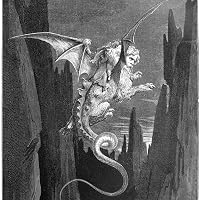
There are two things the book is lacking in my opinion: one is sufficient art. The art that it has is fun, sort of cartoonish but grim. But only a small number of creatures receive illustrations and there is fair amount of repetition and redundancy within those illustrations: Werewolf has two illustrations, though both just appear to be wolves--vicious yet strangely fluffy and cute as well-- and the only distinction between the drawing of Fenris and them are the chains that bind him; Ghouls as well receive two illustrations, one a fairly good picture of a ghoul itself, the other of a (human) desert traveler stalked by ominous silhouettes in the background; the design of Fafnir is hardly distinct from that of the generic Dragon, except rendered in red instead of muddy green; and the illustrations of Gnomes, Goblins, Dwarfs, and such (monsters that might be described as resembling little old men) are hardly distinguishable at all.
The other thing it lacks is sources. Knowing the source of the information for some of the creatures would, I think, show a greater amount of respect for the cultures behind some of the less common ones. And I'm also just curious to know more about some of the stories (like a giant called Torch apparently from Armenia), or wonder about seeming errors, like how Gorgons are described as scaly bulls with deadly breath-- a conception most strongly associated with D&D in my experience-- and made stranger by the fact that the entry for Medusa in this book says she was a Gorgon, describes them as they existed in Greek myth, and comments not at all on the contradiction with the entry on Gorgon earlier in the book. There are some other gaming related oddities that I wonder at, like the Su (a rather obscure monster I first encountered in D&D, though I have found traces of it in other places) or the Bay-kok (Pathfinder, a D&D variant, has a creature based on this-- and a miniature for it-- a sort of undead archer seemingly, and I had had no idea there was a real mythical basis for it before).
This was one of the books I grew up with that stoked my obsession with monsters that lasts to the present day. And rereading it, I can see why. This is a simple A-Z guide aimed at children, but it’s a very good version. The monsters covered are global, as opposed to just Western Europe, and have a lot of obscure creatures. The illustrations are in very dramatic watercolors, and I remember a number of them absolutely terrifying me as a small child. The book doesn’t steer away from gruesomeness—the dietary habits of monsters like the ahuizotl and baykok are explained. Something that struck me on this read is how many of these monsters are also in the AD&D Monster Manual; this book has Topsell’s gorgon and lamia, for example. Which makes me wonder if this book was written with “and here’s the real stories behind D&D monsters” in mind. Or just if The Elizabethan Zoo, which is a compilation of Topsell, was just much better known in the early 80s than it is now.
I admire the art of Victor Ambrus and this book had been mentioned in a novel I was reading so I tracked down a copy. As it turns out, the text is also a delight and so the volume has taken a place of honor on my coffee table. Just the thing to pick up and savor in small bites.
Een oud boek, na veel zeuren tijdens een zomervakantie hebben mijn ouders het voor me gekocht (zeuren werkt). nu lees ik het voor mijn kind. Het is enig, een encyclopedie van allerlei beesten en monsters, waar mensen in geloofden. Met mooie, fantasievolle tekeningen van Victor Ambrus.
Dit heeft mij mijn eerste stapjes op mijn latere weg richting fantasy doen zetten.
A great collection of creatures from all over the world!
The pictures are beautiful and the creatures are interesting. I spent hours just flipping through the pages and reading about every single one of them over and over. A lot of fun for kids, adults and anyone in between!