Elle voulait en finir avec la vie, mais arrivée au purgatoire, elle gagne contre son gré le droit de revenir chez elle, bien vivante. Elle découvre que si rien n'a changé — sa vie morne et monotone, sa profonde solitude — elle voit désormais autour d'elle tous les fantômes des gens morts, à commencer par le sien, à elle, de fantôme. Et la jeune femme de découvrir que cohabiter avec son fantôme a des avantages, et pas tant d‘inconvénients que ça...
4,5 pour les dessins qui font fa-bu-leux. Sérieusement, je suis fan du trait, de la poésie des images et du mystère qu'elles recèlent. Par contre, l'histoire... 2 ? Je ne suis pas certaine d'avoir réellement compris l'objectif derrière le récit. La vacuité de la vie? Son côté répétitif? De très rares dialogues, avec des pointes d'absurde, une atmosphère lourde... si ça avait été moins beau à regarder, je pense que je me serais ennuyée.
The protagonist of All the Living is a young woman who, after entering the afterlife, becomes the one and only winner of a lottery that sends her back into the realm of the living. What else can she do but fall asleep, wake up, go to work, go home—where she ends up meeting her own ghost.
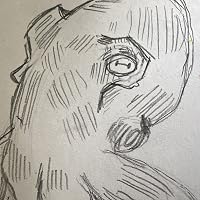
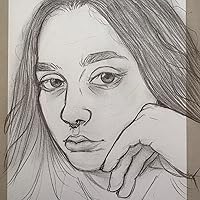
The dialogue is very delicately done—expressive and understated—which lets Roman Muradov’s illustrations shine. He moves really beautifully between a kind of raw, spontaneous sketch-like quality to more crisply realized illustrations. The drawings evoke a very distinctive, melancholic monotony. Life can be empty and dull and strange and drained of meaning; it can also have funny little moments of morbid humor…
This isn’t a particularly happy read, but it’s very sensitive and cathartic. It actually made me appreciate some of the monotonous aspects of my own existence—the endless need to make dinner and eat dinner and wash up and face evenings that feel lonelier than they should be. I really loved this.
An absolutely stunning meditation on the meaninglessness of life and the eternity of death. By turns equally tragic and thought-provoking, with uniquely gorgeous illustrations throughout. Not an uplifting read given the dark subject matter (although there are flashes of wry humour), but a moving and unforgettable experience which will surely haunt me for a considerable time.
Mouais ça m'a laissé assez indifférente... Les dessins sont sublimes mais parfois j'avais du mal à les comprendre, la superposition des traits me perdaient...
I'm a huge fan of Roman Muradov, and I've supported him on Patreon for a while. He serialised this there - sort of. Most of it, mostly completed pages, albeit smallish images.
Ridiculously, it seems no English language publishers wanted to take up "The Living", so here it is in French. In a very handsome edition from Dargaud. I'm very lucky to have been sent a copy gratis, and I love it to bits.
It's a very Muradov kind of story.
But it's all rendered in gorgeous Muradov artwork - exquisite cursive linework, beautiful flat colour palettes, inventive compositions. Just enough scrappiness, just enough surreality (the narrow, teetering apartment block, the library boy with a massive head). I mean, it's perfect en français really, but I still wish there was an English edition - even one as beautifully presented as the Editions Dargaud one. We should be so lucky.
I liked the art and loved the play with the pronoun . It made me think if I would be good company to myself, how I would feel, and about control and choice. I liked how she began to see other ghosts. I didn’t love the end, although I appreciate that there wasn’t an arbitrary change or forced happy ending.
J’ai lu, Tous les vivants de Roman Muradov, une BD qui aborde le suicide d’une façon plutôt.. particulière.
On y suit une jeune femme qui se retrouve dans le monde des morts suite à son suicide. Aussitôt arrivée, elle gagne à la loterie et retourne à sa vie d’avant. Elle retombe dans sa routine monotone et sans éclat. La seule différence avec avant, c’est qu’elle voit désormais des fantômes. Dont le sien, avec qui elle cohabite.
Je vais être honnête avec toi, je n’ai pas aimé cette lecture… 🥲
Le sujet est délicat et il est abordé très en surface. Ça manque terriblement d’émotion et de profondeur.
Il n’y a pas (ou très peu) d’information sur la personnage principale, sur sa vie et sur la raison qui l’a amené à se suicider. J’aurais aimé être en mesure de la comprendre et de m’attacher à elle. Mais j’ai été tenue à distance. Je reste donc sur ma faim avec de nombreuses questions sans réponse.
Les illustrations étaient parfois difficiles à saisir. Elles sont sombres et elles se superposent. Ce qui est dommage étant donné qu’il y beaucoup de pages sans dialogue.
Cette BD est loin d’être ce à quoi je m’attendais..
I loved the art style! I didn't love the story, and the humor was hit or miss for me, but it was depressingly realistic about how slow people are to change, even after life-changing events.
A girl hangs herself in her bathroom and end up in purgatory, where two creatures tell her she's won the impossible lottery, and gets ti go back to the living. When she wakes up in her apartment, she finds her ghost waiting for her, and slowly starts to realize she can now see "all the living and the dead".
This really feels like March's Karmen's weird younger sibling. While Karmen was all about appreciating the beauty life had to offer, this one's just bleak and monotone. Our protagonist just goes back to her day job, and only hangs out with her ghost. When she finally decides to go out if her comfort zone, something traumatic happens. I'm not quite sure what Muradov's message is...
As per usual though, utterly gorgeous. It's his trademark blen if very scratchy and loose art while still having fairly straightforward paneling. Coupled with the very sparse text, and the many contemplative pages, it gives it a very dreamy feel.
I can never tell if I really like or even understand Muradov's book, but I always keep coming back for more.. He's just got such an interesting voice, and his art hits just right for me
Ce livre, à travers une introduction d’une tentative de suicide, nous parle de la vie avec une extrême poésie. La patte graphique peut dérouter à premier abord mais sublime le propos du texte. Il n’y a quasiment pas de texte: c’est un livre contemplatif, il n’est pas là pour raconter une histoire mais pour nous immerger dans les pensées de l’auteur. J’ai énormément aimé cette bd graphique dans laquelle je retrouve une certaine forme de sensibilité à travers les dessins qui accompagne le propos: la vie c’est ça.
Hmm. Not sure how to feel about this one! I don’t want to be harsh, but I feel like I can only give this around a 2.5. I did really like the art and how unique it looked, but the story was lackluster for me and a bit depressing at the end. I would’ve like to see the main character find new hobbies or a new job and gain some semblance of love for their life. But maybe it’s supposed to be pretty depressing?? Like the character going back to taking their life for granted?? Idk not for me ig. There was a funny moment where that one guy died in a compromising position LOL that part really got me 😂
It was ok... C'était doux et triste avec un chouette dessin. Ça m'a fait penser à C'est comme ça que je disparais de Mirion Malle mais en moins bouleversant. Ça ne me laissera pas un souvenir impérissable.
3☆pour les dessins uniquement sinon ce serait plutôt un 2☆.
J’ai adoré le côté graphique du livre, on dirait un petit livre d’artiste avec une patte à la Kandinski.
Par contre l’histoire j’ai RIEN compris ? Elle n’a pas de fond, se répète, va dans tous les sens et en même temps nul part…on se perd parfois (voire bien souvent).
Et lorsqu’on se dit que l’on va se rattacher à la lecture purement visuelle pour mieux comprendre, et donc, passer par les dessins, on se perd à nouveau.
Graphiquement intéressant même si cela ne m'a pas touché. Peut-être car les dessins ne facilitent pas le suivi du fil de l'histoire. Quant à l'histoire, autour du purgatoire et de la vie après la mort (fantômes), je l'ai trouvée obscure et sans réel ajout à l'existant, le sujet ayant été traité mille fois. Certaines scènes sont un peu "quirky"... bon ou mauvais point? cannot tell.
What a strange little book. The extremely interesting art style for sure, I found myself wanting some pages/panels as prints. Story wise, pretty interesting if harrowing at times. It is quiet in what it is saying, but it is very much a feel it story rather than a narrative. Pne thing I hated was the font used for the text.
I hated this. It's about a woman who kills herself and wins a lottery to return to Earth. There she meets her own ghost who becomes her roommate and proceeds to do nothing. It was just a complete waste of time. The pencil work is so light that it's barely on the page. So many pages I couldn't tell at all what was happening.
This was such a lonely and sad story. I've been in the mindset of "Is this all there really is?" and it can be an isolating frame of mind. The illustrations were a bit of a mess, but it absolutely made sense and matched the tone of the graphic novel. I think I liked this one despite the sadness and loneliness.
C'est minimaliste et fin et d'une beauté.... Le mot allemand "unaufgeregt" me venait en lisant. C'est une BD d'un calme mélancolique. Mais c'est aussi très déprimant. Après ça parle de suicide, donc je ne sais pas à quoi je m'attendais.
le style graphique est sympa et l'idée plutôt intéressante, mais je suis pas sûre de comprendre où l'auteur voulait en venir + j'ai plus eu l'impression de lire un rêve sans queue ni tête qu'un récit, dommage
Still not entirely sure how to rate this. I really enjoyed the art, but the story was... so very depressing. I understand that it does reflect the reality of life, and of death, but also. Soooooo depressing.
Just upfront, this starts off with a self-termination scene promptly followed by a scene based on religious lore. So...trigger potential at maximum. This was alright, initial scenarios aside. Nothing really wow but more reflective and more self-care aware. Unique.
Muradov’s style is absolutely gorgeous. The more I think about this book, the more I like it. Morbid and contemplative, we constantly circle a drain not unlike our protagonist’s bathtub. Muradov seemingly reminds us that living in interesting times is in fact a curse.