Jane Elton, orphaned as a young girl, goes to live with her aunt Mrs. Wilson, a selfish and overbearing woman who practices a repressive Calvinism. In their rural New England village, Jane grows up yearning to break free from Mrs. Wilson's tyranny and find her place as a citizen of the evolving American Republic. She is helped by her encounters with characters who embody various shadings of moral, religious, and civic the affectionate servant Mary Hull, a pious Methodist; Mr. Lloyd, a kind Quaker; Crazy Bet, emotional, sympathetic, but deeply unstable; and Old John, bereaved but wise. Ultimately, A New-England Tale is about the connection between parenting and governing, and the key role women play in shaping a fledgling nation.
For more than seventy years, Penguin has been the leading publisher of classic literature in the English-speaking world. With more than 1,700 titles, Penguin Classics represents a global bookshelf of the best works throughout history and across genres and disciplines. Readers trust the series to provide authoritative texts enhanced by introductions and notes by distinguished scholars and contemporary authors, as well as up-to-date translations by award-winning translators.
Catharine Maria Sedgwick was born December 28, 1789 in Stockbridge, Massachusetts. As a young woman, Sedgwick took charge of a school in Lenox. She converted from Calvinism to Unitarianism, which led her to write a pamphlet denouncing religious intolerance. This further inspired her to write her first novel, A New-England Tale.
With her work much in demand, from the 1820s to the 1850s, Sedgwick made a good living writing short stories for a variety of periodicals. She died in 1867, and by the end of the 19th century, she had been relegated to near obscurity. There was a rise of male critics who deprecated women's writing as they worked to create an American literature.
Interest in Sedgwick's works and an appreciation of her contribution to American literature has been stimulated by the late 20th century's feminist movement. Beginning in the 1960s, feminist scholars began to re-evaluate women's contributions to literature and other arts, and created new frames of reference for considering their work. In addition, the advent of low-cost electronic reproductions, which became available at the end of the 20th century, made Sedgwick and other nineteenth-century authors' work more accessible for study and pleasure.
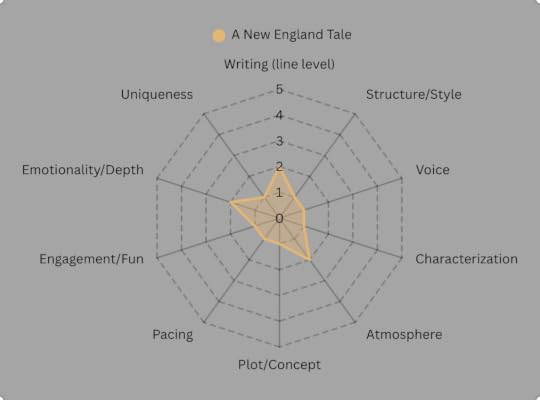
Sedgwick adapted one of her tracts into this novel, which explains a lot. It's extremely didactic, an anti-Calvinist screed parable. The good characters are good, the bad characters are bad, and there is no redemption of the bad characters nor falling of the good characters. It made a lot more sense to me when I tried to read this as a novel for those who didn't read novels, because the form was suspect in the early 19th century. For the reader who has never encountered anything outside of the gothic novel and erotica that was so popular at the time, A New-England Tale may have felt refreshingly moral, and just in its universe. Yet, for the reader like me who has access to the millions (if not billions) of novels published since 1822, including those of Sedgwick's more artistic contemporaries like Austen, A New-England Tale doesn't hold up.
There is little to no moral complexity here. The "right" thing for our Cinderella heroine, Jane, to do is always immediately apparent. I'm not one to complain about plot most of the time, but this story was so boring because after one chapter, I knew exactly what Jane would do and was never proved wrong. She was extremely predictable, as was everyone else in the novel. They were less characters than types, which makes for poor fiction.
Someday I will read one of Sedgwick's other novels, one that did not find its genesis as a tract. I am woefully under-read in early American fiction. Sedgwick did demonstrate a political and literary awareness in A New-England Tale that makes me think she does better in her many other novels. Often I enjoyed her narrative voice, as in the hilarious passage quoted below. Yet, I failed to emotionally connect with any of her characters here, and the didacticism was annoying. In so many places, Sedgwick could have made her point better without commenting on what the reader must understand from the situations she manufactured for her characters. I understand why Sedgwick wrote it that way, but I don't like it. Perhaps A New-England Tale spurred on early American readers and writers to better things, for which I cannot fault it.
Enjoy the mirthful passage below about the evils of dancing, while thinking of Austen's liberal balls occurring less than a decade earlier on the other side of the pond.
-----
"A few months after Jane entered her aunt's family, an unusual commotion had been produced in the village of —— by an event of rare occurrence. This was no less than the arrival of a dancing-master, and the issuing of proposals for a dancing-school.
"This was regarded by some very zealous persons as a ruse de guerre of the old Adversary, which, if not successfully opposed, would end in the establishment of his kingdom.
"The plan of the disciple of Vestris, was to establish a chain of dancing-schools from one extremity of the county to the other; end this was looked upon as a mine which would be sprung to the certain destruction of every thing that was 'virtuous and of good report.' Some clergymen denounced the impending sin from their pulpits. One said that he had searched the Bible from Genesis to Revelation, and he could not find a text that expressly treated of that enormity, but that was manifestly because it was a sin too heinous to be spoken of in holy writ; he said that dancing was one of the most offensive of all the rites of those savage nations that were under the immediate and visible government of the prince of this world; and, finally, he referred them to the church documents, those precious records of the piety, and wisdom, and purity of their ancestors; and they would there find a rule which prohibited any church member from frequenting, or being present at, a ball, or dance, or frolic, or any such assembly of Satan; and they would moreover find that such transgressions had been repeatedly punished by expulsion from the church, and exclusion from all christian ordinances. Some of this gentleman's brethren contented themselves by using their influence in private advice and remonstrance; and a few said they could not see the sin nor the danger of the young people's indulging, with moderation, in the healthful exercise and innocent recreation adapted to their season of life; that what the moral and pious Locke had strenuously advocated, and the excellent Watts approved, it did not become them to frown upon; but they should use their efforts in restraining the young people within the bounds of moderation."
The story of Jane Elton is one of pure resiliency that cannot go unnoticed. If patience is a virtue then by right she has earned her prize in the highest regard. Her journey is absolutely captivating as well as the characters that help support the narrative. The audience really gets the opportunity to better understand what life was truly like to exist as a woman during the pre civil war era. The author does a wonderful job of capturing this particular time period due to the fact that it was written in such close proximity of those events. Thus it can be said that A New England Tale gives an accurate portrayal of the roles of women during that generation. The exposition begins with the tragic events of Jane Elton who is left orphaned by both of her parents who die due to unpredictable ailments. After this traumatic experience, Jane who has been brought up in a more fundamentalist Christian home is taken in by her aunt who could be compared to the wicked stepmother from Cinderella. She continues to grow in character that is deeply rooted in faith as anticipation builds for conflict which is eminent. All the meanwhile other supporting roles are beginning to take notice of the flowering beauty in Jane who struggles to identify with who she really is. More Notably a gentlemen known as Mr. Lloyd was taking note of the physical and spiritual maturity of Jane after mentoring and consistently providing encouragement to her for years. After a tug-of-war battle between Jane and her aunts family happens, lies and deceit are proven, making everything come to a head. She moves in with one named Mr. Erskine because of desperation, and the struggle takes on a new form making Jane decide over her husband or faith. Feelings come to the surface about Mr. Lloyd and eventually an epic duel in the forest happens over an old disagreement that wasn’t addressed. Jane and Mr. Erskine separate, Aunt Wilson dies along with her family’s legacy and Mr. Lloyd’s love for Jane comes into fruition as they pursue marriage. This of course comes with the happy ending of everyone else who has been effected by the antagonist in the story. The novel addresses the active role of women so well in the fact that it pulls you in to what is actually happening to Jane as a character. As a Calvinist young woman in that era she was frowned upon by other majority denominations. The fact that her family struggled financially and were lower class set her up for failure when she was left orphaned. She was completely at the hands of her aunt and eventually Mr. Erskine who seduced Jane into making hasty decisions. If it wasn’t for Jane’s high value that she put on her faith and how that affected marriage the story might not have ended as happily. It was her wit and rhetoric that persuaded Mr. Erskine to take the high road in the end. The issues of race, religion, and class are also addressed in a more subtle manner throughout the book. For instance the presence of slaves is apparent because Mrs. Wilson owns a slave who acts as caretaker and laborer for the home. The interaction mentioned though minimal is one of sisterly love between the protagonist and the house servant. Within this realm the reader can definitely identify a class system that exist between the wealthy and the not so fortunate. The class system can be noted in the beginning of the story with the details of Jane’s parents and the distinction that can be made in contrast to her aunts family. The encompassing theme overall that affects the majority of the characters undoubtedly is that of religion. Being written during the middle period of the "Great Awakening," the author was very much so influenced by the same issue of religion and possibly related her own realities to the lead character. Nowhere else can religion be found manifested best in the story than when Jane confronts her Aunt Wilson about David telling about " The spiritual disciple of Jesus; and then presented to Mrs. Wilson so true an image of her selfishness, her pride, her domestic tyranny, and her love of money, that she could not but see that it was her very self. There was that in Jane's looks, and voice, and words, that was not to be resisted by the wretched woman; and like the guilty king, when he saw the record on the wall, her countenance was changed, her thoughts were troubled, and her knees smote one against the other" (Sedgwick 217). Jane’s words were so passionate because they were saturated with the Gospel that she had believed in her whole life. From the very opening of the story with hymns correlating to scripture to the very reason she decided to separate from Mr. Erskine Jane valued religion over everything. Her faith determined her decisions, actions, choices and played a big role in dialogue with others. Mr. Lloyed fittingly as a quaker, also could be found quoting and referencing the Bible on several occasions throughout the book. So one could deduce from the reading that the value of religion was not only to be in character during that era but also imbedded in the mainframe of the community. Now on to the value of the novel and its validity of being a primary source for doing women's history. As a book that was actually written before the civil war it can be noted that the author was actually alive to experience life in that generation. The language and dialect used in this piece of literature is strong and paints a valid picture of what life consisted of for women in the New England area. Knowing that Sedgwick herself was from Massachusetts also helps aid in the historical accuracy of the book being a primary source as opposed to somebody writing the story from a different part of the country. To not only be from that area but also to live during that time coupled together makes this novel legitimate material. In conclusion A New England Tale and the story of Jane Elton is one that should be read by every historian to get a better consensus of life for women in the eighteenth century. It’s rich language gives a rare glimpse into the life of humanity during that age just as the fine works of William Shakespeare give credit to people during the English Renaissance. The role of women is answered by its depth and the issues of class and religion can be seen manifested in its characters. The accuracy of the book is hard to argue as its audience gets to step inside and live a day in the life of an eighteenth century woman. This book should be on the shelf for every reader who appreciates classic literature.
This entire review has been hidden because of spoilers.
I actually found this more compelling than I expected. It was written more as a religious tract and morality tale than a novel, yet I found myself drawn into the travails of the orphaned heroine and wanted to keep reading to find out how far her terrible cousins would fall and how long it would take Jane to find love.
Don't mind me. Just searching for a female writer who can top The Minister's Wooing... or at least inspire some sort of depth of thought. This, while admirable for its time, was more reminiscent of Mary Jane Holmes.
P. S. What was with this whole "Marry the man who is 20 years older, has a daughter, and paid for your education" thing that was going around in the 1800s?
I have to say, I do not know my full thoughts on this book because it is just one of those books that leaves me unsure. However, I really liked the character Jane and loved her perseverance as she moved throughout her life. If I am being honest, I also think I fell in love with the character Crazy Bet. I mean is she really that crazy or is she crazy for their time?
I've always enjoyed early American sentimental fiction and this was no exception. Read it for my Early American Lit class but I am planning on reading her other books.
A New-England Tale by Catherine Maria Sedgwick is a classic book written in the 18th century about a lady named Jane Elton. Jane Elton is a lady who is looking for love in the New World and she lives with her aunt. Jane’s Aunt is very religious and most of the book follows Jane’s morals views. Personally, the book was not for me because of its long pace and very “old-fashion style. I like books with high intensity problems and action. This book was very opposite to what I craved. The book feels very long with its in depth descriptions and unassuming dialogue. I would personally recommend A New-England Tale to people with similar problems with Jane. Jane lives with people who talk about religious ideals but do not exactly follow what they are saying. I do think the book has a lot of charm and it teaches young readers how life was back in older times.
This book was a very interesting portrait of life in the early nineteenth century. Jane was a very likable heroine. I appreciated how she negotiated her commitment to her values and her dependence on her aunt. I also like the characters of Crazy Bet and John, and their role on the margins of society.
The first half of this was pretty enjoyable, but found the back half to become a total chore.
Really didn’t enjoy the holier than thou protagonist that failed to have the slightest hint of a flaw. Found that really uninteresting, but have to give that up tot he times I suppose.
I don’t know, I don’t think I was the audience for this.
An interesting glimpse into the mores of early America through the ultimate Mary Sue of heroines. The back cover blurb bills it as a Cinderella variation, but really, it's Daddy Long-Legs. Make of that what you will.
This is probably my least judgmental one-star review I will ever give.
I cannot give this book any higher of a rating because it was seriously that boring. It's less than 200 pages, but it took me almost five days to read because every time I picked it up, I fell asleep in less than 15 pages. But, unlike many other one-star books, I think the problem lies mostly with me and the time period in which I exist.
While I've read quite a few books from the 1700s, almost all have been from English writers. In the interest of being more exposed to American authors of the time, I snagged this. The back cover copy claimed a "New England variation on the Cinderella plot". Unfortunately, it is anything but. Had I instead read the introduction on the interior, I would have realized that this was a religious tract turned moral "novel". And that is not a winning formula.
It is hard to use the word novel in this context because when compared to Austen--her contemporary--this book falls short in every category. The characters are one-dimensional, everything is told rather than shown, there is no complexity or ambiguity, and every action that Jane Elton embarks on is so exceedingly obvious, I resented being told her story because she had no impetus of her own. She was simply a marionette, a tool of the author.
On top of that, Sedgwick struggled with how to introduce characters or new threads to the story, and I felt continually jarred as stories were told within stories--not for the purpose of layering, but rather with the obvious fact that she was converting a piece of writing into fiction and she wasn't aptly familiar with doing so.
Perhaps at the time, this book would have felt refreshing in such a puritan culture where novels were looked down upon, but in this day and age, this book holds little value in that aspect. I think the main value now resides in literature class, where you are discussing at the evolution of the novel and the background of American history and culture that shaped it. When looked at in terms of being a building block in the foundation of American literature, I'm sure it has much more interesting information to impart.