Jump to ratings and reviews
Rate this book

The Best American Essays 2010

Rate this book

The provocative and best-selling author Christopher Hitchens takes the helm of the twenty-fifth anniversary edition of this perennial favorite that is “reliable and yet still surprising—the best of the best” (Kirkus Reviews).

272 pages, Paperback

First published October 5, 2010

35 people are currently reading
478 people want to read

About the author

Robert Atwan

254 books26 followers
Robert Atwan has been the series editor of The Best American Essays since its inception in 1986. He has edited numerous literary anthologies and written essays and reviews for periodicals nationwide.

Ratings & Reviews

What do you think?
Rate this book

Friends & Following

Create a free account to discover what your friends think of this book!

Community Reviews

5 stars
95 (21%)
4 stars
170 (39%)
3 stars
142 (32%)
2 stars
26 (5%)
1 star
1 (<1%)
Displaying 1 - 30 of 61 reviews
Profile Image for David.
865 reviews1,661 followers
November 22, 2010
Of all the anthologies appearing annually under the "Best American" rubric, the one whose quality appears most highly dependent on the particular choice of guest editor is the "Best American Essays" collection. Just compare the 2007 and 2008 collections, edited respectively by David Foster Wallace and Adam Gopnik, to see just how much difference a guest editor can make (DFW leaves Gopnik in the dust, unsurprisingly). So I was somewhat reassured to see Christopher Hitchens as this year's invited editor. After all, Hitchens can be regarded as a kind of literary Simon Cowell -- someone who projects the image of being way too self-satisfied with his own gleefully obnoxious persona, but who's nonetheless possessed of reasonably good judgment, with a refreshing unwillingness to suffer fools gladly. Although one might be repelled by his personality, the chances of his serving up a plateful of dud essays seemed remote. At the very least, he seemed likely to have high editorial standards and a broad range of interests. So I had high hopes for this year's anthology.

Which were, unfortunately, not quite met. The 2010 collection of "best" essays is not a complete failure. Many of the contributions are excellent, though there are few that I would classify as outstanding (Steven Pinker's "My Genome, Myself" is an honorable exception, though I had already read it twice - in the NY Times when it first appeared, and in the 2010 anthology of Best American Science Writing; James Woods's New Yorker piece on George Orwell, "A Fine Rage", also shines, as does Jane Churchon's exquisite "The Dead Book"). But there were many pieces that simply failed to take off, in that the reader could only observe the writer's passion for his subject, but was never moved to share it ("Brooklyn the Unknowable", "Rediscovering Central Asia", "Gettysburg Regress" all proved too soporific for me to finish). And I remain puzzled as to the reason for including the longest essay in the collection, a 24-page profile of former Washington DC mayor, Marion Barry, whose relevance in 2010 would appear to be non-existent. Retired ophthalmologist John Gamel's beautifully written piece "The Elegant Eyeball" was spoiled for me by being about a decade behind the times as far as available treatments were concerned. I thought Zadie Smith's recent essay collection Changing my Mind was astonishing, but "Speaking in Tongues" is not the essay I would have singled out for inclusion here. Fans of David Sedaris will be more delighted than I was by inclusion of his piece "Guy Walks into a Bar Car", but my Sedaris-fatigue is well-documented, so your mileage may vary.

A breakdown of essay by general topic/type is revealing:

# of pieces concerned with writers/writing - 8 of 21
# of pieces that are autobiographical - 10 of 21

Even allowing for some double counting between those two categories, that's still an awful lot of navel-gazing for a 250-page volume. And this is ultimately what prevents this collection from being anything more than adequate. Perhaps if writers understood that the world of writers and writing is nowhere near as infinitely fascinating to the general reader as it apparently is to them, there would be a greater chance of producing an anthology of pieces that are genuinely interesting.

I thought Christopher Hitchens might have the breadth of vision to produce a genuinely dazzling collection this year. I was wrong. The 2010 anthology is not an embarrassment. But neither is it particularly exciting.

Profile Image for Jennifer.
525 reviews9 followers
November 15, 2017
As with any compilation, some essays were definitely better than others. My favorites blended the personal with the public; Gyromancy by Rindo (about his own diagnosis of Meniere's disease and the possibility that Van Gogh suffered from it as well) and Speaking in Tongues by Zadie Smith (about language, being biracial, and the US President) were brilliant, five-star essays. Go read them now. A few other good, but not great ones, were The Murder of Leo Tolstoy by Batuman, The Elegant Eyeball by Gamel, and My Genome, My Self by Pinker. These succeeded, though to a lesser degree than the first two because, again, they blended the personal with the science or history and made an engaging read. The essays I really didn't care for didn't do that: How Einstein Divided America's Jews by Isaacson read like a very dry chapter from a very dry history of early 20th century Zionism; Me, Myself, and I's (Kramer) exploration of the father of the essay, Montaigne, was sadly lacking the personal, too (so ironic, I know!). And the essays on Updike, Orwell, and Buckley, though well written, are really only for already-existing fans.

So a mixed bag, but on the whole interesting. Well worth the $1 I paid for it at the used book sale. :)
Profile Image for Holly.
1,067 reviews293 followers
August 13, 2016
No wooly-minded gushing ruminations on nature here, no sir!. Maybe Christopher Hitchens thought Mary Oliver's essay selections were too soft last year. I'm not usually one to complain about how many women are included in anthologies, but with just 5 of 21 essays by women, plus all the encomiums from male writers to male writers here, I was getting a definite masculine vibe. Just checked my other editions, though, and they're just as lopsided, although I don't recall noticing this before. [Oliver 2009:7; Gopnik 2008:4; DFW 2007:6; Slater 2006:8 (LOVE her); Orlean 2005:6; Menand 2004:7; Fadiman 2003:10; Gould 2002:4; Norris 2001:8; Lightman 2000:8]. D'Agata's The Next American Essay has a better ratio of 13 essays by women/18 by men.

Batuman on attending an academic conference at Tolstoy's home: my favorite piece from her collection The Possessed. Hitchens's intro mentions the essay's "quiddity" - and that is a nice word for Batuman's refreshing sensibility. Bentley on a bad lion/tourist safari: Her style is strangely jerky; had to read a couple of sentences twice. Churchon on pronouncing people dead: yes, okay. Doyle on marriage/divorce: nice. Gamel on opthamology and the "eloquent eyeball": Had to skim lest I were to throw up. Isaacson on Einstein and Zionism/Kramer on Montaigne: these two essays were more expository than exploratory, despite Kramer's "I think"s. I'd have happily read either one independently in a magazine, but not in this annual collection. Isenberg on meetings with Auden, Forster, Empson: pleasing snapshots. Krystal on writers' thinking differently/being "smarter" when writing than when speaking: I liked this slight essay and was thinking about it later. Not that the essay itself was so staggering, but just the idea. Labash on Marion Barry: interesting. Lopate on Brooklyn: SNOOZE. McEwan on Updike: Could this really be the best Updike piece published after his death? I'm beginning to realize that most of these essays are so very SAFE. Pinker on personal genomics: Good, and dovetails with another book I just read on the invention of race. Rindo on living with Meniere's Disease (vertigo, etc.): Okay. Sounds miserable. Sedaris on . .. . ? I don't know how to paraphrase it. I prefer to listen to him rather than read on the page. Zadie Smith on identity and speech: I'd read this before, back when we were all enthralled with Obama. Good. Starr on Central Asia's tradition of science and philosophy: Informative. Indeed. -- Let's just say that if I were handed these essays and told to pick out the one from the Wilson Quarterly, I wouldn't have guessed David Sedaris's. Summers on Gettysburg restoration: I got excited when Summers set out to look at the changing expectations Americans apply to history, but then it's only lightly explored. Wideman on Emmet Till's father and the meaning of race: okay. Wills on William F. Buckley: I respect Garry Wills, but this was SO boring. Wood on Orwell: A James Wood piece is a fine anchor to any collection.
29 reviews
December 19, 2011
I wandered through the library pulling books off the shelves with no design, no intent, just letting the universe guide my first round of winter break reading. We have a small, outdated public library; usually I have to request books in advance or go in with a battle plan to find what I want to read, so this was complete surrender to the contingent. I grabbed this compilation because I missed it last year, and when I got home I found out that Christopher Hitchens had just died.

I didn't know how I felt about Hitchens, so I read a few interviews with him online. I still don't know exactly how I feel about Hitchens the polemic*, but Hitchens the editor wrote a love letter to the essay in the introduction that charmed me:

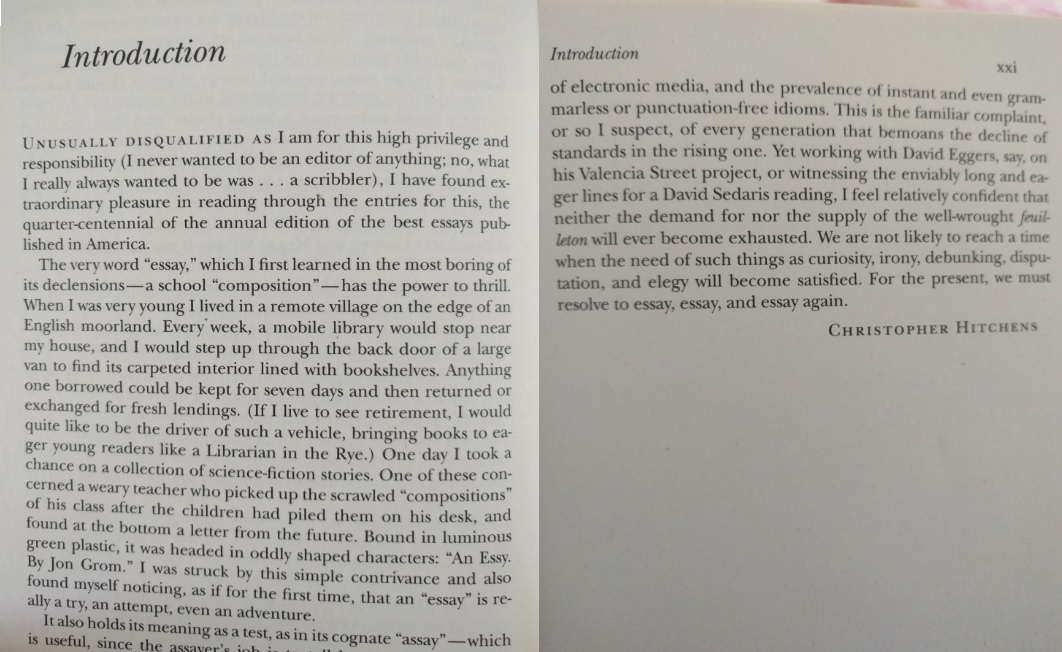
"When I was very young I lived in a remote village on the edge of an English moorland. Every week, a mobile library would stop near my house, and I would step up through the back door of a large ban to find its carpeted interior lined with bookshelves... (If I live to see retirement, I would quite like to be the driver of such a vehicle, bringing books to eager young readers like a Librarian in the Rye.) One day I took a chance on a collection of science fiction stories. One of these concerned a weary teacher who picked up the scrawled "compositions" of his class after the children had piled them on his desk, and found at the bottom a letter from the future. Bound in luminous green plastic, it was headed in oddly shaped characters: "An Essy. By Jon Grom." I was struck by this simple contrivance and also found myself noticing, as if for the first time, that an essay is really a try, an attempt, even an adventure.
It also holds its meaning as a test, as in its cognate "assay"--wish is useful, since the assayer's job is to tell base metals from true gold--and as a trial, or a putting to the proof... the jaunty original French word essai still connotes a challenge, a good try, an effort, even a first draft.

We are not likely to reach a time when the need of such things as curiosity, irony, debunking, disputation, and elegy will become satisfied. For the present, we must resolve to essay, essay, and essay again."

The collection is clearly curated by Hitchens: natural wonder at art ("Gyromancy") and writing ("Lunching on Olympus") and science ("My Genome, My Self") and human history ("The Gettysburg Regress") is its unifying force.

I've definitely read better essays, but as a collection this held together. Favorites: "The Murder of Leo Tolstoy," "Irreconcilable Dissonance," "When Writers Speak," "Speaking in Tongues."


*I think I like him.
Profile Image for Joshunda Sanders.
Author 12 books467 followers
February 17, 2011
Lots of great standouts for me here: Matt Labash's 2009 profile of Marion Barry from The Weekly Standard is more than 9,000 words of gloriousness. Zadie Smith is also delightful. David Sedaris also does a great job. Phillip Lopate waxes poetic on Brooklyn and my Bronx roots made me reluctant to submit that he had good points about the greatness of the borough.
5 reviews
July 15, 2018
When I encountered this book accidentally, I thought this book would be very difficult. Actually, it was very difficult as I expected, but some of the essays were very touching. One of the essays was 'The dead book' by Jane Churchon. In this essay, " the dead book" means a record of deceased people in hospital. The author of this book is a nurse who takes dead patients with honor. For example, when she pronounces someone dead occassionally instead of doctors, she likes to take time before declaring it. And she describes the morgue in very respectful attitude in the essay. I was very shocked and overwhelmed by the the atmosphere that the essay gave to me. As I've never heard about the procedure after death, it made me think seriously about death. And the most impressing part of the essay was the last sentence; "One day someone else's hands will feel my neck and find no purse, someone else's eyes will look into my pupils and see no contraction…
This made me realize that everyone, including me, will die one day. Death is just disappearing in this beautiful world, and it also means a complete silence. Whether I'll have lived well or not, I'll anyway die in the future. As Steve Jobs said, thinking about death makes us decide what we have to do now. So, I think concentrating in current situation is one straight way for happiness, and if I stick to this principle, maybe I can die with no regrets when I get old.
I was also touched by the essay "the elegant eyeball''. The author is a ophthalmologist, and he is a one who handeled hundreds of patient's eyes. He introduces few anecdotes regarding with patients during his career. One of them was an anectode about a patient with macular degeneration. Even though his disease was not totally cured after the surgery, he just said to his doctor " Why so sad, doctor? Who do you think you are a magician, or a god?". I don't know why, but after reading this part, I couldn't help bursting out tears. Maybe the attitude accepting the misery of his life is so touching for me. If I were him, I would take that misery with serious mind, I think.
Anyway, these two essays regarding with lives, gave me a lesson. One day, I'll be ill as I get old, and eventually will die. But there will be a someone who takes my death with honor like the nurse in this essay; and actually I don't have to be so afraid of illness because I'll die one day. Eeverything is just a one procedure...and when I grow up, I want to be a person who thinks about others' death and life miseries like disease with respectiful attitude.
Profile Image for Eric Bettencourt.
73 reviews6 followers
May 11, 2020
I really love this series of books; amazing for those times when you don't know what to read or need a pallet cleanser. This one though, I'm sad to say, was by far the most boring and unengaging yet. Hence the fact that it took me over two years to finish. Not to say that there weren't some really great essay's in it but they were too far and few between. Reading this has confronted me with a inconvenient realization about my love for Christopher Hitchens, the guest editor. Firstly, I absolutely love listening to him talk and find his encyclopedic recall and word choice amazing and inspiring. i've also read a lot of his books and having just finished the one on Thomas Paine (took a year; and it's short) I'm realizing that sometimes I find his writing so dense and voluptuous that it's downright boring. I've slogged through a couple of his larger volumes of Eassys and it's been either hit or miss especially with the content. Though I could read 'god is not great' over and over again - but I just can't read about some archaic book written by some obscure English author 75 years ago... there's a lot of that in his output. So I think it follows that the essays that he chose to incorporate in this were of the same nature. Pretty sure he reveled in knowing about stuff that other people didn't and I wouldn't be surprised if most of the essays within he picked just on the chance that they'd fly over the readers head.
Profile Image for Bibliophile10.
172 reviews5 followers
February 2, 2018
According to my checkmark rating system (1 for good essays, 2 for great, 3 for jaw-fractured-from-hitting-the-floor-amazing), this volume contains 7 pieces I'd return for:

1 Checkmark
Toni Bentley's "The Bad Lion"
John Gamel's "The Elegant Eyeball"
Jane Kramer's "Me, Myself, and I"
Steven Pinker's "My Genome, My Self"
Zadie Smith's "Speaking in Tongues"
John H. Summers's "Gettysburg Regress"

2 Checkmarks
Brian Doyle's "Irreconcilable Dissonance"

Of the 21 selections, 5 were by women--not surprising, given the editor.

Overall, while several selections were strong, I was turned off by the Old White Guyness of this BAE--OWG authors writing about other OWG authors. Time for some fresher, varied voices!
Profile Image for Peter Zhang.
218 reviews4 followers
July 12, 2024
many good essays, i particularly enjoyed brian doyle's irreconcilable dissonance, steven isenberg's lunching on olympus, zadie smith's speaking in tongues, and fatheralone by john wideman. other picks were more questionable. isaacson's essay on einstein's relation to zionism felt slow and dry; david sedaris' piece was just uncomfortable to read; matt labash's profile of marion barry was just ok
Profile Image for Andrew Westphal.
91 reviews4 followers
Read
February 21, 2024
Much preferred the Best American Short Stories: I guess I don’t like essays.
Profile Image for Ariadna73.
1,726 reviews120 followers
February 7, 2017
This is a very interesting collection of essays, and one of its virtues is that it was selected in part by the genius of Christopher Hitchens. This "The Best American..." series is one of my favorite series because it is done with seriousnes and it is rarely disappointing.

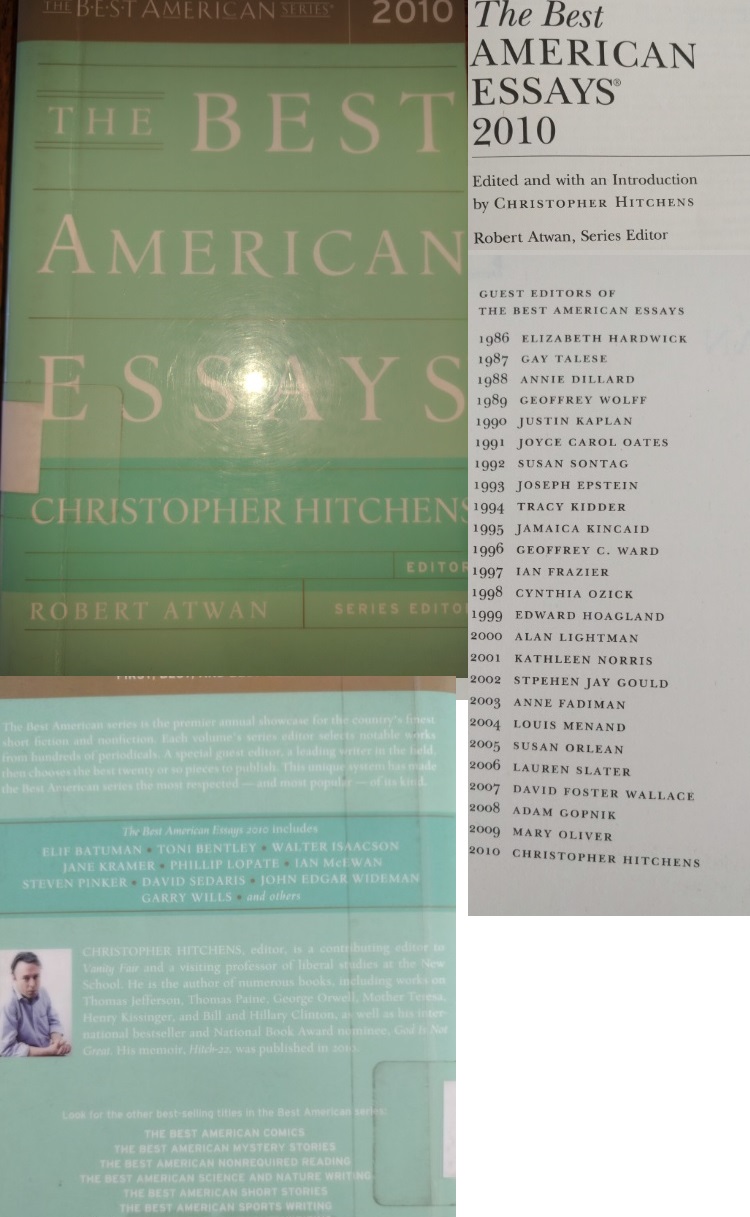
This is the cover and editorial information of the book I read:


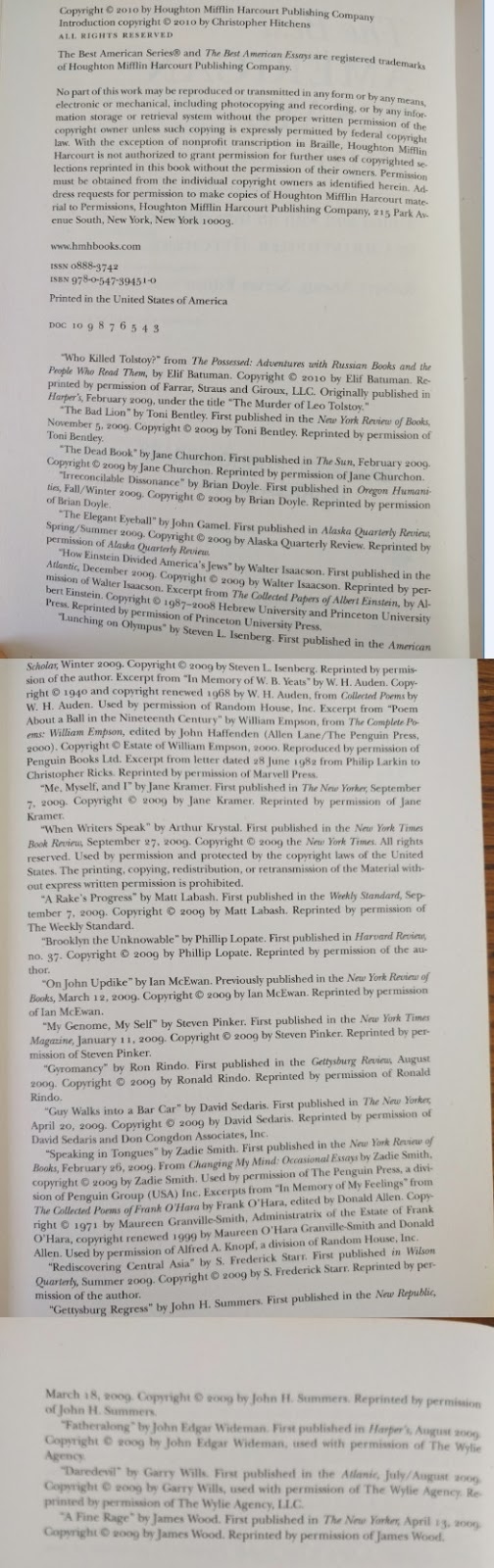
Here is the list of copyrights and stories in the book. As you can see, all the stories come form very reputable sources:


This is the table of contents. When I first read this book, I couldn't guess what I was going to be facing. There are such different topics and fascinating stories. For example, there is one about a wild lion that gave me goosebumps. It is so well written that I felt in the skin of the adventurous person who had the experience.


This is the foreword. So well written that I had to reproduce it here. It deserves to be read several times:


And this is the introduction by Christopher Hitchens. I am conscious of my bias, but I really think this little "scribble" is a masterpiece on its own:


I hope you liked this review. Did you know that I also have a blog? Take a look here: http://lunairereadings.blogspot.com
Profile Image for Chuck O'Connor.
269 reviews13 followers
December 29, 2011
If I could give 2.5 stars I would. This is a middling effort from the "Best of . . ." series.

I really enjoy the "Best American" collections because they seem to be edited towards novel voices and points of view. They have a consistent ability to surprise and delight. The collections often work like an interesting bar-room conversation where cultural finds are endorsed between friends. I had hoped that it would be the case with this collection seeing as it was edited by Christopher Hitchens, but the gathering here seems to be that on an uncomfortable dinner party where exhausted intellectuals rely on talking points to invite conversation.

I don't know if the Hitch was overwhelmed with things while editing this (the publication date was approximate to his cancer diagnosis) but the works here lack a consistent standard one might expect from the famous contrarian essayist.

There are some excellent choices, notably the odd world of Tolstoy scholarship described by Elif Batuman, Jane Churchon's moving look at the documentation of the dead, John Gamel's meditation on the human eye, which leaves the reader to experience an ironic sense of self-awareness when reading about the mechanics of the organ allowing him to read about the mechanics of said organ, and Stephen Pinker's intelligent philosophical consideration of the human genome.

The insight from Brian Doyle that every marriage is pregnant with divorce was excellent and helped me consider the beauty and value of my own marriage, and Ron Rindo's examination of race as a mechanism of belief was a sublime angle on that most human of traits.

But there are equally confusing choices that tend towards unsurprising recapitulation of tired theses.

Do I need to read another homage to the romantic ambiance of Brooklyn as found in Phillip Lopate's "Brooklyn the Unknowable" (a pretentious title for an exposition of obvious observations) or, another examination of Orwell as in James Wood's "A Fine Rage" (sentimental tosh from Hitchens towards his intellectual forebear maybe?)

There is no center to this collection and too often a fine work that offers narrative insight is bounded by something obvious (Zadie Smith on the uncomfortable assimilation of mixed race intellectuals with the too tired allusion to President Obama) or simply offensive in its revisionist homage (Garry Wills eulogy for William Buckley).

I wish there was more here to delight in but unfortunately the finds are too few.
Profile Image for Victoria.
65 reviews37 followers
May 6, 2011
In general, the “Best American” series is more often than not, a mixed bag and gamble. I find that whether or not I find the series successful is solely dependent on the Guest Editor’s taste in reading matching up with my own. The way the series is structured, a series editor (in this case Robert Atwan) whittles down a veritable pool of submissions from various publications for the best 100 or so essays from any given year, and the guest editor picks, in his/her own personal opinion, the best 20 for the book. I read the 2005 edition of the “Best American Short Stories” and found that Michael Chabon and I have vastly differing taste in fiction, and therefore found the experience rather uninspired.

I had higher hopes this time around as I generally admire Christopher Hitchens as a writer. Overall, I was pleased, but by no means blown away. All of the pieces are well written, but Matt Labash’s “A Rake’s Progress” is the only one whose writing really left a lasting impression and reminded me very much of Gay Talese. Essays covered a wide variety of intellectual topics ranging from eyeballs to sadistic necrophiliac lions to a discourse on how Einstein divided America’s Jewish population. I’d recommend this book to anyone wanting to brush up on long-form essay writing, or looking for inspiration for creative non-fiction writing with the caveat that some of the pieces will probably be uninteresting for those with no desire to read about sometimes obscure topics such as 18th century French poets or George Orwell’s political and literary evolutions.
23 reviews
November 10, 2011
This collection was the first non-fiction collection that I've ever picked up. What I found was that non-fiction pieces have a trend; the author knows way more than the reader will ever about the subject, the author uses insane amounts of detail with little imagery, and the author sums up the lesson learned from their various experiences in the last paragraph of their piece. Every story in the collection followed a similar path. What I took from reading the essays is how detailed an author must be while describing a setting. For example, in Phillip Lopate’s “Brooklyn the Unknowable” the reader needs exactly what Lopate gives them, setting. For example, Lopate says “Looking south toward Red Hook, there is a parking lot filled with Verizon telephone trucks, in the distance the elevated trestle of the F train, and the Kentile Floors sign, and a factory placard that reads “Alex Figliola Contracting.” Some of my favorites were the humorous self deprecating essays like Doyle’s “Irreconcilable Dissonance,” Labash’s “A Rake’s Progress and Sedaris “Guy Walks into a Bar Car.” I found Churchon’s “The Dead Book” very emotional and unfitting in the collection and Gamel’s “The Elegant Eyeball” very hard to relate to.
102 reviews
December 14, 2014
here's the thing--what, exactly, is the BEST American Essay? or American Essays? Do I judge, as the edition does, from a rather limited, "well-established" base to republish published works, or ...from sources never dreamed of--i.e. editorials, Ebony, etc.? I was left feeling like I nibbled on sawdust with the numerous Brit/American lit references, the reflective Orwellian slants of "what he got right" (which I did enjoy) to "what he did not" (yes, with British references, again) to the interesting pondering of what does the removal of innocent trees have to do with promoting a more historic Gettysburg?

I wonder if the 2014 collection will be brave enough to contain the police handling of race, the Bill Cosby scandal, the Republican hatred of all things Obama and...dare I say, Donald Trump's hair. Will there be an essay that deals with the continued Wall Street scandals, the lack of banks rewarding their constituents with a respectable percent (say 9 and up) for having savings accounts/checking instead of their shareholders and management, global warming...etc. I wonder.
6 reviews1 follower
June 12, 2014
This is disappointing! Should be called "mediocre and unremarkable american essays." I normally enjoy essays because I find that they enlighten or offer a window into a different perspective. I find that the best essays take a smaller phenomenon that somehow relates to the larger picture, and you leave feeling like you've learned something important. These were smaller picture essays, that seemed isolated in their scope. If you're dying to learn more about eyeballs and Marion Barry (DC's crook mayor from the 80s, which as a DC res, I didn't even find that interesting), then this is the book for you. One caveat, I haven't read the Zadie Smith essay yet, and the Updike one was interesting. The first one, on a Tolstoy scholar was quirky and at least had some flare. Maybe this is just my personal taste. To give you an idea of what I like, I love David Brooks' essays, especially the most recent one in the New Yorker.
Profile Image for Andrew Bertaina.
Author 4 books16 followers
October 25, 2012
I kind of love The Best American Essays. This particular iteration wasn't as strong as the 2011 edition. However, that's somewhat up to the proclivities of the guest editor, in this case, Christopher Hitchens. However, it's a collection worth reading. That said, let's take a look at the individual essays.

5 star
The Murder of Leo Tolstoy
Irreconcilable Dissonance (A short and lovely essay on divorce)
The Elegant Eyeball
My Genome, My Self
Guy Walks into a Bar Car (David Sedaris)
Speaking in Tongues (Zadie Smith on Obama)
Gyromancy (Vertigo and Picasso)

lesser lights
The Bad Lion
Me Myself and I (About Montaigne)

Dimmer Things

A Rake's Progress (re Marion Barry)
Brooklyn the Unknowable
Rediscovering Central Asia
The Dead Book
Lunching On Olympus
On John Updike
Gettysburg Regress
Daredevil (about William Buckley)
How Einstein divided america's Jews
Fatherlong
A Fine Rage (about Orwell's politics)
Profile Image for Billie Pritchett.
1,201 reviews120 followers
June 29, 2016
This is the best collection of this series' volumes I have ever read. Some of my favorites include: "The Murder of Leo Tolstoy," maybe one of the best or the best essay I have ever read, which speculates that Leo Tolstoy didn't die of natural causes but murder (cue scary music); "Irreconcilable Dissonance," about the seemingly trivial causes for divorce, which incidentally are the most common reasons; "A Rake's Progress," about former New York Mayor Marion Barry; "My Genome, My Self," about the prospects of personal genomics; "Rediscovering Central Asia," about when central Asia was an open, ecumenical, bright place; and "A Fine Rage," an essay about Orwell. Fine, fine collection. I want to chock it up to Christopher Hitchens' keen editing of this volume, but it could have just been a very very good year.
Profile Image for M.E..
342 reviews13 followers
November 3, 2010
As always, there are some gems and some duds in this year's collection. The stength this year, though, is the variety in the types of pieces contained here. The essays range from a short, elegaic look at divorce, to a historical narrative of Einstien's visit to America, to personal accounts of virtigo, to a profile of a city, and on and on. Each piece published in this collection is distinct and of high quality. While I didn't much like the more political essays, there was enough in here that I did like for me to recommend this year's collection. I especailly liked Elif Bautman's "The Murder of Leo Tolstoy," Brian Doyle's "Irreconcilible Dissonance," and Steven Pinker's, "My Genome, My Self."
Profile Image for Jeff.
121 reviews17 followers
January 25, 2011
Refreshing change of pace to read essays and this collection is solid. Most of the pieces are very fresh.

5-stars:
The Murder of Leo Tolstoy
Irreconcilable Dissonance (about divorce)
The Elegant Eyeball (opthamology memoir)
A Rake's Progress (re Marion Barry)
Brooklyn the Unknowable
My Genome, My Self (personal genomics by Pinker)
Guy Walks Into a Bar Car (by Sedaris)
Speaking in Tongues (by Zadie Smith)
Rediscovering Central Asia

4-star
The Bad Lion
The Dead Book
Lunching On Olympus
On John Updike
Gettysburg Regress
Daredevil (about William Buckley)

3star
How Einstein divided america's Jews
me, myself and I (re Montaigne )
Gyromancy (about vertigo)
Fatherlong
A Fine Rage (about Orwell's politics)

Profile Image for Tiffany.
57 reviews4 followers
March 7, 2011
I've been reading this series pretty religiously for....maybe a decade now. Recently, I've been less impressed by the selections, but this year they published an essay by Zadie Smith, "Speaking in Tongues," which is one of the best essays I've read in a long time and epitomizes all the potential of the genre. She manages to weave analyses of the play Pygmalion (i.e. My Fair Lady), the life of William Shakespeare, and Barack Obama's Dreams From My Father into this really thought-provoking piece about language, race, class, and identity. You can read it here: http://www.nybooks.com/articles/archi...
Another essay I enjoyed was "Irreconcilable Dissonance," by Brian Doyle, a brief, humorous piece about the presence of divorce in every marriage.
Profile Image for Jessica.
Author 1 book218 followers
Read
October 27, 2018
This is the 5th of these collections I've read (my plan is to complete all between 2006, when I started graduate school in creative nonfiction writing, and the present) and it is one of the weakest so far. I'm hoping this will change as I get to the more recent editions, but someone needs to do a VIDA count on these anthologies. There are 21 essays here and five are by women. A lot of the essays seem to be chosen for their content, rather than their style, which would be fine if this was called "Best American Journalism/Research/Reporting" but an "essay," in its truest, Montaigne-ian sense is something more searching, more experimental.
Profile Image for Sherry.
464 reviews
July 29, 2012
I love Christopher Hitchens, and I think him being the guest editor of the collection says as much about him in his selections as it does the writers who are in it. Great selections. I liked the book very much, felt I learned a lot and am going to check out more collections from the library. The best thing about books like this is that they put essays from all types of publications in one place. It would be nearly impossible to get all of the publications, and have time to read all of the material yourself any other way. Recommended.
Profile Image for Patrick Donohue.
48 reviews5 followers
September 14, 2012
Enjoy these throughly, which shouldn't be a surprise (they're the best of the best).

Must have been one of C. Hitchens' last projects.

Standouts (for me):
-Bad Lion (messier side of nature)
-The Elegant Eyeball (I have a family member with macular degeneration)
-A Rake's Progress (on former Mayor Barry in DC; would be good on Atavist)
-Brooklyn the Unknowable (visited this year)
-My Genome, Myself (helpful points on the meaning of genetic probabilities)
-A Fine Rage (on George Orwell; I read "Homage to Catalonia" last year)
Profile Image for Jamison Spencer.
234 reviews2 followers
May 16, 2013
I generally like Christopher Hitchens, but we obviously have very different taste in essays. This is the first of any of the best American series I ever found boring. There were a few exceptions (the essay on Marion Berry springs to mind) but generally I found these too short compared to the amount on info they imparted, which meant they often didn't really feel fully like essays too me. I would have found many of these interesting if I stumbled across them in a magazine, but I wouldn't have walked away thinking about them as essays, just about the information within them.
1,789 reviews3 followers
April 26, 2012
I liked nearly all of the essays in this collection, though I found them rather oddly organized (alphabetical by author) which led to a choppy random feel. There seemed to be in inordinate number of essays about medical topics, which was fine with me. I liked the one by a nurse about pronouncing patients dead and the eye doctor's memoir, "The Elegant Eyeball" was good too. I especially liked "Brooklyn the Unknowable" by Phillip Lopate and Zadie Smith's "Speaking in Tongues."
Profile Image for Matthew.
18 reviews1 follower
November 23, 2010
Hitchens selections are a little on the esoteric side. Example: an essay on Einstein's first trip to America sounds interesting, but it turned out to be heavy on details about the inner conflicts of America's post-war Zionist movement.
The David Foster Wallace collection from a few years ago is still the one to beat.
Profile Image for Christian.
45 reviews26 followers
February 10, 2011
Some great ones: Pinker, the one about Van Gogh, but most of them completely forgettable, not because of poor writing, but for being a bit too pedagogic and too much hand holding. Clearly Hitchens liked to be taught about some specific subject, like Central Asia, which is not bad in itself, but lacks depth and doesnt really do much after you have finished reading it.
127 reviews3 followers
April 23, 2011
Not one of the better ones. Hitchens apparently chose the essays based on his interest in the subject matter, not on the quality of writing. many dead white men as subjects. A couple of memorable ones, notably Zadie Smith, who is someone I'd like to read more of, John Gamel on the eyeball, and Ron Rindo on vertigo and Van Gogh.
134 reviews1 follower
January 21, 2020
This year's collection is edited by Christopher Hitchens. It doesn't have the usual few whimsical essays, but there is a terrific piece on George Orwell, and how his desire for a class-free society bumps up against his mixed feelings about the lower classes, and there's an appreciation of William F. Buckley by his buddy Garry Wills (Buckley didn't like to read books!).
Displaying 1 - 30 of 61 reviews

Can't find what you're looking for?

Get help and learn more about the design.