*If you don't want to read this long "review" (and I don't blame you!), skip to the asterisk at the bottom.
What I like most about this play is Anouilh's skilled weaving of contemporary politics, history, and his own message. Much like his Antigone, this play takes an already-familiar story and reimagines it to tell the story that Anouilh wants to tell.
In 1959, when Anouilh wrote this play, Charles De Gaulle wanted to weaken, if not nullify, the shared and contested world power of the United States and the USSR. He instituted a new franc and sold some of the French currency to the US in order to decrease the States' financial presence in his country. He dreamed of resuscitating the Europe of old. His famous slogan, Europe "from the Atlantic to the Urals," conspicuously left out Britain, a country that aided in liberating France from the Germans (paraphrased from Wikipedia). This political climate must have had a role in Anouilh's engendering of Becket, which has as a major sub-theme the tension between the Normans and the Saxons. In one scene, Becket finds a "petit moine," who is threatening to kill him or Henry with a knife (my French is decent but not 100%). The monk refuses to speak to Becket in French, answering his questions in English. Becket understands the monk, but he continues speaking in French. After all, his king, Henry II of England, is Norman. His is a French king of French and English ancestry, sitting on the English throne, and Becket serves this king. Becket speaks French, and it is a badge of honor that Henry's "petit Saxon" can speak it without an English accent. When Becket must leave the country because of his conflict with the king, he runs to France, of course. In a conversation with a nobleman, the French King, Louis, Henry's cousin, states, "Mon droit a faire le courtois s’arrête a l’intérêt de la France et l’intérêt de la France est de faire toutes les difficultés possible a l'Angleterre" (My duty to be courteous stops with the interest of France, and the interest of France is to make everything as difficult as possible for England), a sentiment that I'm sure De Gaulle would have agreed with. In Rome, the Pope and one of his Cardinals discuss the problems between France and England (with "bad Italian accents," according to the stage directions), including Becket, and eventually come up with a scheme to resolve the issues by duping both countries. The Pope says, "C'est tout simplement faire un geste d'apaisement dans l’intérêt de la paix en Europe" (it's simply to make a gesture of appeasement in the interests of peace in Europe), another remark that sounds suspiciously De Gaullian. The Pope makes the claim that both France and England have "a long arm" and that Rome must balance the two.
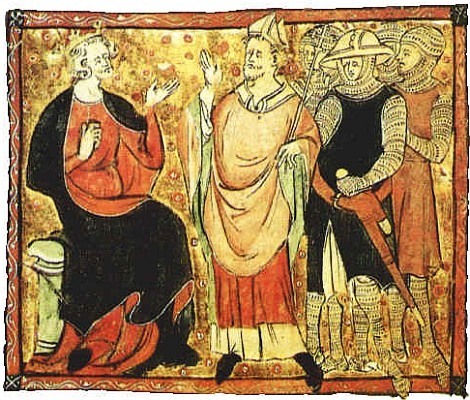
The historical inspiration and background are that Henry II was a Norman, born to a French father and an English mother. His mother helped him contest the throne of England, to which she had a right as the daughter of Henry I. Henry eventually became King of England and Duke of various French locales, including Normandy. Becket, Henry's chancellor and friend, was born in England to Norman parents. The main tension between Henry and Becket was that Becket was a clergyman, and his duty and desire were to strengthen the power of the Church, while Henry wanted to strengthen the power of the Crown. When Becket became Archbishop and took the part of Saxon monks, Henry was not pleased. The tension between Normans (conquerors) and Saxons (conquered) and the tension between the Church and the Crown are the major conflicts in the play. Becket, above all else, values order. Because he is a clergyman, his first duty is to God, and he has to fulfill it at the expense of the king's desires. Without order, nothing endures. When Henry wants to tax the Church for not sending their men out to fight, the bishops originally say no but eventually give in. Becket tells Henry that they only give in because the power of one king is temporary compared with the centuries of power the Church has established. The king uses the Church, but the Church uses the king better. Henry says to Becket: "Vous pouvez vous dire aussi que le grandeur de l’église et celle de l'Etat étant intimement liées, c'est en definitive a la consolidation de la foi catholique que vous travaillerait en me servant" (You can also say that the grandeur of the church and that of the state being intimately connected, it is ultimately for the consolidation of the Catholic faith that you would work by serving me).
What Anouilh adds to the political and historical backdrops is the story of two friends, one who loves the other unconditionally and one who loves his duty and his honor above all else. Le Roi and Becket are foils for each other. They love to hunt and make love to women, they are extravagant in their tastes (it's a big deal when Becket buys a bunch of gold forks--the king tells him, "I don't even eat from gold; I eat from silver," and he doesn't know what forks are because, apparently, B is the one introducing them to England). But the king can be vapid, clueless even, and Becket is all intelligence. The king is all too aware of Becket's superior intelligence. For instance, Becket escapes his sentence when he first disobeys the king by wearing his crucifix and other holy articles to the meeting of the king's barons because he knows that they won't touch him with the untouchable objects decorating his person. When the king hears about Becket's actions, he accepts them as inevitable, basically: "Of course Becket did that." At first, Becket serves the king loyally and wholeheartedly. He does whatever the king says, always calling him (ironically) "mon prince." But when the king makes Becket the Archbishop of Canterbury, the supreme head of the Catholic Church in Pre-Anglican England, Becket tells him (warns him) that he cannot serve both God and King, that he will have to choose, and that he will choose God. The king doesn't believe him, but Becket proves it to the extreme emotional pain of the king, who bursts out randomly after their split, when alone or in the middle of conversation with others, including his nobles, "Je l'amais, Becket, je t'aime" and various versions of the same. Once Becket makes his decision, though, he sticks to it. He wants to fulfill his duty and let God's will take over for the rest. He tells Henry, when they're on the verge of making amends, that the King must steer the boat but also be prepared for the wind to batter against it. He says, "Tenir la barre du bateau" (take the helm of the boat). Henry asks him, "Et toi qu'est-ce que tu as a faire?" (and you, what will you do?). Becket replies, "J'ai a vous resister de toutes mes forces craint vous barrer contre le vent" (I will resist you with all of my force, fearing that you will go against the wind). He thinks that he and Henry can work this out, that Henry can accept the wind beating against his boat and let it knock the boat about sometimes. Becket must rise up and push against the current, but Henry can't accept this. Ultimately, the two split for good. The play opens and closes with Becket's death and a naked Henry kneeling before Becket's grave. Despite his refusal to bend, Henry defends Becket to the end and refuses to hear anyone talk badly about him. Even when Becket has been killed by the king's own men, the king will not acknowledge his role in his friend's death and states that Becket must be mourned as a man of faith and of honor.
I realize that this more of a report/essay than a review, but I couldn't help it. This play is very wide in scope. There are so many aspects of it that I'm leaving out, like Anouilh's stage directions and intended production of the play, the women, Becket's choice of "Norman" and "Saxon" (loaded terms) over French and English, Henry's relationships with his mother, wife, and children, Henry's childlike fear, the politics in the Church and the nobility, the relationship between Becket and his "petit moine," etc.
*The review is simply this: A very good play; interesting and thought provoking as well as entertaining. I highly recommend it!