Presented in a graphic novel format, a personal memoir about the author's experience of growing up in the 1950s with a pair of holocaust survivor parents describes their memories of other family members lost in the war and the author's observations about the universality of memory and loss. 40,000 first printing.
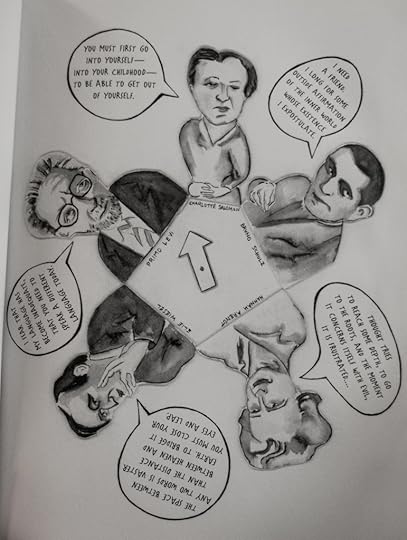
This is a book that is in some ways brilliant and in others uneven and hard to connect with. I loved the illustrations and the humor was at times very compelling. And I love the opening comic with Bruno Schulz, Charlotte Salomon, Primo Levi, Elie Wiesel and Hannah Arendt talking about the difficulty of experiencing integrated selfhood and the strange divide between the internal and external self, and the unspeakableness and unknowableness and unreachableness of language and meaning as the Holocaust comes into being. Below is the image. I hope it is okay to post it here. (If it is an infringement of any kind, let me know and I'll take it down.)
Reading the reviews of this book on Goodreads I was surprised so many people gave it two stars. It seems people wanted a drama-filled book, Eisenstein's parents' horror stories, more than they wanted to hear about her life (as the child of people who had survived horrors that are so often spoken of, but nevertheless unspeakable and unimaginable.)
It makes me uncomfortable that people want "more drama" more "holocaust" and less of the introspective, inquisitive writing that Eisenstein offers. For, this isn't a book called "My Parents the Holocaust Survivors." It is one that sets out to explore the experience of growing up around people whose silences are louder and--for a young child who doesn't understand them but feels them quite powerfully--more terrifying and destructive than words. The experience of knowing there is some great force and matter that is keeping everything in its gravitational orbit but is not, itself, visible, is the one I think she is trying to get at. And her writing is at times very graceful. Only I found myself having trouble going back and forth between the more conversational stories and philosophical reflections (hinted at by the above comic). I was drawn in by both, but not necessarily able to stay engaged with the structure and the ambivalent tone (it was as if there were two separate books in here wrestling it out, and maybe that is something I should be more curious about. Rather than see it as a fault, see it as part of the fact that a book is nothing if not a conversation with the self and the other, the page and the world.)
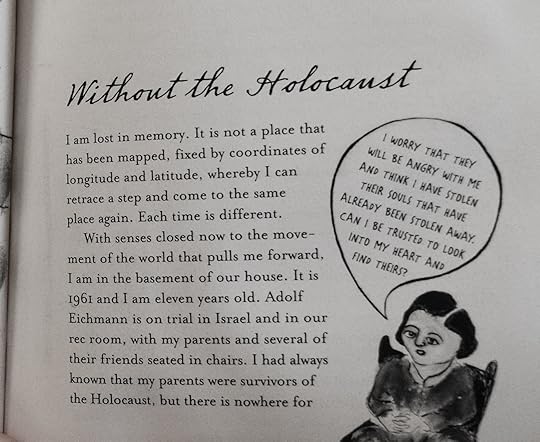
Here is an example of some of her rich reflections on memory as a child of Holocaust survivors.
There are many stories about her childhood, her parents experiences during the war, the loss of her father, meeting her parents' friends. They are all well-enough written, I am just not always sure about the movement between story and reflection.
But, I appreciate what this book is and I also appreciate what this book isn't. That it isn't something along the lines of "disaster porn." This is not a book meant to titillate people with Holocaust suffering and I am worried, after reading the reviews, that people wanted this to be a Holocaust story they could use for some kind of self-indulgent catharsis. Maybe it's just a human fascination with horror, or people want to see the world as broken up simply into good and evil, and to place themselves into the good category. That they want to feel a moment of compassion for the victims while reading a book so they can convince themselves they are one of the "good" ones and let themselves off the hook in much more complicated real life. (There is an interesting discussion about this in "The Subject of Holocaust Fiction" by Emily Miller Budick. But of course, it is not something that only pertains to the Holocaust.)
It is not a bad thing to be curious about or interested in the Holocaust. But if you go to a book called "I Was A Child Of Holocaust Survivors" with the expectation of reading a detailed account of her parents' suffering, well, maybe that's something worthy of introspection.
This is a book I may pick up again and I look forward to reading more of Eisenstein's work. Right now it looks like there are only two other books she's got some writing in, but one is made up of correspondences with Anne Michaels and David gave it a five star review, so I hope they have it at the library.
Pensando all'Olocausto, tematica da sempre presente nelle mie letture, mi sono sempre chiesta quale sia, nel presente, l'atteggiamento e il pensiero dei figli e nipoti dei sopravvissuti, i cosiddetti "testimoni di seconda o terza generazione". Com'è stato per loro essere cresciuti ed educati da testimoni diretti di una simile tragedia? Cosa provano nel vedere filmati girati nei campi di sterminio e nel leggere testimonianze ben sapendo che i loro stessi genitori, nonni, parenti, hanno subìto la medesima sorte, sorte che tra l'altro essi stessi, se fossero vissuti qualche decennio prima, avrebbero potuto subìre? Come accolgono, se ci riescono, la grande eredità loro trasmessagli, quella del ricordo? Pensavo che questo graphic novel di Bernice Eisenstein potesse aiutarmi a rispondere a queste curiosità: il punto di vista di questa lettura, infatti, è quello di una figlia di due ebrei sopravvisuti ad Auschwitz, la quale cresce portando in sè l'ombra del loro passato. Curiosità siddisfatte, dunque? Solo in parte. La Eisenstein sviluppa questi aspetti solo in alcuni punti del libro, in maniera cauta, sottile, di striscio: si tratta di momenti rari ma profondi ed emblematici, che offrono al lettore ottimi spunti di riflessione (significativo, ad esempio, il passaggio in cui racconta di quando, da adolescenti, lei il cugino fanno conoscenza con un gruppi di coetanei non ebrei, e l'avvenimento scatena un misto di disapprovazione e paura nei loro genitori). Quanto al resto, l'autrice si dilunga in descrizioni delle usanze della sua famiglia, dei primi anni del matrimonio dei genitori, degli hobbies del padre, quasi volesse, nel suo inconscio, sviare dall'obiettivo principale che si era prefissa scrivendo il libro. Ma d'altronde mi rendo conto della difficoltà di scrivere su un tema simile, da parte di chi ha sempre voluto chiedere e sapere ma non sempre ha ottenuto le risposte che voleva e così è andato a cercarsele...e le risposte hanno fatto male. In conclusione il bilancio del libro resta comunque buono. Ero indecisa fra due stelline e tre, ma alla fine ho optato per tre, per premiare la volontà e il coraggio dell'autrice di scrivere su un tema simile dal suo punto di vista e perchè no, anche per i frequenti bei disegni disseminati in tutto il libro.
I read this book in one day, so it was on the whole very captivating. I also loved the drawings and quotes. I honestly just wish the author would have focused more on what the title was about than random stories about growing up Jewish in Toronto. This was probably a very cathartic book for the writer to write and I do like her style, I just felt like I was going to get a bit more of an insight into what it was like growing up with Holocaust survivor parents (and her's included aunts, uncles, grandparents and most of her parents' friends).
Engaging and often heart-breaking memoir of a woman whose parents had survived the German concentration camps during WWII.
The narrative is enhanced by many black-and-white illustrations. They are a bit somber and not particularly to my taste, but the characters are very expressive and complement the narrative well.
interesting quotes:
"It is impossible for me not only to have wished for more from my grandmother and grandfather but also for them, each in their own lives. I am unable to find the place where they were forever lost to themselves. Perhaps this is my grandparents' legacy to me." (p. 129)
"There is a Yiddish saying: A wise man hears one word and understands two. I have no claims on wisdom, but over time I have tried to consider things things in more than one way." (p.131)
A short book, an interesting book. This is written by the child of two people who met, then married after the last days of Auschwitz. These parents never spoke about their time there, until finally Eistenstein's mother recorded some camp memories for a Canadian broadcasting company. Eisenstein relied on other family members, on unguarded fragments, on tangible small souvenirs (her father's wedding ring, rescued from the effects of a deceased prisoner in Auschwitz by her mother) to build up an understanding of what her parents had been through before landing in Canada to begin a new life. These survivors put all their efforts into being normal Canadian citizens, normal Jews. The strain on them, and by extension Eisenstein, was sometimes almost unbearable, and her sense of alienation is palpable. I'm not sure what, if anything, her pictures added to this record.
This book, being only 187 pages and full of pictures, took me an embarrassingly long time to read because I have been extremely busy lately, what with the summer ending and preparations for school having to be made. I kind of feel bad because if I had read the book in a day or two, which it should have taken me to read it, I might have liked it more. But OH WELL. It is what it is.
I found the premise of this book interesting. Who doesn't want to read about what it's like to have parents who have survived one of the most horrifying and shocking tragedies of human history?? However, I found that, even though the book WAS so short, it dragged in places. In fact the only reason I gave this two stars instead of one was because when she was telling her mother and father's stories about the war and all that it was really interesting. But I did not enjoy the parts when she spoke about random things from present day, like "The Group" of her parents friends and things like that.
Like I said before I wish that I could do this book justice by not taking so long to read it, but from reading this book in the time frame that I did, it just didn't satisfy as much as I would have liked.
I'd really prefer to give this 2.5 stars instead of just two, but alas, Goodreads frowns upon the whole half-star thing. I really wanted to like this book. Its premise is unique: what *is* it like to grow up as the child of such damaged people, who witnessed the absolute worst that humans can inflict on one another, in an age before psychiatric drugs and diagnoses of PTSD? But I didn't really get the sense at all of what that was like. Eisenstein shares many of her childhood memories with us, and shows how emotionally unavailable her father and grandfather were, but that's about the extent of it. I would have liked more depth, more description of how it all made her feel. I also felt that Eisenstein's writing was about as clear as mud. I would have to read a sentence over two or three times to glean its meaning, which frustrated me. It's such a shame, too, because I wanted to love this book, with its gorgeous watercolors to punctuate the prose.
Didn't really live up to the expectation, maybe because it's too short, perhaps because it doesn't really satiate that shameful, alien 'angsthunger' for Holocaust Eisenstein describes in the book and which I know so well, but I just can't give this 2 stars when it so obviously springs from the depth of the author's heart. And I would've loved to see some photographs along with the drawings...
3 1/2 stars. Not quite what I was expecting. But then again, life as next generation after this would be complicated and varying - as many reactions as each survivor coped differently. (Owned - selling)
Fin da quando, undicenne, assiste in televisione al processo ad Adolf Eichmann, Bernice Eisenstein sviluppa una morbosa attrazione per l'Olocausto, che assume le caratteristiche di una vera e propria dipendenza: Bernice si nutre di tutto ciò che racconta lo sterminio degli ebrei, film, testimonianze, libri, poesie, fotografie, oggetti. È lei stessa a spiegare il motivo di questa ossessione: «[...] senza l'Olocausto non sarei chi sono». I suoi genitori, infatti, si sono conosciuti ad Auschwitz e, per i successivi quarantasei anni, non si sono mai più lasciati. La loro intera esistenza di ebrei polacchi emigrati in Canada dopo la liberazione ha sempre ruotato intorno alla loro appartenenza al Gruppo, una cerchia molto coesa di europei scampati allo sterminio, che si sono ricostruiti una vita oltreoceano.
Bernice vuole mantenere la promessa di non dimenticare mai, anche se la guerra, i pogrom, la sopravvivenza nel ghetto e poi nel campo di concentramento le sono state raccontate e non le ha vissute in prima persona. Il suo passato tragico la definisce, a partire dal suo «desiderio inespresso di essere amata ancora di più perché i miei genitori erano stati ad Auschwitz»; è come un marchio, che la vincola indissolubilmente alla sua gente e che lei stessa sintetizza con chiarezza nell'immagine di copertina, ritraendosi bambina, con le ombre dei genitori che si sostituiscono alla sua. Sembra quasi che Bernice non abbia una propria identità, ma il suo stesso esistere sia fondato sul sacrificio e sul dolore di coloro che l'hanno preceduta.
Sono, dunque, i suoi genitori, Regina e Ben, i veri protagonisti di questo memoir, che mescola una prosa molto emozionante, in cui si alternano inglese e yiddish per dare maggiore fluidità al racconto, e illustrazioni morbide, colorate ad acquerello, capaci in pochi tratti di aggiungere senso e profondità alle parole stampate. Tutti i disegni sono in bianco e nero, immagine per antonomasia del luogo dei ricordi, ad eccezione di alcuni particolari simbolici, che assumono il loro senso all'interno della narrazione: un anello, foglie verdi, un pollo, una mela, una vecchia teiera. L'autrice riesce nell'intento di esternare il proprio disagio interiore e tramanda ai suoi lettori l'incapacità di comprendere l'Olocausto, sforzandosi di trovare immagini che possano completare quello che le parole non riescono a trasmettere, e, così facendo, prova a proseguire lungo la scia di pensiero forgiata per lei da Elie Wiesel, Primo Levi, Hannah Arendt, Charlotte Solomon e Bruno Schultz, dalle cui lezioni prende avvio questo libro. Il Leitmotiv che guida Bernice, e che poi è il filo rosso che fa da collante a tutta la produzione letteraria che affronta il tema dell'Olocausto, è ben riassunto in questo brano: «[...] se cominciassi a piangere, non mi fermerei più».
This is a biography about the child of two Auschwitz survivors.
While she rarely heard all that much about what her parents went through for obvious reasons, she was really curious about the Holocaust and what it did to her parents, especially her father and tried to put together what she could. This isn't so much a story about the war itself, but mostly about the life afterwards with bits of war sprinkled in... for example the story of her father's wedding ring was a tie-back to when her mother was a prisoner before her parents met.
I do think this book is a little confused at times, the cartoony illustrations were at times quite funny, which lessens the gravity of the subject matter although that could simply be the Jewish tendency to use humour.
This is a deeply moving read but at the same time it is a pleasure to read. Not only is it well written, but Eisenstein's illustrations add much to the narrative. They are simply and slightly comic in a Jewish kind of way, but at the same time they capture the sadness of the people she is writing about. How can a child of Holocaust survivors every grasp their pain? The ghost of the horrendous past erects a kind of barrier, making her feel alienated from her own family. There is wonderful insight here. Somehow Eisenstein manages to convey her dilemma; after all most readers are also cut off from this unfathomable experience.
Ich muss mich hier einigen Vorschreibern anschließen: Irgendwie habe ich etwas anderes erwartet. Ich habe nicht recht in Eisensteins Buch gefunden und war dann, als es ausgelesen war, auch sehr schnell wieder draußen. Velleicht war der Einblick in die Familie der Erzählerin zu kurz. Vielleicht war mir der Einblick in die Gefühle und Gedanken der Erzählerin nicht tiefgreifend genug. Ich weiß es nicht. Irgendwie wirkt das Buch unfertig auf mich, aber das ist vielleicht auch mein Unvermögen, mit diesem Text umgehen zu können.
As the author repeatedly acknowledges, this is a challenging book to write because she is dealing with so much indirect trauma and what is and is not her own experience. This ground has certainly been well-covered by Spiegelman and many others. Regardless, I found the penultimate chapter exquisite as the author observes "The Group" during a present-day celebration with families while simultaneously looking back at their Holocaust experiences and families who were killed, and forward to their own eventual demises.
⭐️⭐️⭐️⭐️ This book and satirical comic book won a lot of awards in Canada, but it’s no Maus. I think it would be a good point of reference for Holocaust literary buffs, who compare Wiesel and Levi to Chaucer and Thoreau. I’m also not sold on her reasoning behind never REALLY discussing what her parents (and extended family) survived.
This entire review has been hidden because of spoilers.
Unique and touching memoir as a tribute to the author's parents and grandparents and other family members who were holocaust survivors. The author also relates the emotional difficulties that survivorship expressed to the survivors and the children of survivors who had to stand in for decreased relatives and try to make sense of the scar on their lives.
This book had some wonderful moments. At other times, it was hard to connect with the narrative. Based on the title, I was hoping for more discussion about the impact of the Holocaust on the next generation.
It's possible that this book was too culturally esoteric for me, and I may have enjoyed it more if I were Jewish. However, having several Jewish friends who are the grandchildren of Holocaust survivors, I was expecting more insight (emotional, psychological, something...) from this book.
Instead of exploring how her parents' experiences affected her upbringing, the author writes mainly about her experiences growing up in a Jewish culture: seders, kosher food, Yiddish mixed in with English at home, etc. While it's advisable to write what one knows, and Eisenstein does so with excessive detail and accuracy, writing about one's experiences growing up does not necessarily make an interesting book. (Do I really care about what street she lived on at what age? Does it further the story to know which books and films about the Holocaust the author enjoyed? I've enjoyed many of the same, and was certainly not a child of Holocaust survivors.) What effect does having been raised in a primarily Jewish neighborhood have on the author today? How did her upbringing affect her parenting of her own children? How were her parents different from any other religious first-generation immigrant families???
The book is at its best when it relates the firsthand experiences of the author's mother during the Holocaust in Europe, transcribed from a video of her mother interviewed for someone else's documentary - her story is riveting, as are most firsthand stories of the most horrifying event in recent human history. However, it has little to do with the author's premise of her own story as a CHILD of Holocaust survivors. This premise and its possible implications are finally touched upon about 2/3 of the way through in about 2 1/2 pages, when the author relates her family's utter devastation when she and her cousin spent one afternoon with some friends their age who were not Jewish. Missing an opportunity to explore the ripples of anger, fear, and their repercussions (abuse? manipulation, perhaps?) that I imagine flow from Holocaust survivors' generation down even to my own, the author refers vaguely to the "Pandora's box" that she and her cousin stumbled upon with an emotionless, impersonal generalization: "After the war, the Jews of Europe had become an endangered genetic pool and, tragically, my aunt know too well the guardianship needed to ensure its renewal."
Perhaps non-specific descriptions of emotion like the following are supposed to demonstrate the author's experiences: "Without my familiy's knowledge or even their understanding, their past has shaped my loneliness and anger, and sculpted the meaning of loss and love. I have inherited the unbearable lightness of being a child of Holocaust survivors." Such trite and poorly constructed abstractions like these dominate Eisenstein's writing, and left me uninterested in her story. I wanted to read about how being the child of Holocaust survivors affected one's upbringing; despite being named "I Was a Child of Holocaust Survivors," this book was a disappointment for me.
(Even though I read the German translation, I'm going to write the review in English as I think that would be the language of the majority of its readers)
This was quite a disappointment. I must confess I was initially drawn to it because of the pretty watercolour illustrations that made it look almost like a children's book, and I thought maybe that would have a haunting effect in contrast with the horrifying tales. I think I mis-labelled it "graphic novel" too, because pictures are, in fact, relatively scarce, and there are sometimes pages and pages on end of text.
The book is based on the lives of the author's parents, Jewish survivors who immigrated to Toronto after the war. It seemed intriguing at first, but then it just descended into mundane life featuring lots of random relatives and anecdotes. All in all, there was actually barely any insight into what it was like being the child of people who were carrying such uncommunicable trauma (the entire premise of the book), which I would have been really interested in.
I get that post-war experiences can be just as important as what happened during it, but after a while I began to get fed up with this particular story. I have read lots of far more informative and compelling accounts of this period of history. After a masterpiece like 'Maus', I'm afraid this paled in comparison. It was not very enlightening at all; it seemed superficial and not very succinct in terms of content, I guess. Didn't really do much for me.
I've had this book on my shelf for a couple of years but didn't pick it up to read until it was mentioned by name in Alison Pick's memoir Between Gods. Since I was reading Pick's book for a book club, I wanted to read Eisenstein's next to it and see what kind of fruitful comparisons I could make.
Although Eisenstein's book is a memoir and includes drawings, it is not a graphic novel in the sense that Maus or Persepolis or Stitches is. It uses illustrations to highlight particular moments in the text to great effect. For me, though, the story she tells of how growing up with survivor parents shaped the way she saw the world and was allowed to be in the world was fascinating. The themes will be familiar to anyone who has studied second-generation Holocaust fiction but Eisenstein's depiction of her Yiddish-speaking community in Toronto is lovely.
qualcosa della traduzione mi ha stranito, forse perché ci sono capitoli che sono praticamente intraducibili (soprattutto uno in cui si gioca molto con le assonanze tra inglese e yddish); in generale non capisco alcune scelte della traduttrice che rendono il tutto poco fruibile (mancano un bel po' di spiegazioni in nota). mi ha infastidito molto, in più, il fatto di aver inaugurato la collana Graphic Novel della Guanda con questo libro che tutto può dirsi tranne un romanzo a fumetti: tutt'al più un romanzo illustrato (e anche qui con una non eccellente cura nella trasposizione in italiano - sempre non fosse così anche nell'originale: molto spesso i disegni sono impaginati nella doppia pagina successiva rispetto a dove vengono citati); i disegni comunque sia sono molto carini.
Although her charmingly eccentric art provides a light counterpoint to the darkness in most of the story, overall, this memoir seems to wander through her parents' reminiscences haphazardly. The only narrative arc provided was a biographical one: what her parents did before, during and after the death camps. The author herself doesn't appear to change noticeably as a character in the story. Did she gain a modicum of wisdom, either profound or common, after her parents' revelations? Did her perspectives on life, on the world, on how people could do such things to each other change? Whatever she did learn, it wasn't conveyed to me as a reader, so I was left wondering about the point of writing the book.
Some parts of the book are more interesting than others, but it's worth reading through the bad parts to get to the good parts. This book is concerned with the burden of memory, the failure of the arts and humanity, and the importance of Jewish culture and the Yiddish vernacular. This is 2nd generation literature, so it would be a good text to study alongside Diary of a Young Girl by Anne Frank in terms of chronology-Anne writes about the Holocaust from the "safety of her attic," and Bernice Einstein writes about her parents' memories of the Holocaust.