

What do you think?
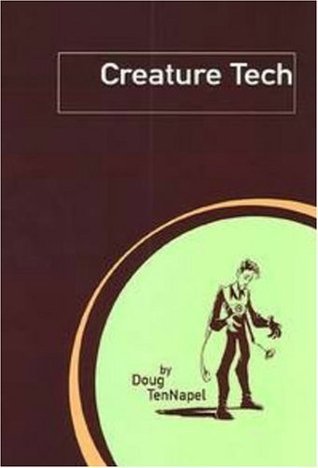
Creature Tech
Good battles evil, and the world hangs in the balance! Resurrected by the Shroud of Turin, the zombified Dr. Jameson intends to finish what he started 150 years ago -- destroying the earth with a giant space eel. Standing in his way is Dr. Ong, a would-be pastor turned scientist who now works in a government research facility infamously known as "Creature Tech." Aided by an unlikely cast of rednecks, symbiotic aliens, and a CIA-trained mantid, Dr. Ong embarks on a journey of faith, love, and self-discovery. All in a day's work at Creature Tech! ... And, by the way, 20th Century Fox and New Regency are currently developing Doug TenNapel's Creature Tech for the sliver screen. We'll keep you posted as things develop.
208 pages, Paperback
First published August 31, 2002
About the author
Doug TenNapel
46 books517 followersDoug TenNapel is the Eisner Award winning writer/artist of over sixteen graphic novels. He is published by Image Comics and Scholastic/Graphics.
He's been married for 27 years to the love of his life and has four book-loving kids.
Doug's favorite authors include G.K. Chesterton, C.S. Lewis and J.R.R. Tolkien. He reads mostly philosophy but tends to get his fiction from audio-books.
His performs live art demonstrations on his Facebook page, and has animated using pixel art for clients like BlueSky software and Electronic Arts. He also regularly posts on his Youtube channel.
Doug tries to write and draw something every day as a discipline that also happens to be a career.
He currently lives in Franklin, Tennessee.
He's been married for 27 years to the love of his life and has four book-loving kids.
Doug's favorite authors include G.K. Chesterton, C.S. Lewis and J.R.R. Tolkien. He reads mostly philosophy but tends to get his fiction from audio-books.
His performs live art demonstrations on his Facebook page, and has animated using pixel art for clients like BlueSky software and Electronic Arts. He also regularly posts on his Youtube channel.
Doug tries to write and draw something every day as a discipline that also happens to be a career.
He currently lives in Franklin, Tennessee.
Ratings & Reviews
Friends & Following
Create a free account to discover what your friends think of this book!
Community Reviews
Displaying 1 - 30 of 159 reviews

June 1, 2018
This was surprisingly low on Tech. And all those Warehouse 13 type crates, and we only opened, what, three of them? Maybe this was meant to be an ongoing series.
Like: the Lovecraft shout-out of the demon-raising, giant-space-eel-summoning crazy 19th century villain whose superpower is cats. Subtle PSA about keeping your felines inside where they're safe?
Dislike: soppy single female character who is just there to be a love interest and get kidnapped. She hardly even has lines.
The MC was a bot boring, and not very convincing as a scientist, but the action was decent once he got the Venom-rip off spider symbiote for extra limbs
Like: the Lovecraft shout-out of the demon-raising, giant-space-eel-summoning crazy 19th century villain whose superpower is cats. Subtle PSA about keeping your felines inside where they're safe?
Dislike: soppy single female character who is just there to be a love interest and get kidnapped. She hardly even has lines.
The MC was a bot boring, and not very convincing as a scientist, but the action was decent once he got the Venom-rip off spider symbiote for extra limbs

July 7, 2012
As an atheist, I have a hard time admitting it, but I really liked this story. Near the beginning, the science versus religion arguments felt forced and unoriginal, but the energy and optimism pulled me in, and by the time I got to the end, I felt grudging admiration for TenNapel's spiritual commentary. Lots of humor and bizarre but charming notes. There's a gratuitous twist of able-ism at the end, so beware that.

April 21, 2009
While quirky and original, this book was also inelegant and unpolished. The storytelling was often awkward, with sudden breaks of exposition. The story didn't as much develop as it piled up on itself. This frantic plot movement was fast-paced when at its best, but just as often felt rushed and unsure.
This continued in the characterization. Some characters were allowed to grow gradually, but others remained half-formed. The villain was so ridiculous that he was less a foil for the hero than a plot device. Yet, he was not ridiculous enough to be campy, which has saved other villains (and heroes) in TenNapel's idiomatic works.
The art also had its highs and lows. At its best, his minimalist chiaroscuro evoked an exciting, fluid world, filled with both the surreal and the recognizable. Other times, the rough starkness lost the cohesion which made it so evocative. It vacillates between the brilliant illustrations of Calvin and Hobbes and the unsureness of a mid-level webcomic.
The entire work gives the impression that TenNapel is throwing his story out as it comes, unplanned and spontaneous. Whenever he achieves something difficult with his deceptively simple style, it seems all the more impressive. However, whenever he fails to do something simple, it drags the whole work down. It feels as if there was no editor to ground his flights of fancy.
Likewise, the religious subtext which makes this less of an adventure and more of a morality play felt shallow and tacked on. I really enjoy the inherent philosophy of a work, and whether or not it agrees with me, I appreciate seeing authors tackle ideas. However, TenNapel's atheist is a straw man, and though his progression is spiritualized, it is achieved wholly by tangible proof and revelation. The small moments of argumentation were more like Plato's instructional 'dialogues' than real, human interaction.
The wild, far-flung aspects of this book were interesting and amusing, but the specifics were murky and roughshod. While this was, in part, the result of stylistic choices, TenNapel's characteristic flair never really overcomes the sense that this is just a rough draft. In the end, the spirituality couldn't exorcise the devil in the details.
My Suggested Reading In Comics
This continued in the characterization. Some characters were allowed to grow gradually, but others remained half-formed. The villain was so ridiculous that he was less a foil for the hero than a plot device. Yet, he was not ridiculous enough to be campy, which has saved other villains (and heroes) in TenNapel's idiomatic works.
The art also had its highs and lows. At its best, his minimalist chiaroscuro evoked an exciting, fluid world, filled with both the surreal and the recognizable. Other times, the rough starkness lost the cohesion which made it so evocative. It vacillates between the brilliant illustrations of Calvin and Hobbes and the unsureness of a mid-level webcomic.
The entire work gives the impression that TenNapel is throwing his story out as it comes, unplanned and spontaneous. Whenever he achieves something difficult with his deceptively simple style, it seems all the more impressive. However, whenever he fails to do something simple, it drags the whole work down. It feels as if there was no editor to ground his flights of fancy.
Likewise, the religious subtext which makes this less of an adventure and more of a morality play felt shallow and tacked on. I really enjoy the inherent philosophy of a work, and whether or not it agrees with me, I appreciate seeing authors tackle ideas. However, TenNapel's atheist is a straw man, and though his progression is spiritualized, it is achieved wholly by tangible proof and revelation. The small moments of argumentation were more like Plato's instructional 'dialogues' than real, human interaction.
The wild, far-flung aspects of this book were interesting and amusing, but the specifics were murky and roughshod. While this was, in part, the result of stylistic choices, TenNapel's characteristic flair never really overcomes the sense that this is just a rough draft. In the end, the spirituality couldn't exorcise the devil in the details.
My Suggested Reading In Comics

February 20, 2017
Doug TenNapel’s Creature Tech is, as the title implies, something of a different creature when it comes to graphic novels. It starts off with bizarre monsters, mad scientist, and demons, but before it is over, it touches on cosmic reality and various responses of many people to meaning and society. Creature Tech isn’t one of those so-called “Christian” comics such as the late Jack Chick used to publish. Mr. Chick wouldn’t have approved of the aliens, the weird phenomena, the faux miracles, or the recurring themes of demons and a “shroud of Turin” that was resurrecting the dead without regard for the just and the unjust. But Doug TenNapel gets in a few good points to those who are prejudiced against Christianity. But, let’s consider the story.
The prologue is about a mad scientist luring giant space eels toward his observatory so that he can prove their existence to his skeptical friends. Things don’t end well, but the scientist who sacrificed part of his body to conjure a demon is able to show up over a century later to become the antagonist for the chief scientist at a small research station. If you think of a cross between X-Files and Warehouse 13, you get the picture. The job is to open crates (I suppose our protagonist is one of the “top men” the government told Indiana Jones would be looking into the Ark of the Covenant.) in a specified order, categorize them, and neutralize any danger.
There is plenty of humor involved. I particularly enjoyed the part where a maladjusted space mantis befriends a couple of “good ole boys.” Seeing the three of them going hunting and fishing together is worthy of more than one chuckle. The nice thing about this secondary story element was that it demonstrated in humor how ridiculous racial/cultural prejudice is and how even very different “people” can find common ground if they’re willing. I also liked the bizarre explanation given for the San Joaquin Valley’s existence (MUCH more interesting than the San Andreas Fault or some “tectonic” theory!).
One gets the feeling that part of this story is semi-autobiographical. Oh, I don’t think Doug works for a secret government operation (although, he did work for Spielberg for a while, so maybe he was one of those “top men”), but he was raised in the conservative Christian denomination represented by the father in the story and he was raised in Denair, California—very close to Turlock (a town in the San Joaquin Valley). As part of the irony, the research facility in the story is in Turlock and our protagonist didn’t want to go back. Last time I was there, Doug’s The Neverhood design studio was in Orange County, so I suspect he didn’t want to go back there, either.
Apologies to my cousins who still live there, but I wouldn’t want to go back to the San Joaquin Valley, either. (Hey! Didn’t the American Graffitti characters escape from Modesto in the SJV?) Our scientific protagonist seems to have trouble getting along with the townspeople. He really dislikes an old fraud who runs a Museum of the Weird, a tourist trap which seems like one of those sideshow rip-offs at the state fair (“See the incredible three-headed squirrel! Nature’s miracle!”). Of course, this “museum” specializes in such things as pastries with the face of Jesus and phony “space” artifacts. Naturally, one of those artifacts plays a special role in the plot.
The faith/science tension in the story is exacerbated by the “scientist’s” father’s role as the minister of the conservative, evangelical church in the town. At one point in the story, the scientist has done everything he can do for a bug-eyed space alien (even using duct tape for the emergency, since duct tape fixes anything) and calls his father in to pray for the being. The father prays, the being goes to bug heaven and is shown a sign with the Hebrew verb for returning or turning around. Visually, this is stunning. When the space alien returns, the father gives credit to God and the scientist, predictably, suddenly gives credit to the duct tape. So, real in my experience with regard to those who must have either/or in their lives.
Another moving moment was when the protagonist is asked to join “The Brotherhood” in order to fight these demonic manifestations. “The Brotherhood” is formed of beings of all kinds. And the deciding factor for him appears to be an alien creature being crucified on a slightly different cross. I liked that a lot. I’ve always maintained that if there are aliens in outer space and if they were subject to the entropic tendency to sin that humankind is, God would be willing to rescue them in the same way. God would become alien in order to live and die for their sins. I know that’s strange, but people who really know me are aware that I am strange. I’m just glad to see that Doug is there, too.
My favorite line in the book is somewhat related to this idea. The scientist is talking to a colleague he considers to be one of the smartest people he knows. So, in a very patronizing way, he asks the colleague how he could be so dumb in believing in God and suggests that the number of “dumb” Christians shows that they aren’t rational. The colleague answers, “That’s a straw man! There are dumb atheists, too! You know that. You’ve been to university!”
No, Doug. The late Jack Chick would not have approved, but as a minister (and successful player of The Neverhood) in another evangelical denomination than yours, I do approve. Your lines about Christianity come honestly from where you are. You don’t force anyone to agree with you but you give your readers plenty to think about. I’m mighty sure your Lord approves, too.
Creature Tech would be fun even without the faith portion and the love interest I didn’t even cover, but with the faith and the romance, it does what great comedy and great stories do—it tells the truth.
The prologue is about a mad scientist luring giant space eels toward his observatory so that he can prove their existence to his skeptical friends. Things don’t end well, but the scientist who sacrificed part of his body to conjure a demon is able to show up over a century later to become the antagonist for the chief scientist at a small research station. If you think of a cross between X-Files and Warehouse 13, you get the picture. The job is to open crates (I suppose our protagonist is one of the “top men” the government told Indiana Jones would be looking into the Ark of the Covenant.) in a specified order, categorize them, and neutralize any danger.
There is plenty of humor involved. I particularly enjoyed the part where a maladjusted space mantis befriends a couple of “good ole boys.” Seeing the three of them going hunting and fishing together is worthy of more than one chuckle. The nice thing about this secondary story element was that it demonstrated in humor how ridiculous racial/cultural prejudice is and how even very different “people” can find common ground if they’re willing. I also liked the bizarre explanation given for the San Joaquin Valley’s existence (MUCH more interesting than the San Andreas Fault or some “tectonic” theory!).
One gets the feeling that part of this story is semi-autobiographical. Oh, I don’t think Doug works for a secret government operation (although, he did work for Spielberg for a while, so maybe he was one of those “top men”), but he was raised in the conservative Christian denomination represented by the father in the story and he was raised in Denair, California—very close to Turlock (a town in the San Joaquin Valley). As part of the irony, the research facility in the story is in Turlock and our protagonist didn’t want to go back. Last time I was there, Doug’s The Neverhood design studio was in Orange County, so I suspect he didn’t want to go back there, either.
Apologies to my cousins who still live there, but I wouldn’t want to go back to the San Joaquin Valley, either. (Hey! Didn’t the American Graffitti characters escape from Modesto in the SJV?) Our scientific protagonist seems to have trouble getting along with the townspeople. He really dislikes an old fraud who runs a Museum of the Weird, a tourist trap which seems like one of those sideshow rip-offs at the state fair (“See the incredible three-headed squirrel! Nature’s miracle!”). Of course, this “museum” specializes in such things as pastries with the face of Jesus and phony “space” artifacts. Naturally, one of those artifacts plays a special role in the plot.
The faith/science tension in the story is exacerbated by the “scientist’s” father’s role as the minister of the conservative, evangelical church in the town. At one point in the story, the scientist has done everything he can do for a bug-eyed space alien (even using duct tape for the emergency, since duct tape fixes anything) and calls his father in to pray for the being. The father prays, the being goes to bug heaven and is shown a sign with the Hebrew verb for returning or turning around. Visually, this is stunning. When the space alien returns, the father gives credit to God and the scientist, predictably, suddenly gives credit to the duct tape. So, real in my experience with regard to those who must have either/or in their lives.
Another moving moment was when the protagonist is asked to join “The Brotherhood” in order to fight these demonic manifestations. “The Brotherhood” is formed of beings of all kinds. And the deciding factor for him appears to be an alien creature being crucified on a slightly different cross. I liked that a lot. I’ve always maintained that if there are aliens in outer space and if they were subject to the entropic tendency to sin that humankind is, God would be willing to rescue them in the same way. God would become alien in order to live and die for their sins. I know that’s strange, but people who really know me are aware that I am strange. I’m just glad to see that Doug is there, too.
My favorite line in the book is somewhat related to this idea. The scientist is talking to a colleague he considers to be one of the smartest people he knows. So, in a very patronizing way, he asks the colleague how he could be so dumb in believing in God and suggests that the number of “dumb” Christians shows that they aren’t rational. The colleague answers, “That’s a straw man! There are dumb atheists, too! You know that. You’ve been to university!”
No, Doug. The late Jack Chick would not have approved, but as a minister (and successful player of The Neverhood) in another evangelical denomination than yours, I do approve. Your lines about Christianity come honestly from where you are. You don’t force anyone to agree with you but you give your readers plenty to think about. I’m mighty sure your Lord approves, too.
Creature Tech would be fun even without the faith portion and the love interest I didn’t even cover, but with the faith and the romance, it does what great comedy and great stories do—it tells the truth.
November 14, 2013
I have never been very fond of Doug TenNapel's books, although my daughter loves them. The art is interesting at times, and the overall stories are reasonably good, but his plotting ranges from so-so to awful. It is not uncommon for characters to jump from one position to another (thematically, not graphically) without any character development in between. Still, his other books all manage to hold together. The same cannot be said of Creature Tech. This book's plot borders on incoherency. It opens with a scientist who has made a deal with a demon - one the demon seems to greatly regret - to bring down giant space eels so that he can (somehow) rule the world. He dies in the process. The book then shifts to the present day and to our hero, a scientist at a (not very) secret lab whose job is to open up and review the content of artifact boxes. Think the final scene in Indiana Jones, or Warehouse 13, or the like. He opens up a box with the real Shroud of Turin - not the fake one previously dismissed as a medieval hoax - which the ghost of the dead scientist steals in order to return to life. Apparently, the real Shroud features the power of resurrection, although it dissolves bit by bit as it is used. What follows is a melange of action scenes involving a bipedal mantis (who has no function other than to die so that we can see the healing power of prayer and get a glimpse of mantis heaven), an undeveloped love interest (the scientist made fun of her as a child, but is now head-over-heels in love with her for no apparent reason), and a symbiotic alien. The level of death is extreme (mostly killing of cat demons). What really makes all of this incoherent, however, is that it all is apparently set forth in support of the underlying theme: a return to faith and an acceptance of intelligent design. The scientist's father is a former scientist himself who is now a pastor. The scientists's assistant, a redneck genius (the book's term), lectures the scientist about his failure to include religion in his scientific method, the mantis visits mantis heaven and is shown the word "again" in Hebrew before being sent back, the scientist is taken to the home world of the alien symbiote where he meets others bearing symbiots who give a necklace with a square charm and call him brother before showing him (no kidding) a symbiote Jesus nailed to a square frame, the scientist returns to Earth and his charm has now changed to a cross, the scientist starts dropping phrases like "irreducible complexity," and the book ends with the scientist silhouetted with his new cross. None of the plot - other than the intrusive text-heavy panels about intelligent design and faith - supports this theme. I would also mention the book features bizarre scenes including the aforementioned crucifixion and a couple of pages at the church picnic where the scientist pours himself a glass of milk from a pitcher, his pastor father warns him not to drink it, and it is explained that the milk is actually human breast milk. W.T.F.
TL;DR: Nearly incoherent plot, almost no character development, lots of killing (mostly of demons), random side plots that contribute nothing, and a poorly supported theme of intelligent design. I am unable to think of any redeeming qualities that would lead anyone to read this book, much less pay money for it.
TL;DR: Nearly incoherent plot, almost no character development, lots of killing (mostly of demons), random side plots that contribute nothing, and a poorly supported theme of intelligent design. I am unable to think of any redeeming qualities that would lead anyone to read this book, much less pay money for it.

May 22, 2025
This was a very interesting graphic novel that broke genre barriers but lost power for me due to its fast pacing. It was hard to keep up with exposition in the midst of all the plot twists. I think the fast pace of the story is very intentional, though - the terrifying monsters aren't meant to be taken seriously. Introducing new weird monsters at every turn also just seems to be TenNapel's way. The parts where the main character is convinced that being a Christian requires belief instead of proof, though - those are meant to be taken seriously. I appreciated the insertion of faith into this comic, as it made the main character's other struggles more believable for me.

January 5, 2017
I consider myself something of a connoisseur of TenNapel's work. And it's interesting to read this, fairly early, work after consuming his later kid- and teen-pitched graphic novels. It clearly took a while to find his audience. This one is aimed at, and stars, adults, but includes many of the traits of his kit-oriented pieces.
There's a government research facility in a small town, charged with opening and cataloging a Indiana Jones/The Librarians/Andy Warhol trove of closed boxes. A spirit gets loose, and starts wrecking havoc. There's a little bit of overt religiosity, a small and weak love story, some yokels, and a fairly dandy symbiotic creature.
A little less graceful, a little more preachy, a little harder to follow in black and white. But I'm glad I read it, as I feel like I've gained a deeper understanding of the auteur.
There's a government research facility in a small town, charged with opening and cataloging a Indiana Jones/The Librarians/Andy Warhol trove of closed boxes. A spirit gets loose, and starts wrecking havoc. There's a little bit of overt religiosity, a small and weak love story, some yokels, and a fairly dandy symbiotic creature.
A little less graceful, a little more preachy, a little harder to follow in black and white. But I'm glad I read it, as I feel like I've gained a deeper understanding of the auteur.

September 6, 2013
Not sure what to make of this graphic novel. It's sci-fi/horror/adventure interspersed with pointed but loving depictions of small-time life. It alternates between violence and surprising moments of humor (especially the occasionally grisly pun). Dr. Michael Ong is a cynical scientist whose job is, ironically, investigating supernatural artifacts. He is *not* thrilled to be back in his hometown of Turlock, where his pastor father and a bunch of evangelical hicks live and not much else. Except, of course, for the secret government research facility nicknamed “Creature Tech” by the locals, and a surprising amount of alien and supernatural creatures, most of them unfriendly. With a bizarre cast of characters including a long-dead ghost, several hillbillies, an alien mantis, and of course the outcast girl from high school that Michael is now irresistibly drawn to, Creature Tech pulls from a variety of genres to make a very odd creature of a book indeed. Combine Tim Burton, Indiana Jones, C.S. Lewis, and Mark Twain, and you might end up with something like Creature Tech. The tone is occasionally didactic, but surprisingly snarky and not above poking gentle fun at even the Christian characters. While it is filled with Christian themes, the symbolism is not always straightforward to decode, making it a rich book to think about. Still not sure what to think about it overall, but that might be a compliment. 3 ½ stars.
(Oh, and don't read if animal death upsets you.)
(Oh, and don't read if animal death upsets you.)

February 20, 2008
Tenapel has away with these things.
He's a great storyteller, with a strong absurdist sense of humor that never devolves his books into novelty (You start out going, Cowboy's and Robots? and end up saying Cowboys and Robots!). His art though perhaps rough is dynamic, but it's his skills as a writer that really carry him. I defy anyone to read about the short sad life of the Meatman and not immediately want to read everything the man has ever written.
The one Caveat is Tenapel is very much a Christian, and most of his work bears the mark. I can't really imagine this bothering anyone, this isn't the Left Behind brand of assholery masquerading as Christianity. It's not attacking anyone (aside from the notion that atheists are automatically smarter then Christians, something that annoys the piss out of me as well) but he is definitely serious about religion. Indeed there's a moment in this book so bizarre, and moving that I hardly know how to react to it. But if the very mention of religion sets your teeth on edge then this one isn't for you.
He's a great storyteller, with a strong absurdist sense of humor that never devolves his books into novelty (You start out going, Cowboy's and Robots? and end up saying Cowboys and Robots!). His art though perhaps rough is dynamic, but it's his skills as a writer that really carry him. I defy anyone to read about the short sad life of the Meatman and not immediately want to read everything the man has ever written.
The one Caveat is Tenapel is very much a Christian, and most of his work bears the mark. I can't really imagine this bothering anyone, this isn't the Left Behind brand of assholery masquerading as Christianity. It's not attacking anyone (aside from the notion that atheists are automatically smarter then Christians, something that annoys the piss out of me as well) but he is definitely serious about religion. Indeed there's a moment in this book so bizarre, and moving that I hardly know how to react to it. But if the very mention of religion sets your teeth on edge then this one isn't for you.

April 28, 2019
Bizarre, fast-paced, and fun.

August 12, 2019
Very fun, creative book and the best Christian comic I have read since that Tijuana Bible shaped comic of the dangers of Dungeons and Dragons.
Really though, it's a "goodread." The twists are unexpected and silly but far from random, and the religion content is not that far from that of Hellblazer in that it's full of magic and mysticism, though presented with a totally different tone.
Really though, it's a "goodread." The twists are unexpected and silly but far from random, and the religion content is not that far from that of Hellblazer in that it's full of magic and mysticism, though presented with a totally different tone.

July 29, 2022
Not bad, not great.

June 15, 2024
Fun. Quick. Kinetic. Silly. Gross. All in one.
5-stars for TenNapel's imagination. It's amazing.
5-stars for TenNapel's imagination. It's amazing.

July 8, 2024
Stylish and unique. Mostly action.

Read
August 6, 2024TenNepal weakest work. Kinda heretical
June 2, 2014
Creature tech as any novel Doug Tenepel creates just hits close to home, his art and story lines just appeal to me unlike any other author's writings I've read, and who wouldn't like sci-fye novel, with a giant praying mantis as the protagonist sidekick anyway? Creature Tech is based apon a secret United States research facility, where they study all the anomaly found and hidden from the populace. Such as Space Eels, aliens, Jesus's holy robe, and ghost. I'm not going to go into anymore detail, because I want you to enjoy the novel as much as I did, this is a must read for anyone with a strong imagination. I rate it 5 giant space eels out of 5 giant space eels.

September 4, 2016
Good and interesting artwork, but that's really the only thing that saves it. Otherwise, the story is pretty one-dimensional. There's no real story arc, the 'love interest' is a girl whose only lines involve surprise and/or resolve, and the underlying premise is moreso about overcoming your past...but in such a way as to constantly be (obviously) "winking" at the reader. One of the worst parts is the antagonist--a funny character who is made into such a cartoon-like parody that seeing him coming up on the page made me inwardly groan.

August 5, 2010
I agree with Terry Mattingly (from the foreword): the best part of the book isn't the amazingly well-paced action sequences, or even the great way the father/son conflict is handled, but the single page images, the incredible still frames that are so powerful. Powerfully funny, but with a solid heart and a deep soul. HIGHLY recommended.

July 2, 2017
Weird, but fun.

June 15, 2019
Really fun, light read with some cool art and bad puns.

December 31, 2018
While I never grew up with the "Earthworm Jim" games or cartoon like many fans of Doug TenNapel, I've read and loved quite a few of his graphic novels -- "Ghostopolis," "Cardboard," and "Monster Zoo," among others. "Creature Tech" seems to be a graphic novel he's caught some flak for, however. Doug seems to have never been terribly shy about inserting his personal beliefs into his work, and nowhere is this more obvious than within the pages of "Creature Tech." However, I didn't find this detrimental to the story, and it in fact serves the plot here. And while not his best work, this is still a delightfully zany, hilarious, and thrilling homage to camp sci-fi and wacky monster movies, as well as a wink and a nod to more modern paranormal series like "The X-Files."
Dr. Ong is the son of a prominent scientist-turned-pastor, one who has largely renounced religion and spends his days at Creature Tech, a facility where paranormal and extra-terrestrial artifacts and creatures are housed and studied. When a crate containing the Shroud of Turin is opened, said shroud is promptly stolen by the ghost of Dr. Jameson, a mad scientist who made a literal deal with the devil to avoid the afterlife... and uses the shroud to resurrect himself. Dr. Ong, with a little help from his unflappable assistant Jim, a giant praying mantis named Blue, and an alien symbiote obsessed with kung fu movies, must stop Dr. Jameson from his mad schemes before they destroy Creature Tech, their hometown, and eventually the world... but are they enough to stop an army of evil cats and a giant eel from outer space?
If the plot sounds absolutely insane, that's because it is -- but in a good way. The story combines the wackiest elements of a lot of classic sci-fi and monster films, resulting in a plot replete with aliens, monsters, demonic cats, ghosts, unexplained phenomena, mad scientists, and more. It reads as a homage and loving spoof of these types of films and of paranormal series like "X-Files" and "Warehouse 13," and isn't afraid to poke fun at its own cheesy premise. And while it DOES grapple with themes like "science vs. religion," it does so in a way that serves the story and doesn't feel terribly heavy-handed.
The characters are a fun bunch as well. Dr. Ong is the put-upon everyday Joe who's been thrust into a world bizarre even by his standards, and while a good man at heart he's flawed enough to be relatable, but not so flawed as to be unpleasant. His assistant, Jim, is an unflappable and down-to-earth sort that serves as a good foil, and Blue, despite being a seven-foot-tall praying mantis, is oddly adorable as a character. Dr. Jameson is one of the hammiest mad scientists I've ever come across in fiction, spewing out puns and chewing the scenery with gusto, and he's oddly enjoyable to read about even if he is the villain. Dr. Ong's love interest is, sadly, a flat character who basically exists to be rescued and fall in love with the hero, which is mildly disappointing.
While not TenNapel's best effort, this is still a highly enjoyable read, one that fans of classic sci-fi and monster films will love. And while religious elements are certainly present, they're not so heavy-handed as to drag down the story.
Dr. Ong is the son of a prominent scientist-turned-pastor, one who has largely renounced religion and spends his days at Creature Tech, a facility where paranormal and extra-terrestrial artifacts and creatures are housed and studied. When a crate containing the Shroud of Turin is opened, said shroud is promptly stolen by the ghost of Dr. Jameson, a mad scientist who made a literal deal with the devil to avoid the afterlife... and uses the shroud to resurrect himself. Dr. Ong, with a little help from his unflappable assistant Jim, a giant praying mantis named Blue, and an alien symbiote obsessed with kung fu movies, must stop Dr. Jameson from his mad schemes before they destroy Creature Tech, their hometown, and eventually the world... but are they enough to stop an army of evil cats and a giant eel from outer space?
If the plot sounds absolutely insane, that's because it is -- but in a good way. The story combines the wackiest elements of a lot of classic sci-fi and monster films, resulting in a plot replete with aliens, monsters, demonic cats, ghosts, unexplained phenomena, mad scientists, and more. It reads as a homage and loving spoof of these types of films and of paranormal series like "X-Files" and "Warehouse 13," and isn't afraid to poke fun at its own cheesy premise. And while it DOES grapple with themes like "science vs. religion," it does so in a way that serves the story and doesn't feel terribly heavy-handed.
The characters are a fun bunch as well. Dr. Ong is the put-upon everyday Joe who's been thrust into a world bizarre even by his standards, and while a good man at heart he's flawed enough to be relatable, but not so flawed as to be unpleasant. His assistant, Jim, is an unflappable and down-to-earth sort that serves as a good foil, and Blue, despite being a seven-foot-tall praying mantis, is oddly adorable as a character. Dr. Jameson is one of the hammiest mad scientists I've ever come across in fiction, spewing out puns and chewing the scenery with gusto, and he's oddly enjoyable to read about even if he is the villain. Dr. Ong's love interest is, sadly, a flat character who basically exists to be rescued and fall in love with the hero, which is mildly disappointing.
While not TenNapel's best effort, this is still a highly enjoyable read, one that fans of classic sci-fi and monster films will love. And while religious elements are certainly present, they're not so heavy-handed as to drag down the story.

November 13, 2017
Oh boy, what can I say about Doug TenNapel? Probably best known for his Earthworm Jim series, his books tend to float in and out of my house when my sons pick up his comics from the library. “Ghostopolis,” “Cardboard,” and “Bad Island” are all pretty clever but I’m not a fan of his Nnewts series whatsoever; overall, his work is imaginative and more than a little zany. TenNapel is also a rarity in the comics world: a politically conservative Christian who has written for far-right websites like Breitbart. This book, “Creature Tech,” is one of his earlier works for Top Shelf Comix and it doesn’t have the typical TenNapel polish; it’s a little rough around the edges, a little unfocused, and features some of his more overt religious and philosophical opinions. It’s not great but it’s a fascinating artifact of a creator struggling early in his career to develop his voice.
“Creature Tech” is about a brilliant scientist (and former clergyman-in-training), Dr. Ong, who is recruited by a government organization to study America’s collection of bizarre and supernatural artifacts. In the process of researching the Shroud Of Turin, purported to be the burial cloth of Jesus, an undead scientist materializes with the intention of using the shroud to resurrect a giant space slug to destroy the planet. For good measure, TenNapel also throws in some helpful rednecks, a giant mantis, a half-blinded high school crush, and a whole slew of zombified monsters. It’s an energetic and uneven book, sort of a mash-up Rob Schrab’s manic “Scud: The Disposable Assassin” series with “Hellboy,” but not as good as those influences. I like that TenNapel is interested in exploring more mature themes than just monsters-and-aliens-trying-to-conquer-Earth but, knowing his politics, it’s hard for me to see his religious content as anything other than an attempt to make his fringe ideas more palatable to a mainstream audience. This is entirely my own prejudice and may not be reflective of TenNapel’s actual work. His drawing is appealingly sloppy throughout, especially compared to his later books, but unfortunately his pacing isn’t as crisp either.
So, the question is: should a creator’s politics and belief have any influence on how the reader interprets their work. I can’t really say if it should, but I know it certainly does where it concerns me and TenNapel’s comics. Something that may rate a four-star review otherwise only gets a 2.5-star rating because I can’t separate the artist from their art. Is it fair? Probably not, but it is what it is. As it stands, for me, “Creature Tech” is a decent book overshadowed by my thoughts on its creator.
“Creature Tech” is about a brilliant scientist (and former clergyman-in-training), Dr. Ong, who is recruited by a government organization to study America’s collection of bizarre and supernatural artifacts. In the process of researching the Shroud Of Turin, purported to be the burial cloth of Jesus, an undead scientist materializes with the intention of using the shroud to resurrect a giant space slug to destroy the planet. For good measure, TenNapel also throws in some helpful rednecks, a giant mantis, a half-blinded high school crush, and a whole slew of zombified monsters. It’s an energetic and uneven book, sort of a mash-up Rob Schrab’s manic “Scud: The Disposable Assassin” series with “Hellboy,” but not as good as those influences. I like that TenNapel is interested in exploring more mature themes than just monsters-and-aliens-trying-to-conquer-Earth but, knowing his politics, it’s hard for me to see his religious content as anything other than an attempt to make his fringe ideas more palatable to a mainstream audience. This is entirely my own prejudice and may not be reflective of TenNapel’s actual work. His drawing is appealingly sloppy throughout, especially compared to his later books, but unfortunately his pacing isn’t as crisp either.
So, the question is: should a creator’s politics and belief have any influence on how the reader interprets their work. I can’t really say if it should, but I know it certainly does where it concerns me and TenNapel’s comics. Something that may rate a four-star review otherwise only gets a 2.5-star rating because I can’t separate the artist from their art. Is it fair? Probably not, but it is what it is. As it stands, for me, “Creature Tech” is a decent book overshadowed by my thoughts on its creator.

July 6, 2025
I found some of the Christian elements of the story off putting and not because they were Christian but because they were almost so on the nose that the only reason I don't see it as an intentionally blasphemous parody is because I know the writer is a Christian. Some of the elements of Christianity featured seemed like magical parody Christianity, almost like you'd see from some atheist mocking Christians. For example the shroud of Turin is presented as a magical artifact, to an actual Christian the reason Jesus returns from being dead is because he's God not because of a magical blanket that can also be used to bring hunks of animal remains back to life.
The other example is he shows the mantis character breifly dying and going to some kind of mantis heaven and he shows the alien symbiote thing taking him to another world where they have their own alien symbiote Jesus being nailed to their version of a cross...and he makes a comment along the lines of wow you even came here. Like his coming to Jesus moment is discovering a new different alien Jesus.
It's somehow both too preachy and kind of blasphemous. Like it's a weird Americanist Christianity that's just thrown into a blender with American politics and where a bunch of extra Biblical stuff is added on top like that the shroud of turin is magical that every species gets their own heaven and there could be a different Jesus for every planet if there's aliens. Like you can make the argument that it's a comic book and obviously Doug doesn't really think there's an alien symbiote Jesus and that it's made over the top on purpose but he blends it in with a sincere attempt to insert his real world beliefs and they blend together with the fantasy stuff and it muddies the waters and make the real beliefs seem like fantasy nonsense...which is what anti-Christian authors also do but they do it on purpose I think Doug did it by mistake.
I also find the author has a weird fixation with a lot of the elements from Earthworm Jim, like being bonded to or using some kind of power enhancing mech suit, cats being evil mutant henchmen there was a bit of it in Gear as well and in Bigfoot Bill. That's not really a criticism because I like those elements to his stories but it just seems weird to do it all the time.
That all being said there is a lot to like here still. I love the artwork, I love that it's both goofy and mature. Like they'll make a slapsticky joke but also have someones dog get killed. It's a fun comic and overall I enjoyed reading it.

Read
April 26, 2025once again going thru my notes app and finding goodreads reviews i forgot about and never posted lol
10/18/24
overall quite good but i have some nits to pick
he talked to her once and then the next time they mentioned her it was like “dude admit it already you’re in love with her” and i was like uh. i feel like we skipped some steps here
ending a bit abrupt
“we don’t believe because we have proof of the supernatural. we believe becuase it’s true.”
hwat ? what even does that mean
we do believe because it’s true but we also do have evidence ?
like what are you. what are trying to say here i genuinely can’t parse it out
like yes we believe even though we can’t necessarily PROVE it but we DO have lots of evidence
you don’t need to see a resurrection shroud in action in order to believe tho
and we do belive it because it’s true but by contrasting this belief with proof it seems like you’re saying that you should believe blindly and that belief from evidence is somehow lesser
like that anti-intellectualism of the church nonsense
love the Lord your God with all your heart and with all your soul and with all your MIND and with all your strength
but I don’t think that’s what he’s going for, that sort of anti-intellectualism that’s a problem in the modern Western church
More like,
I wish you had trusted what you did not understand instead of waiting until you saw it proven ? IDEK
I mean look at Paul like. he did not believe until God showed up and was like BANG listen to Me you goOf yanno
idek that line just. what
10/18/24
overall quite good but i have some nits to pick
he talked to her once and then the next time they mentioned her it was like “dude admit it already you’re in love with her” and i was like uh. i feel like we skipped some steps here
ending a bit abrupt
“we don’t believe because we have proof of the supernatural. we believe becuase it’s true.”
hwat ? what even does that mean
we do believe because it’s true but we also do have evidence ?
like what are you. what are trying to say here i genuinely can’t parse it out
like yes we believe even though we can’t necessarily PROVE it but we DO have lots of evidence
you don’t need to see a resurrection shroud in action in order to believe tho
and we do belive it because it’s true but by contrasting this belief with proof it seems like you’re saying that you should believe blindly and that belief from evidence is somehow lesser
like that anti-intellectualism of the church nonsense
love the Lord your God with all your heart and with all your soul and with all your MIND and with all your strength
but I don’t think that’s what he’s going for, that sort of anti-intellectualism that’s a problem in the modern Western church
More like,
I wish you had trusted what you did not understand instead of waiting until you saw it proven ? IDEK
I mean look at Paul like. he did not believe until God showed up and was like BANG listen to Me you goOf yanno
idek that line just. what

January 4, 2024
I have become a big fan of Doug TenNapel's work and I'm glad this is my first completed book of 2024. I love his creativity, storytelling, artistic skills, and evidence of compassion and selflessness that comes through in a multitude of characters. This story was so out of left field, and yet, I was able to suspend my disbelief aptly. Creepy English ghost boosting the Shroud of Turin from a government tech facility? Sure! Main character with superpowers from a symbiotic parasite that is self-aware and capable of moral choices? Why not? A ginormous mantis-like creature that fits in better with the local rednecks of Turlock and randomly uses their bathrooms? Absolutely. This was an excellent story. And I have to agree with Terry Mattingly who wrote the forward - reading the book did feel like watching a movie.

March 8, 2025
I really enjoyed "Creature Tech." I've followed Doug TenNapel from afar for years, but never had the pleasure of reading any of his books. "Creature Tech" is the first, and I was happy to start here. There's a lot of creativity that exudes from the pages of this graphic novel, and when you combine the strange "Warehouse 13"-like feel of the premise with the deep-rooted theological concepts that are associated, this book makes for not just an easy read, but a page-turning one. While the narrative feels a bit all over the place at times, mixing demonic ghosts with alien creatures with the Shroud of Turin and rednecks, it all comes together in the end marvelously. For the first time in years, "Creature Tech" made me want to pick up a pencil again and return to the drawing board, a place I haven't visited in quite some time. Cheers to Doug TenNapel, I'd definitely read a sequel!

April 5, 2025
This one is a little more mature than some other TenNapel books - maybe PG-13 instead of PG. If you like surprises, skip the foreword.
The pacing felt uneven to me, particulalry around the 3/4 mark. There's a scene I just don't understand. I get the parallel it's making, just not why it exists in the story. (And the more I think about it, the less sense it makes.)
Still, it's not a bad read. Feels a bit like TenNapel had lots of ideas for where this could go and he had toeublw settling on which parts to actually explore and develop.
The more I think about it, the less I'm on board with this one. All the characters present as white. I can count the number of female characters (including every side character) on one hand. The "main" female character is treated as an object over which two men are fighting for control, and exhibits no agency of her own. Definitely problematic.
The pacing felt uneven to me, particulalry around the 3/4 mark. There's a scene I just don't understand. I get the parallel it's making, just not why it exists in the story. (And the more I think about it, the less sense it makes.)
Still, it's not a bad read. Feels a bit like TenNapel had lots of ideas for where this could go and he had toeublw settling on which parts to actually explore and develop.
The more I think about it, the less I'm on board with this one. All the characters present as white. I can count the number of female characters (including every side character) on one hand. The "main" female character is treated as an object over which two men are fighting for control, and exhibits no agency of her own. Definitely problematic.

June 29, 2021
The ultimate fanboy space fantasy as imagined by the delirious mind of Doug Tennapel. It’s got aliens, giant space eels, gun-toting rednecks, faith picnics, a man-sized mantis, demons, hell cats, ghosts, teleporters, a mad supervillain and the Shroud of Turin.
It’s wild and woolly mayhem with moments of genuine rib-tickling humor. There’s even a Hitchhiker’s Guide moment when a bunch of meat parts become alive and sentient, joyfully goes out to embrace the world and gets its pseudo-life perfunctorily cut short. (“And the rest, after a wet thud, was silence.”)
The artwork features Tennapel’s blunt, stark outlines and quirky sense of design. I’ve bought only one of his graphic novels before this one but I’ll definitely keep an eye out for more in the future.
It’s wild and woolly mayhem with moments of genuine rib-tickling humor. There’s even a Hitchhiker’s Guide moment when a bunch of meat parts become alive and sentient, joyfully goes out to embrace the world and gets its pseudo-life perfunctorily cut short. (“And the rest, after a wet thud, was silence.”)
The artwork features Tennapel’s blunt, stark outlines and quirky sense of design. I’ve bought only one of his graphic novels before this one but I’ll definitely keep an eye out for more in the future.
December 4, 2018
I'd never heard of this, and I certainly don't normally go for such out-there, wacky fare. But, you know what? This was very likeable. The plot and themes, if there are any, don't really bear summary, as it's a you-have-to-be-there kind of appeal to the weirdness that drives the reader along. The artwork isn't the best, and the colouring seems to be equally cheap and vintage, but this edition must now be deemed the definitive one. This is memorable for all the dodgy things the hero has to endure (unrequited love, rednecks, aliens invading his body to live symbiotically with him, giant devil cats and more), and of course for *that* eel joke.
A strong four stars.
A strong four stars.

May 13, 2019
I randomly scooped this at a used bookstore based on its curiously old-school vibe, which fit me proper, given that it read like a comic book I would’ve dug but been unable to explain its source as a kid. It was a fun, innocent, and breezy romp about a dude with an alien symbiote attached to his chest working at a mysterious government agency underground and battling a ghost summoning an ancient space eel with an army of hellcats and the shroud Christ was buried in, all in some quiet, small town.
Displaying 1 - 30 of 159 reviews