This startling, high-octane collection includes short novels by Clive Barker and Karl Edward Wagner, and stories by such luminaries of fear as Lisa Tuttle, David J. Schow, Ramsey Campbell, Brian Lumley, Dennis Etchison, and others.
interesting collection with a wide variance in quality. there's enough outstanding material to make this an important addition to any horror collection.
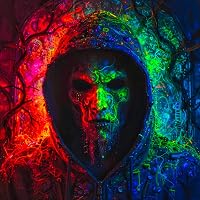
but such a horrifying cover, and not in a good way. thanks a lot, cover, for making sure I will never read this book in public.
4 stars
"The Yougoslaves" by Robert Bloch: perfectly executed tale of a gentleman vampire encountering vicious ragamuffins and their repulsive, bestial Fagin. a mordantly amusing lark that doesn't stint on the horror. I know I'm in the presence of a master of the form when realizing I've been smiling with glee the entire time.
"The Last Illusion" by Clive Barker: private investigator fights demons from hell over the soul of a magician. tremendous fun. Barker put together a glorious urban fantasy tale well before urban fantasy was even a thing. a world weary noir hero, two lost women, a pale villain and other striking antagonists, even a demon sidekick of sorts. the author's fertile imagination and smart sense of humor made this one thoroughly enjoyable, from its startling opening to its hellzapoppin finish.
"The House of the Temple" by Brian Lumley: the collection's Lovecraft-inspired entry. melancholy American inherits the Temple House and travels to Britain to explore its mysteries. hits all the right notes in just the right way: atmospheric and morbid, full of mysterious letters and dictates from the past, and of course the requisite Lovecraftian monster - lying in wait to ensnare the protagonist, as it has so many others before.
"Murgunstrumm" by Hugh Cave: feverishly paced novella about a group of fearful vampire killers taking on a grotesque, ghoulish innkeeper - the titular Murgunstrumm - and his vampire pals. Cave wrote this in the 30s and it has all the hysterics, shouting, and blazing-eyed righteousness of horror films from that period. plus it opens with a bold escape from a madhouse. great stuff!
3 stars
"The Late Shift" by Dennis Etchison: a strikingly nihilistic story about a zombie work force. Etchison makes sure that the reader is aware that all trajectories move downward. the prosaic uses to which the undead are put make the horror almost infuriating in its dreadful banality.
"Firstborn" by David Campton: a wonderfully weird tale of a botanist, two poor relations, and various experiments with both plant and human. never the two shall meet! or shall they? what happened in the past shall inform, queasily, what will be happening presently. from the mad scientist to the histrionics, Firstborn's retro flair is a lot of fun.
"Amber Print" by Basil Copper: the story of a haunted print of the classic film "The Cabinet of Dr. Caligari". Copper is a master at writing strange stories in a distinctly old-fashioned style and this story follows suit. there's something delightful to me on a personal level about a tale featuring two friends sipping wine while discussing film classics from a collector's perspective... even more delightful is Copper's skill at creating a discomfiting, hallucinatory experience for both his characters and his readers.
"Crystal" by Charles L. Grant: an American abroad in London finds trouble after purchasing a strange painting. enjoyably perplexing tale of a death magnet and women who are both victims and villains. I enjoyed the inexorable move from the prosaic to the horrible and Grant excels at making his tale feel real. that said, the central character's final decision doesn't ring particularly true based on his development throughout the story.
"The Horse Lord" by Lisa Tuttle: family moves to an upstate property governed by a hostile force. this was a really original take on the old children-being-possessed standard. a little bit of fascinating history, a little bit of kitchen sink reality, a little bit of gray atmosphere. the image of children dancing like horses was perfectly eerie; even better is the shocking ending.
2 stars
"Bunny Didn't Tell Us" by David J. Schow: not only is a limo buried in that cemetery, there's something buried in that limo too. eh. was sort of funny but basically one-note.
"Out of Copyright" by Ramsey Campbell: spooky nonsense by one of my favorite horror authors. Campbell is capable of much better. that said, the focus on the sinister shapes that dust can take - floating in the air, settling on furniture, settling on you - felt pretty original.
"Pig's Dinner" by Graham Masterton: effectively disgusting blast of gore. but I'm sorry but my power to suspend disbelief doesn't extend to accepting that a man who has just had his entire crotch ripped out can somehow still operate heavy machinery.
"The Jumpity-Jim" by R. Chetwynd Hayes: an historical pastiche concerning the tribulations of a young maid new to the sorcerous ways of certain manor folk. florid, superficially characterized, unconvincing. the unearned darkness of its gotcha ending also aggravated me. but the repulsive Jumpity-Jim itself is a fine creation, and worthy of a better vehicle.
"Junk" by Stephen Laws: the intro calls this "techno-terror", which... no. its goal of creating a horrorshow set within an auto junkyard was certainly accomplished; how it reached that goal was unfortunately quite predictable. the story reaches its heights in the description of the eerie being at the heart of it all.
1 star
"The Satyr's Head" by David Riley: a muddled, overlong mess describing the unappealing side effects of owning an unappealing little curio. it's clear that Riley is attempting to harness some of Lovecraft's xenophobia and fear of hidden dark desires, via regular bits of racism dropped randomly throughout the story and the protagonist's increasing self-loathing over his incipient homosexuality. but sadly the confused - rather than ambiguous - storytelling only makes his tale come across as racist and homophobic, rather than as a commentary on such things.
"Buckets" by F. Paul Wilson: the worst of the bunch. you know those right-wing Christian "haunted houses" that function as gory morality lessons concerning drug use, premarital sex, homosexuality and the like? this story is one of those haunted houses: an OB-GYN doctor gets his bloody due at the hands of ghost children he's aborted. verdict: an eye-rollingly moralistic and offensive piece of garbage that pretty much guarantees I will never read anything by this ridiculous author again.
5 stars
there are two absolutely perfect tales in this collection. they couldn't be more different from each other.
"The Black Drama" by Manly Wade Wellman: Lord Byron... immortal warlock! sorta. this late 1930s novella is pure dazzling fun. a formerly down-on-his-luck actor's memoir tells the story of a sinister and charismatic fellow who puts together a lost play purportedly written by that infamous libertine/ revolutionary/ mad genius, Lord Byron. The Black Drama has atmosphere to die for (a creepy lakeside theater), fun heroes, heaps of references to cinema and theater and Byron, and a beguiling villain. Wellman's prose is so smooth and engaging; his plot is the very example of page-turning. this story made me immediately add its author to my Must Read More list.
"The River of Night's Dreaming" by Karl Edward Wagner: a woman escaping prison soon finds herself within another. it's hard to know what to say about this one except that it has everything I want from my horror. everything! luscious prose, brilliant dialogue, a dreamy narrative, layers upon layers of ambiguity, the past coming back to haunt and slowly infiltrate the present, a heavy-breathing erotic charge (of the lesbian variety), mind-bending twists and turns, a sublimely disturbing end. plus references to The King in Yellow. everything!
I think Stephen Jones’s huge collections of themed horror stories sum up the best of modern short fiction. The Mammoth Book of Terror is no exception. Although this expansive anthology is more generally themed than others in the series, I found a common theme in the quality of the writing, the freshness of the storylines and the general enjoyment to be had from each and every tale.
THE LAST ILLUSION is a spellbinding opening to the collection, and a fine introduction to the intelligent works of Clive Barker. This novella is a gruesome cross between H. P. Lovecraft and Raymond Chandler, full of weird demons and ferocious imagination. I loved it.
BUNNY DIDN’T TELL US is one of David J. Schow’s better efforts. Some extremely dark humour enlivens the story of a couple of graverobbers tasked with an unpleasant job. I found it highly engaging, as is Dennis Etchison’s THE LATE SHIFT, an eerie, paranoid thriller full of subtle hints and clues building up to a monstrous mystery.
Another highlight is Hugh B. Cave’s MURGUNSTRUMM, an epic novella that marks the epitome of the 1930s pulp movement. An all-too-believable hero faces down a clan of vampires in a story filled with twists, surprises and fantastically written action. Suspenseful and atmospheric, I’ve never encountered anything like this before.
Of course, there will be more minor tales amid the stand-outs. Lisa Tuttle’s THE HORSE LORD uses the old chestnut of an ancient patch of cursed land, and is slightly repetitive to boot. I didn’t find it frightening in the least. Karl Edward Wagner’s THE RIVER OF NIGHT’S DREAMING makes use of the classic work of weird fiction, THE KING IN YELLOW, but diverts from traditional thrills to focus on sadism and sexual behaviour. I found it unpleasant rather than scary.
Well-established authors contribute some superior efforts. R. Chetwynd-Hayes is a bit of a hit or miss writer, but THE JUMPITY-JIM is one of his best efforts: a deeply unpleasant supernatural outing not dissimilar to the Graham Masterton novel, THE MANITOU. Ramsey Campbell’s OUT OF COPYRIGHT, a tale of revenge from beyond the grave against an evil publisher, of all things, is prosaic, chilling and delightful.
Still the good tales come. Basil Copper’s AMBER PRINT takes that old German silent classic, THE CABINET OF DR CALIGARI, and weaves an uneasy, nightmarish tale around it without ever resorting to bloodshed. Brian Lumley’s THE HOUSE OF THE TEMPLE is a wonderful Lovecraftian effort about a hideous being living in the depths a pond. Robert Bloch’s THE YOUGOSLAVES might well be my very favourite of that author’s impressive body of work: witty and surprising, with a real level of danger that it’s rare to find in pulp fiction.
David Campton goes for another old pulp standby, the evil plant, in FIRSTBORN, adding an unpleasant sexual angle to the otherwise well-written hijinks. THE BLACK DRAMA, by Manly Wade Wellman, is a slow-paced exercise in creeping fear and mounting terror featuring his ‘psychic detective’, Judge Pursuivant. I loved it to bits. Less so the obtuse Charles L. Grant, whose CRYSTAL, about a cursed painting, is as flimsy and opaque as the other stories of his I’ve encountered. And the less said about F. Paul Wilson’s absolutely sickening BUCKETS, covering the topic of abortion, the better!
I first read THE SATYR’S HEAD in an old ‘70s anthology and I was delighted to see it included here. It’s perverted and repulsive, taboo breaking and hard to read at times, and must have been at the cutting edge of ‘70s horror fiction, because it still packs a punch even now. David A. Riley doesn’t disappoint with this story of a homosexual incubus.
JUNK, Stephen Laws’s junkyard-set horror, is rather predictable, but I liked it all the same. It plays a lot like Stephen King, except with a British angle to the style and writing. The setting is fresh, too. The last story in this mammoth collection is PIG’S DINNER, by novelist Graham Masterton. It offers grisly, gruesome gore and nothing else, and is written purely to test the strength of the reader’s stomach. Yuck.
This is an above average collection of horror stories set to turn your veins to ice with terror. Not only are there short stories but there are a few longer works and a couple of short novellas - from the cream-of-the-crop of horror writers. There are a few stories that are worth the price of the book themselves.
The Last Illusion by Clive Barker - 8 / 10
This is one really good story of magicians and the dark realms which surround them. This story stars Harry D'Amour, Barker's PI who has the unfortunate luck to be hired in occult cases. This tale is very reminiscent of The Books Of Blood stories, so if you enjoy dark and graphic horror with high tension and thrills then you'll love this story.
Bunny Didn't Tell Us by David J Schow - 6 / 10
Gangsters and hitmen are not your average fayre for horror stories so this little tale is a nice change. Schow, who has been acclaimed to have created the Splatter Punk sub-genre, does a good job of interweaving dark humour. However, be aware that there really isn't much splatter in this story. That doesn't really detract from it's telling or your enjoyment of it. In the blurb before the story, we're informed that Schow wrote the story as a homage to EC Comics. I must confess that, at times, I could actually see the artwork and the frames in the comics pages.
Murgunstrumm by Hugh B Cave - 8 /10
I had never heard of Hugh B Cave before reading this novella and I am ashamed of that. I thought I was up on my horror and dark fiction writers but sadly I have missed Cave. This is a brilliant tale of love and insanity. I have never been one for the Gothic as I find it a little too romantically inclined with not enough weird. However, they way Cave attacks and structures this story and his skill at painting visions in my mind hooked me in right from the start and had me read the story in one sitting. I now have a desire to hunt out more of Cave's work... I believe it will be well worth it.
The Late Shift by Denis Etchison - 5 / 10
If you thought that death was the end of your boring work routine then Etchison has you thinking again with this dark little tale, as he asks the question of what happens between the time you die and the moment you are laid to rest? This for me isn't the strongest story in the collection as I'm not too keen on Etchison's style (but that's just me) and the story concept for me was a little weak... and there's not a lot of terror in the piece.
The Horse Lord by Lisa Tuttle - 6 / 10
I do like Lisa Tuttle and this short story about a malignant spirit is no exception. Though the story is dark and does worm it's way under your skin it's the build to the climax that lets the story down as it feels rushed when compared to the rest of the tale. For me a slow burn and creepy atmosphere would have been better and kept in style with the story; though it is still worth a read or two.
The Jumpity Jim by R Chetwynd-Hayes - 5 / 10
This is the type of Gothic horror that I'm not too keen on. There's love, romance, and lots of hints at strange things. Then when the horror finally shows itself... well it just wasn't that horrific - especially when Hayes was building it up to be one of the worst entities ever born. Hayes does a good job with the writing and the pace flows well enough to keep the reader going, it's just a shame that he goes for a standard ending.
Out Of Copyright by Ramsey Campbell - 7 / 10
Campbell, for me, is one of the great horror and dark fantasy writers of our time. I really did love this little revenge tale of an unscrupulous editor who uses out of copyright stories for his anthologies so he doesn't have to pay the writer - and it also gives him the privilege of altering the narrative to suit his needs. The twist is nice and well thought out.
The River Of Nights Dreaming by Karl Edward Wagner - 8 / 10
This is a strange little nightmare of a story depicting the fall of a female prisoner into the abyss after an accident allows her to escape. If you like strange and weird, peppered with a little sex, then this could be your cup of tea. There is one brilliantly written sequence where her mind starts to crack and realities and dreams merge, mix, and rip apart. I have never read anything so convincing; a brilliant job by Wagner and makes the story worth the read it itself.
Amber Print by Basil Copper - 7 / 10
This story of movie collectors spoke to my heart. I love film and I love the film this tale is based around - The Cabinet Of Dr Calgari. Copper magnificently weaves his dark tale around the film and gives the reader a new insight that will chill the bones. If you, like myself, have a good imagination then this will have you thinking of movies in a different way...
The House Of The Temple by Brian Lumley - 7 / 10
Being a fan of Lovecraft's it's always nice to read other author's stories based upon his mythos. Lumley does a great job creating a dark and oppressive atmosphere in which to set his tale. I have to admit that I also like his "Monster" as it's not one of the Old Gods, which is a nice twist in itself. Well worth a read, even if you're not a fan of Cthulhu.
The Yougoslaves by Robert Bloch - 9 / 10
This is one well thought out and structured short story and easily shows why Bloch is a master of his craft. It also has some of the most believable characters, situations, and outcomes, in the compilation. Though there is no gore in the story, it is easily the darkest and most unnerving tale so far - and still, if not more-so, relevant today. For me, this is the one to read.
First Born by David Campton - 7 / 10
The Little Shop Of Horrors meets One Born Every Minute - this is a slightly humorous dark tale of a bored, newly-retired, successful businessman with a hobby and a dream. Unfortunately for his surviving relatives, he needs their help to reach the next step in his experiments.
The Black Drama by Manly Wade Wellman - 8 / 10
This is a short novella that is based on Lord Byron's lost vampyric tale Ruthven. What Wellman gives the reader is a very clever story based on Urban Legend and blood-sucking mythos. The twist isn't exactly a surprise as I'd figured it out quite early in the tale, though the writing is splendid and Wellman can really create a believable and creepy world and atmosphere.
Crystal by Charles L Grant - 6 / 10
I am a great fan of Grant's though I have to say that even though this has a great idea it isn't one of Grant's better-written works... and loses a lot as it's missing his eerie atmosphere which is usually present in his works.
Buckets by F Paul Wilson - 9 / 10
This IS my favourite tale in the compilation. It's the still controversial subject matter which I loved the most. That and I really do love a great Halloween story - and this is great. Though if you're not into graphic detail then this may not be for you.
The Satyr's Head by David A Riley - 7 / 10
This is a strange and weird sexual horror story based on mythology. Though it's well written and structured it does seem to be lacking in some elements. I think the story would have been stronger had Riley added a little more sensuality to the storyline. However, it is still an enjoyable read as it stands. Riley was looking at turning this tale into a novel - I will try and find the book and see how the story has been expanded.
Junk by Stephen Laws - 8 / 10
Ever since I came across Ghost Train, The Wyrm, and Spectre in a secondhand bookshop while on holiday on the Isle of Wight I have been a fan and avid reader of Laws. I would highly recommend horror fans to check him out if you haven't done so already. In this short we are introduced to a stranger, who may be more than he first appears, that has an interest in used car parts... The only trouble for the owner of the junkyard is that the parts have some dark "conditions" attached to them. This could be a nice little opener for a bigger and nastier tale.
Pig's Dinner by Graham Masterton - 6 / 10
Claiming to be the most gruesome story in the collection I have to say it falls short of that title, as both Yougoslaves and Buckets left me more grossed-out and chilled. Though the gore is there it's missing atmosphere... to be honest, it would have been difficult to add a creepiness. I do like the dark humour that Masterton infuses into his writing, though I would have liked a little more of everything as the story is pretty much over before it's begun. This could be because it's one of the shortest tales in the collection.
The very first Stephen Jones anthology I bought and read. Although it has been a number of years since I've read it I do remember which stories struck me. I must admit my view of Barker's "Last Illusion" was a little tainted by the movie "Lord of Illusions". I guess I was just expecting more since the plots are a little similar. Its an okay story. I'd say a large portion of this collection is devoted to neo-gothic stories(Hugh B. Cave's Murgunstrumm, R. Chetwynd-Hayes' "The Jumpity-Jim", Karl Edward Wagner's "The River of Night's Dreaming", and David A. Riley's "The Satyr's Head"). There are also more visceral stories such as F. Paul Wilson's "Buckets" and Graham Masterton's "Pig's Dinner". You'll also find Dennis Etchison's classic "The Late Shift. I think it's a great introduction to those unfamiliar with these great horror writers.
Books with "mammoth" or "the best" in the title often disappoint me. This anthology, clocking in at five hundred and eighty-seven pages, certainly deserves to be considered a mammoth, and I can't deny that there is a dash of terror to be found within. Overall, the quality of the writing is quite good and the stories entertain, but there none really stood out, although a couple almost made it. I've given the anthology as a whole three stars, but here are the tales that are closer to four stars for me, in order of preference: "Firstborn" by David Campton "The River of Night's Dreaming" by Karl Edward Wagner "The House of the Temple" by Brian Lumley "Buckets" by F. Paul Wilson
I read this at a pretty tender age, and remember a few of the more graphic stories having a rather profound effect on me. There was one, I recall, about a guy killing himself (after being nearly mauled to death by a wild pig) by throwing himself feet first into an industrial grinder. Of course, this being a horror short story, the description was a bit more flowery.
Somewhere hit or miss collection. The best stories are probably The Black Drama, The Horse Lord (I find horses really creepy for some reason, I think it's their teeth), Crystal, The Last Illusion, Out Of Copyright, Murgunstrumm, and The Late Shift. The the worst is probably Buckets, a poorly written political tract disguised as horror; the fact that I happen to disagree with the author about the issue at hand being besides the point (yes, I dislike politics, but that doesn't mean I don't have opinions about it). Very rarely do I get this angry about a story, but this has to be one of the worst horror stories I've read; it makes stuff like The Flying Eyes and The Slime Beast look like quality literature in comparison; hell, it even makes The Owlsfane Horror, The Brownstone, and Lair of the White Worm look good. The rest range from good to poor, but other reviewers have described them in enough detail that I don't feel the need to summarize them here







![Profile Image for [on hiatus, probably forever] The rockabilly werewolf from Mars.](https://i.gr-assets.com/images/S/compressed.photo.goodreads.com/users/1592110608p8/94590224._SX200_SY200_.jpg)