Jump to ratings and reviews
Rate this book

London Live

Rate this book
(Book). From tiny pubs and clubs, to refined concert halls, to huge amphitheatres and parks, this unusual book celebrates the venues, musicians and shows that put live rock in the spotlight of London's 1950s-'70s cultural scene. Based on eyewitness accounts, this spectacular tale is told by the musicians themselves stars and unknowns plus the promoters, owners, bouncers, roadies, and fans who made it happen. Rare color photos bring it all to life, along with an outstanding collection of memorabilia featuring tickets, advertisements, contracts, handbills, and more. 192 pages, 100 color photos, 7 x 9 0-87930-572-X

192 pages, Paperback

First published January 1, 1999

1 person is currently reading
17 people want to read

About the author

Tony Bacon

59 books10 followers

Ratings & Reviews

What do you think?
Rate this book

Friends & Following

Create a free account to discover what your friends think of this book!

Community Reviews

5 stars
2 (16%)
4 stars
4 (33%)
3 stars
6 (50%)
2 stars
0 (0%)
1 star
0 (0%)
Displaying 1 - 3 of 3 reviews
Profile Image for Ian "Marvin" Graye.
956 reviews2,797 followers
April 30, 2020
I Know a Room Full of Musical Tunes

This work tracks London's live music scene over three decades by focussing on its many venues from jazz, skiffle and rock ‘n' roll in the 1950’s via folk and psychedelia (mainly Pink Floyd and Jimi Hendrix) in the 1960's, to pub-rock and punk in the 1970’s.

The book is beautifully designed in a style that was popular in the early 1980’s. Both subject matter and style suggest that it took a long time between completion and eventual publication in 1999. No attempt seems to have been made to update the subject matter to the turn of the century.

As informative and readable as the book is, there are a number of flaws that derive more from its conception than its execution.

Maps and Legends

There are useful maps that show the location of key venues in the main areas of London, essentially central and north London.

Unfortunately, the largest map (110 venues) captures London at one particular time (which isn't specified). Thus, unlike the narrative itself, it doesn't hint at the changes of use or name over a period of time.

It would have been helpful to visualise the guises that a notorious building progressed through chronologically. Instead, brief mention of these changes is made sporadically in the body of the text.

Genre Dives

The chosen musical genres are discussed in terms of the main venues that promoted relevant bands and musicians. You get to appreciate the brevity of a venue’s time in the sun, before the scene changed and the audience moved on to a competitor.

This would be regrettable where considerable amounts of money had been invested in construction or refurbishment. However, you don't get the impression that a lot of capital was used.

Most of the venues were basements that qualified as “dives". Even major venues like the Roundhouse are described as extremely cold and uncomfortable.

description

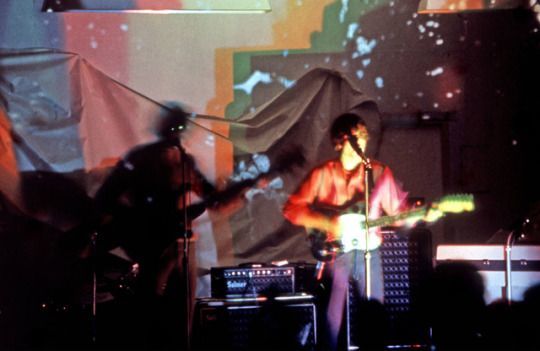
Syd Barrett with Pink Floyd at All Saints Hall

You Should Have Been Here Last Night

The choice of musical genre means that some prominent artists are barely mentioned, if at all. I don't recall any mention of heavy metal bands at all. I would have expected more detail about David Bowie and Roxy Music.

Bowie was closely associated with the Hammersmith Odeon (later known as the Hammersmith Apollo and now known as the Eventim Apollo), because that is where the last performance of Ziggy Stardust and the Spiders from Mars occurred in 1973.

I would also have expected more detail about the Venue (1978 to 1984), where I saw a number of international artists in April, 1982.

Snippets, Tidbits and Strings

The book is replete with interesting comments and snippets of information.

Coffee houses were essential to the early skiffle (auto-corrected to sniffle) scene. “In 1953 the Moka Bar at 29 Frith (auto-corrected to Froth) Street had become the first coffee house in town with a Gaggia.”

By 1955, Charing Cross was described as “the seedy hive of Bohemian culture".

An RAF serviceman, the victim of a police drug raid on a jazz venue in 1961, complains, “It left me filled with resentment of the police, because I was accused of possessing a low moral standard, fraternising with ‘buck Niggers', and the likelihood of becoming a drug addict.”

In 1962, the owner of the Troubadour coffee bar encountered Bob Dylan at the entrance and proposed, “Right, if you play, you can come in for nothing.” Half the audience loved it, the other half hated it.

Eric Clapton, then of the Yardbirds, was called “Slowhand" because he used incredibly thin guitar strings which broke every two songs and the audience would slow-handclap while he replaced them.

“A small lift was the only means to reach the penthouse niterie [Ad Lib], where the visitor was greeted by fur-lined walls, mirrors everywhere, and tanks of piranha fish.”

Paul McCartney was proud to see Jimi Hendrix play a cover version of the song “Sgt. Peppers" at the Saville Theatre just three days after the album was released.

When Marianne Faithfull went to see Hendrix with Mick Jagger, the guitarist asked, “What are you doing with this jerk, anyway?”

Frank Zappa introduced Cream at a gig as “a dandy little combo".

“[Sex Pistols] bassist Glen Matlock was replaced by the witless Sid Vicious in February, 1977.”

The front cover features a photo of Syd Barrett at the 1966 All Saints Hall gig where the crazy diamond first blew his mind on acid, and had to be taken off the stage.


SOUNDTRACK:
Profile Image for Jim Jones.
Author 3 books8 followers
April 12, 2020
A trainspotter's guide to the clubs and bands of London from WWII to 1980. Well written, beautiful layout and photos, great map of clubs. Highly recommend this.
57 reviews3 followers
November 9, 2011
Fantastic reference for anyone study or interested in the history of London's live music!
Displaying 1 - 3 of 3 reviews

Can't find what you're looking for?

Get help and learn more about the design.