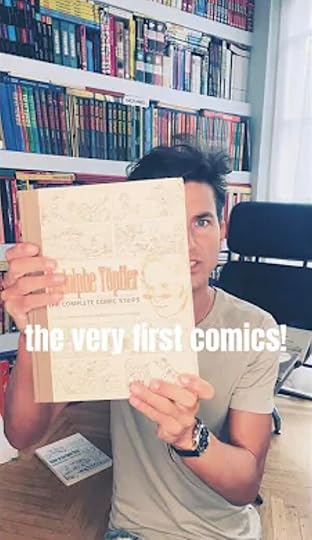
Among the many accomplishments in art and literature by Genevan Rodolphe Topffer (1799-1846), his virtual invention of the comic strip, or graphic novel, stands out as the most surprising, curious, and to us, after a century inundated by comic strips, by far the most significant.
This volume is the first English-language version of the Topffer comics oeuvre and includes (unlike previous French and German editions) all of his eight full-length stories, plus previously unpublished fragments of stories started and abandoned and manuscript segments omitted in the printed versions. Comics scholar Kunzle translates the captions from the French, gives essential biography and chronology, and appends socio-political contexts for all the stories with explanation of references obscure today. He deals with questions of dating and the differences among manuscript, printed version, and the various editions. He also lists the plagiaries, translations, and adaptations in other media.
Topffer's complete comic strip output, combined with Kunzle's annotative material and analyses, makes this volume one of the most significant works of comics history to be published and reestablishes Topffer's seminal place in the comics canon.
Really nice surprise that these comics aren't dry and esoteric, but actually really damn funny and exciting. It peaks at Story of Albert, when Topffer shows the tiniest bit of interest in playing with this new art form. Sadly, he didn't really take it any further. Very glad that now I've not only seen the roots of my favorite art form, but have also enjoyed them!
The comedic story was not originally intended for publication but Rodolphe continued to create others in his spare time to entertain his acquaintances. Notable among them was Johann Wolfgang von Goethe who in 1831 persuaded Rodolphe to publish his stories. Seven of them were eventually published in newspaper form across Europe but Goethe would not live to see them.
Histoire de M. Jabot – created 1831, first published 1833. It features the adventures of a middle class dandy who attempts to enter the contemporary upper class.
Monsieur Crépin – first published in 1837. It features the adventures of a father who employs a series of tutors for his children and falls prey to their eccentricities.
Histoire de M. Vieux Bois – created 1827, first published 1837. The above-mentioned story.
Monsieur Pencil – created 1831, first published 1840. An escalating series of events beginning with an artist losing his sketch to the blowing wind and almost resulting in a global war.
Histoire d'Albert – first published in 1845. The adventures of an inexperienced young man in search of a career. After many attempts he ends up as a journalist in support of radical ideas. The panels show the erection of barricades and crowds singing La Marseillaise.
Histoire de Monsieur Cryptogame – first published in 1845. The story of a lepidopterist who goes to great lengths to replace his current lover with a more suitable one.
Le Docteur Festus (or Voyages et aventures du Docteur Festus) – created 1831, first published 1846. A scientist wanders the world, offering his assistance. He is blissfully unaware that disaster marks his path.
All seven are considered satirical views of 19th century society and proved popular at the time. On 14 September 1842 the Histoire de M. Vieux Bois was first introduced to a United States audience as The Adventures of Mr. Obadiah Oldbuck. It was published in comic book form as a supplement to that day's edition of Brother Jonathan, a New York City newspaper. It has come to be considered the first American comic book and, according to Robert Beerbohm, the inspiration for an entire U.S. genre of nineteenth-century graphic novel.
I appreciate this immensely. Like it? Eh. It is basically the first comics, so for such a huge formal leap, Topffer did amazing work. I mean, we can't expect the inventor of a medium to perfect it. This is like "Mr. Watson, come here, I need you," the first thing Bell said on the telephone, because once you have a new way to communicate, you might have trouble deciding what to say. These comics are silly, but it's often a good thing. They go on a little long, but wouldn't you, too, if you had this new thing coming from your pen? Kunzle's is the real work here: his scholarship is intense and minute, his translations are mostly faithful, and he has a companion book about Topffer's life and legacy.
I only read Histoire de M. Vieux Bois/The Adventures of Obadiah Oldbuck. As a comics fan, it's really interesting, but only to see the start of a new form of storytelling. The actual story was just ok.