

What do you think?
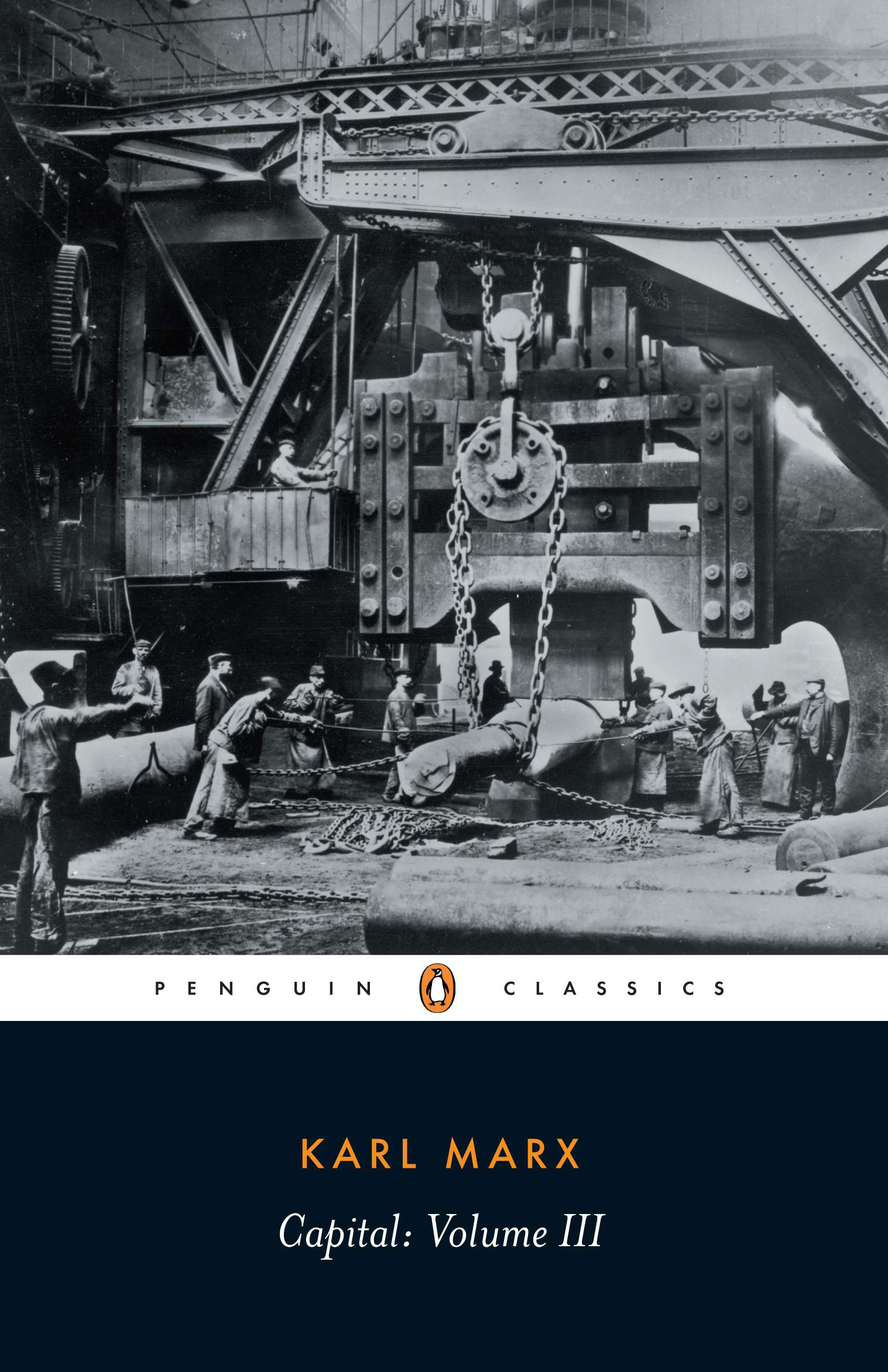
Capital #3
Capital: A Critique of Political Economy, Volume 3
The third volume of a political treatise that changed the world
Unfinished at the time of Marx’s death in 1883 and first published with a preface by Frederick Engels in 1894, the third volume of Capital strives to combine the theories and concepts of the two previous volumes in order to prove conclusively that capitalism is inherently unworkable as a permanent system for society. Here, Marx controversially asserts that—regardless of the efforts of individual capitalists, public authorities or even generous philanthropists—any market economy is inevitably doomed to endure a series of worsening, explosive crises leading finally to complete collapse. But he also offers an inspirational and compelling prediction; that the end of capitalism will culminate in the birth of a far greater form of society.
Unfinished at the time of Marx’s death in 1883 and first published with a preface by Frederick Engels in 1894, the third volume of Capital strives to combine the theories and concepts of the two previous volumes in order to prove conclusively that capitalism is inherently unworkable as a permanent system for society. Here, Marx controversially asserts that—regardless of the efforts of individual capitalists, public authorities or even generous philanthropists—any market economy is inevitably doomed to endure a series of worsening, explosive crises leading finally to complete collapse. But he also offers an inspirational and compelling prediction; that the end of capitalism will culminate in the birth of a far greater form of society.
1152 pages, Paperback
First published October 4, 1894
About the author
Karl Marx
3,503 books7,138 followersWith the help of Friedrich Engels, German philosopher and revolutionary Karl Marx wrote
The Communist Manifesto
(1848) and
Das Kapital
(1867-1894), works, which explain historical development in terms of the interaction of contradictory economic forces, form many regimes, and profoundly influenced the social sciences.
German social theorist Friedrich Engels collaborated with Karl Marx on The Communist Manifesto in 1848 and on numerous other works.
Mikhail Mikhailovich Bakunin in London opposed Communism of Karl Marx with his antithetical anarchy.
Works of Jacques Martin Barzun include Darwin, Marx, Wagner (1941).
The Prussian kingdom introduced a prohibition on Jews, practicing law; in response, a man converted to Protestantism and shortly afterward fathered Karl Marx.
Marx began co-operating with Bruno Bauer on editing Philosophy of Religion of Georg Wilhelm Friedrich Hegel (see Democritus and Epicurus), doctoral thesis, also engaged Marx, who completed it in 1841. People described the controversial essay as "a daring and original piece... in which Marx set out to show that theology must yield to the superior wisdom." Marx decided to submit his thesis not to the particularly conservative professors at the University of Berlin but instead to the more liberal faculty of University of Jena, which for his contributed key theory awarded his Philosophiae Doctor in April 1841. Marx and Bauer, both atheists, in March 1841 began plans for a journal, entitled Archiv des Atheismus (Atheistic Archives), which never came to fruition.
Marx edited the newspaper Vorwärts! in 1844 in Paris. The urging of the Prussian government from France banished and expelled Marx in absentia; he then studied in Brussels. He joined the league in 1847 and published.
Marx participated the failure of 1848 and afterward eventually wound in London. Marx, a foreigner, corresponded for several publications of United States.
He came in three volumes. Marx organized the International and the social democratic party.
Marx in a letter to C. Schmidt once quipped, "All I know is that I am not a Marxist," as Warren Allen Smith related in Who's Who in Hell .
People describe Marx, who most figured among humans. They typically cite Marx with Émile Durkheim and Max Weber, the principal modern architects.
Bertrand Russell later remarked of non-religious Marx, "His belief that there is a cosmic ... called dialectical materialism, which governs ... independently of human volitions, is mere mythology" ( Portraits from Memory , 1956).
More: http://en.wikipedia.org/wiki/Karl_Marx
http://plato.stanford.edu/entries/marx/
http://www.econlib.org/library/Enc/bi...
http://www.marxists.org/archive/marx/...
http://www.historyguide.org/intellect...
http://www.bbc.co.uk/history/historic...
http://www.spartacus.schoolnet.co.uk/...
http://www.britannica.com/EBchecked/t...
German social theorist Friedrich Engels collaborated with Karl Marx on The Communist Manifesto in 1848 and on numerous other works.
Mikhail Mikhailovich Bakunin in London opposed Communism of Karl Marx with his antithetical anarchy.
Works of Jacques Martin Barzun include Darwin, Marx, Wagner (1941).
The Prussian kingdom introduced a prohibition on Jews, practicing law; in response, a man converted to Protestantism and shortly afterward fathered Karl Marx.
Marx began co-operating with Bruno Bauer on editing Philosophy of Religion of Georg Wilhelm Friedrich Hegel (see Democritus and Epicurus), doctoral thesis, also engaged Marx, who completed it in 1841. People described the controversial essay as "a daring and original piece... in which Marx set out to show that theology must yield to the superior wisdom." Marx decided to submit his thesis not to the particularly conservative professors at the University of Berlin but instead to the more liberal faculty of University of Jena, which for his contributed key theory awarded his Philosophiae Doctor in April 1841. Marx and Bauer, both atheists, in March 1841 began plans for a journal, entitled Archiv des Atheismus (Atheistic Archives), which never came to fruition.
Marx edited the newspaper Vorwärts! in 1844 in Paris. The urging of the Prussian government from France banished and expelled Marx in absentia; he then studied in Brussels. He joined the league in 1847 and published.
Marx participated the failure of 1848 and afterward eventually wound in London. Marx, a foreigner, corresponded for several publications of United States.
He came in three volumes. Marx organized the International and the social democratic party.
Marx in a letter to C. Schmidt once quipped, "All I know is that I am not a Marxist," as Warren Allen Smith related in Who's Who in Hell .
People describe Marx, who most figured among humans. They typically cite Marx with Émile Durkheim and Max Weber, the principal modern architects.
Bertrand Russell later remarked of non-religious Marx, "His belief that there is a cosmic ... called dialectical materialism, which governs ... independently of human volitions, is mere mythology" ( Portraits from Memory , 1956).
More: http://en.wikipedia.org/wiki/Karl_Marx
http://plato.stanford.edu/entries/marx/
http://www.econlib.org/library/Enc/bi...
http://www.marxists.org/archive/marx/...
http://www.historyguide.org/intellect...
http://www.bbc.co.uk/history/historic...
http://www.spartacus.schoolnet.co.uk/...
http://www.britannica.com/EBchecked/t...
Ratings & Reviews
Friends & Following
Create a free account to discover what your friends think of this book!
Community Reviews
Displaying 1 - 30 of 121 reviews

April 29, 2013
Capital Volume III completes Marx’s unrivaled trifecta. Upon completing Vol I-III of Capital, one underground rumor is shown to be true, and another is not. First the correct rumor: the reader will arise from his study reborn into an invulnerable phoenix! Now for the incorrect rumor: with outstretched wings, your flight will not be too close to the sun, as Icarus found out, for Marxian phoenix wings are not made of feathers and wax, but knowledge, sweat, and blood! Marx remarked of Capital Vol I, that “there is no royal road to science, and only those who do not dread the fatiguing climb of its steep paths have a chance of gaining its luminous summits,” what he did not inform the reader is that those who climb all three luminous summits will cease need to climb at all! Soaring above the (theoretical) world is now readily at their disposal!
In Volume III all the questions, literally all of them, that the reader is left with in regards to Vol I are answered. One might wonder upon completing Vol I, why places that employ no labor (e.g., laundry mats), or places that employ less labor – which is the source of surplus value - than others in the same industry, are able to derive such larger profits. One might also wonder what the role of monopoly or inter-corporate collusion will do to prices. And again, one may wonder further what role supply and demand have upon price and value, since it’s ignored in Vol I, yet it is intuitively obviously it must play some role. Marx addresses all of these questions and more (e.g., the answer to the meaning of life, whether or not chocolate is better than strawberry, and the final digit in π (pi)!)
Seriously though, despite the hyperbole, Marx does address numerous questions which the reader is left with after completing Vol I. Some of the primary discussions emphasized in Vol III deal with the transformation problem, and also the share of profits across common industries. The reader learns in Vol I that unnecessary labor is the source of profit/surplus value, and because it is unnecessary it’s clearly exploitation. This means that the more people work in accords with socially necessary labor time, the more the capitalist can generate a profit. But in a globalized economy, or even within a nation, it’s clear that some places employ more workers than others, and the profits between these competing firms do not mesh with Marx’s theory in Vol I. Of course people also rarely take the time to see how Marx addressed this issue in Vol III. Marx points out those industrial investments are made by the capitalist class as a whole, so we cannot analyze anyone sectors surplus in relation to their constant and variable capital (S/C+V) and expect for the numbers to all align. Instead we have to look at the S/C+V in relation to that entire sector of the economy, and that will give us the rate of profit in general. Since investments are made by the capitalist class as a whole and consumption is therefore done on this wider basis. But this leads each industry to try to cut down on cost, reducing their work force, and trying to increase productivity and exhaust or invest in newer and more efficient constant capital. Thus the race to the top by each firm is in fact the race to the bottom for the capitalist class overall!
This leads to Marx’s theory of crisis, which is frequently misread, maligned, or completely ignored and brushed aside. Although Marx referred to the theory as the law of the tendency of the fall in the rate of profit, which leads readers to believe that there is a law in the interworkings of capitalism that mandates the rate of profit to fall constantly, he also offered six counteracting tendencies to the rate of profit. These six counteracting tendencies are increasing the rate of exploitation, depressing wages, cheapening the elements of constant capital, relative over population, foreign trade, and the increase of stock capital. So for all those people who point to any one year, or series of years in capitalism and claim “look Marx was wrong, profits haven’t fallen,” they best check the previously mentioned six tendencies. As Michael Roberts, among others, have pointed out, the year before any crisis, it does turn out that there is a rise in the organic composition (C and V) of capital (i.e., more C than V), which does in fact prove Marx’s point overall.
The other intriguing element of Vol III is the discussion of credit, finance, securities, banks, etc. It’s quite overwhelming the degree to which Marx’s predictions in Vol III have come true in regards to the modern finance industry and financial capital in general. Every day we hear things like Wall Street is making record profits, and the price and amount of securities have never been higher! Yet we see that Wall Street is sitting on their money and failing to invest it in anything productive. How can we call this profit then, if profit is derived from exploited labor? In fact this is fictitious capital, or potential money capital, which presently sits idle. For those who say Wall Street is making record profits, they are fetishizing finance, and failing to get at the essence of the capitalist system.
Marx also deals with merchants’ capital in this book, and the role of exploitation in regards to the employees of merchants’ capital (e.g., wal mart or publix employees). Are they exploited? They seem underpaid, yet they do not engage in productive labor. In fact they are exploited in a sense. As Marx points out, merchants in buying up products en masse get it at less than its produced value, and they derive a profit by selling the products at their actual value. But the merchants don’t actually do a lot of work. The Walton family certainly doesn’t do a whole lot of work for their income. It is the employees of merchants’ capital (the truck drivers, the shelf stockers, the cashiers) that help these merchants realize the value difference between their purchase of bulk commodities, and their sale. And yet they are not compensated for the overall difference, ergo they are exploited too.
In sum, I’ve hardly covered the primary details laid out in Vol III. And Capital Vol III is every bit as important now, if not more so, than it was when Engel’s published it toward the end of the 19th century. It is also every bit as important as Vol I. One cannot understand capitalism off the first volume alone. It’s not exaggeration to say that in order to understand, fully, the capitalist world we live in today, and in order to understand how to overcome, one must read Marx’s trilogy. It is not easy task, but the phoenix wings are totally worth the belabored process.
In Volume III all the questions, literally all of them, that the reader is left with in regards to Vol I are answered. One might wonder upon completing Vol I, why places that employ no labor (e.g., laundry mats), or places that employ less labor – which is the source of surplus value - than others in the same industry, are able to derive such larger profits. One might also wonder what the role of monopoly or inter-corporate collusion will do to prices. And again, one may wonder further what role supply and demand have upon price and value, since it’s ignored in Vol I, yet it is intuitively obviously it must play some role. Marx addresses all of these questions and more (e.g., the answer to the meaning of life, whether or not chocolate is better than strawberry, and the final digit in π (pi)!)
Seriously though, despite the hyperbole, Marx does address numerous questions which the reader is left with after completing Vol I. Some of the primary discussions emphasized in Vol III deal with the transformation problem, and also the share of profits across common industries. The reader learns in Vol I that unnecessary labor is the source of profit/surplus value, and because it is unnecessary it’s clearly exploitation. This means that the more people work in accords with socially necessary labor time, the more the capitalist can generate a profit. But in a globalized economy, or even within a nation, it’s clear that some places employ more workers than others, and the profits between these competing firms do not mesh with Marx’s theory in Vol I. Of course people also rarely take the time to see how Marx addressed this issue in Vol III. Marx points out those industrial investments are made by the capitalist class as a whole, so we cannot analyze anyone sectors surplus in relation to their constant and variable capital (S/C+V) and expect for the numbers to all align. Instead we have to look at the S/C+V in relation to that entire sector of the economy, and that will give us the rate of profit in general. Since investments are made by the capitalist class as a whole and consumption is therefore done on this wider basis. But this leads each industry to try to cut down on cost, reducing their work force, and trying to increase productivity and exhaust or invest in newer and more efficient constant capital. Thus the race to the top by each firm is in fact the race to the bottom for the capitalist class overall!
This leads to Marx’s theory of crisis, which is frequently misread, maligned, or completely ignored and brushed aside. Although Marx referred to the theory as the law of the tendency of the fall in the rate of profit, which leads readers to believe that there is a law in the interworkings of capitalism that mandates the rate of profit to fall constantly, he also offered six counteracting tendencies to the rate of profit. These six counteracting tendencies are increasing the rate of exploitation, depressing wages, cheapening the elements of constant capital, relative over population, foreign trade, and the increase of stock capital. So for all those people who point to any one year, or series of years in capitalism and claim “look Marx was wrong, profits haven’t fallen,” they best check the previously mentioned six tendencies. As Michael Roberts, among others, have pointed out, the year before any crisis, it does turn out that there is a rise in the organic composition (C and V) of capital (i.e., more C than V), which does in fact prove Marx’s point overall.
The other intriguing element of Vol III is the discussion of credit, finance, securities, banks, etc. It’s quite overwhelming the degree to which Marx’s predictions in Vol III have come true in regards to the modern finance industry and financial capital in general. Every day we hear things like Wall Street is making record profits, and the price and amount of securities have never been higher! Yet we see that Wall Street is sitting on their money and failing to invest it in anything productive. How can we call this profit then, if profit is derived from exploited labor? In fact this is fictitious capital, or potential money capital, which presently sits idle. For those who say Wall Street is making record profits, they are fetishizing finance, and failing to get at the essence of the capitalist system.
Marx also deals with merchants’ capital in this book, and the role of exploitation in regards to the employees of merchants’ capital (e.g., wal mart or publix employees). Are they exploited? They seem underpaid, yet they do not engage in productive labor. In fact they are exploited in a sense. As Marx points out, merchants in buying up products en masse get it at less than its produced value, and they derive a profit by selling the products at their actual value. But the merchants don’t actually do a lot of work. The Walton family certainly doesn’t do a whole lot of work for their income. It is the employees of merchants’ capital (the truck drivers, the shelf stockers, the cashiers) that help these merchants realize the value difference between their purchase of bulk commodities, and their sale. And yet they are not compensated for the overall difference, ergo they are exploited too.
In sum, I’ve hardly covered the primary details laid out in Vol III. And Capital Vol III is every bit as important now, if not more so, than it was when Engel’s published it toward the end of the 19th century. It is also every bit as important as Vol I. One cannot understand capitalism off the first volume alone. It’s not exaggeration to say that in order to understand, fully, the capitalist world we live in today, and in order to understand how to overcome, one must read Marx’s trilogy. It is not easy task, but the phoenix wings are totally worth the belabored process.

Read
July 13, 2020Bit of a surprise ending there...
***
If Volume 1 is Marx's Inferno, volume 2 might plausibly be likened to purgatory (at least in that it's a long, boring thing you just have to get through). Volume 3, however, is by no stretch an ascent into heaven. No, instead we find ourselves back in hell, a much more subtle and devious hell than the gothic brutality of volume 1. As a young man composing the manifesto, Marx was able to say confidently how capitalism would end. Decades later, after reading and writing millions of words on the subject, the question only grew more obscure; the answer endlessly deferred. In some respects, volume 3 is like the scene at the end of 1984 in which Winston Smith has a frank conversation with the agent and realizes all his seemingly radical ideas were already anticipated and neutralized by the system.
While definitely not as dull as the second volume, volume 3 still isn't a literary masterpiece like volume 1. In some respects, however, it's actually more relevant to understanding the present state of things. The tendency of the rate of profit to fall is perhaps the key to the various crises rending capitalist society in the 21st century. Drawing out the implications of this also leads one to a deeper understanding of Marx's materialism and the labor theory of value.
As a book, volume 3 is incomplete and not terribly well-organized. Perhaps that's inevitable for any attempt to develop a total theory of history and society. History keeps happening. Reaching the end of the whole trilogy, I don't feel like I'm all that close to decoding the social order.
***
If Volume 1 is Marx's Inferno, volume 2 might plausibly be likened to purgatory (at least in that it's a long, boring thing you just have to get through). Volume 3, however, is by no stretch an ascent into heaven. No, instead we find ourselves back in hell, a much more subtle and devious hell than the gothic brutality of volume 1. As a young man composing the manifesto, Marx was able to say confidently how capitalism would end. Decades later, after reading and writing millions of words on the subject, the question only grew more obscure; the answer endlessly deferred. In some respects, volume 3 is like the scene at the end of 1984 in which Winston Smith has a frank conversation with the agent and realizes all his seemingly radical ideas were already anticipated and neutralized by the system.
While definitely not as dull as the second volume, volume 3 still isn't a literary masterpiece like volume 1. In some respects, however, it's actually more relevant to understanding the present state of things. The tendency of the rate of profit to fall is perhaps the key to the various crises rending capitalist society in the 21st century. Drawing out the implications of this also leads one to a deeper understanding of Marx's materialism and the labor theory of value.
As a book, volume 3 is incomplete and not terribly well-organized. Perhaps that's inevitable for any attempt to develop a total theory of history and society. History keeps happening. Reaching the end of the whole trilogy, I don't feel like I'm all that close to decoding the social order.

November 17, 2022
"Freedom in this field can only consist in socialised man, the associated producers, rationally regulating their interchange with Nature, bringing it under their common control, instead of being ruled by it as by the blind forces of Nature; and achieving this with the least expenditure of energy and under conditions most favourable to, and worthy of, their human nature. But it nonetheless still remains a realm of necessity. Beyond it begins that development of human energy which is an end in itself, the true realm of freedom, which, however, can blossom forth only with this realm of necessity as its basis. The shortening of the working-day is its basic prerequisite." (959)
"In capital – profit, or still better capital – interest, land – rent, labour – wages, in this economic
trinity represented as the connection between the component parts of value and wealth in general
and its sources, we have the complete reification of the capitalist mode of production, the
conversion of social relations into things, the direct coalescence of the material production
relations with their historical and social determination. It is an enchanted, perverted, topsy-turvy
world, in which Monsieur le Capital and Madame la Terre do their ghost-walking as social
characters and at the same time directly as mere things. It is the great merit of classical economy
to have destroyed this false appearance and illusion, this mutual independence and ossification of
the various social elements of wealth, this personification of things and conversion of production
relations into entities, this religion of everyday life."(969)
Marx's Das Kapital Volume III, is an enormous intellectual feat. Volume I provided deep insights into production, the class struggle, the origin of capitalism, and the tensions within it. Volume II, "the unknown one" (p.9), then shifted to analysing circulation, the way capitalism sustains itself, regenerating and growing - capital is ceaselessly regenerating, albeit with inner tensions and frictions. Then finally, in Volume 3, "the controversial one" (ibid), Marx examines market prices, property income, land, and rent.
Whilst the second volume isn't particularly interesting, and shares with the third volume a lot of unfinished arguments, shifting and often complicated assumptions, which are not saved by digressions about long forgotten economists such as Rodbertus, Thomas Tooke, and William Newmarch to name a few, there is much more of Marx's intellectual flair in here than in volume 2. Engels has made more effort to resurrect Marx's literary style, which is perhaps why it took Engels a decade to edit and publish this volume, whilst volume II only took a year. Despite Engels' ill health, he does his best to keep his comments to a minimum, occasionally taking slight disagreement with Marx, and then providing a supplement to volume 3, which was written mere months before he passed.
Now, despite the occasional page of explosive prose, I cannot honestly recommend this book to anybody who isn't either an academic, autodidact, or has a serious interest in Marx. This book, to put it bluntly is not for the general reader. I say this not as an expert, as reading this book made me come to terms with my own limited understanding of economic theory - something I have no formal background in. Volumes 2 and 3 are very complicated, and I think that reading this with an expert, a reading group, and absolutely with the aid of a good companion such as A Guide to Marx's 'Capital', Marx's Capital, is advisable. Whilst I still stand by my statement that one should be wary of guidebooks for the first volume, I don't think this stands for this volume, at least for laypeople like myself.
Throughout the book, there is a consistent theme of appearance versus reality. Classical economy, Marx believed, spoke the language of the capitalist. This lead to numerous antinomies, and the occasional grasping at what was the truth. By critically analysing classical political economy, and pointing out its ludicrousness, and its occasional insight into the murky exploitative nature, and then bearing this out with his Hegelian problematic, heuristics, and historical examples, Marx believed that he could solve the problems which perplexed classical economy. Why was this complicated system, which dominates the globe so all encompassing? Why did this system seem objective and taken-for granted? Why was this historically contingent system the everyday existence for man? Why did the language of political economy reflect the needs and interests of those who benefited most from this system? And it is within the pages of Capital vols 1-3, and throughout the whole collected works of Marx and Engels that we find Marx's answers.
"In capital – profit, or still better capital – interest, land – rent, labour – wages, in this economic
trinity represented as the connection between the component parts of value and wealth in general
and its sources, we have the complete reification of the capitalist mode of production, the
conversion of social relations into things, the direct coalescence of the material production
relations with their historical and social determination. It is an enchanted, perverted, topsy-turvy
world, in which Monsieur le Capital and Madame la Terre do their ghost-walking as social
characters and at the same time directly as mere things. It is the great merit of classical economy
to have destroyed this false appearance and illusion, this mutual independence and ossification of
the various social elements of wealth, this personification of things and conversion of production
relations into entities, this religion of everyday life."(969)
Marx's Das Kapital Volume III, is an enormous intellectual feat. Volume I provided deep insights into production, the class struggle, the origin of capitalism, and the tensions within it. Volume II, "the unknown one" (p.9), then shifted to analysing circulation, the way capitalism sustains itself, regenerating and growing - capital is ceaselessly regenerating, albeit with inner tensions and frictions. Then finally, in Volume 3, "the controversial one" (ibid), Marx examines market prices, property income, land, and rent.
Whilst the second volume isn't particularly interesting, and shares with the third volume a lot of unfinished arguments, shifting and often complicated assumptions, which are not saved by digressions about long forgotten economists such as Rodbertus, Thomas Tooke, and William Newmarch to name a few, there is much more of Marx's intellectual flair in here than in volume 2. Engels has made more effort to resurrect Marx's literary style, which is perhaps why it took Engels a decade to edit and publish this volume, whilst volume II only took a year. Despite Engels' ill health, he does his best to keep his comments to a minimum, occasionally taking slight disagreement with Marx, and then providing a supplement to volume 3, which was written mere months before he passed.
Now, despite the occasional page of explosive prose, I cannot honestly recommend this book to anybody who isn't either an academic, autodidact, or has a serious interest in Marx. This book, to put it bluntly is not for the general reader. I say this not as an expert, as reading this book made me come to terms with my own limited understanding of economic theory - something I have no formal background in. Volumes 2 and 3 are very complicated, and I think that reading this with an expert, a reading group, and absolutely with the aid of a good companion such as A Guide to Marx's 'Capital', Marx's Capital, is advisable. Whilst I still stand by my statement that one should be wary of guidebooks for the first volume, I don't think this stands for this volume, at least for laypeople like myself.
Throughout the book, there is a consistent theme of appearance versus reality. Classical economy, Marx believed, spoke the language of the capitalist. This lead to numerous antinomies, and the occasional grasping at what was the truth. By critically analysing classical political economy, and pointing out its ludicrousness, and its occasional insight into the murky exploitative nature, and then bearing this out with his Hegelian problematic, heuristics, and historical examples, Marx believed that he could solve the problems which perplexed classical economy. Why was this complicated system, which dominates the globe so all encompassing? Why did this system seem objective and taken-for granted? Why was this historically contingent system the everyday existence for man? Why did the language of political economy reflect the needs and interests of those who benefited most from this system? And it is within the pages of Capital vols 1-3, and throughout the whole collected works of Marx and Engels that we find Marx's answers.

September 5, 2020
Contains Economic Trades; Materials for Capital and in appendices: plans and summaries of Capital, letters on economics, various texts including Malthus and texts by Friedrich Engels.

January 28, 2016
Whew. This one was great!! I think it's probably at least as important and interesting as Volume 1 honestly. This is where we see Marx develop the implications of critique of bourgeois political economy that was introduced in Volume 1 as they develop in the actual economy. This is where Marx starts talking about credit, debt, finance, transportation, and even military aid (for like a paragraph lol) while showing how the course of the historical development of capitalist economy obscures the relationships that underpin it. How, for example, it appears to the individual capitalist that labor appears as a constituent part of revenue as opposed to the fundamental source of value. A lot of the analysis here is still extremely helpful in understanding how capitalism works today even though all of the analysis of currency assumes a metal base for the currency (It wasn't immediately easy for me to tell exactly which parts of the analysis, if any, run into trouble due to modern currency not having a metallic base, though admittedly I haven't done a lot of research on the topic myself).
As with Volume 1 (and to a rather lesser extent Volume 2) there is also a lot of historical interest here. Lots of quotations of interviews with senior bankers are analyzed and you can really see Marx doing some hefty Critique of Ideology. Good stuff IMO.
Anyway, definitely super important and helpful to read. Check it out yall!!!
As with Volume 1 (and to a rather lesser extent Volume 2) there is also a lot of historical interest here. Lots of quotations of interviews with senior bankers are analyzed and you can really see Marx doing some hefty Critique of Ideology. Good stuff IMO.
Anyway, definitely super important and helpful to read. Check it out yall!!!

February 2, 2017
Capital, Volume 1: Mastered.
Vol. 2: MAstered.
Vol. 3: Mastered.
Vol. 4: Heres when they start trying to trick you
Vol. 5: This ones hard
Vol. 2: MAstered.
Vol. 3: Mastered.
Vol. 4: Heres when they start trying to trick you
Vol. 5: This ones hard

August 1, 2021
Another banger Mr. Marx

November 22, 2018
Karl Marx originally had the plan, in 1865, to write Das Kapital. Volume 1 he could finish, but he still had three volumes worth of notes left. The rest of his life he was too busy - atleast, between the moments when he was busy living like a bourgeous - stoking up controversy and organising international communism to finish his magnum opus. Then, the man passed away in 1883, after his daughter had died some months earlier. After this event, his life-long friend Friedrich Engels started to get the manuscripts for the remaining volumes of Das Kapital ready for publishing.
But there is of course the problem that Marx once was busy collecting materials for the remaining volumes and had written full chapters, but also long trains of thoughts - to be worked out at a later date. Anyaway, the end result is that Engels had to either publish the work in its manuscriptural form - which would have been a disaster (terribly unreadable) -, or else he would have to polish the existing chapters and supplement the unfinished ones with his own ideas and present it as a whole. He chose the last option.
The problem? Volume 2 is as dry as anything you can imagine - and then some. It's almost unreadable for modern day readers and it could have used an editor with an eye for conciseness and accessibility of texts. But so could Das Kapital Volume 1 - which is as inaccessible and unreadable as Volume 2, but was written and published by Marx himself in a complete form. The real problems start with Volume 3. Engels writes in the (long) preface that he tried to supplement and polish certain parts of the book more than three times, after which he gave up and decided to write down his own words, based on Marx's ideas. Many chapters that he simply edited somewhat are terribly unfocused and contain much repetitive and/or redundant materials.
In short: Das Kapital Volume 3 is just a terribly bad book. It is extremely long (1100 pages plain text); it is not one whole but rather a collection of loose chapters and parts; much material is presented in terribly convoluted form; and it simply is written in a way that makes the book a pain to read (and keep reading).
The problem is, the material in the book is interesting. And the book itself has a definite place in Marx's criticism of political economy. In Volume 1 he looked at the essence of capitalism: the process of production. How is value created? Whence does it arise? And what are the consequences of this mode of production? Then, in Volume 2, Marx leaves the ground and soars high up in the sky, looking down on capitalism as a continuous system of which production is only one part. According to Marx, capital is value in motion: money is exchanged for commodities; commodities are used, along with labour, in the process of production; the commodities are then sold again on the market with profit; the bigger value is then re-invested; and so the cycle continues. The faster value moves, the more value is created; turnover rates are an essential ingredient of capitalism, hence the important place of transport, communications, money (in the form of credit), reducing fixed and replacing it with circulating capital - anything that speeds up or smoothens the process helps.
With Volume 3, Marx planned to show how capitalism worked out in the real world. Now we know how and by whom value is created, and how the movement of value is essential, we need to look at the more detailed picture. After the commodities are produced, the capitalist tries to sells his goods on the market and make a profit. But what is profit? Is it surplus value? Is it something different? And what does the rate of profit have to do with the surplus value? And what are the effects of the latter connection? These sorts of questions were meant to be answered in Volume 3.
And for a big part they are. The first four parts (about 45% of the book) are really breath-taking. They are truly hard to digest, but if one has paid attention in Volume 1 and 2 to what Marx was saying, the new material clicks into place rather easily. It's just that Marx has a terrible way of presenting his materials, and that Engels hasn't really done anything about it.
The main ideas:
1. Profit is surplus value as it shows its face to the capitalist and the market. The capitalist sees his commodity being sold for a certain price, and consequently thinks the market determines the price and value of the commodity. If pushed, he looks at his production processes and sees the cost price - the constant and variable capital that went into the materials, including labour, to produce the commodity -, deducts this amount from the product price and sees the profit. Marx shows how profit is nothing but surplus value and how this form of appearance hides the generator of value: exploitation of labour. It's labour that generates surplus value, not the market.
The rate of profit in this sense is nothing but the proportion of surplus value to the total capital expended to generate this surplus value. And here the difference shows itself: the rate of surplus value is the proportion of surplus value to just variable capital (i.e. labour) expended to generate this surplus value. With this distinction, Marx has a tool with which to look at the market from a whole new perspective.
2. Up to now, Marx looks as the profit and profit rate of an individual capital. But of course individual capital is part of the entire system of capitalism. Individual capital expended on production of a commodity is part of the total capital expended on all commodities. And it's the same with the rate of surplus value, the profit, and the profit rate.
But now, when we look at the rate of profit from the perspective of the social production (i.e. marcoeconomics), we see something happening. Within a certain branche of production, all the individual rates of profits (just like anything else) goes into the sum total of all rate of profits. This total is then, on the market, redistributed over all the individual capitals - just like the market value and the market price are in essence nothing but the average values and average prices of all the commodities on the markets.
And here capitalism shows it's true face: competition. An individual capital can be more or less than the average. Just like an individual profit can be more or less than the average profit. And the average rate of profit is the rate of profit as an aggregation of all the individual rates of profits. It is this factor that's leading in capitalism, not the individual rate of profit. The laws of capitalism make all capitalists pawns in its game, just like it makes every labourer a pawn. The individual capitalist just plays along, but in reality is, ultimately, nothing but a temporary robot.
For the capitalist, who looks at the market from his own, money-making perspective, all that exists are market prices and market values, and he tries to cut down on the cost price of his own commodities, while trying to sell his commodities dearer than his competitors. Political economics - Adam Smith, David Ricardo, and their followers - look at the market to determine value, while Marx looks at the essence of value - labour - and sees the market, with all it's fluctuations, as the logical consequence of this capitalist mode of production.
3. The average rate of profit is the death knell of capitalism. When looked at from the perspective of social production, the rate of profit is the inherent contradiction that runs down the whole system.
Why? Because the rate of profit is nothing but the proportion of surplus value to total capital expended on generating this surplus value. But this total capital is composed of constant capital - land, buildings, machinery, raw materials, ancillary materials, etc. - and variable capital - wages paied. Since variable capital, wages, generate surplus value, it follows that the higher the ratio of variable to constant capital, the higher the rate of surlus value and the higher the rate of profit.
But what happens in capitalism? Capital accumulates. Bigger capitals can pay more wages and generate more surplus value. Bigger capitals also offer economy of scale and the adaptation of innovation and technology. In short: bigger capitals are more productive. Capitalists are forced, by the laws of capitalism, to perpetually increase labour productivity - producing ever more by ever fewer hands.
In other words: capitalism thrives on development, always increasing the component of constant capital and always decreasing the component variable capital. The value generating element - labour - is perpetually becoming less and less a part of the total capital spend on the total surplus value. Investing in constant capital is also much more expensive than wages.
This, all combined, means that the amount of total capital is comprising more and more - highly expensive - constant capital, leading to lower and lower proportion of surplus value to the total capital spend on it. And what was the rate of profit? Right, surplus value to total capital. So capitalism eats itself. What this 'law of the tendency of the fall in profit' basically says is that capitalism forces capitalists to spend steadily more on capital, forcing down the rates of profit - even when the new machinery puts more people to work (increasing variable capital and hence total capital slightly), and even when this leads to more surplus value, the rate of profit will go down.
The consequences of this? You need more and more money to generate profit. And since capital is nothing but value in motion, capital that stops moving evaporates. Capital thus gets concentrated in the hands of fewer and fewer people, since the concentration of capital is what keeps the profits - harder to make by the day - coming in. More and more smaller capitalists are thus reduced to the rabble: the fall of the rate of profit creates overpopulations of labourers, presses down wages, all the while producing cheaper and cheaper goods (since the labour factor, and hence surplus value, and hence product value, decreases).
Capital accumulates, and this 'law of accumulation' is nothing but saying that ever-increasing capital is needed to keep the production processes running, 'the law of the tendency of the fall in profit rate'. In short: both laws are one and the same!
And this process of accumulation or the fall in profit rates will, according to Marx, speed up ever faster. The only way that profits can be made is through crises. But the longer capital continues to accumulate and profit rates continue to drop, more and bigger crises are needed to keep the system running.
4. And then the most interesting part of the book is over. Marx tells us in part 4 how merchant capital and money capital (i.e. credit) is used as oil in the capitalist system of production. Merchants don't generate any surplus value, although the exploit labour all the same: they don't add any value to the products but only sell them dearer than they were bought for. (No wonder Engels called merchants 'parasitical sycophants' in his own works.)
The same with money lenders. Capitalism is characterized by time lags. No matter how far up the production chain you look, ultimately, all the raw materials that are used in production are products of nature. And nature knows boundaries. It takes time for sheep to grow wool and for potatoes to become eatable. This means that supply follows demand; market prices start to rise, leading to over-investments; then, when, over time, supply grows, and demand declines, an overabundance of goods floods the market and capitalists go bankrupt. Crises are inherent consequences of capitalism - this is capitalism for you.
Money credit can be used to keep the machine going, so to speak, buffering the effects of time delayed issues. You can borrow money and start investing already, just like you can buy now and pay later. Money smoothens the circulation of capital and hence keeps value in motion. But like the merchants, creditors are, ultimately, parasites - not adding value to anything and living of interests.
After this, Das Kapital Volume 3 goes on for more than 500 pages. The problem is, part 5 (almost 300 pages of this) was so terrible that Engels tried reworking it three times - spending a year on this - and ultimately decided to rearrange all the original materials and stuffing it up on his own account where necessary. This makes for terrible reading (just like Part 4 already suffers from some of these ills). The first half of the book clearly looks at the division of profit and wages; the rest of the book (parts 4-7) is occupied with the division of profit: interest on profit, interest on loans, rent, taxes, etc.
Due to the poor structure and text I decided to leave it at that. I have ploughed through Volumes 1 and 2, and made it halfway across Volume 3 - I am now familiar with the main ideas of Marx. And I am truly happy that I decided to spend some days off last couple of weeks to read more of Marx and Engels. They were important historical figures and one understands history, as well as current times, better when one has read the original works.
My final verdict is this. The works of Marx should be put into two categories. His political works, guided by both his agenda of spreading communism all over the world and his opposition to classes and groups of people. These works are toxic, aggressive and provocative.
But then there is his critical analysis of political economy, Das Kapital Volumes 1-3 (and, maybe, 4) deal specifically with an exhaustive and all-encompassing analysis of the capitalist mode of production that he saw first conquering Great Britain, and slowly the world. Marx's economic studies are brilliant in their originality, sharpness of critque and their tracing out of all the minute details. I can honestly mention no economist who comes close this. But at the same time, Marx studied economics philosophically, while modern day economics is much more empirical: it studies economic trends and facts as they actually are. What one can learn from Marx is to try to look at the same object from a different perspective, and suddenly discover a plethora of new, intriguing things.
And much of his ideas are still valuable today. In that sence, Marx was right in many of his general conclusions and observations, although it isn't really fanciful to say this nowadays. To name just one: his analysis of and critique on merchants capital is spot on. Ultimately, Ikea, Nike and Walmart are nothing but parasitical money-grabbers. Apple literally sucks up surplus value from its exploited labourers - it doesn't do anything but make others objectify its ideas and designs. H&M does nothing but squeeze out everything they can from Asian women working in sweatshops; it doesn't generate any value - all it does it put its logo on it, distribute the clothing all over the world, and sell it much dearer than it is bought for. IKEA's purchasing manager is doing exactly what Marx tells us he does: look at product prices, deduct his own cost price from it, and try to sell it as dear as possible on the market- not realising whence the value comes from.
So from that point of view, Marx is very recommendable to read. The problem is the 2500+ pages (of plain text) one has to wrestle through. Highly problematic - Marx (or Engels) should have just cut down his works to their bare essence. And maybe re-write the abstract parts. Would have been much better...
But there is of course the problem that Marx once was busy collecting materials for the remaining volumes and had written full chapters, but also long trains of thoughts - to be worked out at a later date. Anyaway, the end result is that Engels had to either publish the work in its manuscriptural form - which would have been a disaster (terribly unreadable) -, or else he would have to polish the existing chapters and supplement the unfinished ones with his own ideas and present it as a whole. He chose the last option.
The problem? Volume 2 is as dry as anything you can imagine - and then some. It's almost unreadable for modern day readers and it could have used an editor with an eye for conciseness and accessibility of texts. But so could Das Kapital Volume 1 - which is as inaccessible and unreadable as Volume 2, but was written and published by Marx himself in a complete form. The real problems start with Volume 3. Engels writes in the (long) preface that he tried to supplement and polish certain parts of the book more than three times, after which he gave up and decided to write down his own words, based on Marx's ideas. Many chapters that he simply edited somewhat are terribly unfocused and contain much repetitive and/or redundant materials.
In short: Das Kapital Volume 3 is just a terribly bad book. It is extremely long (1100 pages plain text); it is not one whole but rather a collection of loose chapters and parts; much material is presented in terribly convoluted form; and it simply is written in a way that makes the book a pain to read (and keep reading).
The problem is, the material in the book is interesting. And the book itself has a definite place in Marx's criticism of political economy. In Volume 1 he looked at the essence of capitalism: the process of production. How is value created? Whence does it arise? And what are the consequences of this mode of production? Then, in Volume 2, Marx leaves the ground and soars high up in the sky, looking down on capitalism as a continuous system of which production is only one part. According to Marx, capital is value in motion: money is exchanged for commodities; commodities are used, along with labour, in the process of production; the commodities are then sold again on the market with profit; the bigger value is then re-invested; and so the cycle continues. The faster value moves, the more value is created; turnover rates are an essential ingredient of capitalism, hence the important place of transport, communications, money (in the form of credit), reducing fixed and replacing it with circulating capital - anything that speeds up or smoothens the process helps.
With Volume 3, Marx planned to show how capitalism worked out in the real world. Now we know how and by whom value is created, and how the movement of value is essential, we need to look at the more detailed picture. After the commodities are produced, the capitalist tries to sells his goods on the market and make a profit. But what is profit? Is it surplus value? Is it something different? And what does the rate of profit have to do with the surplus value? And what are the effects of the latter connection? These sorts of questions were meant to be answered in Volume 3.
And for a big part they are. The first four parts (about 45% of the book) are really breath-taking. They are truly hard to digest, but if one has paid attention in Volume 1 and 2 to what Marx was saying, the new material clicks into place rather easily. It's just that Marx has a terrible way of presenting his materials, and that Engels hasn't really done anything about it.
The main ideas:
1. Profit is surplus value as it shows its face to the capitalist and the market. The capitalist sees his commodity being sold for a certain price, and consequently thinks the market determines the price and value of the commodity. If pushed, he looks at his production processes and sees the cost price - the constant and variable capital that went into the materials, including labour, to produce the commodity -, deducts this amount from the product price and sees the profit. Marx shows how profit is nothing but surplus value and how this form of appearance hides the generator of value: exploitation of labour. It's labour that generates surplus value, not the market.
The rate of profit in this sense is nothing but the proportion of surplus value to the total capital expended to generate this surplus value. And here the difference shows itself: the rate of surplus value is the proportion of surplus value to just variable capital (i.e. labour) expended to generate this surplus value. With this distinction, Marx has a tool with which to look at the market from a whole new perspective.
2. Up to now, Marx looks as the profit and profit rate of an individual capital. But of course individual capital is part of the entire system of capitalism. Individual capital expended on production of a commodity is part of the total capital expended on all commodities. And it's the same with the rate of surplus value, the profit, and the profit rate.
But now, when we look at the rate of profit from the perspective of the social production (i.e. marcoeconomics), we see something happening. Within a certain branche of production, all the individual rates of profits (just like anything else) goes into the sum total of all rate of profits. This total is then, on the market, redistributed over all the individual capitals - just like the market value and the market price are in essence nothing but the average values and average prices of all the commodities on the markets.
And here capitalism shows it's true face: competition. An individual capital can be more or less than the average. Just like an individual profit can be more or less than the average profit. And the average rate of profit is the rate of profit as an aggregation of all the individual rates of profits. It is this factor that's leading in capitalism, not the individual rate of profit. The laws of capitalism make all capitalists pawns in its game, just like it makes every labourer a pawn. The individual capitalist just plays along, but in reality is, ultimately, nothing but a temporary robot.
For the capitalist, who looks at the market from his own, money-making perspective, all that exists are market prices and market values, and he tries to cut down on the cost price of his own commodities, while trying to sell his commodities dearer than his competitors. Political economics - Adam Smith, David Ricardo, and their followers - look at the market to determine value, while Marx looks at the essence of value - labour - and sees the market, with all it's fluctuations, as the logical consequence of this capitalist mode of production.
3. The average rate of profit is the death knell of capitalism. When looked at from the perspective of social production, the rate of profit is the inherent contradiction that runs down the whole system.
Why? Because the rate of profit is nothing but the proportion of surplus value to total capital expended on generating this surplus value. But this total capital is composed of constant capital - land, buildings, machinery, raw materials, ancillary materials, etc. - and variable capital - wages paied. Since variable capital, wages, generate surplus value, it follows that the higher the ratio of variable to constant capital, the higher the rate of surlus value and the higher the rate of profit.
But what happens in capitalism? Capital accumulates. Bigger capitals can pay more wages and generate more surplus value. Bigger capitals also offer economy of scale and the adaptation of innovation and technology. In short: bigger capitals are more productive. Capitalists are forced, by the laws of capitalism, to perpetually increase labour productivity - producing ever more by ever fewer hands.
In other words: capitalism thrives on development, always increasing the component of constant capital and always decreasing the component variable capital. The value generating element - labour - is perpetually becoming less and less a part of the total capital spend on the total surplus value. Investing in constant capital is also much more expensive than wages.
This, all combined, means that the amount of total capital is comprising more and more - highly expensive - constant capital, leading to lower and lower proportion of surplus value to the total capital spend on it. And what was the rate of profit? Right, surplus value to total capital. So capitalism eats itself. What this 'law of the tendency of the fall in profit' basically says is that capitalism forces capitalists to spend steadily more on capital, forcing down the rates of profit - even when the new machinery puts more people to work (increasing variable capital and hence total capital slightly), and even when this leads to more surplus value, the rate of profit will go down.
The consequences of this? You need more and more money to generate profit. And since capital is nothing but value in motion, capital that stops moving evaporates. Capital thus gets concentrated in the hands of fewer and fewer people, since the concentration of capital is what keeps the profits - harder to make by the day - coming in. More and more smaller capitalists are thus reduced to the rabble: the fall of the rate of profit creates overpopulations of labourers, presses down wages, all the while producing cheaper and cheaper goods (since the labour factor, and hence surplus value, and hence product value, decreases).
Capital accumulates, and this 'law of accumulation' is nothing but saying that ever-increasing capital is needed to keep the production processes running, 'the law of the tendency of the fall in profit rate'. In short: both laws are one and the same!
And this process of accumulation or the fall in profit rates will, according to Marx, speed up ever faster. The only way that profits can be made is through crises. But the longer capital continues to accumulate and profit rates continue to drop, more and bigger crises are needed to keep the system running.
4. And then the most interesting part of the book is over. Marx tells us in part 4 how merchant capital and money capital (i.e. credit) is used as oil in the capitalist system of production. Merchants don't generate any surplus value, although the exploit labour all the same: they don't add any value to the products but only sell them dearer than they were bought for. (No wonder Engels called merchants 'parasitical sycophants' in his own works.)
The same with money lenders. Capitalism is characterized by time lags. No matter how far up the production chain you look, ultimately, all the raw materials that are used in production are products of nature. And nature knows boundaries. It takes time for sheep to grow wool and for potatoes to become eatable. This means that supply follows demand; market prices start to rise, leading to over-investments; then, when, over time, supply grows, and demand declines, an overabundance of goods floods the market and capitalists go bankrupt. Crises are inherent consequences of capitalism - this is capitalism for you.
Money credit can be used to keep the machine going, so to speak, buffering the effects of time delayed issues. You can borrow money and start investing already, just like you can buy now and pay later. Money smoothens the circulation of capital and hence keeps value in motion. But like the merchants, creditors are, ultimately, parasites - not adding value to anything and living of interests.
After this, Das Kapital Volume 3 goes on for more than 500 pages. The problem is, part 5 (almost 300 pages of this) was so terrible that Engels tried reworking it three times - spending a year on this - and ultimately decided to rearrange all the original materials and stuffing it up on his own account where necessary. This makes for terrible reading (just like Part 4 already suffers from some of these ills). The first half of the book clearly looks at the division of profit and wages; the rest of the book (parts 4-7) is occupied with the division of profit: interest on profit, interest on loans, rent, taxes, etc.
Due to the poor structure and text I decided to leave it at that. I have ploughed through Volumes 1 and 2, and made it halfway across Volume 3 - I am now familiar with the main ideas of Marx. And I am truly happy that I decided to spend some days off last couple of weeks to read more of Marx and Engels. They were important historical figures and one understands history, as well as current times, better when one has read the original works.
My final verdict is this. The works of Marx should be put into two categories. His political works, guided by both his agenda of spreading communism all over the world and his opposition to classes and groups of people. These works are toxic, aggressive and provocative.
But then there is his critical analysis of political economy, Das Kapital Volumes 1-3 (and, maybe, 4) deal specifically with an exhaustive and all-encompassing analysis of the capitalist mode of production that he saw first conquering Great Britain, and slowly the world. Marx's economic studies are brilliant in their originality, sharpness of critque and their tracing out of all the minute details. I can honestly mention no economist who comes close this. But at the same time, Marx studied economics philosophically, while modern day economics is much more empirical: it studies economic trends and facts as they actually are. What one can learn from Marx is to try to look at the same object from a different perspective, and suddenly discover a plethora of new, intriguing things.
And much of his ideas are still valuable today. In that sence, Marx was right in many of his general conclusions and observations, although it isn't really fanciful to say this nowadays. To name just one: his analysis of and critique on merchants capital is spot on. Ultimately, Ikea, Nike and Walmart are nothing but parasitical money-grabbers. Apple literally sucks up surplus value from its exploited labourers - it doesn't do anything but make others objectify its ideas and designs. H&M does nothing but squeeze out everything they can from Asian women working in sweatshops; it doesn't generate any value - all it does it put its logo on it, distribute the clothing all over the world, and sell it much dearer than it is bought for. IKEA's purchasing manager is doing exactly what Marx tells us he does: look at product prices, deduct his own cost price from it, and try to sell it as dear as possible on the market- not realising whence the value comes from.
So from that point of view, Marx is very recommendable to read. The problem is the 2500+ pages (of plain text) one has to wrestle through. Highly problematic - Marx (or Engels) should have just cut down his works to their bare essence. And maybe re-write the abstract parts. Would have been much better...

February 24, 2023
In Book III of monumental “The Capital”, Karl Marx seeks to analyze the capitalist system in all its complexity and with all its peculiarities. The Capital as a whole marks an important counterpoint to economic thought; a radical shift in the focus of the scientific status quo, then represented by the Classical Political Economy.
If Adam Smith dedicated his greatest work to the investigation of the causes of the wealth of nations, Marx decides to investigate the poverty of the working class, provoked by the same phenomenon of the enrichment of European nations between the 18th and 19th centuries.
For those who have read Books I and II, Book III resumes a more fluid writing, though not as much as Book I, but far more palatable than Book II. Book III is long, though it was not finished. The magnificent Brazilian edition by Editora Boitempo has 970 pages. Marx’s friend Friedrich Engels carried out a herculean editing work of Marx’s manuscripts and published it after his death, just like he did with Book II.
In Book I (my review here: https://www.goodreads.com/review/show...), Marx exposes the fundamental and general concepts and laws of the functioning of the capitalist system, mainly concentrated on the phenomenon of production. Book I also portrays the degradation of the working class in 19th century England, a phenomenon framed as an inevitable process and which, in fact, is the motto of the entire work. Book II, on the other hand (my review here: https://www.goodreads.com/review/show...), is entirely a description of the process of transformation and circulation or rotation of capital in the capitalist system — which makes reading quite dull. Closing the trilogy, and despite not having been finished, Book III seeks to analyze the functioning of the capitalist system in a comprehensive and totalizing way, with all its rules identified in the previous books, and important exceptions to them, covering production, circulation and distribution.
Book III returns to the theory of value, now with more nuances, presenting the differentiation between value, price, and profit. Marx addresses the relationship between surplus value and profit. He analyzes interest rates, the law of supply and demand, and competition. He also analyzes the role of commerce in the scheme of capital distribution. He identifies the important phenomenon of the tendency of rate of profits to fall, and the consequent concentration and accumulation of capital in the capitalist system. He goes on to analyze interest, land rent, and ends with income, at which point he summarizes his theory in what he calls the trinitarian formula of capital.
The work is vast and the themes treated are numerous, intricate, and objects of countless in-depth academic studies. Therefore, it will not be here – a review on Goodreads – that these themes will be explained with academic rigor. But I focus here on what I have identified as major themes:
THEORY OF VALUE
Marx essentially talks about cost price, surplus value, and profit. Value, for Marx, is given by the amount of labor used to produce the commodity. However, this is not to be confused with the cost of producing the commodity for the capitalist: this is composed only of the work for which the capitalist has paid. But the commodity, for Marx, includes unpaid labor. The sale of the commodity, in the end, results in remuneration to the capitalist for the work he paid for, plus a part of the work he did not pay for, which is the surplus value, corresponding to the measure of exploitation of the worker by the capitalist. “The price of production of the commodity equals its cost price plus the percentage of profit added to it — in correspondence with the general rate of profit — or equals its cost price plus average profit”. Marx continues elsewhere: “the rates of profit which prevail in different branches of production [are] originally [very] different. The profit which, in conformity with this general rate of profit, corresponds to a capital of a given size, whatever its organic composition, is called average profit. The price of a commodity, which equals the cost price plus the average annual profit, in proportion to its conditions of rotation, corresponds to the capital employed in producing it (and not merely to the capital consumed in its production), that is the production price”.
Thus, the minimum limit of the sale price of the commodity is given by its cost price. Competition governs the general rate of profit and the prices of production. For Marx, the difference between value and cost price is what makes it possible to sell certain commodities at prices below their value and at a profit, since the selling price in these cases would still be higher than their value.
Since Book I, Marx differentiates between constant and variable capital. Constant capital is represented by instruments of production (i.e., machines, tools). Variable capital is labor employed. For Marx, the surplus value will be distributed according to the total capital of the capitalist and not just the variable capital. Marx identifies at this point that, despite being competitors, deep down the capitalists in the same line of business constitute “a true Masonic fraternity before the working class as a whole”, since they all need to make profits from employees, which contain the surplus value, which is the appropriation of other people's work without remuneration, and all of them take into account the total capital invested.
COMPETITION, SUPPLY AND DEMAND
Marx explains the relationship between supply and demand differently from his predecessors. For him, supply and demand never coincide or, if they do, it is by accident. The relationship between supply and demand explains the differences between market prices and market values and the tendency to cancel out the effect of this divergence or inequality: if demand drops, the market price drops and consequently there is a withdrawal of capital and a subsequent reduction in supply, etc. Competition is the engine that sets this system in motion on the supply side. For Marx, clearly, it is demand that causes supply and not the other way around.
COMMERCE
For Marx, commerce is not a productive activity, but the merchant, with all his use of material means and people, appropriates part of the surplus value produced by industry when selling the commodity at the market price. The merchant’s appropriation of the unpaid labor carried out by his employees is actually also a part of the surplus value generated by the industrial production of the whole product sold.
LAW OF THE FALLING TENDENCY OF THE RATE OF PROFIT
Marx elaborates on a rule Adam Smith had described: that profits tend to fall with accumulation of capital and increasing of competition. For Marx, variable capital tends to fall in relation to constant capital, that is, competition forces innovation in the material means of production, making them more productive, leading the capitalist to employ more material means than workers. Thus, the rate of the number of workers employed falls, their productivity increases so that surplus value remains constant and capitalist accumulation increases. This increases the industrial reserve army (though he uses this term only in Book I), because although there is overproduction, it is not enough to either employ or provide for everyone. The working day also tends to decrease, as there are fewer men supervising more efficient machines. Competition gets more aggressive with the elimination of smaller capitalists from the market, leading to business concentration and accumulation of capital. Trying to revert the trend of reducing the rate of profit, the capitalist needs to increase the invested capital. This means that, from time to time, overproduction forces halts in the system to match supply with demand, resulting in crises. These phenomena would tend to implode the system, were it not for the opposing causes: an increase in the degree of labor exploitation; salary compression below its value; cheapening of constant capital elements; relative overpopulation; foreign trade; and the increase in share capital.
LAND INCOME
Marx elaborates on a point that challenges his conception of value versus price. If there is only value if there is work, why do people buy land? Marx explains that there are goods without value, but with a price for the utility they represent. Land is one of those goods without absolute value, but with use value and price. For him, land is equivalent to pure capital or a property title, in which one can speculate and generate income even when there is no work involved.
Marx thoroughly analyzes David Ricardo's formulation of the law of diminishing returns, which later served as a blueprint for the formulations of the marginalist school. For Marx, unlike Ricardo, the most fertile lands are not necessarily occupied first and start to produce first; worse lands can be occupied and produce first due to their privileged geographical positions, i.e., close to a river, for example.
INTEREST AND USURY
Marx deals with interest and usury, declaring that the former integrates profit into the capitalist logic and the latter, together with other capitalist conditions, revolutionized pre-capitalist forms and constituted itself as a means of the new mode of production, causing the ruin of feudal lords and small production, and centralizing working conditions, which were converted into capital.
TRINITARIAN FORMULA
Marx closes the work by summarizing everything that has been explained in what he calls the trinitarian formula: capital-profit-interest, land-rent, and labor-wages. Or, more simply: capital, income, and labor. These, according to Marx, are the foundations of the capitalist economy. The system as a whole, as said, leads inexorably to the exploitation and impoverishment of the worker.
With Marx, the labor theory of value reaches its exhaustion. It is inevitable to think that Marx needed to do some intellectual gymnastics to accommodate his monumental theory, still attached to the canons of the labor-value binomial, since he lacked at least two themes addressed by his contemporary economists and others immediately after him: the importance of the subjective perception of value by demand, and the role of the State as a relevant economic actor.
The Capital is a monumental intellectual work, with brilliant insights that have marked the history of economic thought, although surrounded by much controversy due to the profile of its author (a revolutionary intellectual) and for bringing, from the beginning, the simple and direct conclusion (resulting from the obvious observation of reality of England at the time) that worker exploitation is the inevitable result of the capitalist system. Because it is an extremely long work and not necessarily pleasant to read at all times, reading the three books in full becomes quite challenging, relegated only to passionate readers or at least very interested in important historical works.
As I stated in my review of Book I, the way the capitalist system proceeded in the 19th century after the industrial revolution, it was inevitable that at least one important intellectual would become sensitive to the extreme inhumanity of the prevailing working conditions. The perspective of the poor and the working man could not have found someone more intellectually brilliant to tackle it and to upend Classical Economics, which tended to see things exclusively from the point of view of the ruling classes – which in fact still happens with its economic schools heirs.
If Adam Smith dedicated his greatest work to the investigation of the causes of the wealth of nations, Marx decides to investigate the poverty of the working class, provoked by the same phenomenon of the enrichment of European nations between the 18th and 19th centuries.
For those who have read Books I and II, Book III resumes a more fluid writing, though not as much as Book I, but far more palatable than Book II. Book III is long, though it was not finished. The magnificent Brazilian edition by Editora Boitempo has 970 pages. Marx’s friend Friedrich Engels carried out a herculean editing work of Marx’s manuscripts and published it after his death, just like he did with Book II.
In Book I (my review here: https://www.goodreads.com/review/show...), Marx exposes the fundamental and general concepts and laws of the functioning of the capitalist system, mainly concentrated on the phenomenon of production. Book I also portrays the degradation of the working class in 19th century England, a phenomenon framed as an inevitable process and which, in fact, is the motto of the entire work. Book II, on the other hand (my review here: https://www.goodreads.com/review/show...), is entirely a description of the process of transformation and circulation or rotation of capital in the capitalist system — which makes reading quite dull. Closing the trilogy, and despite not having been finished, Book III seeks to analyze the functioning of the capitalist system in a comprehensive and totalizing way, with all its rules identified in the previous books, and important exceptions to them, covering production, circulation and distribution.
Book III returns to the theory of value, now with more nuances, presenting the differentiation between value, price, and profit. Marx addresses the relationship between surplus value and profit. He analyzes interest rates, the law of supply and demand, and competition. He also analyzes the role of commerce in the scheme of capital distribution. He identifies the important phenomenon of the tendency of rate of profits to fall, and the consequent concentration and accumulation of capital in the capitalist system. He goes on to analyze interest, land rent, and ends with income, at which point he summarizes his theory in what he calls the trinitarian formula of capital.
The work is vast and the themes treated are numerous, intricate, and objects of countless in-depth academic studies. Therefore, it will not be here – a review on Goodreads – that these themes will be explained with academic rigor. But I focus here on what I have identified as major themes:
THEORY OF VALUE
Marx essentially talks about cost price, surplus value, and profit. Value, for Marx, is given by the amount of labor used to produce the commodity. However, this is not to be confused with the cost of producing the commodity for the capitalist: this is composed only of the work for which the capitalist has paid. But the commodity, for Marx, includes unpaid labor. The sale of the commodity, in the end, results in remuneration to the capitalist for the work he paid for, plus a part of the work he did not pay for, which is the surplus value, corresponding to the measure of exploitation of the worker by the capitalist. “The price of production of the commodity equals its cost price plus the percentage of profit added to it — in correspondence with the general rate of profit — or equals its cost price plus average profit”. Marx continues elsewhere: “the rates of profit which prevail in different branches of production [are] originally [very] different. The profit which, in conformity with this general rate of profit, corresponds to a capital of a given size, whatever its organic composition, is called average profit. The price of a commodity, which equals the cost price plus the average annual profit, in proportion to its conditions of rotation, corresponds to the capital employed in producing it (and not merely to the capital consumed in its production), that is the production price”.
Thus, the minimum limit of the sale price of the commodity is given by its cost price. Competition governs the general rate of profit and the prices of production. For Marx, the difference between value and cost price is what makes it possible to sell certain commodities at prices below their value and at a profit, since the selling price in these cases would still be higher than their value.
Since Book I, Marx differentiates between constant and variable capital. Constant capital is represented by instruments of production (i.e., machines, tools). Variable capital is labor employed. For Marx, the surplus value will be distributed according to the total capital of the capitalist and not just the variable capital. Marx identifies at this point that, despite being competitors, deep down the capitalists in the same line of business constitute “a true Masonic fraternity before the working class as a whole”, since they all need to make profits from employees, which contain the surplus value, which is the appropriation of other people's work without remuneration, and all of them take into account the total capital invested.
COMPETITION, SUPPLY AND DEMAND
Marx explains the relationship between supply and demand differently from his predecessors. For him, supply and demand never coincide or, if they do, it is by accident. The relationship between supply and demand explains the differences between market prices and market values and the tendency to cancel out the effect of this divergence or inequality: if demand drops, the market price drops and consequently there is a withdrawal of capital and a subsequent reduction in supply, etc. Competition is the engine that sets this system in motion on the supply side. For Marx, clearly, it is demand that causes supply and not the other way around.
COMMERCE
For Marx, commerce is not a productive activity, but the merchant, with all his use of material means and people, appropriates part of the surplus value produced by industry when selling the commodity at the market price. The merchant’s appropriation of the unpaid labor carried out by his employees is actually also a part of the surplus value generated by the industrial production of the whole product sold.
LAW OF THE FALLING TENDENCY OF THE RATE OF PROFIT
Marx elaborates on a rule Adam Smith had described: that profits tend to fall with accumulation of capital and increasing of competition. For Marx, variable capital tends to fall in relation to constant capital, that is, competition forces innovation in the material means of production, making them more productive, leading the capitalist to employ more material means than workers. Thus, the rate of the number of workers employed falls, their productivity increases so that surplus value remains constant and capitalist accumulation increases. This increases the industrial reserve army (though he uses this term only in Book I), because although there is overproduction, it is not enough to either employ or provide for everyone. The working day also tends to decrease, as there are fewer men supervising more efficient machines. Competition gets more aggressive with the elimination of smaller capitalists from the market, leading to business concentration and accumulation of capital. Trying to revert the trend of reducing the rate of profit, the capitalist needs to increase the invested capital. This means that, from time to time, overproduction forces halts in the system to match supply with demand, resulting in crises. These phenomena would tend to implode the system, were it not for the opposing causes: an increase in the degree of labor exploitation; salary compression below its value; cheapening of constant capital elements; relative overpopulation; foreign trade; and the increase in share capital.
LAND INCOME
Marx elaborates on a point that challenges his conception of value versus price. If there is only value if there is work, why do people buy land? Marx explains that there are goods without value, but with a price for the utility they represent. Land is one of those goods without absolute value, but with use value and price. For him, land is equivalent to pure capital or a property title, in which one can speculate and generate income even when there is no work involved.
Marx thoroughly analyzes David Ricardo's formulation of the law of diminishing returns, which later served as a blueprint for the formulations of the marginalist school. For Marx, unlike Ricardo, the most fertile lands are not necessarily occupied first and start to produce first; worse lands can be occupied and produce first due to their privileged geographical positions, i.e., close to a river, for example.
INTEREST AND USURY
Marx deals with interest and usury, declaring that the former integrates profit into the capitalist logic and the latter, together with other capitalist conditions, revolutionized pre-capitalist forms and constituted itself as a means of the new mode of production, causing the ruin of feudal lords and small production, and centralizing working conditions, which were converted into capital.
TRINITARIAN FORMULA
Marx closes the work by summarizing everything that has been explained in what he calls the trinitarian formula: capital-profit-interest, land-rent, and labor-wages. Or, more simply: capital, income, and labor. These, according to Marx, are the foundations of the capitalist economy. The system as a whole, as said, leads inexorably to the exploitation and impoverishment of the worker.
With Marx, the labor theory of value reaches its exhaustion. It is inevitable to think that Marx needed to do some intellectual gymnastics to accommodate his monumental theory, still attached to the canons of the labor-value binomial, since he lacked at least two themes addressed by his contemporary economists and others immediately after him: the importance of the subjective perception of value by demand, and the role of the State as a relevant economic actor.
The Capital is a monumental intellectual work, with brilliant insights that have marked the history of economic thought, although surrounded by much controversy due to the profile of its author (a revolutionary intellectual) and for bringing, from the beginning, the simple and direct conclusion (resulting from the obvious observation of reality of England at the time) that worker exploitation is the inevitable result of the capitalist system. Because it is an extremely long work and not necessarily pleasant to read at all times, reading the three books in full becomes quite challenging, relegated only to passionate readers or at least very interested in important historical works.
As I stated in my review of Book I, the way the capitalist system proceeded in the 19th century after the industrial revolution, it was inevitable that at least one important intellectual would become sensitive to the extreme inhumanity of the prevailing working conditions. The perspective of the poor and the working man could not have found someone more intellectually brilliant to tackle it and to upend Classical Economics, which tended to see things exclusively from the point of view of the ruling classes – which in fact still happens with its economic schools heirs.

January 22, 2021
It's hard to assign a rating to a book like Capital. On the one had it is one of the greatest expressions of human genius ever written, by one of the greatest genius' of all time. Capital is surely the most influential book since the Bible. On the other the book can be an agonisingly slow, boring and difficult read. Volume 1 is a lot more readable, mixing complex economic formulae and equations with some brilliant sociological and historical analysis that is easier for a lay reader to engage with. Volume 2 is just the complex economics. Volume 3 is between the two. This volume focuses a lot on the place of rent and landlords in a Capitalilst economic system, and also explains Marx' theory of the tendancy for profit to fall (a key concept). I am proud to have finished the whole series. I intend to read David Harvey's companion to Capital soon to help me digest and interpret it all.

September 3, 2026
Surplus-value narrates a tale about itself—a tale which is at the same time a totally false alibi. Why lie? As it turns out, surplus-value has a little secret to keep, and not just that, but a secret which holds the key to unlocking the whole capitalist House of Terror. But as soon as it emerges from the hellfire, our friend takes on the stage name profit, and sets out on an epic quest of self-denial and self-effacement. At every crucial moment of the narration a further untruth ossifies as an autonomous form—as an “automatic subject”: production price, average profit, commercial profit, interest, profit of enterprise, ground-rent. Value appears to be sourced from circulation, from cheating or good business wits, from money qua money, from formal titles of ownership, and even from the depopulated and parceled-out land itself. And hence we find that the wretched origins of surplus-value, the sanguineous hecatombs of generations of proletarians and viscera offered up to Moloch, lie safely buried beneath the earth, imperceptible to bourgeois forensics. A whole cast of social characters takes the stage with profit’s autonomous forms, bearing familiar names like le Capital and la Terre, who stand and dance on their own two feet despite the fact that they really are mere things, simple fetish objects. Essence must appear, and on the surface stage of bourgeois society, everything must appear totally upside-down, distorted and perverted through a convex lens. By this point, what first appeared only ever so slightly topsy-turvy in the commodity fetish has “autonomized” into a dominant mode of perception and feeling, a really-existing universe of constantly dissimulating and dissembling social forms, a world-making “religion of everyday life”—surplus-value’s dramatic alibi of lies, defended in the final instance by the sacristans of the bourgeois police power.
(if there is a God he was somewhere in these pages. special thanx to Beverly Best for inspiring this review, to Teinosuke Otani for telling me about banking capital and rent, to random blog authors for y’know, to David Harvey for a whole lot of nothing, to Vladimir Lenin for also telling me about rent, to Mikkkael Heinrich for being larp larp larp sahur, to Fred Engels for being the goat, and of course, to old Karl himself.)
(if there is a God he was somewhere in these pages. special thanx to Beverly Best for inspiring this review, to Teinosuke Otani for telling me about banking capital and rent, to random blog authors for y’know, to David Harvey for a whole lot of nothing, to Vladimir Lenin for also telling me about rent, to Mikkkael Heinrich for being larp larp larp sahur, to Fred Engels for being the goat, and of course, to old Karl himself.)

December 5, 2021
Most difficult part: the chapters of differential rent (obviously this is in no small part due to the extensive tables Marx includes here).
Funnest parts: the chapters touching on currency and gold reserve.
What can be said? When it gets hard, you can comfort yourself with the reminder that the man himself couldn’t finish it. There’s much that’s invaluable in here and that isn’t usually mentioned in the cribsheet version of Marx, such as the role of the average rate of profit in competition. He also further elucidates his theory of history and the central role mercantile capital plays in the development of the capitalist mode of production within the margins of this great economic work.
Funnest parts: the chapters touching on currency and gold reserve.
What can be said? When it gets hard, you can comfort yourself with the reminder that the man himself couldn’t finish it. There’s much that’s invaluable in here and that isn’t usually mentioned in the cribsheet version of Marx, such as the role of the average rate of profit in competition. He also further elucidates his theory of history and the central role mercantile capital plays in the development of the capitalist mode of production within the margins of this great economic work.

September 17, 2019
"Start listening to the Capital audiobooks," I told myself 18 months ago. "That will be a good way to use up monthly Audible credits." 150 hours of listening later (plus reading the 80-page introduction by Mandel to this edition), I feel like I've learnt everything and nothing. I've relearnt concepts from simple socialist group educational circles that never seemed satisfactory to me, like the tendency of the rate of profit to fall, the process of capital accumulation, or even how fundamental assumptions about market-based economies being natural and ever-present in society are complete falsehoods. But now I want to go back over a paperback copy and underline and interrogate every sentence, every mathematical formula. Lordy did Marx love algebra.
If I don't hit my 2019 reading challenge target, I'll be blaming Ukemi audiobooks for making this otherwise intimidating works so accessible in full. But for every hour you spend listening, you'll probably end up spending another two reflecting and re-listening.
Still, the three volumes of this work stand as the most fundamental critique of capitalism, or class economies as a whole, yet written. Everyone ought to have read it at least once.
If I don't hit my 2019 reading challenge target, I'll be blaming Ukemi audiobooks for making this otherwise intimidating works so accessible in full. But for every hour you spend listening, you'll probably end up spending another two reflecting and re-listening.
Still, the three volumes of this work stand as the most fundamental critique of capitalism, or class economies as a whole, yet written. Everyone ought to have read it at least once.
November 2, 2012
Of the three volumes of Capital, this is my favorite. Volume 1 is a necessary foundation; volume 2 involves thinking through the abstractions of the ideas of v. 1; but volume 3 in its unfinished state involves the hints, dead-ends, and musings about the present and future that enlivens some of Marx's earlier work.

October 21, 2016
کارلا مارلا
لعنت به کارلا مارلا!
با آن خیار و خیارکش!
چه ساده دنیامان را
چون خدمتکارش
آبستن کرد!
کار!کار!کار!
راستی که کار دستمان داد!
نانمان را آجرکرد
و جای زنجیر
آزادی مان را گرفت!
تف به ریش شومش!
و بر ریش من!
اگر بخواهم
با خودتراش قومش
آن را بتراشم!
لعنت به کارلا مارلا!
با آن خیار و خیارکش!
چه ساده دنیامان را
چون خدمتکارش
آبستن کرد!
کار!کار!کار!
راستی که کار دستمان داد!
نانمان را آجرکرد
و جای زنجیر
آزادی مان را گرفت!
تف به ریش شومش!
و بر ریش من!
اگر بخواهم
با خودتراش قومش
آن را بتراشم!

March 1, 2015
Complex.

June 15, 2016
I don't have access to my whole book collection right now, so I don't have the external sources I'd like to cite to articulate my view.
Just gimme 2 weeks....
Just gimme 2 weeks....

July 30, 2017
I'm ranking this 5 starts, not necessarily because it deserves it, but rather as a reward to myself for having finished it.

February 17, 2024
Very difficult but necessary read!

March 23, 2026
For class!

December 7, 2020
Marx tackles distribution. The highlight is part 3 on the falling rate of profit and capitalist expansionism.

May 17, 2026
I have read the three volumes of Das Kapital mainly to reach the final paragraph of this book. I wanted my experience in reading Marx to be coherent, and my understanding to be complete. Of this, I was very disappointed. First, let us discuss what Marx attempts to do in the third and final volume of his Das Kapital.
I should first note that Marx himself had not much choice in what appeared in the third volume and what content would be left in the second volume. The latter two volumes of Das Kapital were collected, refined, and patched by Friedrich Engels (and partially by Samuel Moore, among other less important secretarial figures). Still, some work was left of Marx's notes, which was supposed to be collected in the fourth volume, but Karl Kautsky published it separately under the title Theories of Surplus Value.
This volume feigns to focus on the data collected on surplus values, and more importantly, to analyze and study the laborer-landlord-capitalist divide. It does a botched job at it, and Engels' comments attest to that, as we see in several areas where he comments that the numbers don't add up, but are merely to prove the point. Though really, if the numbers do not add up, should not the scientist take a step back and say: Perhaps I could not prove my point unless I know for sure that these numbers are correct and verify, or at least, strengthen my conclusion? (An anecdote: My Ph.D. advisor once asked me to fetch a reference from a paper. I got reference 52 and added it to our research article, but notified him that the paper that cited it was retracted, where my professor promptly verified. Then, quite naturally, he took his pen and wrote on the retracted paper that its result was doubtful, to which I immediately reproached him: 'Why would that be necessary, since every paper is doubtful. Of course, I knew that the paper being retracted allows us to pragmatically cast greater doubt onto its result, but it was funny to note that out. He replied: "Well...")
Finally, this volume shows a maturity beyond what was seen in the first two paragraphs. It seems that Marx by now is less quick to jump to conclusions, and is interested in proving and clarifying the main ideas and concepts explored in the first volumes. The final section of the volume is most illuminating. Toward that end, let me reproduce the final paragraph, and then I will put Murray N. Rothbard's discussion from his An Austrian Perspective on the History of Economic Thought as a case in point. Thus, Marx:
F. E.'s Note:
What a beautiful end of a trilogy. An unfinished chapter by which Marx has destroyed Marxism.
Let us now consider Rothbard's comment, reproduced in full:
Let us look at Rothbard's [pp. 381 - 385] commentary:
\end of excerpt.
Glorious.
I should first note that Marx himself had not much choice in what appeared in the third volume and what content would be left in the second volume. The latter two volumes of Das Kapital were collected, refined, and patched by Friedrich Engels (and partially by Samuel Moore, among other less important secretarial figures). Still, some work was left of Marx's notes, which was supposed to be collected in the fourth volume, but Karl Kautsky published it separately under the title Theories of Surplus Value.
This volume feigns to focus on the data collected on surplus values, and more importantly, to analyze and study the laborer-landlord-capitalist divide. It does a botched job at it, and Engels' comments attest to that, as we see in several areas where he comments that the numbers don't add up, but are merely to prove the point. Though really, if the numbers do not add up, should not the scientist take a step back and say: Perhaps I could not prove my point unless I know for sure that these numbers are correct and verify, or at least, strengthen my conclusion? (An anecdote: My Ph.D. advisor once asked me to fetch a reference from a paper. I got reference 52 and added it to our research article, but notified him that the paper that cited it was retracted, where my professor promptly verified. Then, quite naturally, he took his pen and wrote on the retracted paper that its result was doubtful, to which I immediately reproached him: 'Why would that be necessary, since every paper is doubtful. Of course, I knew that the paper being retracted allows us to pragmatically cast greater doubt onto its result, but it was funny to note that out. He replied: "Well...")
Finally, this volume shows a maturity beyond what was seen in the first two paragraphs. It seems that Marx by now is less quick to jump to conclusions, and is interested in proving and clarifying the main ideas and concepts explored in the first volumes. The final section of the volume is most illuminating. Toward that end, let me reproduce the final paragraph, and then I will put Murray N. Rothbard's discussion from his An Austrian Perspective on the History of Economic Thought as a case in point. Thus, Marx:
The owners merely of labour-power, owners of capital, and land-owners, whose respective sources of income are wages, profit and ground-rent, in other words, wage-labourers, capitalists and land-owners, constitute then three big classes of modern society based upon the capitalist mode of production.
In England, modern society is indisputably most highly and classically developed in economic
structure. Nevertheless, even here the stratification of classes does not appear in its pure form. Middle and intermediate strata even here obliterate lines of demarcation everywhere (although incomparably less in rural districts than in the cities). However, this is immaterial for our analysis. We have seen that the continual tendency and law of development of the capitalist mode of production is more and more to divorce the means of production from labour, and more and more to concentrate the scattered means of production into large groups, thereby transforming labour into wage-labour and the means of production into capital. And to this tendency, on the other hand, corresponds the independent separation of landed property from capital and labour, [F.E. Note] or the transformation of all landed property into the form of landed property corresponding to the capitalist mode of production.
The first question to he answered is this: What constitutes a class? – and the reply to this follows naturally from the reply to another question, namely: What makes wage-labourers, capitalists and landlords constitute the three great social classes?
At first glance – the identity of revenues and sources of revenue. There are three great social groups whose members, the individuals forming them, live on wages, profit and ground-rent respectively, on the realisation of their labour-power, their capital, and their landed property. However, from this standpoint, physicians and officials, e.g., would also constitute two classes, for they belong to two distinct social groups, the members of each of these groups receiving their revenue from one and the same source. The same would also be true of the infinite fragmentation of interest and rank into which the division of social labour splits labourers as well as capitalists and landlords-the latter, e.g., into owners of vineyards, farm owners, owners of forests, mine owners and owners of fisheries.
[F.E.: Here the manuscript breaks off.]
F. E.'s Note:
F. List remarks correctly: “The prevalence of a self-sufficient economy on large estates demonstrates solely the lack of civilisation, means of communication, domestic trades and wealthy cities. It is to be encountered, therefore, throughout Russia, Poland, Hungary and Mecklenburg. Formerly, it was also prevalent in England; with the advance of trades and commerce, however, this was replaced by the breaking up into middle estates and the leasing of land.” (Die Ackerverfassung, die Zwergwirtschaft und die Auswanderung, 1842, p.10.)
What a beautiful end of a trilogy. An unfinished chapter by which Marx has destroyed Marxism.
Let us now consider Rothbard's comment, reproduced in full:
Let us look at Rothbard's [pp. 381 - 385] commentary:
There is a grave inner contradiction at the heart of the Marxian system, in Marx's crucial concept of class. In the Marxian dialectic, two mighty social classes face each other in inherent conflict, the ruling and the ruled. In the first two of history's major conflicts: 'oriental despotism', and 'feudalism', the social classes are defined by Marx in what we have seen to be the libertarian, or Misesian, manner: as classes privileged or burdened by the state. Thus, in 'oriental despotism', or the 'Asiatic mode of production', the emperor and his technocratic bureaucracy run the state, and constitute its 'ruling class'. This class acquires privileges from the state, and taxes and controls the 'ruled' classes, that is, everyone else, largely the peasantry but also craftsmen and merchants. Here Marx adopts the libertarian (as we have seen advanced by James Mill) definition of a two-class system, the ruling Few who have gained control of the state, who are governing and exploiting the ruled Many. Under feudalism, a similar concept applies. The landlord class has acquired territory through war and conquest, and has settled down to oppress the peasantry and the merchants and craftsmen via coerced rents, taxes, controls and serfdom. Once again, Marx's class categories are 'caste' categories: the ruling class is such by virtue of its having gained control of the state, the main social apparatus of coercion.
All well and good. But then, suddenly, when Marx gets to capitalism, the class categories change, without acknowledgement. Now the ruling class is not simply defined as the class that runs the state apparatus. Now, suddenly, the original act of rule or 'exploitation' is the voluntary market wage contract, the very act of a capitalist hiring a worker and a worker agreeing to be hired. This in itself, to Marx, establishes a common 'class-interest' among capitalists, exploiting a 'common class' of workers. It is true that Marx also believed that this 'capitalist class' runs the state, but only as 'the executive committee of the ruling class' , that is, of a ruling class that previously existed on the free market, because of the wage system. So that what Marx, as analyst of oriental despotism or feudalism, would consider ruling-class exploitation still exists under capitalism, but only as an addendum to the preexisting capitalist exploitation of the w0rkers through the wage system. Ruling-class exploitation under capitalism is unique in exercising a double exploitation: first, on the market as part of the wage contract, and second, the alleged exploitation by the state as executive committee of the ruling class.
It should be evident that Marx's analysis of class is by this point a mishmash, in total disarray; two contradictory definitions of class are jammed together, unfused and unacknowledged. Why should capitalism, of all systems', be able to levy a 'double' exploitation that no other ruling class in Marx's historical schema can ever enjoy?
But the crucial point is that Marx's definition of class and class conflict under capitalism is hopelessly muddled and totally wrong. How can 'capitalists' , even in the same industry let alone in the entire social system, have any thing crucial in common? Brahmins and slaves, in a caste system, certainly enjoy a common class-interest, in conflict with other castes. But what is the common 'class-interest' of the 'capitalist class'? On the contrary, capitalist firms are in continual competition and rivalry with each other. They compete for raw material, for labour, for sales and customers. They compete in price and quality, and in seeking new products and new ways to get ahead of their competitors. Marx, of course, did not deny the reality of this competition. So how can all capitalists, or even 'the steel industry' , be considered a class with common interests? Again, in only one way: the steel industry only enjoys common interests if it can induce the state to create such interests through special privilege. State intervention to impose a steel tariff, or a steel cartel with restricted output and higher price, would indeed create a privileged 'ruling class' of steel industrialists. But no such class having common interests pre-exists on the market before such intervention comes about. Only the state can create a privileged class (or a subordinate and burdened class) by acts of intervention into the economy or society. There can be no 'capitalist ruling class' on the free market.
Similarly, there can be no 'working class' with common class-interests on the free market. Workers compete with each other, just as capitalists or entrepreneurs compete with each other. Once again, if groups of workers can use the state to exclude other groups, they can become a ruling class as against the excluded groups. Thus, if government immigration restrictions keep out new workers, the native workers can benefit (at least in the short run) at the expense of incomes of immigrants; or if white workers can keep black workers out of skilled jobs by state coercion (as was done in South Africa), the former becomes a privileged or ruling class at the expense of the latter.
An important point here is that any group that can manage to control, or gain privileges from, the state can take its place among the exploiters: this can be specific groups of workers, or businessmen, or Communist Party members, or whatever. There is no reason to assume that only 'capitalists' can acquire such privileges.
In his class analysis, Marx constantly had to struggle with the fact that neither capitalists nor workers act in practice as if they are each members of monolithic, conflicting classes. On the contrary, capitalists persist in competing with each other, and workers likewise. Even in their rousing Communist Manifesto, Marx and Engels had to admit that 'The organization of the
proletarians into a class, and consequently into a political party, is continually being upset again by the competition among the workers themselves'. Indeed.
But there are more grave problems. For Marx had his two-class analysis; the essence of each titanic struggle in history is between two great social classes: the ruling vs the ruled, the rising class in tune with the new material productive forces, the declining one out of tune. But it is one thing to employ a two-class ruler vs ruled analysis according to libertarian or Millian definitions; since there are indeed common caste interests and conflicts, this concept is here a simplification, but an important and workable one. But what are we to do in the complex, multi-class world of the capitalist market economy? How can we employ a two-class model there, either for market or political action?
And there is no question that Marx is committed to the two-class model: capitalists vs proletarians. All other classes fade away, so that the mighty, exploited immiserated class can and will rise up as a monolith to overthrow 'the capitalist class'. As Marx and Engels say in the Communist Manifesto:
'Our epoch, the epoch of the bourgeoisie, possesses, however, this distinctive feature: it has simplified the class antagonisms: Society as a whole is more and more splitting up into two great hostile camps, into two great classes directly facing each other: Bourgeoisie and Proletariat.'
But in practice, in analysing recent history or current events, Marx and Engels were forced to talk about many classes and groups, and their interactions - thereby implicitly but definitely betraying their own absurd two-class model. And so we have the problem that Marx's two classes are far from monoliths, that their members compete with each other constantly and collaborate very rarely, and also that in capitalist society in particular it is impossible to analyse historical action by squeezing all human actors into two classes.
In practice, however, Marx and other Marxists happily use a multi-class model in analysing historical events: 'steel capital', 'textile capital', 'armament capital', 'finance capital' , etc. But they do not seem to realize that while they are being far more realistic than when prating about 'capitalists' vs 'workers' as two-class monoliths, they are totally betraying the Marxian dialectic itself. No inevitable revolution,·for example, will ever follow from multi-class squabbling - certainly not Marx's cherished proletarian one. Marx himself, and Marxists generally, have devoted many millions of words to the concept and use of the term 'class'. Yet in all his writings, Marx never once defined it. For if he had attempted a definition, the stark inner contradiction in the concept, the slippage between state creation and mere market action, would have become starkly clear, and something would have had to give.
Thus, in Marx's theoretical magnum opus, Capital, there is no attempt at a definition of class. Only an incomplete Volume I was published in Marx's lifetime (1867), at which point he had substantially finished working on the book. After Marx's death in 1883, Engels worked up, edited and published the remaining manuscript in two further volumes (1885, 1894).14 Only in the famous very last chapter of the third volume does Marx finally arrive at an attempt to define what he and Engels had been talking and writing about for four decades. It is an unfinished chapter of startling brevity - five short paragraphs. In this chapter, 'Classes', Marx begins with the classical Ricardian triad: that the sources of income in the market economy are wages, profits and rents, and that the receivers of such income constitute the 'three big classes of modern society' - labourers, capitalists and landlords. 15 So far, so good. But then Marx adds that even England, 'the most highly and classically developed' capitalist country, contains 'middle and intermediate strata [which] even here obliterate lines of demarcation everywhere'. But, he quickly hastens to assure his readers that this problem is irrelevant, since the concentration and polarization of classes is proceeding apace.
Marx then begins the third paragraph of this seemingly climactic chapter. 'The first question to be answered is this: What constitutes a class?' Indeed. He then adds that the reply to this question 'follows naturally' from the reply to a second, related question: 'What makes wage-labourers, capitalists, and landlords constitute the three great social classes?' We are now primed for the answer, first to the latter Ricardian question and then to the first, critical query, 'What constitutes a class?'
On the second question, Marx states that 'at first glance' the identity of incomes with their sources constitutes the answer. After all, workers earn wages from their labour, capitalists make profits from their capital, and landlords obtain rent from their land. But Marx quickly warns us that this
simple answer will not do. For:
However, from that standpoint, physicians and officials, e.g., would also constitute two classes, for they belong to two distinct social groups, the members of each of these groups receiving their revenues from one and the same source. The same would also be true of the infinite fragmentation of interest and rank into which the division of social labour splits labourers as well as capitalists and landlords - the latter, e.g. into owners of vineyards, farm owners, owners of forests, mine owners and owners of fisheries.
Precisely. Marx has said it very well; his cherished two-class monolith model (or three-class, if we throw in the allegedly declining 'feudal remnant' - the landlord class) lies totally in ruins.
Thus Marxian class theory, and therefore Marxism, lay destroyed by its creator's own hand. But if it is always darkest before the dawn, if the suffering of the oppressed class is greatest just before the apocalyptic revolutionary moment, we would expect Karl Marx to step in and triumphantly save the day. How does he do it? How does the drama unfold? In one of the great anti-climactic moments in the history of social thought, the manuscript ends with the lines we have just quoted. There is just a cryptic footnote from Engels: 'Here the manuscript breaks off'.
The way Engels puts it implies that the Master was struck down just as his pen was ready to wield the Answer that would rescue the crumbling Marxian theory of class and place it on solid foundations. But we know this was not true, for the 'breaking off' occurred 16 years before Marx's death. Marx had ample time for his dramatic and conclusive answer. Why didn't he pursue it? We can only conclude that he couldn't, that he was stopped, that he realized that there was no answer, and that Marxism would henceforth have to rely on repetition and bluster to carry it through.
\end of excerpt.
Glorious.

January 29, 2025
So, Vol. 3 is not nearly as enthralling or interesting or revelatory as Vol. 1. It is, however, infinitely more readable and memorable than Vol. 2. What it does, is ties the two previous volumes together beautifully while elaborating on the tying between of those two gives rise to the ideas within this one ranging from Rent to Interest to Banking etc. It's a brilliant work that only made me want to tear my hair out about half the number of times as Vol 2 while being double the length.
Jokes aside (they're not really jokes though) I do think this is a vital work to understanding the roots of capitalism. It's an evil exploitative system that must be eradicated, not merely "reformed."
That ends my 1.25 year long read through of all of Das Kapital. I'll read it again one day, but not anytime soon.
Jokes aside (they're not really jokes though) I do think this is a vital work to understanding the roots of capitalism. It's an evil exploitative system that must be eradicated, not merely "reformed."
That ends my 1.25 year long read through of all of Das Kapital. I'll read it again one day, but not anytime soon.

February 4, 2018
I have little doubt that I will soon be ashamed at having given Volume III only three stars. Once I read David Harvey’s second Companion to Marx’s Capital, I’m sure the insights provided through close and careful study reveal layers beyond what a simple first-time read-through provides. But this was my first read of Marx’s three volume magnum opus and what I took away is what laid on the surface.
Marx spends Volume III dispelling past myths. Specifically, he focuses on an economic mystical trinity:
On each of these topics, he reacts to the flaws he sees in his predecessors and contemporaries. Much of the book sketches his responses to established views of Adam Smith, David Ricardo, Jean-Baptiste Say and, for whom he saves his most biting and snarky responses, Lord Overstone.
Though Volume III is most referenced when talking about his chapters on rate of profit and his thoughts on the inverse relationship between technological innovation and profit, I actually found Marx’s chapters on rent the most compelling. Not the tedious charting he does regarding rent differentials, but simply in his more mundane thoughts on capitalizing land. By the time Marx arrives at the end of his book, and summarizes his notion of the “trinity”, the idea that we have commoditized everything hits home:
By reducing all things to an expression of “labour-value”, Marx convincingly shows the demons inside capitalism. However, it seems as if Marx would rather appropriate those demons to the labourer’s benefit than exorcise them.
Anyway, I’m sure Harvey will add to my appreciation of Marx’s second and third volumes, just like Harvey’s first Companion greatly improved my appreciation for Volume 1. Marx is repetitious, unclear and difficult. No doubt. But his writing has greatly changed the way I look at capitalism and how we, as a society, value.
Marx spends Volume III dispelling past myths. Specifically, he focuses on an economic mystical trinity:
Capital-profit (or better still capital-interest), land-ground-rent, labour-wages, this economic trinity as the connection between the components of value and wealth in general and its source, completes the mystification of the capitalist mode of production, the reification of social relations, and the immediate coalescence of the material relations of production with their historical and social specificity: the bewitched, distorted and upside-down world haunted by Monsieur le Capital and Madame la Terre, who are at the same time social characters and mere things. Pg. 968-69..
On each of these topics, he reacts to the flaws he sees in his predecessors and contemporaries. Much of the book sketches his responses to established views of Adam Smith, David Ricardo, Jean-Baptiste Say and, for whom he saves his most biting and snarky responses, Lord Overstone.
Though Volume III is most referenced when talking about his chapters on rate of profit and his thoughts on the inverse relationship between technological innovation and profit, I actually found Marx’s chapters on rent the most compelling. Not the tedious charting he does regarding rent differentials, but simply in his more mundane thoughts on capitalizing land. By the time Marx arrives at the end of his book, and summarizes his notion of the “trinity”, the idea that we have commoditized everything hits home:
Capital, land, labour! But capital is not a thing, it is a definite social relation of production pertaining to a particular historical social formation, which simply takes the form of a thing and gives this thing a specific social character. Capital is not the sum of the material and produced means of production. Capital is the means of production as transformed into capital, these being no more capital in themselves than gold or silver are money. It is the means of production monopolized by a particular section of society, the products and conditions of activity of labour-power, which are rendered autonomous vis-à-vis this living labour-power and are personified in capital through this antithesis… And now to take land, inorganic nature as such, rudis indigestaque moles ('a rude and motley mass') in its primeval wilderness. Value is labour. So surplus-value cannot be earth. The land’s absolute fertility does nothing but let a certain quantum of labour give a certain product, conditioned by the natural; fertility of the land. Pgs.953-954.
By reducing all things to an expression of “labour-value”, Marx convincingly shows the demons inside capitalism. However, it seems as if Marx would rather appropriate those demons to the labourer’s benefit than exorcise them.
Anyway, I’m sure Harvey will add to my appreciation of Marx’s second and third volumes, just like Harvey’s first Companion greatly improved my appreciation for Volume 1. Marx is repetitious, unclear and difficult. No doubt. But his writing has greatly changed the way I look at capitalism and how we, as a society, value.

September 7, 2020
Finally managed to complete all three Volumes of Marx’ seminal work – Capital – after months of struggle, and now that I am finally done I cannot but help be disappointed by the amount of time I invested in completing this massive tome. The effort I had to put in was much more than I would for any author, but this exception had to be made for Marx, given how impactful his work continues to be even today. Furthermore, because the text is, especially in the latter Volumes haphazard and all over the place, I read this book alongside David Harvey’s Companion to Marx’ Capital so as to better understand what Marx wants us to know, and so my understanding of Marx (and consequently my review) is necessarily colored by Harvey’s reading of this text.
Capital consists of three Volumes, of which only one Volume was completed by Marx himself whereas the remaining two were completed by Engels using Marx’s notes and manuscripts. While anyone would want an intellectual giant whose had the level of impact Marx has had on thinking and society since the 1800s, to have completed their entire thought process and leave behind a complete work to evaluate and judge on its own merit for completeness and accuracy, I wonder how much ‘value’ would Marx have truly added beyond his first Volume. This is because, in my opinion his truly novel assumptions and arguments were sketched out in the first Volume, and from there the work only went downhill. This is primarily because both the dialectical mode of analysis as well as key assumptions of his (such as the labor theory of value) have little explanatory and predictive power, and Marx has to construct notions and ideas continuously to uphold his original assumptions and premises. This does not seem to be too much of a problem initially in Volume One, but by the next two Volumes the continuous entropy of constructions starts sounding cumbersome, conflicting, and nonsensical even if you can extract and delineate the ideas clearly from the Volumes (and that is a mammoth task on its own unless you’re using a companion guide like I did). This is further confirmed by the fact that the manuscripts for the last Volume contains a section called ‘the great confusion’ by Marx, as mentioned by Engels in the preface to the third Volume. Maybe this is too harsh of a judgement, maybe I am off mark, but I do believe there is only so much you can build on shaky premises.
However, this is not meant to be a review of Marx’s ideas, all of which have been discussed, debated and analyzed threadbare repeatedly since they were first published in the One800s. I intend here to only review Capital as a work of literature (or three works of literature). I found Marx’ writing to be incredibly tedious. He has a habit of continuously repeating ideas that have already been drilled into our heads multiple times (yes I get it you argue that ‘value’ can only be produced by labor and that machines cannot create value, no need to ramble about it repeatedly). This work genuinely needed an army of editors, who would have cut off all the excess fat and left us with the key ideas which could be packed in a couple of chapters or fewer. In a nutshell, in Volume One Marx analyzes the process of production and seeks to identify what ‘value’ is and how it is created and what the consequences of this mode of production are. In Volume Two, he sought to move away from focusing just on production and tried to describe capital as a value in motion, and used two hypothetical departments as producing and exchanging goods to describe how value moves around in a capitalist system. And finally, in Volume Three he tries to relate his ideas to the real world, especially the world of money, credit, finance and financial crises.
If one were drawing dialectical relationship diagrams between ideas and constructs, Volume One contains relations in the following format: commodities have two branches of values (use value and exchange value) which connect with ‘Value’ that is connected with ‘socially necessary labor time’ which has two branches of ‘concrete labor’ and ‘abstract labor’ which merge to produce exchange value form which again connects via two relation branches of relative and equivalent form to give us money form. This money form then has two branches that include the relations between things and relations between persons, which combine to result in market exchange, which in turn has dialectical twin branches of owners and sellers (Marx calls them non buyers), which are connected to ‘money commodity’ which in turn has two dialectical branches of a measure of value and a medium of circulation which combine to give you Money. Now that you have reached node money, this dialectic does not stop, it branches again into two branches of debtors and creditors who combine to produce capital. If you find this mindbogglingly confusing, a diagram might help to visualize all of this in one place.
What does not help however is the explanation (provided in the companion texts) that these are ‘dialectical relations’ not causal connections. So by the time you have muddled through thousands of pages of original text and companion works, to basically figure out a diagrammatic thema, you are left with a massive question mark – if these aren’t causal connections then, what exactly is the point of it all? Furthermore, you can see how my earlier remark about an ever increasing entropy is true – if for every construction you need to create two branches of relations, and connect them to the original thema, very soon you have a massive array of nodes and branches, and precious little, if any understanding of what is actually going on. The great confusion was not just for Marx, it would be there for anyone trying to slog through his work.
Volume one at the very least has elements of hilarity – Marx is at his absolute best when he is ripping apart ‘bourgeois economists’ (as well as non-bourgeois economists like Proudhon). Volume two however is by far the worst of the lot. Here Marx resorts to accounting tautologies repeatedly (these are present in the other Volumes as well but Volume two is pretty much just these) and this is by far the most abstract of the three volumes. Volume three I liked the most, and this is because in this volume Marx brought his ideas to evaluate the real world. I personally am extremely interested in economic and financial crises, and the third volume is the one that discusses these. Overall, however, it is hard to call the latter two volumes complete books, they are simply a collection of Marx’ ideas. Volume one alone is somewhat consistent and has some semblance of a flow to it.
Before someone suggests that I, like Marx, need an editor for this rambling review, I should conclude it myself – and I would do so by saying that while I am glad that I have managed to read this work, if I were doing it again, I would not do so. The value I derived from completing this work on its own does not justify the time I spent on it. Would I recommend Capital to anyone? Only to people who want to read Marx’s text and get a feel for his writing in his own words. If you wish to learn about Marx’ ideas, there are plenty of shorter, clearer texts that do justice to his ideas (Harvey’s Limits to Capital seems to be one such work). If you, like me, for some unknown reason have decided to skip other texts and learn about Marx’s ideas primarily from this text, I strongly recommend doing what I did – read a companion text (like Harvey’s Companion to Marx’ Capital). Even though this would substantially increase your reading load, you will at least have engaged with the text as best as possible.
Rating: 3 stars. 3 for Volume 1, 2 for Volume 2, 4 for Volume 3. Averaged to 3.
Capital consists of three Volumes, of which only one Volume was completed by Marx himself whereas the remaining two were completed by Engels using Marx’s notes and manuscripts. While anyone would want an intellectual giant whose had the level of impact Marx has had on thinking and society since the 1800s, to have completed their entire thought process and leave behind a complete work to evaluate and judge on its own merit for completeness and accuracy, I wonder how much ‘value’ would Marx have truly added beyond his first Volume. This is because, in my opinion his truly novel assumptions and arguments were sketched out in the first Volume, and from there the work only went downhill. This is primarily because both the dialectical mode of analysis as well as key assumptions of his (such as the labor theory of value) have little explanatory and predictive power, and Marx has to construct notions and ideas continuously to uphold his original assumptions and premises. This does not seem to be too much of a problem initially in Volume One, but by the next two Volumes the continuous entropy of constructions starts sounding cumbersome, conflicting, and nonsensical even if you can extract and delineate the ideas clearly from the Volumes (and that is a mammoth task on its own unless you’re using a companion guide like I did). This is further confirmed by the fact that the manuscripts for the last Volume contains a section called ‘the great confusion’ by Marx, as mentioned by Engels in the preface to the third Volume. Maybe this is too harsh of a judgement, maybe I am off mark, but I do believe there is only so much you can build on shaky premises.
However, this is not meant to be a review of Marx’s ideas, all of which have been discussed, debated and analyzed threadbare repeatedly since they were first published in the One800s. I intend here to only review Capital as a work of literature (or three works of literature). I found Marx’ writing to be incredibly tedious. He has a habit of continuously repeating ideas that have already been drilled into our heads multiple times (yes I get it you argue that ‘value’ can only be produced by labor and that machines cannot create value, no need to ramble about it repeatedly). This work genuinely needed an army of editors, who would have cut off all the excess fat and left us with the key ideas which could be packed in a couple of chapters or fewer. In a nutshell, in Volume One Marx analyzes the process of production and seeks to identify what ‘value’ is and how it is created and what the consequences of this mode of production are. In Volume Two, he sought to move away from focusing just on production and tried to describe capital as a value in motion, and used two hypothetical departments as producing and exchanging goods to describe how value moves around in a capitalist system. And finally, in Volume Three he tries to relate his ideas to the real world, especially the world of money, credit, finance and financial crises.
If one were drawing dialectical relationship diagrams between ideas and constructs, Volume One contains relations in the following format: commodities have two branches of values (use value and exchange value) which connect with ‘Value’ that is connected with ‘socially necessary labor time’ which has two branches of ‘concrete labor’ and ‘abstract labor’ which merge to produce exchange value form which again connects via two relation branches of relative and equivalent form to give us money form. This money form then has two branches that include the relations between things and relations between persons, which combine to result in market exchange, which in turn has dialectical twin branches of owners and sellers (Marx calls them non buyers), which are connected to ‘money commodity’ which in turn has two dialectical branches of a measure of value and a medium of circulation which combine to give you Money. Now that you have reached node money, this dialectic does not stop, it branches again into two branches of debtors and creditors who combine to produce capital. If you find this mindbogglingly confusing, a diagram might help to visualize all of this in one place.
What does not help however is the explanation (provided in the companion texts) that these are ‘dialectical relations’ not causal connections. So by the time you have muddled through thousands of pages of original text and companion works, to basically figure out a diagrammatic thema, you are left with a massive question mark – if these aren’t causal connections then, what exactly is the point of it all? Furthermore, you can see how my earlier remark about an ever increasing entropy is true – if for every construction you need to create two branches of relations, and connect them to the original thema, very soon you have a massive array of nodes and branches, and precious little, if any understanding of what is actually going on. The great confusion was not just for Marx, it would be there for anyone trying to slog through his work.
Volume one at the very least has elements of hilarity – Marx is at his absolute best when he is ripping apart ‘bourgeois economists’ (as well as non-bourgeois economists like Proudhon). Volume two however is by far the worst of the lot. Here Marx resorts to accounting tautologies repeatedly (these are present in the other Volumes as well but Volume two is pretty much just these) and this is by far the most abstract of the three volumes. Volume three I liked the most, and this is because in this volume Marx brought his ideas to evaluate the real world. I personally am extremely interested in economic and financial crises, and the third volume is the one that discusses these. Overall, however, it is hard to call the latter two volumes complete books, they are simply a collection of Marx’ ideas. Volume one alone is somewhat consistent and has some semblance of a flow to it.
Before someone suggests that I, like Marx, need an editor for this rambling review, I should conclude it myself – and I would do so by saying that while I am glad that I have managed to read this work, if I were doing it again, I would not do so. The value I derived from completing this work on its own does not justify the time I spent on it. Would I recommend Capital to anyone? Only to people who want to read Marx’s text and get a feel for his writing in his own words. If you wish to learn about Marx’ ideas, there are plenty of shorter, clearer texts that do justice to his ideas (Harvey’s Limits to Capital seems to be one such work). If you, like me, for some unknown reason have decided to skip other texts and learn about Marx’s ideas primarily from this text, I strongly recommend doing what I did – read a companion text (like Harvey’s Companion to Marx’ Capital). Even though this would substantially increase your reading load, you will at least have engaged with the text as best as possible.
Rating: 3 stars. 3 for Volume 1, 2 for Volume 2, 4 for Volume 3. Averaged to 3.
This entire review has been hidden because of spoilers.

May 30, 2019
ان التمييز بين فائض القيمة المطلق وفائض القيمة النسبي ان هو الا تمييز خيالي ففائض القيمة النسبي مطلق لانه يشترط اطالة مطلقة ليوم عمل بعد ذلك القدر من وقت العمل اللازم للعامل كي يمده بعيشه وفائض القيمة المطلق نسبي لانه يشترط زيادة الانتاجية مما يسمح بقصر وقت العمل الضروري على جزء واحد من يوم العمل
تعيد عملية الانتاج الرأسمالية انفصال قوة العمل عن ادوات العمل وتولد من جديد الاحوال اللازمة لاستغلال العامل وتعمل على تخليدها وترغم العامل دائماً على ان يبيع ما يملك من قوة العمل حتى يستطيع البقاء بينما تمكن صاحب راس المال من شراء قوة العمل حتى يثرى بذلك . ولم يعد وقوف الرأسمالي والعامل في سوق السلع على هيئة مشتر وبائع . والحقيقة ان العامل ملك لرأس المال قبل ان يبيع نفسه للرأسمالي فالعبودية الاقتصادية التي يرسف في اغلالها يسببها ويخفيها ما يقوم به من وقت لآخر من بيع ذاته والانتقال من اخد سادة الاجور الى الاخر والتقلبات التي تطرأ على ثمن العمل بالسوق
دفعت قيمة راس المال في الاصل على هيئة نقود اما القيمة الفائضة فتوجد في الاصل كقيمة جزء محدود من المنتج الملي فحينما يباع هذا ويتحول الى راس مال تستعيد قيمة راس المال شكلها الاصلي ولكن القيمة الفائضة تطرح عن نفسها شكلها الاصلي وتتخذ شكل نقود ويحدث تحويلهما من جديد الى راس مال بنفس الطريقة . ان القيمة الفائضة يمكن تحويلها الى رأس مالاً لان المنتج الفائض الذي تمثل هي قيمته يشمل العناصر المادية اللازمة لتكوين رأس مال جديد .
يصف الاقتصاد السياسي راس المال عموماً بأنه ثروة متجمعة يعاد استخدامها في انتاج قيمة فائضة . ويصف الرأسمالي بأنه صاحب المنتج الفائض . ان كل رأس المال الموجود عبارة عن فائدة متجمعة او متحولة الى راس مال، اذ ليست الفائدة سوى جزء من القيمة الفائضة .
تجميع راس المال يفترض وجود القيمة الفائضة وهذه تفترض الانتاج الرأسمالي الذي يفترض بدوره وحود مقادير كبيرة من راس المال وقوة العمل في ايدي منتجي السلع. هكذا تبدو الحركة كلها كأنها تدور في دائرة خبيثة لا مخرج منها الا بفرض مقدمة للتجميع الراسمالي وجود عملية من التجميع الاصلي .
ان الاقتصادالسياسي بالعالم القديم قد كشف سراً عظيما في العالم الجديد ونادى به في كل مكان هذا السر ينحصر في ان الطريقة الراسمالية في الانتاج والتجميع او ان الملكية الخاصة الراسمالية باختصار تتطلب كشرط اساسي لقيامها القضاء على الملكية الخاصة التي يكتسبها المرء بعمله وبعبارة اخرى تتطلب فصل العامل عما يملك من الشروط اللازمة لأداء العمل
تعيد عملية الانتاج الرأسمالية انفصال قوة العمل عن ادوات العمل وتولد من جديد الاحوال اللازمة لاستغلال العامل وتعمل على تخليدها وترغم العامل دائماً على ان يبيع ما يملك من قوة العمل حتى يستطيع البقاء بينما تمكن صاحب راس المال من شراء قوة العمل حتى يثرى بذلك . ولم يعد وقوف الرأسمالي والعامل في سوق السلع على هيئة مشتر وبائع . والحقيقة ان العامل ملك لرأس المال قبل ان يبيع نفسه للرأسمالي فالعبودية الاقتصادية التي يرسف في اغلالها يسببها ويخفيها ما يقوم به من وقت لآخر من بيع ذاته والانتقال من اخد سادة الاجور الى الاخر والتقلبات التي تطرأ على ثمن العمل بالسوق
دفعت قيمة راس المال في الاصل على هيئة نقود اما القيمة الفائضة فتوجد في الاصل كقيمة جزء محدود من المنتج الملي فحينما يباع هذا ويتحول الى راس مال تستعيد قيمة راس المال شكلها الاصلي ولكن القيمة الفائضة تطرح عن نفسها شكلها الاصلي وتتخذ شكل نقود ويحدث تحويلهما من جديد الى راس مال بنفس الطريقة . ان القيمة الفائضة يمكن تحويلها الى رأس مالاً لان المنتج الفائض الذي تمثل هي قيمته يشمل العناصر المادية اللازمة لتكوين رأس مال جديد .
يصف الاقتصاد السياسي راس المال عموماً بأنه ثروة متجمعة يعاد استخدامها في انتاج قيمة فائضة . ويصف الرأسمالي بأنه صاحب المنتج الفائض . ان كل رأس المال الموجود عبارة عن فائدة متجمعة او متحولة الى راس مال، اذ ليست الفائدة سوى جزء من القيمة الفائضة .
تجميع راس المال يفترض وجود القيمة الفائضة وهذه تفترض الانتاج الرأسمالي الذي يفترض بدوره وحود مقادير كبيرة من راس المال وقوة العمل في ايدي منتجي السلع. هكذا تبدو الحركة كلها كأنها تدور في دائرة خبيثة لا مخرج منها الا بفرض مقدمة للتجميع الراسمالي وجود عملية من التجميع الاصلي .
ان الاقتصادالسياسي بالعالم القديم قد كشف سراً عظيما في العالم الجديد ونادى به في كل مكان هذا السر ينحصر في ان الطريقة الراسمالية في الانتاج والتجميع او ان الملكية الخاصة الراسمالية باختصار تتطلب كشرط اساسي لقيامها القضاء على الملكية الخاصة التي يكتسبها المرء بعمله وبعبارة اخرى تتطلب فصل العامل عما يملك من الشروط اللازمة لأداء العمل
February 16, 2026
Again, mad respect to Fred in putting the not fully sketched out manuscripts together. The initial half of the book had the quality of Cap vol 1, the latter half, despite the incomplete manuscripts, were salvaged really well.
I found myself disagreeing in many places, considering that we know what we now know from research within the Marxist tradition and historiography in general for the history bits, but I can't go as far as to suggest that much editorialisation happened here, as certain critics would like to say. I still have to fully process and digest certain sections and read independently on their topics (the British monetary and fiscal policies between 1840-1870, the specificities of differential rent II), so I'll save a more comprehensive review for later.
All in all, an enlightening read. Fully agree with the statement that one can't grasp the descriptivist critique that was beginning to be outlined in Vol 1, without finishing Vol 3 in which it matures. The general rate of profit and the phenomena of interest bearing capital and rent are some aspects one has to eventually touch.
I found myself disagreeing in many places, considering that we know what we now know from research within the Marxist tradition and historiography in general for the history bits, but I can't go as far as to suggest that much editorialisation happened here, as certain critics would like to say. I still have to fully process and digest certain sections and read independently on their topics (the British monetary and fiscal policies between 1840-1870, the specificities of differential rent II), so I'll save a more comprehensive review for later.
All in all, an enlightening read. Fully agree with the statement that one can't grasp the descriptivist critique that was beginning to be outlined in Vol 1, without finishing Vol 3 in which it matures. The general rate of profit and the phenomena of interest bearing capital and rent are some aspects one has to eventually touch.

June 5, 2020
The sexiest volume! Lmao

August 14, 2026
We did it lads.
Unfortunately I am too stupid to understand ground rent despite reading a billion pages about it.
Unfortunately I am too stupid to understand ground rent despite reading a billion pages about it.

September 12, 2021
This was an interesting and worthwhile read.
I enjoyed it, and am glad to have finished the Capital series!
Would recommend!
4.1/5
I enjoyed it, and am glad to have finished the Capital series!
Would recommend!
4.1/5
Displaying 1 - 30 of 121 reviews