

What do you think?

The Narrow Corner
Filled with adventure, passion, and intrigue, The Narrow Corner is a classic tale of the sea by one of the twentieth-century's finest writers.
Island hoping across the South Pacific, the esteemed Dr. Saunders is offered passage by Captain Nichols and his companion Fred Blake, two men who appear unsavory, yet any means of transportation is hard to resist. The trip turns turbulent, however, when a vicious storm forces them to seek shelter on the remote island of Kanda. There these three men fall under the spell of the sultry and stunningly beautiful Louise, and their story spirals into a wicked tale of love, murder, jealousy, and suicide.
Island hoping across the South Pacific, the esteemed Dr. Saunders is offered passage by Captain Nichols and his companion Fred Blake, two men who appear unsavory, yet any means of transportation is hard to resist. The trip turns turbulent, however, when a vicious storm forces them to seek shelter on the remote island of Kanda. There these three men fall under the spell of the sultry and stunningly beautiful Louise, and their story spirals into a wicked tale of love, murder, jealousy, and suicide.
224 pages, Paperback
First published January 1, 1932
About the author
W. Somerset Maugham
1,711 books6,344 followersWilliam Somerset Maugham was born in Paris in 1874. He spoke French even before he spoke a word of English, a fact to which some critics attribute the purity of his style.
His parents died early and, after an unhappy boyhood, which he recorded poignantly in Of Human Bondage, Maugham became a qualified physician. But writing was his true vocation. For ten years before his first success, he almost literally starved while pouring out novels and plays.
Maugham wrote at a time when experimental modernist literature such as that of William Faulkner, Thomas Mann, James Joyce and Virginia Woolf was gaining increasing popularity and winning critical acclaim. In this context, his plain prose style was criticized as 'such a tissue of clichés' that one's wonder is finally aroused at the writer's ability to assemble so many and at his unfailing inability to put anything in an individual way.
During World War I, Maugham worked for the British Secret Service . He travelled all over the world, and made many visits to America. After World War II, Maugham made his home in south of France and continued to move between England and Nice till his death in 1965.
At the time of Maugham's birth, French law was such that all foreign boys born in France became liable for conscription. Thus, Maugham was born within the Embassy, legally recognized as UK territory.
His parents died early and, after an unhappy boyhood, which he recorded poignantly in Of Human Bondage, Maugham became a qualified physician. But writing was his true vocation. For ten years before his first success, he almost literally starved while pouring out novels and plays.
Maugham wrote at a time when experimental modernist literature such as that of William Faulkner, Thomas Mann, James Joyce and Virginia Woolf was gaining increasing popularity and winning critical acclaim. In this context, his plain prose style was criticized as 'such a tissue of clichés' that one's wonder is finally aroused at the writer's ability to assemble so many and at his unfailing inability to put anything in an individual way.
During World War I, Maugham worked for the British Secret Service . He travelled all over the world, and made many visits to America. After World War II, Maugham made his home in south of France and continued to move between England and Nice till his death in 1965.
At the time of Maugham's birth, French law was such that all foreign boys born in France became liable for conscription. Thus, Maugham was born within the Embassy, legally recognized as UK territory.
Ratings & Reviews
Friends & Following
Create a free account to discover what your friends think of this book!
Community Reviews
Displaying 1 - 30 of 260 reviews

August 12, 2020
A VOLTE RITORNANO - THEY COME BACK SOMETIMES

E poi succede che per l’entusiasmo di leggere quest’ottimo narratore inglese si acquistano libri già letti e posseduti.
E succede che gli editori facciano a gara a pubblicarlo, visto che vende bene, e per accaparrarsi anche quei lettori che lo hanno già letto – ‘lo’ nel senso di questo romanzo, proprio questo – gli cambiano il titolo rispetto all’edizione precedente.
E succede che un editore prestigioso come Adelphi storpi il titolo originale The Narrow Corner, correttamente tradotto dall’editore precedente, l’altrettanto, o quasi, prestigioso Sellerio, con Lo spazio angusto, e lo trasformi in Acque morte, secondo un’operazione che ricorda molto gli obbrobri della distribuzione cinematografica.
Io sarei dovuto essere più attento, potevo risparmiarmi la doppia spesa. Ma rileggere questo bel romanzo non mi ha fatto affatto male. Tutt’altro.

William Somerset Maugham, che si autodefiniva “uno dei primi nella fila dei secondi”, credeva in una sola cosa, e lo spiegò come meglio non si poteva al nipote Robin, che gli dedicò il libro autobiografico Conversazioni con zio Willie - e qualcuno fornito della stessa celebre cinica perfidia di Maugham direbbe che una biografia ‘positiva’ di Maugham non poteva che scriverla suo nipote, nessun altro:
In tutto il mondo ci sono storie meravigliose da scrivere. Basta avere le palle.
E Maugham sapeva raccontarle, le storie. Con un talento non comune. Infatti, il cinema che è affamato (e/o assetato) di storie, le cerca e ruba ovunque, ha saccheggiato Maugham perfino più di Conan Doyle: 98 film contro 93.

Acque morte – The Narrow Corner (1932) si apre con un magistrale prologo nel quale Maugham dice che:
I personaggi letterari sono strane creature. Si affacciano, ti entrano nella mente. Crescono… Allora li racconti, e per te cessano di esistere.
Ma non sempre è così: ci sono personaggi che non mollano, a volte ritornano, l’ossessione continua. E scrittori come Maugham sentono che non hanno finito di raccontarli, la storia va avanti.
Così è per due dei protagonisti di questo romanzo: il dottor Saunders, già apparso brevemente nel libro di viaggi On a Chinese Screen: Sketches of Life in China e poi anche nel racconto intitolato Lo straniero. e il capitano Nichols, che si trova in La luna e sei soldi.
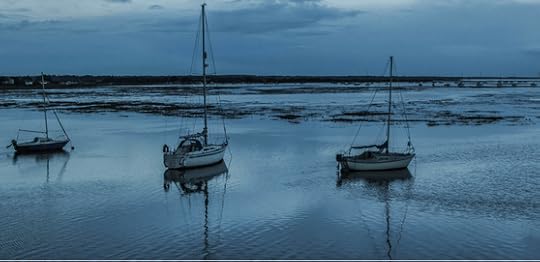
Il capitano Nichols comanda il Fenton, un bialbero di quindici metri australiano. Sappiamo che ha contrabbandato armi in Sudamerica e oppio in Cina, praticato la tratta dei neri nelle isole Salomone, e ha una cicatrice sulla fronte residuo di una ferita inflittagli da una canaglia di negro che non capiva le sue intenzioni filantropiche. in sintesi, marinaio provetto e briccone incallito.
Il dottor Saunders è stato radiato dall’albo dei medici, vive a Fuchu, in Cina, è comunque un bravo medico, specializzato nelle malattie degli occhi, cura gratis chi non può pagare, ma sottrae onorari principeschi a chi se lo può permettere. Non ha ambizione, vuole solo vivere in pace, che in qualche modo ha trovato andando a vivere nei mari del Sud.
Saunders ricorda lo stesso Maugham: stesso aspetto non proprio attraente, stesso cinismo, o disillusione, che dir si voglia, medesima bisessualità malcelata, attrazione per donne e uomini, ma soprattutto verso i secondi, uguali opinioni tranchant che sono giudizi, quando non sentenze, identica massima tolleranza per vizi e abiezioni altrui, e simile passione per l’oppio e derivati.
Sul Fenton viaggia un unico passeggero, giovane e bello e misterioso, che ha dovuto frettolosamente allontanarsi da Sidney: Fred Blake. Passggero con i nervi a fior di pelle che si da il caso sia anche il proprietario di quel guscio di noce, e quindi, il capitano Nichols è al suo servizio.
Saunders diventa il secondo passeggero.
Il terzo è Ah Kay, il domestico che viaggia con il dottore.
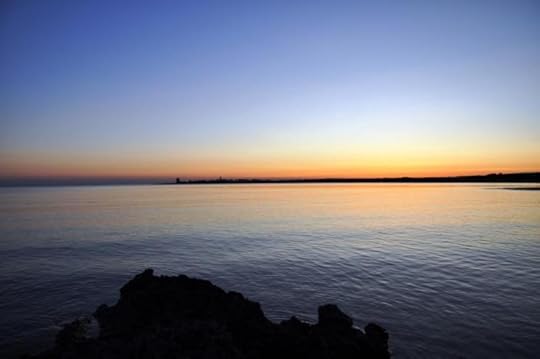
Ambientazione esotica, tempesta, onde altissime, vele stracciate, isole così ravvicinate che sembra di navigare in un canale (il narrow corner del titolo?), altri bianchi europei che in quella parte di mondo hanno trovato un rifugio, un nascondiglio, una soluzione.
In una delle isole gemelle del mar di Kanda vivono un giovane danese che dirige l’unico albergo dell’isola; un inglese vedovo di moglie scandinava che vive col ricco suocero possidente (piantagioni di noce moscata e chiodi di garofano), e Louise, la splendida nipote diciottenne che scatena sentimenti e passioni incontrollabili:
Louise indossava un sarong verde, di seta, con un complicato disegno a fili d’oro, di uno splendore sommesso; giavanese, del tipo che a Djiokjakarta le donne dell’harem portavano nelle cerimonie ufficiali. Aderiva al suo corpo sottile come una guaina, teso sui giovani capezzoli e teso sui fianchi stretti. Le spalle e le gambe erano nude. Era bella da togliere il fiato.
La trama si sviluppa avvincente, ricca, ghiotta ed emozionante, con gusto del mistero e dell’avventura, senza mai tralasciare la riflessione. Non sono tristi i tropici che Maugham narra, ma malinconici sì, e decadenti. È un mondo che sta cambiando.
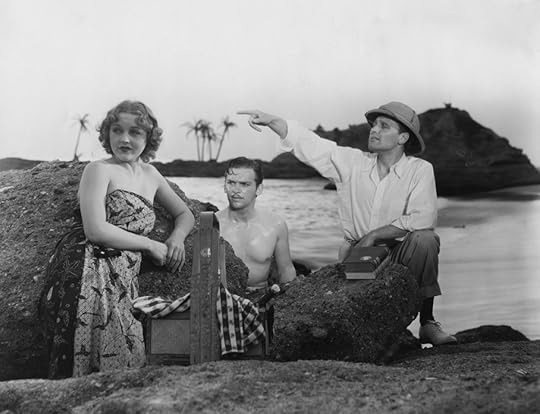
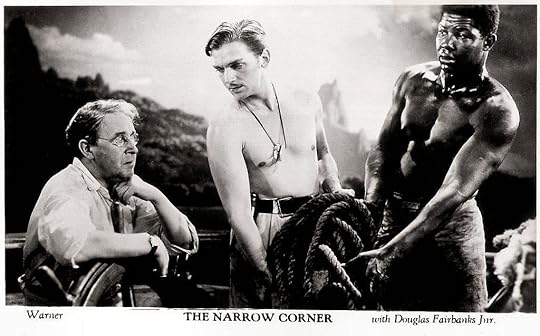
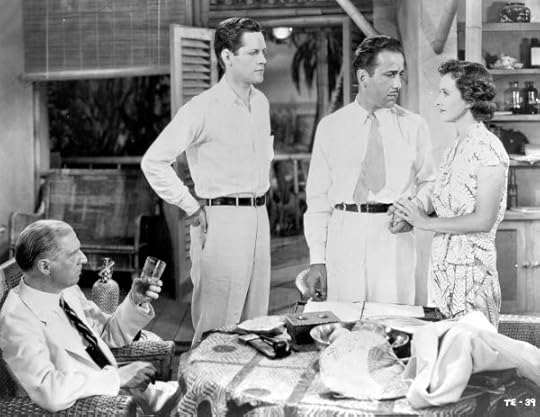
Patricia Ellis, Douglas Fairbanks Jr. e Ralph Bellamy nel film “The Narrow Corner” di Alfred E. Green (1933).
Questo romanzo ha generato un altro adattamento cinematografico, “Isle of Fury” diretto da Frank Mcdonald nel 1936. Il protagonista è interpretato da Humphrey Bogart, la lei è Margaret Lindsay, ma della storia originale è rimasta solo l’isola.
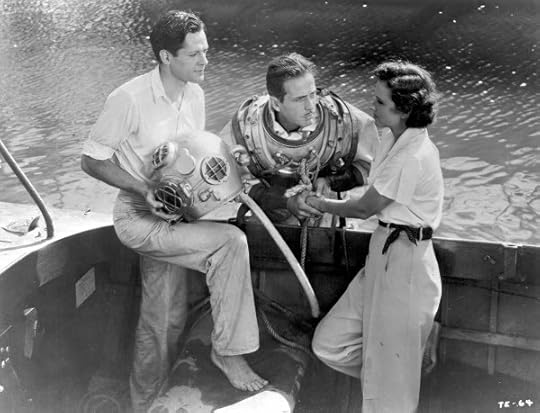
Un altro momento di “Isle of Fury”.
E poi succede che per l’entusiasmo di leggere quest’ottimo narratore inglese si acquistano libri già letti e posseduti.
E succede che gli editori facciano a gara a pubblicarlo, visto che vende bene, e per accaparrarsi anche quei lettori che lo hanno già letto – ‘lo’ nel senso di questo romanzo, proprio questo – gli cambiano il titolo rispetto all’edizione precedente.
E succede che un editore prestigioso come Adelphi storpi il titolo originale The Narrow Corner, correttamente tradotto dall’editore precedente, l’altrettanto, o quasi, prestigioso Sellerio, con Lo spazio angusto, e lo trasformi in Acque morte, secondo un’operazione che ricorda molto gli obbrobri della distribuzione cinematografica.
Io sarei dovuto essere più attento, potevo risparmiarmi la doppia spesa. Ma rileggere questo bel romanzo non mi ha fatto affatto male. Tutt’altro.
William Somerset Maugham, che si autodefiniva “uno dei primi nella fila dei secondi”, credeva in una sola cosa, e lo spiegò come meglio non si poteva al nipote Robin, che gli dedicò il libro autobiografico Conversazioni con zio Willie - e qualcuno fornito della stessa celebre cinica perfidia di Maugham direbbe che una biografia ‘positiva’ di Maugham non poteva che scriverla suo nipote, nessun altro:
In tutto il mondo ci sono storie meravigliose da scrivere. Basta avere le palle.
E Maugham sapeva raccontarle, le storie. Con un talento non comune. Infatti, il cinema che è affamato (e/o assetato) di storie, le cerca e ruba ovunque, ha saccheggiato Maugham perfino più di Conan Doyle: 98 film contro 93.
Acque morte – The Narrow Corner (1932) si apre con un magistrale prologo nel quale Maugham dice che:
I personaggi letterari sono strane creature. Si affacciano, ti entrano nella mente. Crescono… Allora li racconti, e per te cessano di esistere.
Ma non sempre è così: ci sono personaggi che non mollano, a volte ritornano, l’ossessione continua. E scrittori come Maugham sentono che non hanno finito di raccontarli, la storia va avanti.
Così è per due dei protagonisti di questo romanzo: il dottor Saunders, già apparso brevemente nel libro di viaggi On a Chinese Screen: Sketches of Life in China e poi anche nel racconto intitolato Lo straniero. e il capitano Nichols, che si trova in La luna e sei soldi.
Il capitano Nichols comanda il Fenton, un bialbero di quindici metri australiano. Sappiamo che ha contrabbandato armi in Sudamerica e oppio in Cina, praticato la tratta dei neri nelle isole Salomone, e ha una cicatrice sulla fronte residuo di una ferita inflittagli da una canaglia di negro che non capiva le sue intenzioni filantropiche. in sintesi, marinaio provetto e briccone incallito.
Il dottor Saunders è stato radiato dall’albo dei medici, vive a Fuchu, in Cina, è comunque un bravo medico, specializzato nelle malattie degli occhi, cura gratis chi non può pagare, ma sottrae onorari principeschi a chi se lo può permettere. Non ha ambizione, vuole solo vivere in pace, che in qualche modo ha trovato andando a vivere nei mari del Sud.
Saunders ricorda lo stesso Maugham: stesso aspetto non proprio attraente, stesso cinismo, o disillusione, che dir si voglia, medesima bisessualità malcelata, attrazione per donne e uomini, ma soprattutto verso i secondi, uguali opinioni tranchant che sono giudizi, quando non sentenze, identica massima tolleranza per vizi e abiezioni altrui, e simile passione per l’oppio e derivati.
Sul Fenton viaggia un unico passeggero, giovane e bello e misterioso, che ha dovuto frettolosamente allontanarsi da Sidney: Fred Blake. Passggero con i nervi a fior di pelle che si da il caso sia anche il proprietario di quel guscio di noce, e quindi, il capitano Nichols è al suo servizio.
Saunders diventa il secondo passeggero.
Il terzo è Ah Kay, il domestico che viaggia con il dottore.
Ambientazione esotica, tempesta, onde altissime, vele stracciate, isole così ravvicinate che sembra di navigare in un canale (il narrow corner del titolo?), altri bianchi europei che in quella parte di mondo hanno trovato un rifugio, un nascondiglio, una soluzione.
In una delle isole gemelle del mar di Kanda vivono un giovane danese che dirige l’unico albergo dell’isola; un inglese vedovo di moglie scandinava che vive col ricco suocero possidente (piantagioni di noce moscata e chiodi di garofano), e Louise, la splendida nipote diciottenne che scatena sentimenti e passioni incontrollabili:
Louise indossava un sarong verde, di seta, con un complicato disegno a fili d’oro, di uno splendore sommesso; giavanese, del tipo che a Djiokjakarta le donne dell’harem portavano nelle cerimonie ufficiali. Aderiva al suo corpo sottile come una guaina, teso sui giovani capezzoli e teso sui fianchi stretti. Le spalle e le gambe erano nude. Era bella da togliere il fiato.
La trama si sviluppa avvincente, ricca, ghiotta ed emozionante, con gusto del mistero e dell’avventura, senza mai tralasciare la riflessione. Non sono tristi i tropici che Maugham narra, ma malinconici sì, e decadenti. È un mondo che sta cambiando.
Patricia Ellis, Douglas Fairbanks Jr. e Ralph Bellamy nel film “The Narrow Corner” di Alfred E. Green (1933).
Questo romanzo ha generato un altro adattamento cinematografico, “Isle of Fury” diretto da Frank Mcdonald nel 1936. Il protagonista è interpretato da Humphrey Bogart, la lei è Margaret Lindsay, ma della storia originale è rimasta solo l’isola.
Un altro momento di “Isle of Fury”.

July 13, 2018
Само истински майстор може да разкаже толкова много, в относително кратък роман като този.
Очарован съм от стила на Моъм още от първия ми досег до неговото творчество - гениалната "Луна и грош" и оттогава очаквам и получавам неизменно много.
Ключово за стойността на романите му се явява почти свръхестественото му познание за човешката натура и неподражаемото ѝ пресъздаване в историите, избрани да вдъхне живот на героите си!
А най-хубавото е, че той е бил плодовит писател и има още много негови творби, до които не съм стигнал.
Моята оценка - 4,5*.
Цитати:
"— Убих един човек.
— На твое място не бих го разправял насам-натам — каза докторът.
— Ти го прие доста спокойно. Убивал ли си човек?
— Само професионално."
"По правило глупаците и подлеците съжаляват, когато им се наложи да страдат от последствията на действията си."
Очарован съм от стила на Моъм още от първия ми досег до неговото творчество - гениалната "Луна и грош" и оттогава очаквам и получавам неизменно много.
Ключово за стойността на романите му се явява почти свръхестественото му познание за човешката натура и неподражаемото ѝ пресъздаване в историите, избрани да вдъхне живот на героите си!
А най-хубавото е, че той е бил плодовит писател и има още много негови творби, до които не съм стигнал.
Моята оценка - 4,5*.
Цитати:
"— Убих един човек.
— На твое място не бих го разправял насам-натам — каза докторът.
— Ти го прие доста спокойно. Убивал ли си човек?
— Само професионално."
"По правило глупаците и подлеците съжаляват, когато им се наложи да страдат от последствията на действията си."

September 19, 2015
Often a dinner invite by an old chum is the best : you know the host and probably the company. Food will be fine as well as the setting. Why rumble with unknowns, given your mood. Hence, I wanted to read the last unread MOM for me.....Underrated, unread today. MOM at his best.
Inspired by Conrad...in a Malaya state (Indonesia, probably) arrive 3 "outcasts," each w a shady past : captain of the boat, a discredited doctor, and a beautiful rich boy. The heat is killing ; everyone has a stiffy. How to repress? ~~ The catalyst is the stunning daughter of a planter...whose Danish beau is sorting stuff out...no, don't ask.
MOM avoids all cliches and all sentimentality. He delivers his finest, most brutal finale...herein, superior writing. Nephew Robin says unkie called this his "queer" novel, though no one noticed anything odd on pub (1932) and it had 2 film versions. At end, the rich boy sighs, "Life fills me with horror..." The characters cannot escape the unreality of their lives or their wickedness. There is no escape.
Inspired by Conrad...in a Malaya state (Indonesia, probably) arrive 3 "outcasts," each w a shady past : captain of the boat, a discredited doctor, and a beautiful rich boy. The heat is killing ; everyone has a stiffy. How to repress? ~~ The catalyst is the stunning daughter of a planter...whose Danish beau is sorting stuff out...no, don't ask.
MOM avoids all cliches and all sentimentality. He delivers his finest, most brutal finale...herein, superior writing. Nephew Robin says unkie called this his "queer" novel, though no one noticed anything odd on pub (1932) and it had 2 film versions. At end, the rich boy sighs, "Life fills me with horror..." The characters cannot escape the unreality of their lives or their wickedness. There is no escape.

January 23, 2023
Originally published in 1932 the language is dated, reading it today one must do so with an open mind.
My impression is that this is a character study of the three male characters: British Dr. Saunders living in China after what we assume was some ‘problem’ in the UK, Captain Nichols, unscrupulous sea captain happy to do whatever is necessary for the money and Australian Fred Blake who has had to flee Australia, much of which we don’t find out until later in the narrative.
I have to say I got the feeling that there are elements of Maugham in each of his characters.
Maugham has a unique writing style, never boring, very descriptive without being flowery, but did required some patience on my part.
I found this paperback copy on my bookshelf and must have read it at some point long ago but didn’t remember it very well, so this is my second reading. Must have liked it the first time since it is still in my possession.
My impression is that this is a character study of the three male characters: British Dr. Saunders living in China after what we assume was some ‘problem’ in the UK, Captain Nichols, unscrupulous sea captain happy to do whatever is necessary for the money and Australian Fred Blake who has had to flee Australia, much of which we don’t find out until later in the narrative.
I have to say I got the feeling that there are elements of Maugham in each of his characters.
Maugham has a unique writing style, never boring, very descriptive without being flowery, but did required some patience on my part.
I found this paperback copy on my bookshelf and must have read it at some point long ago but didn’t remember it very well, so this is my second reading. Must have liked it the first time since it is still in my possession.

September 6, 2018
«Gli dèi ridono quando gli uomini ottengono quel che desiderano»
I personaggi letterari sono strane creature. Si affacciano, ti entrano nella mente. Crescono. Assumono talune, opportune, caratteristiche. Vivono in un certo ambiente. Di tanto in tanto ti accade di pensare a loro. A volte diventano un’ossessione, sicché non riesci a pensare ad altro. Allora li racconti, e per te cessano di esistere.
Questo è l’incipit della prefazione di Maugham a The Narrow Corner, titolo originale della sua opera. Non possiedo sicuramente il germe della creazione, in qualità di lettore però, posso affermare di aver protratto la vita a personaggi come Frank Bescombe, Harry Angstrom, Morris Bober (sono coloro di cui ricordo i nomi a memoria, ve ne sono molti altri di cui ricordo solo le gesta). I personaggi letterari muoiono come bruchi per rinascere farfalle nella testa di chi legge. È una cosa particolare che io ricordi quasi tutto di Marino Guzzi e quasi niente di Camillo Benso, che Edmond Dantes abbia più di 500.000 occorrenze su Google pur non essendo mai vissuto. I personaggi che ci regalano gli scrittori, noi a nostra volta li dotiamo di caratteristiche che i loro creatori non avevano contemplato. In un personaggio possiamo riconoscerci o riconoscere qualcun altro, lo possiamo odiare o ammirare. Per un lettore un personaggio non cessa di esistere dopo aver chiuso il libro. La prefazione di Maugham reca una sorpresa, io vi consiglierei di leggerla dopo il romanzo.
Siamo in estremo oriente su un’isola dell’arcipelago malese, Il dottor Saunders sbadiglia, sono le nove del mattino. Ha tutta la giornata davanti a sé e niente da fare. Se non avete mai letto Maugham scoprirete di quanto raffinatezza è capace, di come sia dettagliata l’analisi fisica e psicologica dei personaggi al momento che li introduce. Se infatti il dottor Saunders
Non leggeva per informarsi o per migliorare il suo intelletto, ma cercava nei libri occasione di fantasticherie. Leggeva con un senso dell’umorismo tutto suo, e traeva dalle narrazioni delle imprese missionarie un sobrio godimento che avrebbe non poco stupito gli autori.
Il personaggio successivo, in ordine d’apparizione, Il capitano Nichols
aveva una curiosa caratteristica: poteva giocare un brutto tiro a qualcuno senza poi serbargli rancore, e non riusciva a capire perché la vittima continuasse ad avercela con lui.
Ho letto con estremo godimento il capitolo 8
Ma il dottore, mirabilmente in pace, contemplava l’enigma dell’esistenza. Il suo corpo riposava così comodo sulla sdraio che egli non ne aveva coscienza, salvo che un senso oscuro di benessere fisico accresceva il suo sollievo spirituale. In questa condizione di libertà la sua anima poteva considerare la carne con un’affettuosa tolleranza simile a quella verso un amico che ci annoia ma il cui amore ci è gradito.
La sua mente era straordinariamente sveglia, e tuttavia scevra da ansia e irrequietezza; si muoveva con la sicura padronanza di un grande fisico che si muove tra i suoi simboli, e con una lucidità che gli dava il piacere assoluto della pura bellezza, fine a sé stessa. Era signore dello spazio e del tempo. Non c’era problema che non potesse risolvere se lo desiderava; tutto era chiaro, tutto stupendamente semplice; ma sembrava una sciocchezza sciogliere i nodi dell’esistenza quando era così squisitamente piacevole sapere che avresti potuto farlo
Fino ai capitoli centrali c’è stato ben poco da sbadigliare, il capitano, il dottore e il giovane Fred Blake, hanno intrapreso un viaggio per mare che si è rivelato assai pericoloso. La parte centrale è quella che ho gradito di meno, ho temuto che come già in altri romanzi di Maugham, vi fosse la svolta religiosa, iniziasse la faticosa ricerca dell’assoluto, invece si è passati al noir, ci sono stati un paio d’omicidi e sono continuate considerazioni ciniche (pardon, sentimentali) da sottolineare in punta di dito. Acque morte diventa il migliore fra i Maugham che ho letto.
I personaggi letterari sono strane creature. Si affacciano, ti entrano nella mente. Crescono. Assumono talune, opportune, caratteristiche. Vivono in un certo ambiente. Di tanto in tanto ti accade di pensare a loro. A volte diventano un’ossessione, sicché non riesci a pensare ad altro. Allora li racconti, e per te cessano di esistere.
Questo è l’incipit della prefazione di Maugham a The Narrow Corner, titolo originale della sua opera. Non possiedo sicuramente il germe della creazione, in qualità di lettore però, posso affermare di aver protratto la vita a personaggi come Frank Bescombe, Harry Angstrom, Morris Bober (sono coloro di cui ricordo i nomi a memoria, ve ne sono molti altri di cui ricordo solo le gesta). I personaggi letterari muoiono come bruchi per rinascere farfalle nella testa di chi legge. È una cosa particolare che io ricordi quasi tutto di Marino Guzzi e quasi niente di Camillo Benso, che Edmond Dantes abbia più di 500.000 occorrenze su Google pur non essendo mai vissuto. I personaggi che ci regalano gli scrittori, noi a nostra volta li dotiamo di caratteristiche che i loro creatori non avevano contemplato. In un personaggio possiamo riconoscerci o riconoscere qualcun altro, lo possiamo odiare o ammirare. Per un lettore un personaggio non cessa di esistere dopo aver chiuso il libro. La prefazione di Maugham reca una sorpresa, io vi consiglierei di leggerla dopo il romanzo.
Siamo in estremo oriente su un’isola dell’arcipelago malese, Il dottor Saunders sbadiglia, sono le nove del mattino. Ha tutta la giornata davanti a sé e niente da fare. Se non avete mai letto Maugham scoprirete di quanto raffinatezza è capace, di come sia dettagliata l’analisi fisica e psicologica dei personaggi al momento che li introduce. Se infatti il dottor Saunders
Non leggeva per informarsi o per migliorare il suo intelletto, ma cercava nei libri occasione di fantasticherie. Leggeva con un senso dell’umorismo tutto suo, e traeva dalle narrazioni delle imprese missionarie un sobrio godimento che avrebbe non poco stupito gli autori.
Il personaggio successivo, in ordine d’apparizione, Il capitano Nichols
aveva una curiosa caratteristica: poteva giocare un brutto tiro a qualcuno senza poi serbargli rancore, e non riusciva a capire perché la vittima continuasse ad avercela con lui.
Ho letto con estremo godimento il capitolo 8
Ma il dottore, mirabilmente in pace, contemplava l’enigma dell’esistenza. Il suo corpo riposava così comodo sulla sdraio che egli non ne aveva coscienza, salvo che un senso oscuro di benessere fisico accresceva il suo sollievo spirituale. In questa condizione di libertà la sua anima poteva considerare la carne con un’affettuosa tolleranza simile a quella verso un amico che ci annoia ma il cui amore ci è gradito.
La sua mente era straordinariamente sveglia, e tuttavia scevra da ansia e irrequietezza; si muoveva con la sicura padronanza di un grande fisico che si muove tra i suoi simboli, e con una lucidità che gli dava il piacere assoluto della pura bellezza, fine a sé stessa. Era signore dello spazio e del tempo. Non c’era problema che non potesse risolvere se lo desiderava; tutto era chiaro, tutto stupendamente semplice; ma sembrava una sciocchezza sciogliere i nodi dell’esistenza quando era così squisitamente piacevole sapere che avresti potuto farlo
Fino ai capitoli centrali c’è stato ben poco da sbadigliare, il capitano, il dottore e il giovane Fred Blake, hanno intrapreso un viaggio per mare che si è rivelato assai pericoloso. La parte centrale è quella che ho gradito di meno, ho temuto che come già in altri romanzi di Maugham, vi fosse la svolta religiosa, iniziasse la faticosa ricerca dell’assoluto, invece si è passati al noir, ci sono stati un paio d’omicidi e sono continuate considerazioni ciniche (pardon, sentimentali) da sottolineare in punta di dito. Acque morte diventa il migliore fra i Maugham che ho letto.

February 24, 2008
It is wonderful, as is everything by maughum i've found so far. He seems to write with no regard for what a novel is supposed to look like, and yet at the same time he has the literary equivalent of an interior clock, or perfect pitch. The timing, pacing and scope always seem just right, even when they're not remotely similar to those of any other novelist (I know of). There is natural flow, almost as in a kind "automoatic writing"--which is not to say there is anything incoherent about his novels. The narrator is a minor presence, but one with a persona and personality, an observer who is intrigued by character and seeks to get "at" the nut of each person. Like Forster--pray tell because he's so gay?--he has an interesting kind of clinical interest in the (hetero) romances; he portrays them without communicating their passion, and yet with his own passionate interest in them as "things"/"encounters."
Another thing I love about Maughum is his treatment of eastern spirituality. Rather than trying to incorporate it in to the worldview of a culture he sees as so drastically apart, he introduces the theme by having characters who are reading the Upanishads, the Baghavad Gita, etc. They hold forth on why they love those works, and then because that sensibility has been introduced, the author/narrator is able to sneak in the sensibility without it seeming so alien.
I also love Maughum's subject, the foreigner abroad. The characters are dislocated and therefore willing to connect with strangers. His characters are conummate outsiders and therefore observers; again the theme of gayness seemes here submerged but evident as well.
Another thing I love about Maughum is his treatment of eastern spirituality. Rather than trying to incorporate it in to the worldview of a culture he sees as so drastically apart, he introduces the theme by having characters who are reading the Upanishads, the Baghavad Gita, etc. They hold forth on why they love those works, and then because that sensibility has been introduced, the author/narrator is able to sneak in the sensibility without it seeming so alien.
I also love Maughum's subject, the foreigner abroad. The characters are dislocated and therefore willing to connect with strangers. His characters are conummate outsiders and therefore observers; again the theme of gayness seemes here submerged but evident as well.

November 30, 2019
This is a Somerset Maugham Far Eastern tale set in what was part of the British Empire and also, for much of this story, in the Dutch Empire near current day Indonesia.
The settings are wonderfully exotic and capture the tropical atmosphere of plantations and foliage. There are a small host of characters and one feels the tensions between them. In each their own way they all appear ill-adjusted to their environment and have warped at being so far removed from their homeland and transplanted to rule in a foreign land. Maugham is superb at portraying human foibles. Nobody is perfect in a Maugham story. I do feel the observant and detached Dr. Saunders is Maugham himself.
As a warning there are racist remarks throughout which was characteristic of the era (this was written in 1932). But Maugham wrote about Europeans and how their behavior became transformed by their new environment, not about the native inhabitants. He examines, at times philosophically, the lives of these colonialists. There is a taunt mystery throughout as the characters unravel.
The settings are wonderfully exotic and capture the tropical atmosphere of plantations and foliage. There are a small host of characters and one feels the tensions between them. In each their own way they all appear ill-adjusted to their environment and have warped at being so far removed from their homeland and transplanted to rule in a foreign land. Maugham is superb at portraying human foibles. Nobody is perfect in a Maugham story. I do feel the observant and detached Dr. Saunders is Maugham himself.
As a warning there are racist remarks throughout which was characteristic of the era (this was written in 1932). But Maugham wrote about Europeans and how their behavior became transformed by their new environment, not about the native inhabitants. He examines, at times philosophically, the lives of these colonialists. There is a taunt mystery throughout as the characters unravel.

March 22, 2018
This story is set out on the sea and on small islands of Southeast Asia. Doctor Saunders (a British trained doctor and eye specialist living in China), Fred Blake (the son of an Australian politician needing to be whisked out of public view), the skipper Nicholls and his crew are onboard a lugger. A lugger is a small sailing ship. Doctor Saunders, having performed an eye operation on Takarna, an island of what was then the Dutch East Indies and now Indonesia, is seeking passage home to Fu-Chou, China, where he lives. An arrangement is made whereby he gets free passage on the sailing vessel if he will treat skipper Nicholls’ dyspepsia ailment. Fred Blake is already onboard.
The story can best be described as character sketches of the three mentioned above and a couple of characters met on the trip. We meet a Dane and a Swedish family of three—grandfather, son and granddaughter. Beside the Australian, the characters are Europeans who have by preference settled themselves in the East. This makes them interesting right off the bat. One smokes opium, another translates obscure Portuguese poetry (The Lusiads), another is devoted to the study of Eastern philosophy and has a nutmeg plantation. One is curious to understand why the Australian is onboard. The Dane is to be married, and then arrive the strangers on the boat. None of the characters are ordinary; one cannot help but be curious to know more about each. What each one says and does and thinks fits perfectly who they are. The book is a study of strangers that meet up, spend a short time with each other and then part.
In my view, it is less important to compare where the story starts and how it ends than to watch how the characters interact with each other. I enjoyed observing how each one behaves so differently when faced with the same event. Each behaves according to their own character. There is a storm and a sea burial and a love affair. Watch how each one behaves. I found myself laughing when I should not logically have been laughing. Yeah, I laughed at the sea burial. This is due to Maugham’s lines and how he draws the scenes.
The audiobook is extremely well narrated by David Thorpe. Each of the characters have an English accent that is a little bit different, each one reflecting their country of origin. The skipper, the English doctor, the young Australian, Blacks, the crew, the Dane and the Swedes are all easily discernible. The accent is perfect for each, all except for one. The Swedish grandfather is said to have a high treble voice, but I cannot imagine an old man sounding as he does. His voice is sort of a squeak. A listener is never in doubt as to who is speaking, and Thorpe flips from one to the other with ease and without error. I think the narration is worth five stars; the old Swedish man does not speak that often. I think maybe one may enjoy the story more by listening to Thorpe than by reading the text; the narration is that good. Thorpe dramatizes, but he does not overdo it, not ever.
*********************
My ratings of Maugham’s books :
*Then and Now 5 stars
*Mrs Craddock 4 stars
*Cakes and Ale 4 stars
*The Painted Veil 4 stars
*The Verger 4 stars
*Liza of Lambeth 3 stars
*The Razor's Edge 3 stars
*The Summing Up 3 stars
*The Gentleman in the Parlour: A Record of a Journey from Rangoon to Haiphong 3 stars
*The Magician 3 stars
*Up at the Villa 3 stars
*Christmas Holiday 3 stars
*Catalina 3 stars
*The Narrow Corner 3 stars
*Ashenden 3 stars
*Theatre 2 stars
*The Moon and Sixpence 2 stars
*Of Human Bondage 2 stars
*The Merry-Go-Round 1 star
Books and short stories by Maugham still to be read :
Rain and Other South Sea Stories currently reading
The Constant Wife
Don Fernando
The story can best be described as character sketches of the three mentioned above and a couple of characters met on the trip. We meet a Dane and a Swedish family of three—grandfather, son and granddaughter. Beside the Australian, the characters are Europeans who have by preference settled themselves in the East. This makes them interesting right off the bat. One smokes opium, another translates obscure Portuguese poetry (The Lusiads), another is devoted to the study of Eastern philosophy and has a nutmeg plantation. One is curious to understand why the Australian is onboard. The Dane is to be married, and then arrive the strangers on the boat. None of the characters are ordinary; one cannot help but be curious to know more about each. What each one says and does and thinks fits perfectly who they are. The book is a study of strangers that meet up, spend a short time with each other and then part.
In my view, it is less important to compare where the story starts and how it ends than to watch how the characters interact with each other. I enjoyed observing how each one behaves so differently when faced with the same event. Each behaves according to their own character. There is a storm and a sea burial and a love affair. Watch how each one behaves. I found myself laughing when I should not logically have been laughing. Yeah, I laughed at the sea burial. This is due to Maugham’s lines and how he draws the scenes.
The audiobook is extremely well narrated by David Thorpe. Each of the characters have an English accent that is a little bit different, each one reflecting their country of origin. The skipper, the English doctor, the young Australian, Blacks, the crew, the Dane and the Swedes are all easily discernible. The accent is perfect for each, all except for one. The Swedish grandfather is said to have a high treble voice, but I cannot imagine an old man sounding as he does. His voice is sort of a squeak. A listener is never in doubt as to who is speaking, and Thorpe flips from one to the other with ease and without error. I think the narration is worth five stars; the old Swedish man does not speak that often. I think maybe one may enjoy the story more by listening to Thorpe than by reading the text; the narration is that good. Thorpe dramatizes, but he does not overdo it, not ever.
*********************
My ratings of Maugham’s books :
*Then and Now 5 stars
*Mrs Craddock 4 stars
*Cakes and Ale 4 stars
*The Painted Veil 4 stars
*The Verger 4 stars
*Liza of Lambeth 3 stars
*The Razor's Edge 3 stars
*The Summing Up 3 stars
*The Gentleman in the Parlour: A Record of a Journey from Rangoon to Haiphong 3 stars
*The Magician 3 stars
*Up at the Villa 3 stars
*Christmas Holiday 3 stars
*Catalina 3 stars
*The Narrow Corner 3 stars
*Ashenden 3 stars
*Theatre 2 stars
*The Moon and Sixpence 2 stars
*Of Human Bondage 2 stars
*The Merry-Go-Round 1 star
Books and short stories by Maugham still to be read :
Rain and Other South Sea Stories currently reading
The Constant Wife
Don Fernando

May 14, 2021
*Warning: Mild Spoilers*
Maugham is an elegant writer. There is no other way to describe him. His stories are not earth-shaking; his plots are ordinary; and his characters are extremely human and flawed. But when he mixes them together and seasons it with his magic prose, what we get is a tragic concoction worthy of Shakespeare.
Maugham has used characters from his previous works in this novel: Dr. Saunders from On A Chinese Screen and Captain Nichols from The Moon and Sixpence. It was not his original intention, but as he says in the preface to this edition, characters sometimes do not let one go. So these two rather unsavoury specimens again resurface in this novel, like bad pennies.
The story is set in the Far East, between the World Wars. Dr. Saunders is an English physician knocking about in China and the Malay Peninsula. Some unmentioned folly from his past has prevented him from ever returning to England. He meets up with the captain of a lugger, Nichols, on an island in the South China Sea, and joins his crew as physician to treat the Captain's chronic dyspepsia; at the same time earning a trip back to the Chinese town of Fu-Chou which he has made his home for fifteen years.
The captain has a mysterious mission; to carry a politically-connected young man named Fred Blake (who is from Australia) around without asking questions. Nichols suspects a crime, committed by the young man, in Australia; but being a crook of the first water, has no qualms about ferrying him around provided the price is right.
A gale forces them out of the way, and after being becalmed for nearly a week, they stop at the twin islands of Kanda-Meria in the Kanda Sea to drop the doctor off, who plans to wait for a Dutch steamer there. The others also decide stay for a couple of days for a bit of rest. During the stopover, they meet the well-read Dane Erik Christessen, the philosophical Frith, his senile father-in-law, the plantation owner Swan - and his lovely daughter Louise. And with the combination of two men and one woman, can the love triangle and its attendant tragedy be far away? As it inevitably overtakes the players, Fred Blake's past also seems to catch up with him...
Did I give you the impression that this story was a trite romance? It would have been, in the hands of a less skilled writer. But with Maugham, it becomes a thing of beauty to be savoured, mostly due to the beautiful prose (not a word out of place) and superb characterisation.
Let's take Dr. Saunders, through whose viewpoint most of the story is told. He is selfish and cynical, and there is something very nasty in his past. Yet he views the world with such a detachment and a high level of tolerance for his fellow human beings, that by the end you find yourself empathising with him. And Captain Nichols, as thoroughgoing a crook as you can ever expect to see; yet he is so honest about his dishonesty that you can't help admiring him! And so with all the other characters - fully realised, each one of them.
The one huge flaw I found in the novel was when the POV suddenly shifted for one chapter from Dr. Saunders to Erik. Technically speaking it can't be called one - but it does disrupt the rhythm of a finely crafted narrative.
Maugham is an elegant writer. There is no other way to describe him. His stories are not earth-shaking; his plots are ordinary; and his characters are extremely human and flawed. But when he mixes them together and seasons it with his magic prose, what we get is a tragic concoction worthy of Shakespeare.
Maugham has used characters from his previous works in this novel: Dr. Saunders from On A Chinese Screen and Captain Nichols from The Moon and Sixpence. It was not his original intention, but as he says in the preface to this edition, characters sometimes do not let one go. So these two rather unsavoury specimens again resurface in this novel, like bad pennies.
The story is set in the Far East, between the World Wars. Dr. Saunders is an English physician knocking about in China and the Malay Peninsula. Some unmentioned folly from his past has prevented him from ever returning to England. He meets up with the captain of a lugger, Nichols, on an island in the South China Sea, and joins his crew as physician to treat the Captain's chronic dyspepsia; at the same time earning a trip back to the Chinese town of Fu-Chou which he has made his home for fifteen years.
The captain has a mysterious mission; to carry a politically-connected young man named Fred Blake (who is from Australia) around without asking questions. Nichols suspects a crime, committed by the young man, in Australia; but being a crook of the first water, has no qualms about ferrying him around provided the price is right.
A gale forces them out of the way, and after being becalmed for nearly a week, they stop at the twin islands of Kanda-Meria in the Kanda Sea to drop the doctor off, who plans to wait for a Dutch steamer there. The others also decide stay for a couple of days for a bit of rest. During the stopover, they meet the well-read Dane Erik Christessen, the philosophical Frith, his senile father-in-law, the plantation owner Swan - and his lovely daughter Louise. And with the combination of two men and one woman, can the love triangle and its attendant tragedy be far away? As it inevitably overtakes the players, Fred Blake's past also seems to catch up with him...
Did I give you the impression that this story was a trite romance? It would have been, in the hands of a less skilled writer. But with Maugham, it becomes a thing of beauty to be savoured, mostly due to the beautiful prose (not a word out of place) and superb characterisation.
Let's take Dr. Saunders, through whose viewpoint most of the story is told. He is selfish and cynical, and there is something very nasty in his past. Yet he views the world with such a detachment and a high level of tolerance for his fellow human beings, that by the end you find yourself empathising with him. And Captain Nichols, as thoroughgoing a crook as you can ever expect to see; yet he is so honest about his dishonesty that you can't help admiring him! And so with all the other characters - fully realised, each one of them.
The one huge flaw I found in the novel was when the POV suddenly shifted for one chapter from Dr. Saunders to Erik. Technically speaking it can't be called one - but it does disrupt the rhythm of a finely crafted narrative.

December 1, 2024
'Fortunately we live in the most democratic country in the world,' he said. 'Nobody is above corruption.'I'd read and enjoyed a number of the more-famous Maugham novels (tho I was a little underwhelmed by 'Cakes and Ale') - and took note of this one that's less-talked-about. For some reason I felt drawn to it, even tho its bumfuck setting (largely) in the Dutch East Indies didn't (to me) hold promise.
You can find yourself going to less-likely places when you trust an author, and I largely trust Maugham. (That said, I still don't feel drawn to 'The Moon and Sixpence'.)
When you begin a novel - any novel - it can be important for some elusive thing to grab you so that you'll have something to hook into relatively soon. What I didn't expect here is that the novel grabbed me perhaps more quickly than any other Maugham novel I'd previously read.
That's because of the writing. Maugham manages a particular thrust early on that I found singularly engaging. ~ all the more striking considering I wasn't feeling invested in the geographical set-up.
'TNC' is (ultimately, and almost before you know it) a riveting tale told by its dispassionate (to say the least) narrator, Dr. Saunders. Significantly, Saunders is an eye doctor; a kind who can pierce through man's leaning toward folly. Life has jaded Saunders. Little (or, I should say, nothing) surprises him when it comes to the human tendency to embrace less-desirable choices (ironically borne of desire):
'Life is short, nature is hostile, and man is ridiculous but oddly enough most misfortunes have their compensations and with a certain humour and a good deal of horse-sense one can make a fairly good job of what is after all a matter of very small of consequence.'With his own desire to finally take a vacation, Saunders finds himself in the company of two shady characters (one young 'passenger', one older skipper) who get him through a vividly detailed sea storm before the three finally touch land on a 'way station'. It's there that all will be revealed, among several new, uniquely eccentric characters - a few charming, a few dilapidated.
'TNC' hinges on human reluctance to part with crucial information; the kind offered more freely when trust has more confidently been established. Trust does not come easily in this scenario, and the narrative somewhat toys with us with its initial focus on the skipper:
It was as if he took so much delight in lying that it would have spoilt it for him if you had accepted it as the truth.We're then toyed with again, as Maugham segues into a period resembling bonhomie.
It's a ruse. The rug will be pulled out from under in a way that, while not wholly unanticipated, shocks with the unraveling.
Maugham again excels at sharp character delineation. Throughout, the author makes a point of strategic pit-stops in order to illuminate what exactly makes most of the people here tick. We get the unsuspected layers inside most of these souls and they're marked by the specific, i.e.:
He was like a well-bred man who will not expose his mistress to the humiliation of knowing that he does not believe her lies.Around the 2/3-mark, all situational pretense (and there's a ton of it) begins to be abandoned, til it's like the fall of upended dominoes.
Then, when you think the story is over, there's more. And it's a zinger.
It's been said that Maugham has a writing style that's 'plain' but, to me, it's just plain good. It's refreshingly clear and unfussy, direct, insightful and, in spite of his claim of being agnostic, cautiously imbued with spiritual yearning:
There was a pause, and with a smile the day broke. Sailing between those uninhabited islands, on that still sea, in a silence that caused you almost to hold your breath, you had a strange and exciting impression of the beginning of the world. There man might never have passed and you had a feeling that what your eyes saw had never been seen before. You had a sensation of primeval freshness, and all the complication of the generations disappeared. A stark simplicity, as bare and severe as a straight line, filled the soul with rapture. Dr. Saunders knew at that moment the ecstasy of the mystic.

January 6, 2010
For me, one of life's pleasures is reading or rereading Somerset Maugham. The luster of his prose never dulls; his ability to capture a character vividly always intrigues. He never does this with anything as prosaic has a physical description or "He Said," but rather by revealing a telling thought or action. Thus, it was with happy anticipation that I opened THE NARROW CORNER.
Once again Maugham carries us to the far corners of the world and introduces rare characters who meet aboard ship, a lugger to be exact. We meet Dr. Saunders, an opium addicted medic, who has lived and practiced in Fu-chou for 15 years. He is an easy man to get along with, observant and non-judgmental. "Right and wrong were no more to him than good weather and bad weather. He took them as they came. He judged but he did not condemn. He laughed."
Saunders is paid a sizeable sum of money to go to Takana to perform surgery on a nearly blind former patient. It turns out to be an incredible journey both on sea and land.
The lugger is a rather sad vessel captained by Nichols, an unsavory character, happy to be escaping from his nagging missus. Saunders finds but one other passenger on board, Fred Blake, a mysterious young man. It seems that Nichols had been retained to take Blake to sea. Following a horrendous storm the ship puts in at a small island, Kanda, formerly a center for spice trade. Here they not only find refuge but the beginnings of a dark drama.
They meet a meager few islanders who are barely making a living, yet seem content with their lot. Among them is a beautiful young woman, Louise. What follows is unexpected emotional upheaval and death.
Maugham sprinkles his narrative with descriptions of the tropical island so vivid that one can almost feel the heat. To read this author is to recognize a master at work, and to read one of his short novels such as THE NARROW CORNER is simply to leave one wanting more.
Enjoy!
- Gail Cooke

November 29, 2020
Sahaflardan almıştım baskı yılı 1966. Yenisini basmadılar sanırım. ''Yaşama Korkusu'' türkçe adı. Somerset, Benim favori yazarlarımdan asla vazgeçemeyeceklerimden. Diğer eserlerine göre daha değişik bu eseri zaten konusu değil sadece mekan olarak da avrupadan oldukça uzakta.Yine de tekrar okuyacağım bu eserini de. Umarım tekrar basarlar okumayı isteyen çok insan vardır bence.
Kitabı tekrar okudum Aralık sonlarında diyeceğim tek şey insan ruhunun derinlerine inmeyi her zaman bir şekilde başaran yazarımızın yine bir harika yaratmış olduğunu görerek benim yazarım demeyi sürdürüyorum.Tavsiye ederim.
Kitabı tekrar okudum Aralık sonlarında diyeceğim tek şey insan ruhunun derinlerine inmeyi her zaman bir şekilde başaran yazarımızın yine bir harika yaratmış olduğunu görerek benim yazarım demeyi sürdürüyorum.Tavsiye ederim.

July 11, 2017
This is one of my favourite stories by WSM. I like it first and foremost because it reminds me of when I worked in Indonesia, during the Timor crisis in 1999. WSM is a master at evocative descriptions of landscape and culture, and reading this story you are transported to the South China sea, with its thousands of islands, all different and yet all imbued with the mystery of the east and the easy-going nature of people in the tropics. But the potential for violence still slumbers beneath the surface, and can be triggered if the people feel they are the victims of injustice.
Beyond that, WSM's novel takes the reader back to an earlier time, before WWII and the Cold War, when travel was much more demanding, and yet perhaps more charming, certainly requiring more engagement. The characters he depicts so well, and with such an eye to humour, are the characters of that time, although they certainly exist in a somewhat different guise today. The story itself is more an excuse to take the reader on a sea voyage, but it nevertheless manages to hook the reader and doesn't fail to deliver drama, humour and suspense right until the very end.
Beyond that, WSM's novel takes the reader back to an earlier time, before WWII and the Cold War, when travel was much more demanding, and yet perhaps more charming, certainly requiring more engagement. The characters he depicts so well, and with such an eye to humour, are the characters of that time, although they certainly exist in a somewhat different guise today. The story itself is more an excuse to take the reader on a sea voyage, but it nevertheless manages to hook the reader and doesn't fail to deliver drama, humour and suspense right until the very end.

February 19, 2023
The story was interesting and entertaining to read. But not as remarkable as other works of Maugham I have read. Again some quotations and aphorisms were truly brilliant. But I would not count this one among his other more memorable works. The characters were, as goes with Maugham, well fleshed out with their characteristics very clearly defined.
I am still conflicted though since writing was fantastic but the characters and plot were not that arresting to me. Hence a 4 star rating and not 5.
I’ll like to make a special note of the last 10 pages or so. The conversation there was brilliant and overall led to a great conclusion to the story.
I am still conflicted though since writing was fantastic but the characters and plot were not that arresting to me. Hence a 4 star rating and not 5.
I’ll like to make a special note of the last 10 pages or so. The conversation there was brilliant and overall led to a great conclusion to the story.

May 19, 2018
“Breve, dunque, è la vita dell’uomo
e angusto l’angolo della terra in cui egli dimora”.
Il dottor Saunders è un medico oppiomane radiato dall’Albo inglese che ritiratosi nelle isole della Malesia esercita lì con successo la sua professione. Ma non è questo quello che interessa. E’ piuttosto il modo in cui lui vede il mondo, scettico e cinico che neanche la morte riesce a sciogliere, come se quell’oppio rimanesse sempre davanti ai suoi occhi creando una patina attraverso cui vedere il mondo.
E’ il fatto che di questo personaggio Maugham non riesce a sbarazzarsi, come ci dice lui stesso nella prefazione, dopo averlo creato per un precedente romanzo, La luna e sei soldi. Un amico a cui rimanere legato in qualche modo.
Con lui lo scrittore ci racconta di abbandoni, morti, debolezze dell’animo umano che sempre si ripetono ad ogni longitudine e latitudine. Ma qui da scenario fanno splendide acque malesi, in cui veleggiamo su notti limpide o con mari in tempesta alla ricerca di risposte agli interrogativi della vita.
“Guardate il mare: un’onda segue all’altra, e non è la stessa onda, ma una è causa dell’altra e le trasmette forma e movimento. Così gli esseri che viaggiano attraverso il mondo non sono gli stessi oggi e domani, né in una vita gli stessi che in un’altra; eppure è la spinta e la forma delle vite precedenti a determinare il carattere di quelle che seguono. Una credenza ragionevole, ma incredibile. .
Una lettura diversa, lontana dalla perfezione del “velo dipinto” su acque scintillanti o stagnanti, ma comunque piacevole anche se con un finale amaro.
“Ciò che dà bellezza a un ideale è la sua irraggiungibilità. Gli dèi ridono quando gli uomini ottengono quel che desiderano” .
e angusto l’angolo della terra in cui egli dimora”.
Il dottor Saunders è un medico oppiomane radiato dall’Albo inglese che ritiratosi nelle isole della Malesia esercita lì con successo la sua professione. Ma non è questo quello che interessa. E’ piuttosto il modo in cui lui vede il mondo, scettico e cinico che neanche la morte riesce a sciogliere, come se quell’oppio rimanesse sempre davanti ai suoi occhi creando una patina attraverso cui vedere il mondo.
E’ il fatto che di questo personaggio Maugham non riesce a sbarazzarsi, come ci dice lui stesso nella prefazione, dopo averlo creato per un precedente romanzo, La luna e sei soldi. Un amico a cui rimanere legato in qualche modo.
Con lui lo scrittore ci racconta di abbandoni, morti, debolezze dell’animo umano che sempre si ripetono ad ogni longitudine e latitudine. Ma qui da scenario fanno splendide acque malesi, in cui veleggiamo su notti limpide o con mari in tempesta alla ricerca di risposte agli interrogativi della vita.
“Guardate il mare: un’onda segue all’altra, e non è la stessa onda, ma una è causa dell’altra e le trasmette forma e movimento. Così gli esseri che viaggiano attraverso il mondo non sono gli stessi oggi e domani, né in una vita gli stessi che in un’altra; eppure è la spinta e la forma delle vite precedenti a determinare il carattere di quelle che seguono. Una credenza ragionevole, ma incredibile. .
Una lettura diversa, lontana dalla perfezione del “velo dipinto” su acque scintillanti o stagnanti, ma comunque piacevole anche se con un finale amaro.
“Ciò che dà bellezza a un ideale è la sua irraggiungibilità. Gli dèi ridono quando gli uomini ottengono quel che desiderano” .

April 11, 2021
— Сега знам какво му е — каза докторът. — Имал си е мечта и тя се е осъществила. А идеалната красота е в непостижимото. Боговете се смеят, когато хората се доберат до това, което са искали.
— Не разбирам за какво говориш — каза Фред. — Още си сънен.
— Да пием по чаша бира. Това поне няма да е илюзия.
*****
Но според мене той (...) не можа да преживее шока от откритието, че човекът, на когото беше приписал всякакви качества и добродетели, в крайна сметка постъпи просто по човешки. Луд е бил, за да си въобразява другото. Това е най-лошото на идеалистите — не приемат хората такива, каквито са.
*****
— Интелигентно момче е този — каза капитан Никълз, когато отминаха малко. — Веднага разбра, че сме джентълмени.
Д-р Сондърз го погледна. В изражението на капитана нямаше и следа от ирония.
— Не разбирам за какво говориш — каза Фред. — Още си сънен.
— Да пием по чаша бира. Това поне няма да е илюзия.
*****
Но според мене той (...) не можа да преживее шока от откритието, че човекът, на когото беше приписал всякакви качества и добродетели, в крайна сметка постъпи просто по човешки. Луд е бил, за да си въобразява другото. Това е най-лошото на идеалистите — не приемат хората такива, каквито са.
*****
— Интелигентно момче е този — каза капитан Никълз, когато отминаха малко. — Веднага разбра, че сме джентълмени.
Д-р Сондърз го погледна. В изражението на капитана нямаше и следа от ирония.

July 10, 2013
Breve, dunque, è la vita dell’uomo, e angusto l’angolo della terra in cui egli dimora
Oltre che raffinato narratore, W. Somerset Maugham è uomo di mondo, inteso nel senso di conoscitore del mondo, ed in ogni suo romanzo la fine ironia, unita a una buona dose di cinismo, sul modo di concepire la vita conferisce piacevolezza alla lettura e profondità a delle storie che a prima vista sono così semplici, quasi banali. Anche in questo romanzo è così: assistiamo alla consumazione ed alle tragiche conseguenze di un triangolo amoroso tra due giovani uomini belli ed aitanti, un ragioniere australiano pieno di entusiasmo, in fuga per i mari tropicali per motivi misteriosi ed un commerciante danese che recita Shakespeare, tra i quali è sorta una amicizia recente ma profonda, ed una donna bellissima e sensuale come una dea greca, che si rivelerà nel finale molto meno candida di come si presenta, il tutto all’ombra asfissiante delle palme e degli alberi di noce moscata delle isole della Malesia, cullati dalle onde dell’Oceano Indiano che l’improvviso arrivo del monsone in un attimo trasforma in un tempestoso muro d’acqua, nel quale le vite umane sono completamente in balia della natura. Le vicende ruotano intorno a un personaggio centrale, il dottor Saunders, un medico inglese radiato dall’albo non si sa per quale motivo, dedito all’oppio, cinico osservatore della varietà della follia umana senza che nulla possa scalfire la sua impertubabilità acquisita con anni di esercizio di “anestesia” dalle emozioni. In lui ritroviamo l’ironia e lo spirito caustico di Maugham, ben espressi in perle di saggezza che racchiudono la sua filosofia di vita: “ La cosa più preziosa che ho imparato dalla vita è di non rimpiangere niente. La vita è breve, la natura ostile, e l’uomo assurdo; ma, stranamente, le sventure hanno per lo più i loro compensi e con un certo umorismo e una buona dose di senso comune possiamo cavarcela discretamente in questa faccenda del vivere, che dopotutto ha ben poca importanza”.
Ancora una volta uno straordinario romanzo, in cui lo humour tipicamente “old England”, pervaso sì di pessimismo ma con un leggero sorriso tra le labbra, rende appassionante la lettura dalla prima all’ultima pagina.
Oltre che raffinato narratore, W. Somerset Maugham è uomo di mondo, inteso nel senso di conoscitore del mondo, ed in ogni suo romanzo la fine ironia, unita a una buona dose di cinismo, sul modo di concepire la vita conferisce piacevolezza alla lettura e profondità a delle storie che a prima vista sono così semplici, quasi banali. Anche in questo romanzo è così: assistiamo alla consumazione ed alle tragiche conseguenze di un triangolo amoroso tra due giovani uomini belli ed aitanti, un ragioniere australiano pieno di entusiasmo, in fuga per i mari tropicali per motivi misteriosi ed un commerciante danese che recita Shakespeare, tra i quali è sorta una amicizia recente ma profonda, ed una donna bellissima e sensuale come una dea greca, che si rivelerà nel finale molto meno candida di come si presenta, il tutto all’ombra asfissiante delle palme e degli alberi di noce moscata delle isole della Malesia, cullati dalle onde dell’Oceano Indiano che l’improvviso arrivo del monsone in un attimo trasforma in un tempestoso muro d’acqua, nel quale le vite umane sono completamente in balia della natura. Le vicende ruotano intorno a un personaggio centrale, il dottor Saunders, un medico inglese radiato dall’albo non si sa per quale motivo, dedito all’oppio, cinico osservatore della varietà della follia umana senza che nulla possa scalfire la sua impertubabilità acquisita con anni di esercizio di “anestesia” dalle emozioni. In lui ritroviamo l’ironia e lo spirito caustico di Maugham, ben espressi in perle di saggezza che racchiudono la sua filosofia di vita: “ La cosa più preziosa che ho imparato dalla vita è di non rimpiangere niente. La vita è breve, la natura ostile, e l’uomo assurdo; ma, stranamente, le sventure hanno per lo più i loro compensi e con un certo umorismo e una buona dose di senso comune possiamo cavarcela discretamente in questa faccenda del vivere, che dopotutto ha ben poca importanza”.
Ancora una volta uno straordinario romanzo, in cui lo humour tipicamente “old England”, pervaso sì di pessimismo ma con un leggero sorriso tra le labbra, rende appassionante la lettura dalla prima all’ultima pagina.

April 27, 2026
Прекалено женомразка книга!
Толкава противни женски образи накуп съм срещала само у Съмърсет Моъм.
И като цяло книгата звучи изключително песимистично и цинично.
Това силно ме отблъсна.
Може би ще напиша и повече в един момент.
Толкава противни женски образи накуп съм срещала само у Съмърсет Моъм.
И като цяло книгата звучи изключително песимистично и цинично.
Това силно ме отблъсна.
Може би ще напиша и повече в един момент.

May 23, 2013
A quick romp around the southern seas. Excellent character painting, philosophic ramblings and the ending was taut. I don't need to tell you that the writing is exquisite, do I!?
Opening: All this happened a good many years ago
4* The Moon and Sixpence
5* Of Human Bondage
4* The Razor's Edge
4* The Painted Veil
3* The Magician
3* Ashenden
4* Collected Stories
3* The Narrow Corner
CR The Trembling of a Leaf (ebook)
Opening: All this happened a good many years ago
4* The Moon and Sixpence
5* Of Human Bondage
4* The Razor's Edge
4* The Painted Veil
3* The Magician
3* Ashenden
4* Collected Stories
3* The Narrow Corner
CR The Trembling of a Leaf (ebook)

December 21, 2012
Отново много интересна история от Моъм. Единствената ми забележка е, че в тази книга нямаше толкова ярък образ, както в другите му книги. Защото в неговите герои има нещо много специално, което тук го нямаше - аз ги запомням като истински хора и ги помня, все едно сме се срещали и сме си говорили и аз им се възхищавам. Тук донякъде се беше получило с капитан Никълъс (той се появява и в "Луна и грош"), но все пак нямаше го онзи най-ярък образ, който аз чакам от Моъм и който да преживявам. Въпреки това - ако на някой му се чете интересна и напоителна с кадри история, няма да съжалява, че е захванал с тази книга. И пак на малко страници е заплел много интригуващи ситуации.

August 14, 2016
Maugham ha proprio ragione: alcuni personaggi letterari, incontrati come comparse in un romanzo, possono acquistare una vita propria e chiedere al loro autore di poter raccontare la loro storia, facendosi protagonisti. Ovviamente, ciò è vero se l'autore che li ha creati è un bravo scrittore, com'è il caso di Maugham. A beneficiare della sua penna eccellente sono il dottor Saunders, già protagonista di un racconto della raccolta On A Chinese Screen (1922) e lo skipper Nichols, apparso fugacemente in La luna e sei soldi (1919).
Sebbene l'autore avverta fin dall'incipit che la storia narrata si colloca in un lontano passato, da vari indizi deduciamo che ci troviamo intorno agli anni Venti del Novecento nell'arcipelago indonesiano, all'epoca sottoposto alla dominazione coloniale olandese. Il dottor Saunders si è recato su un'isoletta sperduta per curare un ricco mercante cinese. Medico di fama nelle Indie Orientali, ha un passato poco limpido (è stato radiato dall'albo) e fa uso di oppio, che gli viene preparato dal domestico cinese Ah Kay, giovane di bellissime sembianze e fedelissima ombra del dottore. Saunders pratica una sorta di umanesimo disincantato e privo di pregiudizi, moderatamente cinico e un po' manipolativo, basato sull'osservazione attenta della natura umana e su piccoli interventi volti a "dipanare i grovigli individuali" tramite la sua conoscenza medica e la sua esperienza mondana. Curioso, ma in modo non inquisitivo, gioviale e aperto, ma non disposto alle confidenze intime, capace di comprensione ma non di empatia o di pietà, è un osservatore acuto che manifesta un forte interesse per come ogni essere umano affronti il dolore, l'agonia e la morte. Il ritratto che ne fa Maugham al cap. 5 è straordinariamente credibile e analitico, e lo rende il personaggio per me più affascinante dell'intero romanzo. Nel cap. 22 Saunders enuncia il proprio credo, che ho idea Maugham condivida in pieno:
Il saggio combina i piacere dei sensi e i piaceri dello spirito in modo da accrescere la soddisfazione che ricava da entrambi. La cosa più preziosa che ho imparato dalla vita è di non rimpiangere niente. La vita è breve, la natura ostile, e l'uomo assurdo; ma, stranamente, le sventure hanno per lo più i loro compensi e con un certo umorismo e una buona dose di senso comune possiamo cavarcela discretamente in questa faccenda del vivere, che dopotutto ha ben poca importanza.
Lo skipper Nichols, altro personaggio "perfetto" nella sua essenza, è di tutt'altra pasta: abile e coraggioso marinaio, è un truffatore che gode nel raggirare le sue vittime più ancora di quanto goda nel trarne guadagni materiali. Presuntuoso, logorroico, sleale, volgare, furbo senza essere astuto, sa cavarsela nelle situazioni di pericolo e sa leggere negli altri quanto basta per raggiungere i suoi scopi. Pratica uno sciovinismo di marca britannica talmente ottuso che suscita quasi ilarità (vedi la scena del funerale del sommozzatore giapponese nel cap. 12). Nichols ha però un unico punto debole: la moglie, che costituisce la sua nemesi.
Insomma, due personaggi veramente particolari, descritti con rara maestria dal nostro autore, che si diverte a porli in mezzo a vicende torbide e a personaggi ambigui. Sull'isola dove ha curato il mercante cinese, Saunders incontra Nichols e un giovane, Fred Blake: costui è scappato dall'Australia in seguito a uno scandalo (i cui dettagli emergeranno un po' alla volta) e Nichols è stato pagato per portarlo in giro sul suo ketch (piccola imbarcazione a due alberi per la vela di diporto) finché le acque non si calmano. Saunders chiede un passaggio ai due – per vincere la noia interessandosi alla strana coppia – e parte con loro per raggiungere un'isola meglio collegata con la costa cinese. Dopo alcune vicissitudini, fra cui una terribile tempesta nel corso della quale Nichols mostra la sua abilità marinaresca, i nostri approdano sulle isole gemelle di Kanda-Meria: qui fanno conoscenza con i pochi abitanti europei, fra cui spiccano Erik, un giovane danese che amministra gli affari coloniali per conto degli olandesi, e una bellissima e sensuale fanciulla di nome Louise, figlia di un inglese di nome Frith. Come spesso nei romanzi di Maugham l'elemento femminile, che agisce in base all'istinto e non alla razionalità, rompe gli equilibri e conduce alla tragedia. Erik manifesta nel corpo e nello spirito una nobiltà d'animo che colpisce il dottore: è un sincero idealista e sognatore che per certi versi assomiglia molto a Larry Darrell (Il filo del rasoio), ma non ha il suo equilibrio, e per questo quando il velo si solleva sulla realtà non può reggere al colpo. Curiosamente, sono Saunders e Nichols, che non sono i protagonisti della tragedia che si consuma sull'isola di Kanda, a pronunciare le poche parole che fanno precipitare gli eventi – venendo meno al loro ruolo di osservatori –, anche se la causa prima è Louise.
La sensazione di claustrofobia che percorre tutto il libro è giocata sul paradosso: nonostante l'immensità di uno spazio aperto come l'oceano, gli esseri umani che incontriamo sono vincolati a luoghi chiusi e soffocanti, dalle strette imbarcazioni alle rovine delle fortezze dei Portoghesi, dai sordidi uffici delle compagnie ai bungalow invasi dal caldo afoso e dagli insetti. Altrettanto claustrofobica è la cultura sterile di cui fanno sfoggio Erik, appassionato di archeologia, e soprattutto l'inglese Mr Frith, pedante studioso di Camões. Sembra che nessuno dei personaggi maschili, nemmeno il dottore, si renda ben conto di quali tempeste possono scatenare le controparti femminili. La differenza essenziale tra uomini e donne, sembra suggerire Maugham, è che i primi preferiscono avere ideali irraggiungibili, che li tengano in continua tensione ma senza appagamento, mentre le seconde sono più prosaicamente attirate da ciò che possono avere ed esercitano la loro libertà senza pensare alle conseguenze.
Mi ha colpito molto che Maugham in un paio di brevi passaggi abbandoni la focalizzazione sul dottore, che mantiene per quasi tutto il romanzo, e ci riveli alcuni particolari di cui lui non può essere testimone diretto. Per altro non dismette mai la sua ironia a tratti bonaria e a tratti beffarda, come nella scena finale, con Saunders e Nichols riuniti a Singapore: Maugham preferisce lasciarci nel dubbio sulla sorte del povero Fred, facendo interrompere la conversazione dall'arrivo di un personaggio più volte evocato e che forse meriterebbe di diventare materia per un altro romanzo.
Il titolo originale è "The Narrow Corner" (potremmo tradurlo come "L'angolo angusto") e nasce dalla citazione di Marco Aurelio posta a epigrafe del romanzo. La traduzione di Adelphi (che sta pubblicando via via le opere di Maugham, molte delle quali ancora inedite in italiano) per opera di Franco Salvatorelli è certamente di ottimo livello, e replica la limpida scorrevolezza dell'originale, anche se personalmente avrei conservato il titolo originale, perché "Acque morte" non mi convince molto.
Consigliato agli entomologi.
Sconsigliato ai claustrofobici.
Sebbene l'autore avverta fin dall'incipit che la storia narrata si colloca in un lontano passato, da vari indizi deduciamo che ci troviamo intorno agli anni Venti del Novecento nell'arcipelago indonesiano, all'epoca sottoposto alla dominazione coloniale olandese. Il dottor Saunders si è recato su un'isoletta sperduta per curare un ricco mercante cinese. Medico di fama nelle Indie Orientali, ha un passato poco limpido (è stato radiato dall'albo) e fa uso di oppio, che gli viene preparato dal domestico cinese Ah Kay, giovane di bellissime sembianze e fedelissima ombra del dottore. Saunders pratica una sorta di umanesimo disincantato e privo di pregiudizi, moderatamente cinico e un po' manipolativo, basato sull'osservazione attenta della natura umana e su piccoli interventi volti a "dipanare i grovigli individuali" tramite la sua conoscenza medica e la sua esperienza mondana. Curioso, ma in modo non inquisitivo, gioviale e aperto, ma non disposto alle confidenze intime, capace di comprensione ma non di empatia o di pietà, è un osservatore acuto che manifesta un forte interesse per come ogni essere umano affronti il dolore, l'agonia e la morte. Il ritratto che ne fa Maugham al cap. 5 è straordinariamente credibile e analitico, e lo rende il personaggio per me più affascinante dell'intero romanzo. Nel cap. 22 Saunders enuncia il proprio credo, che ho idea Maugham condivida in pieno:
Il saggio combina i piacere dei sensi e i piaceri dello spirito in modo da accrescere la soddisfazione che ricava da entrambi. La cosa più preziosa che ho imparato dalla vita è di non rimpiangere niente. La vita è breve, la natura ostile, e l'uomo assurdo; ma, stranamente, le sventure hanno per lo più i loro compensi e con un certo umorismo e una buona dose di senso comune possiamo cavarcela discretamente in questa faccenda del vivere, che dopotutto ha ben poca importanza.
Lo skipper Nichols, altro personaggio "perfetto" nella sua essenza, è di tutt'altra pasta: abile e coraggioso marinaio, è un truffatore che gode nel raggirare le sue vittime più ancora di quanto goda nel trarne guadagni materiali. Presuntuoso, logorroico, sleale, volgare, furbo senza essere astuto, sa cavarsela nelle situazioni di pericolo e sa leggere negli altri quanto basta per raggiungere i suoi scopi. Pratica uno sciovinismo di marca britannica talmente ottuso che suscita quasi ilarità (vedi la scena del funerale del sommozzatore giapponese nel cap. 12). Nichols ha però un unico punto debole: la moglie, che costituisce la sua nemesi.
Insomma, due personaggi veramente particolari, descritti con rara maestria dal nostro autore, che si diverte a porli in mezzo a vicende torbide e a personaggi ambigui. Sull'isola dove ha curato il mercante cinese, Saunders incontra Nichols e un giovane, Fred Blake: costui è scappato dall'Australia in seguito a uno scandalo (i cui dettagli emergeranno un po' alla volta) e Nichols è stato pagato per portarlo in giro sul suo ketch (piccola imbarcazione a due alberi per la vela di diporto) finché le acque non si calmano. Saunders chiede un passaggio ai due – per vincere la noia interessandosi alla strana coppia – e parte con loro per raggiungere un'isola meglio collegata con la costa cinese. Dopo alcune vicissitudini, fra cui una terribile tempesta nel corso della quale Nichols mostra la sua abilità marinaresca, i nostri approdano sulle isole gemelle di Kanda-Meria: qui fanno conoscenza con i pochi abitanti europei, fra cui spiccano Erik, un giovane danese che amministra gli affari coloniali per conto degli olandesi, e una bellissima e sensuale fanciulla di nome Louise, figlia di un inglese di nome Frith. Come spesso nei romanzi di Maugham l'elemento femminile, che agisce in base all'istinto e non alla razionalità, rompe gli equilibri e conduce alla tragedia. Erik manifesta nel corpo e nello spirito una nobiltà d'animo che colpisce il dottore: è un sincero idealista e sognatore che per certi versi assomiglia molto a Larry Darrell (Il filo del rasoio), ma non ha il suo equilibrio, e per questo quando il velo si solleva sulla realtà non può reggere al colpo. Curiosamente, sono Saunders e Nichols, che non sono i protagonisti della tragedia che si consuma sull'isola di Kanda, a pronunciare le poche parole che fanno precipitare gli eventi – venendo meno al loro ruolo di osservatori –, anche se la causa prima è Louise.
La sensazione di claustrofobia che percorre tutto il libro è giocata sul paradosso: nonostante l'immensità di uno spazio aperto come l'oceano, gli esseri umani che incontriamo sono vincolati a luoghi chiusi e soffocanti, dalle strette imbarcazioni alle rovine delle fortezze dei Portoghesi, dai sordidi uffici delle compagnie ai bungalow invasi dal caldo afoso e dagli insetti. Altrettanto claustrofobica è la cultura sterile di cui fanno sfoggio Erik, appassionato di archeologia, e soprattutto l'inglese Mr Frith, pedante studioso di Camões. Sembra che nessuno dei personaggi maschili, nemmeno il dottore, si renda ben conto di quali tempeste possono scatenare le controparti femminili. La differenza essenziale tra uomini e donne, sembra suggerire Maugham, è che i primi preferiscono avere ideali irraggiungibili, che li tengano in continua tensione ma senza appagamento, mentre le seconde sono più prosaicamente attirate da ciò che possono avere ed esercitano la loro libertà senza pensare alle conseguenze.
Mi ha colpito molto che Maugham in un paio di brevi passaggi abbandoni la focalizzazione sul dottore, che mantiene per quasi tutto il romanzo, e ci riveli alcuni particolari di cui lui non può essere testimone diretto. Per altro non dismette mai la sua ironia a tratti bonaria e a tratti beffarda, come nella scena finale, con Saunders e Nichols riuniti a Singapore: Maugham preferisce lasciarci nel dubbio sulla sorte del povero Fred, facendo interrompere la conversazione dall'arrivo di un personaggio più volte evocato e che forse meriterebbe di diventare materia per un altro romanzo.
Il titolo originale è "The Narrow Corner" (potremmo tradurlo come "L'angolo angusto") e nasce dalla citazione di Marco Aurelio posta a epigrafe del romanzo. La traduzione di Adelphi (che sta pubblicando via via le opere di Maugham, molte delle quali ancora inedite in italiano) per opera di Franco Salvatorelli è certamente di ottimo livello, e replica la limpida scorrevolezza dell'originale, anche se personalmente avrei conservato il titolo originale, perché "Acque morte" non mi convince molto.
Consigliato agli entomologi.
Sconsigliato ai claustrofobici.
This entire review has been hidden because of spoilers.

December 4, 2013
Без изнендади и този път от Моъм - страхотна история, предадена по типичния му увлекателен начин, вплитаща и заплитаща съдби и герои, рамкирана от страхотни умозаключения за човешката природа, за лошия и добрия човек, за избора, за болката, за промяната у хората и разбира се, за липсата й...
Затвърди ми се усещането, че в романите на Моъм рядко се разказва от 1во лице единствено число, но винаги има един герой, който е символичният разказвач - той не участва много-много в самото действие, животът му не се развива така стремглаво пред очите на читателите, а този човек е по-скоро наблюдател. Много ми допада този подход - защото пък, от друга страна, дава възможност да видим какво се случва с другите герои, дори и когато този 'наблюдател' не е наоколо. Той обикновено е човек улегнал, донякъде мъдър, може би уравновесен и не особено емоционален. Вероятно поради тази причина по-динамичните (често много млади) герои успяват да му се доверят и му разказват безумните си преживявания; начият човек слуша търпеливо, обикновено е пестелив откъм думи и реакции, но накрая забива някое уникално прозрение или доста хаплива реплика съвсем на място и обикновено съвсем/ почти безпристрастно...
В този случай, обаче, наблюдателят не ми беше особено симпатичен; но авторът не ни дава да разберем какви са прегрешенията му в миналото.
Накратко - действието се развива в Далечния изток, един доктор по някаква случайност (а дали?) се оказва на шхуна с двама пътници - капитан (изпечен мошеник) и някакъв младеж ('убавец снажен), който упорито се опитва да скрие всякаква информация за себе си - толкова упорито, че, разбира се, става подозрителен. Интересната групичка в един момент акостира на малък остров, холандско владение, където се запознава с един датчанин (от когото сякаш добротата струи на лъчи - нещо в този смисъл) и негови близки - семейство от изкуфял дядо швед - бивш капитан, зет му англичанин - увличащ се по източни философии и португалска поезия, и дъщеря му - красиво ангелоподобно създание, излязло сякаш от приказка...
След което всичко (т.е. доброто и лошото начало) си идва по местата - за по-малко от сто страници. Този път обаче се намери и един вид 'наказаение' за лошите...
Затвърди ми се усещането, че в романите на Моъм рядко се разказва от 1во лице единствено число, но винаги има един герой, който е символичният разказвач - той не участва много-много в самото действие, животът му не се развива така стремглаво пред очите на читателите, а този човек е по-скоро наблюдател. Много ми допада този подход - защото пък, от друга страна, дава възможност да видим какво се случва с другите герои, дори и когато този 'наблюдател' не е наоколо. Той обикновено е човек улегнал, донякъде мъдър, може би уравновесен и не особено емоционален. Вероятно поради тази причина по-динамичните (често много млади) герои успяват да му се доверят и му разказват безумните си преживявания; начият човек слуша търпеливо, обикновено е пестелив откъм думи и реакции, но накрая забива някое уникално прозрение или доста хаплива реплика съвсем на място и обикновено съвсем/ почти безпристрастно...
В този случай, обаче, наблюдателят не ми беше особено симпатичен; но авторът не ни дава да разберем какви са прегрешенията му в миналото.
Накратко - действието се развива в Далечния изток, един доктор по някаква случайност (а дали?) се оказва на шхуна с двама пътници - капитан (изпечен мошеник) и някакъв младеж ('убавец снажен), който упорито се опитва да скрие всякаква информация за себе си - толкова упорито, че, разбира се, става подозрителен. Интересната групичка в един момент акостира на малък остров, холандско владение, където се запознава с един датчанин (от когото сякаш добротата струи на лъчи - нещо в този смисъл) и негови близки - семейство от изкуфял дядо швед - бивш капитан, зет му англичанин - увличащ се по източни философии и португалска поезия, и дъщеря му - красиво ангелоподобно създание, излязло сякаш от приказка...
След което всичко (т.е. доброто и лошото начало) си идва по местата - за по-малко от сто страници. Този път обаче се намери и един вид 'наказаение' за лошите...

February 9, 2015
PAROLA DEL MESE: ACQUA
E così colgo l'occasione per leggere finalmente qeusto libro.
Maugham è come sempre ineguagliabile. Come riesce a farti entrare nelle persone, nei momenti e nei luoghi nessuno ne è capace. Anche in questo libro la sua bravura si conferma. Purtroppo però la trama personalmente l'ho trovata noiosia fino a metà più o meno del libro, per questo le tre stelle. L'ho addirittutra spospeo per alcuni giorni.Questo dottore che gira per le isole incontrando persone e filosofeggiando..mi ha un pò spiazzato. Non capivo dove volesse arrivare.. ma dopo è un crescendo di emozioni.
Quando finisco un suo libro mi lascia sempre in subbuglio. Vi scrivo con il cuore in pezzi e frastornata, Sto cercando di fare ordine. Non riesco a fare uan recensione come si deve. Struggente e vero. Bisogna leggerlo per capire.
Peccato che la prima mi abbia annoiato. Continuava a girarci intorno, ma quando c'è arrivato mi ha trafitto il cuore solo come lui sa fare.
E così colgo l'occasione per leggere finalmente qeusto libro.
Maugham è come sempre ineguagliabile. Come riesce a farti entrare nelle persone, nei momenti e nei luoghi nessuno ne è capace. Anche in questo libro la sua bravura si conferma. Purtroppo però la trama personalmente l'ho trovata noiosia fino a metà più o meno del libro, per questo le tre stelle. L'ho addirittutra spospeo per alcuni giorni.Questo dottore che gira per le isole incontrando persone e filosofeggiando..mi ha un pò spiazzato. Non capivo dove volesse arrivare.. ma dopo è un crescendo di emozioni.
Quando finisco un suo libro mi lascia sempre in subbuglio. Vi scrivo con il cuore in pezzi e frastornata, Sto cercando di fare ordine. Non riesco a fare uan recensione come si deve. Struggente e vero. Bisogna leggerlo per capire.
Peccato che la prima mi abbia annoiato. Continuava a girarci intorno, ma quando c'è arrivato mi ha trafitto il cuore solo come lui sa fare.

May 14, 2025
The sky had the washed-out colour of an archaic statue. The virgin forests on each side of them still held the night, but then insensibly the grey of the sea was shot with the soft hues of a pigeon's breast. There was a pause, and with a smile the day broke. Sailing between those un-inhabited islands, on that still sea, in a silence that caused you almost to hold your breath, you had a strange and exciting impression of the beginning of the world. There man might never have passed and you had a feeling that what your eyes saw had never been seen before. You had a sensation of primeval freshness, and all the complication of the generations disappeared. A stark simplicity, as bare and severe as a straight line, filled the soul with rapture. Dr. Saunders knew at that moment the ecstacy of the mystic.
August 22, 2019
Somerset M. does magic with words, and humour is subtly placed around various characters. Most of the conversation is philosophical. Dr Saunders sets out on a long journey to treat a patient. Adventurous sea voyage post the treatment becomes tempestuous, forcing the Dr to land on a quiet and quaint east Asian island, where drama unfolds amid a confluence of strangers belonging to different nationalities. Dr appears to be closeted gay, as time and again he is enamoured by handsome, rich and young Australian boy on board the lugger whereas he displays indifference towards a beautiful young island girl. There is a good degree of suspense. If only the story was as captivating as the wonderful writing!

September 26, 2011
I had not heard of this book by Somerset Maugham but it is as good as all his others. He combines great story tellng, character building and debating moral issues like no other writer I have ever read.

June 19, 2017
Classic Maugham with its morally apathetic observer/narrator Dr Saunders, opium addict and once high--occasional philosopher. The plot however, starts with old salts and seafaring intrigues whilst on the Dutch East Indies, which had me thinking about Joseph Conrad, specifically his short story, Youth and the novel Lord Jim. The first three quarters of the book may as well have been written by Joseph Conrad. Which is, coming from this Conrad fan, a compliment as well as an observation.
That said however, it is the vivid scenes in the last quarter of the book which will very likely stay with me. In fact, I think this last quarter, on its own, could have actually stood as the story. These include the revelations of Blake, whom I had earlier dismissed as a bland figure unnecessary to the story, getting to know Erik, the erudite, Shakespeare-quoting Dane and surely one of fiction's finest, most decent characters, and because this is classic Maugham, unraveling Louise, the young woman whom he first exalts to stratospheric heights with intimations of her beauty and purity of body and soul, before flinging her, with one fell blow, into the gutter. Let me note here that this is something Maugham seems to relish in most of his stories, especially his short stories: he gives us an exemplary lady, untainted and irreproachable; by the end of the story, he will have demolished our initial impressions, and we are left with a woman of broken spirit, beyond redemption. But with every metamorphosis, Maugham humanizes them, sometimes just enough to find them almost familiar to us, and sometimes drastically so that we never forget them.
That said however, it is the vivid scenes in the last quarter of the book which will very likely stay with me. In fact, I think this last quarter, on its own, could have actually stood as the story. These include the revelations of Blake, whom I had earlier dismissed as a bland figure unnecessary to the story, getting to know Erik, the erudite, Shakespeare-quoting Dane and surely one of fiction's finest, most decent characters, and because this is classic Maugham, unraveling Louise, the young woman whom he first exalts to stratospheric heights with intimations of her beauty and purity of body and soul, before flinging her, with one fell blow, into the gutter. Let me note here that this is something Maugham seems to relish in most of his stories, especially his short stories: he gives us an exemplary lady, untainted and irreproachable; by the end of the story, he will have demolished our initial impressions, and we are left with a woman of broken spirit, beyond redemption. But with every metamorphosis, Maugham humanizes them, sometimes just enough to find them almost familiar to us, and sometimes drastically so that we never forget them.

October 16, 2020
"Short, therefore, is man's life, and narrow is the corner of the earth wherein he dwells."
- Marcus Aurelius
- Marcus Aurelius

July 8, 2022
Gli dei ridono quando gli uomini ottengono quel che desiderano.
Una vicenda di passione, gelosia e morte che va in scena tra l’oceano indiano e le isole delle Indie Orientali olandesi. Avvolti dai fumi dell’oppio e abbacinati dal caldo soffocante, vaghiamo tra vecchi lupi di mare contrabbandieri, medici oppiomani radiati dall’albo, giovani facoltosi che nascondono un passato oscuro e ragazze dei Tropici dalla bellezza irresistibile.
Il dottor Saunders, nostro chaperon in questa avventura marittima dalle tinte noir, è uno scrutatore del genere umano, fatalista e sempre benevolo nei confronti dei vizi altrui. Non crede in nulla se non in se stesso e nella propria esperienza e si diletta ad osservare uomini e donne barcamenarsi tra le tragedie dell’esistenza, giudicandoli ma senza mai condannarli.
Quasi come un alter ego dello scrittore, Saunders è un ometto dall’aspetto non piacente, lo sguardo attento, la battuta sagace sempre pronta e una fascinazione particolare per il genere umano, donne ma soprattutto uomini, uomini giovani che si arricchiscono di una carica sensuale e intrigante.
Quello che nelle mani di scrittori mediocri risulterebbe come il solito romanzetto noir/sentimentale, tra le spire di Maugham si trasforma in un’opera ben più sfaccettata, malinconica, cinematografica, decadente e ricca di momenti riflessivi e filosofici.
Dialoghi brillanti si alternano al delinearsi dei profili psicologici dei personaggi che appaiono tagliati con precisione chirurgica. La vicenda si snoda lenta e indolente come il caldo tropicale per poi accelerare il passo sul finale, giacché per dirla come Shakespeare, certe gioie e passioni violente hanno violenta fine.
Nessuno si salva, tutti sono corrotti, imperfetti e dunque manchevoli in qualche modo. Imbevuti di illusioni e grandi ideali, il loro risveglio sulla realtà è brutale. Ma se la vita è un terreno ostile fatto di disincanti e rassegnazione, possiamo provare a rendercela più digeribile sorridendo della nostra e dell’altrui ingenuità.
Una vicenda di passione, gelosia e morte che va in scena tra l’oceano indiano e le isole delle Indie Orientali olandesi. Avvolti dai fumi dell’oppio e abbacinati dal caldo soffocante, vaghiamo tra vecchi lupi di mare contrabbandieri, medici oppiomani radiati dall’albo, giovani facoltosi che nascondono un passato oscuro e ragazze dei Tropici dalla bellezza irresistibile.
Il dottor Saunders, nostro chaperon in questa avventura marittima dalle tinte noir, è uno scrutatore del genere umano, fatalista e sempre benevolo nei confronti dei vizi altrui. Non crede in nulla se non in se stesso e nella propria esperienza e si diletta ad osservare uomini e donne barcamenarsi tra le tragedie dell’esistenza, giudicandoli ma senza mai condannarli.
Quasi come un alter ego dello scrittore, Saunders è un ometto dall’aspetto non piacente, lo sguardo attento, la battuta sagace sempre pronta e una fascinazione particolare per il genere umano, donne ma soprattutto uomini, uomini giovani che si arricchiscono di una carica sensuale e intrigante.
Quello che nelle mani di scrittori mediocri risulterebbe come il solito romanzetto noir/sentimentale, tra le spire di Maugham si trasforma in un’opera ben più sfaccettata, malinconica, cinematografica, decadente e ricca di momenti riflessivi e filosofici.
Dialoghi brillanti si alternano al delinearsi dei profili psicologici dei personaggi che appaiono tagliati con precisione chirurgica. La vicenda si snoda lenta e indolente come il caldo tropicale per poi accelerare il passo sul finale, giacché per dirla come Shakespeare, certe gioie e passioni violente hanno violenta fine.
Nessuno si salva, tutti sono corrotti, imperfetti e dunque manchevoli in qualche modo. Imbevuti di illusioni e grandi ideali, il loro risveglio sulla realtà è brutale. Ma se la vita è un terreno ostile fatto di disincanti e rassegnazione, possiamo provare a rendercela più digeribile sorridendo della nostra e dell’altrui ingenuità.

September 30, 2020
Magnificent.
I don't have a clue what the title means.
And very little of this book has to do with the sea (contrary to the description here on goodreads.)
Layer upon layer of story. The overall narrator (Dr. Saunders), a disgraced British physician living in China, summoned to an island to treat a wealthy acquaintance. To get home, he gets a ride on small but sea-worthy ship with a disreputable captain (Nichols) and a mysterious young man (Fred Blake), who seems to be fleeing from legal trouble. On the way, they land on a remote island where they meet a would-be poet, his enchanting daughter, and the daughter's Danish fiance. That's when the story really takes off -- about two-thirds of the way through. Saunders partakes of opium every night and prompted by the people he encounters and the events that take place he often insightfully muses about the meaning of life, the universe, and everything. I'm addicted to Maugham's musings of that kind.
Here are a few samples:
p. 61 Transmigration? Look at the sea: wave follows wave, it is not the same wave, yet one causes another and transmits its form and movement. So the beings travelling through the world are not the same today and tomorrow, nor in one life the same as in another; and yet it is the urge and the form of the previous lives that determine the character of those that follow.
p. 90 There was something absurd in the notion that this pearl diver, the heir of innumerable generations, the result of a complicated process of evolution that had lasted since the planet was formed, here and now, because of a succession of accidents that confounded the imagination, should be brought to death on this lost and uninhabited spot.
p. 111 He knew once more that he had but to stretch his intelligence ever so little to solve a great mystery; and again he did not do it because it gave him more pleasure to know that it was there waiting to be solved.
p. 120 He ws amused by the lad's ingenuous surprise at the complexity of human nature.
p. 155 the value of life lay not in its moments of excitement but in its placid intervals when, untroubled, the human spirit in tranquility undisturbed by the recollection of emotion could survey its being with the same detachment as the Buddha contemplated his navel.
p. 158 Critics divide writer into those who have something to say and do not know how to say it, and those who know how to say it and have nothing to say.
p. 175 does the outer man represent the man within?... The goal is perfect knowledge of the soul's nature...
p/ 181 My life has been a journey in search of truth and there can be no compromise with truth. The Europeans ask what is the use of truth, but for the thinkers of India it is not a means but an end. Truth is the goal of life.
p. 205 It's the self which is part o the universal self; perhaps we've all got it; but what is so wonderful in her is that it's almost sensible, and you feel that if only your eyes were a little more piercing you could see it plain.
p. 291 The contrast between a man's professions and his actions is one of the most diverting spectacles that life offers... What does it all mean? Why are we here? Where are we going? What can we do?
I don't have a clue what the title means.
And very little of this book has to do with the sea (contrary to the description here on goodreads.)
Layer upon layer of story. The overall narrator (Dr. Saunders), a disgraced British physician living in China, summoned to an island to treat a wealthy acquaintance. To get home, he gets a ride on small but sea-worthy ship with a disreputable captain (Nichols) and a mysterious young man (Fred Blake), who seems to be fleeing from legal trouble. On the way, they land on a remote island where they meet a would-be poet, his enchanting daughter, and the daughter's Danish fiance. That's when the story really takes off -- about two-thirds of the way through. Saunders partakes of opium every night and prompted by the people he encounters and the events that take place he often insightfully muses about the meaning of life, the universe, and everything. I'm addicted to Maugham's musings of that kind.
Here are a few samples:
p. 61 Transmigration? Look at the sea: wave follows wave, it is not the same wave, yet one causes another and transmits its form and movement. So the beings travelling through the world are not the same today and tomorrow, nor in one life the same as in another; and yet it is the urge and the form of the previous lives that determine the character of those that follow.
p. 90 There was something absurd in the notion that this pearl diver, the heir of innumerable generations, the result of a complicated process of evolution that had lasted since the planet was formed, here and now, because of a succession of accidents that confounded the imagination, should be brought to death on this lost and uninhabited spot.
p. 111 He knew once more that he had but to stretch his intelligence ever so little to solve a great mystery; and again he did not do it because it gave him more pleasure to know that it was there waiting to be solved.
p. 120 He ws amused by the lad's ingenuous surprise at the complexity of human nature.
p. 155 the value of life lay not in its moments of excitement but in its placid intervals when, untroubled, the human spirit in tranquility undisturbed by the recollection of emotion could survey its being with the same detachment as the Buddha contemplated his navel.
p. 158 Critics divide writer into those who have something to say and do not know how to say it, and those who know how to say it and have nothing to say.
p. 175 does the outer man represent the man within?... The goal is perfect knowledge of the soul's nature...
p/ 181 My life has been a journey in search of truth and there can be no compromise with truth. The Europeans ask what is the use of truth, but for the thinkers of India it is not a means but an end. Truth is the goal of life.
p. 205 It's the self which is part o the universal self; perhaps we've all got it; but what is so wonderful in her is that it's almost sensible, and you feel that if only your eyes were a little more piercing you could see it plain.
p. 291 The contrast between a man's professions and his actions is one of the most diverting spectacles that life offers... What does it all mean? Why are we here? Where are we going? What can we do?
Displaying 1 - 30 of 260 reviews