Few would dispute that we live in an unequal and unjust world, but what causes this inequality to persist? In the new paperback edition of this timely book, Danny Dorling, a leading social commentator and academic, claims that in rich countries inequality is no longer caused by not having enough resources to share, but by unrecognised and unacknowledged beliefs which actually propagate it.
Based on significant research across a range of fields, Dorling argues that, as the five social evils identified by Beveridge at the dawn of the British welfare state are gradually being eradicated (ignorance, want, idleness, squalor and disease), they are being replaced by five new tenets of injustice, that: elitism is efficient; exclusion is necessary;prejudice is natural;greed is good and despair is inevitable.
In an informal yet authoritative style, Dorling examines who is most harmed by these injustices and why, and what happens to those who most benefit. With a new foreword by Richard Wilkinson and Kate Pickett, authors of The Spirit Level and a new Afteword by the author examining developments during 2010, this is hard-hitting and uncompromising in its call to action and continues to make essential reading for everyone concerned with social justice.
Danny Dorling is a British social geographer researching inequality and human geography. He is the Halford Mackinder Professor of Geography of the School of Geography and the Environment of the University of Oxford.
Danny Dorling has lived all his life in England. To try to counter his myopic world view, in 2006, Danny started working with a group of researchers on a project to remap the world (www.worldmapper.org). He has published with many colleagues more than a dozen books on issues related to social inequalities in Britain and several hundred journal papers. Much of this work is available open access and will be added to this website soon.
His work concerns issues of housing, health, employment, education and poverty. Danny was employed as a play-worker in children’s summer play-schemes. He learnt the ethos of pre-school education where the underlying rationale was that playing is learning for living. He tries not to forget this. He is an Academician of the Academy of the Learned Societies in the Social Sciences, Honorary President of the Society of Cartographers and a patron of Roadpeace, the national charity for road crash victims.
Dorling presents five main inter-connected neoliberal truisms, and discusses how these beliefs function to create and reinforce the inequalities in our society:
* elitism is efficient * exclusion is necessary * prejudice is natural * greed is good * despair is inevitable
At heart this is about our old friend, the ideology of meritocracy: that people have innate capabilities, and the best will "naturally" rise to the top. QED, if you're not at the top, if you are not a "success," it's because you have less capability than others, and you both deserve your social position, and are incapable of "achieving" more. The odd exception only reinforces the general rule.
Dorling highlights the lack of compassion which those at the top display to those not at the top, with the self-justification that if these people deserved compassion, they'd be doing better in life.
Why this was only 2 stars for me was that I didn't find Dorling bringing anything new to this discussion. This is more of a book for someone who hasn't been following contemporary culture, and wants a catch-up. I'm not saying this is not a great book to read, only that for me, personally, it wasn't an interesting approach.
Dorling also seems to be claiming that inequalities are leveling out, and that they can't get any worse. To which I can only respond with hollow laughter.
Nor does Dorling suggest strategies that might be used to reduce inequalities.
Personally, I recommend Bruce Rumbold's strategy towards elitist beliefs leading to structural inequalities. "They cannot be resolved by legislation or managed away. Such beliefs can only be changed by millions of small acts of kindness and resistance, carried out by millions of citizens who no longer wish to live in this sort of society." ¹
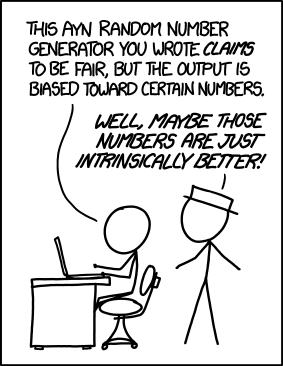
ETA: Coincidentally, this was the xkcd panel today:
¹ Rumbold, B. (2012). Compassionate care: Engaging the spirit in care. Progress in Palliative Care, 20(2), 106-113.
Daniel Dorling is one of the researchers who has shown that the idea that we are ‘sleepwalking into segregation’ because ethnic minorities are becoming more concentrated in British cities like Bradford is wrong – in fact, the reverse is happening. Where we are becoming more segregated is between rich and poor. Affluent people are voting with their feet and moving further and further away from city centres, including of course in some cases into gated communities.
In his new book Dorling takes on the task of looking not only at the whole range of ways in which the gap between the rich and the poor is growing but why this is the case. To anyone who has looked at the recent book The Spirit Level: Why more equal societies almost always do better, Dorling provides some stimulating arguments on why so much inequality has come about and what we ought to do about it.
First of all he challenges the idea that inequality is somehow natural. He points out that all the evidence indicates that so-called primitive man lived in much more equal societies, and it is only in last few thousand years that we have created the inequality that is now almost worldwide. When we see the graphs called ‘bell curves’ showing characteristics like children’s intelligence we assume that it’s ‘natural’ that some should be more intelligent than others. Dorling argues that it isn’t and that we have either created inequalities or made them much worse than they need to be.
Nowhere has inequality manifested itself more than in housing, of course. The mantra ‘location, location, location’ might ostensibly be about buying a house near a good school or a park but in practice is about putting as much distance as you can afford between you and the poor. We use houses to flaunt our wealth, buying more than one when we know there is a shortage, or buying a bigger one than we need (then criticising ‘underoccupation’ in council housing). Dorling mentions the extreme case of a house worth $135m, owned by a Saudi prince: it is so big it could accommodate 100 council flats. Others have less grandiose properties but need more of them: rich people in the USA now commonly own four or more homes, flying between them.
The US and Britain have also become massively indebted nations. And Dorling is not talking about government debt, he is talking about mortgages and credit cards. Among the other astonishing facts in the book is that half the credit card debt in Europe is now owed by people in Britain.
Dorling keeps on posing the question of why we know much of this but are not shocked by it. Indeed, celebrity culture tends to celebrate excess and only in extremes (eg drug taking) criticises it. His conclusion is that we have conned ourselves into believing that excess is natural and injustice unavoidable. As in other areas of life, we are perfectly able to hold two contradictory ideas in our heads at the same time: we put up with, perhaps even add to, inequality because it seems to be inevitable, while contributing to charities or fund-raising efforts designed to reduce it.
He says that the problem is therefore not someone else’s responsibility, it’s in our own heads. While we continue to accept this state of affairs, it will persist. Part of the solution is understanding where we have reached and why we have got there. If you want to do this, or think you do already but want to convince others, Dorling’s book is an excellent place to look for both the facts and the arguments.
To begin with, I started this book at a constant pace. Soon, though, into the second or third chapter, it begun to become more and more gruelling. Specifically, my problem lies with the invocation of bizarre and, at least to me, esoteric mathematics (both in formulae and written form). Dorling has a propensity, and probably one that is imperceptible to him, to postulate an argument, and then, immediately afterwards, rather than elucidate it clearly and in-depth, make a superficial and insubstantial point about it. This, too, detracted from making it a brilliant book.
That is what is wrong with the book. The actual content, on the other hand, is, for the most part, cogent and pertinent. It not only talks about the usual and widely acknowledged woes of income inequality (or, in fact, inequality in general), but also other more obscure ones, some I have never heard or encountered before. His prose is easy to read (bar the maths), which is always an added bonus. The account given is multidimensional, in that it examines numerous different effects of inequality.
In each chapter Dorling identifies an axiomatic consequence of continued inequality, and diligently unravels why it ought to cause alarm to the general reader.
In sum, the book is well written, not too scholarly and dry; and the content is far-reaching and covers numerous facets of society.
If anybody has a spare half an hour, and would like a brief yet detailed insight into inequality (of income specifically), feel free to read my latest blog: http://longblogsaboutpracticallyanyth...
The tragedy of this book which could have had the makings of a classic is that Danny Dorling falls for Oliver James wrong psychological idea that The Blank Slate applies to newborn infant minds in his lengthy discussion of elitism. This approach is false and far too simple as current research demonstrates. For a geographer Dorling is not sufficiently wideread.
But otherwise the marshalling of facts throughout the book is quite masterly although tighter editing would have improved matters. The passgage from the Gilded Age of the elite to its second coming in our own time is documented and the statistics speak for themselves.
This is an intensive work, it was first published in 2010 and then had a major revision in 2016. It is close to 500 pages and covers eight chapters: (1) Introduction, (2) Inequality, (3) Elitism is Efficient, (4) Exclusion is Necessary, (5) Prejudice is Natural, (6) Greed is Good, (7) Despair is Inevitable and (8) Conspiracy, Consensus, Conclusion
The authors argument is social injustice changes, what was lack of education has morphed into conservative elitist distain, from lack of money to exclusion & economic segregation, from lack of work to economic prejudice and scorn for those poor, and from lack of comfort to excessive greed is good, and from disease to endless worry, stress and despair.
The book is not a book of solutions, it is a book of statistics, facts and ideas. I first heard about the book in August 2015 but just got around to reading it, if you recommend a book to me it take three years to get to it, with my current must read book backlog 🙂
From a review perspective, I thought the book was powerful in facts and social commentary but weaker in deep historical context and philosophy. It reminded me of the more recent book on our environment catastrophe “No Good Alternative”. The book believes readers will help the world become better by becoming more aware of the worlds injustices.
3.5 stars FINALLY! This book took me about 5 months to read. It was on a short but sweet 'Books you could read if you're interested before starting your degree' list my uni sent me (which also included The Spirit Level: Why More Equal Societies Almost Always Do Better btw).
The book itself was less short and less sweet and Dorling's writing style got on my nerves more often than not, but I feel this book has been integral to my higher and political/social/economical education.
Daniel Dorling, with plenty of evidence in his hand, argues very well in this book. In my opinion it should be compulsory reading for those wishing to go in power especially when our leaders have no idea of their policies and impact.
We should all be equal. But Dorling is a fine man, he will leave the wholesome act of digging trenches and picking tomatoes to the less virtuous than himself.
Dorling’s book seems to fit in with the welcome proclamation of the new egalitarianism launched by Richard Wilkinson and Kate Pickett in the publication of The Spirit Level – Why equality is Better for Everyone. Other bits and pieces of the argument are scattered around in other similar best sellers, like Oliver James’s Affluenza and Richard Layard’s Happiness.
Modern times are making us sick, bone weary, horribly depressed. We suffer when we have no money, when we are making it, and when we have it by the ton. Why? Because human beings are the ultimate social being, blessed (or cursed) with a nature and a brain that functions best when the evidence affirms the hypothesis that “all those out there are pretty much the same as me.” When this is patently true we feel secure and trusting, eager to experience the fullness of life. But when are societies are allowed to degenerate into impersonal hierarchies which are obviously unjust, we want to curl up on hour own and die.
Dorling thinks that injustice and inequality are extraordinary things which are so obviously contrary to human welfare that they could only be maintained because of a gigantic misunderstanding about what we actually are as individual people and as a species. There are five parts to this horrible mistake: the beliefs that elitism is efficient, exclusion is necessary, prejudice is natural, greed is good, and despair is inevitable. His book takes up each of these notions in turn and savages their evil presumption like a righteous attack dog destroying a pestilential rodent.
His method is to gather up in an often untidy heap all the evidence which is supposed to support the wicked propositions and then to render it asunder with an eclectic mix of social scientific forensic analysis, or a plain booting it in the ribs. The too elegant curves of the bell graph, along which human intelligence is supposed to be unequally distributed, are gone over using the jargonistic tools of Pearsonite ‘goodness of fit’ tests which show that ‘too elegant’ usually means ‘too good to be true’.
Other times he is just plain rude. Middle class families claim rights for the well-being and education of their children with selfish attitudes which deprive the children of less well-off families of security and hope. Unequal claims made on health resources produce a crazy system which leaves a large number without adequate services, and leaves even the rich caught up in treatments which probably prolong illness rather than seek its cure.
In short, Dorling’s book is rollicking good fun for those who enjoy the excitement of full frontal engagement with the enemy and a no-hold barred approach as to how you grapple and gouge out its eyes.
But there are reasons for thinking this isn’t a totally satisfactory approach. The issue of what we mean by ‘justice’ itself is totally unexplored in the text. Anyone hoping for arguments that would get us beyond standard Rawlsian liberal orthodoxy will have to find another book to help them with this quest. It is anger and frustration which drives Dorling forward – not philosophical reasoning.
But it occupies a place on my bookshelf where I can reach for it easily, looking for the many neat arguments which carry the egalitarian cause forward.
This was a really interesting book on the nature of social injustice. It has a lot of useful data and also links to the author's website which has yet more great stats on this issue. Although the book is a bit British centric, it does include analysis of the rest of the world, especially US injustice. I think what I liked most about it was its history of the last 40 years in terms of how elites responded to threats to their well being by propagating ideologies that convinced people to let them take most of the proceeds of economic growth. My only reservation, is that the author doesn't know much about production or wealth creation. At heart, unless you make the generation of wealth more equal via more focus on manufacturing and reasonably well paid jobs for large numbers of people, the response to inequality is always going to be a band aid and redistribution. I would like a society of smaller companies, smaller businesses, more coops, more profit sharing in major companies and a decentralization of energy generation and wealth creation.
Fascinating book. Made me angrier than almost any other book I've read on the state of the world today. Here's a taste:
"Based on significant research across a range of fields, Dorling argues that, as the five social evils identified by Beveridge at the dawn of the British welfare state are gradually being eradicated (ignorance, want, idleness, squalor and disease), they are being replaced by five new tenets of injustice, that: elitism is efficient; exclusion is necessary; prejudice is natural; greed is good; and despair is inevitable."
Those five beliefs permeate our system and create the injustices most people suffer under. While this book doesn't propose any solutions, it does drop the veil from your eyes and at least allows you to see the problem. I'm both disgusted with the powers that be and energized to be a force for change.
I actually read the second edition of this book which came out in 2016. The author specifies which changes have been made between the editions, mainly updated data. This book challenged my beliefs about elitism and the education system, and made me much more aware of structural inequalities in the United States and the U.K. I recommend this book for people who are sick of inequality, economics and sociology students and people interested in learning more about the systems at work in developing countries.