

What do you think?

Spring Essence: The Poetry of Hô Xuân Huong
Hồ Xuân Hương — whose name translates as "Spring Essence" — is one of the most important and popular poets in Vietnam. A concubine, she became renowned for her poetic skills, writing subtly risqué poems which used double entendre and sexual innuendo as a vehicle for social, religious, and political commentary.
The publication of Spring Essence is a major historical and cultural event. It features a "tri-graphic" presentation of English translations alongside both the modern Vietnamese alphabet and the nearly extinct calligraphic Nôm writing system, the hand-drawn calligraphy in which Hồ Xuân Hương originally wrote her poems. It represents the first time that this calligraphy—the carrier of Vietnamese culture for over a thousand years—will be printed using moveable type. From the technology demonstrated in this book scholars worldwide can begin to recover an important part of Vietnam’s literary history. Meanwhile, readers of all interests will be fascinated by the poetry of Ho Xuan Huong, and the scholarship of John Balaban.
The translator, John Balaban, was twice a National Book Award finalist for his own poetry and is one of the preeminent American authorities on Vietnamese literature. During the war Balaban served as a conscientious objector, working to bring war-injured children better medical care. He later returned to Vietnam to record folk poetry. Like Alan Lomax’s pioneering work in American music, Balaban was to first to record Vietnam’s oral tradition. This important work led him to the poetry of Hồ Xuân Hương.
Ngo Than Nhan, a computational linguist from NYU’s Courant Institute of Mathematics, has digitized the ancient Nôm calligraphy.
"The Unwed Mother"
Because I was too easy, this happened.
Can you guess the hollow in my heart?
Fate did not push out a bud
even though the willow grew.
He will carry this a hundred years
but I must bear the burden now.
Never mind the gossip of the world.
Don’t have it, yet have it! So simple.
The publication of Spring Essence is a major historical and cultural event. It features a "tri-graphic" presentation of English translations alongside both the modern Vietnamese alphabet and the nearly extinct calligraphic Nôm writing system, the hand-drawn calligraphy in which Hồ Xuân Hương originally wrote her poems. It represents the first time that this calligraphy—the carrier of Vietnamese culture for over a thousand years—will be printed using moveable type. From the technology demonstrated in this book scholars worldwide can begin to recover an important part of Vietnam’s literary history. Meanwhile, readers of all interests will be fascinated by the poetry of Ho Xuan Huong, and the scholarship of John Balaban.
The translator, John Balaban, was twice a National Book Award finalist for his own poetry and is one of the preeminent American authorities on Vietnamese literature. During the war Balaban served as a conscientious objector, working to bring war-injured children better medical care. He later returned to Vietnam to record folk poetry. Like Alan Lomax’s pioneering work in American music, Balaban was to first to record Vietnam’s oral tradition. This important work led him to the poetry of Hồ Xuân Hương.
Ngo Than Nhan, a computational linguist from NYU’s Courant Institute of Mathematics, has digitized the ancient Nôm calligraphy.
134 pages, Paperback
First published January 1, 1801
About the author
Hồ Xuân Hương
8 books24 followersHồ Xuân Hương (胡春香; 1772–1822) was a Vietnamese poet born at the end of the Lê Dynasty. She grew up in an era of political and social turmoil – the time of the Tây Sơn rebellion and a three-decade civil war that led to Nguyễn Ánh seizing power as Emperor Gia Long and starting the Nguyen Dynasty. She wrote poetry using Chữ Nôm (Southern Script), which adapts Chinese characters for writing demotic Vietnamese. She is considered to be one of Vietnam's greatest classical poet. Xuân Diệu, a prominent modern poet, dubbed her "The Queen of Nôm poetry".
(from Wikipedia)
(from Wikipedia)
Ratings & Reviews
Friends & Following
Create a free account to discover what your friends think of this book!
Community Reviews
Displaying 1 - 30 of 62 reviews

Read
September 5, 2015
Little seems to be known about the life of Hồ Xuân Hương,(*) born between 1775 and 1780 and deceased by the mid-1820’s, or even if she had actually composed the poems attributed to her in the form that has come down to us. The received and much elaborated legend presents her as a professional concubine who ran a tea shop in Hanoi, had a series of relationships with a number of men in the upper class, and wrote risqué poems subversive of the paternalistic culture of late 18th and early 19th century Vietnam, but the paucity of concrete, verifiable facts is striking in view of the relatively small two century distance from the present.
What is known is that the poems circulated orally for at least 70 years, for they were not collected in written form until 1893 and did not appear in print until 1909. So they became/were part of the apparently immense oral poetic tradition in Vietnam, from which - unlike the case in China(**) - the poetic tradition of the literati was not completely estranged. What is also clear is that her lifetime was marked for all Vietnamese by turmoil and ruin as the Le dynasty collapsed, the decades long Tay-Son rebellion took hold, and it in turn was swept away when the Nguyen dynasty was established.
It is also known that she existed and was a poet, for there exist poems by Vietnamese literati which engage with her own, sometimes playfully and sometimes with condemnation. So her work was noted in her lifetime by at least some of the cultural elite. There is a note in a contemporary chronicle mentioning the execution of the governor of Yen Quang province in which is mentioned "the concubine of this man is named Ho Xuan Huong. At that time she was well-known as a talented women in literature and politics." And in 1842 a member of the royal family wrote a poem mentioning her gravesite and legacy with some respect.
It is believed that she was born into a relatively high class family since she had received a very good education,(***) but towards the end of the Le dynasty circumstances changed in ways I don't yet understand so that marriage became so expensive that even women of her class were obliged to become concubines instead of wives.
But what makes me believe that she was an actual person and that the long submersion of her poems in the ocean of the oral tradition did not create a sea change in her work are the coherent and consistent voice, in the first place, and the subtlety of the poems, in the second. Part of this subtlety is reflected in many of the poems' penchant to be readable on two levels: one "respectable" and the other sexual.
Jackfruit
My body is like the jackfruit on the branch:
my skin is coarse, my meat is thick.
Kind sir, if you love me, pierce me with your stick.
Caress me and sap will slicken your hands.
(It should be noted that in Southeast Asia, where this very tasty fruit grows, it is standard practice to drive a stick into the fruit to test its ripeness.) But there is also another, very different kind of subtlety in these poems:
Spring-Watching Pavilion
A gentle spring evening arrives
airily, unclouded by worldly dust.
Three times the bell tolls echoes like a wave,
We see heaven upside-down in sad puddles.
Love's vast sea cannot be emptied.
And springs of grace flow easily everywhere.
Where is nirvana?
Nirvana is here, nine times out of ten.
But she can also get scathingly direct:
Male Member
Newborn, it wasn't so vile. But, now, at night,
even blind it flares brighter than any lamp.
Soldierlike, it sports a reddish leather hat,
musketballs sagging the bag down below.
Her scorn isn't reserved just for men's tender bits:
Young Scholars
Jostling about by the temple door,
they'd like to be scholars but they can't even talk.
Someone should teach these illiterate fools
to take their brushes and paint the pagoda wall.
She also goes after monks and husbands, widows and wives with sometimes wry, sometimes bitter humor. Some of the poems could now be feminist anthems:
The Condition of Women
Sisters, do you know how it is? On one hand,
the bawling baby; on the other, your husband
sliding onto your stomach,
his little son still howling at your side.
Yet, everything must be put in order.
Rushing around all helter-skelter.
Husband and child, what obligations!
Sisters, do you know how it is?
Like Chinese, Vietnamese is not only a tonal language (which adds an additional important structure to the poetics for regulation and play), it also does not employ all the grammatical filler familiar from European languages. So a literal translation of a few lines from "Spring-Watching Pavilion" reads:
peaceful evening spring go pavilion
light light not dirty little world dust
three times watch bell tolls waves
It is evident that to bring such a poem meaningfully and artfully into a European language will strongly engage the translator's personal tastes. I'll not repeat here the warnings and the reasons for persevering nonetheless made in some of my earlier reviews of classical Chinese poetry, but I shall mention my belief that in order to try to triangulate the original poem it is very useful to read more than one translation, if available.
Consider the following translations of one of Ho's poems, the first from John Balaban's Spring Essence: The Poetry of Ho Xuan Huong (2000), which includes some fifty poems, and the second from Huynh Sanh Thong's An Anthology of Vietnamese Poems: From the Eleventh through the Twentieth Centuries (1996), which includes twenty of Ho's poems:
River Snail
Fate and my parents shaped me like a snail,
day and night wandering marsh weeds that smell foul.
Kind sir, if you want me, open my door.
But please don't poke up into my tail.
Snail
Father and mother joined to breed a snail.
I grovel night and day among foul weeds.
Sir, if you love me, take my breastpiece off.
Don't wiggle, please, your finger in my hole.
Both translators note the knotty problem they face: Ho is playing upon a pun possible in Vietnamese but not in English: One homonym means cache-sein, and the other means a kind of translucent door in a snail's shell that is developed in case of drought when it must shut itself off from the drying air. I'd say that between these two translations one has a fair idea of Ho's intentions and humor. And I am grateful to both translators for a glimpse into the work of one of Vietnam's most respected poets.
(*) I shall henceforth drop the many diacritical marks displayed in modern Vietnamese; they are used primarily to indicate which of the six tones (at least in mainline Vietnamese) are used in the pronunciation of each syllable. Recall that in a tonal language the meaning of a syllable is a function of the tone used to pronounce it.
(**) Oral folk poetry entered into some of the earliest official collections of Chinese poetry, and these were extremely influential subsequently, but the poetic tradition developed by the Chinese literati deliberately separated itself from the ongoing tradition of folk poetry (though some important poets like Po Chu-i tried to change that). Huynh Sanh Thong asserts that in Vietnam, despite pressures to conform to the Chinese model, there was usually a constructive interchange between the poetry of the literati and the evolving folk tradition.
(***) Not only was she a master of language and form in the Vietnamese poetic tradition, but recently a small number of poems written in Chinese have been found which scholars believe are hers.

August 16, 2011
SPRING ESSENCE
Ho Xuan Huong (1772-1822) was a Vietnamese woman poet born at the end of the Later Le Dynasty (Period 1428'1788: the greatest and longest lasting dynasty of traditional Vietnam) who wrote poems with unusual irreverence and shockingly erotic undertones for her time. She is considered as one of Vietnam’s greatest poets, such that she is dubbed “the Queen of Nom Poetry" and has become a cultural symbol of Vietnam. I came across her name first in a travel guide where one her poems was listed. It led me to search for her poetry. It was a sheer delight to read her poems in the book titled "Spring Essence", which is what her name means in Vietnamese language.
The epoch she lived was marked by calamity and social disintegration. A concubine, although a high-ranking one, Ho Xuan followed Chinese classical styles in her poetry, but preferred to write poetry in an extinct ideographic script known as Nom, similar to Chinese but representing Vietnamese. And while her prosody followed traditional forms, her poems were anything but conventional: Whether mountain landscapes, or longings after love, or apparently about such common things as a fan, weaving, some fruit, or even a river snail, almost all her poems were double entendres with hidden sexual meaning.
She brought to life the battles of the sexes and the power of the female body vis-a-vis male authority, human weakness and desire, and boldly discussed various aspects of religious life, social justice, and equality including sexual freedom, as well as a range of other issues and experiences potentially detrimental to the status and aspirations of women. On close scrutiny, her lyrics offer surprising insight into a private Vietnamese past: the candid voice of a liberal female in a male-dominated society.
In a Confucian tradition that banished the nude from art, writing about sex was unheard of. And, if this were not enough to incur disfavor in a time when impropriety was punished by the sword, she wrote poems which ridiculed the authority of the decaying Buddhist church, the feudal state, and Confucian society. So, in a time when death and destruction lay about, when the powerful held sway and disrespect was punished by the sword, how did she get away with the irreverence, the scorn, and the habitual indecency of her poetry? The answer lies in her excellence as a poet and in the paramount cultural esteem that Vietnamese have always placed on poetry, whether in the high tradition of the literati or the oral folk poetry of the common people. Quite simply, she survived because of her exquisite cleverness at poetry.
Her poems were copied by hand for almost 100 years before they finally saw a woodblock printing in 1909.
Below are some samplers of her playful poetry. I am sure it will delight you as much as it did me. The reader will experience Ho Xuan Huong’s lonely, intelligent life, her exquisite poetry, her stubbornness, her sarcasm, her bravery, her irreverent humor and her bodhisattva’s compassion in these poems.
Swinging
Praise whoever raised these poles
for some to swing while others watch
A boy pumps, then arcs his back.
The shapely girl shoves up her hips,
Four pink trousers flapping hard,
Two pairs of legs stretched side by side.
Spring games. Who hasn't known them?
Swingingposts removed, the holes lie empty
Male Member
New born, it wasn't so vile. But, now, at night,
even blind it flares brighter than any lamp.
Soldierlike, it sports a reddish leather hat,
Musket balls sagging the bag down below
Jack Fruit
My body is like the jackfruit on the branch:
My skin coarse, my meat thick
Kind sir, if you love me, pierce me with your stick
Caress me and sap will slicken your hands
Weaving at Night
Lampwick turned up, the room glows white.
The loom moves easily all night long
as feet work and push below.
Nimbly the shuttle flies in and out,
wde or narrow, big or small, sliding in snug.
Long or short, it glides smoothly.
Girls who do it right, let it soak
then wait a while for the blush to show
The man- and -wife mountain
A clever showpiece nature here displays
It shaped a man ,then shaped a woman, too
Above some snowflakes dot his silver head.
Below , some dewdrops wet her rosy cheeks.
He flaunts his manhood underneath the moon.
She rubs her sex in view of hills and streams.
Even those aged boulders will make love.
Don't blame us, human beings, if in youth .
(On a journey, the poetess saw two huge rocks, one poised on top of the other, resembling a couple engaged in sexual intercourse)
The Condition of Women
Sisters, do you know how it is? On one hand,
the bawling baby; on the other, your husband
sliding onto your stomach,
his little son still howling at your side.
Yet, everything must be put in order.
Rushing around all helter-skelter.
Husband and child, what obligations!
Sisters, do you know how it is?
(A very touching poem capturing the social issues of women)
On Sharing a Husband
Screw the fate that makes you share a man.
One cuddles under a cotton blanket, the other's cold
Every now and then, well maybe or maybe not.
Once or twice a month, oh, it's like nothing.
You try to stick to it like a fly on rice
but the rice is rotten. You slave like a maid,
but without pay. If I had known how it would go
I think I would have lived alone.
The Unwed Mother
Because I was too easy, this happened.
Can you guess the hollow in my heart?
Fate did not push out a bud
even though the willow grew.
He will carry it a hundred years
but I must bear the burden now.
Never mind he gossip of the world
Don't have it,yet have it! So simple.
( This poem is a classic gem of leaving unsaid everything but what is needed. A heart unfolding. In those times, for an upper class woman, pregnancy out of wedlock could be punished by being forced to lie down while an elephant trod on her stomach, killing both mother and unborn child. For peasants, socially far more free in sexual encounters, there’s a folk proverb:
“No husband, but pregnant, that’s skillful.
Husband and pregnant, that’s pretty ordinary.”)
Questions for the Moon
How many thousands of years have you been there?
Why sometimes slender, why sometimes full?
How old is the white Rabbit?
How many children belong to Moon-Girl?
Why do you circle the purple loneliness of night
and seldom blush before the sun?
Weary, past midnight, who are you searching for?
Are you in love with these rivers and hills?
Autumn Landscape
Drop by drop the rain slaps the banana leaves.
Praise whoever sketched this desolate scene:
the lush dark canopies of the gnarled trees,
the long river, sliding smooth and white.
I lift my wine flask, drunk with rivers and hills.
My backpack , breathing moonlight, sags with poems.
Look and love everyone.
Whoever sees this landscape is stunned.
(What an amazingly beautiful sketch it is! 'Look and love even men' has a subtle sarcasm.)
Spring -Watching Pavilion
A gentle spring evening arrives
airily, unclouded by worldly dust.
Three times, the bell tolls echoes like a wave
We see heaven upside- down in sad puddles.
Love's vast sea cannot be emptied.
And spring of grace flow easily everywhere.
Where is Nirvana?
Nirvana is here, nine times out of ten
(This is my favorite, a masterpiece indeed. Seeking solitude in nature, she realizes that it is nature itself, not any organized religion or other construct of the human world, that holds the key to the search for nirvana and sometimes can' see heaven upside- down in sad puddles ')
Ho Xuan Huong (1772-1822) was a Vietnamese woman poet born at the end of the Later Le Dynasty (Period 1428'1788: the greatest and longest lasting dynasty of traditional Vietnam) who wrote poems with unusual irreverence and shockingly erotic undertones for her time. She is considered as one of Vietnam’s greatest poets, such that she is dubbed “the Queen of Nom Poetry" and has become a cultural symbol of Vietnam. I came across her name first in a travel guide where one her poems was listed. It led me to search for her poetry. It was a sheer delight to read her poems in the book titled "Spring Essence", which is what her name means in Vietnamese language.
The epoch she lived was marked by calamity and social disintegration. A concubine, although a high-ranking one, Ho Xuan followed Chinese classical styles in her poetry, but preferred to write poetry in an extinct ideographic script known as Nom, similar to Chinese but representing Vietnamese. And while her prosody followed traditional forms, her poems were anything but conventional: Whether mountain landscapes, or longings after love, or apparently about such common things as a fan, weaving, some fruit, or even a river snail, almost all her poems were double entendres with hidden sexual meaning.
She brought to life the battles of the sexes and the power of the female body vis-a-vis male authority, human weakness and desire, and boldly discussed various aspects of religious life, social justice, and equality including sexual freedom, as well as a range of other issues and experiences potentially detrimental to the status and aspirations of women. On close scrutiny, her lyrics offer surprising insight into a private Vietnamese past: the candid voice of a liberal female in a male-dominated society.
In a Confucian tradition that banished the nude from art, writing about sex was unheard of. And, if this were not enough to incur disfavor in a time when impropriety was punished by the sword, she wrote poems which ridiculed the authority of the decaying Buddhist church, the feudal state, and Confucian society. So, in a time when death and destruction lay about, when the powerful held sway and disrespect was punished by the sword, how did she get away with the irreverence, the scorn, and the habitual indecency of her poetry? The answer lies in her excellence as a poet and in the paramount cultural esteem that Vietnamese have always placed on poetry, whether in the high tradition of the literati or the oral folk poetry of the common people. Quite simply, she survived because of her exquisite cleverness at poetry.
Her poems were copied by hand for almost 100 years before they finally saw a woodblock printing in 1909.
Below are some samplers of her playful poetry. I am sure it will delight you as much as it did me. The reader will experience Ho Xuan Huong’s lonely, intelligent life, her exquisite poetry, her stubbornness, her sarcasm, her bravery, her irreverent humor and her bodhisattva’s compassion in these poems.
Swinging
Praise whoever raised these poles
for some to swing while others watch
A boy pumps, then arcs his back.
The shapely girl shoves up her hips,
Four pink trousers flapping hard,
Two pairs of legs stretched side by side.
Spring games. Who hasn't known them?
Swingingposts removed, the holes lie empty
Male Member
New born, it wasn't so vile. But, now, at night,
even blind it flares brighter than any lamp.
Soldierlike, it sports a reddish leather hat,
Musket balls sagging the bag down below
Jack Fruit
My body is like the jackfruit on the branch:
My skin coarse, my meat thick
Kind sir, if you love me, pierce me with your stick
Caress me and sap will slicken your hands
Weaving at Night
Lampwick turned up, the room glows white.
The loom moves easily all night long
as feet work and push below.
Nimbly the shuttle flies in and out,
wde or narrow, big or small, sliding in snug.
Long or short, it glides smoothly.
Girls who do it right, let it soak
then wait a while for the blush to show
The man- and -wife mountain
A clever showpiece nature here displays
It shaped a man ,then shaped a woman, too
Above some snowflakes dot his silver head.
Below , some dewdrops wet her rosy cheeks.
He flaunts his manhood underneath the moon.
She rubs her sex in view of hills and streams.
Even those aged boulders will make love.
Don't blame us, human beings, if in youth .
(On a journey, the poetess saw two huge rocks, one poised on top of the other, resembling a couple engaged in sexual intercourse)
The Condition of Women
Sisters, do you know how it is? On one hand,
the bawling baby; on the other, your husband
sliding onto your stomach,
his little son still howling at your side.
Yet, everything must be put in order.
Rushing around all helter-skelter.
Husband and child, what obligations!
Sisters, do you know how it is?
(A very touching poem capturing the social issues of women)
On Sharing a Husband
Screw the fate that makes you share a man.
One cuddles under a cotton blanket, the other's cold
Every now and then, well maybe or maybe not.
Once or twice a month, oh, it's like nothing.
You try to stick to it like a fly on rice
but the rice is rotten. You slave like a maid,
but without pay. If I had known how it would go
I think I would have lived alone.
The Unwed Mother
Because I was too easy, this happened.
Can you guess the hollow in my heart?
Fate did not push out a bud
even though the willow grew.
He will carry it a hundred years
but I must bear the burden now.
Never mind he gossip of the world
Don't have it,yet have it! So simple.
( This poem is a classic gem of leaving unsaid everything but what is needed. A heart unfolding. In those times, for an upper class woman, pregnancy out of wedlock could be punished by being forced to lie down while an elephant trod on her stomach, killing both mother and unborn child. For peasants, socially far more free in sexual encounters, there’s a folk proverb:
“No husband, but pregnant, that’s skillful.
Husband and pregnant, that’s pretty ordinary.”)
Questions for the Moon
How many thousands of years have you been there?
Why sometimes slender, why sometimes full?
How old is the white Rabbit?
How many children belong to Moon-Girl?
Why do you circle the purple loneliness of night
and seldom blush before the sun?
Weary, past midnight, who are you searching for?
Are you in love with these rivers and hills?
Autumn Landscape
Drop by drop the rain slaps the banana leaves.
Praise whoever sketched this desolate scene:
the lush dark canopies of the gnarled trees,
the long river, sliding smooth and white.
I lift my wine flask, drunk with rivers and hills.
My backpack , breathing moonlight, sags with poems.
Look and love everyone.
Whoever sees this landscape is stunned.
(What an amazingly beautiful sketch it is! 'Look and love even men' has a subtle sarcasm.)
Spring -Watching Pavilion
A gentle spring evening arrives
airily, unclouded by worldly dust.
Three times, the bell tolls echoes like a wave
We see heaven upside- down in sad puddles.
Love's vast sea cannot be emptied.
And spring of grace flow easily everywhere.
Where is Nirvana?
Nirvana is here, nine times out of ten
(This is my favorite, a masterpiece indeed. Seeking solitude in nature, she realizes that it is nature itself, not any organized religion or other construct of the human world, that holds the key to the search for nirvana and sometimes can' see heaven upside- down in sad puddles ')

October 30, 2020
Went down a treat. But given how long it must have taken to learn to read Hồ Xuân Hương's poetry, let alone translate it, one really does feel guilty for reading it so quickly!
I also learned much from Kaion's thoroughgoing review of this collection: https://www.goodreads.com/review/show...,
full of links that are well worth following up.
I also learned much from Kaion's thoroughgoing review of this collection: https://www.goodreads.com/review/show...,
full of links that are well worth following up.
December 18, 2013
3.5/5
I imagine a fair number of those in the audience saw some variation on the phrase of "sexual innuendo" and immediately became 69% more interested in reading this work, although that thought inevitably leads to contemplation of the sort of sordid white maleness that lusts after their "waifu" through the lenses of their various masters and doctorates, so let's not continue along that path. Beyond the nod at Orientalism that compromises the landscape through which works such as this are permitted to function, as I said earlier, Hồ Xuân Hương, for all intents and purposes, fucked around in an extraordinarily noteworthy and productive sense, and what I didn't get from her writing I will get from the incentive to track down something more biographical concerning her as subject, warnings about conflicting and conflating material be damned. I wouldn't mind material about the other famous people she interacted with, but what I really want is something about the travels she underwent, as all the awed hints at how long and arduous they must have been pale in comparison to the amount of academic text to be found on her status as concubine, her various marriages established through such a relationship, and even the constant questioning of her authorship, her biography, and, ultimately, her claim to classical fame. I don't know the first thing about Vietnamese beyond the romanized syllables of various menu items, but the introduction to this edition tells me that even the text Hồ Xuân Hương is aged beyond modern Vietnamese grasp, much as The Tale of Genji and Beowulf are old enough to need guiding through the convulsions the centuries has forced their respective languages through to let ancient words reach new linguistic inheritors. Is the effort worth it? Should that even ever be a question worth asking?
This is my first finished work of 2019, and what a way to enter the year. Not an absolute favorite, nor a loved or even really liked it, but does it remind me of how small a place the reading status quo truly has in the world and how much further I have to go? Most assuredly, and that's all one can ask of what one reads at times. More informed readers will have a much better go at this than I, and until Sacramento Public Library and others commit to the ownership of editions safe from all forms of censorship, all I can do is send this book on its way and hope it wanders into hands more accredited, although without the all too often accompaniment of fetishization, than mine. As for further pursuits, this edition informed me that my beautiful edition of An Anthology of Vietnamese Poems: From the Eleventh through the Twentieth Centuries has a good twenty poems of Hồ Xuân Hương and selections from myriad other names, so I'll be waiting on the incentive to pick that up one of these days. I may run into Love After War, Memories of a Pure Spring, or even Dumb Luck first should my instinctive shying away from poetry win out, but it'll be there when I need it.
Không chồng mà chửa mới ngoan.This work has a high enough average rating that I can display my level of engagement more honestly than not. Poetry, translation, innuendo (although admittedly obvious in more than one place): all conspire to slow the passage of my comprehension, and a little less than a 150 pages, truncated even more by the necessaries of introduction and end notes, is usually incapable of forcing patience onto my reading pace. The inevitable argument appears when the overlords of the general public (male, WASP, sexually predatory, etc) confront a nonwhite woman writing (and fucking, and writing about fucking, and perhaps fucking through writing? the 21st century didn't invent the conversing played in the theme of 'send nudez') through the late 18th and early 19th century, and the lack of concrete (in a EuroAnglo sense of things, of course) evidence as to whether Hồ Xuân Hương wrote or even existed and blah, de blah, de blah, has contributed to the piss poor number of ratings on this side of things, but I'm hoping Vietnam and its disaspora have treated and continue to treat her better. My copy has its 'female presenting nipples' censored with a big ol' library ownership sticker that, I'm assuming, didn't save it from being subsequently discarded, but there's nothing anyone at the Sacramento Public Library or anywhere else can do about the text, and I'm sure it's even more delightful in both the raunchy and celibate turn of the word for those who can directly interpret the aesthetically pleasing polygonal organizations of the non-romanized scripts. As such, never you mind that only one poem spoke to me in any sense that didn't require further consultation of the end notes in order to appreciate. One can educate themselves well enough in an extremely necessary manner on the facts and supposed fictions of Hồ Xuân Hương alone.
Có chồng mà chửa thế gian sự thường.
No husband, but pregnant, that's skillful.
Husband and pregnant, that's pretty ordinary.
-Vietnamese Folk Proverb
I imagine a fair number of those in the audience saw some variation on the phrase of "sexual innuendo" and immediately became 69% more interested in reading this work, although that thought inevitably leads to contemplation of the sort of sordid white maleness that lusts after their "waifu" through the lenses of their various masters and doctorates, so let's not continue along that path. Beyond the nod at Orientalism that compromises the landscape through which works such as this are permitted to function, as I said earlier, Hồ Xuân Hương, for all intents and purposes, fucked around in an extraordinarily noteworthy and productive sense, and what I didn't get from her writing I will get from the incentive to track down something more biographical concerning her as subject, warnings about conflicting and conflating material be damned. I wouldn't mind material about the other famous people she interacted with, but what I really want is something about the travels she underwent, as all the awed hints at how long and arduous they must have been pale in comparison to the amount of academic text to be found on her status as concubine, her various marriages established through such a relationship, and even the constant questioning of her authorship, her biography, and, ultimately, her claim to classical fame. I don't know the first thing about Vietnamese beyond the romanized syllables of various menu items, but the introduction to this edition tells me that even the text Hồ Xuân Hương is aged beyond modern Vietnamese grasp, much as The Tale of Genji and Beowulf are old enough to need guiding through the convulsions the centuries has forced their respective languages through to let ancient words reach new linguistic inheritors. Is the effort worth it? Should that even ever be a question worth asking?
This is my first finished work of 2019, and what a way to enter the year. Not an absolute favorite, nor a loved or even really liked it, but does it remind me of how small a place the reading status quo truly has in the world and how much further I have to go? Most assuredly, and that's all one can ask of what one reads at times. More informed readers will have a much better go at this than I, and until Sacramento Public Library and others commit to the ownership of editions safe from all forms of censorship, all I can do is send this book on its way and hope it wanders into hands more accredited, although without the all too often accompaniment of fetishization, than mine. As for further pursuits, this edition informed me that my beautiful edition of An Anthology of Vietnamese Poems: From the Eleventh through the Twentieth Centuries has a good twenty poems of Hồ Xuân Hương and selections from myriad other names, so I'll be waiting on the incentive to pick that up one of these days. I may run into Love After War, Memories of a Pure Spring, or even Dumb Luck first should my instinctive shying away from poetry win out, but it'll be there when I need it.
Cảnh thu (Autumn Landscape)
Thánh thót tầu tiêu mấy hạt mưa,
Khen ai khéo vẽ cảnh tiêu sơ.
Xanh om cổ thụ tròn xoe tán,
Trắng xóa tràng giang phẳng lặng tờ.
Bầu dốc giang Sơn say chắp rượu,
Túi lưng phong nguyệt nặng vì thơ.
Ơ hay, cảnh cũng ưa người nhỉ,
Ai thấy, ai mà chẳng ngẩn ngơ.
(Drop by drop rain slaps the banana leaves.
Praise whoever sketched this desolate scene:
the lush, dark canopies of the gnarled trees,
the long river, sliding smooth and white.
I lift my wine flask, drunk with rivers and hills.
My backpack, breathing moonlight, sags with poems.
Look, and love everyone.
Whoever sees this landscape is stunned.

October 10, 2011
"Jackfruit" (t. Marilyn Chin)
My body is like a jackfruit swinging on a tree
My skin is rough, my pulp is thick
Dear prince, if you want me pierce me upon your stick
Don't squeeze, I'll ooze and stain your hands
Not much is known about the Vietnamese poet Ho Xuan Huong. She lived approximately 1775-1825, spending at least some of that time in Hanoi. Other details of her life —that she was married twice to minor officials, that she was a concubine, that she ran a tea shop where scholars studying for their civil service exams would come to challenge her— tend toward conjecture or are entirely legend. Because the earliest-surviving copy of her poetry is from 1893, it is not even entirely clear which of the ~140 poems associated with her are truly hers and which have been attributed to her from a long folk tradition.
What I did find clear about Xuan Huong (or "Xuan Huong") from her poetry was not only her skillfulness in writing in luc-bat, but her characteristic playfulness and her unabashed sensuality. In some of her best poetry, these qualities impart a sense of a real joy in ordinary experience, as in this poem about country living:
"Water-bailing" (t. Nguyen Ngoc Bich)
Not a drop of rain for this dry heat!
Come, girls, let's go bail water.
Let's drag our delta-shaped buckets to that huge square field
where our bodies can pulse to the water's lapping.
Crouched, straining to catch each trickle from the rockheads,
our buttocks tighten with such labor.
Indeed we work so hard we forget the effort
and, taking a final stance to bend and lift—
you part your legs a second, and it's filled.
Unable to resist bawdy entendre and tricky wordplay, Huong seems equally unwilling to pass up a chance to poke fun of the pompous or inflated. To a weeping widow she scoffs, "If it disturbs your blood, then swear off meat!"; on passing a general's shrine, she grouses ("Oh, to trade in my lot and be a man!/ Was that all that a hero could have done?") [Huynh Sanh Thong].
If you sense some proto-feminism in that last one, you’re not alone. Huong is most known for her poems which are equally frank in expressing her frustrations with what she sees as the unique tribulations of being a woman. At times this takes the form of lament, sorrow in the face of her vulnerable place in a patriarchal, Confucian society. Other times she flashes with anger; for instance, on the life of a concubine:
"Sharing a Husband" (t. Linh Dinh)
One under the quilt, one freezes.
To hell, father, with this husband-sharing.
Once in a while, twice a month, maybe,
I might as well not have it.
Trade punches for rice, but rice is moldy.
And work’s work, but I’m working for free.
Had I known things would turn out this way,
I would have settled for being alone.
In her willingness to speak of her pain and her bitterness, Huong shows she's not cowed. Rather her emotionality is a sign of her defiance, which links her to the heroine of Nguyen Du's beloved epic Tale of Kieu, who could've expressed something like of the following sentiment:
"The cake that drifts in water" (t. Huynh Sanh Thong)
My body is both white and round
In water I may sink or swim.
The hand that kneads me may be rough—
I still shall keep my true-red heart.
*ETA: It occurs to me to clarify she's talking about the dessert chè xôi nước, which is both fun to make, and delicious (with lotsa ginger).
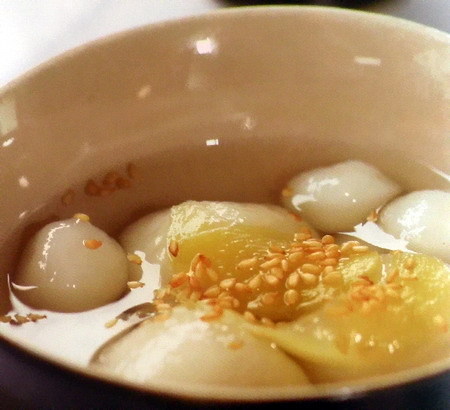
It's this defiance that makes her such an irresistible subject of folk legend, and a continuing target of controversy. Look no further than the kerfuffle* in 2008 when Poetry published some translations of her work by Marilyn Chin, and a publisher of Balaban's Spring Essence accused her of "noodling" around. This kicked off a series of furious letters/blog posts in the poetry-sphere in which accusations of racism, cultural imperialism, sexism, and more of ‘em fighting words were thrown about.
POETS GETTING REAL, which is undeniably a little funny, but why? Cause Ho Xuan Huong gets real.
In his post on the myth surrounding Huong for the Poetry website, Linh Dinh says her "enduring popularity testifies to the Vietnamese’s need and desire for a masterfully blunt, loose-talking woman". I would argue we could all use some blunt, loose-talking woman. And why wouldn’t we when they’re this fun and on tap for a penis joke? Rating: 5 stars
*Mezzo Cammin: The Women Poets Timeline offers a nice essay on Ho Xuan Huong that puts her into historical context and elaborates the Poetry Foundation incident.
**Notes on English translations
- As for this particular book, John Balaban's Spring Essence is the only dedicated volume of Ho Xuan Huong’s poetry in English. His translations are generally lyrical, if a teensy lacking in fire. He tends to excel at the more melancholy and pastoral selections. He misreads a few poems, but is overall very readable, offering notes on most of the poems. This will be the most accessible volume for many readers, and it's not a bad introduction. (Rating: 3.5 stars)
- Linh Dinh's translations of six of her poems in his aforementioned Poetry Foundation post on Ho Xuan Huong are the best of all that I've compared, and he provides nice context on the tradition Ho is coming from. He's also pretty unsparing about Balaban's translations.
- Marilyn Chin offers a very modern, fun takes on five of Ho's poems that for the record, I consider very valid.
- For greater accuracy, Huynh Sanh Thong has includes some twenty Ho poems in his exhaustive An Anthology of Vietnamese Poems: From the Eleventh through the Twentieth Centuries. I find his more archaic cadence rewarding, though it may take some getting used to.

February 7, 2009
Ho Xuan Huong, whose name means "Spring Essence," was a concubine during the end of Vietnam's second Le Dynasty (1592-1788), a period of unrest and social decay. She was a woman who wrote poetry in male-dominated, Confucian tradition--a remnant, both social and artistic, of the Chinese who had once dominated Ho Xuan Huong's country. Though the poems are full of double entendre, sexual innuendo, and subtle attacks on all levels of male authority (social, religious, political, etc), she and her works have survived because of her charming cleverness and pure mastery of poetry. As the Utne Reader has noted, "Ho Xuan Huong was simply, one of the most remarkable poets who ever lived." I would highly recommend this volume to anyone interested in poetry or women's studies; it is uncomplicated and beautiful. Her words are inspiring, and the scenes she paints elegantly mix disintegration and the sacred. Similar, I imagine to walking through a ruined pavilion.

September 26, 2013
I enjoy anything that has survived against the odds of history, and even more so if it's the work of a woman. There's a permanence to these poems, a sense that Ho Xuan Huong's spirit is alive in them still. She writes about mountain passes, wellsprings, rusted coins, willow trees; a second reading reveals the innuendos behind these nouns. So, too, we have poems about men and women, life and death, sexuality and love.
The translation is equally fascinating: each poem is printed in three forms, (1) the ancient and near-extinct Nôm script in which Ho Xuan Huong wrote; (2) the modern Vietnamese equivalent, quốc ngữ; (3) the English translation by John Balaban. Having no understanding whatsoever of calligraphic languages, I still enjoyed the sight of Nôm on each page. It gave me a sense of just how vast the gap, not only in time and geography, that Ho Xuan Huong and I had travelled to meet. The work of John Balaban in bringing these poems to a wider readership is applaudable; and this book marks the first time that Nôm has been printed as type.
My favourite poem was Country Scene:
"Pluck the low branches, pull down the high.
Enjoy alike the spent blossoms, the tight buds."
The translation is equally fascinating: each poem is printed in three forms, (1) the ancient and near-extinct Nôm script in which Ho Xuan Huong wrote; (2) the modern Vietnamese equivalent, quốc ngữ; (3) the English translation by John Balaban. Having no understanding whatsoever of calligraphic languages, I still enjoyed the sight of Nôm on each page. It gave me a sense of just how vast the gap, not only in time and geography, that Ho Xuan Huong and I had travelled to meet. The work of John Balaban in bringing these poems to a wider readership is applaudable; and this book marks the first time that Nôm has been printed as type.
My favourite poem was Country Scene:
"The waterfall plunges in mist.
Who can describe this desolate scene:
The long white river sliding through
the emerald shadows of the ancient canopy
...a shepherd's horn echoing in the valley,
fishnets stretched to dry on sandy flats.
A bell is tolling, fading, fading
just like love. Only poetry lasts."

February 20, 2021
Book club reading.
While I liked some of the poems in the first half and think she as individual is very impressive, I wasn't too excited about this. I don't consider myself to be a prude, but when at least every second poem is about sex, even I get uncomfortable and tired of reading pretty quickly.
(Then again, I'm still not a poetry person and never will be.)
While I liked some of the poems in the first half and think she as individual is very impressive, I wasn't too excited about this. I don't consider myself to be a prude, but when at least every second poem is about sex, even I get uncomfortable and tired of reading pretty quickly.
(Then again, I'm still not a poetry person and never will be.)

November 23, 2023
Village schoolmaster
Schoolday over, classroom empty,
he stands up, sits down, then lies down exhausted.
Mouth parched, he reaches for his jar of sour wine.
Throat dry, he looks for his pot of foul tea.
He chews a bit of betel,
takes four or five puffs on his pipe.
Anyone returning to his village can tell his wife
that while things aren’t good, he’s not desperate either.
Schoolday over, classroom empty,
he stands up, sits down, then lies down exhausted.
Mouth parched, he reaches for his jar of sour wine.
Throat dry, he looks for his pot of foul tea.
He chews a bit of betel,
takes four or five puffs on his pipe.
Anyone returning to his village can tell his wife
that while things aren’t good, he’s not desperate either.

September 11, 2007
Ho Xuan Huong's clever way of loading her poetry with naughty double-entendres and delicate sexual undertones really resonated with me. Her poems on themes other than sex were comparatively uninteresting; I simply wasn't very moved by them. In light of the fact that Ho Xuan Huong is considered one of Vietnam's great poets, I would guess that the fault lies with the translator rather than with Ho Xuan Huong herself, though.

June 29, 2021
Gray sky. A rooster crows
Bitter, I look out on the thickets and folds
I haven't shaken grief's rattle, yet it clatters
I haven't rung sorrow's bell, though it tolls
Their noise only drags me down, angry
with a fate that says I'm much too bold
Men of talent, learned men, where are you?
Am I supposed to walk as if stooped and old?
Hô Xuân Hurong was a Vietnamese poet who lived from 1772 to 1822 and this collection is gathered from around 1801. I was astonished by the resonance, humour and sexuality presented in these poems. When you view women writing in classical times we are often given an image of more refined and even if they were more outspoken in their lives more restricted in their output. Huong does not suffer from this. She writes honestly with humour and spirit and barely veiled eroticism.
She was a cocubine and she has this poem called 'On Sharing A Husband'
Screw the fate that makes you share a man
One cuddles under cotton blankets; the other's cold
Every now and then, well, maybe or maybe not
Once or twice a month, oh, it's like nothing
You try to stick to it like a fly on rice
but the rice is rotten. You slave like a maid
but without pay. If I had known how it would go
I think I would have lived alone
___
It is also cool as we see the original Vietnamese, the transliteration of Vietnamese into our alphabet, and then the translation into English. I always love when translation is visible on the page. It immerses you better in the culture and the history of these poems.
It sits at probably just under a four as like most poetry not every one worked for me but the ones I liked, I really liked. And I think it's history, context and content all make it a really powerful collection. But it's one of those cases that rating it three felt criminally wrong when it is probably a 3.75 for me.
Bitter, I look out on the thickets and folds
I haven't shaken grief's rattle, yet it clatters
I haven't rung sorrow's bell, though it tolls
Their noise only drags me down, angry
with a fate that says I'm much too bold
Men of talent, learned men, where are you?
Am I supposed to walk as if stooped and old?
Hô Xuân Hurong was a Vietnamese poet who lived from 1772 to 1822 and this collection is gathered from around 1801. I was astonished by the resonance, humour and sexuality presented in these poems. When you view women writing in classical times we are often given an image of more refined and even if they were more outspoken in their lives more restricted in their output. Huong does not suffer from this. She writes honestly with humour and spirit and barely veiled eroticism.
She was a cocubine and she has this poem called 'On Sharing A Husband'
Screw the fate that makes you share a man
One cuddles under cotton blankets; the other's cold
Every now and then, well, maybe or maybe not
Once or twice a month, oh, it's like nothing
You try to stick to it like a fly on rice
but the rice is rotten. You slave like a maid
but without pay. If I had known how it would go
I think I would have lived alone
___
It is also cool as we see the original Vietnamese, the transliteration of Vietnamese into our alphabet, and then the translation into English. I always love when translation is visible on the page. It immerses you better in the culture and the history of these poems.
It sits at probably just under a four as like most poetry not every one worked for me but the ones I liked, I really liked. And I think it's history, context and content all make it a really powerful collection. But it's one of those cases that rating it three felt criminally wrong when it is probably a 3.75 for me.

August 18, 2024
I’m not really a poetry person, but some of the made me chuckle, so I’ll say I enjoyed it.
May 4, 2026
It’s okay…

June 15, 2025
4.5 stars

January 12, 2008
Fascinating, often sexual poems written by an eighteenth century concubine.
When I first read this book, I was sure that it was a hoax perpetrated by a scholar or a gaggle of them, but now I'm not too sure and I simply don't care because the writing is so interesting.
This was written in Nom, "(a) nearly extinct ideographic script." From the jacket: "This book is the first in history to have Nom printed as type, and features the 1,000-year old script alongside its modern Vietnamese equivalent, quoc-ngu, and John Balaban's English translations."
The poems vary in quality (as in any collection) but there are some real stunners in here. Like this...
Consoling a Young Widow
Your funeral cries just hurt our ears.
Stop wailing or you'll shame the rivers and hills.
Let me advise you on your tears:
If you've got weak blood, don't eat rich food.
The poet pretty much exhibits the heartlessness and wit one expects of a courtesan, and this keeps the poetry interesting. Of course, the poor translator struggles horribly with the poet's constant punning. Only can only empathize. I think he does very well with a nigh impossible task.
This one's been around for a while. You've probably noticed its distinctive cover in one of the chain bookstores before.
Congrats, Copper Canyon Press. Another winner from you folks.
When I first read this book, I was sure that it was a hoax perpetrated by a scholar or a gaggle of them, but now I'm not too sure and I simply don't care because the writing is so interesting.
This was written in Nom, "(a) nearly extinct ideographic script." From the jacket: "This book is the first in history to have Nom printed as type, and features the 1,000-year old script alongside its modern Vietnamese equivalent, quoc-ngu, and John Balaban's English translations."
The poems vary in quality (as in any collection) but there are some real stunners in here. Like this...
Consoling a Young Widow
Your funeral cries just hurt our ears.
Stop wailing or you'll shame the rivers and hills.
Let me advise you on your tears:
If you've got weak blood, don't eat rich food.
The poet pretty much exhibits the heartlessness and wit one expects of a courtesan, and this keeps the poetry interesting. Of course, the poor translator struggles horribly with the poet's constant punning. Only can only empathize. I think he does very well with a nigh impossible task.
This one's been around for a while. You've probably noticed its distinctive cover in one of the chain bookstores before.
Congrats, Copper Canyon Press. Another winner from you folks.

September 26, 2017
Superb! The translations and cultural notes by John Balaban make the poems of the brilliant Ho Xuan Huong accessible to English readers.

February 21, 2018
‘What does it imply’, Professor Kai asks me, ‘about the national psyche when its national literary heroine is a prostitute?’ ‘Vietnam’s national heroine a prostitute?’ I am alarmed (…)
‘It says everything about the Vietnamese, understand – no?’ say the professor in his lilting pedantic rambling. ‘She is a prostitute. The things she has done are not commendable great deeds. But don’t you see it is the reason why she does things. They are selfless acts. Sacrifices. Everything is there. You must read it’.
Andrew X. Pham ‘Catfish and Mandala’
What can I add to this recommendation?
Perhaps that it is a miracle that Hô Xuân Huong (1772 – 1822) wrote at all in a male dominated Confucian tradition. A tradition in which few women were tutored in the rigorous literary studies given to young men preparing for the imperial examines.
Perhaps that it was surprising what she wrote, constantly questioning the order of things, especially male authority. In her time not only shocking but also personally risky.
Perhaps that she wrote in ‘Nôm’, a writing system that represented the Vietnamese speech, rather than Chinese, the language of the Mandarin elite. Using the ‘Nôm’ gives her poetry a special Vietnamese dimension filled with aphorisms and speech habits of the common people.
Perhaps most surprising that all her poems, written in the ‘lu-shih’ style, have hidden within them another poem with sexual meaning. Very unfortunately I don’t read any Vietnamese. But with the beautiful English translations of John Balaban I come a long way, and sometimes I can
“see heaven upside-down in sad puddles”
‘It says everything about the Vietnamese, understand – no?’ say the professor in his lilting pedantic rambling. ‘She is a prostitute. The things she has done are not commendable great deeds. But don’t you see it is the reason why she does things. They are selfless acts. Sacrifices. Everything is there. You must read it’.
Andrew X. Pham ‘Catfish and Mandala’
What can I add to this recommendation?
Perhaps that it is a miracle that Hô Xuân Huong (1772 – 1822) wrote at all in a male dominated Confucian tradition. A tradition in which few women were tutored in the rigorous literary studies given to young men preparing for the imperial examines.
Perhaps that it was surprising what she wrote, constantly questioning the order of things, especially male authority. In her time not only shocking but also personally risky.
Perhaps that she wrote in ‘Nôm’, a writing system that represented the Vietnamese speech, rather than Chinese, the language of the Mandarin elite. Using the ‘Nôm’ gives her poetry a special Vietnamese dimension filled with aphorisms and speech habits of the common people.
Perhaps most surprising that all her poems, written in the ‘lu-shih’ style, have hidden within them another poem with sexual meaning. Very unfortunately I don’t read any Vietnamese. But with the beautiful English translations of John Balaban I come a long way, and sometimes I can
“see heaven upside-down in sad puddles”
March 13, 2022
The introduction was a bit of downer because it basically highlighted how impossible it is to translate these poems into English without losing 90% of the word-play and skill (i.e. basically the whole poem).
Whatever we are left with, however, was definitely worth reading. The sense of playfulness does come through as there are some helpful notes in the back about double meanings lost in translation - I would have liked more of this! A number of tongue in cheek character portraits are fun to read as well e.g. The Crab and The Lustful Monk.
There is a sense of wonder in natural landscapes e.g. in 'Autumn Landscape' "the lush, dark canopies of gnarled trees" and the double entendre in some of these descriptions only serves to show how woven into the fabric of nature desire is.
There are also more politically charged poems about the state of religion (see again The Lustful Monk) and poems that address the role of women (where the political and the personal intertwine). It's extraodinary that such subversive poems, written by a woman no less, were not only permitted but praised.
I read some other translations of a couple of the same poems on Poetry Foundation and they were quite different e.g. Jackfruit in Balaban's translation has the lines "Kind sir, if you love me, pierce me with your stick. | Caress me and sap will slicken your hands." which Marilyn Chin translates as: "Dear prince, if you want me pierce me upon your stick | Don't squeeze, I'll ooze and stain your hands" - the "Don't" gives a more definite instruction in the latter. Which is the truest sense? Who knows, but I enjoy both!
Whatever we are left with, however, was definitely worth reading. The sense of playfulness does come through as there are some helpful notes in the back about double meanings lost in translation - I would have liked more of this! A number of tongue in cheek character portraits are fun to read as well e.g. The Crab and The Lustful Monk.
There is a sense of wonder in natural landscapes e.g. in 'Autumn Landscape' "the lush, dark canopies of gnarled trees" and the double entendre in some of these descriptions only serves to show how woven into the fabric of nature desire is.
There are also more politically charged poems about the state of religion (see again The Lustful Monk) and poems that address the role of women (where the political and the personal intertwine). It's extraodinary that such subversive poems, written by a woman no less, were not only permitted but praised.
I read some other translations of a couple of the same poems on Poetry Foundation and they were quite different e.g. Jackfruit in Balaban's translation has the lines "Kind sir, if you love me, pierce me with your stick. | Caress me and sap will slicken your hands." which Marilyn Chin translates as: "Dear prince, if you want me pierce me upon your stick | Don't squeeze, I'll ooze and stain your hands" - the "Don't" gives a more definite instruction in the latter. Which is the truest sense? Who knows, but I enjoy both!

August 2, 2025
I am not at all familiar with Vietnamese literary style or tradition, so I appreciate the work John Balaban does to contextualize these poems in the introduction and end notes (identifying proverbs, explaining common symbols, pointing out wordplay in the original that he hasn’t been able to transfer into the English), in addition to the enormous task of translating this body of work, poems both concise and layered with meaning.
Many of these are surprisingly sexy poems. There are metaphors, but they are very thinly-veiled references. In the end notes, Balaban mentions many more that escaped his translation because they are based on tonal or word order changes. The poetic speaker (presumably female like the author) refers to female sexual pleasure and female agency, which I assume would have been quite rare at the time.
Some of the nature images are quite beautiful, and I’m really glad I read this. I have the feeling that much has gone over my head or slipped past me, but I also feel like I have learned a lot.
There are several admirable aspects of Balaban’s scholarly work in this project, and his dedication to it over a long period of time is praiseworthy. Not many people can say they have shepherded the first text printed in a language, but here we have an example of it.
This was an unusual ride for me, and I’m really glad I took it.
Many of these are surprisingly sexy poems. There are metaphors, but they are very thinly-veiled references. In the end notes, Balaban mentions many more that escaped his translation because they are based on tonal or word order changes. The poetic speaker (presumably female like the author) refers to female sexual pleasure and female agency, which I assume would have been quite rare at the time.
Some of the nature images are quite beautiful, and I’m really glad I read this. I have the feeling that much has gone over my head or slipped past me, but I also feel like I have learned a lot.
There are several admirable aspects of Balaban’s scholarly work in this project, and his dedication to it over a long period of time is praiseworthy. Not many people can say they have shepherded the first text printed in a language, but here we have an example of it.
This was an unusual ride for me, and I’m really glad I took it.
March 29, 2021
So happy to have found this extraordinary collection, and so grateful to John Balaban for his work translating these poems from Vietnamese. And for the introduction and footnotes, which help the reader understand the context and significance of these poems. Spring Essence is the English Translation of the poet's name; she was born in the latter part of the 1700s, was a concubine and an extraordinary poet who spoke her mind in a way that was quite unusual for her time. Many of her poems are "two poems in one", painting a portrait of natural beauty that is full of double entendres and doubled meanings.

October 5, 2026
Translating poetry comes with the challenge of identifying, capturing, then maintaining the voice of the original poet. From my limited perspective, I feel like John Balaban was able to translate what must have been truly masterful rhythms and imagery by Hồ Xuân Hương, and so this collection felt like such a treat.
Hồ Xuân Hương’s clever phrases and turns, her use of traditional structure to her playfulness with sexual themes—changed as they were by the inadequacies of the English language— stand as a reminder that “only poetry lasts”, through different dynasties, across the seas, and over two hundred centuries and counting.
Hồ Xuân Hương’s clever phrases and turns, her use of traditional structure to her playfulness with sexual themes—changed as they were by the inadequacies of the English language— stand as a reminder that “only poetry lasts”, through different dynasties, across the seas, and over two hundred centuries and counting.

January 9, 2024
I picked up this collection of poetry at a library's used book sale not expecting a lesson in Vietnamese history and a fantastic introduction to Hô Xuân Huong. Hô Xuân Huong was a 18th and 19th century concubine that wrote poetry in a way that fought against social norms, specifically by having each poem be a double entendre. None of the poetry felt crass, it always felt like a way of embracing humanity and femininity. While I am only capable of reading the translation, I was blown away by her talent. It reminded me of the Persian poet Forough Farrokhzad. I highly recommend.
January 15, 2020
Though most of these poems are known for boldly sneaking in double meaning, even the hidden meanings have meaning layered on them, adding extra depth and beauty to these brief poems about desire, power and the abuse or lack thereof, and even a hope of a way forward. These poems are definitely not G-rated, but for their subtlety and complexity they are a gift.

February 7, 2018
Great collection but unfortunately some of the English translations are incorrect. I recognize the difficulty of translating Vietnamese poems written in Nôm to English so overall I think this book is excellent.
April 16, 2019
Beautifully seductive, full of lush imagery and sometimes rather racy. A good book for those interested in Asian poetry. One usually finds collections of Chinese or Japanese poetry but it's great to find some Vietnamese poetry in translation. Good stuff.
July 27, 2023
I was not familiar with this poet, historical context, or poetic style, but the translator includes an excellent introduction and endnotes. It was fun trying to guess the double entendres before looking up the poem in the endnotes.

March 4, 2017
fresh vietnamese salt

February 26, 2019
I really enjoyed both the poetry here, as well as the endnotes describing some of the Vietnamese word-play, culture, and history.
January 11, 2020
Great poetry, and you learn a lot about Vietnamese culture, history, and language by reading the foreward and the end notes.

April 10, 2021
An incredible glimpse into the all-too-familiar life of a woman, a sexual woman, and a self-aware woman.
Displaying 1 - 30 of 62 reviews