Jump to ratings and reviews
Rate this book

The Man-Wolf and Other Tales

Rate this book
It has often been remarked with perfect justice that the eminent French writers a translation of one of whose works is here attempted are singularly faithful in their adherence to historic truth.

178 pages, Paperback

First published January 1, 1860

20 people are currently reading
263 people want to read

About the author

Erckmann-Chatrian

633 books15 followers
Erckmann-Chatrian is a pen name for two writers : Émile Erckmann (Phalsbourg 1822 - Lunéville 1899) and Alexandre Chatrian (Soldatenthal 1826 - Villemomble 1890)

Both Erckmann and Chatrian were born in the département of Moselle, in the Lorraine region in the extreme north-east of France. They specialised in military fiction and ghost stories in a rustic mode, applying to the Vosges mountain range and the Alsace-Lorraine region techniques inspired by story-tellers from the Black Forest. Lifelong friends who first met in the spring of 1847, they finally quarreled during the mid-1880s, after which they did not produce any more stories jointly. During 1890 Chatrian died, and Erckmann wrote a few pieces under his own name.

Many of Erckmann-Chatrian's works were translated into English by Adrian Ross.

Tales of supernatural horror by the duo that are famous in English include "The Wild Huntsman" (tr. 1871), "The Man-Wolf" (tr. 1876) and "The Crab Spider." These stories received praise from the renowned English ghost story writer, M. R. James, as well as H. P. Lovecraft.

Erckmann-Chatrian wrote numerous historical novels, some of which attacked the Second Empire in anti-monarchist terms. Partly as a result of their republicanism, they were praised by Victor Hugo and Émile Zola, and fiercely attacked in the pages of Le Figaro. Gaining popularity from 1859 for their nationalistic, anti-militaristic and anti-German sentiments, they were well-selling authors but had trouble with political censorship throughout their careers. Generally the novels were written by Erckmann, and the plays mostly by Chatrian.

Ratings & Reviews

What do you think?
Rate this book

Friends & Following

Create a free account to discover what your friends think of this book!

Community Reviews

5 stars
26 (16%)
4 stars
45 (28%)
3 stars
63 (39%)
2 stars
20 (12%)
1 star
5 (3%)
Displaying 1 - 27 of 27 reviews
Profile Image for Julio Bernad.
486 reviews195 followers
August 20, 2025
El relato La araña cangrejo se trata con más detalle en el Gabinete de Curiosidades - 15 Cuentos de terror para pasar Halloween (Parte I): https://go.ivoox.com/rf/118059422

Relatos de terror elegantes, de corte clásico, pero con pequeños detalles que anuncian lo nuevo que vendrá. En estos dos alsacianos se combina a la perfección la expresividad francesa de Dumas y el gótico de Balzac con el gusto germano por lo grotesco, heredero de Hoffman y los románticos, y que luego llevarían al paroxismo los autores alemanes de principio de siglo XX como Ewers y Strobl. No son relatos que vayan a cambiarte la vida ni tu concepto del terror: no vas a descubrir a dos pioneros desconocidos, solo a dos buenos artesanos que conocían a la perfección los intrincados mecanismos para provocar escalofríos y estremecer a las pacatas almas decimonónicas.

La colección que nos ocupa incluye los siguientes relatos:

El boceto misterioso (****): un joven ilustrador está pasando una muy mala racha: no solo no puede pagar el alquiler ni librarse de su insistente casero, sino que encima es acusado de un brutal asesinato que no cometió, pero que, sin embargo, plasmó a la perfección en un dibujo que le vino a la mente la víspera del crimen. Un muy buen cuento de presagios fantasmales que destaca por su crudeza a la hora de describir la mano izquierda del brazo de la ley para arrancar la verdad a los presuntos criminales.

Las tres almas (****): hemos encontrado el ancestro del cuento El horror de Clive Barker. Un filósofo está dispuesto a demostrar mediante los métodos más expeditivos sus teorías acerca de la naturaleza del alma. De una crueldad y morbosidad que enorgullecería a Edgar Allan Poe.

La araña cangrejo (*****): mi favorito de la colección. Un cuento más cercano a los romances científicos de H.G. Wells que a las fantasías góticas de Alexandre Dumas. Una serie de desapariciones extrañas convierten una comarca montañesa, famosa por las propiedades salutíferas de sus manantiales, en un destino a evitar. Lo que más me gusta de este cuento es esa ingenuidad de los escritores del siglo XIX a la hora de reinterpretar las teorías científicas del momento para justificar los fenómenos más locos.

Hans Weiland el cabalista (***): un simpático relato de enredo con toques sobrenaturales. Hans Weiland, el profesor de metafísica del narrador, huye a París tras haber acabado con un importuno en un duelo. Años después el narrador se encuentra con el maestro prófugo, famélico, demacrado y totalmente absorbido en sus estudios herméticos.

Réquiem para un cuervo (****): el tío Zacharias, reconocido músico del pueblo, se propone a componer la más hermosa composición para mayor gloria de Dios. Sin embargo, un elemento siniestro bloquea su creatividad y frustra su cometido: un cuervo, uno que no se mantiene silencioso sobre el busto de Palas pero cuya presencia es igual de agorera. Lo mejor de este relato es un personaje secundario, el del doctor Haselnoss, una figura mefistotélica de la que apenas se dice nada pero de la que se insinúa mucho...

Maese Tempus (**): He tenido que volver a leer este cuento porque no recordaba nada. Nunca es buena señal. El narrador, tras una larga ausencia de su hogar, para a descansar en una posada que frecuentó de joven, famosa por la belleza de la hija del tabernero. Pero cuando llega todo ha cambiado, la escena que encuentra en el salón es lúgubre y el tiempo parece haber causado estragos tanto en el aspecto como en la mente de la antaño hermosa joven.

El ojo invisible (****): quizá este sea el relato más famoso de la colección y el que más veces se ha incluido en antologías terroríficas. Una serie de misteriosos suicidios se suceden en el albergue del Buey Gordo. Ninguno de los suicidas tenía verdaderos motivos para acabar con su vida ahorcándose en sus habitaciones. Lo único que tenían en común las víctimas es el haber coincidido con una anciana, Fledermaus, de muy mala fama. Este relato de brujería comparte muchos elementos con un cuento posterior de Hans Heinz Ewers, La araña, a saber, el modus operandi del verdugo, los extraños suicidios, la determinación del narrador y el final. Eso sí, prefiero más el horror de Ewers, mucho más cínico, que el de los alsacianos, más clásico.

El burgomaestre embotellado (****): dos sumilleres deciden pasar la noche en una posada trasegando los famosos caldos de la región. Conforme caen las botellas, una transformación se ha obrado en uno de los bebedores: lejos de embriagarse, comienza a volverse más y más huraño. Un muy buen cuento de fantasmas que termina con una nota escatológica divertidísima. Y es que a las maldiciones tampoco hay que tomarlas muy en serio.

El violín del ahorcado (***): el joven protagonista, aspirante a violinista, decide que la única manera de mejorar su técnica es pasar por un via crucis personal, desprendiéndose de todo lo mundano para tocar con el alma, como los grandes músicos. Una serie de sucesos le harán darse cuenta de que este camino a la perfección no es muy deseable. Un cuento breve, bien narrado, que no aporta mucho.

La reina de las abejas (****): un cuento fantástico muy tierno en el que una joven ciega demuestra al narrador como no necesita los ojos para ver, pues cuenta con miles de ojos distribuidos por los prados, las montañas y los ríos.

Hugo el lobo (***): más que un cuento se trata de una novela corta. El narrador se aloja en la residencia señorial del conde Nideck. Allí descubre que el conde está aquejado de una extraña enfermedad: sufre de terribles ataques, sus ojos se vuelven blancos y expulsa espuma por la boca. Lo más extraño de esta afección es su recurrencia, pues siempre se intensifica en Navidades, y la relación que tiene con la proximidad de una anciana misteriosa. Es un cuento de, obviamente, hombres lobos, pero su misterio se alarga demasiado y su lectura termina por hacerse pesada.
Profile Image for Иван Величков.
1,076 reviews67 followers
February 6, 2017
Не знам дали книгата може да се нарече класика. За мен определено е.
Класически готически роман с бавно нагнетяване на напрежението, великолепни описания на пейзажи и характери, малко неясна централна история, въртяща се около древно проклятие и щипка френски декаденс, колкото да ме раздразни.
Тандемът Еркман – Шатриан разбиват.

Един млад лекар е извикан от пастрока си в стар замък, намиращ се в студеното сърце на Шварцвалд, за да излекува графа му, който страда от циклична болест. Замъкът е изпълнен с тайнства, чудати обитатели и една красива млада благородничка. Болестта на графа е необяснима и дори трезво мислещия лекар започва да се убеждава, че се дължи на хилядолетно проклятие.

Пейзажите ме накараха да се влюбя в студената зимна красота на Шварцвалд, контрастираща с горещите сърца на героите в книгата. Всяко изречение вътре доставя мрачна наслада.
Да се чете през зимата и по възможност в планината, на светлина от догаряща камина с чаша тежко червено вино в ръка.
Profile Image for Suvi.
866 reviews154 followers
November 23, 2014
One of the most popular tourist destinations in Germany, the Black Forest region is known for its wood-carving, Black Forest Cake, gourmet cuisine, and beautiful scenery, but the dense and sinister forests have also served as inspiration for myths and storytellers (the most famous ones are of course the brothers Grimm). Émile Erckmann's and Alexandre Chatrian's werewolf story draws from that tradition, but also reminds us of the classical historian Tacitus, who wrote that Germans dress in the skins of wild beasts.

Every year, on the same day, count Nideck suffers from fits, and his chief huntsman invites the narrator to the castle to try and cure the count of his malady. A mysterious old woman called the Black Plague is seen on the castle grounds every year, and is therefore suspected to be a witch and responsible for the count's howling and yelling.

Hugues-le-loup is rich with descriptions of the Vosges mountain range, and you can feel the mysterious air of the castle and the crisp silence of a wintry forest. Traditional horror this is not, instead it leans more towards the Gothic genre with its wolf howling, dark rooms, family curse, decaying aristocracy, fainting lady, and brooding master of the house.

I do take issue with the bland narrator, who constantly disrupts the action with his long and boring ponderings. At one point he contemplates the nature of Knapwurst, "this dwarf, - - an ill-shaped caricature", and during a chase he's thinking about animals and whether "the wolf, the fox, and the ferret seek the darkness that conforms to their ugly deeds". Shouldn't you, uh, maybe stay sharp in case the witch is trying to kill you?

The story would be perfect for cold and quiet winter evenings, but the fact that it could have been told within half the space somewhat detracts from the enjoyment. Plot-wise not the most balanced short story either, but the atmosphere and the involvement in the Black Forest tradition might prove interesting to others as well.

This is also pretty much a definite must-read for those who are intrigued by the older mythical werewolf stories, and how the "condition" is portrayed in them. In that sense Hugues-le-loup is (like Hugues the Wer-Wolf ) without a doubt interesting, because it treats lycanthropy as a thing of the mind (at least if I interpreted the transformation scene correctly), and one particular scene is effective in all its creepiness.

(Will probably check the other stories in the collection later on, but for now I was only after the title story.)
Profile Image for Oscar.
2,236 reviews580 followers
September 27, 2017
‘Hugo el lobo y otros relatos de terror’ (Valdemar, 1999), del dúo de escritores Emile Erckmann y Alexandre Chatrian, originarios de la Alsacia francesa, incluye los siguientes diez cuentos y una novela corta:

-El boceto misterioso
-Las tres almas
-La araña cangrejo
-Hans Weinland el cabalista
-Réquiem para un cuervo
-Maese Tempus
-El ojo invisible
-El burgomaestre embotellado
-El violín del ahorcado
-La reina de las abejas
-Hugo el lobo

Me ha parecido un buen libro, con una traducción excelente y que deja entrever la calidad de ambos escritores. Algunos relatos recuerdan a E.T.A. Hoffmann. Los relatos que más me han gustado son ‘Las tres almas’ (científico loco con extrañas ideas), ‘La araña cangrejo’ (cuyo título lo dice todo, quizá un tanto tópico, pero es un gusto leerlo), ‘El boceto misterioso’ (donde un pintor dibuja algo que es imposible que haya visto) y ‘El ojo invisible’ (elogiado por Lovecraft, logra transmitir la angustia del protagonista).
Profile Image for Guzzo.
248 reviews
December 16, 2017
Relato sobre hombres lobo, que es más una fábula que un cuento de terror. Narrado con encanto y gusto por el lenguaje.

Recomendable
Profile Image for زياد بوشوشة.
Author 11 books108 followers
February 1, 2024
قصة رعب قوطي مثالية عن طبيب ألماني يزور سيد قلعة يعاني من مرض غريب لتصبح الأحداث عبارة عن تحقيق بوليسي للكشف عن السر الذي تخفيه هذه العائلة. ينجح الكاتبان في جعلك تعيش الأجواء الباردة للغابة السوداء وجو القلاع المخيفة في ألمانيا في أواخر القرن التاسع عشر.. لو أخذنا في الاعتبار أن القصة كتبت منذ أكثر من 150 ينة، فسندرك أي عمل كبير قام به الكاتبان.

بقدر ما تبدو الشخصيات الرجالية محركة للأحداث هنا بقدر ما تبدو المرأة في الرواية تمثلا للشر والخير ، للمشكلة والحل في الآن نفسه
ربما لو كتب الكتاب في هذا العصر لكان يحمل جرعة أكبر من التشويق لكن هذا لا ينقص من جودته شيئا
Profile Image for Powersamurai.
236 reviews
November 12, 2012
Anne Rice brought me to this book from her latest The Wolf Gift. The final short story in this volume was the most poignant for me. There is so much out there to read from one and a half centuries ago that is mostly lost on readers today. Thank you, Anne, for bringing old books to my attention. Now to read the other 5 books you mention in the novel.
Profile Image for Hugo Vilalta Garcia-Faria.
76 reviews44 followers
October 21, 2021
Para incondicionales del género, lo que uno espera cuando lee esta editorial, muy satisfecho, hablaré bien de él aunque quizás no lo recomiende nunca.
Profile Image for Ана Хелс.
897 reviews85 followers
March 16, 2013
Красив готически разказ за мрачен замък, нападнат от странна и зловеща болест благородник, с красива , безкрайно тъжна дъщеря, криеща страшна тайна, свръхествени проклятия на кръвта и ужасяващи вещици, дебнещи в тъмнината. Страхът идва от атмосферата, магичността се нанася във възприятията напластена от неизвестното и недоизказаното, героите са подозрителни и невдъхващи дори секунда доверие . Прекрасното старостилие отпреди повече от век за много ще се стори твърде нечетивно или досадно даже, но за мен е повече от релаксиращо ума пътешествие във времена, които са далеч по-близки на читателската ми душа от която и да е съвременна лесноснилаема бълвоч, включваща блещукащи вампири и върколаци - мускуляги. Еркман и Шатриан са блестящ тамдем, духовни братя на По и МР Джеймс, създаващи изящни страховити приказки по всички постулати на жанра, атмосферични, стилни и тежащи от заглъхнал ужас, с много размисли и лични оценки, цветни образи и необяснимо развитие на историята. Нищо общо с Кинг, или по-широко известните образи на овълчени младежи, но просто задължително за почитателите на готиката и мистериите. За ценители и колекционери. Какъв късмет , че съм и двете.
Profile Image for Gabriel Benitez.
Author 47 books25 followers
February 15, 2022
Una historia trágica de licantropía. Un médico acude al castillo de un conde que sufre accesos de locura brutales que parecen estar relacionados con una extraña y andrajosa mujer que deambula cerca del castillo. ¿Es una enfermedad o una brujería lo que sufre el conde? La respuesta oculta un terrible secreto que se pierde en el origen de la familia del conde. Estos dos autores franceses son excelentes.
Profile Image for Keith.
937 reviews12 followers
July 16, 2022
Every year at the same day and hour the count has shuddering fits. The malady lasts from a week to a fortnight, during which he howls and yells so frightfully that it makes a man’s blood run cold to hear him. Then he slowly recovers his usual health. He is still pale and weak, and moves trembling from one chair to another, starting at the least noise or movement, and fearful of his own shadow.

The Man-Wolf is a novella* by Alexandre Chatrian and Émile Erckmann, commonly referred to in their partnership as Erckmann-Chatrian. It is an early example of a werewolf story and provides a strange mix of the psychological with the supernatural.


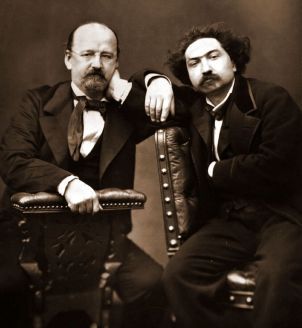
[A photograph of Erckmann-Chatrian]

I read The Man-Wolf this year because it is featured in The Literature of Lovecraft, Volume 1 (2021), a collection of stories that influenced the American author H.P. Lovecraft (1890-1937). Lovecraft wrote about Erckmann-Chatrian and this novella specifically in his literary essay Supernatural Horror in Literature. In the sixth chapter titled “Spectral Literature on the Continent,” he wrote:
The collaborators Erckmann-Chatrian enriched French literature with many spectral fancies like The Man-Wolf, in which a transmitted curse works toward its end in a traditional Gothic-castle setting. Their power of creating a shuddering midnight atmosphere was tremendous despite a tendency toward natural explanations and scientific wonders; and few short tales contain greater horror than “The Invisible Eye”, where a malignant old hag weaves nocturnal hypnotic spells which induce the successive occupants of a certain inn chamber to hang themselves on a cross-beam. “The Owl’s Ear” and “The Waters of Death” are full of engulfing darkness and mystery, the latter embodying the familiar overgrown-spider theme so frequently employed by weird fictionists…the French genius is more naturally suited to…dark realism than to the suggestion of the unseen; since the latter process requires, for its best and most sympathetic development on a large scale, the inherent mysticism of the Northern mind. (chapter 6, para. 7).

Looking over my Goodreads account, I see that I first read this The Man-Wolf two years ago and rated it 1 out of 5 stars, sticking it in my “hated” category. It held up much better this time around. The authors create a powerful atmosphere at times. The character Knapwurst is quite compelling. He happens to be a dwarf who is likely afflicted with Kyphosis, causing him to have an appearance that the narrator describes as “grotesque.” Despite his revulsion, Fritz comes to respect Knapwurst as a scholar, an historian who “almost lives in the library” of the gothic castle. The scene where Fritz visits Knapwurst at 4 AM in chapter 10 slows down the narrative, but has some beautiful writing that is worth quoting at some length. The scene also provides insight into Knapwurst as a person. I almost wish that he was the main character of the novella and not Fritz:
We went into the hut, and in spite of my complete state of numbness, I could not help admiring the state of picturesque disorder in which I found the place. The slate roof leaning against the rock, and resting by its other side on a wall not more than six feet high, showed the smoky, blackened rafters from end to end.
The whole edifice consisted of but one apartment, furnished with a very uninviting bed, which the dwarf did not often take the trouble to make, and two small windows with hexagonal panes, weather-stained with the rainbow tints of mother-of-pearl. A large square table filled up the middle, and it would be difficult to account for that massive oak slab being got in unless by supposing it to have been there before the hut was built.
On shelves against the wall were rolls of parchment, and old books great and small. Wide open on the table lay a fine black-letter volume, with illuminations, bound in vellum, clasped and cornered with silver, apparently a collection of old chronicles. Besides there was nothing but two leathern arm-chairs, bearing on them the unmistakable impression of the misshapen figure of this learned gentleman.
I need not stay to do more than mention the pens, the jar of tobacco, five or six pipes lying here and there, and in a corner a small cast-iron stove, with its low, open door wide open, and throwing out now and then a volley of bright sparks; and to complete the picture, the cat arching her back, and spitting threateningly at me with her armed paw uplifted.
All this scene was tinted with that deep rich amber light in which the old Flemish painters delighted, and of which they alone possessed the secret, and never left it to the generations after them.
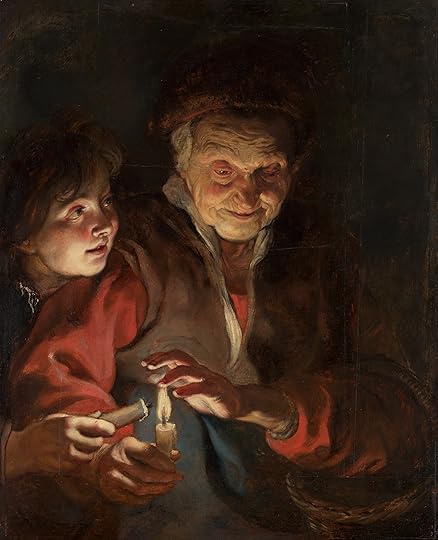


[Old Woman and Boy with Candles (c. 1616/17) by Flemish painter Peter Paul Rubens. The scene in chapter 10 of The Man Wolf makes me think of the lighting in here]

I do find The Man-Wolf to be overly drawn out. A trim of 5,000-10,000 words would probably have resulted in a better tale. Then again, the 19th century had different sensibilities and this fault I find has a great deal to do with late 20th century storytelling preferences. I also find the ending to be disappointing. The combination of a supernatural and scientific explanation for the events does not quite work for me. Still, The Man-Wolfis worth reading for anyone with an interest in werewolf lore and gothic horror tales.

Title: The Man-Wolf
Authors: Alexandre Chatrian and Émile Erckmann
Dates: 1876 (English translation published, translator identifies himself only as F. A. M.), 1859 or 1860 (original publication in French)
Genre: Fiction - Novella*, horror, fantasy
Word count: 37,686 words*
Dates read: 7/11/22-7/13/22
Reading journal entry #211 in 2022

Link to the story: https://www.gutenberg.org/files/15745...
Link to Lovecraft’s essay: https://www.hplovecraft.com/writings/...

Sources:
Chatrian, A. & Erckmann, É. (2021). The man-wolf. In H.P. Lovecraft Historical Society (Ed.), The literature of H.P. Lovecraft (S. Branney, Narr.; A. Leman, Narr.) [Audiobook]. HPLHS. https://www.hplhs.org/lol.php (Original work published 1876)

Lovecraft, H. P., & Joshi, S. T. (2012). The annotated supernatural horror in literature (second edition). Hippocampus Press. https://www.hplovecraft.com/writings/... (Original work published 1927)

Sutherland, D. V. (2021, July 21). Werewolf Wednesday: “The Man-Wolf” by Émile Erckmann and Alexandre Chatrian (1859). Attack of the Six-Foot Tranny. https://dorisvsutherland.com/2021/07/...

Links to the images: https://dorisvsutherland.com/2021/07/...

https://commons.wikimedia.org/wiki/Fi...

The contents of The Literature of H.P. Lovecraft, Volume 1 are:
"The Adventure of the German Student" by Washington Irving
"The Avenger of Perdóndaris" by Lord Dunsany
"The Bad Lands" by John Metcalfe
"The Black Stone" by Robert E. Howard
The Boats of the "Glen Carrig" by William Hope Hodgson
"Count Magnus" by M.R. James
"The Dead Valley" by Ralph Adams Cram
"The Death Mask" by Henrietta Everett
"The Fall of the House of Usher" by Edgar Allan Poe
"The Ghost of Fear" by H.G. Wells (also called “The Red Room”)
"The Ghostly Kiss" by Lafcadio Hearn
"The Horla" by Guy de Maupassant
"The House and the Brain" by Edward Bulwer-Lytton
"The House of Sounds" by Matthew Phipps Shiel
"Idle Days on the Yann" by Lord Dunsany
"Lot #249" by Arthur Conan Doyle
"The Man-Wolf" by Erckmann-Chatrian
"The Middle Toe of the Right Foot" by Ambrose Bierce
"The Minister's Black Veil" by Nathaniel Hawthorne
"The Monkey's Paw" by W.W. Jacobs
"One of Cleopatra's Nights" by Théophile Gautier
"The Phantom Rickshaw" by Rudyard Kipling
The Place Called Dagon by Herbert Gorman
"Seaton's Aunt" by Walter de la Mare
"The Shadows on the Wall" by Mary E. Wilkins
"A Shop in Go-By Street" by Lord Dunsany
"The Signal-Man" by Charles Dickens
"Skule Skerry" by John Buchan
"The Spider" by Hanns Heinz Ewers
"The Story of a Panic" by E.M. Forster
"The Strange Case of Dr. Jekyll and Mr. Hyde" by Robert Louis Stevenson
"The Tale of Satampra Zeiros" by Clark Ashton Smith
"The Tapestried Chamber" by Sir Walter Scott
"The Upper Berth" by F. Marion Crawford
"The Vampyre" by John Polidori
"The Venus of Ille" by Prosper Mérimée
"The Were Wolf" by Clemence Housman
"What Was It?" by Fitz-James O'Brien
"The White People" by Arthur Machen
"The White Wolf of the Hartz Mountains" by Frederick Marryat
"The Willows" by Algernon Blackwood
"The Yellow Sign" by Robert W. Chambers
"The Yellow Wallpaper" by Charlotte Perkins Gilman

If you want to hear the stories in the order in which they were written, here's a guide.
The Vampyre (1819)
The Adventure of the German Student (1824)
The Tapestried Chamber (1828)
The Minister's Black Veil (1836)
The Venus of Ille (1837)
The White Wolf of the Hartz Mountains (1839)
The Fall of the House of Usher (1839)
What Was It? (1859)
The House and the Brain (1859)
The Signal-Man (1866)
The Man-Wolf (1876)

The Ghostly Kiss (1880)
One of Cleopatra's Nights (1882)
The Upper Berth (1886)
The Strange Case of Dr. Jekyll and Mr. Hyde (1886)
The Horla (1887)
The Phantom Rickshaw (1888)
The Middle Toe of the Right Foot (1891)
Lot #249 (1892)
The Yellow Wallpaper (1892)
The Ghost of Fear (1894) - also called The Red Room
The Yellow Sign (1895)
The Dead Valley (1895)
The Were-Wolf (1896)
The Monkey's Paw (1902)
The Shadows on the Wall (1903)
Count Magnus (1904)
The White People (1904)
The Willows (1907)
The Boats of the "Glen Carrig" (1907)
Idle Days on the Yann (1910)
The Story of a Panic (1911)
The House of Sounds (1911)
A Shop in Go-By Street (1912)
The Avenger of Perdóndaris (1912)
The Spider (1915)
The Death Mask (1920)
The Bad Lands (1920)
Seaton's Aunt (1922)
The Place Called Dagon (1927)
Skule Skerry (1928)
The Tale of Satampra Zeiros (1929)
The Black Stone (1931)
*The difference between a short story, novelette, novella, and a novel: https://owlcation.com/humanities/Diff...

Vignette, prose poem, flash fiction: 53 - 1,000 words
Short Stories: 1,000 - 7,500
Novelettes: 7,500 - 17,000
Novellas: 17,000 - 40,000
Novels: 40,000 + words


This review was written on 7/16/22
Profile Image for Rain Blackmoore.
30 reviews2 followers
January 27, 2018
Pourquoi n'ai-je jamais rien lu d'Erckmann et Chatrian jusqu'à présent? J'ai adoré. L'écriture est dynamique, les descriptions fantastiques, les dialogues souvent amusants, et en plus cela se lit vite.

Petit exemple:
Gédéon, avec sa grande figure couleur de vieux buis, sa pelisse de chat sauvage, et son bonne de fourrure à longues oreilles pendantes, galopait devant moi, sifflant je ne sais quel motif du Freischutz; parfois il se retournait, et je voyais alors une goutte d'eau limpide scintiller, en tremblotant, au bout de son long nez crochu.


Alors, bien sûr, par moments c'est un peu lent/lourd/bizarre (les renards, loups etc. sont diaboliques par nature?!), mais considérant qu'il s'agit d'un roman écrit en 1860, cela se pardonne aisément. Reste un joli texte, parfois dur, et des personnages attachants.
Profile Image for RedDagger.
145 reviews4 followers
June 25, 2023
A folksy novella, curse, castles and all, that strains under the often excessive wordiness the author seems fond of. The tale itself seems a little lost under the dense descriptions and dialogue, wrapping up at the end rather abruptly, although the course of the story is made clear early on.

Completely unrelated to this, this passage of a huntsman getting rather...excited...about his ability to track people by their footprints was too funny not to quote:
"I know the old woman by her foot better than by her figure (...) it is finely shaped, the heel is rather long, the outline clean, the great toe lies close to the other toes, and they are all as fine as if they were in a lady's slipper. It is a lovely foot. Twenty years ago I should have fallen in love with a foot like that. Whenever I come across it, it has such an effect upon me!"
Profile Image for Faby Lună.
30 reviews1 follower
November 27, 2017
Me mega encanta estas historias es la segunda vez que leo este libro. Se trata de 10 historias cortar de terror y una novela corta "Hugo el Lobo" crean una atmósfera de suspenso e incertidumbre algunas son racionales y otras sobrenaturales dando una psicosis que te deja un tanto nerviosa y te hace pensar sobre la "realidad" en la que vives. Mis historias favoritas son La araña Cangrejo y El Violín el Ahorcado. Estas historias me hacen recordar cuando era apenas una niña y rogaba porque me contaran historias de terror a mis padres quedándome al final sola en mi cama en la oscuridad soñando con mundos oscuros, criaturas malvadas y cosas que no se pueden explicar.

Retomar este libro hace que mi corazón vuelva a latir con la misma fuerza como la primera vez
Profile Image for Pilar.
26 reviews12 followers
May 25, 2025
3.5 stars

Have never heard of the authors before, or of the story. Basically I listened to Frankenstein not so long ago, and really liked the way the person who read it, did it, so I just checked out what else they gave their voice to. I was looking for a short-ish book to listen to while I'm gaming, so decided on this one.

If it starts a little slowly - and I couldn't see how it was going on the whole werewolf plot - I did enjoy it overall. It really is a book of its time, you can tell the plot is very much an excuse to describe customs etc. of its time (much like frankenstein was in a way) but I liked it, and will eventually check out other stories from these authors.

(listened in french)
Profile Image for Hanna  (lapetiteboleyn).
1,599 reviews39 followers
November 16, 2021
As with most collections of short stories, this was something of a mixed bag. Interestingly, I found the titular 'Man-Wolf' to be the weakest of the group. They do all hang together nicely with similar themes and settings. Especially the setting. The lavish descriptions of rural Germany are a real treat to armchair travellers.
313 reviews33 followers
October 6, 2020
It was hard to get invested into the main story, The Man-Wolf but halfway through the story got really fascinating. Then after the main story, all the other short stories were so much fun to read. My favorite story in this book was The Queen of the Bees.
Profile Image for Carlo Milan.
120 reviews2 followers
May 26, 2020
Historias góticas excelentes.. un libro para leer una y otra vez, muy recomendable
Profile Image for Marise.
78 reviews10 followers
June 20, 2022
Only listened to The Man-Wolf from the audio book The Literature of Lovecraft Vol. 1
Profile Image for Juushika.
1,819 reviews221 followers
August 17, 2019
I was slow to invest in this, despite the excessively evocative descriptions of the barren German forest, because it's so external: an observation of the werewolf as a dreamlike illness; distant, impersonal. But the outside view allows for the werewolf to be Othered, something less than human but more than animal, interacting with humans in a unique way:


This is an early werewolf story, and I love that these early examples can feel fresh, exploring aspects that haven't become central to a trope with defined, repetitious elements. But however interesting, I still didn't enjoy this, and it holds no candle to Clemence Housman's The Were-Wolf, also early werewolf fiction, also engaging a relatively unexplored element of the trope, but distinctly more captivating.
Profile Image for Jason Arbuckle.
365 reviews1 follower
March 17, 2024
Book 39 - Emile Erckmann and Alexandre Chatrian - The Man-Wolf

And so after Dracula, Frankenstein, The Mummy and The Invisible Man I have reached the end of finding the classic horror tropes with The Man-Wolf. Another trip in to the 1800s and another story of castles, ill lords and bewitching hags.

Unfortunately my mantra of finishing each book I start meant I had to finish this dull journey of a sick lord needing to be cured due to an enchantment by an old she-wolf witch. Sigh...the best thing about this book was its brevity....next !!
Profile Image for Gabriel Benitez.
Author 47 books25 followers
August 8, 2021
Una historia trágica de licantropia. Un médico acude al castillo de un conde que sufre accesos de locura brutales que parecen estar relacionados con una extraña y adrajosa mujer que deambula cerca del castillo. ¿Es una enfermedad o una brujería lo que sufre el conde? La respuesta oculta un terrible secreto que se pierde en el origen de la familia del conde. Estos dos autores franceses son excelentes.
Profile Image for Vaishali Muzumdar.
120 reviews
June 18, 2018
Interesting book it start with strange description of mental disorder but then it turns in interesting supernatural nice book
Displaying 1 - 27 of 27 reviews

Can't find what you're looking for?

Get help and learn more about the design.