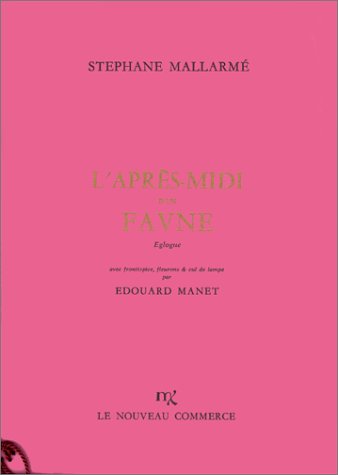
A gorgeous facsimile of the epochal collaboration between Mallarm� and Manet that inspired Nijinsky's most famous danceThe second published collaboration between St�phane Mallarm� and �douard Manet (after Mallarm�'s translation of Poe's "The Raven"), L'apr�s-midi d'un faune is one of the poet's best-known works. It provided the basis for Debussy's Pr�lude � l'apr�s-midi d'un faune (1894), which in turn inspired Nijinsky's ballet L'apr�s-midi d'un faune , first performed in Paris in 1912, with Nijinsky famously dancing the title role. Mallarm�'s poem unfolds in a sensual reverie as a Pan-like faun, arising from slumber, recollects his encounters with two forest nymphs in a monologue filled with pastoral and erotic allusions.For Mallarm�, such publications were total works, with attention paid to every detail of layout, typography, punctuation and artwork. For the original 1876 publication, Manet created four wood two drawings that open and close the poem, and a frontispiece and ex-libris sheet that the artist hand-tinted with pink wash. This volume reproduces that first edition at full size accompanied by a new translation.
Stéphane Mallarmé (French: [stefan malaʁme]; 18 March 1842 – 9 September 1898), whose real name was Étienne Mallarmé, was a French poet and critic. He was a major French symbolist poet, and his work anticipated and inspired several revolutionary artistic schools of the early 20th century, such as Dadaism, Surrealism, and Futurism.
Beautiful work. Mallarmé is an absolute essential poet à propos the french tradition, especially through the ways by which he preludes much of the 20th century French theorists.
¡Oh cierto castigo... Pero el alma, de palabras vacante, y este cuerpo sombrío tarde sucumben al silencio del estío: sin más, fuerza es dormir, lejano del rencor, sobre la arena sitibunda, a mi sabor la boca abierta al astro de vinos eficaces.
E a poesia nunca mais foi a mesma. Ou poderia nunca mais ter sido, se os poetas não operassem a cada palavra a metamorfose da sua arte, pelo simples facto de ser essa a essência da poesia. Aquilo que estes dois poemas representam é fundamentalmente isso: um Mallarmé que conhece os códigos poéticos do seu tempo, que os transforma primeiro numa écloga cujo tema é a tarde de um fauno, com todas as ressonâncias míticas que essa personagem comporta, e que depois rompe com todas as regras tácitas da poesia para produzir Um lance de dados. E este será, porventura, o verdadeiro golpe de génio: um lance de dados não pode abolir o acaso, tal como a arquitetura não pode abolir o caos, mas aquilo que ambos produzem é uma aniquilação da possibilidade. Por outras palavras, um poema que parece um produto do acaso é afinal uma pauta onde cada um de nós pode interpretar os versos como quiser. Assim, jogando a esse jogo, cheguei a um verso (ou uma das múltiplas possibilidades de um verso): «nada/ terá tido lugar/ senão o lugar».
Runous on kuin vieras kieli; jos lukemisesta on kulunut aikaa, niin runojen lukeminen tuntuu hiostavalta, hankalalta, hitaalta. Tänä vuonna olen lukenut, ÖH useamman vuoden tauon jälkeen, jälleen runoutta, mutta tähän en ollut vielä valmis. Kuin olisi hypännyt ranskankieliseen tiedeartikkeliin parin juorulehden jälkeen ja ajatellut että onhan se kielitaito tässä jo verrynnyt ja palautunut mieleen. Edes Debussy ei auttanut keskittymään!
Löysin runoista paljon kieltä mistä pidin mutta sanoakseni teoksesta yhtään mitään minun on odotettava, että saan inspiraation uuteen yritykseen. Ehkä kesäflunssan luovutettua paremmalla keskittymisellä, ehkä kun olen saanut luettua alle useamman runokirjan ja tämänkin kaltaiseen kieleen on helpompi syventyä...