

What do you think?
Marshal Guarnaccia Mystery #3
Death in Springtime
Italian law forbids paying ransom to criminals, and Marshal Guarnaccia must find the missing girl before her kidnappers decide to end her life.
Two foreign girls are abducted from a Florence piazza in broad daylight. The unusual March snowfall has distracted everyone, even the marshal, who is unsure of what he has actually witnessed. One of the girls turns up in a village in the Chianti, claiming the kidnappers have released her to propose a ransom for the other victim. But the marshal thinks she’s lying.
Two foreign girls are abducted from a Florence piazza in broad daylight. The unusual March snowfall has distracted everyone, even the marshal, who is unsure of what he has actually witnessed. One of the girls turns up in a village in the Chianti, claiming the kidnappers have released her to propose a ransom for the other victim. But the marshal thinks she’s lying.
165 pages, Paperback
First published January 1, 1983
About the author
Magdalen Nabb
67 books56 followersMAGDALEN NABB was born in Lancashire in 1947 and trained as a potter. In 1975 she abandoned pottery, sold her home and her car, and came to Florence with her son, knowing nobody and speaking no Italian. She has lived there ever since, and pursues a dual career as crime writer and children's author.
She has written fourteen crime novels featuring Marshal Guarnaccia of the carabinieri, all set in Florence, which she describes as 'a very secret city. Walk down any residential street and you have no idea what is going on behind those blank walls. It's a problem the Marshal comes up against all the time.'
Magdalen Nabb also writes the immensely successful Josie Smith books, set in her native Lancashire, which form the basis of the Granada children's TV series, Josie Smith, scripted by the author. Her first book, Josie Smith, was runner-up for the Guardian Children's Fiction Award in 1989, and in l99l, Josie Smith and Eileen was winner of the prestigious Smarties Book Prize for the 6-8 age group.
Series:
* Marshal Guarnaccia Mystery
* Josie Smith
She has written fourteen crime novels featuring Marshal Guarnaccia of the carabinieri, all set in Florence, which she describes as 'a very secret city. Walk down any residential street and you have no idea what is going on behind those blank walls. It's a problem the Marshal comes up against all the time.'
Magdalen Nabb also writes the immensely successful Josie Smith books, set in her native Lancashire, which form the basis of the Granada children's TV series, Josie Smith, scripted by the author. Her first book, Josie Smith, was runner-up for the Guardian Children's Fiction Award in 1989, and in l99l, Josie Smith and Eileen was winner of the prestigious Smarties Book Prize for the 6-8 age group.
Series:
* Marshal Guarnaccia Mystery
* Josie Smith
Ratings & Reviews
Friends & Following
Create a free account to discover what your friends think of this book!
Community Reviews
Displaying 1 - 30 of 40 reviews

Read
May 14, 2026Florence, Italy is a great place for an adventure and this story makes the most of the shepards who live in the surround hillsides. Most of the shepards are Sardinians who relocated due to over development of their grazing lands in their homeland. American money is the root of the evil that results in the springtime abduction of a young American girl studying in Florence.

May 17, 2024
These are great short mysteries set in Tuscany in 1950`s so great.I am truly enjoying them all- the setting steals the show of course and the Marshal Guarnaccia is a very curious character with many quirks. lovely series.

January 8, 2024
Before I wrote my review I read what several other readers thought of the book. Because the author, an English woman living in Florence, wrote a series about Marshal Guarnaccia and this is the third (but my first one), several reviewers were disappointed in it. Apparently the Marshal is a skilled investigator, but he plays a small role in Death in Springtime. On the plus side, it is a very short novel, almost a novella.
Two foreign students are kidnapped. This seems to be a common way for Sardinian shepherds to make money to supplement their meager incomes. They are organized kidnappers, hold victims for ransom, and then release them unharmed. But this is not the case in this situation. The kidnappers seem to be amateurs and the girl from Norway is released with a message to pay up for the return of the rich American girl.
The local police get involved in trying to rescue the girl before the kidnappers panic and kill her. The search is on, interviewing local people reluctant to ever talk to the police, or to help them. I seemed to enjoy the story more than several other readers, and I particularly liked the Italian setting as I have been to Florence before. I liked it more than the very popular Inspector Bruno series by Donna Leon.
Two foreign students are kidnapped. This seems to be a common way for Sardinian shepherds to make money to supplement their meager incomes. They are organized kidnappers, hold victims for ransom, and then release them unharmed. But this is not the case in this situation. The kidnappers seem to be amateurs and the girl from Norway is released with a message to pay up for the return of the rich American girl.
The local police get involved in trying to rescue the girl before the kidnappers panic and kill her. The search is on, interviewing local people reluctant to ever talk to the police, or to help them. I seemed to enjoy the story more than several other readers, and I particularly liked the Italian setting as I have been to Florence before. I liked it more than the very popular Inspector Bruno series by Donna Leon.

May 18, 2018
I believe that I have enjoyed the previous books of the series but it feels that I must have missed something with this one.
Usually when I think that there will be a problem keeping track of the charactors, particularly when non-English names are involved, I make a Charactor Map in my notebook.
I should have done that here as I confess that I did confuse charactors both on the side of the goodies and the baddies.
Unfortunately it went further than this because at the end , I felt that I didnt understand a part of the solution that was being hinted at. Regrettably I cannot be more precise without without giving too much away. Some parts of the narrative especially those about country life, I enjoyed but I am left with the feeling that something of signifcance eluded me.
It wont put me off the series but next time I will remember my map.
Between writing my notes and typing them up, I think that I now understand some of the reasons for the actions that confused me.
Usually when I think that there will be a problem keeping track of the charactors, particularly when non-English names are involved, I make a Charactor Map in my notebook.
I should have done that here as I confess that I did confuse charactors both on the side of the goodies and the baddies.
Unfortunately it went further than this because at the end , I felt that I didnt understand a part of the solution that was being hinted at. Regrettably I cannot be more precise without without giving too much away. Some parts of the narrative especially those about country life, I enjoyed but I am left with the feeling that something of signifcance eluded me.
It wont put me off the series but next time I will remember my map.
Between writing my notes and typing them up, I think that I now understand some of the reasons for the actions that confused me.

October 10, 2021
I loved the idea of a mystery series set in the charming, historical city of Florence. This third book in the series was written in 1983 (her first and second books were written in 1981) so the methods the detectives used did not include current methods like cell phone records, DNA or GPS so the investigation centred around the police officers’ knowledge of people, and their ability to use their brains and intuition to assess people. The main character, Marshall Guarnaccia, is an unusual police officer who sees what others miss, and is himself, as a Sicilian, somewhat of a fish out of water in a city where most people’s families have lived forever. Thus this series is really a more old fashioned kind of mystery set in Florence. It’s a quick, read that is more like Hercule Poirot or Sherlock Holmes than it is like recent mysteries.

June 25, 2019
Two American students are kidnapped in Florence. One student is released; the rich student is held. Apparently this is an ongoing issue that is a pattern in Florence that immigrants from Sardinia use to make money. The local carabinieri is aware of how the operation works and knows that the kidnapped person will be released unharmed. This time amateurs have kidnapped this woman and nothing is as it should be. Marshal Guarnaccia has little to do with this book as advertised. I was disappointed in this book.

February 2, 2022
In spite of the sheer number of officials involved (the Captain, the Marshall, the Substitute Prosecutor—why “Substitute”? I have no idea) this was an interesting read, if a slightly confusing story.
It’s about a kidnapping. But along the way I learned about cheesemaking, Sardinian shepherds (and cheesemaking Sardinian shepherds) who live in the mountains outside Florence, the complexities of Italian policing.
Not your average procedural, but a pleasant diversion. Only recommended if you are looking for an international police procedural using mid-20th century, Cold War methods.
It’s about a kidnapping. But along the way I learned about cheesemaking, Sardinian shepherds (and cheesemaking Sardinian shepherds) who live in the mountains outside Florence, the complexities of Italian policing.
Not your average procedural, but a pleasant diversion. Only recommended if you are looking for an international police procedural using mid-20th century, Cold War methods.

January 10, 2023
I've read several of Nabb's Florentine mysteries to complement my vacation to Italy. In general, I have found them charming and very enjoyable. This one suffers from two flaws: it does not feature Marshal Guarnaccia, and it is really a thriller rather than a mystery. The Marshal is one of the best detectives I have ever encountered. He thinks of himself as slow-witted and stupid, but he is actually kind and perceptive.
March 6, 2025
Rating: 3,5. Relido. É sem dúvida um belíssimo romance policial muito embora contenha algumas passagens dificilmente compreensíveis. Nabb tem um estilo intencionalmente muito sincopado e a autora não manifesta grande preocupação em ser explícita, deixando ao leitor a tarefa de preencher as lacunas do enredo. Como se tal não chegasse, a tradução, sem ser propriamente má, contem alguns lapsos e imprecisões que contribuem para tornar o texto ainda mais opaco e difícil de entender.
April 23, 2019
Another very interesting tale about the culture of Florence. When a young woman is kidnapped, her friend is released. The problem is why? Marshal Guarnaccia takes on the case, which proves to be much more complex than it appeared at first.

December 20, 2021
This is a good series, very well written and precisely observed. In this one, the seemingly ‘routine’ kidnapping of an American student turns into something more complicated involving, among other things, changes in the economy of the countryside.

June 15, 2026
3 1/2 stars. Bleak novel with too little of Marshall Guarnaccia. The main characters are well drawn, but I couldn't get a grip on the other characters, perhaps not the author's fault. Well written, but lacked some essential liveliness I've come to expect from this series.

October 31, 2022
a short book and very one dimensional

June 4, 2023
2nd book I've read by Nabb, amazing. What an incredible writer. You feel like you are in Florence and finding out so much about the place and people. Her ability to make you feel and live in a scene with such economy is just amazing.
What starts as kidnapping - proceeds to an unusual demand for money and the people in law enforcement are a bit stumped because it is done so poorly. It's pretty chilling in the end, and very sad. In these stories the horror and sadness is for both the criminal and victim... as they seem both to be victims to a larger situation.
What starts as kidnapping - proceeds to an unusual demand for money and the people in law enforcement are a bit stumped because it is done so poorly. It's pretty chilling in the end, and very sad. In these stories the horror and sadness is for both the criminal and victim... as they seem both to be victims to a larger situation.
July 29, 2023
A good snapshot of life in Tuscany but there were too many characters to keep track of and I was a little lost when it came to both the plot and the solution!

November 14, 2023
Character and a sense of place are paramount
August 10, 2024
I thought it charming as I read it, but in the end? It’s one of those books where the most interesting thing is what happens to the characters after the conclusion, but since the characters were never much more than cardboard cutouts, you don’t care that much.
Read
November 15, 2024The captain, the shepherds and a kidnapping.
May 1, 2026
Suspenseful and somewhat melancholy. Really gives you a feeling for the area, the different types of people who live there. The Substitute was my favorite

Read
July 5, 2021This is a quick read and it's perfect for those who like plot-driven procedurals that focus on the events at hand and do not diverge into the private lives of the detectives on the case. None of these officers have drinking problems or ex-wives or unsavory past histories. In fact, other than a select few, they are known simply as The Brigadier, The Substitute, and so on.
As well follow along with the Marshal on his way to work, we pause at a piazza to observe a late snowfall that strikes everyone as out of the ordinary. It's March, near Palm Sunday and then Easter. People are shivering in the unexpected cold, hurrying to drop their children off with the nuns at nursery and pick up their market goods, and the marshal to get to work. A few miles north of Florence, a car screeches to a stop on a country road and ejects a young woman, who staggers toward lights and collapses in a town square at a florist shop. She's been released but her friend has been kept as a kidnap victim. This book was written in the 1980s, when kidnappings were common in Italy. Is it a professional jobs, or more worrying, is it one of the newer residents from Sardinia who keeps sheep in the mountains, make expensive cheese, and have been known to engage in a criminal activity here and there? What will ensure the safety of the captive, a wealthy American studying Italian in Florence, and also bring about the capture of the kidnappers? Not all of everyone's stories are the whole truth, and the search takes the reader to the shepherd culture on the mountains outside of Florence. The ending is a bit of a surprise twist that is appropriate both in hope and suffering for the Easter time ending.
This is the third of a series written by Magdalen Nabb and following a police officer in Florence. Nabb was a British author who passed away in 2007, and her books (twelve in all) were praised by fellow mystery writers such as Georges Simenon at the time. Recommend for those who would enjoy a quick-paced, lean procedural that gives a taste of northern Italian culture and history.
As well follow along with the Marshal on his way to work, we pause at a piazza to observe a late snowfall that strikes everyone as out of the ordinary. It's March, near Palm Sunday and then Easter. People are shivering in the unexpected cold, hurrying to drop their children off with the nuns at nursery and pick up their market goods, and the marshal to get to work. A few miles north of Florence, a car screeches to a stop on a country road and ejects a young woman, who staggers toward lights and collapses in a town square at a florist shop. She's been released but her friend has been kept as a kidnap victim. This book was written in the 1980s, when kidnappings were common in Italy. Is it a professional jobs, or more worrying, is it one of the newer residents from Sardinia who keeps sheep in the mountains, make expensive cheese, and have been known to engage in a criminal activity here and there? What will ensure the safety of the captive, a wealthy American studying Italian in Florence, and also bring about the capture of the kidnappers? Not all of everyone's stories are the whole truth, and the search takes the reader to the shepherd culture on the mountains outside of Florence. The ending is a bit of a surprise twist that is appropriate both in hope and suffering for the Easter time ending.
This is the third of a series written by Magdalen Nabb and following a police officer in Florence. Nabb was a British author who passed away in 2007, and her books (twelve in all) were praised by fellow mystery writers such as Georges Simenon at the time. Recommend for those who would enjoy a quick-paced, lean procedural that gives a taste of northern Italian culture and history.

October 20, 2013
Lately I have read a number of half-backed, poorly written mysteries. I was beginning to despair that I would never find another decent detective story. One of the problems with current mysteries is that they too often rely on a gimmick, ones often involving setting, transplanted characters from famous books, hobbies, another time period or cats. If one was to go by current mystery trends one could conclude that every other well bred Georgian woman, including the great Miss Austen and her beloved creation Lizzie Bennett, was hot on the trail of some nefarious ne'er do well. What would Jane think? What would Jane do? Reach for her magnifying glass and fingerprint kit? I'm thinking no.
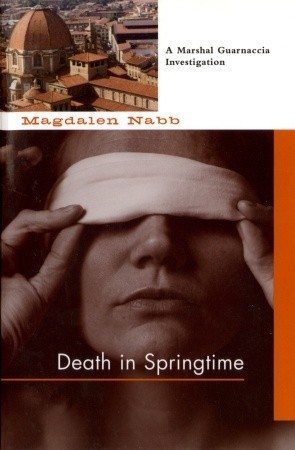
Thank goodness for Magdalen Nabb's small jewel of a mystery, Death in Springtime. Despite what I said about setting before, the thing that drew me to this book was the cover illustrations of Florence. Oh, I do love Florence! Last time I read a mystery set in Florence I was irritated beyond belief. It was so cheesy. Now, Death in Springtime is cheesy too. As in there are Sardinian shepherds and their wives busily, steadfastly making the pecorino and ricotta. Cheeses are stolen. The cheese making, shepherding and illegal activities of the Sardinian population of Tuscany forms the backdrop for the plot which revolves around the Carabinieris' search for a kidnapped American student. I also have a weakness for the Carabinieri; have since my childhood in Naples. Splashy dressers! Nabb's use of setting is not superficial or gimmicky. Her exploration into the history and culture of the maligned Sardinians is based on solid research, yet she incorporates the information seamlessly into the story. Her characters are well conceived, solid, interesting people. The stage is shared by four carabinieri officers and an Substitute prosecutor. There is the serious minded Captain Maestrangelo, a seasoned hand in kidnapping cases. Kidnapping is apparently a lucrative business in Tuscany. The soft-heartened, intuitive Marshal Guarnaccia. For subtle humor there is the woeful Brigadier of Pontino. Often he bemoans his understaffed department which is principally filled by youngsters doing their national service year, "mama's boys who can't even cook pasta." His knowledge of the area, insight into and sympathy for the Sardinians proves invaluable to the city officers. There is the lovelorn Bacci, a sub- lieutenant whose excellent English the others rely on. Only problem is the poor fellow tends to fall in love. Finally, the quietly ironic, cigar smoking Substitute Prosecutor who keeps the Captain well feed.
Nabb's style also sets her apart. To say her style is literary may be off- putting. Let's say her writing is far better than that of the majority of books that have made their way into this grossly bloated field. Much of this has to do with trust. I think too many writers of the mystery genre today do not trust adult readers to be intelligent, thus their writing style is juvenile, simplistic and heavy on needless explanation.
Finally! A mystery series that holds up well in comparison to Sayers, Marsh and Co. Granted this is not really a new offering; it was actually first published in 1983 before the invasion of the cozy.
Thank goodness for Magdalen Nabb's small jewel of a mystery, Death in Springtime. Despite what I said about setting before, the thing that drew me to this book was the cover illustrations of Florence. Oh, I do love Florence! Last time I read a mystery set in Florence I was irritated beyond belief. It was so cheesy. Now, Death in Springtime is cheesy too. As in there are Sardinian shepherds and their wives busily, steadfastly making the pecorino and ricotta. Cheeses are stolen. The cheese making, shepherding and illegal activities of the Sardinian population of Tuscany forms the backdrop for the plot which revolves around the Carabinieris' search for a kidnapped American student. I also have a weakness for the Carabinieri; have since my childhood in Naples. Splashy dressers! Nabb's use of setting is not superficial or gimmicky. Her exploration into the history and culture of the maligned Sardinians is based on solid research, yet she incorporates the information seamlessly into the story. Her characters are well conceived, solid, interesting people. The stage is shared by four carabinieri officers and an Substitute prosecutor. There is the serious minded Captain Maestrangelo, a seasoned hand in kidnapping cases. Kidnapping is apparently a lucrative business in Tuscany. The soft-heartened, intuitive Marshal Guarnaccia. For subtle humor there is the woeful Brigadier of Pontino. Often he bemoans his understaffed department which is principally filled by youngsters doing their national service year, "mama's boys who can't even cook pasta." His knowledge of the area, insight into and sympathy for the Sardinians proves invaluable to the city officers. There is the lovelorn Bacci, a sub- lieutenant whose excellent English the others rely on. Only problem is the poor fellow tends to fall in love. Finally, the quietly ironic, cigar smoking Substitute Prosecutor who keeps the Captain well feed.
Nabb's style also sets her apart. To say her style is literary may be off- putting. Let's say her writing is far better than that of the majority of books that have made their way into this grossly bloated field. Much of this has to do with trust. I think too many writers of the mystery genre today do not trust adult readers to be intelligent, thus their writing style is juvenile, simplistic and heavy on needless explanation.
Finally! A mystery series that holds up well in comparison to Sayers, Marsh and Co. Granted this is not really a new offering; it was actually first published in 1983 before the invasion of the cozy.

January 7, 2009
DEATH IN SPRINGTIME (Pol. Proc.-Captain Maestrangelo-Italy-Cont) – G+
Nabb, Magdalen – 3rd in series
Charles Scribner’s Sons, 1983, US Hardcover ISBN: 0684181339
First Sentence: “It can’t be.”
It is the first of March and snowing in Florence. This is such an unusual event, no one notice two college woman being kidnapped at gunpoint. One of the girls is released but the second, the daughter of a wealthy American business, is still being held.
Although Marshal Guarnaccia does what he can to help, it is up to Captain Maestrangelo, under the eye of the new Substitute Prosecutor to find and save the girl.
Within 165 pages, Ms. Nabb has provided a well-crafted, classic police procedural. This isn’t a guns-blazing, car chase story. It is one of gathering clues, knowing the area and the residents and putting together the evidence piece by piece.
It is certainly evident how different the Italian system is from the American, but at the same time similar in the way the investigation was done and the determination to rescue the victim and find the kidnappers. Nabb provides a visual sense of the area, a bit of history of the Sardinian sheepherders and the impact of changing times.
Guarnaccia plays a minor role in this story, but it is all handled so realistically. I very much enjoyed this book and look forward to continuing with the series.
Nabb, Magdalen – 3rd in series
Charles Scribner’s Sons, 1983, US Hardcover ISBN: 0684181339
First Sentence: “It can’t be.”
It is the first of March and snowing in Florence. This is such an unusual event, no one notice two college woman being kidnapped at gunpoint. One of the girls is released but the second, the daughter of a wealthy American business, is still being held.
Although Marshal Guarnaccia does what he can to help, it is up to Captain Maestrangelo, under the eye of the new Substitute Prosecutor to find and save the girl.
Within 165 pages, Ms. Nabb has provided a well-crafted, classic police procedural. This isn’t a guns-blazing, car chase story. It is one of gathering clues, knowing the area and the residents and putting together the evidence piece by piece.
It is certainly evident how different the Italian system is from the American, but at the same time similar in the way the investigation was done and the determination to rescue the victim and find the kidnappers. Nabb provides a visual sense of the area, a bit of history of the Sardinian sheepherders and the impact of changing times.
Guarnaccia plays a minor role in this story, but it is all handled so realistically. I very much enjoyed this book and look forward to continuing with the series.

March 23, 2010
This is the third Magdalen Nabb book and I have to say that each one I read gets better and better. I like her writing style, the way she is able to spin so much out of so little. The plot of “Death in Springtime” is a simple one, a kidnapping in the hills around Florence, however Nabb is able to bring about a solution in a way that is unique from other mystery writers.
It’s interesting that Nabb’s mystery series is still called “The Marshal Guarnaccia Mysteries” since in these first three books in the series, Guaranccia plays a very minimal role. The stronger character is Captain Maestrangelo, who is presented as a silent man of few words. The Marshal, at this point in the series, seems to be adept at providing the Captain with not only small clues but he is also able to wrap up the end of the book in a very satisfying way.
It’s interesting that Nabb’s mystery series is still called “The Marshal Guarnaccia Mysteries” since in these first three books in the series, Guaranccia plays a very minimal role. The stronger character is Captain Maestrangelo, who is presented as a silent man of few words. The Marshal, at this point in the series, seems to be adept at providing the Captain with not only small clues but he is also able to wrap up the end of the book in a very satisfying way.

October 24, 2013
When I read a mystery, I like to find books that have a strong sense of place, interesting characters, and of course a good puzzle of a mystery to solve.
While the author does a great job of evoking Florence, I just could not sustain an interest in the story.
Also, the characters were often referred to by their rank, instead of by name, such as 'the Marshal, or the Captain'. Probably a minor point, but I found it a bit impersonal for the majority of the characters to only be referred to in this way.
This is the first of the series I read, since it's the third in the series I may not have chosen the best place to start. I'm sure there's things that I missed that were referred to in earlier books.
Overall, not an entirely bad book, just not very memorable for me.
While the author does a great job of evoking Florence, I just could not sustain an interest in the story.
Also, the characters were often referred to by their rank, instead of by name, such as 'the Marshal, or the Captain'. Probably a minor point, but I found it a bit impersonal for the majority of the characters to only be referred to in this way.
This is the first of the series I read, since it's the third in the series I may not have chosen the best place to start. I'm sure there's things that I missed that were referred to in earlier books.
Overall, not an entirely bad book, just not very memorable for me.

August 12, 2015
Snowfall is so unusual in Florence, that when people are questioned about the abduction of two girls at gunpoint in the middle of a storm, all they can recall is the weather. One of the girls is released and turns up in a dreadful state, eventually revealing that the kidnappers have released her to deliver a ransom demand for the other victim. It turns out that as Corsica has been subjected to rapid development, the shepherds of that island have moved to the hills of Tuscany, bringing with them their skills in sheep, herding, cheese-making, and kidnapping and providing an instant pool of suspects. An intelligently written procedural in an interesting setting.

October 8, 2014
The cover says it is a Marshal Guarnaccia investigation, Marshal doesn’t show up until the middle of the book, and the Brigadier is the main character. It has an Italian feel, the writing style that is, straightforward, even visceral, pragmatic about the machismo of officials, and sleight of hand strategy to get things done. A U.S. young woman is missing, and what opens up is intrigue of cocaine sells, Sicilian shepherd mafias relocated to the mainland. It is pretty good complication, and there is a lot of local color with various characters, in the mountains. I liked it.

October 29, 2011
Like all of Nabb's mysteries, you get a fantastic sense of place from her writing. I love the details of Florence she includes and the feeling the reader gets that the city is as much of a character as the Marshal himself. As part of her series about the Marshal, this wasn't the strongest of the bunch, but it kept me reading and interested right to the end. A must read for anyone who has been to Florence or is planning a trip there.

April 22, 2013
This series continues to be good but not great. It is a quick read, but didn't stand out really as memorable. I need to read this for an upcoming review, but feel that I can head into that review without finishing the series. This series is not strongly character driven and focuses more on the mystery rather than relationship development. On a side note they are incredibly quick reads.

May 3, 2014
Nabb's books evoke a strong image of Tuscany and Florence. This episode of the Marshal Guarnaccia series is about a kidnapping of a young American student.
I like the way the books are written, the interaction between the "Marshal" and the "Captain".
Not a traditional whodunnit but more a scenic description of Tuscan Pastoral life and Florence.
I like the way the books are written, the interaction between the "Marshal" and the "Captain".
Not a traditional whodunnit but more a scenic description of Tuscan Pastoral life and Florence.
October 3, 2015
I was underwhelmed by this first entry to the series. I was hoping for something like Sjowall & Wohlinski (Martin Beck) or Janwillem van de Wetering (Grijpstra & de Gier). Instead, I got a sort of aimless plot that never quite seemed to click into place. It wasn't bad, but left me wishing for more. I'll try another and see how the series progresses.
Displaying 1 - 30 of 40 reviews