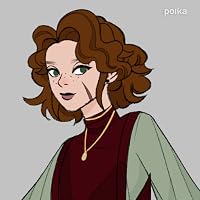
"Amongst the crowd of people who were waiting in the Out-Patients' Department of the London Hospital on a certain foggy day toward the latter end of November might have been seen an old cherry-cheeked woman. She had bright blue eyes and firm, kindly lips. She was a little woman, slightly made, and her whole dress and appearance were somewhat old-fashioned. In the first place, she was wonderfully pretty. Her little face looked something like a russet apple, so clear was her complexion and so bright and true the light in her eyes. Her hair was snow-white, and rather fluffy in texture; it surrounded her forehead like a silver halo, adding to the picturesque effect of apple cheeks and deep blue eyes. Her attire was quaint and old-fashioned. She wore a neat black dress, made without the least attempt at ornament; round her neck was a snowy kerchief of somewhat coarse but perfectly clean muslin; over her shoulders a little black shawl was folded corner-ways, and pinned neatly with a large black-headed pin at her breast. A peep of the snowy handkerchief showed above the shawl; the handkerchief vied with the white of her hair. On her head was a drawn black silk bonnet with a tiny border of white net inside. Her hands were clothed in white cotton gloves. She stood on the borders of the crowd, one of them, and yet apart from them, noticeable to everyone present by her pretty, dainty neatness, and by the look of health which to all appearance she possessed. This had evidently been her first visit to the Out-Patients' Department. Some habitues of the place turned and stared at her, and one or two women who stood near-burdened, pallid, ill-looking women-gave her a quick glance of envy, and asked her with a certain show of curiosity what ailed her."
Mrs. L.T. Meade (Elizabeth Thomasina Meade Toulmin Smith), was a prolific children's author of Anglo Irish extraction. Born in 1844, Meade was the eldest daughter of a Protestant clergyman, whose church was in County Cork. Moving from Ireland to London as a young woman, after the death of her mother, she studied in the Reading Room of the British Museum in preparation for her intended career as a writer, before marrying Alfred Toulmin Smith in September 1879.
The author of close to 300 books, Meade wrote in many genres, but is best known for her girls' school stories. She was one of the editors of the girls' magazine, Atalanta from 1887-93, and was active in women's issues. She died in 1914.
Definitely not as fascinating as the previous two Meades I read, in part because I found the "endearing" grandmother intensely annoying. On the plus side, it does refute some of the cast-in-steel gender roles of the late Victorian era with David being far more domestic (both in talent and inclination) than his sister Alison. That's the thing about L. T. Meade - even when the book isn't great, she always throws you a bone.
Patience Reed was "an old cherry-cheeked woman. She had bright blue eyes and firm, kindly lips...She was wonderfully pretty. Her little face looked something like a russet apple...Her hair was snow-white, and rather fluffy in texture..."
And Mrs. Reed was at the Out-Patients' Department of the London Hospital that foggy morning. Her right hand had been hurting "awful - right up to the shoulder." The doctor's verdict is the equivalent of writer's cramp. That means no more needlework. How will she support her six orphan grandchildren now?
Alison, the eldest girl, was now seventeen and working in a clothing shop. Harry, the eldest boy, is somewhat of a scamp and a real concern to his grandmother. David was fifteen and was doing something for himself. The youngest three are Polly, Susie, and Kitty, and they are all attending school.
The story revolves around a series of events that brings great concern to the family. How will they survive without Mrs. Reed's income from her needleworking?
Although I enjoyed the story, there were a few inconsistencies that bothered me. The author didn't keep straight which boy was older, which girls shared which bedrooms, and how long they lasted on the money they had. There were quite a few loose ends at the conclusion of the story, and there was a bit too much preaching for my taste.
My mom bout this book for a few dollars from an antique store because she liked the art on the cover—it is rather lovely. I took it because it seemed quaint. Well, dear heavens, I have never half-read anything so pulse-slowing in my life. I say “half-read” because I skipped the second, third, and fourth sixths of the book—and lost none of the plot, making me wonder what possibly could have been contained in that half that was so necessary to write.
Two stars because I liked the main character (as I am wont to like all old lady main characters) and because this sort of vintage slice-of-life is a great genre, if often dreadfully dull.