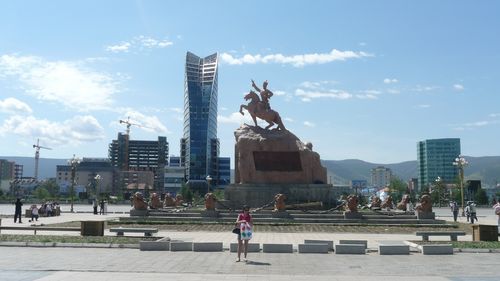
De sa tour d'Oulan-Bator, Gengis II Mao IV Khan règne, en ce XXIe siècle, sur le monde entier. Sur ce qu'il en reste. En 1991, une éruption cataclysmique du Cotopaxi a assombri le ciel pour des semaines. À la faveur de la terreur et de la nuit, des émeutes. Puis des révolutions. Des guerres, enfin. Et sur les ruines du vieil ordre, les survivants meurent lentement du pourrissement organique, virus surgi d'une usine d'armes bactériologiques. L'Humanité pourrit sur pied.
Sauf à Oulan-Bator, sauf dans l'organisation du Khan, où grâce à l'antidote de Roncevic, développé sur son ordre, le pourrissement est arrêté. Grâce à l'électronique, le Khan a des yeux partout. Il est le garant de Reconstruction. Il manifeste une vitalité prodigieuse. Il a quatre-vingt-treize ans. Il ne veut pas mourir. Avec l'aide de Shadrak, noir américain devenu son médecin, il ne mourra jamais. Grâce à trois projets immortalité dont le plus sinistre, Avatar, consiste à transférer dans un corps jeune sa personnalité. Pour assurer une tyrannie éternelle ?
There are many authors in the database with this name.
Robert Silverberg is a highly celebrated American science fiction author and editor known for his prolific output and literary range. Over a career spanning decades, he has won multiple Hugo and Nebula Awards and was named a Grand Master by the Science Fiction and Fantasy Writers of America in 2004. Inducted into the Science Fiction and Fantasy Hall of Fame in 1999, Silverberg is recognized for both his immense productivity and his contributions to the genre's evolution. Born in Brooklyn, he began writing in his teens and won his first Hugo Award in 1956 as the best new writer. Throughout the 1950s, he produced vast amounts of fiction, often under pseudonyms, and was known for writing up to a million words a year. When the market declined, he diversified into other genres, including historical nonfiction and erotica. Silverberg’s return to science fiction in the 1960s marked a shift toward deeper psychological and literary themes, contributing significantly to the New Wave movement. Acclaimed works from this period include Downward to the Earth, Dying Inside, Nightwings, and The World Inside. In the 1980s, he launched the Majipoor series with Lord Valentine’s Castle, creating one of the most imaginative planetary settings in science fiction. Though he announced his retirement from writing in the mid-1970s, Silverberg returned with renewed vigor and continued to publish acclaimed fiction into the 1990s. He received further recognition with the Nebula-winning Sailing to Byzantium and the Hugo-winning Gilgamesh in the Outback. Silverberg has also played a significant role as an editor and anthologist, shaping science fiction literature through both his own work and his influence on others. He lives in the San Francisco Bay Area with his wife, author Karen Haber.
There is a certain audacity to the outrageous quality of much of science fiction, usually exemplified by the work of such authors as Philip K. Dick or Theodore Sturgeon. Theirs is an off the beaten path that runs perpendicular to other fiction, their’s are proudly unique ideas, stridently and proudly declaring, Voltaire like, that here is something different.
Robert Silverberg first published Shadrach in the Furnace in 1976 and this novel, perhaps more than any other of his I’ve read, also represents this quality of science fiction.
In the not too distant future, the world has been transformed by a series of natural, political and biological calamities into one only partially recognizable. Mongolia once again stands atop the world’s econo-political power base, this time not the result of marauding horsemen, but out of an opportunistic power play and the favorable use of the Virus War. While this event took place in the past and off stage, the results are omnipresent, except for the chosen few of the Khan’s select, who benefit daily from the good effects of the antidote.
Attending the aging Khan, Genghis Mao, in his palace of Ulan Bator is our hero Shadrach Mordecai, the Khan’s personal physician. Shadrach and his staff have kept the totalitarian leader alive decades beyond what nature would have provided and intend on keeping him alive much, much longer. The Khan has projects in place that will allow him to stay alive perhaps indefinitely.
From here comes the conflict and Silverberg’s protagonist is deftly chosen for the role. Using this setting as an opportunity to explore much of the world after the results of a global viral pandemic, Silverberg demonstrates his great storytelling ability and his masterful knowledge of cultural and theological themes.
Good enough to be nominated for the Hugo and the Nebula, probably on the strength of the ideas alone, the story, in my humble opinion, was inconsistent and fragmented, there were parts where I thought this may be his best writing and other sections that I had to muck through.
All in all, still a damn fine story by one of the genre’s best.
Shadrach in the Furnace is Silverberg doing what he does best, giving us a deep, soul searching story in a richly imagined world that's both wholly different from ours but chillingly similar in many regards just below the surface.
The world is here a post apocalyptic dystopia, broken and dying from genetic "organ rot" after the virus wars of the late 20th century. Themes of life, renewal, guilt and death are seen through the eyes of Shadrach, a solemn and dedicated young doctor, and the despotic, megalomaniac ruler he serves, an aged man who seeks immortality at any cost. It wouldn't be a Silverberg novel without mysticism, which take several forms including trans-temporalism, drug induced hallucinations of time/place displacement; dream death, hypnotically induced visions of death and the afterlife; and "cults", semi-religious organizations where one seeks a kind of spiritual fulfillment through the exercise of skill and great focus. As fascinating as these are, they don't tie into the plot as deeply as they could have. Also, as one would expect from Silverberg there's a fair bit of eroticism.
Although Dying Inside and Downward to the Earth remain my favorite Silverberg titles, Shadrach in the Furnace certainly stacks up well with his best stuff, which I guess given its Hugo and Nebula nominations shouldn't be a surprise.
"The lunatics are running the asylum. And the head lunatic is the craziest one of all. And you just don't fit in. Can you think of anything crazier than a world full of rotting people governed by a thousand antidote filled bureaucrats and ruled by a ninety year old Mongol warlord who is planning to live forever. This is sanity?"
-Los conceptos que no dan para una novela no deberían estirarse.-
Género. Ciencia ficción.
Lo que nos cuenta. En el libro Sadrac en el horno (publicación original: Shadrach in the Furnace, 1976), la humanidad ha sufrido los estragos de una gigantesca explosión volcánica y de guerras biológicas; ahora, en el siglo XXI, el mundo está regido por Genghis II Mao IV Khan desde Ulan Bator, un hombre ya anciano pero con una salud relativamente buena gracias a la tecnología y los cuidados de su médico, Sadrac Mordecai, que incluso tiene implantes en su cuerpo que le informan en tiempo real de las variaciones en el organismo del presidente. Varios proyectos secretos están destinados a prolongar la vida del soberano y Sadrac es de las pocas personas que los conoce, pero ni siquiera él tiene idea de todos los planes del Khan a ese respecto.
¿Quiere saber más de este libro, sin spoilers? Visite:
Shadrach in the Furnace was serialized in Analog magazine from August through October of 1976, when Ben Bova was the editor, and then appeared as a Bobbs-Merrill hardback and a selection of the SF Book Club. It was on the final best-novel-of-the-year ballots but lost the Nebula to Pohl's Man Plus and the Hugo to Wilhelm's Where Late the Sweet Birds Sang. It's set three dozen years in the future in 2012, on an Earth which has been decimated by virus wars and subsequent economic collapse. The world capital is Ulaanbataar in Mongolia, where Genghis II Mao IV rules and wants to be immortal. The main character is Shadrach Mordecai, his personal physician, who's leading one of three groups seeking immortality. There's a bit too much morality-play-style philosophizing, but it is a thought-provoking novel. Shadrach is a Black man, and there are a diverse group of different ethnicities presented as main characters, which was quite unusual for the time. (Especially, I'd say, in Analog stories.) The ending is a little too pat, but it's an interesting story that goes there. I enjoyed the read way back when, but probably won't be moved to pick it up again.
As America celebrated its bicentennial year in 1976, sci-fi great Robert Silverberg was, by all reports, feeling not a little "burnt out"...and quite understandably so. The author, by that point, had already come out with almost 320 books (!) since his first, "Revolt on Alpha C," in 1954. Granted, of that staggering number, over half had been adult-oriented sex novels (178, by my rough count), while a good 93 had been nonfiction volumes dealing with such widely varied subject matter as the pharaoh Akhnaten, extinct animals, John Muir and Antarctica. But it is his science fiction work, of course, that Silverberg is best known for today. During his initial writing phase (1954 - ’65, which included the author’s first "retirement," due to his dissatisfaction with the literary restraints of the era), the author had come out with 23 pleasing, workmanlike, pulpish sci-fi entertainments. But Silverberg astonished his peers and readers alike with his second phase, from 1967 - ’76, during which time--given considerable creative leeway by editor Frederik Pohl, and reveling in the written word’s newly liberalized freedoms as regards language, style, sex and subject matter--the author came out with 25 novels that constitute one of the greatest streaks any writer, in any genre, has ever enjoyed. Each of the 25 is a little gem, as different from the others as can be; beautifully written, literate, intelligent and highly imaginative creations, all. But all that creative effort must have taken its toll, the result being, as mentioned, one burnt-out writer. (Oh...did I fail to mention the 450 short stories and novellas that Silverberg had ALSO produced up to this point?!) One would think that the author’s final work, after all this expenditure of effort, would exhibit some signs of creative bankruptcy, of imaginative decline. Happy to say, that is hardly the case here. "Shadrach in the Furnace," released in ’76 as a Bobbs-Merrill hardcover, turns out to be one of its author’s greatest creations, every bit as wonderful and captivating as any of his many other lauded works from this middle phase. The novel was nominated for a Nebula Award (ultimately “losing” to Pohl’s "Man Plus") as well as a Hugo (Kate Wilhelm’s "Where Late the Sweet Birds Sang" prevailed that year, however), and has remained a fan favorite ever since.
The book takes place over the course of a few months in the spring/summer of 2012. The Earth, at this point, is in a very sorry state, indeed, with over half its population dead as a result of the “organ rot” disease that had arisen after the Virus Wars of the mid-'90s. Now, while the remaining population slowly succumbs to the rot, the world dictator, Genghis II Mao IV Khan, rules over what’s left from his enormous tower in Ulan Bator, Mongolia. The book’s central story revolves around the Khan’s doctor, Shadrach Mordecai, a 39-year-old black man from Philadelphia who, by dint of the telemetering devices implanted in his body, is able to keep track of the Khan’s precise medical status from anywhere within a 1,000-kilometer radius! The Khan is immensely old (we never learn his exact age, but it is suspected to be around 90), and through innumerable organ transplants and transfusions, intends to keep his run going for many more years. Three scientific projects that are under way in the tower are expected to enable the Khan to achieve an even greater longevity: Project Talos, which strives to build a robotic leader; Project Phoenix, which would enable the Khan to regenerate his cellular matter; and, perhaps most remarkably, Project Avatar, which would make it possible for the aged leader to put his soul/spirit into the healthy body of a younger man! And when Shadrach inadvertently learns that the Khan has taken an interest in his own young, healthy body, he must decide whether to flee (not an easy proposition, in this world of ubiquitous citizen police and omnipresent spy satellites) or stay loyal to his leader and patient....
"Shadrach in the Furnace" is a fitting culmination of Silverberg’s sci-fi work up until that point. Like many of its predecessors, it features a highly likable leading character (Shadrach is one cool customer indeed: hugely intelligent, well spoken, compassionate, smooth with the ladies), a liberal dose of somewhat graphic sex (Shadrach has relationships with two female scientists in the book: Dr. Nikki Crowfoot, head of Project Avatar, and Dr. Katya Lindman, head of Project Talos), and scenes set in an amusement park of the future (here, the dead city of Karakorum has been rebuilt as a wonderland/playground for adults). The book is one of boundless imagination, with some new wonder or stunning plot development on practically every page. Thus, we get to experience three of the world’s latest fad religions with Shadrach: transtemporalism (which allows one, via drugs, to witness ancient historic events), dream death (a hypnotic state that resembles the timeless/spaceless experience of death, and during which Silverberg gets to spin still another psychedelic sequence, harking back to his truly bizarre novel of 1971, "Son of Man") and carpentry (or the attaining of an almost Zen-like state through woodworking). Typical for Silverberg, the book contains some truly fascinating, well-written dialogue, from an author who always seems to instinctively know the right word to employ. And just as the reader begins to wonder if this entire longish novel will remain confined to the Mongolian capital, off Shadrach goes on a tour of the world, allowing the reader to see what’s going on in Nairobi, Jerusalem, Istanbul, Rome and San Francisco, as the organ rot continues to lay the world to waste. It really is some spellbinding stuff; even New Wave legend J.G. Ballard has called the book "ingenious," and he, I have a feeling, was a tougher critic than myself! The novel is a nearly flawless creation (my only real problem with it is that we never fully learn how Shadrach came to be in the Khan’s employ to begin with) and ends quite wonderfully, with the world almost literally in the palm of Shadrach’s left hand....
Of course, "Shadrach," happily, was NOT Silverberg’s final novel after all, and it was just four years later when the author came roaring back with the start of his hugely popular Lord Valentine series. He has come out with almost 30 more novels since, in this, his current, third phase. I have not read any of his third-phase books (yet), but after having taken in the bulk of phase 2, I must admit that I have concluded that Robert Silverberg is one of the best we’ve got. Just read his final three works of that middle phase--"Dying Inside," "The Stochastic Man" and "Shadrach in the Furnace," all written, mind you, by the author as he complained of a diminution of his creative abilities--and tell me if the man isn’t some kind of a freakin’ genius.
(This review, by the way, initially appeared on the great Fantasy Literature website. I heartily commend the site to Silverberg fans' attention: http://www.fantasyliterature.com/)
What a surprising and enjoyable read. All the more so because I recently read my first Silverberg book Thorns, and I can hardly believe the same person wrote both books. Thorns has shallow characters, vague descriptions, a weak plot, simple writing, and an enigmatic quality. Shadrach in the Furnace, by contrast, focuses intently on characterization, provides some genuinely novel and detailed scenes, forwardly presents the plot, showcases complexity in writing, and is forthcoming with how it all fits together. There are a couple of areas in which I can see some similarities , but it is hard to believe the same person wrote both books and that they were published less than ten years apart. The ideas and writing are also surprisingly current; I'm amazed that it was written in 1976. Were it published now (instead of then), I think it would have been more excitedly received today.
I've been reading a lot of science fiction lately, and I count this as a standout. It doesn't quite register as magisterial though because so much of detail ends up being ornamentation rather than development.
Another interesting story by Robert Silverberg but unfortunately I didn't enjoyed this as much as all the previous Silverberg books. I think it could have been a good novella but he stretched it out for a novel, I found myself skipping pages (the fake Mao diary sections for example). Not one of his best works comparing with what I've read from him so far.
It’s the summer of 2012 and the Earth is a disaster. A deadly virus has killed most of the world population and those who remain will eventually succumb to its organ-rotting effects if they are not given an antidote before they start to show symptoms. All of the national governments have collapsed and the world is now ruled by the opportunistic dictator Genghis II Mao IV Khan with the help of the bureaucrats who do his bidding. All of them have been inoculated against the virus and, according to the Khan, they are working on increasing their supply of the antidote so it can be distributed to the people. Meanwhile, the Khan spends his day in his room, observing the dying people with the surveillance equipment that watches every part his domain.
One of the Khan’s most important advisors is his doctor, Mordecai Shadrach, a tall attractive black man whose implanted sensors constantly alert him of the Khan’s physical and emotional status. He loyally attends the Khan daily and regularly performs organ transplants and other surgeries that keep the elderly leader alive. All of this has worked fine so far, but what will happen when the Khan’s brain starts to deteriorate? There are signs of it already.
To prepare, the Khan has teams of scientists working on different projects that he hopes will ensure his survival. When Shadrach learns that one of these plans involves transferring the Khan’s consciousness into Shadrach’s body, he has a big decision to make. If he stays, he’ll lose himself. If he flees, he’ll be caught, tried as a traitor, and sent to one of the Khan’s organ farms. He is being watched very closely...
I’m always fascinated by Robert Silverberg’s novels, but I can’t say that I always like them. I did, however, thoroughly enjoy Shadrach in the Furnace. The dystopic “Big Brother” setting is intriguing, the plot is exciting and tense, there are numerous ethical issues to consider, and Shadrach is a likeable protagonist. Silverberg uses the story to discuss the history and possible future of the field of medicine. Especially interesting are the ideas about how we might preserve someone’s consciousness after the body deteriorates — a common theme in modern SF, but not so common in 1976 when this was written.
Silverberg takes the usual time-outs for sex scenes and extended drug trances, but these fit into the plot successfully (not always the case in Silverberg’s stories). For example, the hallucinogenic trips allow us to visit major historical and fictional world events and to see them from the perspective of people who lived in that time.
Similarly, Shadrach’s vacation (when he’s trying to discover whether he can flee) takes us to Jerusalem, Istanbul, and Rome where we see the evidences of a past glorious civilization alongside the new devastated — but still hopeful — life that people are now leading. Silverberg also uses this time to remind us of the slavery that the Jews and Blacks endured in Egypt and America and the pain that Jesus Christ suffered along the Via Dolorosa on his way to the cross.
There are other Biblical allusions. (There often are in Silverberg’s novels.) The title Shadrach in the Furnace refers, of course, to the Biblical story of Shadrach, Meshach and Abednego who were put into the furnace by King Nebuchadnezzar because they refused to worship him. When they didn’t burn up, Nebuchadnezzar acknowledged the power of the Hebrew God. Will Shadrach burn up when he refuses to bow to the Khan? Or will he walk the Via Dolorosa and become the savior of the world?
Shadrach in the Furnace was nominated for the Hugo and Nebula Awards. I listened to Audible Frontiers’ production which was narrated by Paul Boehmer who always gives a great performance. He never overacts or uses annoying accents and his enunciation is crystal clear. This was an excellent story for audio.
Dr Shadrach Mordecai is the personal physician of Chairman Gengis Mao, who rules the world after a devastating plague. When he finds himself in danger, Shadrach must reevaluate his life and decide where his true loyalties lie.
Silverberg is a great world builder. His concepts are believable and his predictions and projections are convincing. This novel is short, but dense and rich in detail. It's frightening how accurate this story almost was.
Sadrac en el Horno es la historia de la esperanza de la salvación. ¿Pero su falta de ambición le jugará en favor o en contra?
Jamás pensé volver a leer nada de Robert Silverberg tan pronto. Creí que en algunos años volvería con The Mountains of Majipoor, o algo así, pero el sábado 5 de octubre de 2024, en la 35° feria del libro de mi ciudad, apareció Sadrac ante mí, y fue mi primer compra y lo primero que he leído de lo que aquella tarde traje a casa. He disfrutado esta historia corta mientras continuaba con mi novela, y considero que valió cada segundo. Pocas historias me han atrapado tanto y me han dejado un camino tan claro que seguir en una reseña. Por lo tanto, la opinión que plasmaré a continuación es la misma que tenía al principio, a la mitad y al final del libro. Para bien o para mal.
El Mundo Ubicado en algún momento de 2012, la historia nos cuenta una realidad alternativa, en el que la llamada Guerra del Virus devino en una pandemia mortal de la que todos forman parte. El mundo se cae a pedazos gracias a la descomposición orgánica, una enfermedad que se ha aferrado al ADN de toda la humanidad, y cuya única salvación es una cura que previene la activación del virus, pero una vez empieza a actuar, no hay nada que hacer... En este mundo la pobreza es cosa de todos sitios, sin importar el lugar; los únicos que podrían considerarse acaudalados, o afortunados, son los miembros del CRP (Comité Revolucionario Permanente), o sea, el gobierno que domina todo el mundo, al mando del presidente del mundo, Genghis II Mao IV Khan, un hombre de edad incierta que está obsesionado con vivir para siempre bajo distintos métodos. La construcción del mundo me parece aceptable, considerando la época en que la novela fue escrita. En este mundo hay cámaras por todos lados, micrófonos por doquier, drogas nuevas que te hacem experimentar la muerte y un pseudo viaje temporal, e incluso sistemas para anestesiar mediante magnetismo o recibir datos vitales de una persona en un cuerpo ajeno. Sin embargo, veo un problema en el mundo, y es que no se siente una dictadura. Las personas, pese a la pobreza, son muy libres. Los revolucionarios existirán siempre, pero parece raro que los mismos estén más presentes alrededor del Khan que en ninguna parte. Genghis Mao no resulta amenazante, pues es un viejo decrépito cuya vida depende de Sadrac, el protagonista, y cuyo carácter no encaja con su puesto, sino que simplemente parece demente. Tampoco lo vemos tomando grandes decisiones o siendo opresivo más allá de los arrestos acaecidos por el supuesto homicidio de su hijo, y su autoridad parece tan mermada que sus conocidos más cercanos hablan de revoluciones aún frente a las cámaras. Por lo demás, el mundo está bien.
Personajes Al leer novelas de este estilo, uno no debe esperar personajes rimbombantes o que sean la epítome de los personajes de ficción, pues en estas narraciones se siente a ser más sutil y más apegado a lo que sería un humano normal que no va por ahí cantando sus ideales a los cuatro vientos o cambiando de cero a cien en un viaje. No. Los personajes cambian, aunque no radicalmente, y siempre basados en un viaje lento del cual no adviertes modificación hasta que no se vuelve evidente. Me gustaría hablarles un poco de los personajes que más destaco o de los que más tengo para decir, pues escribirlo en prosa podría entorpecer mi explicación al respecto; A - Sadrac Mordecai: Es un hombre negro, doctor personal de Genghis Mao, alguien bastante calmado. Ocasionalmente prueba a aventurarse a experiencias como las drogas transtemporalistas o la muerte onírica, pero es un hombre de oficio al que no le gusta huir ni esconderse, pues considera que sus antepasados esclavos ya lo hicieron durante mucho tiempo. Es amante de Nikki, y, digamos, también de Katya. B - Nikki: Una mujer de ciencias que al principio caía bien, pero que luego demostró su verdadero interés. Es descrita como alguien bella, sensual, y es muy a menudo la pareja sexual de Sadrac, a quien ama. Sin embargo, su traición a Sadrac, demostrando que prefiere decirle adiós a su amado antes de echar a perder su carrera, resulta dolorosa para el lector que había interiorizado a la pareja como un uno. C - Katya: Quien al principio es tosca, casi gruñona y enojona, pero que resulta ser como una Helga Pataki, pues secretamente ama a Sadrac Mordecai. Es la única que le advierte lo que le pasará, y quien, sin malas intenciones, le hace ver que Nikki le ha traicionado. Es un personaje con el que me encariñé y que considero la opción correcta para Sadrac. D - Genghis Mao: Un viejo obsesionado con la vida y la muerte quien ya ha pasado por decenas de operaciones y cuyos órganos han sido cambiados tantas veces que probablemente ninguno de ellos es originario de su cuerpo. Es un viejo juguetón, algo bromista, pero un corrupto y un tirano que ignora la muerte y la destrucción acaecida en el mundo, y quien, sin embargo, se considera a sí mismo un salvador.
Elementos de Ciencia Ficción Sadrac en el Horno es una suerte de Ciencia Ficción blanda. Posee los suficiente elementos para ser considerada tal, y es un deleite cuando ahondan en explicaciones científicas, aún siendo la mayoría del ámbito médico. No considero que ninguno de los elementos presentados desentona o resulten inverosímiles; es más, hay pocos elementos, a decir verdad. Se habla de algunas tecnologías puntuales usadas en la anestesia o para provocar una muerte cerebral, y luego están los nódulos que Sadrac posee en su cuerpo y usa para medicar los signos vitales y los cambios fisiológicos de Genghis Mao, pero no hay extravagancias como naves espaciales, androides o cosas que requerirían una mayor explicación y una hondura más pronunciada. Sus elementos son simples, y no se lleva a la boca más de lo que puede masticar, sino que da pequeños bocados. Y si bien estos elementos de ciencia ficción son escasos, al realizar una comparativa entre el mundo en decadencia y los afortunados de vivir en Ulan Bator y sus cercanías, te das cuenta de que la brecha es enorme; uno se ha atrasado, mientras que el otro ha avanzado.
Desarrollo y Final Ante la noción de saber que pronto hallará un final, Sadrac Mordecai decide alejarse, pero no huir. En su viaje experimenta la muerte, la podredumbre, la impotencia. Se encuentra en un mundo sin esperanza, y, sin embargo, halla una; él mismo. Es mediante el diálogo con figuras como Brishma Das, quien le habla sobre su preocupación por la gente del futuro, o Mesach Jakov, quien le enseña a rezar y le trae una alegría debido a que Mesach y Sadrac son dos personajes bíblicos que se hallaron una vez en el horno y salieron ilesos. En este viaje Sadrac entiende qué debe hacer, y cómo la hará. Comprende que no quiere ser presidente del mundo, pero que quiere cambiar, que la vacuna por fin sea producida y enviada y, así, el mundo sea salvado. Sadrac, entonces, contacta con sus amigos y un hombre que está oficialmente muerto, y le pide que haga algo por él. La astucia de Sadrac da frutos, y hasta el mismo Khan lo felicita al darse cuenta de que, prácticamente, Sadrac le ha implantado una bomba en la cabeza y que puede activarla a gusto. Habiendo conseguido esto, exige a Genghis Mao que lo vuelva jefe de la política médica del gobierno para así controlar la distribución de la cura. Este final ha sido satisfactorio; una consecuencia directa de las experiencias que Sadrac tuvo en su viaje a través de países destruidos con calles astestadas de cadáveres y moribundos. Me hace felíz saber que Sadrac fue la esperanza, y que quizás todo mejore en el futuro. Ciertamente Genghis Mao puede que no viva por siempre, tal como quiere, pero ya no podrá implantar su mente en el cuerpo de Sadrac, pues él tiene control sobre el presidente. En un mundo en el horno, fue Sadrac quien lo hizo salir vivo, aunque no indemne.
Conclusión Fue una gran lectura, una que, si bien no recomendaría, sí que valió la pena. Nunca sentí estar perdiendo el tiempo, pues todo es parte de la trama y todo contribuye a algo que pasará más adelante. Porque esta novela aprovecha sus acontecimientos de manera retroactiva, y nada resulta vano. Primero puedes creer que Buckmaster pasa a segundo plano en cuanto muere, pero luego te das cuenta de que sigue vivo y será fundamental para la conclusión. Cosas que se dicen, cosas que se hacen; todo con un sentido y una justificación. Nos presentan un conflicto, y, si bien no dan una solución directa a ese conflicto paciente-doctor, si nos dan una conclusión paralela; ¿Matar a un dictador o hacer que viva más tiempo? Controlarlo y obligarlo a hacer las cosas bien.
Al principio pregunté si su falta de ambición le venía bien o mal. Sadrac en el Horno presenta pocos temas, pero se centra en los mismos sin desviarse en ningún momento. Quizás había espacio para más, quizás Robert Silverberg podría haber aprovechado ciertos elementos o ahondar más en otros, pero no hacía falta. La novela está bien así; es concisa, es directa y autoconcluyente. Entonces no, no le hacía falta más ambición
Regresa a las reseñas Silverberg, autor que no había leído hasta hace un par de años y vertiginosamente se transformó en uno de mis escritores favoritos de toda la vida. Y esto se debe a que nunca, reitero NUNCA, Silverberg falla. Y no es que no falle por proponerse objetivos modestos, claro que no. Cada novela del autor es un mundo, un universo completo, explicado desde cero, con sus reglas, sus sistemas, su status quo, sus sociedades, etc, mundos riquísimos que a cualquier escritor de franquicias le servirían para media docena de novelas, pero los que Silverberg crea para disfrutar -exhaustivamente, eso sí- una única vez. Aquí nos encontramos en 2012, en un mundo que ha cambiado bastante si lo comparamos con el mundo que conocemos. Un virus mortal -de descomposición orgánica- ha diezmado a la población de todo el planeta y hundido todo tipo de organización política en caos. Bueno, toda no. Porque desde nada menos que Mongolia, un orden dictatorial se erige -apoyado en gran parte por contar con una vacuna que protege del virus- e instala a Gengis II Mao IV Khan en el poder, un supremo dictador que rige los destinos del universo. Pero claro, este dictador no deja de ser, en definitiva, un hombre y, como tal y a sus 90 años de edad, se le aproxima el fin. Pero no se entregará fácilmente, no, tiene -de hecho- a casi toda su plana mayor organizada en conseguirle la supervivencia a cualquier costo. Nuestro narrador es Sardac Mordecai -el del horno, del título- el principal médico del tirano y con quien iremos conociendo el universo que Silveberg ha diseñado. Conoceremos la organización política de este mundo, los distintos cultos que han llegado hasta aquí -la muerte onírica, el transtemporalismo y la carpintería (sí, la carpintería)- y hasta, eventualmente, el estado de las principales ciudades de este mundo. Pero lo que más importa -a Sadrac y a todos- es la supervivencia del Khan, al punto de que la situación pronto pasará de castaño oscuro. Una vez más -y quizá sin llegar a sus grandes logros como ser Retorno a Belzagor o Estación Hawksbill- Silverberg deslumbra, te sumerge en un mundo obsesivamente detallista, creado para nuestro propio disfrute, con personajes estupendos -de entre todos, destaca obviamente Gengis II Mao IV Khan y ese diario apocrífo que leeremos de él- y las distintas reflexiones que el autor va brindando sobre el mundo que ha creado (y sobre el totalitarismo como gobierno, algo que es tan relevante como en 1976, cuando Silverberg lo escribió) en otra gran novela de este inagotable escritor.
’Sadrac en el horno’ (Sadrach in the Furnace, 1976), sin ser una de las mejores novelas de Silverberg, sí es una obra interesante de ciencia ficción, donde las reflexiones sobre religión, enfermedad, megalomanía, el Bien y el Mal, así como los dilemas morales que conllevan, están bien desarrollados. Sadrac es el médico privado del Presidente del planeta, Genghis II Mao IV Khan, que ha establecido la capital en Ulan Bator, Mongolia. La Tierra ha pasado por una serie de catástrofes, entre ellas un gran terremoto, pero lo que ha afectado al planeta definitivamente ha sido un virus que ha acabado con más de la mitad de la población mundial; pero la enfermedad, que produce la descomposición orgánica, sigue vigente. De este modo, ante el caos mundial, Genghis se hizo con el poder e impuso el orden. Genghis, para perpetuarse en el poder (ya es nonagenario), pasa por continuas operaciones de transplante de órganos. Su salud está muy controlada, y el máximo encargado es Sadrac, el protagonista. Al mismo tiempo, se están estudiando varios proyectos para volver a Genghis prácticamente inmortal, entre ellos el traspaso de su conciencia a otro cuerpo más joven y sano.
Resulta curioso observar cómo, pese a que el gobierno de Genghis es claramente dictatorial y vigilante (existen cámaras en todo el mundo captando imágenes subversivas), la población se ha adaptado a esta situación, sin protestar. En el gobierno de Genghis existen elementos conspiratorios, pero parece que nadie se atreve a dar el paso. Y es que Genghis no es un déspota de manual.
Aunque le sobran páginas (y eso que no es una novela excesivamente larga), ’Sadrac en el horno’ resulta una buena historia. Me ha gustado reencontrarme con Silverberg, sin duda uno de los grandes del género.
I first read this novel as a serial in "Analog" magazine, in, was it 1976? So long ago, in my youth. I was mesmerized by the lush and word dense world spun by Silverberg: the mind numbing premise of an Earth rocked by a new and deadly disease, and subsequently ruled by a tyrant who styled himself as both (both) Mao and Genghis Khan (could not see an ideological connection).
Silverberg's protagonist is this chap's personal physician. He spends his time overseeing a research project to extend the ruler's life, and, of course, ensure his personal health. This damaged and fragile world is revealed to us, via dreams and deep intrigue, to be a place both fascinating and deadly.
Potrebbe sembrare una variazione sulla distopia, col solito dittatore spietato e lo stuolo dei sudditi abbrutiti dall'oppressione. O potrebbe essere un giallo futuristico, perché un cadavere c'è e all'inizio non è chiaro se sia frutto di suicidio od omicidio. Ma poi la componente gialla viene liquidata rapidamente verso metà volume, mentre quella distopica permane ad aleggiare fino alla fine, ma non è determinante, e forse è meglio così, perché dopo Orwell il rischio di far brutte figure letterarie è alto. Alla fine resta un libro che, al di là dell'ambientazione fantascientifica e dell'insistente gergo medico-anatomico, parla prima di tutto di disperazione umana, quasi esistenziale, com'è tipico di diversa produzione dell'autore, quella più cupa, con un protagonista dissociato risetto alla sua epoca e ai suoi fratelli umani. Ma soprattutto è un libro che si concede ampî spazî per divagare e mettere alla prova un certo funambolismo verbale e stilistico, con squarci visionarî sul limite tra la vita e la morte, su viaggi mentali nei secoli passati, su un pianeta cosparso di esseri umani devastati da una malattia terrificante. L'autore, certo, ha scritto di meglio, ma il suo peggio rimane comunque sempre un meglio rispetto a tanto meglio altrui.
5/10. Media de los 30 libros leídos del autor : 6/10
Leí mucho a Silverberg de chaval. Junto a joyas como "Tiempo de mutantes" o "El hombre en el laberinto" (o incluso la saga e Majipur) tiene libros normalitos o malos-malos.
Este tiene mucha fama en el mundillo de la CF pero a mi no me dijo nada de chaval.
Post apocalypse world where the world is riddled by a virus released in the war called organ rot. There is a treatment, but this is kept under control by the ruling authorities, rules over by Gengis II Mao IV Khan, who is aging and kept going by a team if medics, including Shadrach Mordecai. This tale turns mostly on descriptions of the world, with particular relations to those parts Shadrach visits, and the details of Gengis' health maintenance. A bit heavy going in parts, but overall an interesting concept. Found it interesting.
In Shadrach in the Furnace the world as we know it became destabilised after the Ecuadorian volcano Copotaxi erupted in 1991, triggering a melt-down of established order everywhere then a devastating Virus War between nations.
As a result of the war the majority of the population were infected with a fatal illness dubbed 'organ-rot'. It's every bit as horrid as the name implies.
From amongst the chaos a new order emerges to govern the world, the Permanent Revolutionary Committee, headed by a crazed leader hell-bent on obtaining immortality.
Genghis Khan IV Mao II (that's right!) creates a political philosophy called centripetal depolarization, its main slogan "redundancy is our main avenue of survival", which basically translates as everyone is expendable.
As doctor to the leader, you might think that Shadrach Mordicai would be exempt from that decree, but this is a Silverberg story, where the main characters are usually either cat or mouse, so Shadrach discovers that he may need to give more to his megalomaniacal patient than the Hippocratic Oath usually demands.
I like Silverberg for two main reasons. One is for his themes, almost always a melting pot of the big ones: power, religion, sex and death. The second is his prose, not great by any means, but capable of higher flights than the vast majority of sci-fi writers.
Shadrach in the Furnace doesn't disappoint on the first score, has some moments where it makes good on the second score also, but was too often undermined by pulpy dialogue, questionable plotting and a disquieting dose of nastiness.
Silverberg's characters are often nasty men who think nasty thoughts and do nasty things, but this time he ranged into the unpleasant. The protagonist is a black man who Silverberg subjects to a whole slew of racial epithets. The contexts were mitigating, yet the author seemed to take too much pleasure in them.
Still, the descriptions of the religious cults were interesting and powerful, the post-disaster world Silverberg envisioned was novel in many ways, though undeveloped.
Interesting, but too frequently repellent.
p.s. set in the future at the time of writing in 1976, much of the story is set in May 2012, the month I read it! It's fair to say that as a piece of prognostication, the novel failed miserably.
I came across this book completely by chance, and I decided to read it because I was intrigued by two attributes. The first was the title, and the second the fact that is a post-dated science fiction novel written in the seventies about 2012.
In the book by 2012 humanity had undergone a catastrophic crisis and the remaining 2 billion people are ruled by a single dictator, the Mongolian leader Genkins II Mao IV Khan. He is incredibly old and he is kept in good health by the unceasing efforts of his personal physician Shardach Mordecai. Shadrach has a bunch of electronic implants, wirelessly linked to the Khan that provide him with real time biometric information, so he can monitor his sole patient continuously. The whole world is plagued by an infectious disease called the rot, that everyone gets sooner or later, with the exception of the ruling elite in Ulan Batar who have access to a scarce antidote. The first half of the book sets the stage and introduces the characters of the drama. It is well written and, though action is scarce, I did not find it boring. The aristocrats surrounding the Khan have access to various forms of entertainment including, in true seventies style, sex and psychedelic escapades.
The crisis in the narrative occurs at the midpoint of the book. At this point the reader, at least I, expect the pace to pick up and action to kick in. In the dystopic narratives of our time, such as the Hunger Games, we expect the beleaguered hero to spring into action, take up arms, and single-handedly bring down the repressive regime. Shadrach doesn't. The reader, even the other characters in the book, grow frustrated with his persistent inaction. Shadrach surprises us by not being the impulsive action hero we've come to expect, but a stoically serene individual who likes to examine things from all angles. He adheres to his principles with integrity and takes his Hippocratic Oath seriously. The protagonist's lengthy introspection made the book a bit slow at times, but I found the novelty of the narrative refreshing. Even though I do not count it among my favorite books, I quite enjoyed reading it.
Good read about a world-dictator and his personal physician. The dictator is the usual awful person, but the personal physician is not your everyday hero. He is a doctor and a healer, first and always. This was first published back in the '70s and everything is happening in the early 21st century in this story - meaning now. Strangely enough, the technology is not far off from what we can do today. It left me thinking about that.
Great writing. Good moral and ethical discussions. These characters are in a horrible environment and make choices to survive. I like them. Even the bad guy is likeable when they let you in his head. Interesting thoughts about life and self-preservation and futility and honor. Many things I would like to quote if I could find them again. Surprised at the length of time it has taken me to read Robert Silverberg.
Lo poco que leí de Silverberg me gustó mucho. Además, estaba bastante barato, y no me puedo ni imaginar la cantidad de desafíos que va a tener que superar el tal Sadrac, ya que según deduzco del título se encuentra en una situación muy pero muy complicada. A saca.
This is a perfectly written book, on the sentence level — for it contains a few very well-crafted sentences indeed. The setting is interesting. But I cannot give a book more than three stars that took me such a long time to read. It was easier to put down than pick up.
Why?
The characters are not exactly the world's most likeable bunch, and Silverberg failed to really plumb the depths of a man, a doctor, who would serve a mad king — the king of the world, so to speak, called Genghis Mao (and that's not his full name, which is something like Genghis II Mao IV Khan!) — who wants to use the doctor's body to live, if not forever, longer.
Well, that's a mid-book revelation, so I guess I have to mark this with a spoiler warning.
The setting is a post-viral "apocalypse" world (2012!) where all authority has been consolidated by a power center in Ulan Baator. The government folks there have "the Antidote" and mete it out to the rest of the world in a way that would disappoint your average socialist reader. This is a regime that understands scarcity, and how to use scarcity to increase power. Silverberg makes some interesting points about anti-democratic post-republican power politics, and mass surveillance, but never really gets to the heart of the new order. Though the protagonist, Dr. Shadrach Mordecai (a fit African-American), does ponder some of the mysteries of the world, this is not exactly adequate to the task.
In many ways, though, the storyline is realistic to the setting, for we do not get a hero, but an important person in a subservient position almost wandering through his own life, directionless except for his job of keeping the tyrant alive. This wandering, directionless element is indicated in the episodic nature of the first half of the book, where Mordecai engages in sexual relations and woodworking therapy and a bizarre drug-induced time-shift hallucination. But then it is made crystal clear by the character wandering the world as he contemplates how to survive the Genghis Mao's design to live longer by taking over his body.
I confess: I have enough of a pulp fiction mentality to have hoped, as I was reading this tale, that the concluding scenario would have been something lurid, like the body switch engaged, but undermined by his lover in charge of the operation, where the world thinks Genghis Khan is in this new black body, but he and his lover know that the tyrant is dead, and he has become the tyrant. That would have been fun.
Silverberg does something different. I'm not spoiling it for you, to say what didn't happen?
I was reminded many times in reading this novel of my two favorite writers to come out of pulp sf, Jack Vance and Philip K. Dick. There are many parallels with their work in this, many common themes. While Silverberg is a better writer than Dick, he is also less poetic than Vance. There is something humble about his approach. We begin with Shadrach Mordecai, servant of a tyrant. He has only one mission, his job of keeping the tyrant alive. The result is not a reversal of fortune, but a marginal upgrade in his condition. It's almost circular, in the manner of comedy, but there is that small element of upgrade.
Silverberg, it seems to me, is always just one step below greatness. PKD would have really made you feel the horror of the surveillance state; Vance would have had his wanderer be a bit more suave and a rogue and not the wet blanket that is Shadrach, furnace notwithstanding. On the sentence level, he's better than PKD but not as individual or classical as Vance. He writes perfectly of imperfect things.
NOTE: The edition I read was not available on Goodreads for me to select, so I chose the first edition which also happens to be the best cover. The one I read is a this-century B-format softcover with an "elegant" but boring cover. Boy, have the art departments of publishers declined in aesthetic sense since this book was written! Modern publishers and editors suck.
This entire review has been hidden because of spoilers.
Genghis II Mao IV Khan rules the world from his palace in Mongolian China. Already over eighty years of age he has overseen the crumbling wreckage of the world after the Virus Wars and the terrible organ-rot, but as a despot. His physician is the tall, athletic and elegant Shadrach Mordecai, who has monitors implanted in himself directly to the vitals of the ruler. He is also aware of three programs in development to ensure that Genghis Mao will rule forever. Project Avatar involves transferring Mao’s soul and mind to a new fitter body; Project Phoenix involves rejuvenation of his current failing body; and Project Talos, which involves transferring the Chairman to a mechanical body. Mordecai is certain Avatar is the frontrunner as he knows for certain that the nominated successor, Mangu, a rather naive young man, is to be the body Mao will transfer to. But when Mangu dies (either suicide or murder) it throws Avatar into confusion and the other programs become more urgent. Some cynics might suspect a connection between events. But eventually Mordecai learns that Avatar is to proceed with a new body. A body that Mordecai particularly cares about - himself. Despite the threat hanging over him, Mordecai takes a leisurely trip around the world where he starts to formulate a plan. After a slow, meticulous start, Robert Silverberg has given us a taut thriller, where Mordecai and his lovers have few choices.
I first read this in Analog back in The 70s as an abridged series. It impressed me then as a true literary triumph. This is the first time I've read the entire novel and that impression is more relevant. Silverberg has always been on my list of favorites. Now he's push to the top of the list.
An excellent novel and a fine sibling book to his earlier effort, Tower of Glass. The dramatic ending is so strong that I wish the rest of the book had been a bit more like it, but Silverberg might counter that he wasn't interested in making a movie on paper. His business was serious literature. The main character in this story is a healer, not an action hero. We already know what happens when an action hero has to contend with a monster. Silverberg himself had already told that story enough times in the '50s. We get something else here and it won't be leaving my mind anytime soon.
I think this is particularly excellent from Silverberg who is always cery creative but imcan be a loose plotter. This is plot and imagination. No idea why this isnt a movie yet, particularly given increased interest in finding different roles for black actors.
A linear successor to Brave New World and 1984, rather than SF as such, but Silverberg was exploring political themes at this point (and about to go on hiatus for three years - which while a typical interval for many writers looked very like retirement in one as prolific as him.)