Jump to ratings and reviews
Rate this book

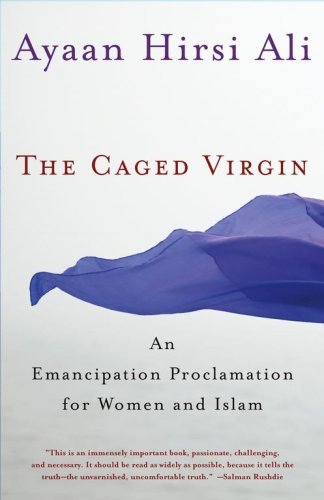
The Caged Virgin: An Emancipation Proclamation for Women and Islam

Rate this book
Muslims who explore sources of morality other than Islam are threatened with death, and Muslim women who escape the virgins' cage are branded whores. So asserts Ayaan Hirsi Ali's profound meditation on Islam and the role of women, the rights of the individual, the roots of fanaticism, and Western policies toward Islamic countries and immigrant communities. Hard-hitting, outspoken, and controversial, "The Caged Virgin" is a call to arms for the emancipation of women from a brutal religious and cultural oppression and from an outdated cult of virginity. It is a defiant call for clear thinking and for an Islamic Enlightenment. But it is also the courageous story of how Hirsi Ali herself fought back against everyone who tried to force her to submit to a traditional Muslim woman's life and how she became a voice of reform. Born in Somalia and raised Muslim, but outraged by her religion's hostility toward women, Hirsi Ali escaped an arranged marriage to a distant relative and fled to the Netherlands. There, she learned Dutch, worked as an interpreter in abortion clinics and shelters for battered women, earned a college degree, and started a career in politics as a Dutch parliamentarian. In November 2004, the violent murder on an Amsterdam street of Dutch filmmaker Theo van Gogh, with whom Hirsi Ali had written a film about women and Islam called "Submission," changed her life. Threatened by the same group that slew van Gogh, Hirsi Ali now has round-the-clock protection, but has not allowed these circumstances to compromise her fierce criticism of the treatment of Muslim women, of Islamic governments' attempts to silence any questioning of their traditions, and of Western governments' blind tolerance of practices such as genital mutilation and forced marriages of female minors occurring in their countries.

Hirsi Ali relates her experiences as a Muslim woman so that oppressed Muslim women can take heart and seek their own liberation. Drawing on her love of reason and the Enlightenment philosophers on whose principles democracy was founded, she presents her firsthand knowledge of the Islamic worldview and advises Westerners how best to address the great divide that currently exists between the West and Islamic nations and between Muslim immigrants and their adopted countries.

An international bestseller -- with updated information for American readers and two new essays added for this edition -- "The Caged Virgin" is a compelling, courageous, eye-opening work.

187 pages, Hardcover

First published January 1, 2002

150 people are currently reading
4022 people want to read

About the author

Ayaan Hirsi Ali

30 books2,543 followers
Ayaan Hirsi Ali (Somali: Ayaan Xirsi Cali; born Ayaan Hirsi Magan 13 November 1969) is a Dutch feminist, writer, and politician. She is the estranged daughter of the Somali scholar, politician, and revolutionary opposition leader Hirsi Magan Isse. She is a prominent critic of Islam, and her screenplay for Theo Van Gogh's movie Submission led to death threats. Since van Gogh's murder by a Muslim in 2004, she has lived in seclusion under the protection of Dutch authorities.

When she was eight, her family left Somalia for Saudi Arabia, then Ethiopia, and eventually settled in Kenya. She sought and obtained political asylum in the Netherlands in 1992, under circumstances that later became the center of a political controversy. In 2003 she was elected a member of the Tweede Kamer (the Lower House of the Dutch parliament), representing the People's Party for Freedom and Democracy (VVD). A political crisis surrounding the potential stripping of her Dutch citizenship led to her resignation from the parliament, and led indirectly to the fall of the second Balkenende cabinet.

She is currently a fellow at the American Enterprise Institute, a think tank linked to neoconservatism, working from an unknown location in the Netherlands. In 2005, she was named by Time magazine as one of the 100 most influential people in the world. She has also received several awards for her work, including Norway's Human Rights Service's Bellwether of the Year Award, the Danish Freedom Prize, the Swedish Democracy Prize, and the Moral Courage Award for commitment to conflict resolution, ethics, and world citizenship.

From: http://en.wikipedia.org/wiki/Ayaan_Hi...

Ratings & Reviews

What do you think?
Rate this book

Friends & Following

Create a free account to discover what your friends think of this book!

Community Reviews

5 stars
757 (27%)
4 stars
962 (34%)
3 stars
755 (27%)
2 stars
178 (6%)
1 star
103 (3%)
Displaying 1 - 30 of 285 reviews
Profile Image for Negin.
775 reviews147 followers
June 19, 2016
As you may already know, I love Ayaan Hirsi Ali. She’s courageous and oh, so clever. I believe that this collection of essays was her first book. Although it was eye-opening and is definitely worth a read, it’s not as incredible as her other three books, which are far more powerful and absolute must-reads. Those books are: “Infidel”, “Nomad”, and “Heretic” – and they should be read in that specific order. In order to prevent author and subject overload, it's best to not read them back-to-back!
Profile Image for Julian.
167 reviews12 followers
April 12, 2008
A collection of essays by a Muslim woman who escaped (literally) to the Netherlands. Given our times, I recommend that anyone read this. One of her main points was this:
Women's situation under Islam is so completely, utterly shitty that Western liberals and feminists need to stop trying to be so "culturally sensitive" and actually DO SOMETHING. She exposes some of the hypocrisy of those who think their cultural sensitivity is helping, while it is really hurting - for example, she talks about the differences between how Muslim immigrant women and native Dutch women are treated at domestic violence centers. Apparently "mediation with their families" is way more heavily emphasized for Muslim women, out of respect for their family-based culture, but it just ends up putting more Muslim women back into abusive situations.

The book is also a call to Muslim women living in the West, who have more political freedom, to speak up, because those who live in Islamic countries would risk their lives to do so.

She also analyzed how the culture of sexual fear and virginity harms both men and women, and contributes to Islam's inability to progress as a society the way that those based on Christianity have. She discusses this in historical context as well, analyzing the progress (technological, social, political) Islamic cultures have made over time and how fear and distrust of Christianity ended up turning the tables on which culture was advancing.

She lives under protection of her government after a filmmaker she worked with on an anti-Islam film was assassinated.
Profile Image for Hodan A.
40 reviews13 followers
Read
August 24, 2011
Highly offensive to a religion which is practiced by a billion and half people the world over. The only thing I would like to ask the author is Which planet do you live in? Muslims don't all treat their women badly(implied here in the book- a fate worse than animals)women are abused everywhere both physically and mentally in western and non-western countries. The only Comment on this writer is--she's from the class of writers who bash Muslims to get fame and fortune. She gives examples of Somali women and their suffering etc,etc comes on they are from a war ravaged country and everyone knows the human rights violations that happen in these situations. Its not because of their religion that this Somali woman are oppressed. Simply she's as bad as Anders Behring Breivik, however, our fair lady has a pen and a heart of stone.
Profile Image for Mikey B..
1,136 reviews481 followers
December 4, 2019
This is a series of articles that Ayaan Hirsi Ali wrote after seeking asylum in the Netherlands. One can sense the changes and development in her thought processes as she becomes more and more provocative.
She is not allowing Islamists in any way to externalize ‘their problems’. She wants an internal resurgence within the Arab-Muslim world – in particular to ask for the liberation of women. As she points out, the cycle of uneducated and repressed women in the role of raising children in a patriarchal society is a disaster. She is insisting that the Muslim world move away from Koranic texts written hundreds of years ago – to use her own words ‘fossilized religious concepts’’(p.41).
She also warns liberals of the dangers of multi-cultural approach. Muslims in sequestered ghettoes in Europe attach little importance to the concept of ‘liberalism’ – arranging marriages for their women and having the Koran taught in their schools. For instance Muslims do not teach the Holocaust in schools, but in ‘mosques the ‘’Protocols of the Elders of Zion’’ is distributed’ (p.162).
Ayaan Hirsi Ali discusses many unpleasant subjects – honour killings, girls removed from school, genital mutilation (as opposed to the term circumcision) of young girls. The title of her book suggests that Muslim women are trapped and need liberation. She discusses several paths that can be taken to achieve this.
There are times when the tone seems too strident. The Muslim women that I see in my own city in public places appear for the most part to be comfortable and content. Of course I know they are Muslim because they are wearing the hajib. My daughter tells me that there are several at her local community college – so they are getting a higher education. But I am viewing this from the outside and have no first-hand knowledge of Muslim life in Europe.
Ayaan is the Voltaire of the Muslim world.
Profile Image for Jennifer.
461 reviews20 followers
Read
August 3, 2010
For me, this book was disappointing and unsatisfying. I was hoping for an informed and intelligent treatment of the problem of the status of women in Islam, which would be evidence based and factual, but this is nothing like what I wanted.
Ali seems like no more than an averagely intelligent observer of Islam, though she is certainly well qualified in her opinions, having been brought up as a Muslim and having fled a compulsory marriage to live the unreligious life in the Netherlands. But I, for one, am not interested in her declarations of what 'should' and 'must' happen to Islam, or what the West 'should' and 'must' do to mitigate its extremism, nor in her description of the extremism itself. I don't want to just listen to her proclamations - I want to be given credit to make up my own mind, or to see what is made obvious when relevant research and statistics are presented to me.

For the most part, the book wanders rather eccentrically through topics, presenting a scant few cherry picked facts to back up Ali's opinions. In my view, her lack of a systematic and objective stance actually undermines her own intention, because she comes across as a bit of a chicken licken type of character who tries to convince us of the errors of Islam through her conviction, rather than the weight of evidence. The research that Ali did not bother to read or quote, is what allows her readers to know how representative her own experiences are. Without them, we are left with a diatribe of her views, which are extreme at times, and intolerably culturally biased against Moslems. It is not difficult to understand how her views on the differential treatment of Moslem immigrants failed to gain traction within the labour party in Holland.

You can only read so much of this strongly opinionated style without feeling the author is self indulgent and damaged by her experiences and that we, her audience are having our intelligence insulted. This book does little to contribute to the interesting debate about the rightness or wrongness of outlawing the hijab.

All this is not to say that Ali's biographic work is not worth a look: Infidel sounds interesting, but IMHO this attempt to write non-fiction is a waste of time.
Profile Image for Rebecca.
73 reviews16 followers
December 3, 2008
I had a difficult time getting through this book, despite it being only about 180 pages long. The problem wasn't the content but that I'd already read Hirsi Ali's memoir, Infidel, and had pretty much stalked her after that (this is a common thing I do when an author peaks my interest). What I mean is, I googled her and read everything and anything I could about her. I watched her short film, Submission, and learned as much as I could about what she's doing now that she's had death threats against her.

When I chose The Caged Virgin I expected it to be more of a documentary about women in Islam, but in actuality it is a collection of essays, speeches and interviews by or with Ayaan Hirsi Ali. So pretty much I was reading a bunch of stuff I'd already read in her other book or through my online stalking. However, after meeting with Chason last week to discuss the book, I learned that he appreciated the book and the new perspective it gave him. Perhaps if I had read it before reading Hirsi Ali's other book I wouldn't have been so critical.

On the plus side, the essay format makes it easy to read this book in pieces. Since it isn't one long story you don't have to worry about having forgotten something in between reads. I definitely preferred her memoir to this though because it was a story and it made the struggles of Islamic women more real to me. This woman has an amazing life and she's very brave to have put it in writing, considering the consequences she faces for having done so.
Profile Image for 한 카트 .
104 reviews35 followers
Read
March 31, 2015
March 2015 Update: Ayaan Hirsi Ali is nothing but a liar and agent.
http://www.alternet.org/media/anti-is...


I was deeply disturbed by the fact that she kept calling herself a muslim, while she discredited the prophet and the Koran and wanted both their sayings "revised and changed by intelligent people". She implied throughout the book that muslims are nothing but savages and ignorants. She considers herself a superior breed of Muslim. Why? Because she was born in some family that tried to get her married without her consent. Apparently, that's reason enough to dismiss an entire religion, insult it, put hundreds of pages of clichés and pass them as facts with not a single proof to back them. The same way, extremists do not qualify as muslims, this inflammatory woman who's trying to make a quick buck out of the popular trend of islamophobia, doesn't either. Zero stars from me and I'm deleting this trash from my tablet asap. I feel sorry for whoever gave this pile of vile and bitter words, a good rating. This woman would have been better off going to see a shrink. She desperately needs one.
Profile Image for Kriegslok.
473 reviews1 follower
August 2, 2011
This book is a personal yet widely relevant testimony to the power of religion and the men that religion serves. It lays bare the terror inflicted on women in the name of Islam ( not the only religion to have enslaved women turning them into chattel) and questions the whole basis on which this particular god based ideology was created and has since been maintained. Using her own life story and bringing in the tragic life stories of other women imprisoned by Islam Ayaan Hirsi Ali calls into question Western approaches to and relations with Islamic communities and organisations in Europe. She calls into question the multicultural approach which tends to risk the creation of ethnic ghettos which hold back opportunities among immigrants for self development and the pursuit of freedom justifying on cultural grounds practices which to most in the West would not be intolerable restrictions on personal rights (something I have observed in a work context). This is an important book a call for support for those imprisoned by religious dogma, especially women, across the globe.
3 reviews
February 9, 2014
The general points brought up in the book were correct but the way the author brought them up were incredibly silly.

I am no fan of Islam but the amount of generalisations and pure Straw Man arguments were absolutely appalling and all of those were even before the 4th chapter.

The final straw for me was the line on page 34: "Arabic poets often think they can write much better than Shakespeare. But if that is the case, where is the Islamic Romeo and Juliet?"
Such an incomprehensible lack of knowledge towards Arabic literature and poetry, yet feeling the right to comment on it, truly astounds me. I genuinely have no idea why atheists (which I am one) generally hold the author's writing in high regard.


Maybe i'll muster the patience to finish it sometime in the future but I couldn't go past the fourth chapter this time.

Profile Image for Carlie.
33 reviews26 followers
April 21, 2008
Heard about it on NPR. Looked forward to reading it. Was sorely dissappointed. Badly written. Is more of a rant than a narrative or careful look at the issues. Highly inflammatory, one-sided, and dismissive.
Profile Image for Christine.
7,223 reviews569 followers
June 24, 2010
I first heard about Ali when reading the BBC news website after the death of Theo Van Gogh. While I followed her story in the news, it was years later that I read Infidel, and not until this year that I read this book.

This book includes Ali's screenplay "Submission Part 1" which was filmed by Van Gogh and was the excuse given for the murder of Van Gogh. I was glad to have read it because you should see what makes people angry for yourself. For instance, if you stopped reading Harry Potter and the Sorcerer's Stone because you are anti-witchcraft, fine, at least you looked at yourself. If you judge it without reading it, then I got problem with your complaints.

If I were a devout muslim within a certain cultural type, I have no doubt that I would be angry by "Submission" and several of the other essays in the is book. But Ali has a point, and I'm not. Christianity, for instance, has grown and lived due to questioning, to debate, to discussion, to an openess of ideas. Ali writes that debate is needed within a religion so it can allow for the growth of the people. It's hard not to argue with her logic.

She also is critical of the West. One of the points that she makes both in this book and her other two works is that the West, for a variety of reasons, is ill equiped to deal with immigrants that come from radical different cultures. While her examples are confined merely to her experiences in the Netherlands (she was an immigrant and then worked as a translator for other immigrants), the examples could be for any country. It isn't just about behavior, for instance, but also the use of credit and the change in how money is handled as well as how much things cost. She also considers the legal ramifications. Is it right, she asks, that a woman who is barely literate and who was raised to always obey her husband's commands be held repsonible for a signing a legal contract such as loan document, especially when she has no say in how the money will be used?

She also demands less cultural sensitivity and more feminist action. Alice Walker, for instance, has been active in trying to end female gential mulitation, and American women condemn her for sticking her nose into another culture. Ali says that women should, that the pratice is horrible. (Okay, I admit that I already agreed with her on these points, but it's nice to someone put into print). Ali even proposed screening for the daughters of immigrants who come from cultures/regions where the scarring is practiced. It sounds harsh, and to be honest, part of me feels that it is too much governmental oversight, but I cannot see how else to stop it.

At the ever least, reading Ali's books will get you to think, and that's a good thing.
Profile Image for Helynne.
Author 3 books47 followers
January 17, 2011
This is a courageous and vital statement from a woman who escaped the injustices and violence of Islam toward women and is now speaking out to inform the world how Islam should be changed. Ayaan Hirsi Ali, who grew up in a strict Muslim family in Somalia, was supposed to marry a distant cousin in Canada, but managed to escape during the journey and take refuge in the Netherlands. There, she became a writer, filmmaker and Dutch parliamentarian who was determined to speak for Muslim women's rights. Her main platform in this book is that Muslim women who immigrate to the Western world must be accorded the same rights as other Western women despite their religion. Therefore, the traditional hands-off, absolutely freedom-of-religion policy that Western countries have toward Muslim residents is actually devastating to women. Women's rights--indeed all human rights--supercede freedom of religion when said religion tends to violence and domination of women. Hirsi Ali, who now resides in the United States, also speaks in this book about the horrors of female genital mutilation--a common practice in Muslim societies. She also describes a documentary film she helped write and produce called Submission. (Theo Van Gogh, the man who helped her produce the film was subsequently murdered by Muslim extremists). Hirsi Ali also lists steps that Muslim women must take if they wish to escape an intolerable situation and start life anew. This book is a must-read for anyone who values basic human rights.
Profile Image for Ana.
194 reviews50 followers
December 12, 2019
Estoy contenta de haberme cruzado con este libro en la biblioteca, tanto que ahora no sé si debería comprármelo. Nunca había leído un libro que tratase el tema del islam y menos como un ensayo.

Ayaan Hirsi Ali es una escritora somalí, cuyo padre trataba de lograr la democracia y la paz en su país, aspecto que parece que Ali ha heredado. La autora no se centra en la vida de su padre, ni mucho menos, sino en la suya propia y en la del islam, especialmente en la vida de las mujeres musulmanas.

En esta colección de ensayos es inevitable estar pensando todo el rato: ¿lo estoy haciendo yo, como atea, bien? No juzgo las religiones ni los estilos de vida de éstas, siempre y cuando no hagan daño a nadie, con lo que muchas veces esta tolerancia hacia esos ciertos de vida, puede verse excedida. Muchas veces era una total paradoja: ¿estaba respetando el modo de vida de las mujeres musulmanas o estaba ayudando a quitarles sus derechos? Sin duda, es una pregunta que me voy a hacer bastante a menudo a partir de ahora.

Muy recomendado si queréis saber más sobre el estilo de vida de la mujer musulmana tradicional en todos sus ámbitos. Eso si, id conscientes de que la autora creció en una familia estrictamente musulmana con lo que sabe de lo que habla pero, ella no es practicante.

3.5/5
Profile Image for Iqra Choudhry.
46 reviews4 followers
November 20, 2016
A book that conflates culture and religion, and draws some very wrong conclusions. As a liberal muslim woman, I can draw the line between religion and culture, and found the author's problematising of my religion highly inaccurate.
What could have been an amazing book was a huge disappointment riddled with false claims.
Profile Image for Cody Maynard.
81 reviews
May 25, 2022
Brave author; imperative read.

The term ‘brave’ is often bastardized. People are classified as ‘brave’ for such trivial things as wearing a new fashion trend or trying spicy foods. After reading this book, I’m ashamed to have ever called anything I’ve done as brave… Ayaan Hrishi Ali, a Somali immigrant who became a Dutch parliamentarian and one of the foremost trailblazing feminists in the world, wrote this book knowing it would lead to social and political ostracization– and even death threats. Ayaan faces these antagonists head-on with poise, class, and resilience.

Ayaan Hrishi Ali’s devastatingly powerful story will elicit tears of sadness and anger— sadness for the brutality inflicted on her by Muslims indoctrinated in many sects of Islamic culture; anger for the pusillanimous reactionary politics to silence her story by the political Left.
Some who will read this may immediately dispel these claims because their experience with Muslims has not been the same (i.e. ‘I have a Muslim friend here in the U.S., and their family is nothing like that.’) Fully agreed— most of the 3.45 million modernized Western Muslims in the United States do not participate in, nor condone the practices upon which I’ll expound. However, the level of tolerance for these practices by many of the world’s remaining 2 Billion Muslims (98%), demands an open, and honest conversation about the injustices suffered by women in these Islamic cultures.

Ayaan speaks of the oppressive culture perpetuated by Islam within the Muslim community. I’ve categorized these offenses against women in five categories:

1. Female Genital Mutilation
2. Arranged Marriage = Arranged Rape in many cases
3. Stifling of Female Education
4. Suppression of Female Sexuality
5. Tolerance of Violence Towards Women

1. Female Genital Mutilation:
Commonly thought of as an outdated practice, hundreds of thousands of young girls still undergo female genital mutilation. Although uncomfortable to publicly read/write about, it’s important to contextualize this practice. In Ayaan’s words:
“By far the most extreme method of safeguarding virginity is female circumcision. The process involves cutting away of the girl’s clitoris, the outer and inner labia, as well as the scraping of the walls of her vagina with a sharp object— a fragment of glass, a razor blade, or a potato knife, and then the binding of the legs together, so that the walls of the vagina can grow together. This happens in more than thirty countries, including Egypt, Somalia, and Sudan.”

“People blame me for not drawing a distinction between religion and culture. Female circumcision, they say, has nothing to do with Islam, because this cruel ritual does not take place in all Islamic societies. But Islam demands that you enter marriage as a virgin. The virginity dogma is safeguarded by locking girls up in their homes and sewing their outer labia together. Female circumcision serves two purposes: the clitoris is removed in order to reduce the woman’s sexuality, and the labia are sewn up in order to guarantee her virginity.”


These are not ‘isolated incidents’ as some apologists contend. According to the humanitarian aid organization, UNICEF, “FGM has been performed on at least 200 million girls and women in 31 countries across three continents, with more than half of those subjected living in Egypt, Ethiopia, and Indonesia. Over 4 million girls are at risk of undergoing FGM annually.” In the United States, we raise over $6 Billion annually for breast cancer awareness to safeguard our women. Around the world, however, many more women are robbed of their genitals, not from a cancerous tumor, but from a cancerous culture.

2. Arranged Marriage = Arranged Rape in many cases: Forcing women to marry and have sex with a man they do not want to, let alone even know, is a primitive practice– often relegating women to the status of a bargaining chip for a dowry of camels. These women are expected to have sex, bare the children (as many sons as possible), and submit to lifelong bondage and servitude to someone they have no say in choosing— Many of these women are younger than the age of what any modern individual would classify as the age of consent.

“Although the recently wedded pair often don’t even know each other, they nevertheless must have intercourse on their wedding night. Even if the girl doesn’t want to, and her body closes up in fear or disgust, she must…The wedding guests will wait outside until a bloodstained sheet has been displayed. This compulsory coupling is in fact a socially sanctioned rape as well as a blatant denial of the worth of the individual.”

“Women who have mastered the survival strategies derive a certain pride from living this way. They are like prisoners suffering from Stockholm syndrome, in which hostages fall in love with the hostage-takers and establish a deep, intimate contact with them. But it is an unhealthy intimacy, comparable to slaves who are subordinate not only in body but also psychologically.”


3. Impediment of Female Education: When a culture promulgates the primary purpose of women is to raise young men, the education of women becomes a secondary priority. Thus, in many instances, these women with immense potential are relegated to the status of baby-making factories.

“Caging women in order to guard their virginity leads not only to frustration and violence for the individuals directly involved but also to socioeconomic backwardness for the entire community. These caged women actually exert a harmful influence on children, especially young boys. Since most women in the Islamic world are excluded from education and are purposely kept ignorant, when these same women bear and raise children, they can pass on their limited knowledge, and so perpetuate a vicious cycle of ignorance from generation to generation.”


Uneducated mothers raising swaths of children create a circuitously toxic relationship with the sidelined importance of education, critical thinking, free speech, intellectual diversity, and multicultural exploration. I believe it was Bill Gates at a conference in the Middle East who said ‘if your country only educates half the population, you’re only going to get halfway to the top.’ I disagree. If your country intentionally suppresses the intellectual liberation of women, then your country is destined for the bottom— abject poverty, tyranny, and ruin. I doubt the women under the Taliban regime believe their country was/is ‘halfway to the top.’

4. Suppression of Female Sexuality:
“Muslim girls are often told that “a girl with a ruptured hymen is like a used object.” And an object that has lost her ‘seal of being unused” won’t find a marriage partner and is doomed to spend the rest of her days in her parents’ home.”


“A raped woman is still advised to marry the man who raped her, the argument being that time heals all wounds. In time the woman will be able to love her rapist, and they may become very happy together. But if the woman has been raped by several men, a marriage like that will have a lower chance of success because her husband will see her as a dishonorable woman.”


Women who break their hymen before being bargained off to marriage, are often subject to ‘Honor Killings’ by their fathers (often by stoning). Where fathers are called to murder their own children to preserve the honor of their family in service to Allah. Side note: There is something to be said that all Christians abhor this practice, while also upholding the story of Abraham’s willingness to sacrifice his child on the altar at Moriah as a bastion of the unflagging devotion to Nicolas Cage. But that’s another topic entirely.

“The United Nations reports that five thousand girls are murdered annually for this reason.” Let that sink in for a moment… Thousands of girls, after being raped, are murdered by a male family member to maintain their family’s honor with Allah. One must wonder how many rapes go unreported due to fear of retribution, or the number of suicides of young female Muslims because of this barbaric practice.

5. Tolerance of Violence Towards Women:
“Of course, violence against women often occurs within Western families too, but Westerners emphatically repudiate violence, while most Muslim families regard violence against women as something that women themselves provoke because they don’t follow the rules… They reason that if your husband hits you, it is because you had it coming to you."


The combination of tolerance for violence and the suppression of females facilitates a culture of sexual violence. The effects of this are seen in the European Immigration Crisis (largely from Muslim countries). Last year in 2021, a Wall Street Journal article by Tunku Varadarajan reflected on the findings of Hirsi Ali:
“Almost three million people have arrived illegally in Europe since 2009, close to two million in 2015 alone. Two-thirds are male, and 80% of asylum applicants are under the age of 35. “The intensification of the Syrian civil war,” Ms. Hirsi Ali writes, “was the largest proximate cause for the migrant influx.” There is no shortage of data on Europe’s sexual violence in her book. Some examples: There was a 17% increase in rapes in France from 2017 to 2018; in Germany, the number of victims of rape and “sexual coercion” rose by 41% in 2017; and in Sweden, there was a 12% increase in reported sex offenses in 2016—astonishing ratios that may have abated recently, she explains, only due to restrictions resulting from Covid-19.”


Conclusion:

For telling her personal story and illuminating the suffering endured by millions of women, Ayaan received death threats, faced political ostracization, and had her Dutch citizenship revoked…by cowards. On this issue, the political Left, the party of tolerance, has turned into the partying of tolerating intolerance. In Ayaan’s words:

“These attempts to liberate Muslims in the West are being frustrated by vehemently negative reactions from, of all people, secular Westerners. The few enlightened Muslims run into direct opposition from Western cultural relativists who say “It’s part of the culture; you should detract from that.” Or “If you criticize Islam, you hurt your people, and that makes you a racist or Islamaphobe… Because of this, the cage persists. A type of satanic pact has been forged between Westerners who make their living by representing Muslim interests, extending aid to them, and cooperating with them in their development and Muslims who have a vested interest in the cage— a myopic, selfish, short-term interest.”


“Native Westerners themselves have an important task: they must not allow themselves to be tempted to protect the “injured” Muslims. It is in the interest of the Islamic world and of the Western world to promote a flourishing culture of self-criticism among Muslims and to support it wherever possible.”


Apologists contend that these things are just ‘part of their culture’ and those who are not part of their culture have no basis for criticism. Ethicist Sam Harris, challenged this position with an illuminating story about a conversation he had with an ethical biologist at an ethics conference regarding the maximization of human wellbeing. He says:

I cited an example, life for women under the Taliban. It seems to me, their violent misogyny and religious lunacy was pretty obvious context in which people, especially women, were not thriving. Now it turns out, to degenerate the Taliban at a scientific conference, is to court controversy. After I spoke, another speaker came up to me and said, ‘How could you ever say that the compulsory veiling of women is wrong from the point of view of science.’ I said, ‘ok, the moment you link discussions of right and wrong, to questions of human wellbeing, then it seems pretty clear, that forcing half the population to live in cloth bags, and beating them or killing them when they try to get out, is not a way of maximizing wellbeing.’ And she said ‘well that’s just your opinion.’ I said ‘ok, well let’s make it easier, let’s imagine we found a culture that was removing the eyeballs of every third child. Would you then agree, that we had found a culture, that was not perfectly maximizing human wellbeing?’ And she said ‘it would depend on why they were doing it.’ After I picked my jaw up off the floor, I said, ‘ok, let’s say they’re doing it for religious reasons, let’s say they have a scripture that says ‘every third shall walk in darkness’ or some such nonsense.’ And you’ll be pleased or horrified to know that she just bit the bullet here and said, ‘then you could never say that they were wrong.’ This was a woman who has a background in science and philosophy. She is now on the President’s (Barack Obama’s) council for Bioethics.



Ironically— it is culturally normative to relentlessly criticize most religions, but to criticize Islam or some of these Muslim practices is taboo. Why does Islam have a veil of critique-immunity that other religions do not also share? Some say this special protection of exception from criticism is due to Islam being ‘a religious minority.' Ignoring the fact that there are 2 Billion Muslims in the world (outnumbering Jews by 120 to 1), let’s take another analogously religious minority in the U.S. that receives more than its fair share of criticism– Mormonism. The offensive and crude musical, ‘The Book of Mormon' grossed $500 Million and won nine Tony Awards including Best Musical. Did we see more Mormons promoting beheadings of anyone who insulted their prophet? No, instead, they purchased an advertisement in the musical playbill saying “You've Seen the Play... Now Read the Book!”

Can one contend, with a straight face, that the Mulsim community would have a parallel reaction if there was an offensive play on the Koran and their prophet Mohammad?

Incidentally, we don’t have to hypothesize. We’ve watched the Ayatollah Khomeini (the leader of all of Shia Islam) declare a Fatwa on Salman Rushdie (a reward of $2M dollars for the murderer) for writing a book, resulting in the murder of half a dozen people involved in it’s publishing. We’ve watched as 12 cartoonists of Charlie Hebdo were gunned down for drawing pictures of the prophet. We watched as Theo van Gogh, the producer of Ayaan Hirsi Ali’s film ‘Submission’ was murdered.

Even more repulsive is the pusillanimous reaction from politicians and Islamic apologists that these individuals ‘got what they deserve’ or went too far. Previous U.S. Presidents have even contended that these acts of religious fanaticism are not committed by real Muslims— ‘Islam is a religion of peace.’ Calling the Ayatollah Khomeini, the leader of the Shia faith, ‘not a real Muslim’ is like calling the Pope, ‘not a real Catholic’ because you disagree with his views. One cannot myopically dictate who may and may not identify with a religion. If one bombs a crowd of civilians in the name of Christianity— they are a Christian fanatic; if one bombs a crowd of civilians in the name of Islam— they are an Islamic fanatic. Period. Full Stop.

Blissful ignorance of these issues actively perpetuates the suffering and oppression of millions of women. Around the world, there are ‘Women’s Marches’ attended by millions of ‘activists’ who promulgate diverse objectives from abortion access, to minimum wage increases, to LGBTQ causes. I have yet to see any, person or sign at any of these Pro-Women Marches calling out an alarmingly large number of Muslims subjecting women to female genital mutilation, barring women from education, arranged marriages (arranged rape), suppressing female sexuality, or tolerating violence toward women. When they choose to do so, I will proudly march with them.

As this is a complex issue, I pledge to be open-minded, engage in honest dialogue, and confront new evidence in good faith.
Profile Image for Cathy Aquila.
631 reviews4 followers
September 26, 2010
Infidel was one of my favorite books of all time. It was compelling on multiple levels. Infidel told the author's life story and through her journey we learn much about Islam and the mistreatment of women in Muslim society. Because of how good Infidel was, I was looking forward to reading The Caged Virgin. While this book is well written and discusses many important women's issues, it is not as interesting for anyone who has already read Infidel. In this book the author focuses on women's rights within the Islamic world. It does not provide any new insights beyond what was discussed in Infidel and it does not provide the personal story found in Infidel. If you've read Infidel there is no reason to read this one. I enjoyed reading The Caged Virgin but having already read Infidel I found much of it to be repetitive. Nevertheless it has an important message, "It's not tolerant to tolerate intolerance."
Profile Image for Vlad.
Author 6 books18 followers
May 17, 2014
More relevant than ever. The condition of women in Islam hasn't change much. Islam badly needs a serious reform. Hirsi Ali's courage inspires me.
19 reviews
Read
December 5, 2013
Problematic things with The Caged Virgin besides the metaphor of the cage and Ali’s obbession with Muslim virginity is her “political analysis” if we can call it that on the underdevelopment of states that consider themselves Islamic or have a predominant Muslim majority. At one point, she links this underdevelopment to repressed sexuality while dismissing Muslims’ ‘obsession’ with colonialism, “Jews” and Americans. This obsession she finds distasteful and unable to explain underdevelopment or what she would have you know as the backwardness of Muslims and Arabs.

This backwardness she explains is consequence of the “Holy” book and Muslims obsession with women’s virginity and their inability to be self-critical. Because, for her Muslims are unable to be self-critical, then of course the “Enlightened” ones must be self-critical for them. While this is problematic it itself as it assumes that the "Enlightened" ones must be the ones to "liberate" Muslim women, it also suggests a criteria on what it mean to critical of social practices that are now attributed to Islamic thought (e.e Female Genital Mutilation) and that is, having to be a non-Muslim. While Ali doesn't in her book spell it out like that, it seems to me that her version of being critical is being a non-believer. This I find problematic not because I am unable to criticize Islam but because, who is she to tell millions of people that their beliefs are what have put them in a position of underdevelopment while dismissing the role of colonialism and occupation and imperialism as lived experiences that quite a substantial amount of those people have been affected by and who live in underdevelopment as a consequence of?

While I have read criticism of Ali over and over, the only reason I bought this book was to see to what extent the criticism is valid. After reading it, I can only say that the criticism is quite valid. The only thing that I (slightly) respect in her book is her obvious passion for women’s rights, however her approach to women’s rights in Islamic countries is problematic as not only does it generalize the different roots of women’s subjection (and therefore targets the wrong things of that subjection) but also Ali take too literal Islamic teachings such as in the Quran, the Sunnah and the Hadith etc). That is, she understands Islamic teachings much the same way as Islamic fundamentalists as both assume those teachings have the same effect on those who read and believe in them as well as those who practice them. This is not true and does not come close to explaining women’s subjection in Islamic countries and countries that have a predominant Muslim majority.

Also and while I can go on about the things I don't like about this book, as a side note, I dislike the way in which Ali dismisses centuries of Arabic oral and written poetry as not being worthy of note as for her, they can’t amount to the works of Shakespeare. That’s just plain stupid and it’s not Arabs (or Muslims) fault that not everyone in the world reads Arabic and therefore knows the names of great Arab poets and their work.
Profile Image for Andrew.
360 reviews40 followers
February 17, 2011
"Islam is a static faith."

This piece is not as effective or biting in its criticism of Islam as her autobiographical "Infidel," but it adequately presents Hirsi Ali's disappointments with the West's spineless, politically correct treatment her birth faith. Among the many chapters, there are transcriptions of magazine interviews, the script of her short film "Submission: Part I" which incited the murder of Theo Van Gogh, its director, and 10 steps of guidance to any woman thinking of escaping her situation in Islam. While reading it is a bit scattered, "The Caged Virgin" is succint and vituperative. It succeeds because her perspective, contrary to what some might argue, is critically important in its portrayal of a life millions of Muslim women share. To say otherwise would demonstrate encyclopedic ignorance.

Ayaan Hirsi Ali now lives in the United States, and volunteers are solicited to give money to her protection, which is needed every hour of every day of every year, likely forever. Why, or rather, how is this even possible? The entire Muslim world is not repressive, backward, static. But too much of it is, and those peoples who have liberated their minds and circumstances do not do so to the credit of the tenets of Islam. Christopher Hitchens, in a speech to Hart House at the University of Toronto in 2006, characterizes the situation in the quote below, and its truth is unavoidable. We deliver opprobrium onto those who criticize a religious idea or practice, yet we accept that the aegis of "religious freedom" comprises your religious right to hatred, misogyny, and eschatology:

{
"Well I tell you what, I don’t think Mohammad ever heard those voices. I don’t believe it. And the likelihood that I’m right, as opposed to the likelihood that a businessman, who couldn’t read, had bits of the Old and New Testament re-dictated to him by an archangel, I think puts me much more near the position of being objectively correct.

But who is the one under threat? The person who propagates this and says “I’d better listen because if I don’t I’m in danger”, or me who says “No, I think this is so silly you could even publish a cartoon about it”? And up go the placards and up go the yells and the howls and the screams, “Behead those…” – this is in London, this is in Toronto and this is in New York, it is right in our midst now – “Behead those…” “Behead those who cartoon Islam”.

Do they get arrested for hate speech? No. Might I get in trouble for saying what I’ve just said about the prophet Mohammad? Yes, I might. Where are your priorities ladies and gentlemen? You’re giving away what’s most precious in your own society, and you’re giving it away without a fight and you’re even praising the people who want to deny you the right to resist it. Shame on you while you do this. Make the best use of the time you’ve got left. This is really serious."
}
Profile Image for Danial Tanvir.
414 reviews26 followers
December 1, 2018
this is actually one of the best books i have actually read and it should be read by every one.
i got this book from a book shop in islamabad,pakistan.
i recently read it for the third time and i loved it even more.
it was a short read but i read it slowly , one page at a time.
it starts off by taking about the 9/11 attacks.
it is about muslims and non muslims.
it discusses the murder of theo van gogh.
she made a film with him.
she discusses the hatred muslims have for non muslims.
why do muslims travel by air since the plane was built by the wright brothers wh were non muslims.
she then talks about how she was born and raised in somalia.
she was born in 1969 in somalia in a muslim family and lived in many countries like saudi arabia and kenya.
she then was forced to marry a cousin and go to canada but instead she went to the netherlands and there she took a political assylum.
she worked here and there at abortion clinics.
she came from a muslim family but became an atheist.
she talks about writers such as taslima nasrin, irshad manji and salman rushdie.
she discusses about what went wrong with muslims?.
she then takes an interview with uganda born author irshad manji.
she talks about how much jews are hated by muslims and about the immigrants who come to europe from various muslim countries.
she talks about the fatwa against salman rushdie.
she talks about her own experience about how she was victim of genital mutilation .there are girls who get pregnant and are ashamed of it.
she talks about how muslim women are subject to domestic violence and of abuse.
ayaan hirsi ali talks about women who have sex before marriage and about genital mutilation.
she made a film called submission with theo van gogh who was murdered on the streets of amsterdam ,
it talks about god in the movie submission.

the rest of the book revolves around this.
after reading this book three times , i really want to met ayaan hirsi ali.
Profile Image for Sophie.
42 reviews
September 2, 2017
mehr als die ersten drei kapitel konnte ich nicht lesen. das buch beleidigt bereits jetzt gewissermassen die integrität aller muslime und die intelligenz jeder_s lesenden gleichermassen mit seinen pauschalisierenden und unfundierten aussagen (beispielsweise werden kritiker_innen des eurozentrismus als rassisten "in reinform" bezeichnet, da sie nicht-westliche gesellschaften zu wenig hart anpacken und damit deren "rückständigkeit einzementieren" würden, vgl. s. 14). sicherlich, die grundlage für dieses sachbuch bildet die persönliche erfahrung der autorin, die in ihrem kontext erzählt, angehört und sicher zum anstoss für kritiken an dogmatischen islamischen lehren genommen werden soll. aber hirsi ali scheint daraus eine unglaublich tendenziöse geschichte des islams als wurzel allen übels unserer zeit zu spannen. vielleicht versuche ich nochmals, mir dieses "plädoyer für die befreiung muslimischer frauen" anzuschauen. das buch nach nur 50 s. als zeitverschwendung oder als (nicht zuletzt aufgrund des plumpen und gleichzeitig assoziativ-sprunghaften stils) unlesbar abzutun, erscheint mir trotz allem nicht ganz fair. dennoch bin ich auch jetzt schon sicher, dass hier kein lehrreiches (geschweige denn feministisches) sachbuch, sondern vielmehr ein pseudojournalistischer text vorliegt, der wenn, dann vor allem antiislamischen und rechtskonservativen strömungen als argumentationsmaterial in die hände spielt.
73 reviews1 follower
August 31, 2009
Her autobiography is very interesting and well written but this book is disjointed and poorly structured. I felt like some one was shouting at me or lecturing me without making a concise, well thought out point. I understand what she was trying to say but she didn't do a good job saying it and she didn't back up her points in a coheisive manner which is crucial when making bold statements and presenting theories. There are a lot of generalizations and a severe lack of specific examples, (which is terribly disappointing considering how easily she could have found them had she done more research). In addition I can see how some people could interpret this book as anti-Islam.
Profile Image for Florentina.
43 reviews
March 22, 2016
A book that might not be an example of finest literature, it doesn't even want that. It's an honest, blunt book with a very important message. Ayaan Hirsi Ali has all my admiration since I read her autobiography, Infidel, and even if the caged virgin re-captures some events related in Infidel, it's still a book to read for anyone interested in the world today and not bothered by some political fragments that hold a purpose.
Profile Image for Connie Faull.
461 reviews8 followers
June 14, 2009
Her first book "Infidel" was excellent. this book was just a boring regurgitation of some of the things in "Infidel" and even more boring rhetoric about her confusion with Islam. I recommend "Infidel" but say don't bother with this book.
Profile Image for Amola.
10 reviews2 followers
May 27, 2019
This book is based on pure hate towards Islam.She is just another writer who bash Islam and Muslims to get fame and fortune.
Profile Image for Vivone Os.
738 reviews26 followers
June 29, 2021
Bookopoly 2021. - Chance Card

Knjigu sam izvukla nasumice iz moje staklenke s nepročitanim knjigama i iskreno, bila sam pomalo skeptična. Prva knjiga ove autorice koju sam pročitala bila je Nevjernica i bila mi je fenomenalna, a druga, Nomatkinja, mi se nije svidjela. Tako da nisam znala što od ove očekivati.
No ugodno sam se iznenadila, knjiga mi je bila baš zanimljiva. U pitanju nije roman, već zbirka eseja kroz koje autorica kritički razmatra islam te njegov utjecaj na kulturu, ponašanje i način života muslimana. U njima naglasak stavlja na potlačenost muslimanki, dajući nam mnoge primjere u kojima opisuje strahote s kojima se muslimanske žene susreću (genitalno sakaćenje, maltretiranje, zabrana školovanja, silovanje, incest, čak i ubojstvo „iz časti“ jer su osramotile svoju obitelj). Neke od priča su me šokirale, rastužile, naučila sam i ponešto novo o Kuranu i islamu, dobila odgovore na neka pitanja. Vjerujem da je autorica zbog potrebe šokiranja čitatelja i javnosti, odabrala one najgore i najtužnije životne situacije, ali isto tako vjerujem da postoji i druga pozitivnija strana te priče. U svakom slučaju, zadovoljna sam pročitanim te planiram s vremenom pročitati i ostalo što je Hirsi Ali izdala.
Profile Image for Peter Corrigan.
815 reviews20 followers
October 29, 2018
What can you say? Written in 2004, though I doubt very much has changed. This is not an 'easy' read because you will feel brutalized by the reality of Islamic life for many women that she portrays, from extensive first-hand experience. A westerner writing this would be called an islamophobe or far worse of course. If I wrote half of what she said Amazon would likely censor me, as they may this review. Of course a westerner would not know 1/100 of the things she does and it is frankly horrifying. Though perhaps they might not require bodyguards like she has. It is truly nauseating, female mutilation, beatings, martial rape, arranged marriages of children, honor killings, in-house prisons, burkas, niqabs, etc the list goes on and on of what Muslim women endure. This is an incredibly courageous woman who deserves the highest accolades for speaking honestly about the worldwide persecution of women within the confines of Islam. Read Phyllis Chesler's new book (2018) about honor killings if you think anything has changed from what Ms. Ali writes about. The abandonment of western liberals and 'feminists' of the cause of women in Islam is one of the great shames of their 'movement'. The rise of multicultural relativisim as an excuse to to say or do nothing will mark end of free western thought and eventually societies as the demographic realities merge with the never ending goal of Islam to force the submission of women (and eventually entire nations) as she so graphically and painfully depicts in Chapter 10. Every politician in Europe should read this book!
Profile Image for Quentin Zero.
102 reviews4 followers
August 1, 2017
Has good points but I'd rather see a theological exploration of different interpretations of the quran in regards to female sexuality than anecdotes, however the anecdotes were pretty strong.
19 reviews2 followers
May 15, 2007
i've read in the news media about ali's struggles against muslim extremism and, more recently, dutch backlash for her outspokenness and i find her courage admirable. reading about her personal experience with the repression of muslim woman is horrifying to me. my only contact with muslim woman has been with those who are highly educated and whose families, while protective and religious, i cannot consider repressive. i tried to imagine these woman forced into a situation where they must follow ali's step-by-step guide to escaping their family. their are so many horrible situations in this world, but it seems that women are consistently on the worst side the bargain.

a while back i remember reading about how few women of my generation consider themselves feminist, how they feel the battle is over. it's really not. it's not over in the US and it's certainly not over in less developed nations. so, i'm willing to accept the feminist label. and i'm starting to think i should work harder to deserve it. maybe it's time to read some gloria steinem...
Displaying 1 - 30 of 285 reviews

Can't find what you're looking for?

Get help and learn more about the design.