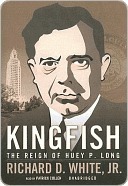
From the moment he took office as governor in 1928 to the day an assassin’s bullet cut him down in 1935, Huey Long wielded all but dictatorial control over the state of Louisiana. A man of shameless ambition and ruthless vindictiveness, Long orchestrated elections, hired and fired thousands at will, and deployed the state militia as his personal police force. And yet, paradoxically, as governor and later as senator, Long did more good for the state’s poor and uneducated than any politician before or since. Outrageous demagogue or charismatic visionary? In this powerful new biography, Richard D. White, Jr., brings Huey Long to life in all his blazing, controversial glory. White taps invaluable new source material to present a fresh, vivid portrait of both the man and the Depression era that catapulted him to fame. From his boyhood in dirt-poor Winn Parish, Long knew he was destined for power–the problem was how to get it fast enough to satisfy his insatiable appetite. With cunning and crudity unheard of in Louisiana politics, Long crushed his opponents in the 1928 gubernatorial race, then immediately set about tightening his iron grip. The press attacked him viciously, the oil companies howled for his blood after he pushed through a controversial oil processing tax, but Long had the adulation of the people. In 1930, the Kingfish got himself elected senator, and then there was no stopping him.White’s account of Long’s heyday unfolds with the mesmerizing intensity of a movie. Pegged by President Roosevelt as “one of the two most dangerous men in the country,” Long organized a radical movement to redistribute money through his Share Our Wealth Society–and his gospel of pensions for all, a shorter workweek, and free college spread like wildfire. The Louisiana poor already worshiped him for building thousands of miles of roads and funding schools, hospitals, and universities; his outrageous antics on the Senate floor gained him a growing national base. By 1935, despite a barrage of corruption investigations, Huey Long announced that he was running for president.In the end, Long was a tragic hero–a power addict who squandered his genius and came close to destroying the very foundation of democratic rule. Kingfish is a balanced, lucid, and absolutely spellbinding portrait of the life and times of the most incendiary figure in the history of American politics.
A native of Williamsburg, Virginia, Richard D. White, Jr., is Dean of LSU's E. J. Ourso College of Business. Dr. White is a Pulitzer-nominated political biographer and author of Kingfish: The Reign of Huey P. Long; Roosevelt the Reformer: Theodore Roosevelt as Civil Service Commissioner, 1889-1895; and Will Rogers: A Political Life. Dr. White received his PhD in Public Administration from Pennsylvania State University, MBA from Purdue University, and BA in Political Science from Old Dominion College. He was a Research Fellow at Harvard University where he studied leadership and ethics and taught a public policy seminar within Harvard’s Institute of Politics. Dr. White has published dozens of scholarly articles in prominent journals, including Public Administration Review, Policy Studies Review, Journal of Public Administration Research and Theory, and Public Integrity. He was elected to Pi Sigma Alpha (Political Science), Pi Alpha Alpha (Public Administration), and Pi Gamma Mu (Social Sciences) honorary societies.
Prior to his academic career, Dr. White was a senior officer in the U.S. Coast Guard. He served over ten years at sea, including voyages to both the Antarctic and Arctic Oceans. He commanded an icebreaker, as well as a large cutter performing drug interdiction operations in South American waters. He served in the White House, the U.S. State Department, and the Central Intelligence Agency. In his final assignment in the Coast Guard, Dr. White directed the enforcement of narcotics, immigration, fisheries, and environmental laws on the Atlantic Icean. Dr. White retired from the Coast Guard in 1994 at the rank of Captain (O-6).
There’ll be peace without end Every neighbor a friend And every man a king!
- Huey Long campaign song, composed by Huey Long
THE LOST ART OF THE POLITICAL INSULT
Let’s start with the fun part. In those days, the 20s and 30s, they had a real gift for insulting their political opponents. I don’t hear that so much anymore. In the last couple of days Sadiq Khan, Mayor of London, said Donald Trump was like a twentieth century fascist – in reply the president called Mayor Khan “a stone cold loser” – really, this is not a patch on the good old days.
Huey’s haters :
Huey Long is a demagogic screech owl from the swamps of Louisiana
A stench in the nostrils of the people of Louisiana, a liar, a briber, an embezzler of other people’s money
A boon companion of indicted criminals, a chronic distorter of facts, a habitual double-crosser, a traducer of character, a beneficiary of funds contributed by gamblers, a tyrant suffering from delusions of grandeur, and the singing fool of New Orleans cabarets
A reprobate of the first water, a man possessing neither culture nor refinement, a man whose every public or private act is offensive to good taste
Big mouth, feeds off suckers, thrives best in mud and slime, and is very hard to catch
Huey on his enemies:
You pronounce LeBlanc’s name by trying to grunt like a hog and changing your mind when you’re half way through
Jim can take the corns off your feet without removing your shoes
No music ever sounded one-half so refreshing as the whines and moans of pie-eaters when shoved away from the pie.
DON’T STOP BELIEVIN’
He started out not poor – it was useful to massage that truth later on – and once he figured out his thing was politics he did not stop. He speechified everywhere and anywhere, week in, week out, nowhere too small or godforsaken that Huey might not get up on the back of a pickup and fulminate against the mighty to a crowd of seven, he was tireless. And this is how politics used to be done. I have noticed this indefatigable speechifying thing twice before, this non-stop gladhanding truehearted man of the people schtick – once in Adolf Hitler’s career throughout the 1920s, and again in Richard Nixon 1961 to 1967. In all three cases they were very far away from any hope of political power but they did not stop for a second. I don’t of course mean that there were similarities in their politics, but their unflagging obsession to get into office was really astounding.
THE KINGFISH
He became governor in 1928 and served one 4 year term, then became a senator. He installed a stooge as the next governor (a guy called O K Allen who was so supine he would move out of the governor’s office whenever Huey came barrelling back to Baton Rouge). How Huey got to have total power in Louisiana is that he could hire and fire hundreds of people on the state payroll, and he just went through the entire lot of them and installed his own supporters. Over and over again. Judges, librarians, contractors, whoever. If you were against Huey you got fired. Then, of course, he had his guys controlling electoral registers and making sure the right people voted and the wrong ‘uns didn’t.
All of this bag of tricks was old hat but Huey used it with demonic glee and total ruthlessness. And of course he believed he was doing this all in the best cause, it was all for the righteous poor people of Louisiana.
As an example of the way Huey rolled, there was an investigation of the state Board of Health and the chairman of that board was asked if the employees of the Board of Health were forced to contribute 10% of their salary towards Huey Long’s political expense account. Oh no, he said, they weren’t forced, “they had to pay it voluntarily.”
IT’S ALL IN THE LAW OF GOD
What Huey did first for the people of Louisiana is he built thousands of miles of roads. That was good, right? Except they were never more than 18 feet wide (22 feet was the safe minimum) and there was no drainage and no foundations and almost no maintenance, so they eroded away really fast. But they were really popular because they were a lot better than nothing. And not just the highways, there were
a hundred new bridges, new schools, free textbooks, free reading classes for 175,000 illiterates, state charity hospitals doubled in size, a new governor’s mansion, a new state capitol, and thousands of extra state workers
Huey was all for the poor and wretched, of whom there was no shortage in the early 30s in the Southern states. He would electrify them with roaring handwaving redfaced popeyed Biblical denunciations of inequality. He was against wealth. He was for redistribution.
God told you what the trouble was. The philosophers told you what the trouble was; and when you have a country where one man owns more than 100,000 people, or a million people, and when you have a country where there are four men, as in America, that have got more control over things than all the 120,000,000 people together, you know what the trouble is.
And again
We say to America, 125 million, none shall be too big, none shall be too poor; none shall work too much, none shall be idle. No luxurious mansions empty, none walking the streets, none impoverished, none in pestilence, none in want. But in the land blessed by the smile of the Creator, with everything to be consumed, to be eaten, to be worn... that America will become a land, sharing the fruits of the land, not for the favored few, not to satisfy greed, but that all may live in the land in which the Lord has provided an abundance sufficient for the luxury and convenience of the people in general.
He was very popular. He got more mail than all of the other senators combined. Those other old fuddy duddy timeservers in Washington were frankly gobsmacked. People called him a Marxist. He said “I never read a line of Marx or any of them economists. It’s all in the law of God.”
WHAT COULD HAVE BEEN
At first he supported Roosevelt but quickly decided he wasn’t the real deal, way too timid. By 1935 he was thinking how he could take a run at the presidency himself, whilst still keeping the tightest control over Louisiana where every day the constitution was being shredded, where every day it was looking more like a police state, and where every day the poor folks were still loving Huey P Long in spite of everything. If he had run, he might have been the Bernie Sanders of 1936 – way too radical to get elected – or he might have been the Donald Trump of 1936 – the leftfield rabblerousing maverick who upsets everyone’s idea of how politics works. But we didn’t get to find out because at that point Huey P Long was assassinated.
Not until 2016 was there ever a more flamboyant, ostentatious, and pretentious S.O.B. in American politics. Huey P. Long proved that if you can buffalo the barely literate into thinking you have their best interests at heart, you can go quite far in this country—even if you have the scruples of a vole and the soul of an ashtray. Long was the state-level template that accurately foretold our future. Had he not met such a violent and untimely end he might very well have ridden his horse of autocracy all the way to the White House.
Huey P. Long was a richard cranium and a rooster lollipop. The only wonder is that he wasn't killed sooner. He certainly put the 'ass' in assassination.
Thank you, Mr. White, for providing a thorough and highly readable account.
This may not be the best biography of Huey "Kingfish" Long but it enthralled me nonetheless.......it will make you shake your head in disbelief as one man became as close to being a dictator as is possible in a democracy. The Kingfish, who served as Louisiana Governor and US Senator from 1928 to 1935, when he was assassinated , ran wild, ignoring laws or creating new ones which were unconstitutional, raiding the state treasury, personally hiring and firing state employees, appointing judges at will, and generally rewarding all those who supported him. His motto was "the end justifies the means".
Granted, in the first few years of his governorship, Long cemented his voter base which was made up of greedy hangers-on and the rural poor by providing free school books to all children, increasing school enrollment, building thousands of miles of much needed highways and bridges, and raising the state university, LSU, to national standards/recognition. But he then turned his attention to his own personal power and true reform faltered and Louisiana sank into debt. Although his boasts of continuing prosperity for the state turned into hollow promises, he continued to build a political stranglehold on the state and he began to have dreams of a Presidential run. This was never to be as he was shot and killed in the capitol building in Baton Rouge. It leaves one to wonder what might have happened if he had lived.
To many, Huey Long looked life a red-neck buffoon but in fact he was extremely clever. But how could such a person, regardless of his political skills, attain the almost complete power that he had.....here is where the author leaves a bit of a hole in the story as he does not give the reader enough background about the political environment of Louisiana at the time of Long's career. It is important to understand that Louisiana was sunk in a morass of debt, illiteracy, crooked politics and poverty and the people were looking for a savior. They thought they found him in the Kingfish.
I would highly recommend this book which will keep you turning pages far into the night!
I hesitated before reading "The Reign of Huey P. Long" since a Pulitzer Price winning biography based on oral history on Long's life was also tempting. But now I don't regret in because diving in White's portrait of the Kingfish was a real pleasure. First and foremost, I learned about how state politics worked under an ambitious politician.
The book is short on details about Huey Long's formative years prior to his second run for the governorship in 1928. Instead, the author focuses almost exclusively on the era that matters the most as far as power is concerned. The book is great at providing details on how Long was successful (and reckless) at grabbing power, changing laws, amending bills, buying legislators and building a machine across the State during his time as governor and senator.
I especially enjoyed the descriptions of friends and feuds plotting and dealing in shady hotel rooms, packed court houses, lavish restaurants serving bourbon, cigars, fried oysters.
This bad book of popular history presents Huey Long as sui generis, with no historical context of any kind. No reference to the long standing tradition of extreme powers of Louisiana governors, the long history of political antics in the region (governors and anti-governors, legislatures and anti-legislatures), no mention of the upland/lowland, Baptist/Catholic, hillbilly/cosmopolitian rivalries and hatreds, no attempt to connect Long with the generations of Southern agrarianism, Populism and white rebellion of which he was the tail end.If someone hadn't put a library hold on this book when I was on page 20, I'd never have finished it. Library competitiveness takes precedence and I was forced to read the whole crappy thing.
Huey Long was definitely a force of nature. He was likeable and repellant in equal parts. I loved the way that he gave hell to the big corporations and special interests. I loved the way that he was disrespectful to pompous members of the establishment. I loved the way that he was for the common man. "Share the wealth" and "Every man a king" are slogans that resonate for me almost a century later. And it wasn't just talk. He rammed through laws, put people to work and dragged Louisiana kicking and screaming into the twentieth century. But he was also a horrible crook who plundered the state for himself and his cronies and for the sake of his political machine. He was power mad, and he had no respect for democratic institutions. I couldn't help liking him, but in the end of the day, if I had been a Louisiana voter, I don't think that I could have voted for him.
I have often wondered whether I could have supported Donald Trump if he had been on left instead of the right. Would I go for a populist left wing rabble rouser who disdained the normal rules of politics, even if he were a liar who disrespected the institutions of democracy? I have often told myself that I have strong enough principles that I couldn't support such a person, but I was never sure. Reading about Huey Long gave me an interesting thought experiment for putting the sincerity of my convictions to the test. I have learned that regardless of what I may say or think, I can never be entirely certain of who I will vote for until I mark my ballot in the privacy of the voting booth, and I have voted a few times for people who I thought were less honest than their opponents, but I really think that I couldn't have brought myself to vote for Huey. Established institutions of government can withstand a good bit of bashing, but at some point they break, and it just isn't a good idea to go at them with a sledgehammer, even if it is fun and at least in part for a good cause.
This was a very interesting read about Huey Long. It was really eye-opening in that I had no idea how ruthless he was, but really showed why people loved and hated him. His public persona (and some of his private) really bears comparison to Donald Trump, so relevant right now! Crude, narcissistic, and power-hungry, he gave his detractors no quarter and attempted to crush them totally. I found the book a little slow and dry in the beginning, but picked up along the way.
Huey Long is one of the great personalities in the history of American politics. He was, like our current president, a corrupt populist, but he was so much more corrupt than Trump, and so flagrant about it, that Trump looks normal and law abiding by comparison.
Long was a better politician than Trump, much smarter, and far more interesting, and in this book Richard White brings him vividly to life.
I read this book in preparation for my first trip to New Orleans. Most of what I knew about Long I gleaned from the Randy Newman album "Good Old Boys" with songs like "Louisiana 1927" and "Here Come the Kingfish."
White's take is a straightforward, relatively concise and highly entertaining look at Long's life, in chronological order, from humble beginnings to corrupt end as a US Senator who posed a serious threat to Franklin Roosevelt's re-election in 1936.
One of many conspiracy theories surrounding Long's death (assassinated by Dr. Carl Weiss in the Louisiana State Capitol in 1935) is that FDR was behind it.
Long was one of the most talented yet least scrupulous and disciplined politicians of all time. When each one of Louisiana's newspapers opposed Long, he started his own daily mouthpiece and subsidized it by requiring every state employee to subscribe.
Kickback and graft schemes were legendary. He accepted only cash which he stored in his Deduct Box (which resembled a giant ballot box). He hid the Deduct Box and died without revealing the location. It has never been found. Supposedly it was stuffed with more than $1 million in cash as well as papers and photos damaging to his enemies. You can see a replica in the opulent Roosevelt Hotel in New Orleans, a place Long was drawn to for its party scene although he detested (and ultimately dismantled) its "Old Regular" power structure.
Long had many enemies whom he sought to destroy not just defeat. He instructed to the state legislature to outlaw the sale of funeral insurance, which happened to be the occupation of one vanquished opponent. He attacked opponents with profane epithets and accusations ranging from supporting blacks to beastiality. He called one genteel opponent with a Col. Sanders beard "Old Feather Duster." He threatened rivals with fisticuffs and firearms and employed the State National Guard to do his bidding, including an armed invasion and occupation of New Orleans.
Long consolidated power by rigging elections, bribes, threats, and packing the legislature and courts with his lackeys. When elected to the US Senator he briefly retained his position as Governor and later continued to run the state through his proxy O.K. Allen. Through such remote control, he rammed through dozens of bills penned by Long himself with virtually no floor debate or opposition. This gave him total control over all patronage, courts, and even appointed positions in New Orealns. He was shameless. He once took a parish vote unanimously with more voters than registered by at least 500.
In the Senate he became a scourge to FDR and refused to disburse New Deal funds within Louisiana. In 1932 Long stumped for FDR (who found Long's pig-in-the-sty eating habits and dandified outfits appalling) but by 1935 he spoke of opposing FDR as a third party candidate. Pundits thought a Long-led ticket could take 3 million votes and throw the election to the Republicans.
Long generated fierce and vitriolic opposition. Prominent New Orleans residents spoke openly of assassination. J. Edgar Hoover sought to snag Long on tax evasion and may have been close when Long died. He was almost impeached and censured several times.
With his back to the wall, Long employed two strategics.
First he would turn to he populist base, the poorest of Louisiana poor. Long had a genuine commitment to elevating the lot of poor whites (otherwise he was initially as racist as they come)by providing free textbooks and building roads, clinics and schools. To pay he took on Standard Oil and the Baton Rouge refineries by dramatically raising their taxes. The poor whites of Louisiana supported the Kingfish unconditionally and would rally to his side as needed within hours.
(Long favored radical redistribution of wealth to be funded by corporate taxes and caps on personal income. While his goals were socialists, he used the means of a fascist and was often accused of being a dictator.)
Second, Long could switch on a dime from ranting demagogue to the most persuasive and rational orator. He possessed a keen (and largely self-taught) legal mind and could build a case like a Darrow or Bailey. Time and again he painted himself into the tightest quarters and literally talked his way out.
He also was a master of the media: vanity newspapers, radio, and a medium he invented: roving trucks mounted with giant loudspeakers. If you've seen "Oh Brother, Where Art Thou," you get the idea.
When Long died (he might have been saved if surgeons rushing from New Orleans had not crashed their car; an inexperienced doctor botched the operation to remove a bullet), huge crowds attended his funeral. For years many refused to believe he was dead.
He was the Elvis of Southern politics. He left his mark everywhere; from artifacts at the Roosevelt Hotel to the massive Huey P. Long Bridge in New Orleans; to the 450-foot-tall State Capitol spire he had designed and built in one year in Baton Rouge and a complete overhaul of his beloved LSU. He also had the Governor's Mansion rebuilt to resemble the White House, so he "could get used to living there."
White’s work is a very succinct account of Long’s “colorful” political career as a Governor and Senator in Louisiana that doesn’t seem to miss any relevant context for the times. White truly revels in the insults, stories, and speeches propagated by both Long and his opponents which seem to be in a class by themselves.
At one point when Long attempted to have the Chief Justice of the State Supreme Court recused from his upcoming impeachment trial, the Justice replied “Don’t they think I will give that thieving son of a bitch a fair trial ?”
I can't imagine why this is garnering five star reviews. It merely gives dates and facts - no context, no explanations, no background to the politician situation that allowed for the rise of a populist. Name after name appears, with a physical description often, but no political context. Endless quotes from Long's campaign speeches, but as always, taken out of context, these shed little light on any politician's philosophy or personality.
I read this because I had loved All the King's Men so much. My recommendation would be to read that instead. It may be fictionalised, but it is still far more insightful about how populist leaders rise and fall.
“Bogan slugged Earl and the two men clinched and grappled on the floor, where Earl sank his teeth into Bogan’s cheek and bit him on the ear. Bystanders pried them apart. ‘I just tore Harney to pieces,’ Earl bragged later. Huey was in his hotel room when he learned of the fight. ‘I bet Earl bit him, didn’t he? Earl always bites.”
I knew nothing about Huey P Long going into this book and the author did a great job explaining his life and accomplishments. This book is so relevant today. For those into politics it is fascinating to read how easily a democracy can turn into a dictatorship. For those not interested in politics, it would be enlightening for you to read about how easily politicians can influence and manipulate the general public.
No matter your political leaning - this book is clearly the playbook of Trump. It is actually crazy in my opinion on how parallels the political actions of Huey Long are to the modern actions of Trump. Right down to fixing elections and calling election false if he didn't get his way along with creating his own media outlet.
I would definitely recommend this book to anyone interested in politics, current events, or history.
Probably the most infamous and interesting character in Louisiana history. So much talent and potential used for selfish gain. Loved hearing about the crooked history of our state.
A good short biography of the sui generis Louisiana pol Huey Long. He made himself dictator of Louisiana and was killed as a result, quite possibly as part of a plot by his political enemies. This book touches the high, or low, points of his outrageous career, but it does little to convey an understanding of the milieu that produced Long. To understand this guy, we need to know why corruption has been tolerated more in Louisiana than anywhere else. White has little to say on the matter. What motivated Huey himself was simpler, and the it is the same thing that motivates all politicians: a lust to dominate other human beings. He differed only in his lack of guile in getting what he wanted. I don't think he stood much of a chance of becoming president; he instantly alienated nearly all other politicians outside of Louisiana and committed so many gaffes that he was doomed to be brought down one way or another. What I perceive as the shortcomings of this book may lead me to read the T. Harry Williams biography, but I have to wonder if I am nearly 900 pages more interested in the Kingfish of the Lodge. Maybe, maybe not.
Interesting, informative, and entertaining biography of Huey P. Long (1893-1935), famously known as “the Kingfish,” a man who thoroughly dominated Louisiana politics in the 1920s and 1930s and was a national figure on the rise when he was assassinated in 1935. The book discusses the Kingfish’s childhood and early adult life, his entry into politics, how he became governor of Louisiana in 1928, what his administration was like (he was governor until 1932), and then his time as a United States senator, beginning in 1932 and continued until his death, with entering the Senate far from meaning the Kingfish no longer had control of state politics, but quite the opposite, as the author showed how Huey P. Long was creating a fascist state and had become a demagogue, concentrating just about every bit of political power in Louisiana, whether state or local, in his hands in a way unlike anywhere else in the country.
The author I think was quite fair to Long, showing the good he did. When he became governor, even good gravel roads weren’t all that common in rural areas of the state, and under his administration thousands of miles of good gravel and especially paved roads were laid down (as well as many bridges were created, in all over 9,000 miles of roads and over 100 bridges), getting Louisiana out of a road situation that seemed little better than what it had in the 19th century. Long gave free textbooks to every school child in the state (and doing this over considerable opposition), made great strides in fighting adult illiteracy, and brought Louisiana State University (LSU) up to national standards both athletically and academically. He fought gambling and prostitution in New Orleans, he instituted public works projects that provided jobs to many Louisianans, vital to thousands of people during the height of the Depression. He produced a gleaming new state capitol, improved hospitals, health care facilities, facilities for the mentally ill, and reformed property taxes, providing relief to many thousands of residents. He was enormously popular with especially the rural poor, and unlike a lot of rising Southern politicians, did not use appeals to white supremacy to drum up support.
Long could be easy to like, with his flashy dress, his flamboyant speeches, his hand and arm waving, his outrageous humor, his often times refusal to stand on ceremony, and his homespun stories. He was skilled at giving the performance needed for whatever audience he was with, that though he was famous for being crass and vulgar, could be as refined and gentile as anyone when the situation required it. The author did a great job of conveying what it was like to meet with Long or to see one of his famous speeches, whether on the campaign trail or on the floor of the Senate during one of his filibusters.
Long however, was no friend to democracy. Definitely recognizing he needed the support if not love of the common person, Long had that with his appeals to the people and his numerous programs (especially early on in his gubernatorial administration), but over time not only did he do less and less for the average voter, he started to hurt them even while they still adored them, whether it was instituting more and more new taxes to fund his profligate spending and graft, keeping out federal funds that would have created jobs thanks to his fights with Franklin Delano Roosevelt, or his crippling so much of state and local government by removing pretty much all local controls over hiring and firing and packing them with his cronies and allies, removing even local controls over garbage collection, police, and fire and putting them in his hands, all while he supposed to be a U.S. Senator.
Long most of all was ruthless and though early on was motivated by genuine desires to redistribute wealth to those less fortunate, later on more often used that as a ploy to get support and was more interesting in getting and more power. Not believing at all in the concept of a loyal opposition, Long tolerated no opposition and avenged all wrongs done to him, with over time eliminating those that opposed or even displeased him from the highest levels of Louisiana government down to the level of say individual police officers. Only drawing the line at murder, he did everything short of murder to get rid of opponents, from gerrymandering districts to eliminate troublesome politicians to fixing elections to writing legislation that essentially stripped all the powers of his opponents, Long in his later years had an unprecedented control of state and really even local politics in Louisiana, leaving most of his opponents impotent and powerless.
A good overview of his life, filled with many great stories, also had some good analysis of how Long viewed his future, which included the White House, and no pun intended the long shadow he cast on Louisiana politics and government in the decades after his death. Few figures in American history, especially 20th century history, had the air of “what if” about them as Long. Long, as the author discussed, was seriously considering a run for the White House and while he might not have been able to win outright, he was powerful enough to siphon off enough votes from FDR so FDR might have lost, thereby changing American history. If Long had gotten into the White House, he would have been arguably the most anti-democracy president the nation had ever seen.
I chose to read this book over the much longer "Huey Long" by T Harry Williams, which I think may have been a mistake -- this biography, while of a very appropriate scope covering in full detail all the actions undertaken by Long as governor & senator of Louisiana, is written in an almost obnoxiously facts-oriented narration, punctuated frequently by comical quotations by the very vulgar Long (almost all, as I understand it, taken from William's thoroughly researched book). Absent are many details that I think would have really fleshed out the history, such as inquiry into Huey Long's private thoughts (though I suppose such may be totally inaccessible to us) and comparisons to other states and American history, which makes the political biography of Long very difficult to parse. Was it normal for a governor to lavish attention onto a state university, and what benefits (other than vanity) might Long have accrued from so doing? Despite a solid fifty of these four hundred pages being devoted to Long's interference with Louisiana State University, I have no good answers to these questions. Moreover, the author seems to have no clear attitude towards Long, sometimes seeming to throttle with excitement as he recounts Long's baffling escapades to outwit his opponents, sometimes seeming to stand back in scorn at the demagogic processes being described. It seems to me that all good historians should have a little Thucydides in them, if only to present a basic thesis (which this author in no ways did) and then construct the facts in a narratorial sequence for to illustrate the thesis. Without this guiding principle, the undertaking collapses in on itself, and becomes facts devoid of any meaning, difficult to apply or even to take seriously.
That aside, the book is still pretty good for what it is. Long was an interesting figure, and part of why I bemoan the lack of contextualization and interpretation on the author's part is that Long, a radical left populist arising like a sort of fascistic halo above the New Deal politics of the FDR era, is so mysterious and evocative a figure, not least because of his assassination shortly prior to his very credible plans to interfere with the 1936 US election. The era was, I suppose, what we could call the beginning of the modern era, where government regulations & social welfare as we know them had to be sorted out for the first time, and the obviously psychotic perspective of Huey Long seems to cast something of a shadow over the more tame centrist regimes that followed from FDR to Nixon; it begs in some ways the interesting question if the US people, or even its institutions, can differentiate meaningfully between economic communism and insolvently short-sighted public demands for programs and redistribution. Moreover, in both of our active parties today (even of the last couple months) we can see elements, and dangerous ones, of the Long 'ideology', which makes it all the more frustrating to have spent the last few weeks reading a book which offered a lot of recapitulation and very little insight. C'est la vie, as they say in N'Orleans.
A big character that needs a bigger book. Fascinating, but not long enough.
White's bio of Louisiana Governor/Senator/Rule Huey P. Long is a well-written but immensely frustrating look at the life of Huey P. Long. It's almost exclusively a political biography because Long's life was almost exclusively political.
From Long's meteoric rise to power in Louisiana to his assassination a mere 7 years later, White writes wonderfully and the reader is consistently shocked at the outrageous tactics Long employed (almost always with success) in increasing his power and punishing his enemies. And when I say "punish," I mean punish.
While Long pursued broadly a progressive/populist agenda (free textbooks for children, massive road projects, taxes on oil companies, and a consistent call to redistribute wealth), if Long didn't like you or thought you hadn't done enough for him on an issue/election, he would ensure you never held any form of state job again. He'd extend that punishment to your family, friends, or ex roommate's brother's cousin. Nobody was safe. From using the state National Guard as his private gendarmes to personally directing plays for LSU's football, Long's rule and grip over Louisiana was as outrageous as it was ironclad.
Yet while White keeps the reader engaged and agog with the constant flood of "he did WHAT?" scenarios, something is lacking in this biography. Histories of dictatorial/fascistic/police state societies controlled by one person always read somewhat similar. Rewarding friends, punishing enemies, and keeping neutrals too scared of the armed wing to even think about challenging the God-Ruler. But other than a train-wreck appeal to such histories, learning HOW a society (state) gets to that point is both the most interesting, least understood, and most difficult to explain.
Unfortunately, White doesn't really make that attempt, other than quickly attributing everything to "the Depression" -- we never get a sense of HOW Long was able to rise so quickly, how he was able to exert control in the face of opposition, or the contours of that support (beyond basic voter fraud).
White's biography rarely delves much past the surface level of the time and is more a history of Long's tenure as recounted by newspapers at the time rather than a deeper examination of how a figure like him could rise and maintain power. After reading this, I have very little understanding or appreciation for Louisiana, its history, its relation to governmental authority, or much of anything. All I know is that it Louisiana fell under the sway of former traveling salesman.....because Depression(?). While a very colorful book and fascinating look at a fascinating individual, "Kingfish" needed more.
I can't recall the last time a book has incensed me to the point of repeatedly wanting to spit and throw it. Huey P. Long was a despicable person, full stop. He channeled his tremendous energy, charisma, and will into amassing power and wealth for himself above all. He cunningly played the populist political card, as well as an Everyman buffoon character, to gain dictatorial control of Louisiana, to dangerously wield his increasing authority, and to enrich himself and his minions. Whatever good he did for the state (paved highways, free schoolbooks, expanded literacy), what I believed to be his beneficial legacy, all occurred in the first couple years of his official term as Governor (he was still Governor in all but name after he became a U.S. Senator), and he half-assed those signature accomplishments anyway (the details about the highway project - the inferior building materials, the inflated billing, the flaunted regulations that led to terrifyingly narrow roads without drainage or foundations - were infuriating). Long's flagrant corruption, attacks on the press and judges (and anyone who uttered criticism that pricked his thin skin), brutish police state tactics, and bullshit public harangues...if all of this sounds like a certain actively dangerous scumbag politician who shall not be named, you'll understand why I was cognitively and viscerally repulsed while reading this book.
Unfortunately, there are several problems with the text which, along with the distasteful content, merit my two-star rating. The author's handling and organization of so much information wasn't even, and this is most evident in his abrupt or dangling transitions, sometimes mid-chapter. His editor(s) ought to have caught repetitive phrases on the same page, because that's the type of unnecessary oversight that makes a reader jump back ("Didn't I just read that?"). White occasionally wavered between using peoples' first and last names, which was confusing: it's traditional to use the main figures' last names in a history (he called Huey 'Huey', and I guess that's fine, but why toggle between 'Dudley' and 'LeBlanc'? write his full name once and then stick with 'LeBlanc'). And there seems to be something major missing altogether, a bigger picture story about Louisiana politics and the state of the nation at the beginning of the 20th century that would have situated Long's emergence, rapid ascension, extraordinary impact, and lasting influence in a more satisfying and comprehensible manner. Maybe that book exists, but I imagine it's at least 200 pages longer, and even if it's better written, I don't care to read it at the moment: I'm exhausted and I have to spit.
This was a great book but, once again, it's hard to know whether it's because of the story or of the writing. In this case, I'm tempted to think it's the former. The book is well written and it takes the reader along with it through the more or less unbelievable story of how a single man built a gigantic political machine that controlled more or less an entire American state. He did this with utter ruthlessness and to some extent caprice. The book is interesting in that it tells a similar story to "The Power Broker" by Robert Caro: a young reformer who, when given power to enacts his reforms, becomes enamored of the power, which eclipses the earlier noble motives. In Long's case the extent to which he asserted his power is much greater than Moses and White does not have the patience for research that Caro had. As a result, the book reads like a narrative of great deeds, which are indeed amazing, but you don't really feel like you have your hands around the man, and his first few steps on the political ladder are not too well laid out. He seems to come out of nowhere to be extremely powerful. Still, it's an incredible tale and I highly recommend reading it.
Historical rubber-necking at its finest: it's so bad, you can't stop looking.
Huey Long is quite the character, and proof positive that, historically speaking, "Politics has been worse!" is nearly axiomatic. I would have liked more treatment of how exactly Long managed to wield such power over the Louisiana legislature, but even lacking that I found this a fascinating, if horrifying, tale.
This is exactly what the title suggests: a book on the Reign of Huey, not the life of Huey. It's sufficiently researched and it's a quality regurgitation of events. It doesn't have any kind of sweeping insights or colorful commentary which may have boosted the rating or blown away the reader. Solid 3.
Interesting insight into a unique character. I had read articles on Long prior to this and was looking foward to shaping my opinion on him after. However, the complexity of his character make it difficult to judge him one way or another. One thing for sure, wouldn't want to go out for dinner with him!
Pretty unbelievable to hear the details of one man effectively becoming a dictator of the state of Louisiana in 20th century America. Seems like it should be impossible that so much obvious election fraud, intimidation, and abuse of power would be tolerated, but apparently it was and it didn’t stop Huey Long from being incredibly popular with voters through out his entire reign.
Hated by the mainstream media and establishment politicians, a portly, flamboyantly-dressed populist reaches the apex of Louisiana's state politics by - to the delight of his voters - verbally abusing his rivals.
Was a very detailed story about Huey Long and his crazy dictatorship run as the governor of Louisiana in the 1930's and his US Senator time and even considered a run at the US Presidency. Sounds a lot like a script for Trump's campaign and strategy .
Wild stories. The amount of fights and near battles during his time in power are remarkable. Seems like there was never a dull moment in louisiana politics during then.