Jump to ratings and reviews
Rate this book
Rate this book
nan

508 pages, Paperback

First published January 1, 2006

19 people are currently reading
320 people want to read

About the author

Marcel Möring

33 books43 followers
Marcel Möring was born in 1957 in Enschede, an industrial town near the Dutch-German border, where he attended a Montessori primary school. In the late sixties his family moved north, to Assen, a small town moderately famous for its annual TT motor races. He finished secondary school and studied Dutch literature for two years, then went from one odd job to another. Since he had already decided to become a writer at the age of thirteen, he saw no point in further education. He wrote several plays in those years, producing and directing two of them, and moved to Rotterdam, the second biggest city in the Netherlands. Möring published his first novel, Mendels Erfenis, in 1990, to almost unanimous critical acclaim. His second novel, Het Grote Verlangen (The Great Longing,published in the UK by Flamingo, in the USA by HarperCollins, and in more than ten other countries) won the AKO Prize, the Dutch equivalent of the Booker Prize. Over 150,000 copies of The Great Longing have been sold in the Netherlands alone. Möring's third book was a novella: Bederf is de weg van alle vlees (Decay is the Way of All Flesh). Then came a 500 page novel: In Babylon. This book won two Golden Owls, a Flemish award for the best Dutch/ Flemish book of 1998. In Babylon was a major success in both the Netherlands (over 100.000 copies sold) and Germany and was published in the UK (Flamingo), France (Flammarion), the USA (William Morrow) and a great number of other countries. His novel, DIS, was published in 2006 and quickly became the subject of a critical debate about contemporary literature. In 2007 DIS was awarded the Bordewijk Prize for the best Dutch novel of 2006.
DIS was published in Germany (2009) as Der Nächtige Ort, in Great Britain (2009) and the US spring 2010) as In A Dark Wood. A Hebrew translation (Schocken) is currently in the works. In 2011 Möring's German publisher Luchterhand boughts the rights to 'Louteringsberg', his latest book, shortly before the novel was published in The Netherlands.

Ratings & Reviews

What do you think?
Rate this book

Friends & Following

Create a free account to discover what your friends think of this book!

Community Reviews

5 stars
29 (16%)
4 stars
41 (23%)
3 stars
55 (31%)
2 stars
30 (17%)
1 star
21 (11%)
Displaying 1 - 26 of 26 reviews
Profile Image for Jim Fonseca.
1,163 reviews8,534 followers
February 3, 2023
[Revised, pictures added 2/3/23]

A Dutch Jew is hidden in a hole by a farmer for several years during World War II. After the war is over, the man returns to reclaim his family’s cobbler shop, now an Aryan Bookstore. With hard work and business acumen he turns the bookshop into the premier downtown department store and becomes one of the biggest landowners and entrepreneurs in the town of Assen.

description

Even after the war, because he was a Jew, he was banned from the Chamber of Commerce, and to some extent his entrepreneurial success is seen as a type of revenge against the town.

He marries a Christian woman and has three daughters. The story shifts to the modern era by following his youngest daughter’s on-and-off romance with a Jewish man who “doesn’t want to be anyone’s Jew.”

Using magical realism and dream-like sequences, an old Jewish peddler, the ‘Jew of Assen,’ appears to the main character as a kind of Ghost of Christmas Past.

The main character and the ghost of the old peddler y discuss their lives and the historical hardships of Jews in Assen. There is some political talk provided by discussions of Marxism and women’s liberation in the 1980s.

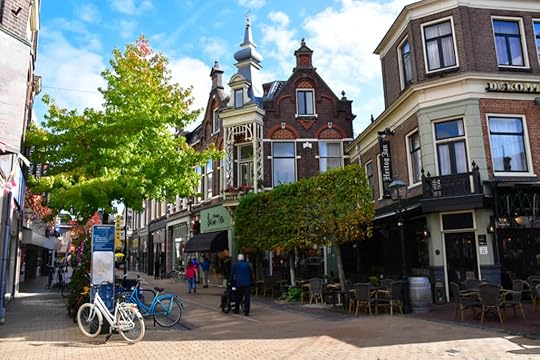
There’s a lot of local color from the setting of modern Assen, a real town, now home to an annual Dutch biker-fest and beer bash. (The Dutch Sturgis, I guess.)

The writing is good; an example: “He had never been the one to end a relationship, but always the first who knew that it was over.”

Translated from Dutch, it’s a decent read, but overly long and slow in places. Thus, I think, it’s low rating on GR. I enjoyed his contemporary novel set in Amsterdam much better, The Great Longing.

description

The author, b. 1957, is much better known in the Netherlands and in Germany than in the English reading world. GR says his books have won numerous awards in the Netherlands and that The Great Longing sold 150,000 copies there. His best-known book on GR in English is In Babylon. That’s in my TBR pile. I started it and set it aside because it’s also slow, but I haven’t given up on it yet.

Photo of Assen from zimminaroundtheworld.com
The author from harpercollins.com
Profile Image for Scribble Orca.
213 reviews398 followers
October 12, 2013
Möring deserves to be much more widely read. All you BBB (Big Brainy Book) readers who've yet to venture along the path to the wood, get thee onmiddelijk naar een Bookery and be prepared for verrukking. The blurb does not disappoint.

The usual hi-jinx of free-wheeling typography, po-mo antix, literary allusion, delusion and collusion with the maestri of yore abound, but these are subtle rather than salacious, reflecting the author's exuberance in the form rather than any overt intent to impress with undoubted erudition. It's there, but isn't the οὐ κινούμενον κινεῖ, and a less-well-read reader should not be daunted (Theroux, move over, although you're still loved (for your vocabulary, at least)).

On the form side, time weaves backwards and forwards something like the threads in a tapestry (the tapestry that is the last century's history of Europe) through a considered and judicious use of the full range of tenses* available to depict the nuances of action, thought, intention, imagination, dreaming, history, the unknown, the bemoaned, the as-yet-to-pass-as-it-was-envisioned-in-the-past, the future, combining cleverly at times a distanced narrative, free indirect discourse, dialogue, and what by now has become (thankfully) standard fare (in appreciation for what film has done for the written word) a director's camera observing details which shade but never bore. Note also that the dreadful beast of interpolating, extrapolating and heavily polemicising author is refreshingly absent, achieved by the protagonist narrating in the guise of his (and her) time-influenced, experience-wrought selves (see Proust for the ultimate in this effect). Commentary rests squarely with the WYSIWYG character(s), owning (and controlling) the story.

For story it is. Content-wise, this is a sly twist on the reality that is not only Europe's shame, but which has its seeds, like the destructive power of every institutionalised religion whose intent is not to succor the spiritually malnourished or weak but gather them to its chest as bulwark and crusaders for its own manipulation and self-avowal, in a history that is not directly referenced but which informs all of the attitudes, responses, thoughts and deeds which follow in the wake of that reality's inception. And by the dubious virtue of its long and illustrious history, is the creation of that shame carefully centred on Europe, when the shoulders which should bear this burden are much more diasporally diffused. But that sounds far more dire than rendered by Möring: satirically, ironically, comically, visually, and sensually.

In short, a thoroughly ripping good romp of yarn that doubles as a history lesson (of sorts, with caveats) for those unfamiliar with a Dutch perspective on the last hundred years (then and now) of Our Glorious Civilisation.

*One review complains of the use of pluperfect (past perfect) tense being unsuited to American tastes. *raises eyebrows* It's part of the fabric of what Möring achieves. Like suggesting that three-dimensional drawings be rendered as two-dimensional. Such a complaint indicates a profound lack of understanding of how tense functions to telescope, macroscope, and nanoscope the text, the rendition of the character (whether in first person or third person perspective), and the sense of time receding and returning via events.
Profile Image for Marc Lamot.
3,469 reviews1,999 followers
September 27, 2018
The Dutch author Marcel Möring with 'In Babylon' (1997) had awakened great expectations about his further literary evolution. With 'Dis' (2006), the first part of a trilogy that clearly refers to Dante, he has severely disappointed me.
The story of 'Dis' takes place in Assen, a town in the north of the Netherlands. Several storylines are connected to each other, with the themes of post-holocaust emptiness and the walking Jew as central elements. That looks like a promising concept, but Möring has made a mess of it, I cannot describe it any differently. Especially stylistically, the book is a real failure: it seems that Möring just wanted to demonstrate how erudite he was, how many literary references he could put into a single book (and play with them), and how many different styles he could handle. Already in the first 150 pages I recognized Joyce, Döblin, Svevo, and Becket, and of course Dante and Homer are directly and indirectly referred to in detail. And then it even aren’t subtle references: Möring has followed his models into the extreme, with continuous repetitions, to the point of annoyance. Even the experiments with the typography fall dead on a cold stone.
Stylistic excess harms, and even more so when it’s detrimental to the content: Moring's main characters, both Jewish, keep on repeating that our earthly existence is a vale of tears, that everything is only emptiness (yes, Ecclesiastes!). And consequently, despite their active wanderings, the protagonists lead a lonely and hopeless existence. Maybe this was intended as a brilliant variation on the 'Inferno' of Dante, but I became utterly annoyed by this book and quickly put it aside.
Profile Image for Jonfaith.
2,150 reviews1,748 followers
June 11, 2014
Hell and nothing but that. That is the world.

In a Dark Wood: A Novel is an urgent retelling of the Inferno as by Patrick White. Ulysses, The Odyssey and The Flounder are all at play. There are also motorcycles, plenty of them -- and beer. This tale may involve survival but certainly not redemption. I have my doubts about the former as the central character emerges damaged and bereft, a healing transformation isn't in the cards. What was actualized within the novel was the incontinence of memory and a diminution of empathy post-Shoah.

3.5 stars

Soundtrack: http://www.youtube.com/watch?v=0JchD-...
Profile Image for Jonathan.
1,010 reviews1,233 followers
Want to read
October 2, 2013
1. There are many as-new copies of this floating around on the interwebs for less than £1
2. The guardian review says: His restless, inventive narrative continually redefines itself - as social satire, cosmic tragedy, soft porn, metaphysical speculation. There's an eight-page excursion into graphic mode, and the novel is punctuated by playful visuals: a character's orgasmic cries are erratically spaced out on the page, while the thoughts that float around Jacob "like fireflies" are represented as free-flowing words printed in white on a black background. The novel's structure is determined not by conventional chronology, but by the notion that, as the Jew of Assen puts it, "stories are doors in time" - one story opening out on to another, or giving place to it, as the characters try to map out their complicated lives

This pushes enough of my buttons to have convinced me...as it may do you...
Profile Image for MJ Nicholls.
2,277 reviews4,867 followers
half-read
October 17, 2013
Did not work out between us. So hard to get beyond the second date stage these days.
Profile Image for Jonathan.
1,010 reviews1,233 followers
January 3, 2021
No time for a proper review, but suffice it to say this is excellent and should be of particular interest to those Barth/Coover fans out there (you know who you are...)
Profile Image for Christine.
422 reviews20 followers
July 11, 2016
I think this was too post modern for my liking, it reminded me of having a conversation with my mother-in-law...off on a tangent here, off on a tangent there and the tangents are so long and winding that I forget what we were originally talking about. I really like the cover though.
Profile Image for Keith.
275 reviews8 followers
July 11, 2013
As the dust jacket states: it's “loosely based on Dante's Inferno”... yes, but very loosely. Jacob Noah materializes from his hiding place in the woods in 1945 to find that his family and most of his friends have died at the hands of the Nazis and he's faced with reestablishing himself in a changed world. At gunpoint, he quickly reclaims his family's business from a Dutch-Nationalist who has renamed it: The Aryan Bookshop, and goes forth into a lonely and unhappy future to become the town's most successful entrepreneur while carrying the baggage of survivor's guilt as one of the last Jews in the community. Although Dante is a constant reference, Nietzsche's influence is quite apparent as well, if not politically then certainly philosophically. The novel's style is wonderfully creative, segueing from narrative to punctuation-free, stream of consciousness and poetic lyricism as various characters are introduced. You probably have to be Dutch to grasp many of the cultural references but Noah's wandering from past to present and back again create a more anguished illusion of Our Town from my perspective. And while George Bailey saw a world as it might have been without him in It's A Wonderful Life, Noah doesn't find George's happy ending, but it's an impressive, thought provoking and sometimes funny book none the less.
Profile Image for Lorri.
563 reviews
November 25, 2012
In a Dark Wood, by Marcel Moring is a compelling book, and one that was difficult to write my thoughts on due to the intensity of the prose, underlying themes, strong metaphors and the overall contents of the novel, part of which is slightly based on Dante’s Inferno, which is the first part of Dante’s poem, The Divine Comedy.

Marcel Moring’s brilliance radiates throughout the pages, and his masterful writing is intense and filled with much to ponder, from metaphors to religious symbolism. I highly recommend In a Dark Wood, by Marcel Moring to those interested in the study of the after-effects, the human emotions and the trauma resulting from the Holocaust and how it can affect those who have survived the atrociousness.
Profile Image for Drew Villeneuve.
16 reviews4 followers
August 23, 2013
Some great material that unfortunately never really gave birth to what the author was expecting. Hard for me to dislike though; Moring has a fascinating style that just has to be tightened and given a clear path to the target in order to work. Some fascinating (maybe a little heavy handed?) allusions and themes. I'd be interested in reading his other works to see if Moring becomes any more precise.
Profile Image for Kees van Duyn.
1,076 reviews7 followers
July 15, 2018
In de jaren vijftig vestigt Jacob Noach, die tijdens de Tweede Wereldoorlog was ondergedoken bij een naburige boer, zich in Assen. Samen met zijn vrouw Jetty, waar hij eigenlijk niets om geeft, begint hij er de allereerste lingeriezaak van Drenthe. De zaak groeit uit tot een waar imperium, want Noach bezit ongeveer het hele centrum van Assen, waaronder het warenhuis dat uit de lingeriezaak is voortgekomen.

Marcus Kolpa is geboren en opgegroeid in Assen, maar zodra hij de kans kreeg is hij er vertrokken. Naar het meer levendige en dus minder saaie Amsterdam. Op 27 juni 1980, op de dag van de nacht van de TT, keert Kolpa echter terug naar Assen. Vooral vanwege zijn grote liefde Chaja, dochter van Jacob Noach.

Dis is de eerste deel van een trilogie. Het verhaal speelt zich vooral af in de Asser nacht van de TT van 1980. De belangrijkste personages zijn Jacob Noach en Marcus Kolpa. Ze kennen elkaar, maar in het boek zullen hun wegen zich niet kruisen. Dat komt vooral doordat Noach in die bewuste nacht verongelukt.

De afzonderlijke verhalen van Noach en Kolpa zijn het meest interessant. Waarschijnlijk omdat deze over het algemeen redelijk realistisch weergegeven zijn. Daarnaast komen wat kortere verhalen in het boek voor die buitengewoon onduidelijk en vaag zijn. Ze lijken ook helemaal niets met de uiteindelijke vertelling te maken te hebben en zijn onbegrijpelijk.

In het boek wordt regelmatig verwezen naar de historie van Assen, zoals bijvoorbeeld het nonnenklooster Maria in Campis en ook de joden die er gewoond hebben. Dat is een aardige vondst van Möring om dit in het verhaal te verwerken. Ook de roemruchte nacht van Assen uit 1967 heeft een kleine rol in het boek. Dat kan eigenlijk ook niet anders in een verhaal dat zich vooral tijdens de TT-nacht afspeelt.

Dis is een boek dat over het algemeen prettig leest. Dat geldt zeker voor de verhalen van Noach en Kolpa. Deze zijn, op enkele uitzonderingen na, boeiend. Daarom is het des te jammer dat in het boek ook bijzonder oninteressante verhaaltjes voorkomen. Dat is helaas een aanslag op de amusementswaarde van het boek.

Als je de betere delen afweegt tegen de minder goede (slechte) delen van het boek is de conclusie die getrokken kan worden dat Dis geen ijzersterke roman is, maar het is ook weer niet zo slecht als critici de lezer destijds wilden doen laten geloven. Eigenlijk is het een boek met twee gezichten.
Profile Image for Tjibbe Wubbels.
590 reviews8 followers
April 4, 2020
In this kind of social satire, we follow Jacob Noah and Marcus Kolpa on a trip through Dis, Dante's city of hell, which in this case is Assen, a small Dutch city. It's the day before the TT motor race, the city is celebrating, so there are plenty of changes for chance encounters. All those people, drinking, partying, contemplating, simply living. It's, of course, a model for the world as a whole. It's here where the depressing message of the novel comes forward
(The people) just like you locked up in their own hell, where they torture themselves with their desires and doubts and dreams and wishes, their fata morganas of true love and meaningful lives, their air castles full of deeds and strength and truth and grand and deep and wonderful. Maybe you're an ant, like the other ants.

There is a lot going on in this lengthy novel: There are horrible memories of WWII and its aftermath, there is a wandering Jew, there is a story of fortune made and love lost, there is a story of a promising young man that didn't quite live up to his potential, etc. Maybe a bit too much. Möring is an exceptional writer, but I feel he got carried away a bit with the side stories and some pages in this novel feel more like a literary exercise than literature. The most powerful prose is found when Möring describes the state of mourning in which the main character finds himself after losing most of his family members to the holocaust.
He has his loss, and he has what's yet to be lost.

A very interesting novel, that combines great insight and beautiful prose with unnecessary literary exercises and way too many drunken bikers.
Profile Image for Kerfe.
973 reviews47 followers
October 20, 2010
The author begins his novel with quotes from Isaiah: "I said: In the midst of my days I shall go to the gates of hell." and Eric Idle: "You come from nothing, you're going back to nothing. What've you lost? Nothing!"

This gallows humor flows through Moring's narrative, really many narratives, but two main, related, somwhat parallel stories. Jacob Noah, a Dutch Holocaust survivor, seemingly (although this is never clearly spelled out) dies in a car crash, and we see past and present merge as he reaches a detente with death. And Marcus Kolpa, would-be suitor of Noah's youngest daughter Chaja, tries to make sense of both where he is going and where he has been. Jacob's story was the more interesting one for me as it combined real events with the nonsensical, the mythical, the magical. Marcus, on the other hand, seems kind of a stereotypical no-longer-quite-young-but-not-really-grown-up man: he feels oppressed, he's obsessed with sex, he distances himself with intellect and irony. Jacob's struggle is much richer and more complex, involving time, space, guilt, regret, fear.

"You're thrown into life without explanation or instructions, unasked and perhaps even unwanted, and then there's nothing to do but finish it off."

A worthwhile journey of words and ideas.
Profile Image for Patricia O'Sullivan.
Author 11 books22 followers
January 21, 2012
“The heart of the heart. The midst of the battle. Midway through our lives, when we find ourselves in a dark wood. In the shit. That’s where we are now.” Readers who enjoy modern writers like James Joyce, Samuel Beckett and Milan Kundera will enjoy Marcel Möring’s haunting prose about the emptiness and guilt felt by Jacob Noah, a Holocaust survivor led on a strange journey by “the Jew of Assen” and Marcus Kolpa, a young man full of promise who drifts unmoored in post-war Holland. Set in the prosperous and willfully ahistorical Dutch town of Assen, In A Dark Wood reads like a stream of consciousness with a plot, tying together vignettes in the lives of its characters, all trying to find meaning in a world in which tragedy has stripped it away. Shaun Whiteside’s translation captures the beauty of Möring’s writing with his philosophical descriptions of life in Assen and his characters’ dream-like recollections of the war. This is not an easy read, but it worth the effort.
Profile Image for Velma.
749 reviews70 followers
December 8, 2012
I tried. I really tried. I wanted this book to be one of those written using a non-traditional story-telling strategy, that you love because it is so different. Well, it's different all right: different in a "My mother is a fish"-kind of way, but without the Faulknerian brilliance to back it up. I gave up after getting at least two-thirds of the way through it; maybe I'm just out of practice reading modernist literature (I loved Joyce but haven't read him in decades & can't take Kundera). I may try again, as there are the seeds of a beautiful story about surviving the Holocaust here, but there are only so many reading hours in the day...


The ARC I read and reviewed here was provided to me by the publisher via my local Indie bookstore, and no money was exchanged.
97 reviews5 followers
May 26, 2010
Although I had this book for over a month, I didn't finish it before it was due to the library, without any more possibilities for renewal.

I would love to finish it, but I don't know when I'll get the chance.
Profile Image for Lisa.
640 reviews12 followers
Read
July 26, 2011
What a disaster this book is. Half the time I didn't know who the story was following, it only used pronouns not names. The book was all over the place with characters and nothing seemed interconnected at all. Did I just not get it? I picked it up as a proof copy, thankfully not paid for.
1 review
April 22, 2014
Definitely did have a few intriguing poetic phases. I thought the topic and plot were very interesting but the overall structure of the story line was a bit unattractive. It was a bit hard to follow but overall I would say I did enjoy the read. I WOULD RECOMMEND IT to others.
Profile Image for Jaime.
161 reviews2 followers
September 10, 2010
So far this book is really good...quite strange, and I'm trying to follow along, but I'm down for the ride.
Profile Image for Jennifer.
213 reviews49 followers
Read
April 3, 2011
I just could not read this right now. Way to hard to follow and pretty depressing. Maybe one day I will come back to it...
504 reviews
February 13, 2025
Dis - in het Nederlands, bizar, toch de moeite waard.
Displaying 1 - 26 of 26 reviews

Can't find what you're looking for?

Get help and learn more about the design.