Hidden in the shadow cast by the great western expeditions of Lewis and Clark lies another journey every bit as poignant, every bit as dramatic, and every bit as essential to an understanding of who we are as a nation -- the 1,800-mile journey made by Chief Joseph and eight hundred Nez Perce men, women, and children from their homelands in what is now eastern Oregon through the most difficult, mountainous country in western America to the high, wintry plains of Montana. There, only forty miles from the Canadian border and freedom, Chief Joseph, convinced that the wounded and elders could go no farther, walked across the snowy battlefield, handed his rifle to the U.S. military commander who had been pursuing them, and spoke his now-famous words, "From where the sun now stands, I will fight no more forever."
The story has been told many times, but never before in its entirety or with such narrative richness. Drawing on four years of research, interviews, and 20,000 miles of travel, Nerburn takes us beyond the surrender to the captives' unlikely welcome in Bismarck, North Dakota, their tragic eight-year exile in Indian Territory, and their ultimate return to the Northwest. Nerburn reveals the true, complex character of Joseph, showing how the man was transformed into a myth by a public hungry for an image of the noble Indian and how Joseph exploited the myth in order to achieve his single goal of returning his people to their homeland.
Chief Joseph & the Flight of the Nez Perce is far more than the story of a man and a people. It is a grand saga of a pivotal time in our nation's history. Its pages are alive with the presence of Lewis and Clark, General William Tecumseh Sherman, General George Armstrong Custer, and Sitting Bull. Its events brush against the California Gold Rush, the Civil War, the great western pioneer migration, and the building of the telegraph and the transcontinental railroad. Once you have read this groundbreaking work, you will never look at Chief Joseph, the American Indian, or our nation's westward journey in the same way again.
I'm a child of the 60's, a son of the north, and a lover of dogs.
Grew up in a crackerbox post-war bungalow outside of Minneapolis with my mother and father, two younger sisters, various dogs and cats, and a neighborhood full of rugrat kids playing outside until called in for the night.
Studied American Studies at the University of Minnesota, Religious Studies and Humanities at Stanford University, received a Ph.D. in Religion and Art in a joint program at Graduate Theological Union and the University of California at Berkeley. Lots of learning, lots of awards. Phi Beta Kappa. Summa cum Laude. Lots of stuff that looks good on paper.
But just as important, an antique restorer's shop in Marburg, Germany; the museums of Florence; a sculpture studio in the back alleys of Pietrasanta, Italy; an Indian reservation in the forests of northern Minnesota; and, perhaps above all, the American road.
Always a watcher, always a wanderer, perhaps too empathetic for my own good, more concerned with the "other" than the "self", always more interested in what people believed than in what they thought. A friend of the ordinary and the life of the streets.
Twenty years as a sculptor -- over-life sized images hand-chiseled from large tree trunks -- efforts to embody emotional and spiritual states in wood. Then, still searching, years helping young people collect memories of the tribal elders on the Red Lake Ojibwe reservation in the Minnesota north. Then writing,
always writing, finding a voice and even a calling, helping Native America tell its story.
A marriage, children, a home on a pine-rimmed lake near the Minnesota-Canadian border.
Book after book, seventeen in all, ever seeking the heartbeat of people's belief. Journeys, consolations, the caring observer, always the teacher, always the learner. Ever mindful of the wise counsel of an Ojibwe elder, "Always teach by stories, because stories lodge deep in the heart."
Through grace and good luck, an important trilogy (Neither Wolf nor Dog, The Wolf at Twilight, and The Girl who Sang to the Buffalo), a film, Minnesota Book Awards, South Dakota book of the year, many "community reads," book sales around the world.
In the end, a reluctant promoter, a quiet worker, a seeker of an authentic American spirituality, more concerned with excellence than quantity. Proud to be referred to as "a guerilla theologian" and honored to be called "the one writer who can respectfully bridge the gap between native and non-Native cultures". But more honored still to hear a twelve-year-old girl at one of my readings whisper to her mom, "He's a really nice man."
At heart, just an ordinary person, grateful to be a father and a husband, more impressed by kindness than by power, doing what I can with the skills that I have to pay my rent for my time on earth. And trying, always trying, to live by Sitting Bull's entreaty: "Come let us put our minds together to see what kind of lives we can create for our children."
“From where the sun now stands, I will fight no more forever…”
Even in the sad annals of relations between the United States and the American Indians, the plight of the Nez Perce stands out. In 1805, in the foothills of the Bitterroot Mountains, Lewis & Clark stumbled onto the Nez Perce. Instead of wiping them out, the Nez Perce welcomed the visitors, even though they were “filthy and squalid” and “all had eyes like dead fish.” The peace formed in that moment lasted for years. Even as white settlers flooded their lands, erecting towns, tilling fields, and mining for gold, the Nez Perce did their best to coexist. Many took to “the Book of Heaven” and converted to Christianity.
In 1855, a treaty established a Nez Perce reservation of 7.5 million acres. Eight years later, the U.S. Government returned to renegotiate. A small group of Nez Perce were badgered into signing away 90% of that reservation. Those who did not sign kept living on their traditional homelands. In 1877, General Oliver Otis Howard, “the Christian general” who had lost an arm in the Civil War, called a council and ordered the “non-treaty” Nez Perce onto the reservation, setting an impossible timetable of thirty days.
Howard humiliated the Nez Perce, going so far as to jail one of their chiefs, Toohoolhoolzote. For a handful of warriors, this insult, accompanied by Howard’s demands, proved too much. They descended on the Salmon River, murdering the white settlers in their path. The Nez Perce fled to White Bird Canyon, where Howard's soldiers found them. The Indians defeated the soldiers sent to punish them. With the die inexorably cast, the Nez Perce turned east, their eyes upon Canada and refuge, many hundreds of rugged miles away.
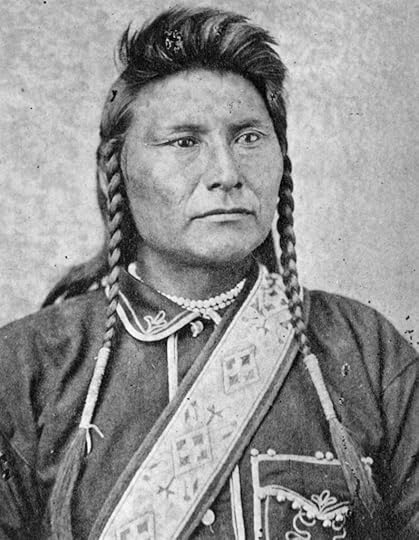
Chief Joseph of the Nez Perce. He played a surprisingly ephemeral role in the fighting escape that made him immortal. Later, though, he was relentless in his efforts to have his people returned home.
The fighting retreat of the Nez Perce is one of the great epics of the American West. It was a saga that captured the attention of contemporary Americans, and has not let go till this day. Even casual students of history have probably heard Joseph’s alleged surrender statement: “I am tired of fighting…It is cold and we have no blankets. The little children are freezing to death. My people, some of them have run away to the hills, and have no blankets, no food. No one knows where they are…I want to have time to look for my children and see how many of them I can find. Maybe I shall find them among the dead. Hear me, my chiefs. I am tired. My heart is sick and sad. From where the sun now stands, I will fight no more forever.”
The trek of Joseph and his people is capably told in Kent Nerburn’s Chief Joseph & the Flight of the Nez Perce. Nerburn breaks this 398-page story into three sections. The first is an overview of Nez Perce-U.S. relations, beginning with that first meeting in 1805. The second covers the Nez Perce War, including the Battle of White Bird Canyon, the Battle of the Clearwater, and the final clash at the Bear Paw Mountain, where the Nez Perce were finally corralled by General Nelson Miles, just short of the Canadian border. The final section tells of the painful exile of the Nez Perce and their long struggle to return home.
Nerburn presents this material as a narrative history. This has both advantages and drawbacks. On the plus side, it makes for an incredibly readable book. Nerburn is a good writer. He has a special talent for description, and does a great job evoking the terrain, the weather, the pageantry of an Indian village on the move, with hundreds of people and thousands of horses. Time and again he paints wonderfully vivid images that put you there, on the march.
For whatever reason, Nerburn doesn’t do as well with the battles. They are described with immediacy, I suppose, but he neglects the tactical aspects. Maps would have helped, but there are only a couple overall maps of the route of the Nez Perce, which are not very helpful.
One of Nerburn’s calling cards – it’s literally in his bio – is that he writes with sensitivity to the native perspective. This is not only appropriate but a requirement for any accurate retelling of the past. Here, Nerburn demonstrates this quality by narrating certain portions from the Nez Perce point of view. There is nothing wrong with this, and at times it is quite effective. However, when Nerburn places us on the ground with the Nez Perce, he tends to limit the information he imparts. In other words, if the Nez Perce wouldn’t have known it, then he’s not going to tell you. This leads to long passages that do not have dates or distances covered. You get a real sense for how the journey felt, but less of a sense of how it unfolded. (I found it helpful to have a timeline nearby).
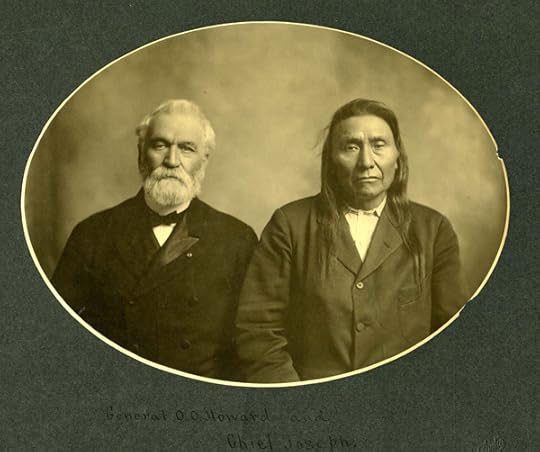
General O.O. Howard and Chief Joseph, side by side. I'm pretty sure sitting for this portrait was not their idea.
The downside to any historical narrative, of course, is that there isn’t any one version of history. There are actually many versions, culled from many viewpoints, all pieced together to form a whole. Thus, certain historical events (ones with a lot of sources) work better as narratives than others (those with fewer sources), because there is more opportunity for corroboration.
I’m not sure that a pure narrative is the best way to tell the odyssey of the Nez Perce. Certain aspects are hotly debated, including – of course – the origin of Joseph’s famous surrender speech. (Joseph did not speak English, so anything he said had to be filtered through an interpreter). This (minor) controversy is barely mentioned. Nerburn chooses the version he wants to relate, and then asks us to trust him that he picked wisely.
I definitely would have appreciated a little more analysis of sources. Indeed, I would have appreciated better sourcing in general. Nerburn doesn’t utilize footnotes or endnotes, instead relying on a “Note on Sources”. He gives as his excuse that he did not want to “clutter” the pages with notes. I agree that clutter is bad. Yet it should be acknowledged that this is a ridiculous excuse, and that you can fully source your book without leaving any trace. There were many, many, many times during the narrative when I would automatically flip to the back, to trace the origins of something I’d read. Time and again I’d stop, knowing it was wasted effort. For instance, Nerburn makes a lot of broad, generalized statements about Joseph’s behavior during the trek. Yet he never connects those statements to an actual event within the narrative that demonstrates Joseph’s behavior. Thus, I want to know how he’s deriving his conclusions. But I can’t! This is frustrating!
(I suppose this is the proper time to note that Nerburn isn’t great at characterizations, especially with the Nez Perce. He sort of just drops people into the story without proper introductions. Until the end, he never makes clear the power structure within the Nez Perce).
Another shortcoming of Nerburn’s analysis-free narrative is that it never explains why it’s main character – Joseph – disappears for almost the entire time the Nez Perce are on the run. Chief Joseph, you see, is partly a creation of the white press. He was not the overall leader. He did not craft battle strategy. He did not make decisions on the march. Yet he became the face of the Nez Perce, one of the most famous of all American Indians. Nerburn does very little to tell us why, leaving it to the reader to piece together.
Frankly, I almost discarded Chief Joseph & the Flight of the Nez Perce halfway through. I am a picky reader, and when I read history, I want it to maintain a good balance between readability and scholarship. Nerburn was certainly readable, but I questioned the scholarship. (Again, I’m not saying this wasn’t researched; I’m saying it’s impossible to verify without endnotes). I stuck with it, though, because it’s relatively short and I have a weird thing about giving up on books. (I'll give up on just about anything - eating well, exercising, not drinking a whole bottle of wine by myself - but I don't give up on books).
I’m glad I finished, because the final third, about the Nez Perce’s banishment to Indian Territory, and their struggle – led by Joseph – to return, is quite good, and easily the highlight. Nerburn tempers his subjective narration and does a better job of taking you through events in a methodical manner.
A story like this is powerful no matter how you tell it. I had some serious misgivings, obviously (have I belabored the endnotes situation enough?). I also recognize that Nerburn intended a popular history, one that stressed accessibility over factual wrangling. At that, he succeeds. That is worth mentioning, since this is a story worth hearing. It is a classic tragedy, a human drama filled with flawed protagonists and desperate battles, of misjudgments, miscalculations, and mistakes. There is heartbreak and death and the timeless love of a people for their homes.
I found this book well written, engagingly presented, and to my understanding a more authentic portrayal of the Nez Percé flight than I've come across in Western culture history. There is much more to this story than many know, and it varies revealingly from the misinformation many have been exposed to.
“Success, like war and like charity in religion, covers a multitude of sins.” ~ Sir Charles Napier
I like Western Stuff. I like Roy Roger's cowboy films and the Calico mine ride at Knott's Berry Farm. I like listening to 1960's country music and the bronze sculptures of Frederic Remington. In other words I like the fake West, the Wild West of movies and romantic nostalgia. Kent Nerburn's chronicle of the disenfranchisement of the Nez Perce and the subsequent ethnic cleansing of this indigenous people group from their traditional tribal lands was a very difficult read. I had heard of Chief Joseph and associated him with his "I will fight no more forever" speech, but that was about it. I had never heard of the Nez Perce before and had no idea that Chief Joseph was a member of that tribe. In reading Nerburn's "Chief Joseph & the Flight of the Nez Perce" I was able to learn about this resilient people group from their first contact with Lewis & Clarke, to the missionary period, through the escalating conflicts with European American settlers and gold miners. In finishing the book, I had the same feeling of sadness I had when I read Dee Brown's "Bury My Heart At Wounded Knee." Sometimes it is good to be reminded of the true history of our country and mourn the injustice done in the name of "progress."
This is a challenging subject that has been handled by the author with an incredibly delicate approach and an engrossing style.
Like the Trail of Tears, every American should know the story of the Nez Perce (Ne-Me-Poo) tribe of eastern Oregon and their quest for freedom. The story begins in the early 1800s as the tribe offers their true friendship to the United States government. The relationship descends into deceipt as corrupt officials and greedy immigrants move in.
Chief Joseph’s father sets the tone at his death bed as he asks his son to promise he will never sell or give away the land of his ancestors. After the great chief dies, the Nez Perce sign a treaty with the federal government which allows them to keep much of their original territory. But miners soon begin staking claims on valuable Nez Perce lands and the United States alters the original treaty, demanding the tribe leave their prized territories.
After some tragic skirmishes, a large segment of the tribe decides to flee on foot and horseback rather than be forced onto a small reservation.
In a vibrant and steadily-paced narrative, the author takes readers along for the twists and turns of this long escape route -- as 800 men, women, children and elders travel over 1000 miles through some of the most breathtaking country in the West, warriors engage in battles with the U.S. Army along the way.
The author states that “these people did not seem wounded by the dominant American culture so much as masters of it.” He clearly spent years researching, visiting sites and getting to know the tribe, going beyond what is expected and doing justice to the topic. Nerburn offers background on the tribe and their admirable customs and philosophies. The reasons they choose to fight for their freedom are abundantly clear.
It was a sad time in American history and there are heart-wrenching moments. (If you’re looking for light entertainment, this isn’t it.) But there are plenty of scenes in which the human spirit triumphs and the character of the Nez Perce shines through.
For a crash course on America’s twisted Indian policies, read this book. The spirit and vitality of today’s Nez Perce offers hope -- as today’s tribe faces plenty of challenges, their people live on and seem to hold true to their time-honored values.
kent nerburn's chief joseph & the flight of the nez perce is an engaging chronicle of the infamous 1877 ordeal endured by the nez perce people. this tragic tale follows an 800-member faction of the pacific northwest tribe driven from their longtime ancestral lands in eastern oregon and their ensuing retreat of nearly 1,200 miles (across parts of four states) while battling hostile army forces. the nez perce were able to effectively outfight and outmaneuver some 2,000 soldiers for five months through unforgiving climate and terrain but, following surrender, were ultimately exiled from their home region for the next eight years. nerburn's book affords chief joseph his proper context within the tribe, rather than the sensationalized and often misrepresented role he played during the tribe's epic flight.
nerburn's narrative style allows for a continuity in storytelling that greatly enriches this already compelling tale. conveying the inconceivable hardships and myriad sorrows of their journey, nerburn is able to vividly illustrate the lasting heartbreak that accompanied so many duplicities and betrayals imposed upon the nez perce people. chief joseph & the flight of the nez perce is a well-researched, meticulously composed biography of a brave people, a stalwart leader, and a defining, however shameful, moment in american history.
hear me, my chiefs. i am tired. my heart is sick and sad. from where the sun now stands, i will fight no more forever.
This book is so sad that at times I had to put it down and breathe. The suffering, courage and tenacity of the Nez Perce brought an ache to my heart. Our country was originally their country and we violently committed genocide against them. My family followed a portion of their escape trail this summer through mountains, forests, deserts and rushing rivers. Our journey was by car and train; their journey with infants and elderly was by foot. Not only was I in awe of the austere beauty of that land, but more so the amazing strength and endurance of these people. This well-researched and thorough book is worth every emotion it stirs. I felt an obligation, even a duty to learn about this part of our country's history; perhaps as a sort of recompense for our crime against their humanity. My grandfather, born in 1861 was part of a Civilian group who cleaned up after the battles of the Nez Perce and Lakota in 1876-1878. His stories, which came to me from my grandmother and father, created an emotional interest and connection to this not so long ago tragedy. Many thanks to the author for telling the stories in such a spell-binding and factual way!
Our public school systems are replete with mandatory reading assignments . While I support the public school systems, our list of works designated as mandatory reading needs an update. Too many of these books glorify or pertain to anglo, European, and/or greek heritage and ideas. I don't know of any that tell of the First People the American Continents. The United States white "civilization " has destroyed and/or subjugated native peoples or people of color since they first landed here. This book tells the story of the Nez Perce. This is the ancient group of First Peoples that friended Lewis and Clark. Without the Nez Perce, that expedition would have failed. This book tells the story of how white america destroyed the Nez Perce and it should be mandatory reading in our high schools.
"Chief Joseph" is a heart-breaking but informative read, told as a narrative but full of historic detail. While I knew the result of the Nez Perce leaving their homeland and the result of the ensuing battles, I couldn't help but hope as I read that the events would somehow unfold differently. This is the tragic story of the Nez Perce, who were given numerous promises to keep or return to their home land which never came to fruition, and the elevation of Joseph (who was the chief of one band of Nez Perce) as their leader in the eyes of white America. He never stopped fighting to bring the Nez Perce home.
Few books have ever impacted me so much. I cannot get Chief Joseph and all his people out of my heart and my mind. I think about them all the time when I drive on streets, walk on sidewalks, look at trees and hear traffic. This was their land. They treated Mother Earth with such respect and love. They treated each other with honor, respect and caring for each other. We should have learned from them and let them teach us (white settlers) their ways and perhaps adapted some of their philosophy and attitudes to better ourselves. We did not, and we are poorer for it. Incredible writing by this author, descriptions of how the Indians lived, and what happened when the white settlers began encroaching on their lands. Heart breaking. We never learned enough about this in school. LOVED THIS BOOK AND LOVED HOW IT IS WRITTEN. Author writes with love and respect of these grand people. Lots of details, lots of explanations, descriptions. Author did about 4 years research to write this book...it's not fiction, and it hurts.
I really enjoyed this book. It gave a different perspective of what happened during the battles over land when the settlers started moving West. In history we were always told the U.S. side of this particular story but I had never really put much thought into the Nez Perce side. This book really shed a lot of light on what the Nez Perce tribe had to go through as they were exiled from their own lands. One thing I really liked about how this book was written was the fact that it was written in a pretty black and white way. I didn't feel like the author tried to sway the reader in one way or another with an opinion about Joseph. From the get go, the author was very transparent that tribes are very divided when it comes to their thoughts of chief Joseph. Some thought he was a champion, and others think of him as a coward. I was glad to be able to decide that for myself and not be swayed by the author.
The only part of the book that I didn't like was, after the surrender, I felt like the book just really lost a lot of its fizzle. I wasn't as hooked as in the beginning and had to somewhat force myself to keep picking up the book to get through it. I realize that in general, the story wasn't as exciting as in the beginning when the Nez Perce were on the run, but I felt that it could have had a little more substance added in other than just, the Nez Perce had to move, they were divided, Joseph went to Washington, wash, rinse repeat. It just seemed to fall flat.
Overall though if you have even the slightest interest in history, I would really recommend reading this book.
This is one of the most incredible books I have ever read. I plan to read it again very soon, when I am done with Kent Nerburn trilogy for the 2nd time. I never knew so much about the tragedy that our government and our people incurred onto the American Indians....my eyes have been opened and my heart has been torn to read what they had to go through. Nerburn did 4 years of research to learn about Chief Joseph...it is so heart-breaking but important for us to just know this. When we see an article in the newspaper about a tribe that is trying to save a piece of land that is sacred to their tribe....now I understand it so much more. It's a beautifully written book, it's interesting , it's historical, and there is so much we should have in our history books that we don't have. After this I wanted to read more by this author and found his Trilogy, beginning with Neither Dog nor Wolf...more learning and more crying heart, but a growing admiration for the Indian Culture. It has been fascinating to learn of their customs, mores, philosophies, life, in all these books.
The tragic saga of the Nez Perce being driven from their Wallowa homelands is told entirely from the Tribe's perspective by Nerbaum in his heartfelt portrayal of the famous attempt by the tribe to evade the American army over thousands of miles, through Oregon, Idaho, Wyoming and Montana in their attempt to reach Canada in the 1870's. The humanity of the tribe, the complexity of the leadership, the terror from ambushes by whites, and and adversity from increasingly cold weather as fall passed and winter approached in the NW mountains--this book gives us a much deeper understanding of the daily life of the Nez Perce throughout their flight. You feel as though you are right there with them every step of the way. Highly recommend.
By turns desperate and triumphant, Nerburn's Chief Joseph and the Flight of the Nez Perce is an extensively researched, engrossing, and important story for anyone interested in our country's first Citizens.
Excellent historical narrative, not just dry facts and dates. An incredibly tragic part of U.S. history. This covers much more than just the Chief and the years of The Flight. It begins about 100 years of the tribes history - from the early 1800’s until Joseph’s passing in 1904. So you get a pretty thorough accounting of the tribe’s history from it’s first encounters with white Europeans (Lewis & Clark in 1805) thru their struggles with the settlers and miners and corrupt government officials, and their interment on Reservations.
Easy to follow narrative of a shameful chapter in our history. Nerburn strips away the myth and celebrity of Chief Joseph - depicting him as a man tormented by the responsibility of protecting his people. An essential- if difficult - story to read.
This is the way history needs to be told. Piles of facts and the bland language of most text books can't convey what happened. It takes a great writer to make facts come alive. Nerburn is just that great writer who can fuse the facts and the story. As testament to Nerbern's skills as a writer, one reviewer here said he held himself to a few pages a day to make it last. I had no such discipline and, hoping for a better ending, I devoured this book ASAP.
I erroneously thought that the Chief's famous words would come at the end of the story. This caused me to be confused by the map, until the middle of the book when "I will fight no more forever" is said and whole new story begins. Why didn't I know this? Every American should know this story, because it doesn't end with the famous quote.
If Gen. Howard had had his battlefield courage as an administrator, this grief might not have happened. He was willing to risk his life (and lives of others) to fight the Nez Perce, but not his career to help them. Unfortunately, this moral lack was all too common and as was the criminality of Indian agents, be they church or government representatives.
I particularly liked the way Nerburn presents his notes and sources. Not only is the book readable... the bibliography is as well!
Having read nearly every book I could find about the Nez Perce (see my 'Nez Perce' list), I wondered how this book would compare. I also wondered if reading again about this history that I already know quite well would turn out to be less engrossing this time around. Fortunately, this book measured up to my hopes. In fact, it is so well-written that I think I would recommend it as the best book for those who intend to read only one book on the subject. It seemed very accurate, yet not so detailed as to ever bog down. Personally, I would have preferred a little more detail about the locations and geography of the areas involved, but most readers will not be bothered by that. It was also short on the military strategies and aspects, which was fine with me.
The most unique part of this book was the final one third which describes the exile period of the non-treaty Nez Perce in much greater detail than any other work I have read. Overall, this is an easy-to-read, accurate, page-turning book.
Great book, well-told history based more scholarly and archival research. In the tradition of Mari Sandoz, writing from inside the Indians experience as much as possible. Shows how the myth of Joseph the noble warrior developed, even as he really was more of a spiritual and logistical leader above all else (ie more concerned with making sure camps were organized well, the sick had food and were cared for, etc. than in military strategy or manuevers, which other chiefs had more of a hand in.) The ugly duplicity of even the sympathetic white population is well on display throughout - willing to lift Joseph and the Nez Perce up as an 'unfortunate' noble and peaceful tribe, but doing nothing to recognize and act in defense of their legitimate claims to their land and old ways. Of the 800 or so Nez Perce that began the long exile in the Camas Prairie, less than 300 returned 7 years later in 1885 and those divided up roughly half on their historic lands near completely occupied by white settlers and half (incl Joseph) to a reservation in northern Washington state.
An amazing account of a great and heroic people that went through the trials and tribulations, the horror and the agonies of coming into contact with white people. The murders and deaths of innocent women, men, elderly and children. These proud people being forced to leave their home land when all they wanted was to live in peace and in their own ways. They had no hatred for white people or Christianity. One man did not speak for them all, no one man ever did. As anyone would expect for promises to be kept and men to be true to their word. But instead they were told lies, deceit and deliberate falsehoods. A whole people were punished, destroyed and almost made extinct because of an unfortunate few angry youth that were weak with white man's alcohol. Their anger of course completely understandable. This book is a great way of explaining what happened and who Chief Joseph was.
Author, sculptor, theologian, and educator, http://kentnerburn.com/ Kent Nerburn's biography begins with Lewis and Clark's encounter with the Nez Perce tribes and then details the experiences of Chief Joseph. This biography follows current historical thought that Joseph was not a war leader, but rather tried to serve as a protector of his people. A great historical read while spending the summer in western Montana, this book details events of the Nez Perce's brief 1877 resistance, their long, torturous journey from Wallowa Valley, OR to almost reach Canada, and covers their tragic experiences following surrender. (lj)
This is such a good story, told from the perspective of the people who lived it, written beautifully, told movingly, and researched painstakingly. Nerburn knows his stuff; he made a scholarly research project into a human-level history. Why didn't anyone compile all these sources into literature before? Well, I'm glad Nerburn did it. Everything thinks they remember something about Chief Joseph - "I will fight no more forever" - but here is the person, growing up, living a normal life, finding normalcy going away quickly on a fast horse, so to speak. This is not romanticized but it is spiritually resonant, Perhaps BECAUSE it is not romanticized. It feels real. It is real.
There is a series on television entitled "American Greed" in my opinion, there is no stronger illustration of American Green than the greedy acquisition of the homeland of the people indigenous to the American continent, by our predecessors. Kent Nerburn's telling of this story is heartbreaking. His story is of the families that made up the Nez Perce Nation; it is a story of husbands and wives and their children, no different in love and affection than what I have for my family. Mostly it is a story of a true, yet often unrecognized, leader in Chief Joseph, a leader who again and again placed his trust in a people and a government that kept only one promise, "We will take your land."
This is a great book written in a purely narrative style, and very easily readable even to someone not interested in any critical analyzation.
This is also a sad book about a man who always tried to do right by his people and got sucked into fighting a war he did not want. He deserves all the praise given to him, but for different reasons than most people think. The saddest part of the book, and I think something that is very revealing about American culture, is how near the end of his life, he was simultaenously treated like a wise hero *and* a cartoon character by the same people.
Fascinating look at the story of Chief Joseph and the Nez Perce Indian Nation being pursued by the U.S. Military and captured 40 miles from their destination in Canada. I have known the tragic story of the Native Americans only from the victor's point of view. This was an ugly stain on our nation's history as a governing people, but a portrait and testament of dedication and commitment of the native people and Chief Joseph.
A detailed and nuanced telling of the sad journeys of Chief Joseph and his band of Nez Perce who were repeat victims of bad faith promises by officials who did not have the power to keep their promises.
I picked up this book on the recommendation of a colleague after visiting the astoundingly beautiful Wallowas in Eastern Oregon, where Chief Joseph was born. In terms of style, this was one of the more interesting histories that I've read. Kent Nerburn wants to tell a story that the Nez Perce approve of, and so many of the details of the account come from memories that are passed on as historical fact. Since the concept of "spirit power" is so important to the people and the story, supernatural events are often presented as completely factual, giving the story a flavor of magical realism. Some of the events are believable, even if you, like me, don't believe in spirit power. For example, I can imagine a group of people who respect spirit power would make group decisions based on dreams, even though I don't believe that dreams are accurate predictors of the future. But other occurences seem more far-fetched, such as the old man with a lot of spirit power, who gets shot, but only steam comes out of the wounds instead of blood. Very cinematic, but not very believable.
In some ways, this makes it difficult to assess the truth of whatever events occur in the book. But on the other hand, it keeps an interesting spotlight on the fact that history is more than a collection of facts and is always interpreted through the lenses of different human observers. Seeing the history told through the lens of the Nez Perce is extremely instructive because you realize that the models the Nez Perce have to interpret events are quite different from the prevailing Western model. Often the incompatibility of these models with the Western model is at the root of why certain conflicts cannot be resolved. Certainly, the oppression, racism, and cruel treatment of the Indians by the people of the United States is the obvious root cause of the conflict, I don't mean to suggest otherwise...but the world models are so different that it leads to constant misunderstanding.
1) The model of leadership is incredibly different. The Nez Perce are strikingly democratic and also way more invested in freedom than the citizens of the United States. Chiefs speak for their small groups of people and are raised from a young age to put the people before themselves and so are respected. But no one is really compelled to follow them. Everyone is assumed to be free to act as they feel they must and be responsible for their own actions. The "command" of the decisions of the Nez Perce, such as the trail chiefs during the retreat, is constantly in flux based on how the people think things are going, and not everyone stays with the group. You're free to try to make it on your own. Everyone just thinks that sticking together is the most prudent. The U.S. government seems constantly confused about who is in charge because they have a totally different model of leadership, and what leadership even means. So, for example, when Joseph "surrenders", the U.S. government is miffed when a bunch of other warriors escape to Canada, despite Joseph trying to explain that "he" decided to stop fighting. Some other people didn't make the same decision.
2) The model of ownership is very different. In some ways, there is less of a conception of ownership, especially of land ownership, which is a trope that I've heard before. How can you sell the land? But in other ways, there is a much, much deeper connection to a specific plot of land. This was the most heart-breaking aspect of the book to me. Chief Joseph's people were given the Wallowas at Creation. They were the people for that land, meant to be its stewards and also to live off of it forever. To be removed from it was like cutting the people off from their main purpose in the world forever.
3) There were deep spiritual battles underlying everything. The spirits you believed in and worshipped was an extremely practical thing for the Nez Perce, so there was a deep conflict between those who believed that the old ways were better and those who believed that Christianity was a more powerful spiritual path. I think this spiritual conflict and the search for greater spiritual power underlies a lot more of the narrative than you usually hear about in history books.
The storytelling is great. Of course, the story is tragic and devastating, with good and evil characters on both sides of the conflict. This ought to be standard reading in American history high school courses.
What a sad, difficult, challenging book. It was a biography of Chief Joseph the younger and focused on the flight of the Nez Perce Native Tribe he led on a 1500 mile diaspora in the 1880's. Driven out of their native lands, hounded and pursued by the U S Army, relentless settlers and other Native tribes, their group shriveled from over 900 souls to a couple hundred who finally made it back to the Idaho area a few years later. Their story represents one of the saddest and slowest evolving events of a Native group facing genocide, relocation and/or death.
Joseph evolved from a line of Nez Perce chieftains. His Grandfather encountered Lewis and Clarke, and peacefully made agreements and welcomed the early pathfinders and settlers. Joseph's father, himself raised as a chief, prepared his son, born in 1840, for the role as caretaker and leader of his people. But no amount of teaching, preparation or training would help Joseph deal with the onslaught of the White settlers and U S Government. I only knew a general story of what made Joseph unique, and knew he had been driven from his land and chased all over the West. I never realized the depths of what he endured, as he tried to compromise in order to return to his homeland and honor his heritage.
Kent Nerburn is one of my favorite authors who can record history and tell a compelling story. His books are engrossing and sensitive. He offers research and insight and captures with his fictionalized history an amazing portrait of his characters and what they experienced. It was surely a pivotal time in our history. The turbulence of the Civil War and slavery tore apart the eastern parts of the country while the settlement of the West became just as epic: grabbing land and farming, multiple gold rushes, huge migrations, transcontinental railroads, Indian wars, slaughter of the buffalo, trying to implement a relocation and reservation system on a race of people whose land was swindled and stolen from them right before their eyes.
I love and hate to read about the genocide of Native culture. It is still painfully real for me to imagine and I am ashamed of what happened to the 300,000 or so souls who just happened to be living in North America when it was DISCOVERED and SETTLED. To many people the Indian cultures were primitive and simply couldn't survive the culture shock of European conquest. They were sadly in the way, couldn't understand how to adapt or cope with the White mentality. They were victims of murder, theft, swindling, lies, broken treaties promises and new toxic diseases forced on them. They didn't stand a chance. They were forced to assimilate and denounce their own culture and history. It was a parallel story of slavery and death and cultural genocide as money and the insatiable and relentless development of the continent pushed the Indians to death.
This book is a slow read. It's deep and weighty. It took me awhile to absorb and was not an easy read. It was also absolutely heart breaking and sad. I learned a lot, and is the sort of history I enjoy reading, despite the upset and emotional weight it carries with it. It's the third book I've read by Kent Nerburn who remains one of my favorite historians of Native culture and history.
It's NOT a new story. It's one we all know well and like reading about slavery or the Holocaust, it marks small pieces of history that matter to us all. These kinds of stories MUST be told, must be witnessed. Must be remembered.