

What do you think?

Broadsides from the Other Orders: A Book of Bugs
Describes the physical characteristics and behavior of butterflies, gnats, ladybugs, black flies, silverfish, and dragonflies
276 pages, Paperback
First published June 8, 1993
About the author
Sue Hubbell
13 books107 followersSue Hubbell is a graduate of the Universtiy of Southern California. She received a master's degree in library science from the Drexel Institute of Technology and was a librarian at Brown University. In addition to her books she has written for Time Magazine, Smithsonian Magazine, The New Yorker, the New York Times and the St. Louis Post-Dispatch. She currently resides in Maine.
Ratings & Reviews
Friends & Following
Create a free account to discover what your friends think of this book!
Community Reviews
Displaying 1 - 30 of 40 reviews

August 14, 2010
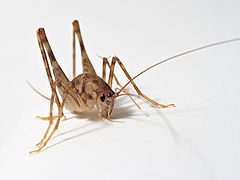
About a month ago, I was poking around my crawlspace when I noticed a lot of dark crickets jumping around like popcorn as soon as I got close to them. Wondering whether they were harmful, I looked online and found out that they were called camel crickets (but also sometimes known as cave crickets), and completely harmless. They like dark damp spaces, eat detritus, and are completely silent, so you won’t hear them chirping at night. The little things looked so cute, the 5 year old in me thought about raising a few in a cage so I could observe them.
Then last week, I was in a used bookstore and I came upon this book through pure luck. A cursory glance through the contents revealed that each chapter is about a different insect, from much loved ones like the butterfly and the ladybug, to ones we consider pests like gnats, silverfish, and flies. I put it in my huge pile of finds that day and took it to the checkout counter. It wasn’t until later that I saw the title of the last chapter—Order Orthoptera: Camel Crickets.
I read this book in random impulsive order. One of the first chapters I read was of course the one on camel crickets. I found out so much more about these little critters than Wikipedia could ever be able to tell me. Hubbell writes from a personal angle; she is not an entomologist, (though she is very knowledgeable) just someone who’s very enthusiastic about bugs, so I was able to get that same sense of excitement and discovery that she did.
She presents you with amazing tidbits that never feel dry. For example, did you know that insects have green blood because their blood (unlike ours) does not have hemoglobin? They have a system of tubes that carries oxygen throughout their small bodies so that their blood doesn't need to do that for them.
Did you know there are water striders (those insects that skim the surface of ponds) that live in the middle of the Atlantic and Pacific oceans?
Her approach with each insect is different. With the ladybug, she followed ladybug harvesters (because they sell them now for people who want them in their gardens), for the daddy longlegs and camel crickets, she raised some of her own in cages and observed them, for the butterfly, she followed a few taxonomists, helping them count the different varieties in the Beartooth Mountains.
Often, each insect is like a launching pad into other subjects. In "Katydids" she talks about insect size as a theoretical question. In "Dragonflies" she talks about people's revulsion to insects in general, and their fear of different-ness. In "Syrphid Flies" she talks about mimicry. In "Black Flies" she talks about our human-centric view of bugs (did you know that the official definition of "endangered species" does not cover insects that can be viewed as pests?) and the dangers of chemical pesticides. In "Gypsy Moths" she talks about the effects of humans introducing a new species from a different continent.
At the end of the book, what struck me most was not all the things I now know about bugs that I didn't before. What struck me most was all the things we as a human race still DON'T know about even the most common bugs! At the end of the chapter on Daddy Longlegs, she lists 3 full pages of questions (most of them very basic) that we still don't understand about these very common insects. And throughout the rest of the book, she is quick to note the many areas that we are still in the dark about. One of the reasons she cites is the lack of funding--especially for insects that don't directly benefit or harm us humans.
We're such selfish creatures.

March 5, 2017
Hubbell channels Rachel Carson in this wonderful wandering through the bug world. She's environmentally conscious & given to almost poetic maundering about them, from the prettiest to the nastiest. Some passages would be almost pornographic out of context, but it's all good & very interesting. She also gets into the science of bugs a fair amount & includes a lot of personal observation of specific habits & traits. She raised honeybees, but she's not truly a professional. Still, she's a very talented writer & interested amateur. Her enthusiasm lends a lot to the narrative.
The main takeaway is that they're extremely prolific (300 lbs of bug per 1 lb of people on Earth) necessary, & often completely misunderstood. Unfortunately, the book is almost 25 years old, so the science is quite dated in some respects. That's not completely bad since it shows just how much more we could answer today, if the resources are available. I doubt they are since bugs aren't nearly as high a priority as they should be, a point she makes quite clear.
Another good point is that bugs is a popular term used incorrectly by scientists & layman alike in general conversation. Ladybugs aren't (they're beetles) while aphids, their prey, are. Bugs are just one of the class Insecta. She also points out that there are a lot of changes going on in the taxonomy of insects. This is even way back in 1993 when this was published. I'm sure now that DNA sampling is settling a lot of arguments & likely creating some more.
Again, I failed to take proper notes as I listened to this. I'm almost done & just now getting around to filling in my thoughts on the chapters, so some things may be a bit out of order or forgotten.
Table of Contents:
1) Order Lepidoptera : butterflies isn't just butterflies, but moths, too. I believe she said that 3/4 were moths. Butterflies are often thought to be the prettiest, but moths can be just as beautiful. Telling them apart isn't as easy as I thought. It's not just feathery versus smooth antenna.
2) Order Diptera : midges and gnats are separate groups, but not terribly distinct if only because not all scientists class them the same even today. Both are in the suborder nematocera along with mosquitos, crane flies, & black flies. Some midges are black flies, but not all bite. Gnats are generally considered to be nonbiting. Confused? Me too. They're pesky little things, but the swarms of gnats are neat to watch.
3) Order Coleoptera: ladybugs are still sold as the natural way to keep the garden free of aphids. I've never tried them & now I'm glad I haven't. How they're harvested is pretty awful & they don't work well, apparently. Aphids are a huge problem (1 million kids per lifetime?!!!) but lacewings are probably a better solution.
4) Order Opiliones: daddy longlegs AKA Harvestmen, shouldn't be confused with other Daddy Longlegs. They've always fascinated me & this section was fantastic. I had no idea about their mating habits & Hubbell even describes keeping some in a cage & sexing them.
5) Order Diptera: black flies proves just how little most of us know & fear bugs. For instance, I thought all black flies bit. Nope. Only a small percentage do according to Hubbell, but the linked Wikipedia article disagrees. In any case, we treat them all the same. Of course, if you've ever been eaten by their swarms, I doubt you have much more use for them than I do.
I found the opinion of one Maine hotel owner illuminating & pertinent. When asked if she thought the government should try to eradicate them, she said no. Folks who couldn't handle them weren't the type she wanted staying at her place anyway. They'd probably want a lot of other things she couldn't provide.
6) Order Hymenoptera: bravo bees IIRC, she mostly discussed sawflies but I think there is some difference in her definition & the definition now. Bug Guide has better pictures & descriptions for some. Anyway, they look like bees but don't/can't sting.
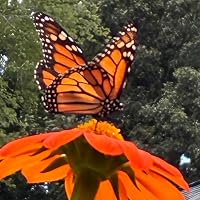
In this section as well as others, she discusses mimicry. The orange & black of the Monarch butterfly which isn't edible due to its diet. This protects others that look similar. I'd always heard the Viceroy butterfly was an example of Batesian mimicry (harmless species looks like dangerous one, so gets a pass), but a study showed Viceroys were often unpleasant to eat too, so they're an example of Müllerian_mimicry instead.
I also thought birds were born with more instincts about what was good to eat, but it turns out it's generally learned behavior. I don't think she handled the evolutionary advantage this lends mimic species very well. Slight edges are far more significant statistically than she lets on, especially in fast breeding prey species in relation to slower breeding predators.
7) Order Hemiptera: water striders have always been a favorite to watch. I also wondered how they got to isolated areas of water so quickly since I never saw wings on them, but it turns out some have wings & others don't. This is called wing polymorphism. I'm definitely going to collect some from my pond this year & check them under my microscope.
8) Order Thysanura: silverfish: The The Thysnaura order is now the Zygentoma order. Silverfish are one of those bugs that define "ick", but they're ancient & quite successful. That's still the only good thing I have to say about them.
9) Order Orthoptera: katydids are just the opposite of Silverfish. I've always liked them, but never knew there were so many varieties. Her descriptions were magnificent & match many of my own observations. They're wonderful mimics & sing so loudly. Often very hard to find even with that clue, sometimes because of it.
10) Order Odonata: dragonflies & she also covers damselflies since most of us lump them together. Very cool, especially their mating habits which require pretzel shapes & specific biting not to mention the guarding fights. I'll definitely be watching them closer this year.
11) Order Lepidoptera: gypsy moths are the poster child for how not to deal with bugs.
England really pushed silk production which resulted in white mulberries (to feed them) becoming an invasive tree as far back as 1700 per New Voyage to Carolina. Until artificial thread filled the gap, we tried over & over again to raise them here, but they never really worked out. In an attempt to improve the breed in the late 1860s, Trouvelot brought them over from Europe. They went wild & have been the subject of some of the most ignorant attempts at stamping out a species ever since. Hubbell covers this well. It's been a nightmare which I have seen first hand. All around us in Maryland during the 1980s, our Dept of Agriculture repeated mistakes made a century before with similar results. Such stupidity would be unbelievable in fiction.
12) Order Diptera: syrphid flies are often called Hover flies. Another bee look alike, she again discusses mimicry. This might be where she got into it in detail.
13) Order Orthoptera: camel crickets shouldn't be confused with the common, dark brown cricket. Same order & suborder, but different superfamily & family. Camel crickets like more moist areas generally, I think. They're a light brown & innocuous little critters, although they sing just like their cousins. That can get irritating. Again she raised them, studied them closely, & discusses their mating habits in almost pornographic detail. It's pretty interesting & her observations with these crickets in captivity were ongoing at the end of this book.
Highly recommended. I'd give it 5 stars if the science wasn't so old. (Yes, science younger than my baby girl is very outdated. Wild!)
The main takeaway is that they're extremely prolific (300 lbs of bug per 1 lb of people on Earth) necessary, & often completely misunderstood. Unfortunately, the book is almost 25 years old, so the science is quite dated in some respects. That's not completely bad since it shows just how much more we could answer today, if the resources are available. I doubt they are since bugs aren't nearly as high a priority as they should be, a point she makes quite clear.
Another good point is that bugs is a popular term used incorrectly by scientists & layman alike in general conversation. Ladybugs aren't (they're beetles) while aphids, their prey, are. Bugs are just one of the class Insecta. She also points out that there are a lot of changes going on in the taxonomy of insects. This is even way back in 1993 when this was published. I'm sure now that DNA sampling is settling a lot of arguments & likely creating some more.
Again, I failed to take proper notes as I listened to this. I'm almost done & just now getting around to filling in my thoughts on the chapters, so some things may be a bit out of order or forgotten.
Table of Contents:
1) Order Lepidoptera : butterflies isn't just butterflies, but moths, too. I believe she said that 3/4 were moths. Butterflies are often thought to be the prettiest, but moths can be just as beautiful. Telling them apart isn't as easy as I thought. It's not just feathery versus smooth antenna.
2) Order Diptera : midges and gnats are separate groups, but not terribly distinct if only because not all scientists class them the same even today. Both are in the suborder nematocera along with mosquitos, crane flies, & black flies. Some midges are black flies, but not all bite. Gnats are generally considered to be nonbiting. Confused? Me too. They're pesky little things, but the swarms of gnats are neat to watch.
3) Order Coleoptera: ladybugs are still sold as the natural way to keep the garden free of aphids. I've never tried them & now I'm glad I haven't. How they're harvested is pretty awful & they don't work well, apparently. Aphids are a huge problem (1 million kids per lifetime?!!!) but lacewings are probably a better solution.
4) Order Opiliones: daddy longlegs AKA Harvestmen, shouldn't be confused with other Daddy Longlegs. They've always fascinated me & this section was fantastic. I had no idea about their mating habits & Hubbell even describes keeping some in a cage & sexing them.
5) Order Diptera: black flies proves just how little most of us know & fear bugs. For instance, I thought all black flies bit. Nope. Only a small percentage do according to Hubbell, but the linked Wikipedia article disagrees. In any case, we treat them all the same. Of course, if you've ever been eaten by their swarms, I doubt you have much more use for them than I do.
I found the opinion of one Maine hotel owner illuminating & pertinent. When asked if she thought the government should try to eradicate them, she said no. Folks who couldn't handle them weren't the type she wanted staying at her place anyway. They'd probably want a lot of other things she couldn't provide.
6) Order Hymenoptera: bravo bees IIRC, she mostly discussed sawflies but I think there is some difference in her definition & the definition now. Bug Guide has better pictures & descriptions for some. Anyway, they look like bees but don't/can't sting.
In this section as well as others, she discusses mimicry. The orange & black of the Monarch butterfly which isn't edible due to its diet. This protects others that look similar. I'd always heard the Viceroy butterfly was an example of Batesian mimicry (harmless species looks like dangerous one, so gets a pass), but a study showed Viceroys were often unpleasant to eat too, so they're an example of Müllerian_mimicry instead.
I also thought birds were born with more instincts about what was good to eat, but it turns out it's generally learned behavior. I don't think she handled the evolutionary advantage this lends mimic species very well. Slight edges are far more significant statistically than she lets on, especially in fast breeding prey species in relation to slower breeding predators.
7) Order Hemiptera: water striders have always been a favorite to watch. I also wondered how they got to isolated areas of water so quickly since I never saw wings on them, but it turns out some have wings & others don't. This is called wing polymorphism. I'm definitely going to collect some from my pond this year & check them under my microscope.
8) Order Thysanura: silverfish: The The Thysnaura order is now the Zygentoma order. Silverfish are one of those bugs that define "ick", but they're ancient & quite successful. That's still the only good thing I have to say about them.
9) Order Orthoptera: katydids are just the opposite of Silverfish. I've always liked them, but never knew there were so many varieties. Her descriptions were magnificent & match many of my own observations. They're wonderful mimics & sing so loudly. Often very hard to find even with that clue, sometimes because of it.
10) Order Odonata: dragonflies & she also covers damselflies since most of us lump them together. Very cool, especially their mating habits which require pretzel shapes & specific biting not to mention the guarding fights. I'll definitely be watching them closer this year.
11) Order Lepidoptera: gypsy moths are the poster child for how not to deal with bugs.
England really pushed silk production which resulted in white mulberries (to feed them) becoming an invasive tree as far back as 1700 per New Voyage to Carolina. Until artificial thread filled the gap, we tried over & over again to raise them here, but they never really worked out. In an attempt to improve the breed in the late 1860s, Trouvelot brought them over from Europe. They went wild & have been the subject of some of the most ignorant attempts at stamping out a species ever since. Hubbell covers this well. It's been a nightmare which I have seen first hand. All around us in Maryland during the 1980s, our Dept of Agriculture repeated mistakes made a century before with similar results. Such stupidity would be unbelievable in fiction.
12) Order Diptera: syrphid flies are often called Hover flies. Another bee look alike, she again discusses mimicry. This might be where she got into it in detail.
13) Order Orthoptera: camel crickets shouldn't be confused with the common, dark brown cricket. Same order & suborder, but different superfamily & family. Camel crickets like more moist areas generally, I think. They're a light brown & innocuous little critters, although they sing just like their cousins. That can get irritating. Again she raised them, studied them closely, & discusses their mating habits in almost pornographic detail. It's pretty interesting & her observations with these crickets in captivity were ongoing at the end of this book.
Highly recommended. I'd give it 5 stars if the science wasn't so old. (Yes, science younger than my baby girl is very outdated. Wild!)
December 9, 2021
3.5 stars--Broadsides from the Other Orders is fun, thought-provoking, and informative. Insects are everywhere, and our entire ecosystem depends upon them and their activities such as pollination, but few think about or pay attention to them. When we do, it is usually to battle the fraction of bugs who bite us, cause destruction, or spread disease, which thankfully is only a tiny percentage of all insects.
Hubbell's writing made me think a bit differently about certain insects that scare me, and made me seriously question whether it's ecological to buy ladybugs for one's garden. Her chapter on raising the unusual creatures known as camel crickets as pets was genuinely funny. Yes, the cultural references and science are dated, but this remains a compulsively readable and enlightening book.
Hubbell's writing made me think a bit differently about certain insects that scare me, and made me seriously question whether it's ecological to buy ladybugs for one's garden. Her chapter on raising the unusual creatures known as camel crickets as pets was genuinely funny. Yes, the cultural references and science are dated, but this remains a compulsively readable and enlightening book.

December 17, 2012
I rather enjoyed this book. It is several short chapters, each easily read separately and out of order, about bugs. Ms. Hubbell's writing is both elegant, whimsical, entertaining and when it gets to the scientific stuff...just "sciency" enough and and yet not too technical to make the information easy and enjoyable to all. Her own observations, tales, experiences and lovely prose in journal-like entries - are interspersed with her visits with entomologists and other bug-lovers alike - as well as quotes from scientific (and some not so scientific) studies of the past and present.
I personally am interested in nature and wildlife - but bugs/insects have never been one of my favorites...but this book may just make me look closer next time when a dragonfly flies by or a daddy longlegs scuttles across my path.
I personally am interested in nature and wildlife - but bugs/insects have never been one of my favorites...but this book may just make me look closer next time when a dragonfly flies by or a daddy longlegs scuttles across my path.

August 7, 2007
Here's a poser: Why are so many entomologists also terrific writers? Hubbell is not an entomologist per se, but her "Book on Bugs" certainly is a gracefully written one. Arranged by orders (Diptera, Coleoptera, Lepidoptera, etc.), the book is packed with facts, but manages to be entertaining. In large part that is because Hubbell takes you along as she ventures into the world of bugs.
Nice illustrations, too, making it easier to understand what she's talking about.
Nice illustrations, too, making it easier to understand what she's talking about.

March 26, 2014
Wonderful book on the natural history of seven of the Orders of Class Insecta including Odonata (Dragonflies), Diptera ("true" Flies), Hymenoptera (Bees), and Orthoptera (Grasshoppers). Engaging stories as in Pilgrim at Tinker Creek, but with the depth of science that I had wished was present in Rabid. Wonderful writer. I think I found my biologic John McPhee!
December 30, 2024
Hubbell is enthralled with insects. In this book she presents insects from 13 orders. An early discovery: "... I realized with one of those flashes of understanding that come now and again that I was going to be analog in a digital world." Later, when discussing introduced species, she notes that "An exotic is an exotic only while we remember that it came from somewhere else."
In a chapter on ladybugs she relates her experiences visiting collectors. After feeding on pollen in the spring ladybugs migrate to higher elevates to last out the summer drought, returning to lower elevations in the fall to feed and mate. While ladybugs are used for pest control, those picked in the summer are well fed and are not likely to be effective predators. Lacewings are generally thought to be better for pest control.
Hubbell is a bee keeper. She discusses the "African" bees which she prefers to call Bravo bees, after the Spanish name. The original bees brought to America were the German bees (Apis millifera millifera), which proved to be ill-tempered and hard to control. Subsequently, the European bee (A. m. ligustica) was imported and proved to be much easier to handle. "These bees are as near as tame as an insect can be." The African bee (A. m. scutellata) has recently come to South America. Interestingly, while it is harder to control, it is more robust and more productive.
Water striders prey heavily on mosquito larvae. Marine water striders are of the genus Halobates, commonly known as sea skaters, and are comparatively poorly studied.
Groves hypothesis is the choosier, coyer player in the mating game is the sex with the bigger physiological investment. In the katydids, the male presents a nutritional present to the female who is the chooser. However, in hard times the male may have the larger investment between the sperm and the gift, and at such times in some species the male becomes the chooser.
While the author enjoys insects, she realizes that most people do not. She suggests that it is the strangeness of insects that repels. Conversely, it is surprising how many "miss" the beauty of some insects. She quotes Vladimir Nabokov who wrote "It is astonishing how little the ordinary person notices butterflies."
The syrphid flies have long been though to be colored so as to benefit from protective mimicry of the bees. This idea is called into question as it has been shown that the flycatchers, major predators, can tell the difference between a syrphid fly and a bee, the later being less attractive as the stinger has to be removed prior to consumption.
In a chapter on ladybugs she relates her experiences visiting collectors. After feeding on pollen in the spring ladybugs migrate to higher elevates to last out the summer drought, returning to lower elevations in the fall to feed and mate. While ladybugs are used for pest control, those picked in the summer are well fed and are not likely to be effective predators. Lacewings are generally thought to be better for pest control.
Hubbell is a bee keeper. She discusses the "African" bees which she prefers to call Bravo bees, after the Spanish name. The original bees brought to America were the German bees (Apis millifera millifera), which proved to be ill-tempered and hard to control. Subsequently, the European bee (A. m. ligustica) was imported and proved to be much easier to handle. "These bees are as near as tame as an insect can be." The African bee (A. m. scutellata) has recently come to South America. Interestingly, while it is harder to control, it is more robust and more productive.
Water striders prey heavily on mosquito larvae. Marine water striders are of the genus Halobates, commonly known as sea skaters, and are comparatively poorly studied.
Groves hypothesis is the choosier, coyer player in the mating game is the sex with the bigger physiological investment. In the katydids, the male presents a nutritional present to the female who is the chooser. However, in hard times the male may have the larger investment between the sperm and the gift, and at such times in some species the male becomes the chooser.
While the author enjoys insects, she realizes that most people do not. She suggests that it is the strangeness of insects that repels. Conversely, it is surprising how many "miss" the beauty of some insects. She quotes Vladimir Nabokov who wrote "It is astonishing how little the ordinary person notices butterflies."
The syrphid flies have long been though to be colored so as to benefit from protective mimicry of the bees. This idea is called into question as it has been shown that the flycatchers, major predators, can tell the difference between a syrphid fly and a bee, the later being less attractive as the stinger has to be removed prior to consumption.

September 7, 2018
You might also enjoy:
✱ Waiting for Aphrodite
✱ Braiding Sweetgrass
✱ Pilgrim at Tinker Creek
✱ A Sting in the Tale: My Adventures with Bumblebees
✱ A Buzz in the Meadow: The Natural History of a French Farm
✱ One Wild Bird at a Time: Portraits of Individual Lives
✱ A Naturalist at Large: The Best Essays of Bernd Heinrich
✱ The Outermost House: A Year of Life on the Great Beach of Cape Cod
✱ The Songs of Trees: Stories from Nature's Great Connectors
✱ The Wood for the Trees: One Man's Long View of Nature
✱ Waiting for Aphrodite
✱ Braiding Sweetgrass
✱ Pilgrim at Tinker Creek
✱ A Sting in the Tale: My Adventures with Bumblebees
✱ A Buzz in the Meadow: The Natural History of a French Farm
✱ One Wild Bird at a Time: Portraits of Individual Lives
✱ A Naturalist at Large: The Best Essays of Bernd Heinrich
✱ The Outermost House: A Year of Life on the Great Beach of Cape Cod
✱ The Songs of Trees: Stories from Nature's Great Connectors
✱ The Wood for the Trees: One Man's Long View of Nature
December 15, 2022
The book is easy enough to read but I am disturbed by the 'it don't matter' killing of insects mentioned in the book for collections supposedly to enhance man's understanding of how these bugs live.
In the first part of the book her butterfly researcher friend who she creams over and talks about how great he is and how he smiles and how knowledgeable he is and how much he loves butterflies nets a butterfly, doesn't know what it is, so he 'pinches its thorax and puts it in a white envelope and his back pack for spreading and drying and identification later' meaning he crushes its torso. What a man. (not)
There are other discriptions too like near the end where she dunks two old granddaddy long legs that she had been keeping and observing while they were alive into a 70% solution of alcohol 'she twitched a few times then was still'. I hate this author and I am glad she is dead.
Then she kills some camel crickets the same way to ship them off to have them identified and then hires the local 10 year old boys to collect and pickle a lot of camel crickets for her. None but one had the heart to do so. He delivered her a jar full. I guess you just discovered the local psychopath soon to be serial killer.
I have always hated reading science books because it doesn't seem you can read about any science without something having to be murdered for inspection or collection.
I have hated science and scientists for that.
And now I have completed my hatred meaning, I cannot stand scientists or science and have no respect for it anymore. Its just another human thing set up for egos and killing.
All through the book she creams all over the great people she met who were so kind and were so talkative and helped her learn so much and she talks about nature and how beautiful it all is and seems to show some sort of regard for the creatures and then the next page she is drowning them in alcohol.
Fuck you.
Needless to say I won't be reading any more of this authors work.
In the first part of the book her butterfly researcher friend who she creams over and talks about how great he is and how he smiles and how knowledgeable he is and how much he loves butterflies nets a butterfly, doesn't know what it is, so he 'pinches its thorax and puts it in a white envelope and his back pack for spreading and drying and identification later' meaning he crushes its torso. What a man. (not)
There are other discriptions too like near the end where she dunks two old granddaddy long legs that she had been keeping and observing while they were alive into a 70% solution of alcohol 'she twitched a few times then was still'. I hate this author and I am glad she is dead.
Then she kills some camel crickets the same way to ship them off to have them identified and then hires the local 10 year old boys to collect and pickle a lot of camel crickets for her. None but one had the heart to do so. He delivered her a jar full. I guess you just discovered the local psychopath soon to be serial killer.
I have always hated reading science books because it doesn't seem you can read about any science without something having to be murdered for inspection or collection.
I have hated science and scientists for that.
And now I have completed my hatred meaning, I cannot stand scientists or science and have no respect for it anymore. Its just another human thing set up for egos and killing.
All through the book she creams all over the great people she met who were so kind and were so talkative and helped her learn so much and she talks about nature and how beautiful it all is and seems to show some sort of regard for the creatures and then the next page she is drowning them in alcohol.
Fuck you.
Needless to say I won't be reading any more of this authors work.

January 27, 2023
This classic book about bugs is so much fun! I have to admit that if I had read it ten years ago, it would have been over my head. Now I understand taxonomy and understand how Hubbell organized the book. She took each order of insects: flies, beetles, true bugs, etc., and detailed the life story of a species or genus. She chose those bugs with which she was familiar in her life.
The chapter on lady beetles detailed how they are captured in the wild for dispersal to gardeners who insist on buying them for their aphid eating abilities, even though there are other insects, like lacewings, which would do a better job. The lady beetle harvest is cutthroat. Harvesters steal territories. Lady beetles are mistreated. All for the almighty dollar.
Hubbell is known for her cave cricket "hobby." It was more than a hobby and has inspired many people to raise them. I have seriously considered raising them, but it is more involved than raising lepidoptera, so I have decided against it.
My favorite chapter, I suppose, was about the spongy moth, Lymantria dispar. The moth that is infamous for defoliating the northeast at various times (and sections of Europe, also) was deliberately imported for the silk trade. It was known even then, in the 1800s, how devastating the consequences could be if the moth escaped. But it did. The social history after its inevitable escape is fascinating.
The book is engaging and even humorous. I laughed outloud when she wrote about a geological age that ended five million years ago "next Tuesday." I wish I had met the lady. Sadly, she passed away at age 83. As soon as I can, I am going to read her personal memoir, A Country Year: Living the Questions. I will, however, read the Kindle edition to enjoy her language and hear her true voice.
The chapter on lady beetles detailed how they are captured in the wild for dispersal to gardeners who insist on buying them for their aphid eating abilities, even though there are other insects, like lacewings, which would do a better job. The lady beetle harvest is cutthroat. Harvesters steal territories. Lady beetles are mistreated. All for the almighty dollar.
Hubbell is known for her cave cricket "hobby." It was more than a hobby and has inspired many people to raise them. I have seriously considered raising them, but it is more involved than raising lepidoptera, so I have decided against it.
My favorite chapter, I suppose, was about the spongy moth, Lymantria dispar. The moth that is infamous for defoliating the northeast at various times (and sections of Europe, also) was deliberately imported for the silk trade. It was known even then, in the 1800s, how devastating the consequences could be if the moth escaped. But it did. The social history after its inevitable escape is fascinating.
The book is engaging and even humorous. I laughed outloud when she wrote about a geological age that ended five million years ago "next Tuesday." I wish I had met the lady. Sadly, she passed away at age 83. As soon as I can, I am going to read her personal memoir, A Country Year: Living the Questions. I will, however, read the Kindle edition to enjoy her language and hear her true voice.
March 21, 2023
Broadsides is a well-written, informative, and entertaining book on bugs, by which the author means insects (mostly, there is one chapter on daddy longlegs). Each chapter is on a different bug and is named after the order the organism belongs to (an "order" in this sense is a part of the system of biological classification). Hubbell describes biological classification well and succinctly in her book, emphasizing not only its usefulness in making sense of the enormous number of bugs out there but also its artificiality; bugs don't care how we classify them.
(A note on the term bug. Those who know something about insects already may be irritated by this seemingly sloppy use of "bug", since there is a family of insects known technically as true bugs. But, according to Hubbell, even entomologists, in casual conversation, will use the term bug in an informal way to mean all insects, as well as other arthropods, such as spiders and related creatures, centipedes, millipedes, etc.)
This book follows in the footsteps of John McPhee in following the interests of the author, who (at the time the book was written) was a beekeeper and had also been a librarian; and combining natural history, technical information, personal observation, and conversations with entomologists as well as non-scientists who happen to work with bugs.
I highly recommend this book to anyone who is already interested in bugs but even more to people who think bugs are creepy, crawly unpleasant, or even scary things that they want nothing to do with. After reading this book, you might just change your mind.
(A note on the term bug. Those who know something about insects already may be irritated by this seemingly sloppy use of "bug", since there is a family of insects known technically as true bugs. But, according to Hubbell, even entomologists, in casual conversation, will use the term bug in an informal way to mean all insects, as well as other arthropods, such as spiders and related creatures, centipedes, millipedes, etc.)
This book follows in the footsteps of John McPhee in following the interests of the author, who (at the time the book was written) was a beekeeper and had also been a librarian; and combining natural history, technical information, personal observation, and conversations with entomologists as well as non-scientists who happen to work with bugs.
I highly recommend this book to anyone who is already interested in bugs but even more to people who think bugs are creepy, crawly unpleasant, or even scary things that they want nothing to do with. After reading this book, you might just change your mind.

August 10, 2019
Makes insects almost kissable
The bugs are: butterflies, midges and gnats, ladybugs, daddy longlegs, black flies, bravo bees, water striders, silverfish, katydids, dragonflies, gypsy moths, syrphid flies, and camel crickets. The writing is lively and readable, familiar and even warm. This lady can cuddle with insects! The chapter on ladybugs and how they are captured to be sold to gardeners is particularly interesting. However the overall content of the book is a little less than I was hoping for. In particular I could have used more information on the habits of silverfish.
What I hope Hubbell focuses on in her next book is urban insects. I would especially appreciate a popular and detailed account of the lives of Argentine ants since they are the ones that plague us during the hot days of summer in southern California—or of flour beetles and book beetles and what have you. And it would be nice to read a book that identified the myriad of insects that live in and around the house: maybe a field manual of urban insects by geographical location.
Just a thought: I wonder if the experts on urban insects have contracts with entomologically-based companies that forbid them to disclose their knowledge of insect behavior for fear of giving away potentially valuable secrets?!
--Dennis Littrell, author of “The World Is Not as We Think It Is”
The bugs are: butterflies, midges and gnats, ladybugs, daddy longlegs, black flies, bravo bees, water striders, silverfish, katydids, dragonflies, gypsy moths, syrphid flies, and camel crickets. The writing is lively and readable, familiar and even warm. This lady can cuddle with insects! The chapter on ladybugs and how they are captured to be sold to gardeners is particularly interesting. However the overall content of the book is a little less than I was hoping for. In particular I could have used more information on the habits of silverfish.
What I hope Hubbell focuses on in her next book is urban insects. I would especially appreciate a popular and detailed account of the lives of Argentine ants since they are the ones that plague us during the hot days of summer in southern California—or of flour beetles and book beetles and what have you. And it would be nice to read a book that identified the myriad of insects that live in and around the house: maybe a field manual of urban insects by geographical location.
Just a thought: I wonder if the experts on urban insects have contracts with entomologically-based companies that forbid them to disclose their knowledge of insect behavior for fear of giving away potentially valuable secrets?!
--Dennis Littrell, author of “The World Is Not as We Think It Is”
February 15, 2024
I have a new fascination with bugs. Well, relatively new. Maybe the better term is revived.
This book is informative and presents that information in a way that’s easily accessible and interesting to read. I really enjoyed my time peering into the curious mind of Sue Hubbell. Our author had so much to offer in terms of both her personal relationship with entomology and bugs. All of tied into her personal life in this really beautiful package. Overall, I just felt so warm and fuzzy reading a piece of non-fiction. That’s rare.
I ordered another book by this author which is regarding ocean creatures. I have no doubt that whatever insights are offered in her other works will be just as thoughtful and educational.
This book is informative and presents that information in a way that’s easily accessible and interesting to read. I really enjoyed my time peering into the curious mind of Sue Hubbell. Our author had so much to offer in terms of both her personal relationship with entomology and bugs. All of tied into her personal life in this really beautiful package. Overall, I just felt so warm and fuzzy reading a piece of non-fiction. That’s rare.
I ordered another book by this author which is regarding ocean creatures. I have no doubt that whatever insights are offered in her other works will be just as thoughtful and educational.
June 13, 2019
Ms Hubbell relates anectdotes of some of her insect experiences as a bee-keeper in the Northeast USA and the trips she made to meet and work with other entomologists. Rather than a comprehensive review of all insects, she focusses on the common familiar bugs: butterflies and moths, ladybugs, flies, bees, water striders, dragonflies, silverfish, katydids, camel crickets and daddy-longlegs (a spider).
It is a well-written and engaging narrative with bits of wisdom and commentary throughout. Such a work serves as a excellent introduction to 'bugs' for someone who begins to pay attention to the insect zoo we live in. There are many, many familiar insects not mentioned but there are really too many for a single volume.
The author is a journalist, keeping bees on the side. She has written several books besides this one. I found this one in my father's nature library and believe that it was a book-of-the-month selection.
It is a well-written and engaging narrative with bits of wisdom and commentary throughout. Such a work serves as a excellent introduction to 'bugs' for someone who begins to pay attention to the insect zoo we live in. There are many, many familiar insects not mentioned but there are really too many for a single volume.
The author is a journalist, keeping bees on the side. She has written several books besides this one. I found this one in my father's nature library and believe that it was a book-of-the-month selection.
November 7, 2023
I loved this book! It was written so accessibly, I never felt overwhelmed by the scientific lingo and all the different bug terms/species names. Sue Hubbell really has a gift for writing and it shows. I think bugs are so cool, and I think my favourite thing about this was how much I could feel her and other people's enthusiasm for bugs through the pages. I really liked the wide range of insects she talked about, and also the drawings that accompanied each chapter. I would gladly read an entire series like this book.

April 17, 2018
α - library sale
Ω(»,Σ,î) - You can make money selling ladybugs even though green lacewings are better at pest control. OMG _killer bees_ WTFBBQ. Invasive species wreck - gypsy moths & Trouvelot's folly. Biologists are still puzzled at mimicry, considering it's not just a fluke.
Φ - Entertaining throughout & beautifully illustrated. I'm curious about DNA & gene expression.
Ω(»,Σ,î) - You can make money selling ladybugs even though green lacewings are better at pest control. OMG _killer bees_ WTFBBQ. Invasive species wreck - gypsy moths & Trouvelot's folly. Biologists are still puzzled at mimicry, considering it's not just a fluke.
Φ - Entertaining throughout & beautifully illustrated. I'm curious about DNA & gene expression.
October 24, 2022
A rare talent, Sue Hubbell moved to the rural Ozarks to raise bees but her writing can stand toe to toe with the best writers from New York, LA etc… She acts most as translator from scientists to general audiences and to do so writing about insects is special.
March 1, 2026
I liked all of the anecdotes in this book. I was pleasantly surprised to find that the author was local as well. It makes many references to the time period in which it was written which is a drawback but other than that I think it’s a fun and engaging entomology book.
August 5, 2026
Genuinely loved this book so much. The perfect mix of information, memoir, and even bits of humor. Loved Hubbell’s writing style, this is the first I’ve read of her works and am eager to read another! Listened to the audio narrated by Barbara Caruso, and greatly enjoyed her as well!

July 24, 2019
Absolutely loved this book. So glad I picked it up at the HPB store.
June 22, 2020
Very entertaining and informing book. I especially liked how her fascination with camel crickets inspired her to set up terrariums and document their previously unknown life style.
January 20, 2023
lovely mix of short stories and scientific descriptions :) so engaging to read

March 2, 2025
I loved this book. It was fascinating for this bug lover, and I really enjoyed Sue's narrative writing style. My only complaint is that it ends with a cliffhanger, and there's no sequel!
October 18, 2025
A fun book about an assortment of bugs. You will for sure learn tons of stuff.

July 6, 2014
I don’t love bugs. Not in general, anyway. I have an inordinate fondness for spiders, specifically and exclusively amongst the creepy crawly world. Several of the 8-leggers are tattooed upon me and I often take the screen name “arachnophile,” though as Hubbell points out, this self-description is inaccurate, or at least insufficient. Arachnids include such vile, horrid little beasties as ticks in addition to the araneae, the true spiders. As far as those blood-sucking bastards are concerned, I’m a confirmed arachnophobe.
A few weeks ago I was violently assaulted by some of these parasitic monsters, and now fear I’ve been infected with some terrible tick-borne illness. So I’m just going on the record and saying that, with a few notable exceptions, I hate bugs.
But then I have to stop and think about bugs like lady bugs and bees, upon which the agricultural system that prevents me from starving to death so vitally depends. While we may look superciliously down our nose at insects crawling about in piles of dung, thinking ourselves far more advanced and sophisticated for that sort of thing at least without Jägermeister, were it not for bugs, at least some bugs, we’d all be up shit’s creek.
Hubbell’s book came out over 20 years ago, and so does not record perhaps the most significant development in the history of bugs and people and their relationship with one another since that unpleasantness with the plague louse back in the 14th century, which is the meteoric rise in Colony Collapse Disorder and the concomitant potentially catastrophic reduction in honey bee populations. If this book came out today, the chapter on bravo bees would be very different. The oversimplified gist of it was that you should probably be a lot less worried about “killer bees” than media hype would have you be. Today I would hope the gist would be that you should be a lot more worried about CCD than you probably are.
Whether you like bugs or, like most people, find them icky at best and often much worse, Broadsides from the Other Orders is an often (though not consistently) fascinating peek into that microcosmos. (True bug lovers have already seen that film , but I figured I’d link to a trailer here anyway, because it is truly awesome, and I mean that it will inspire genuine awe, not just that it’s pretty cool.)
Hubbell’s book and documentaries like Microcosmos are more than just interesting. It’s not overstating the case to say that a deeper understanding of insects and what makes them (wince) tick may be crucial to our continued life on Earth, at least a life that includes the benefits of modern agriculture, such as actually feeding all 7 billion of us.
I’ll be getting my blood test in the next few days, and hope it will come back negative for Lyme’s. In the meantime, I may spend part of my day harvesting some crops from my garden, which I share with a lot of assorted arthropods. It’s an organic garden, so my options for fighting the bugs are limited. On the other hand, since chemical pesticides are considered a likely significant contributor to CCD, smaller crop yields seem a relatively small price to pay to avoid the wholesale collapse of the entire agricultural system.
Oh hey, don’t mention it, bees. It’s the least I could do. Really, it almost is.
A few weeks ago I was violently assaulted by some of these parasitic monsters, and now fear I’ve been infected with some terrible tick-borne illness. So I’m just going on the record and saying that, with a few notable exceptions, I hate bugs.
But then I have to stop and think about bugs like lady bugs and bees, upon which the agricultural system that prevents me from starving to death so vitally depends. While we may look superciliously down our nose at insects crawling about in piles of dung, thinking ourselves far more advanced and sophisticated for that sort of thing at least without Jägermeister, were it not for bugs, at least some bugs, we’d all be up shit’s creek.
Hubbell’s book came out over 20 years ago, and so does not record perhaps the most significant development in the history of bugs and people and their relationship with one another since that unpleasantness with the plague louse back in the 14th century, which is the meteoric rise in Colony Collapse Disorder and the concomitant potentially catastrophic reduction in honey bee populations. If this book came out today, the chapter on bravo bees would be very different. The oversimplified gist of it was that you should probably be a lot less worried about “killer bees” than media hype would have you be. Today I would hope the gist would be that you should be a lot more worried about CCD than you probably are.
Whether you like bugs or, like most people, find them icky at best and often much worse, Broadsides from the Other Orders is an often (though not consistently) fascinating peek into that microcosmos. (True bug lovers have already seen that film , but I figured I’d link to a trailer here anyway, because it is truly awesome, and I mean that it will inspire genuine awe, not just that it’s pretty cool.)
Hubbell’s book and documentaries like Microcosmos are more than just interesting. It’s not overstating the case to say that a deeper understanding of insects and what makes them (wince) tick may be crucial to our continued life on Earth, at least a life that includes the benefits of modern agriculture, such as actually feeding all 7 billion of us.
I’ll be getting my blood test in the next few days, and hope it will come back negative for Lyme’s. In the meantime, I may spend part of my day harvesting some crops from my garden, which I share with a lot of assorted arthropods. It’s an organic garden, so my options for fighting the bugs are limited. On the other hand, since chemical pesticides are considered a likely significant contributor to CCD, smaller crop yields seem a relatively small price to pay to avoid the wholesale collapse of the entire agricultural system.
Oh hey, don’t mention it, bees. It’s the least I could do. Really, it almost is.

July 16, 2008
I learned a great deal from this book, and as someone with a casual interest in entomology, was thrilled by many of the gems I came across. However, I had two reservations: 1) very few of the orders were actually represented; I would like to have seen a wider range of insect types. 2) I have to admit that the book was a bit of a struggle to read. It took me a really long time, as I wasn't enthusiastic about picking it up again after putting it down. Hubbell has so many wonderful ways of describing the natural world... as well as so many dry and uninteresting passages, which rarely flow into the following topic easily. I would have loved to have worked with her as an editor to clean things up, pare others down, tighten the language and eliminate her tendency to ramble. And maybe this would have left room for a few more orders.
October 1, 2016
I loved Broadsides from the Other Orders: A Book of Bugs, but I also love bugs. I bought this book years ago when I was teaching insects to second graders, because it contains lots of interesting stories and facts about lots of bugs. There are chapters covering all of my favorites: butterflies, ladybugs, daddy longlegs and dragonflies. Lesser-known bugs, such as syrphid flies, were also discussed. Sue Hubbell, a beekeeper from the Ozarks in Missouri, did a great job of making bugs interesting and relevant. My only complaint was the ending. I was left wondering what happened with the camel crickets! It’s definitely not a kids’ book and probably not a scientific textbook. It is, however, a very good read for people who have an interest in bugs.

January 1, 2017
This book reminded me of how much I enjoyed summer biology classes. One of my high school friends and I took bug-collecting to creative and enthusiastic heights. We fearlessly caught and studied all kinds of specimens, and collected bugs for our more squeamish fellow students. We found quicker, and we supposed more humane, ways of dispatching bugs destined for Styrofoam boards. I still find bugs very entertaining and genuinely interesting. Sue Hubbell reminds me of my biology teacher in the good ways: knowledgeable and generous with information. Her thrill for the subject comes through: nothing in it is forced and her enthusiasm shows no artifice. She likes bugs. With more time and land, this book could become, for me, a cautionary tale.
January 16, 2015
I thoroughly enjoyed this book. Hubbell is an amateur naturalist (and professional apiarist) and this is a series of essays about various bugs and how they interact and impact our lives. She writes well, paints wonderful verbal pictures of her subjects, ranges far and wide in her observations, and makes the connections with the larger world that I find fascinating. This is not a nail-biter, nor a "must read" but a gentle, enjoyable set of essays through which I learned much about various bugs and insects that I found interesting.
Displaying 1 - 30 of 40 reviews