Jump to ratings and reviews
Rate this book

The Bridge

Rate this book
Winner of the Corneliu M Popescu Prize for European Poetry in Translation The Bridge is Marin Sorescu’s farewell to a book of wryly quizzical poems composed from his sickbed over five weeks as he waited for death to take him, his testament not just to human mortality and pain but to resistance and creative transformation. The Bridge is unlike any other poetry like a medieval dance of death but sombre in movement, a procession of breathlessly spoken, painfully comic poems. Marin Sorescu was a cheerfully melancholic comic genius, and one of the most original voices in Romanian literature. His mischievous poetry and satirical plays earned him great popularity during the Communist era. While his witty, ironic parables were not directly critical of the régime, Romanians used to a culture of double-speak could read other meanings in his playful mockery of the human condition. But later – like a hapless character from one of his absurdist dramas – the peasant-born people’s poet was made Minister of Culture.

98 pages, Paperback

First published July 15, 2004

17 people want to read

About the author

Marin Sorescu

146 books169 followers
In 1964 the Romanian Communist government relaxed its censorship policies, signaling a new openness to free expression. The nation's poets heeded that signal, and Romanian poetry experienced a striking revival. Poet and playwright Marin Sorescu is perhaps one of the most popular figures to emerge from Romanian literary culture in the years since.

Sorescu writes in a plainspoken, down-to-earth style spiced with sly humor. He responds to the hardships of Romanian life not with grand rhetoric or fire-and-brimstone sermons, but with what translator Michael Hamburger describes as "ironic verse fables," as quoted by Dennis Deletant in the Times Literary Supplement. Virgil Nemoianu, also writing in the Times Literary Supplement, comments that "[Sorescu's] reactions to an increasingly absurd political regime were always cleverly balanced: he never engaged in the servile praise of leader and party usually required of Romanian poets, but nor did he venture into dissidence. He was content to let irony do its job."

His choice of irony over confrontation has made it possible for Sorescu to publish freely and frequently. The journal he edited for years, Revista Ramuri, managed like his poetry to stay within the bounds expected by the Romanian regime. Sorescu's plays, however, have not always fared as well. Both Iona and Exista nervi played to packed houses in Bucharest, the former in 1969 and the latter in 1982. But both plays were quickly withdrawn, their content deemed too controversial. Nonetheless, notes Deletant, the success of these pieces during their brief runs solidified "Sorescu's status as one of the leading writers of his generation."

Sorescu's plays and poetry have earned him, Deletant further states, "an unequaled audience" at home in Romania. And translations of his work into English have helped him build a secure international reputation. The qualities that have allowed his writings to flourish on Romania's state-controlled literary scene may contribute to his popularity abroad as well. There is a universality to Sorescu's conversational tone and ironic perspective, what Nemoianu calls "his rueful jocularity and the good-natured cynicism." George Szirtes, writing in Times Literary Supplement, finds in Sorescu's voice "the wry wisdom that sees through everything and yet continues to hope and despair."

source: Poetry Foundation

Ratings & Reviews

What do you think?
Rate this book

Friends & Following

Create a free account to discover what your friends think of this book!

Community Reviews

5 stars
9 (60%)
4 stars
2 (13%)
3 stars
3 (20%)
2 stars
1 (6%)
1 star
0 (0%)
Displaying 1 - 2 of 2 reviews
Profile Image for Roger Brunyate.
946 reviews749 followers
January 7, 2018
Last Will

Marin Sorescu (1936–96) was a Romanian writer whose satirical poems and plays maintained a viewpoint of sly subversion during the Communist era. In later years, with fine dramatic irony, he found himself both Minister of Culture and a nominee for the Nobel Prize. Only to fall sick with liver disease and die at the age of 60. The Bridge is a collection of the poems he scribbled in a notebook and dictated to his wife in the five weeks leading up to the day of his death. We see no decorated laureate or government official here, only a man in pain. Though the quirky brilliance of his imagination remains, any satire in it is directed against fate, the universe, or even the God in whom he still believes:
Next to the cross
There also was
A letterbox —
He still received
Correspondence.

He read it, well after midnight,
When He climbed down
To give His bones a shake
And take a deep breath of fresh air.

He read without opening the envelopes:
He continued to refine His spirit
And always kept in touch with the world —
The world it was that recoiled from Him.
This complete poem, one of the last, also shows the clarity of the translation by Adam J. Sorkin and Lidia Vianu. I cannot speak to the original Romanian, but I am convinced here by the directness with which they convey Sorescu's more extraordinary images, as well as the simple power of the ordinary. The title image of the Bridge, for example, that "flimsy plank between earth and sky." Or his mythological references: suffering from torments of the liver, the poet compares himself several times with Prometheus, to whom Zeus sent an eagle to feed daily on his liver as punishment for giving mortals the gift of fire. But even here, Sorescu finds a wince of humor:
Look, if you really want to cheer him up,
Ask him to give you a light.

His face, disfigured
In the battle with the eagle,
Will fall for a moment,
Then brighten,

As if he were smirking at Zeus:
You see, I'm still quite useful to people.
[...]
Or, for total simplicity, there is an early poem called "The Departed":
He left without making sure
He'd turned off the gas
Or tightened the water tap.
[...]

He stepped past his dog
Without saying a word.
The animal wondered, then felt at ease:
'It means he's not going far.
He'll be coming right back.'
He does not come back, but amazingly he takes his poetry with him. What follows is not so much a Last Will as a last summoning of will, to put down everything that happens to him, the pain, the prayers, the moments of despair and those of brief joy, the trees beyond the window, a spider descending on a silken ladder towards his head, the irony of having to console the visitors who have come to console him. He will end with the thought of that dog once more, in an image that combines mythological resonance with a picture of such devastating simplicity that it will break your heart. Read the book to find out.

======

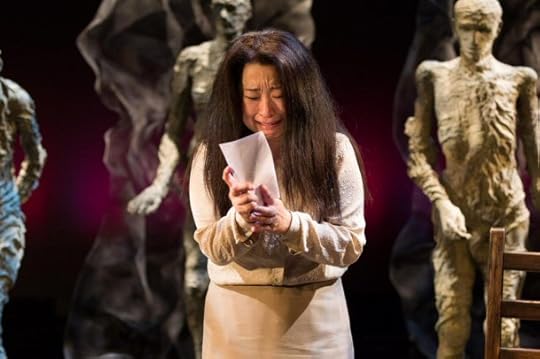
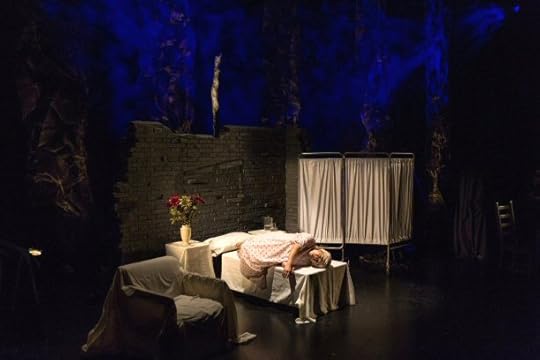
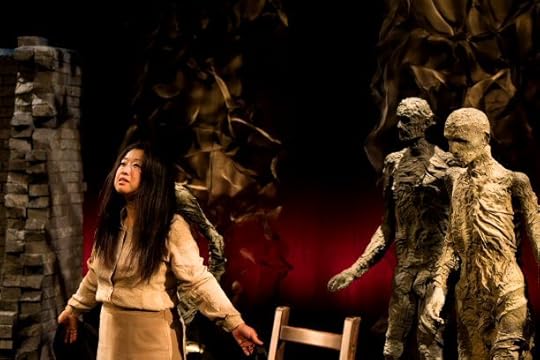
A PERSONAL NOTE: I obtained the book and originally wrote this review in 2013. The composer Michael Hersh, a colleague of mine at the Peabody Conservatory and a friend of the translator Adam Sorkin, had written a one-woman opera, On the Threshold of Winter, and invited me to stage it. The premiere took place at the Brooklyn Academy of Music on June 25, 2014, featuring the extraordinary singer Ah Young Hong. Rather than making a story out of Sorescu's poems, Hersh combined fragments of text into a collage that in turn inspired the harrowing psychic journey of his music, written with an intensity that eschews irony to magnify the pain. There have been other productions of the work since; the photos below are of mine.


Ah Young Hong in On the Threshold of Winter by Michael Hersch
Profile Image for Robert.
23 reviews42 followers
February 7, 2025
Ladder to Heaven

by Marin Sorescu. Translation by Constantin Roman.

A silken thread, spun by a spider
Hangs from the ceiling
Just above my bed.

Day by day I watch it descend.
And think, 'now heaven offers me ladder,
It reaches to me from above'.

Weakened though I be,
A shadow of my former self,
I think the ladder might not
Support my weight.

Listen, my soul, on you go ahead,
Softly, softly.


Note:
“Scara La Cer” was the last poem written by
Marin Sorescu before he died in 1996
Displaying 1 - 2 of 2 reviews

Can't find what you're looking for?

Get help and learn more about the design.