Те превърнаха Флоренция в световно средище на власт и донесоха на човечеството светлината на Италианския ренесанс. След това загубиха всичко. Медичите са банкерска фамилия с несметно богатство, огромна власт и гореща кръв, невиждани в историята. Покровители на неизвестни за времето си художници и учени като Леонардо да Винчи, Микеланджело, Ботичели и Галилей, в продължение на повече от три столетия влияят на държавници, творци, висши църковни сановници. Ала остават в паметта на света и с безмерно задоволяване на прищевки и сексуални щения, които в крайна сметка довеждат до самоунищожението на забележителната династия.
Автор на над двайсет и пет истории и биографии, "бисер сред биографите" според определението на списание Ню Стейтсман, англичанинът Кристофър Хибърт се заравя в изключително пъстрия живот на лукавия Козимо ІІ Стари, на всестранно надарения Лоренцо, на злочестия Джулио и на мнозина други. За да предсъздаде завладяващата история на рода, чиято слава ще се носи дълго след като последната им издънка е изчезнала завинаги.
Christopher Hibbert, MC, FRSL, FRGS (5 March 1924 - 21 December 2008) was an English writer, historian and biographer.
He was a Fellow of the Royal Society of Literature and the author of many books, including Disraeli, Edward VII, George IV, The Rise and Fall of the House of Medici, and Cavaliers and Roundheads.
Described by Professor Sir John Plumb as "a writer of the highest ability and in the New Statesman as "a pearl of biographers," he established himself as a leading popular historian/biographer whose works reflected meticulous scholarship.
This has been a highly enjoyable read. Hibbert has written this book with great clarity and with more fluency and less dryness than I remembered in his George III: A Personal History. I have also enjoyed learning a fair amount about a family with whose name one is greatly familiar but about whom one really knows very little. That is the problem with fame. The glitz precludes us seeing its source.
The Medici were formidable, but as so often happens with these powerful clans, the source of excellence had already disappeared by the time all its splendour shone in its full marvel.
This family appears clearly on the map in the second half of the 14thC, that is, after the Black Death, when society was beginning anew. Giovanni di Bicci de Medici set the ground; he established a bank at the right time. And he knew how to make the suitable investments. His most successful was to bet on the Popes and their return--after that messy Avignon split-- to unquestionable power in Rome. He thereby acquired a long lasting and weighty customer. The Papacy was the best of customers: they always came back for more funds and they opened doors to other businesses. Giovanni also began the “global” expansion and opened up branches in most trading cities in the Europe of the time. The busy ports of Flanders were the main objective, but smaller units were also set up in smaller towns such as London. Cloth and wool, and later silk, were the major goods dispatched around thanks to the Medici Letters of Credit. Which each “giro” of textiles, their financing capital increased.
But the real source of excellence was Giovanni’s son, Cosimo “without a number”. He was the first Cosimo but not Cosimo The First. An astute man who, without officially holding any political power, governed the politics of that prosperous Florence. He was not just astute; he was also wise. He knew how to wield his influence without people noticing it and how to accumulate wealth without inviting envy. He was also highly cultured. He began the patronage of major painters, artists, writers, philosophers, etc. He supported personalities of the calibre of Donatello, Gozzoli, Fra Angelico, as well as Marsilio Ficino. For example, he sponsored the first translation into Latin of Plato’s works.
But may be it is impossible to exterminate all the buds of envy and Cosimo could not avoid being hated by the rival Albizzi clan. He lost the battle and had to leave on exile. But Cosimo was astute not for nothing, and soon came back and won the Albizzi war. This clash was also the first of very many that would plague the Medici clan.
The next star was his grandson, the notorious Lorenzo il Magnifico. But with him that quality of excellence begins to darken. If to posterity he seems the most prominent of his lineage that is because violence offers sensational stories, and the Pazzi conspiracy is certainly one of them. But in reality Lorenzo was less magnificent because he was not as good a manager as his grandfather, and he was also somewhat less wise. He neglected their source of strength--finance, and paid too much attention to what only brought them trouble--politics. He may have not noticed either that Florence itself began its decay. As a continuing excellent patron of the arts and humanistic circles, his troubles have long since been forgotten and his stunning legacy is still with us. The second generation of geniuses, Botticelli, Leonardo, Michelangelo and Pico della Mirandola were backed by him.
Lorenzo died on the fatidic year on which the trade routes in Europe began to change radically, on 1492. Unaware of what had fundamentally changed, he Medici family entered the 16th century with the inertia of its splendour.
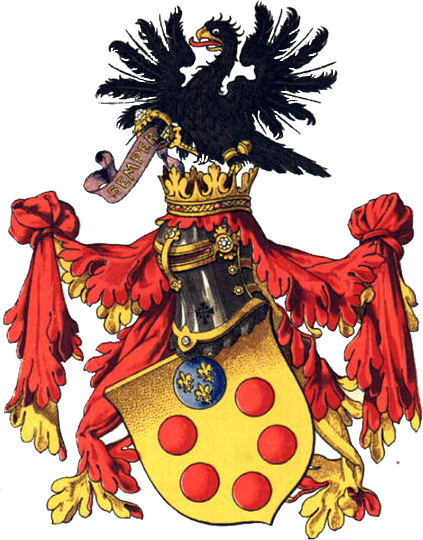
If Cosimo’s arms had been:
It is with his descendant Cosimo the First (really the second) that they acquire the extra paraphernalia and become this:
For the position of manager of a bank had transformed into that of Grand Duke. The logo had to change.
The enigmatic Grand Duke Cosimo, who descended from the two branches of the Medici family, moved with the top society of Europe. He negotiated directly with the Emperor, not loans, but political allegiances. After all, it was Charles V who placed his family back on Florence after he sacked Rome to show the Pope that he could not side with the irritating France. But even if now the Grand Duke belonged to the reduced circle of the European princes, he began to be one of several, and not the most powerful one. He had become dependent on others, while his ancestor Cosimo had the others dependent on him.
And although Hibbert does not expand on this, something similar had happened to Cosimo’s city, Florence. With the blocking of the Eastern Mediterranean by the Ottomans, the opening of alternative trade routes, Florence (and Venice) stopped being at the centre of money flows and began to pave the way to their future as centres of leisurely travel.
Nonetheless, even if the Medici had gradually lost the financial edge that brought them their prosperity, their expansion and extended and aggrandized prestige allowed them to have four of them elected as Popes and two of their women chosen as the wives, and Queens, by the Kings of France.
Medici blood runs through the veins of most of the European monarchs and Florence can forever feel proud to have housed such a family. The last Medici, Anna Maria Luisa, on her death in 1743 had bequeathed all the Medici treasures to the city of Florence for the pleasure and benefit of the whole world.
Chosen for 3 reasons. First of all, I am fascinated by this period in Italian history. Secondly, I was bought this book as a Christmas present and lastly, I wanted to add a ninth genre. For those who haven’t watched the series of the Medici dynasty or read a book from this period, I would highly recommend that you combine. I feel one embellishes the other unless of course it is a history book you are after.
The House of Medici, chronicles the life, rise and fall of the De Medici dynasty from the early 15 century through the renaissance and the prominence of Florence on the European and world stage. A family heritage deeply rooted in banking, Finance and Commerce, are elevated to become a prominent family in Italian politics. The story is interwoven with the greatest renaissance artists Leonardo DaVinci, Donatello, Michelangelo who were nurtured and championed by Lorenzo De Medici earning him the title of patron of arts and Godfather of the renaissance. As history has it, the powerful dynasty falls, is strengthen and weakened through the years and with the appointment of two Popes their fate cannot be reversed.
The most interesting parts of this legacy involves the battle between the D'Medici family and the De'Pazzi and Rome. Lorenzo wins the battle of dynasties and survives a Pazzi conspiracy led by Jacopo de'Pazzi largely because of the connection and relationship he has with the people of Florence. He is noted for his sense of fair play, his protection of his people and has highly regarded principles. Nevertheless Lorenzo's punishment of the Pazzi family and its supporters (including an archbishop) for having killed his brother and for the attempted murder on his life, earned him the wrath of the Holy See and so Florence was put under interdict, but with little effect.
What evolves is a man shaped by others and the events around him and in a bid to remain the leading force in Florence, he shows himself to be corrupt and ruthless to gain and retain political power and dominance. There is also a wonderful power struggle between the Medici dynasty and the papal see, for even in those times, the clergy preached against the creation of art as a sin against God. At the time of his death, we see the man in all his splendour, and taking back the order to kill an arch-rival that could have secured his dynasty. Instead, Florence descended into chaos for 6 years, but the dynasty lasted for centuries, creating two De Medici Popes and Catherine de Medici from France.
Compared to the other books I have read of the period, this book seems to focus more on the people, the artists of the period and their artwork and is a bit lighter on the historical context, the events, battles and conspiracies that were rife at the time. I imagine history students would believe this edition does not provide enough substance.
However, what I would offer in defence of this particular version and historical chronology is that it would make a great travel companion, for history lovers, if you are travelling to Florence because of its detailing of the history of Florence and the Medici dynasty, the artworks and the people that created this dominant force in Europe.
I'm somewhat torn about this book. The writing is well done and the subject matter, the Medici, SHOULD be interesting. But the author seems to focus on the more trivial details of this family's life and times. So much detail goes in to describing what the Medici liked to eat, what they liked to wear, what they did for fun, it sometimes seems like this is the special Medici issue of USWeekly. The title of the book would seem indicate the focus of the book is HOW the Medici came to power and HOW they eventually lost it, but these subjects are treated almost as secondary. A typical passage in the book is a sentence like "Cosimo de Medici became wealthy through his business acumen and hard-working nature.", followed by a paragraph on the pageant he threw to celebrate St. Laughably Obscure Day. Some people, I'm sure, would find the art history, culinary details, and wardrobe descriptions interesting, but I didn't buy this book for that. I bought the book to find out why the Medici, rather than any other Florentine family, rose to dominate the city for so long, and why they eventually lost their grip on power. A more accurate title for this book might be "The Medici: Their Lives and Times" or "The Medici: A Cultural History". Maybe there's just not a lot of information available on how the Medici rose to economic prominence, but in that case don't subtitle your book 'Its Rise and Fall'.
In 2019 I was able to wander around Florence. Florence's undeniable Medici influence is on display everywhere. From the architecture of the prominent buildings, to the art that adorns their interiors and exteriors, it even includes their influence on government. Christopher Hibbert's superb history of the Medici family is one that I wished I'd read before going to Florence, as my appreciation for what I was seeing would have been deeper.
"A Florentine who is not a merchant...enjoys no esteem whatsoever.."
With these words, we start the tale of Florence. Hibbert explains the socio-economic factors that produced this remarkable city. A city of merchants and bankers with a rich history of republican thought and government. Into this mixture in 1296 the Medici family appears. It is interesting that both versions of the Medici emblem are explained, with it representing the dents on Averardo's shield during his service under Charlamange (this is certainly the Medici propaganda version), as well as the explanation more historically likely- the coat of arms displays three red balls which could be pills or cups, signifying the importance of their last name having to do with the medical practice.
By the 1370s the Medici family had a reputation for populist politics, something that Giovanni di Bicci de' Medici was anxious to dispel. Giovanni would be instrumental in helping Florence to increase its wealth significantly by taking over the port of Pisa, as well as the city itself. Giovanni was also the one who owned two wool-making shops and then branched off into banking. In time, he would become Pope John XXIII's banker.
His son is the famous Cosimo, who was born in 1389, who lived during the inter-familial conflicts endemic to the Italian city-states. The famous Albizzi-Medici conflict occurs during this time. From this point on the book is a treasure trove of information about the various Medicis. From the great and mighty like Cosimo or Lorenzo the Magnificent, to the dregs of the family that appear near the end.
Engaging to read, full of information, and a very enriching experience for anyone with a desire to learn about the Medici family, but also for anyone who wishes to travel to Florence (IMHO you ought to once-it's a truly beautiful place and one of my personal favorite world cities). From the beautiful descriptions, the city will come alive during different time periods. But, for me, the most wonderful part was detailed Notes on the Buildings and the Art found in the back. As someone who loves to wander around cities, this is a great resource. A great deal of information about how the major buildings came into being and it also points out buildings that could be missed but have huge historical significance. I loved it!
Hibbert's history of the Medici is excellent. I shall have to find a hardcover version of this to place in my library and take the paperback with me next time I find myself in Florence. Highly recommended.
Gossipy, broad overview of Italian history. Not much political analysis but a lot of description and colorful anecdotes. It's a good introduction. I'll look at more narrowly-focused histories to learn about areas that interested me.
Read through page 120. I tried! Mostly because I am interested in reading more social history about Italy, and which is hard to come by, and group biographies can be a good way to get it. Unfortunately, this book is just all the same stuff I’ve come to expect from British Empire-educated, white male historians.
It’s dull: endless names of everyone the principals were associated with, all the artists they patronized, festivals celebrated, streets walked down, etc., etc. I am sure this is more entertaining for those personally familiar with Florence as exact locations and routes are constantly specified.
It’s highly traditional: all “official” history, textbook-type stuff about politics and battles and artworks and names, names, names, names.
It’s enamored of power and utterly uncritical of it: after 60 pages all about Cosimo de’ Medici, for instance, we get all the bad stuff he did summarized in a single tidy paragraph focused on his end-of-life confession:
“There were those he had wronged, he well knew. Had he been more lenient, more forebearing he could never have won for himself so much power and wealth. He had never thought it prudent to pardon or allow back to Florence those rivals whom the Signoria had banished in 1434; he had not hesitated to ruin families or businesses that had appeared to threaten his own; he had always been careful to ensure that his own family’s friends were given profitable or honorable appointments which the Medici’s opponents were rigorously denied. Yet to the Florentines as a whole, to those fellow citizens who had due cause to feel grateful for all he had done for them and for their city, he died revered and sincerely lamented, honoured for his generosity, his political acumen and the wide range of his many accomplishments. As his friend, Vespasiano da Bisticci, wrote of him, his knowledge, taste and versatility were truly remarkable.”
(Maybe some of the preceding 60 pages should’ve focused on that stuff sandwiched in the middle there? But no, blink and you’ll miss his entire lifelong Machiavellian modus operandi.)
It's entirely about (powerful) men, with an amused, contemptuous unconcern about everyone else: see the offhand remarks about each of the Medici men buying a teenaged Circassian girl for a sex slave when he comes of age (in another very brief aside, we learn their bank regularly traded in slaves), or passages like this about a Medici friend:
“The only person of whom he himself appeared to be in awe was his termagant of a mistress whom he had taken over from one of his five brothers, much to the annoyance of the rest of the family. One day two of these brothers, enraged by the girl’s brash ill-temper, bundled her out of the house and gave her a good thrashing. Niccolo, to whose sensitive ears even the ‘squeaking of a trapped mouse’ was intolerable, burst into tears at her screams.”
I don’t even have time to start unpacking that one. Back to the library and good riddance.
Ever gone into a second-hand bookshop? Have you glanced over the shelves of books, dusty and overlooked, their authors fading into forgetting? Writing a book is a tilt against futility, a challenge to eternity and entropy – but the shelves of second-hand bookshops tell us that almost all such challenges end in failure. Run your finger along the spines, reading off the names of the authors. Have you heard of any of them?
Unless it’s the inevitable row of Dickens, then probably not. They are being forgotten, consigned to oblivion as the graves in a cemetery slowly disappear under ivy as the rain wears the names from the headstones.
Christopher Hibbert, the author of The Rise and Fall of the House of Medici, was one of the best-known writers of popular history in the 1970s and ’80s (he died in 2008). But, having taken this book off a shelf where it was slowly gathering dust, and having read it, I hope that the veil of oblivion will draw back from Hibbert’s work for a while, for this is an excellent book, with all the virtues of the best popular history – verve, narrative drive, vivid characters – and very few of the drawbacks. It deserves to be read, rather than forgotten. So if you’re at all interested in the history of the Renaissance, and the plots, intrigues and assassinations that drove it on, then this is a book for you. Fight back against entropy and decay: take the book off the shelf.
I have been meaning to read about the Medicis for a while and while Hibbert's work is considered outdated by many today, it still felt like it would be the most comprehensive introduction to this family and this period of Florentine history. I was not wrong. I enjoyed the book and got to know the basics, and can now decide what else I want to read in a more knowledgeable manner.
The early Medicis were the most interesting. Cosimo, Piero, and Lorenzo take up most of the pages, which is understandable because these men ruled over Florence in its heyday. In my opinion, Lorenzo killed both the Medici influence and the beauty of Florence by bringing Savonarola, which resulted in the downfall of both. But after Lorenzo, my interest waned. Medici after Medici came and went and they were all kind of useless and boring. Florence never reached such heights again. The author describes not just the politics of the day but also adds several descriptions of daily life that I found invaluable in understanding the times in its entirety.
Four Medici Popes were elected, all of them proving to be ineffectual and unpopular. But it was interesting to read since the Medici involvement shaped European history in different ways. The latter Medicis were utterly uninteresting in many ways, until the line died out in 1737 with Gian Gastone de' Medici.
The writing was lively, and Hibbert managed to bring Renaissance Florence to life. It's a light book but covers a great deal within 400 or so pages. I would highly recommend this as an introduction to Florence and / or the Medici family. It's also a great book to read in preparation for a trip to Florence. Recommended.
This was an ideal companion to Tim Parks’ Medici Money: Parks is good at explaining the workings of fifteenth century banking, but Hibbert is better at bringing the people to life. His approach is traditional: the biographies of the powerful, the concerns of those who have the say and little concern for lesser mortals. It’s lively and readable, takes the story right through to the Grand Dukes of the seventeenth century and is excellent on the shifting of loyalties and European coalitions. There are footnotes that indicate where the numerous works of art commissioned by the Medicis can be found, but the relationship between Medici wealth and art is not the main focus of this work. But extremely useful as preparation for any time spent in Florence.
Ahoy there mateys! So ever since I had to do a project on Catherine de Medici back in me school days, I have had a fascination with the Medici family. This book is an in depth look at this Florentine family beginning with Cosimo de Medici in the 1430s and ending with the death of Medici family line in 1737. The Medici family was influential in art, politics, and especially economics. This book takes a look at all the main players in Florence. It does not get into the Medici members, like Catherine, who lived their lives outside of the Florentine sphere of influence. I absolutely loved reading about the escapades of this wily clan. Of particular interest to me were the discussions of the Medici’s patronage of the arts. I studied many of those great works in me art history classes and I loved getting a different perspective on things. I would certainly listen to this audiobook again.
This wasn’t a terrible popular history but, it dodged interpretation and sought to exhibit the grisly and garish. I continue to be fascinated by Leo X.
Synopsis: Florentine brand excels at corrupting democracy and enhancing a corresponding aesthetic. Credit is solid, unlike plague and crop failures. Diversifying the mission leads to church appointments by the score and a few popes to boot. The history of the family is an unsightly affair: murder plots, torture and unchecked hedonism. The legacy of such undermines our institutions, sowing considerable doubt about meritocracy and due process.
The house of Medici rose from a rich merchant family to becoming Grand Duke of Tuscany, producing four Popes and two queens of France along the way. But the real draw (for me at least) is their patronage of art and artists, leaving us a wonderful legacy. Read Michelangelo's fictionalized biography "The agony and ecstasy", you can't escape the impression that Lorenzo the magnificent (il magnifico) helped make Michelangelo one of the greatest artists that he was.
Back in the 15th century, Florence prized itself for its republican government: At that time Naples was a kingdom, Milan a dukedom. The city has 7 major and 14 minor guilds. Government is formed by randomly choosing names from leather bags (known as borse) with some additional rules. The chosen citizens would serve a 2-month term as the Signoria, one of whom would be the standard-bearer (Gonfalniere). They were paid a modest salary but enjoys the service of a large staff, including a Buffone (lucky them!). And rich merchants did not proposer without taking a share in the government. So Giovanni de' Medici served in the Signoria in 1402. His interest was banking though he also belongs to the Guild of wool, silk, and cloth. The Florentine gold coin (florin) somehow gained universal confidence and was in use throughout Europe. This helped the Medici banking business prosper. Giovanni is very discreet and urged his two sons to follow his example as he lay dying: be inoffensive to the rich and strong. One of the sons, Cosimo, would later repeat the same advice to his own sons.
Born in 1389, Cosimo (the elder, grandfather of il magnifico) developed deep respect for classical learning and classical ideals. He is a highly cultured and knowledgeable man. He married the daughter of his father's partners in Rome branch. The dowry included a family palace. By hinting the Florentine army could not win the unnecessary war with Milan, Cosimo made himself an enemy of the ruling oligarchy the Albizzi family. Rumors were spread about his attempt to overthrow the government. He was even arrested in 1433 and on the verge of being executed. Bribes were made and Cosimo was banished to Padua for the next 10 years. A year later, after defeat from Milan, Albizzi became unpopular and ousted from power. Cosimo was welcome back like a hero. He was clever enough to know that to rule successfully, he needs to appear scarcely to rule at all. So he drives to work in his beat-up volkswagen (aka. mule), allowing a talkative flamboyant man to appear to be the most powerful. But a few years later, he was firmly rooted and became the undisputed patriarch of Florence. He persuaded the pope to move the general council to Florence; started a Platonic Academy; make marvelous additions to his library which is open to friends who wish to study there; lavished money on adorning Florence. He grew deeply attached to Donatello and assumed a kind of paternal responsibility. Meanwhile, he knows the humor of the city: "Before 50 years we shall be expelled, but my buildings will remain." He also terminated what he saw as unwarranted hostility towards Milan and eventually made it an ally. When he die, Cosimo was sincerely revered and honored for his generosity. The Signoria passed a decree conferring him the title "Pater Patriae", a title once accorded to Cicero. Cosimo had two sons. One of them refused to diet and died of a heart attack before Cosimo. The other, Piero the Gouty, didn't have good health either and lasted just a few years more. But he continued his father's tradition of munificence.
Lorenzo (il magnifico) had a naturally joyful nature and brought a marvelously infectious zest to everything he does. He's also renowned for his kindness and consideration. He has a rare gift for friendship and a deep love of animals. He generally feeds his own horse. Every time the power passes down to a new generation, the family's old enemy tried a coup. Every time they failed. They label him as a tyrant and to quote a Florentine historian "If Florence was to have a tyrant, she could never have found a better or more delightful one". Lorenzo is good to be sure. Case in point, mercenaries under Florentine pay were sent to Volterra to put down a revolt. They also ransacked the streets. Upon hearing this, Lorenzo rode over immediately to Volterra to reassure the people that his fellow citizens in Florence profoundly regretted the outrage and he distributed money to those affected. His regret was sincere and in Volterra these things are not forgotten even to this day. He asked Ghirlandaio for recommendation of promising pupils. Michelangelo was among the list of names. Following his family tradition, he treated Michelangelo like one of his own sons. Far less rich than his father or grandfather, Lorenzo didn't commission many works. But he went out of his way to ensure Botticelli was well supplied with orders from other Florentine patrons. He helped Pisa reviving its university and contributed handsomely to University of Florence. But things weren't always good for Lorenzo. A new Pope was not friendly with the family and supported a change of ruler. A rival family's conspiracy to overthrow Medici tried to assassinate him and his brother Giuliano and managed to kill Giuliano. When the plotters were killed by Florentines, the Pope was furious. He sequestrated Medici bank and other properties, excommunicated Lorenzo, and declared war on Florence. The King of Naples followed suite. Florence had no allies to speak of (after the friendly Milan Duke Sfroza was murdered, and the French king only wrote a letter of sympathy). Well aware that Florence can not survive the campaign, he left the city to the Signoria and presented himself to the Naples court. Before he left, he wrote a letter to the city saying that it is he that the enemy wanted. By going there he may contribute to the welfare of the city. Not a single member of the Signoria was able to restrain his tears. He was 29. Lorenzo is quite clever and not as foolhardy as it might appear. He actually had secret communication with Naples for a while, trying to convince them that having an ally in him is in Naples's interest. So after 10 weeks in Naples, a peace treaty was signed. But sadly, Lorenzo died in his 40s. And the good part of the Medici's influence ended too. What followed was a series of mostly self-centered or unremarkable Mediceans. But there is still quite some drama.
Lorenzo's first son, Piero, is a far less admirable than his father. This permitted Savonarola to increasing his attack of the regime. All the while, the French king Charles was claiming the crown of Naples when its king died. He organized a 30 thousand strong army to attack Italy and wanted to pass through Tuscany. Piero resisted to no avail and agreed to flee the city. Savonarola begged for mercy from Charles who agreed to leniency. A new government was formed and Savonarola was now the one with real power. In the subsequent war between Charles and papal mercenaries, Savonarola didn't do a thing to help the Pope. Long story short, this contributed to his eventual downfall and he was burned at the stake for heresy. Meanwhile Piero drowned and the head of Medici family passes on to Cardinal Giovanni (2nd son of Lorenzo the magnificent, who had decided Giovanni should pursue an ecclesiastic career and got his son a cardinal at a young age). For the next few years after the death of Savonarola, Florence's importance was gone. It also failed to regain the vitality of the golden age under Lorenzo. To strengthen the government, they elected a Gonfaloniere for life. Although hardworking and honest, Soderini, the new head of government is less famous than a minor official who he consulted frequently: Niccolo Machiavelli. Later, Medici supporter won the day; Soderini resigned in 1512; and Machiavelli returned home to write "The Prince". Not long after, Giovanni was elected Pope and became known as Leo X. He said "God gave us the papacy, let's enjoy it". He envisioned central Italy to be united into a powerful state under Medici control. He made his nephew (Lorenzo) first the Captain General of the Florentine Republic, then Duke of Urbino. He spent lavishly, dining on rare delicacies such as peacock's tongue. Leo did lavish money on improving Rome, though he didn't get along well with the abrasive Michelangelo, preferring the polite Raffaello Sanzio instead. Pope Leo died in 1521. His younger brother Cardinal Giulio became the next Pope (Clement VII). Pope Clement did patronize art well including setting up an apartment for Da Vinci and commissioning Michelangelo to build a family library back in Florence. But ultimately, he's considered to have developed from "a great and respected cardinal into a small and little respected Pope".
Later on, Florence becomes a duchy and then a grand duchy (of Tuscany, in 1569). Under Grand Duke Cosimo I, all government offices as well as major guilds were gathered under one roof near Palazzo Vecchio. This new office (uffizi) later became the wonderful museum, but that is all thanks to the last Medici: Anna Maria. By the time of her death, Florence is only an appendage of the Austrian empire. She donated all Medici possessions on the condition that they should not leave Florence and always be available for the pleasure and benefit of the people of the whole world.
In the interest of full disclosure, I admit that I probably wouldn't have read this book at all if it weren't for a video game. I'm a big fan of the Assassin's Creed series, and the second game introduced me to the Medici and features both the Pazzi conspiracy and Savonarola's bonfires of vanities as major plot points. In some ways, this was actually helpful, at least for part of the book. Running over the rooftops of Florence helped me visualize the world of Cosimo and Lorenzo Medici better than I would have otherwise. But once Cosimo and Lorenzo have been left behind, I'm probably on the same footing as most other readers: interested in the history, but with little to no background.
I think that this would be a slightly more satisfying experience if it hadn't been a complete overview of the Medici family. Trying to cram nearly 300 years of a powerful family's history into roughly 280 pages is a tall order. The result is a series of very brief biographies of very powerful people. This could have gotten very dry, very easily. Luckily, Hibbert's writing is engaging, and his subjects are even more so. It would take a very dry writer indeed to make the Medici, or Renaissance Italy in general, boring, and Hibbert is anything but.
I'm sure there are plenty of other books on the Medici family that are far more in depth than this one. But this was a great introduction to the time period, and will give me a slightly different perspective when I play Assassin's Creed II again.
Christopher Hibbert’s book The House of Medici: It’s Rise and Fall is a thoroughly researched and documented work on the members of the Medici family who controlled Florence, Italy for many years and influenced the power structure not only in the various Italian city states but also in the Vatican and Europe.
The first part of the book is a bit difficult to wade through even with all the helpful footnotes. My lack of familiarity with Italian history and geography made it so. But keep reading and you will be rewarded with the history of political scheming and battles for power.
One of the most surprising things I learned in this book was about the corrupt lives of many of the popes and cardinals who served the Roman Catholic Church. Hibbert describes many selfish and debauched men who held these offices. Not at all what I imagined.
The Medici family also contained a pope (Leo X) and several cardinals over the years who were also not the spiritual scholars I imagined. Many of the Medici ate, drank, to excess and enjoyed sexual exploits with men or women outside of the bonds of marriage. However, it’s due to the Medici that many wonderful buildings and masterpieces of art were created. The family supported charities, collected books for their libraries, and kept great artists employed.
For all their faults, the Medici did much to preserve works of art and scholarship that we enjoy today.
Hibbert’s prose and sense of style bring the personalities of these long dead men and women to life, and the book is well worth reading.
Having recently spent a little time in Florence I delved into more than a few Florentine histories and Hibbert was one of the best. Very well-written, and often funny, Hibbert also delineates his subject in great detail.
I've always been intrigued by the Medici family primarily due to their large role as patrons of the arts in the Renaissance Era. Also, being such a wealthy and powerful family they played many roles throughout that whole range of history. I finally picked up this book, which had been on my shelf for a while, in preparation for my upcoming trip to Italy. It was a great book to get a grasp on the chronological history of the entire Medici family. I was pleased to see this non-fiction book was not a difficult, dry, or heavy read.
It never fails to amaze me how many amazing artists lived in the same period of time. A particular highlight for me was the role of Popes in society. With religion being the "politics" of that time, it is not surprising to discover that Popes were more like politicians than religious leaders. They blatant adventures outside the religious spectrum failed to either surprise people or cause any rebellion it seems.
I don't fault the writer, but after Savonarola, life for the Medici was pretty off and on in Florence. The remarkable drive of Cosimo and Lorenzo is so appealing, but after them, things got more and more chaotic. Such is the nature of human endeavors it seems to me. A garden is planted, slowly grows, gains strength, flowers and finally as it dies back becomes overwhelmed with weeds. Occasionally it flowers again, and again, but nothing flowers forever. Fortunately, the fruit of those flowers bear new seeds and so did the efforts of this remarkable family. Granted, they were ruthless when crossed, but also so willing to support the work of bringing new and ancient ideas to life again. I thank the author of this book for telling their story.
I’m only on chapter 5 and I’m already so confused. The author talks about various people, starting chapters 1 and 5 about Cosimo de’ Medici, whole chapters 2-4 didn’t really have anything to do with him, and mostly talked about the state of female slavery.
I’ve been interested in this topic for a while, but this book was dry, confusing and boring. Which should be quite hard to achieve, all things considered about the Medici.
A really good introduction to understanding Florence and its long relationship (Love/hate/love/hate/love) with the Medici Dynasty. A real fascinating look into their life and how they gave Florence a name for art and culture and philosophy. I do feel that I need to read a bit more into this family. Cannot get enough of them.
This was interesting and enjoyable in the first half and felt like work to get through in the second, but I guess that’s a reflection of the family itself through the generations. I read this in prep for my Italy trip, like I did with A History of Venice (admittedly a more satisfying read than this). 2.5/5. I wish the author went into more detail with certain related historical figures mentioned in the synopsis, like da Vinci because once the Médicis were restored to power as Dukes, this became a snooze fest and I could no longer keep track of the generations.
I read some other reviews that articulated this better, but this book is so obsessed with the trivial aspects of the lives of the Médicis. Of course, there is wonderful detail on art history and the projects patronized by the family, but the rest of the book gives so little time to historical context and the actual reasoning behind the family’s “rise and fall.” They got rich initially from banking, yes, but that’s basically the extent to which the matter is covered.
This was a fine read and honestly I’m relieved it wasn’t too long so as to start really dragging, but at the same time I would not have minded an extra 100 or so pages if the author went into more detail with the things I was most interested in.
I guess read this is you’re very curious about the Médicis. In spite of my complaints, it’ll be a good piece of context for my time in Florence.
I made it through 200 pages in almost two months and now I'm just giving up tbh (which is something I almost never do). This was probably the most mindnumbingly boring book I've ever attempted to read. It read like a text book; actually, no, scratch that, I've read textbooks that were more fascinating than this. It takes a special kind of talent to make a tale about politics and murder and scandal so incredibly boring so ... good job I suppose. Just ... stay away from this book, read the wikipedia page on the Medici family, I guarantee you it's more interesting.
~3,5 Sterne, wenn das möglich wäre. Teil 1 (von 4) fand ich ziemlich anstrengend und ich habe im schieren Chaos und Überfluss von historischen italienischen Namen so gar kein Land gesehen. Teile 2 bis 4 fand ich dann sehr unterhaltsam, wenn auch zugegeben auf eine gewisse voyeuristisch, morbide Art. Die Art und Weise, wie in den beschriebenen geschichtlichen Zeiträumen Intrigen gesponnen wurden, eine Exzentrik ausgelebt wurde, rumgehurt worden ist, Leute ermordet wurden, Macht erschlichen und wieder verloren wurde, Kriege geführt, die Kirche in den alltäglichen Machtkämpfen verstrickt war und in den beschriebenen Kreisen in völligem Überfluss gelebt wurde, lässt Game of Thrones wie eine Kinderbuchreihe dagegen aussehen. Nur, dass es hier alles reale Geschichte ist. Der Autor schildert das mit einigen sprachlichen Spitzen durchaus unterhaltsam, nicht ganz ohne eine Prise angenehmer Ironie und unterstreicht an anderer Stelle die schiere Absurdität der Brutalität durch eine besonders nüchterne Schilderung der Dinge. Für mich persönlich war es einfach aufgrund der schieren Masse an Personen und Namen schwierig irgendwas dauerhaftes aus dem Buch mitzunehmen. Insgesamt aber eine ganz schöne Grundlage wenn man sich für die Medici interessiert (oder sich, wie ich, ein wenig auf eine anstehende Florenz Reise einstimmen möchte).
If the book had kept up the standard it had set for itself in the first half of the book, then I would without doubt have given three stars, maybe, four. However it felt as of Hibbert lost some of the drive and dedication that defined the first half.
the title is rather self explanatory, the Medici family is as (in)famous as the Borgias, the Sforza for Italian history are. these were the names that dominated the renaissance period Italy and through their machinations, their sponsorship and ambitions shaped this period of political volatility and cultural production. Christopher Hibbert starts off well enough, giving the context of Florence and the dynamics of the city socio economical/ political in which the Medici maneuvered. The two big names of the Medici Cosimo and Lorenzo are given the space needed with adequate attention to the structural and institutional rather then just recounting their lives.
Halass, after this the book declines sharply. The core issue is that while Lorenzo and Cosimo got 5 chapters the following half of the book still has 250 years of Medici to go. This naturally leads to a quicker pace and less space to talk, which led to Hibbert preferring to prioritize the social lives, quirks and personalities with side stories and anecdotes while glossing over the structural, the institutional. Now, anecdotes and the perosnal lives had been part of the Lorenzo and Cosimo chapters, but there had been a balance that lacks in the latter half. For example, Duke Cosimo the first (not to be confused with the earlier Cosimo) gets one chapter which is spent on his hobbies and less then admirable mercurial nature yet at the very end we get a paragraph that goes; "if an admirer were to speak approvingly of his promotion of the Pisa university and the studio fiorentiono, of his invitation to such gifted men as Benedetto Varchi, of his encouragement of Italian music, of scientists and botanists and of etruscean archaeology, of his improvement of florence herb gardens, his foundation of pisa school of botany, and introduction into tuscany of medicinal plants from america and of farm crops from the orient" .....; this is frustrating as hell!
I don't care about his eating habits or that he shouted at his wife!!! How did he do all this stuff? What does it mean that he introduced plants? How did he acquire them? How did he spread them? What was uncovered through his support for archaeology? the same goes for the next duke, Francesco Medici who spent most of his time in a personal alchemy lab and apparently discovered new ways to make pottery and synthetic jewelry but no, lets focus on the rumours he was a poisoner. I genuinly don't understand how you can write "he invented a new revolutionary method of making porcelain which enabled Tuscan potters to produce exquisite wares comparable to those imported from China" but don't delve deeper into this!! How?? did he force potters to try it? did he organize workshops?
There is nothing that frustrates me more then hints at interesting stuff that is glossed over as if it was an afterthought. Hibberts choice to reduce the latter half of his book to a day by day anecdotal life of each of the following medici while dismissing the economic, scientific and cultural achievements they sponsored as in effect minor details, is infuriating. This kind of historical writing is a waste of time and energy, yet this kind of stuff remains so popular with the wider audience. I guess if you want to read this kind of thing and are convinced that whole pages about hunting and family drama is the most interesting about the Medici, this would be fine. For me it wasn't.
I am one of those who came to this book having braved my way through all three seasons of the Netflix show. (An idle bid to improve my knowledge of Florence, a city to which I have not yet traveled.) While I quite enjoyed the series, not least the theme song, I give it extra points for nurturing my interest in this hypnotically repulsive and constantly fascinating Italian dynasty who rose from modest money-lenders to become one of the most powerful families in medieval Europe. Spanning the bones of four centuries, its cast are often mind-numbingly extravagant and devastatingly cruel but there are instances of genuinely moving philanthropy and kindness and tragedy thrown in. They produced four popes and oodles of cardinals, each one more corpulent and irreligious than the next, and despite the excellence of all that art and architecture in Florence, one finds oneself rather rooting for an Augustinian friar from Germany by name of Martin Luther. I had also never realised Henry VIII’s request for a divorce from Catherine of Aragon was so badly timed; the city of Rome had literally just been violently sacked, and the pope taken hostage by Catherine’s uncle. If Henry had put in his request a year earlier, where would the world be? Hibbert’s book is superbly written with just the right assortment of trivia nuggets and juicy asides to keep the saga rolling on, even if it starts to become inevitably repetitive in its final chapters. I’d have liked a few paragraphs about Caterina de’ Medici, Queen of France and arguably the wickedest mother-in-law in history. His family trees at the back are also invaluable.
I loved this book. Although it is a history book, it is far from a textbook. It gave names, politics and everything you’d need to understand the cultural context within the time of each Medici head.
I read this after watching the Medici series on Netflix. This family is so interesting to read about as they are the reason so many masterpieces were created in Florence and why it is a cultural center.
I thoroughly enjoyed reading this book and felt like I was traveling back in time. It not only describes the family but every important event surrounding them and Florence at the time. It was interesting to notice the involvement of foreign diplomats instead of solely Italian ones increase over the years. Also how the Medici, though not royal or one of the ancient noble families of Italy, were treated like kings.
The family that greeds together, stays together. The Medici were such an amazing clan, a group that did much to influence history. Though Italians, they also changed the culture of France, when Caterina de Medici became the Queen of France and brought Italian epicurean standards to the still-Gothic French.
If this family existed today, they would be all over the tabloids and probably have their own sitcom, but they were THE standard bearers for the Renaissance, so their successes and challenges changed history. It was hard to put this book down, due to the excellent biographies of each family member. The book is not overly long, thus making it a suitable companion for a weekend jaunt.