In the late 1800s, John Muir made several trips to the pristine, relatively unexplored territory of Alaska, irresistibly drawn to its awe-inspiring glaciers and its wild menagerie of bears, bald eagles, wolves, and whales. Half-poet and half-geologist, he recorded his experiences and reflections in Travels in Alaska, a work he was in the process of completing at the time of his death in 1914. As Edward Hoagland writes in his Introduction, “A century and a quarter later, we are reading [Muir’s] account because there in the glorious fiords . . . he is at our elbow, nudging us along, prompting us to understand that heaven is on earth—is the Earth—and rapture is the sensible response wherever a clear line of sight remains.”
This Modern Library Paperback Classic includes photographs from the original 1915 edition.
John Muir (1838 – 1914) was a Scottish-American naturalist, author, and early advocate of preservation of wilderness in the United States. His letters, essays, and books telling of his adventures in nature, especially in the Sierra Nevada mountains of California, have been read by millions. His activism helped to preserve the Yosemite Valley, Sequoia National Park and other wilderness areas. The Sierra Club, which he founded, is now one of the most important conservation organizations in the United States. One of the best-known hiking trails in the U.S., the 211-mile (340 km) John Muir Trail, was named in his honor. Other such places include Muir Woods National Monument, Muir Beach, John Muir College, Mount Muir, Camp Muir and Muir Glacier.
In his later life, Muir devoted most of his time to the preservation of the Western forests. He petitioned the U.S. Congress for the National Park bill that was passed in 1890, establishing Yosemite and Sequoia National Parks. The spiritual quality and enthusiasm toward nature expressed in his writings inspired readers, including presidents and congressmen, to take action to help preserve large nature areas. He is today referred to as the "Father of the National Parks" and the National Park Service has produced a short documentary about his life.
Muir's biographer, Steven J. Holmes, believes that Muir has become "one of the patron saints of twentieth-century American environmental activity," both political and recreational. As a result, his writings are commonly discussed in books and journals, and he is often quoted by nature photographers such as Ansel Adams. "Muir has profoundly shaped the very categories through which Americans understand and envision their relationships with the natural world," writes Holmes. Muir was noted for being an ecological thinker, political spokesman, and religious prophet, whose writings became a personal guide into nature for countless individuals, making his name "almost ubiquitous" in the modern environmental consciousness. According to author William Anderson, Muir exemplified "the archetype of our oneness with the earth".
Muir was extremely fond of Henry David Thoreau and was probably influenced more by him than even Ralph Waldo Emerson. Muir often referred to himself as a "disciple" of Thoreau. He was also heavily influenced by fellow naturalist John Burroughs.
During his lifetime John Muir published over 300 articles and 12 books. He co-founded the Sierra Club, which helped establish a number of national parks after he died and today has over 1.3 million members. Author Gretel Ehrlich states that as a "dreamer and activist, his eloquent words changed the way Americans saw their mountains, forests, seashores, and deserts." He not only led the efforts to protect forest areas and have some designated as national parks, but his writings gave readers a conception of the relationship between "human culture and wild nature as one of humility and respect for all life," writes author Thurman Wilkins.
His philosophy exalted wild nature over human culture and civilization. Turner describes him as "a man who in his singular way rediscovered America. . . . an American pioneer, an American hero." Wilkins adds that a primary aim of Muir’s nature philosophy was to challenge mankind’s "enormous conceit," and in so doing, he moved beyond the Transcendentalism of Emerson and Thoreau to a "biocentric perspective on the world."
In the months after his death, many who knew Muir closely wrote about his influences.
In my year of reading Canada and Alaska, nobody has written as eloquently about glaciers as John Muir. His reverence for the natural world and his fearlessness in exploring it shines through in Travels in Alaska, the book he was writing when he died in 1915. I spent some time comparing his photos to present day and some of his observed glaciers from the 1870s-1890s are only rivers now.
Considering the era it must be said that his descriptions of the native populations are at times somewhat horrifying. He travels with missionaries because they have preexisting relationships with the indigenous people and better trekking gear, but he makes some side comments about how he is spreading the gospel of glaciers. He also titles a chapter "Discovering Glacier Bay" which, I mean come on, he didn't discover it, he was led there by local guides. .
But this is a classic for a reason. I bought it in Alaska at an indie bookstore and that made my armchair return to that place even more special.
A little embarrassed to say this is the first of Muir's books I've read. After all, this is a man with plants, animals, mountains, a glacier, trails, a wilderness, and a forest named after him, is the founder of the Sierra Club, and a true original. He is part of, arguably the father of, an era when environmentalism was innocent love of nature.
To share his pure joy of being in the Alaskan bush is more than worth the effort of working through his archaic style. The anecdotes of what he experienced are an added bonus: "Then a box was brought from some corner and opened. It seemed to be full of tallow or butter. A sharp stick was thrust into it, and a lump of something five or six inches long, three or four wide, and an inch thick was dug up, which proved to be a section of the back fat of a deer, preserved in fish oil and seasoned with boiled spruce and other spicy roots...I was unable to taste it even for manners' sake." And: "While we were yet half a mile or more away, we heard sounds I had never before heard--a storm of strange howls, yells, and screams rising from a base of gasping, bellowing grunts and groans...Our guides quietly recognized this awful sound, if such stuff could be called sound, simply as the 'whiskey howl'...the whole village was afire with bad whiskey. This was the first time in my life that I learned the meaning of the phrase 'a howling drunk.'"
If you don't try taking this all at once, but dip into it occasionally, you'll enjoy discovering a sense of who John Muir was as well as his descriptions of the vast natural wonders of Alaska.
I thought I would completely enjoy this book, but I didn't.........at all. This was a little on the painful side to get through. Primarily, it dealt with what Alaska looks like which isn't the detail I enjoy reading. I grew up in Alaska, so I'm already well acquainted with what it looks like. I wanted something a little more personable and a little less factual.
Even today Alaska is one of the few unspoilt wildernesses in the world. This vast part of America still has glaciers, bears, eagles and wolves, and still has the capability of filling people with awe at the scenery. In the late nineteenth century, John Muir made a number of trips to Alaska. At this point the land was barely explored, and was relatively untouched. Travelling by boat to a variety of places to camp, from there he climbs high onto the pristine glaciers.
We read of his encounters with the locals as well, Indian clans who forged an existence from this harsh and unforgiving environment. They people welcomed him into their villages and as acted as guides on some of his more adventurous walks too.
The writing is lyrical and elegant, along with his descriptions of the scenery, the long fjords, the forests, the glaciers and the moraines are beautiful making this an enjoyable read. But in lots of ways this is a time capsule, taking us back to a time and a landscape that we are unlikely to see with the way that climate change is going.
John Muir is amazing. He's like a nature-based superhero. Hiking for days with no food other than a pocketful of grain? Fun! Falling into glacial crevasses? Sure! Fending off hypothermia by doing jumping jacks all night? Of course! Snow blindness? Bring it on! And he does it all with a smile and an eagerness to do it all again tomorrow.
Reading this book was delightful and exhausting. Muir's descriptions of the Alaskan scenery and surroundings were wonderful and exuberant. He used "Yosemitic" as an adjective to describe scenery he loved--and I loved him for doing it. His adventures would sound overwhelmingly stressful if told by anyone else, but he talks about them with joy and energy. He expresses some concern for his wellbeing at times, but is sustained by the love he feels for his majestic surroundings.
This book was a wonderful pick-me-up. It is more of a series of stories about his adventures, rather than one overarching narrative, so you could easily read it in parts and chunks and still feel his amazing energy and joy.
Extremely pompous and repetitive in the constant romanticization of nature. I guess I can forgive him because (1) Herzog wasn't born yet, and (2) he had already foreseen that humans were destroying the environment.
His adventures are cool though. There are some pretty great ones amidst the never ending descriptions. Like when he almost got buried under ice at night, and then a hour later stretched out on a boulder to watch the northern lights. One can almost see him. Such a fearless optimist. And his descriptions of water are very vivid, and beautiful. Plus this dude could start a fire in the ice.
But damn is he long-winded.
And sometimes disturbing in the way he describes the First People there. If one would speak like that today there’s no other word to describe that beside racist — but I’m always confused on how to read that in context of time. Plus in the next sentence Muir can talk about them with so much awe and admiration. It’s confusing.
I did learn some new words anyway.
Finally, I definitely agree with him that Alaska is incredibly beautiful.
So much Jesus (SO MUCH JESUS), condescension towards native Americans, and a constant reckless behavior that endangered himself and others which was rather annoying. Always saying that he's lucky/god will keep them safe' which was pretty annoying
Beautiful. I am so jealous Muir got to experience an almost untouched , raw, pure Alaska. And if not for the travel dates Muir wrote on each part I would not believe this was written in the late 1800s. It hurt to read about the Natives Muir encountered submissively praising the "white man" for being "smarter" and "better" and teaching them about God because the Natives "were too stupid to know him on their own". I'm glad Muir abstained from forcing christianity on them and respected and admired them.
Muir’s reverence for nature is 100% unquestioned as evidenced by the way he describes the landscapes, foliage, geological activity, etc. - coupled with his determination to not let anything stop him from exploring it and experiencing everything it has to offer.
The grit he had in enduring all forms of suffering for the chance of merely experiencing more of the landscape is really inspiring. He literally risked his life (frequently) crossing glacier crevasses, venturing into ice-packed bays and fjords in a flimsy canoe that even the Natives cautioned against - and becoming snow-blind on a multi-day venture onto a massive glacier. All of this for him to then only happily end each day - cold, wet and exhausted - having a cracker and maybe a cup of tea, falling asleep on a rock - only to then excitedly get up the next day and do it all over again.
I really appreciated the poetic language Muir used when describing the natural beauty around him - specifically in the way he often presents nature as sacred.
“…the word of God was being read in these majestic hieroglyphics blazoned along the sky. The earnest, childish wonderment with which this page of Nature’s Bible was contemplated was delightful to see.”
“Not a bush or tree was moving; every leaf seemed hushed in brooding repose. One bird, a thrush, embroidered the silence with cheery notes, making the solitude familiar and sweet, while the solemn monotone of the stream sifting through the woods seemed like the very voice of God, humanized, terrestrialized, and entering one’s heart as to a home prepared for it.”
“Still more impotent are words in telling the peculiar awe one experiences in entering these mansions of the icy North, notwithstanding it is only the natural effect of appreciable manifestations of the presence of God.”
“And here, too, one learns that the world, though made, is yet being made; that this is still the morning of creation; that mountains long conceived are now being born…and plains of other predestined landscapes, to be followed by still others in endless rhythm and beauty.”
I became aware of John Muir's extensive travels in Alaska while kayaking the Stikine River in 2008. I hadn't realized the founder of the Sierra Club had spent so much time in Southeast Alaska. When Ken Burn's 'National Parks' book/documentary came out last year, it further cemented my desire to dive into Muir's journals about his travels in Alaska. The coup di gras was reading 'The Only Kayak' by Kim Heacox. He further exposed me to Muir's writings that have inspired generations of intrepid adventurers. Heacox also exquisitely defined and represents the ethos that Muir inspired. I really had no choice but to head straight to Tidal Wave and get myself a copy of this book.
I'm glad I did. It isn't a book that you dive into and find yourself unable to put it down, but its definately inspiring. Muir's description of life around Fort Wrangell, and his canoe treks all around Southeast Alaska over a century ago is an incredible window into the history of where I grew up. His descriptions of the Tlingit way of life help me better understand the culture that surrounded my childhood, its deep roots in nature, and the transitions that culture made once exposed to explorers, traders, and missionaries from the outside world. Muir's infatuation and adoration of glaciers led to incredible treks, adventures, and discoveries as he lived out his passion. Its incredible to read his vivid descriptions of the very lands and glaciers that defined my childhood, and to realize how much the land has changed since then. It isn't only the death of an era as global warming consumes these giants as they wash into the sea. Rather, its a rebirth into new life as glaciers recede and new land rises up. Very very fascinating stuff!
In the end, reading his journals leaves me with a very deep appreciation for the geology that has shaped this gorgeous state, and a deeper appreciation for the culture that was here first. In a strange way, it also leaves me with a desire to fulfill my own passions. It might not involve tromping across miles of glaciers and ice slivers, millimeters away from glisading into an icy death with only a bit of tea and hard tack as sustenance. But it certainly calls me to live with more conviction and adventure about my own passions.
I've always been drawn to Alaska and spent 14 years following high school living there. Muir write beautifully of the landscape and Native Alaskans. My favorite chapter was that of his glacial adventure with Stickeen. Silly dog should have listened and stayed home but boy did he have a story to tell! For anyone who hasn't yet laid eyes on a glacier, put it on your list. While you don't have to go to Alaska to see glaciers, I highly recommend it!
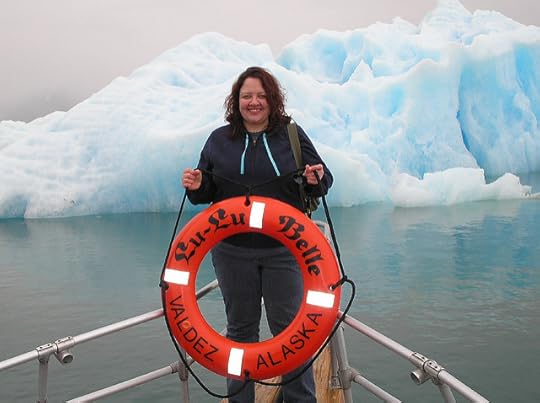
Me on a day cruise in Prince William Sound to Columbia Glacier circa 2006
Wow! This man could brave anything, I believe! Throughout this short book, Muir walked and hiked and climbed (in some of the worst weather) more terrain than most of us walk in our lives. Muir was preparing this book for publication from his journals when he died, so much of what is in the now-published version would surely have been edited by him had he lived longer. Unfortunately, there were long stretches of the writing that I found less than engaging, though his use of metaphor is well done.
thoroughly enjoyable, get a real sense of author's scientific curiosity, exploring the Alaskan glaciers and meeting indigenous people. interesting perspective on the interactions between commercial interests and church with local population, although Muir did see himself as separate and did give glimpses from indigenous perspective. mix of awe and scientific adventurousness in face of forces of nature
This book made me want to go to Alaska 100x more than before. Also, I would love to follow in arm John Muir’s steps, but alas, I am not as brave as he is… I cannot believe he pressed on when I would have turned back in so many of his adventures! Still, reading this inspires me to commit even more so to nature and revel in her glory as he has.
John Muir was an interesting guy. I think that I would have liked knowing him. He was simple, good, knowledgeable and smart about his ideas for protecting our wilderness. So many books from this time and earlier are filled with horrible racism and disregard for indigenous people. Not Muir. He is respectful of all of the people he encounters and never seems to look down on any of them.
Muir took crazy treks deep into the wilderness with minimal gear. In all of his books he has close calls with serious injury or death. He was so good at wilderness survival that he always managed to come through, but I can't help thinking that he was also very lucky and could have as easily met an untimely end. He definitely did a lot of stuff that is not recommended to emulate, even with modern gear, training and an experienced guide.
Most of this book is about the mountains, forests and glaciers of the Alaska panhandle, an area that I have had the good fortune to visit. I was hoping that it would also cover Denali and the Kenai Peninsula, which are areas that I have not been but would like to visit, but no help from Muir here. I'll have to get other guides to prep me for going to those areas.
Another John Muir, and another fantastic book. This time moving away from his much loved locations in the south, and particularly California, Muir recounts several trips he made to Alaska, primarily to view in person the sort of glacial erosion that formed his beloved Yosemite and much of the Sierras where he spent most of his time.
He voyaged to Alaska with Mr Young, a missionary who was seeking to spread the good word to the local savages, indians, or indiginous people, as they may better be termed these days. This leads to some of the most fascinating insights into the times of missionaries and natives, Muir's first hand accounts of the meetings between cultures are a joy to read and offer insights I've never heard before when reading accounts written from a historical perspective.
Muir's tales of adventure delight as ever, I particularly enjoyed his recalling how he found himself out in a storm and decided he wanted to see how the trees would look by firelight - he promptly built a fire, stoked it up to "flames of 30 or 40 feet" and enjoyed the blaze. Meanwhile, 3/4 of a mile away, both the natives and the white men concluded the world was ending or at the very least some wizardry was afoot.
This book also introduces us to the second greatest adventurer of the age, Stickeen, Mr Young's dog, who follows Muir on a walk in a storm that, quite frankly, even for John Muir was ridiculously dangerous. The tale with the little dog was later expanded into a short volume on it's own, and you should read that, also you should read this. Read all the John Muir you can, please.
7.5/10 John Muir easily finds himself on my top 10 Johns all time after this summer. After hiking some of the John Muir trail in Yosemite, I wanted to learn more about him so I picked this up. In this one he wrote about some incredible adventures into a lot of Alaska that hadn’t been documented before. He would explore solo or with the help of Indians, missionaries, and some cool dogs. I wish it was more story and less factual (he loves him some detailed glaciers) but he was witnessing things a lot of humans hadn’t seen yet so he had to get a buncha detail which is fair. His appreciation for God and His creation felt so pure, and even opened my heart and eyes a bit more to wonder at this wild world this wild God made. His writings about his times with Indians and missionaries were interesting for sure. He didn’t like how the missionaries were sort of forcing their religion on the natives, who he knew to be intelligent and aware of spiritual things; yet people in his time claimed natives to be inhuman savages. The missionaries zealousness wasn’t graceful, and they ignored cultural differences. This might lead me on a rabbit trail to learn more about this period of time in America. Just curious if/how things would be different today if colonizers didn’t try to “civilize and Christianize” native Americans. How much more beautiful this land would be? How much more we could learn and know about this land from the folks who lived on it? Overall this was a fun read but probably wouldn’t hit the same for folks who don’t know a lick ab John Muir or care about nature/history
It’s a little embarrassing to admit that I haven’t read John Muir yet, especially since I have such an enjoyment of nature writing. I have always associated Muir with California and the High Sierra and wasn’t as familiar with his experiences traveling in Alaska. In the 1880’s, Muir made several trips to Alaska, exploring the wilderness and the glaciers. HIs writing about the outdoors is spectacular - both evocative and informative. At times you can absolutely picture the landscape as he describes it — and with some of his adventures, i was uneasy for him even though i know he survived to publish his journals. The only distraction in the reading experience was in his descriptions of the Native peoples that he met and relied on during his expeditions. In today’s framework, it seems racist at times — although he clearly has a great admiration for them at the same time.
We can thank John Muir and others like him for convincing our countries leaders to protect, preserve, and create our superb national park system. Today we now are able to enjoy the wonders they experienced in a much easier way. This book relates Muir's three Alaskan trips over a decade or more and his insatiable curiosity with glaciers in particular. His knowledge of glaciers and their methods of creation of new habitats and shaping our current topography were unprecedented at that time. His detailed description of plant life, intelligence and his flowery prose make this an enjoyable read. He was a true adventurous and pioneering scientist and admirer of all of nature and it's gifts to mankind. If you're planning a trip to Glacier Bay, I highly recommend reading this account so you can appreciate your travels and see how much this area has changed since Muir's original explorations.
There are few things more wonderful and enticing than earnest enthusiasm, and John Muir is the poster boy for earnest enthusiasm. I have never read his writing, fearing that it would be self-righteous and scoldy. It is not! His genuine curiosity about and love for the natural world is infectious, and the reckless courage with which he pursues encounters with it is engaging and delightful, as we know with hindsight that he does not meet a tragic end. This book should be required reading while on an Alaskan cruise, as I was while reading it, although the genuinely brave and amazing adventures that Muir has on the glaciers and with the people of southern Alaska make the cruise experience seem even more superficial and inadequate.
The more books by John Muir I read, the more I come to realize that beneath his humble demeanour also lies a streak of bravado which he carefully covers up, and which once exposed diminishes somewhat the myth of his persona: Muir likes to tell stories of dangerous or exhausting trips and situations during which he is amazed that other people encountered difficulties, even though in all fairness he had no reason to be surprised.
This doesn't mean he was not a great character with great stories to tell; it just means that he was perhaps significantly less humble than he would like us to perceive him as.
It was interesting reading his comparisons about Yellowstone and especially Yosemite (bucket list for Yosemite for me). I've never been to Alaska, but I have watched many documentaries and even heard of friends' tales on their Alaskan Cruises.
Sounds so beautiful. I have always loved Muirs descriptive narrative of his travels.
I really enjoyed making this journey with John Muir and loved the insights he gave into the work of Presbyterian missionaries in Alaska as well through his relationship with Mr. Young.
Growing up in the woods is a privilege many do not have and even some take for granted. Billions of people scurrying across the globe looking for meaning and a silver bullet for whatever ails them. Many people grow old and never know what it is like to see and feel the sensation of spiritualism that they've spent miles searching for, and it has been closer to them than they ever knew.
A dog, kid, and their imagination can carry a day full of adventure, tribulation, and exhaustion. During the course of the day, secret passages will be found left behind by the deer, natural water slides and pools not too much above freezing temperatures cool off the body and mend the soul on a blistering hot day, rocks with time capsules imprinted in or on them from millennia ago telling a historic story, trees that tower over and protect every living species known, and finally, when the young boy or girl looks back down to the creek, they will see a river otter splashing and playing between fish snacks. This otter family proving that life doesn't mean you labor in doldrums for four-fifths of your life will stick with them like a pecking raven in their brain stem as they become more "civilized" and "productive." The youngster doesn't know it yet, but they are now infected with the exploration bug. Close to being curious, but with a sense of purpose.
Famous but mostly infamous people have proved the exploration bug to be true. Columbus, De Soto, Ghandi, Amerigo Vespucci, Sitting Bull, and Sacajawea. All of the prophets of the Abrahamic religions spoke to God in a desert, in a mountain cave, in a bushfire, and so on. They too, knew the power in nature. I am far from talking about a new religion, but nature is a God-created sanctuary giving us a taste of heaven. And any explorer not terrorizing native peoples and is exploring to touch and understand the heavens knows that what I just wrote is true.
Many explorers have looked to John Muir as a soothsayer growing up, as did I. He was like a nature wizard casting spells on Presidents and travelers alike to serve nature's glory. John Muir, growing up, was in the hall of fame for exploring and supposedly doing a splendid job in showing important people the wilds as extensions of providence. I was shameful that it took me my whole life to finally open a Muir book. I felt like a borderline heretic. I finally came upon a book of his and decided it was time. It will be my last John Muir book. Like many held up giants in a white-dominated culture, his story masked serious shortcomings. And for me, the shortcomings were tantamount to treason and blasphemy. Throw him in with Cortez and Joseph Smith to the explorers' hall of shame.
On an arctic chilled night in the middle of Pennsylvania's portion of Appalachia, I was gifted John Muir's Travels in Alaska amongst many other books, but he was going to be the top of the list to gorge myself on when book reading season commenced. Finally, I was prepared to enter the mind of one of the greatest naturalists to show me clarity on better feeling God in the trees, and in his case, the glaciers.
This collection of entries took place in 1879-1880. Muir entered the panhandle of Alaska before industrialization melted it. He intended to study glaciers and their rugged surroundings in the many of the fjords that held these monumental ice cubes of Earth. The book started off innocent enough, as when he took a slight at man-made greed.
"The big Stickeen Glacier is hardly out of sight ere you come upon another that pours a majestic crystal flood through the evergreens, while almost every hollow and tributary canon contains a smaller one, the side of course, varying with the extent of the area drained. Some are like mere snow-banks; others, with blue ice apparent, depend in massive bulging curves and swells, and graduate into the river-like forms that maze through the lower forested regions and are so striking and beautiful that they are admired even by the passing miners with gold-dust in their eyes."
No harm, a shot at greedy prospectors, and a focus on the immenseness of the wilderness. Muir included tales also of his physical prowess when embarking into the woods with a pesky preacher:
"At a distance of about seven or eight miles to the northeastward of the landing, there is an outstanding group of mountains crowning a spur from the main chain of the Coast Range, whose highest point rises about eight thousand feet about the level of the sea; and as Glenora is only a thousand feet above the sea, the height to be overcome in climbing this peak is about seven thousand feet. Though the time was short I determined to climb it, because of the advantageous position it occupied for general views of the peaks and glaciers of the east side of the great range.
Although it was now twenty minutes past three and the days were getting short, I thought that by rapid climbing I could reach the summit before sunset, in time to get a general view and a few pencil sketches, and make my way back to the steamer in the night. Mr. Young, one of the missionaries, asked permission to accompany me, saying that he was a good walker and climber and would not delay me of cause any trouble. I strongly advised him not to go, explaining that it involved a walk, coming and going, of fourteen or sixteen miles, and a climb through brush and boulders of seven thousand feet, a fair day's work for a seasoned mountaineer to be done in less than half a day and part of the night. But he insisted that he was a strong walker, could do a mountaineer's day's work in half a day, and would not hinder me in any way.
'Well, I have warned you,' I said, 'and will not assume any responsibility for any trouble that may arise."
About a fifth the way through the book, I begin to feel excited sensations coarse through my nervous system as he begins to make the connection I thought he would. He begins to discuss the spirituality of natural power and beauty entering into a fjord:
"Arriving opposite the mouth of its fiord, we steered straight inland between beautiful wooded shores, and the grand glacier came in sight in its granite valley, glowing in the early sunshine and extending a noble invitation to come and see. After we passed between the two mountain rocks that guard the gate of the fiord, the view that was unfolded fixed every eye in wondering admiration. No words can convey anything like an adequate conception of its sublime grandeur--the noble simplicity and fineness of the sculpture of the walls; their magnificent proportions; their cascades, gardens, and forest adornments; the placid fiord between them; the great white and blue ice wall, and the snow-laden mountains beyond. Still more impotent are words in telling the peculiar awe one experiences in entering these mansions of the icy North, notwithstanding it is only the natural effect of appreciable manifestations of the presence of God."
On the 70th page of page he goes further, but then we begin to read about interactions with native tribes of the area. At first glance, it seems that Muir understood the pain and encroachment upon native lands by missionaries and greedy carpetbaggers. There was a point during his exploration where the rabid consumer ethos of white North Americans almost came to a head in their attempt to erase and profit off native cultures:
"It was decided, therefore, that the Cassiar Company should have the benefit of another day's hire, in visiting the old deserted Stickeen village fourteen miles to the south of Wrangell.
'We shall have a good time,' on of the most influential of the party said to me in a semi-apologetic tone, as if dimly recognizing my disappointment in not going to Chilcat. 'We shall probably find stone axes and other curiosities. Chief Kadachan is going to guide us, and the other Indians aboard will dig for us, and there are interesting old buildings and totem poles to be seen.'
It seemed strange, however, that so important a mission to the most influential of the Alaskan tribes should end in a deserted village. But divinity abounded nevertheless; the day was divine and there was plenty of natural religion in the newborn landscapes that were being baptized in sunshine, and sermons in glacial boulders on the beach where we landed..."
...While I was busy with my pencil, I heard chopping going on at the north end of the village, followed by a heavy thud, as if a tree had fallen. It appeared that after digging about the old hearth in the first dwelling visited without finding anything of consequence, the archaeological doctor called the steamer deck hands to one of the most interesting of the totems and directed them to cut it down, saw off the principal figure, -- a woman measuring three feet three inches across the shoulders, --and convey it aboard the steamer, with a view to taking it on East to enrich some museum or other. The sacrilege came near causing trouble and would have cost us dear had the totem not chanced to belong to the Kadachan family, the representative of which is a member of the newly organized Wrangell Presbyterian Church. Kadachan looked very seriously into the face of the reverend doctor and pushed home the pertinent question: 'How would you like to have an Indian go to a graveyard and break down and carry away a monument belonging to your family?'
However, the religious relations of the parties and a few trifling presents embedded in apologies served to hush and mend the matter."
Another piece of beautiful connection making of nature to the power of God. After this spiritual excerpt, he transitioned into interactions with Native deck hands and religion. This is where I began smelling a fink. At first, you may think Muir seemed understanding or even slightly empathizing with the Native peoples that witness the desecration of their family’s monuments. But look again. The attention of Muir laid on the glaciers and inhuman features of the area. When given the opportunity to discuss the few differences of his own species as part of this power of nature, he was too busy doodling and watching the cutting of a woman off a totem pole as a minor inconvenience that could have lead to a full out and possible violent conundrum.
Why the extreme detail using a pencil as a microscope on the features of the Earth save one part? While describing the different colors of glaciers and diversity of God on Earth, he shows that he truly does not believe that the human element has the most effect on the planet. Different humans act differently with God-in-the-trees he claims to proselytize about. There was no curiosity in the great naturalist in how his own species interacts with the glaciers, mountains, trees, streams, and plants that he wrote about profusely.
As I pressed further beginning to form a sense that Mr. Muir is not who he was once revered to be. A usual patterned developed in his journeys into Native villages and it further eroded my trust at a quicker pace than the disappeared glaciers he described:
“Luncheon over, Mr. Young as usual requested him to call his people to a meeting. Most of them were away at outlying camps gathering winter stores. Some ten or twelve men, however, about the same number of women, and a crowd of wondering boys and girls were gathered in, to whom Mr. Young preached the usual gospel sermon. Toyatte prayed in Thlinkit, and the other members of the crew joined in the hymn-singing. At the close of the mission exercises, the chief arose and said that he would no like to hear what the other white chief had to say. I directed John to reply that I was not a missionary, that I came only to pay a friendly visit and see the forests and mountains of their beautiful country. To this he replied, as others had done in the same circumstances, that we would like to hear me on the subject of their country and themselves; so I had to get on my feet and make some sort of speech, dwelling principally on the brotherhood of al races of people, assuring them that God loved them and that some of their white brethren were beginning to know them and become interested in their welfare; that I seemed this evening to be among old friends with whom I had long been acquainted, though I had never been here before; that I would always remember them and the kind reception they had given us; advised them to heed the instructions of sincere self-denying mission men who wished only to do them good and desired nothing but their friendship and welfare in return. I told them that in some far-off countries, instead of receiving the missionaries with glad and thankful hearts, the Indians killed and ate them; but I hoped, and felt sure, that his people would find a better use for missionaries than putting them, like salmon, in pots for food. They seemed greatly interested, looking into each other’s faces with empathetic nods and a-ahs and smiles.
Muir came up to the edge of getting to talk about exactly what I wished and then quickly pivoted to pleasantries and implying that he may be a wee bit unsettled about savage cannibals. Again notice that he wished not to be bothered by a tribe of people with thousands of years passed down to them before acquiescing. When asked to talk about their country AND the tribe, he did not have any deeper of an answer other than possibly being friendly to save his own ass. I doubted the sincerity he vocalized about being old friends later on. He never goes into much else besides simple observations of behavior amongst the Natives and progressively becomes more paternal and separated:
“This chief promised to pray like a white man every morning, and to bury the dead as the whites do. ‘I often wondered,’ he said, ‘where the dead went to. Now I am glad to know’; and at last acknowledged the whiskey, saying he was sorry to have been caught making the bad stuff. The behavior of all, even the little ones circled around the fire, was very good. There was no laughter when the strange singing commenced. They only gazed like curious, intelligent animals. A little daughter of the chief with the glow of the firelight on her eyes made an interesting picture, head held aslant. Another in the group, with upturned eyes, seeming to half understand the strange words about God, might have passed for one of Raphael’s angels.”
Quite a way to describe people you mentioned previously as old friends. Not a bit of curiosity of how the brown poison of whiskey got there and how they learned to distill ito distill. The abrupt acceptance of Christianity and implied rejection of their traditional faith seems too convenient to Muir’s paternalistic story. Unless the chief was reciprocating Muir’s feigned talk until they could peacefully part ways. Also, notice again, Muir separates God and nature. If nature is the presence of God, then wouldn’t you think more about the rituals and their meanings of the Natives rather then passingly call it “strange” and com