

What do you think?

Wild Apples
Henry David Thoreau was an American author, poet, naturalist, tax resister, surveyor, historian, philosopher, and leading transcendentalist. He is best known for his book Walden. He was deeply interested in the idea of survival in the face of hostile elements, historical change, and natural decay. He was a strong abolitionist and his belief in a philosophy of civil disobedience influenced the political thoughts and actions of such later figures as Leo Tolstoy, Mahatma Gandhi, and Martin Luther King, Jr. First published in "The Atlantic Monthly" in 1862, Thoreau's essay begins with a history of the apple tree, and ends with a meditation on parallels between the wild apple and humanity.
Kindle Edition
First published January 1, 1862
About the author
Henry David Thoreau
2,695 books7,048 followersHenry David Thoreau (born David Henry Thoreau) was an American author, naturalist, transcendentalist, tax resister, development critic, philosopher, and abolitionist who is best known for Walden, a reflection upon simple living in natural surroundings, and his essay, Civil Disobedience, an argument for individual resistance to civil government in moral opposition to an unjust state.
Thoreau's books, articles, essays, journals, and poetry total over 20 volumes. Among his lasting contributions were his writings on natural history and philosophy, where he anticipated the methods and findings of ecology and environmental history, two sources of modern day environmentalism.
In 1817, Henry David Thoreau was born in Massachusetts. He graduated from Harvard University in 1837, taught briefly, then turned to writing and lecturing. Becoming a Transcendentalist and good friend of Emerson, Thoreau lived the life of simplicity he advocated in his writings. His two-year experience in a hut in Walden, on land owned by Emerson, resulted in the classic, Walden: Life in the Woods (1854). During his sojourn there, Thoreau refused to pay a poll tax in protest of slavery and the Mexican war, for which he was jailed overnight. His activist convictions were expressed in the groundbreaking On the Duty of Civil Disobedience (1849). In a diary he noted his disapproval of attempts to convert the Algonquins "from their own superstitions to new ones." In a journal he noted dryly that it is appropriate for a church to be the ugliest building in a village, "because it is the one in which human nature stoops to the lowest and is the most disgraced." (Cited by James A. Haught in 2000 Years of Disbelief.) When Parker Pillsbury sought to talk about religion with Thoreau as he was dying from tuberculosis, Thoreau replied: "One world at a time."
Thoreau's philosophy of nonviolent resistance influenced the political thoughts and actions of such later figures as Leo Tolstoy, Mohandas K. Gandhi, and Martin Luther King, Jr. D. 1862.
More: http://plato.stanford.edu/entries/tho...
http://thoreau.eserver.org/
http://en.wikipedia.org/wiki/Henry_Da...
http://transcendentalism-legacy.tamu....
http://www.biography.com/people/henry...
Thoreau's books, articles, essays, journals, and poetry total over 20 volumes. Among his lasting contributions were his writings on natural history and philosophy, where he anticipated the methods and findings of ecology and environmental history, two sources of modern day environmentalism.
In 1817, Henry David Thoreau was born in Massachusetts. He graduated from Harvard University in 1837, taught briefly, then turned to writing and lecturing. Becoming a Transcendentalist and good friend of Emerson, Thoreau lived the life of simplicity he advocated in his writings. His two-year experience in a hut in Walden, on land owned by Emerson, resulted in the classic, Walden: Life in the Woods (1854). During his sojourn there, Thoreau refused to pay a poll tax in protest of slavery and the Mexican war, for which he was jailed overnight. His activist convictions were expressed in the groundbreaking On the Duty of Civil Disobedience (1849). In a diary he noted his disapproval of attempts to convert the Algonquins "from their own superstitions to new ones." In a journal he noted dryly that it is appropriate for a church to be the ugliest building in a village, "because it is the one in which human nature stoops to the lowest and is the most disgraced." (Cited by James A. Haught in 2000 Years of Disbelief.) When Parker Pillsbury sought to talk about religion with Thoreau as he was dying from tuberculosis, Thoreau replied: "One world at a time."
Thoreau's philosophy of nonviolent resistance influenced the political thoughts and actions of such later figures as Leo Tolstoy, Mohandas K. Gandhi, and Martin Luther King, Jr. D. 1862.
More: http://plato.stanford.edu/entries/tho...
http://thoreau.eserver.org/
http://en.wikipedia.org/wiki/Henry_Da...
http://transcendentalism-legacy.tamu....
http://www.biography.com/people/henry...
Ratings & Reviews
Friends & Following
Create a free account to discover what your friends think of this book!
Community Reviews
Displaying 1 - 30 of 63 reviews

October 4, 2016
I am preparing myself to read Walden. So before that I chose this short writing piece of Henry David Thoreau to know about his writing. This short book speaks about apples...History of Apple tree, how wild apples grow, the fruit and it's flavor, their beauty, naming them.. etc.
After the first paragraph of this book, I thought for a moment that this would be an uninteresting fact sheet about apples. I was proved wrong soon as it was not a boring sort of writing piece, it is written in a very delightful language. Beautiful poetic references and panoramic description of the journey of 'Apple' has given me a sweet smelling palatable feel in reading !
There are some very interesting things from Greek mythology to modern geology, about apples in this book.
“Some have thought that the first human pair were tempted by its fruit. Goddesses are fabled to have contended for it, dragons were set to watch it, and heroes were employed to pluck it"
“Of trees there are some which are altogether wild, some more civilized." Theophrastus includes the apple among the last one.
He writes how insects and birds welcomed the apple tree in the forest of France...
“The tent-caterpillar saddled her eggs on the very first twig that was formed, and it has since shared her affections with the wild cherry; and the canker-worm also in a measure abandoned the elm to feed on it. As it grew apace, the bluebird, robin, cherry-bird, king-bird, and many more, came with haste and built their nests and warbled in its boughs, and so became orchard-birds, and multiplied more than ever."
Then encircling one of the best bearing trees in the orchard, people drank the following toast there several times:—
"'Here's to thee, old apple-tree,
Whence thou mayst bud, and whence thou mayst blow,
And whence thou mayst bear apples enow!
Hats-full! caps-full!
Bushel, bushel, sacks-full!
And my pockets full, too! Hurra!'”
I don't know if this “apple-howling" is still practiced in various counties of England on New-Year's eve, where writer says ....A troop of boys visited the different orchards, and, encircling the apple-trees, repeated the following words:—
"Stand fast, root! bear well, top!
Pray God send us a good howling crop:
Every twig, apples big;
Every bow, apples enow!”
Overall, I enjoyed this short book and it turned out to be a nice warm up reading for me before turning to Walden !
After the first paragraph of this book, I thought for a moment that this would be an uninteresting fact sheet about apples. I was proved wrong soon as it was not a boring sort of writing piece, it is written in a very delightful language. Beautiful poetic references and panoramic description of the journey of 'Apple' has given me a sweet smelling palatable feel in reading !
There are some very interesting things from Greek mythology to modern geology, about apples in this book.
“Some have thought that the first human pair were tempted by its fruit. Goddesses are fabled to have contended for it, dragons were set to watch it, and heroes were employed to pluck it"
“Of trees there are some which are altogether wild, some more civilized." Theophrastus includes the apple among the last one.
He writes how insects and birds welcomed the apple tree in the forest of France...
“The tent-caterpillar saddled her eggs on the very first twig that was formed, and it has since shared her affections with the wild cherry; and the canker-worm also in a measure abandoned the elm to feed on it. As it grew apace, the bluebird, robin, cherry-bird, king-bird, and many more, came with haste and built their nests and warbled in its boughs, and so became orchard-birds, and multiplied more than ever."
Then encircling one of the best bearing trees in the orchard, people drank the following toast there several times:—
"'Here's to thee, old apple-tree,
Whence thou mayst bud, and whence thou mayst blow,
And whence thou mayst bear apples enow!
Hats-full! caps-full!
Bushel, bushel, sacks-full!
And my pockets full, too! Hurra!'”
I don't know if this “apple-howling" is still practiced in various counties of England on New-Year's eve, where writer says ....A troop of boys visited the different orchards, and, encircling the apple-trees, repeated the following words:—
"Stand fast, root! bear well, top!
Pray God send us a good howling crop:
Every twig, apples big;
Every bow, apples enow!”
Overall, I enjoyed this short book and it turned out to be a nice warm up reading for me before turning to Walden !

Want to Read
June 11, 2019Mütercim ve/veya editör nedeniyle maalesef okuması zor bir metin çıkmış. Bazı cümleler anlamı değiştirecek şekilde çevrilmiş. Örneğin "This must have been near its northern limit" ifadesi "Bu olay kuzey sınırının yakınlarında gerçekleşmiş olmalıydı."(s.27) olarak çevrilmiş. Ama buradaki "limit" ifadesi ABD'ni kuzey sınırını değil, yaban elmasının (crab) yetiştiği en kuzeydeki toprakları ifade ediyor sanırım. Yine "They are also an excellent covert from hawks for many small birds that roost and build in them." cümlesi de "İçinde yuva kuran küçük kuşlar için ve aynı zamanda şahinlerden korunmak için mükemmel bir sığınak."(s.32) olarak tercüme edilmiş. Şahinlerden kaçan da yuva kuran (tüneyen) da küçük kuşlar aslında.
Son bir örnekle tercüme ötesinde problemler olduğunu ve metnin tekrar gözden geçirilmesi gerektiğini de vurgulayayım: "Bu toprakların sahipleri, topraklarının meyve için mükemmel olduğunu kabul etseler de fazla taşlık olduğunu ve toprağı sabanla sürmekle uğraşmak istemediklerini, mesafe sorunu da eklenince topraklarının işlenmeden kaldığını söylüyorlar." (s.22) Bir cümlede aynı kelimeye dört defa yer vererek ne belirtilmek isteniyor acaba?
Orijinal metne Gutenberg'den erişebilirsiniz.
Son bir örnekle tercüme ötesinde problemler olduğunu ve metnin tekrar gözden geçirilmesi gerektiğini de vurgulayayım: "Bu toprakların sahipleri, topraklarının meyve için mükemmel olduğunu kabul etseler de fazla taşlık olduğunu ve toprağı sabanla sürmekle uğraşmak istemediklerini, mesafe sorunu da eklenince topraklarının işlenmeden kaldığını söylüyorlar." (s.22) Bir cümlede aynı kelimeye dört defa yer vererek ne belirtilmek isteniyor acaba?
Orijinal metne Gutenberg'den erişebilirsiniz.

August 27, 2023
when you realize that not a single apple has its genesis sticker after you queued to pay... how to survive wild card fruit pricing wheele of fortune at the check out

August 15, 2019
This very short work by Thoreau is sheer poetry to read. He explores the role of wild apples within history and culture, often citing the classics. It's highly readable--more so than many 19th century works--and a pure sensory delight. Honestly, it made me hungry for apples.
"The out-door air and exercise which the walker gets give a different tone to his palate, and he craves a fruit which the sedentary would call harsh and crabbed. They must be eaten in the fields, when your system is all aglow with exercise, when the frosty weather nips your fingers, the wind rattles the bare boughs..."
"Almost all wild apples are handsome. They cannot be too gnarly and crabbed and rusty to look at. The gnarliest will have some redeeming traits even to the eye."
This book is available for free, legal download online.
"The out-door air and exercise which the walker gets give a different tone to his palate, and he craves a fruit which the sedentary would call harsh and crabbed. They must be eaten in the fields, when your system is all aglow with exercise, when the frosty weather nips your fingers, the wind rattles the bare boughs..."
"Almost all wild apples are handsome. They cannot be too gnarly and crabbed and rusty to look at. The gnarliest will have some redeeming traits even to the eye."
This book is available for free, legal download online.

March 5, 2024
Es una maravilla de ensayo. Nunca había visto tanto cariño hacia una manzana
January 26, 2025
Had to read for a class but not mad at all. This man sure does love apples.

September 17, 2018
Feeling strongly enough about something like apples to write an entire essay about them boggles my mind. This was delightful, though.
Some Favorite Quotes:
There is thus about all natural products a certain volatile and ethereal quality which represents their highest value, and which cannot be vulgarized, or bought and sold.
Nay, they spring up wild and bear well there in the midst of pines, birches, maples, and oaks. I am often surprised to see rising amid these trees the rounded tops of apple-trees glowing with red or yellow fruit, in harmony with the autumnal tints of the forest.
I know of no trees which have more difficulties to contend with, and which more sturdily resist their foes. These are the ones whose story we have to tell.
So are human beings, referred to the highest standard, the celestial fruit which they suggest and aspire to bear, browsed on by fate; and only the most persistent and strongest genius defends itself and prevails, sends a tender scion upward at last, and drops its perfect fruit on the ungrateful earth.
deserted now by the owner, who has not faith enough to look under their boughs.
Indeed, I have no faith in the selected lists of pomological gentlemen.
The Saunter-er's Apple not even the saunterer can eat in the house. The palate rejects it there, as it does haws and acorns, and demands a tamed one; for there you miss the November air, which is the sauce it is to be eaten with.
These apples have hung in the wind and frost and rain till they have absorbed the qualities of the weather or season, and thus are highly seasoned, and they pierce and sting and permeate us with their spirit. They must be eaten in season, accordingly,--that is, out-of-doors.
Some Favorite Quotes:
There is thus about all natural products a certain volatile and ethereal quality which represents their highest value, and which cannot be vulgarized, or bought and sold.
Nay, they spring up wild and bear well there in the midst of pines, birches, maples, and oaks. I am often surprised to see rising amid these trees the rounded tops of apple-trees glowing with red or yellow fruit, in harmony with the autumnal tints of the forest.
I know of no trees which have more difficulties to contend with, and which more sturdily resist their foes. These are the ones whose story we have to tell.
So are human beings, referred to the highest standard, the celestial fruit which they suggest and aspire to bear, browsed on by fate; and only the most persistent and strongest genius defends itself and prevails, sends a tender scion upward at last, and drops its perfect fruit on the ungrateful earth.
deserted now by the owner, who has not faith enough to look under their boughs.
Indeed, I have no faith in the selected lists of pomological gentlemen.
The Saunter-er's Apple not even the saunterer can eat in the house. The palate rejects it there, as it does haws and acorns, and demands a tamed one; for there you miss the November air, which is the sauce it is to be eaten with.
These apples have hung in the wind and frost and rain till they have absorbed the qualities of the weather or season, and thus are highly seasoned, and they pierce and sting and permeate us with their spirit. They must be eaten in season, accordingly,--that is, out-of-doors.

July 24, 2018
Decidí que era buen momento para leerlo ahora que tengo manzanos en casa. Como todo texto de Thoreau, resulta agradable y edificante. Además de unos cuantos datos curiosos sobre el árbol y su fruto, en este pequeño ensayo encontramos la esencia del pensamiento del escritor norteamericano.

November 19, 2019
Maravilloso Thoreau

March 28, 2024
simply can’t not give Thoreau five stars, just out of principle
July 4, 2022
A very slim book. Enjoy his etymological deep dives and general musings on the Apple -- and its role in growing alongside man. Makes me want to try a crabapple!
Bought on a farm in Red Hook: Rose Hill Farm. (A beautiful place to check out.)
Bought on a farm in Red Hook: Rose Hill Farm. (A beautiful place to check out.)

September 11, 2026
Çok kötü bi çeviri bu adamın hiçbi kitabı bizde düzgün çevirilmemiş. Elmaya olan bir güzelleme kitapçığı. tarihte, dinde ve mitolojide elmayla olan küçük anekdotlar paylaşılmış.

October 4, 2024
Trying some Thoreau today. Fascinating all the varieties of apples. 🍏🍎🍏

November 28, 2020
Thoreau has the rare talent of being able to write about the most basic things like Walking and also here, about wild apples, and make it brilliantly grasping. Reading his essays is like watching a rewind of How it's Made, which is like the cheapest form of television show entertainment ever but at the same time arguably the best and most satisfying as well. Reading Thoreau makes one envious of his ability to thoroughly enjoy ‘the little things in life’ and be totally amazed about them at the same time. His enthusiasm is infectious and I'll never be able to think of apples the same way as I did before.
I also now want my own apple tree.
I also now want my own apple tree.
October 12, 2010
Thanks to my West Texas High School American Literature teacher, I've been a fan of Henry David Thoreau for 40 years. Wild Apples is one book that I have not had a chance to read until this point in life. It is quite different and gives the reader an insight into the history and variations of the apple. This book reflects more of Thoreau's insights into one of nature's products. Like the apple, this book is an acquired taste.

July 25, 2019
Uno de los mayores méritos de este pequeño ensayo sobre y a favor de las manzanas es no haber nombrado a John Chapman en el abanico de referencias que pululan por sus páginas. Y eso que los dos eran de Massachussets. A pesar de lo anterior, una escritura pasional, sincera ha conseguido que lea sobre un tema del que jamás creería que leería más de un párrafo. Y ahora, el muy canalla de Henry David ha conseguido que quiera beberme un vaso de sidra.

February 2, 2014
Wild Apples - It gave me warm thoughts of Autumn, desire to explore the woodland of New England and have Vermont apple cider from the Tunbridge Fair freshly pressed touch my lips.
July 24, 2023
"the apple of the eye."
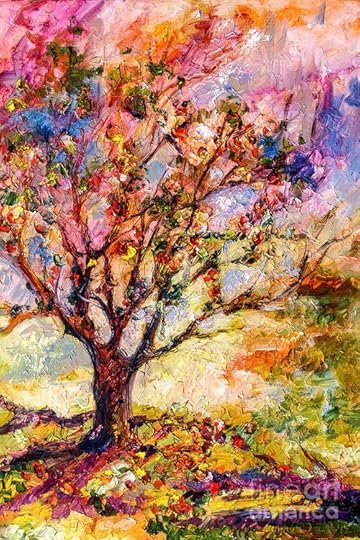
[Grandmas Apple Tree, © Ginette Callaway.]
`It is remarkable how closely the history of the Apple-tree is connected with that of man`.
Wild Apples by Henry David Thoreau. First published in 1862.
After reading in the blurb that this book is about the history of the apple tree, it does feel that these passages may seem like a botanical textbook. But after a few paragraphs, this book turns into the typical Thoreau writing - philosophical, meditative and contemplative. As it was with Walden, Wild Apples brims with the feeling of peace and contentment, and is brilliantly and lyrically written.
`It is in this sense the most civilized of all trees. It is as harmless as a dove, as beautiful as a rose, and as valuable as flocks and herds. It has been longer cultivated than any other, and so is more humanized; and who knows but, like the dog.`
Thoreau shares his observations and reflections about nature and this wonderful fruit, and the fruit`s relationship and importance to humankind. The History, 'immigration', flavour, beauty and the names - all this is covered in a deep and reflecting writing.
This book is important to read for those of all ages - helps build understanding, appreciation, gratitude and respect (`I respect the tree, and I am grateful for Nature's bounty`).
It was interesting that Thoreau had a herbarium [* A herbarium is a collection of preserved plant specimens and associated data used for scientific study - wikipedia].
|Pomological - the scientific study and cultivation of fruit.|
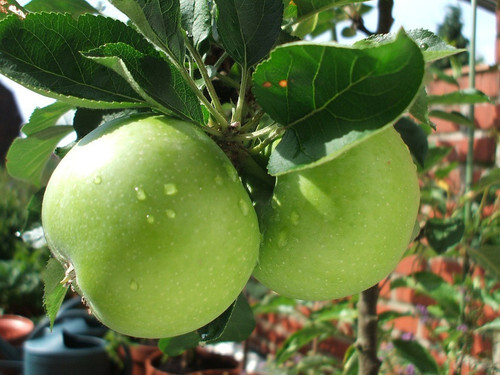
[Green Apples, yorksj.ac.uk.]
`What is sour in the house
a bracing walk makes sweet.`
These are all the different types of apple trees:
the Wood-Apple (Malus sylvatica);
the Blue-Jay Apple;
the Apple which grows in Dells in the Woods (sylvestrivallis),
in Hollows in Pastures (campestrivallis);
the Apple that grows in an old Cellar-Hole (Malus cellaris);
the Meadow-Apple;
the Partridge-Apple;
the Truant's Apple (Cessatoris);
the Saunterer's Apple;
the Beauty of the Air (Decks Aeris);
the Frozen-Thawed (gelato-soluta);
the Concord Apple;
the Assabet Apple;
the Brindled Apple;
the Chickaree Apple;
the Green Apple (Malus viridis);
the Hedge-Apple (Malus Sepium);
the Slug-Apple (limacea);
the Railroad-Apple.
Read the book here: https://www.theatlantic.com/magazine/...
"Thus the apple-tree may be considered a symbol of peace no less than the olive."
==========
"'Here's to thee,
old apple-tree,
Whence thou mayst bud,
and whence thou mayst blow,
And whence thou mayst bear apples enow!
Hats-full! caps-full!
Bushel, bushel, sacks-full!
And my pockets full, too! Hurra!'"
[Grandmas Apple Tree, © Ginette Callaway.]
`It is remarkable how closely the history of the Apple-tree is connected with that of man`.
Wild Apples by Henry David Thoreau. First published in 1862.
After reading in the blurb that this book is about the history of the apple tree, it does feel that these passages may seem like a botanical textbook. But after a few paragraphs, this book turns into the typical Thoreau writing - philosophical, meditative and contemplative. As it was with Walden, Wild Apples brims with the feeling of peace and contentment, and is brilliantly and lyrically written.
`It is in this sense the most civilized of all trees. It is as harmless as a dove, as beautiful as a rose, and as valuable as flocks and herds. It has been longer cultivated than any other, and so is more humanized; and who knows but, like the dog.`
Thoreau shares his observations and reflections about nature and this wonderful fruit, and the fruit`s relationship and importance to humankind. The History, 'immigration', flavour, beauty and the names - all this is covered in a deep and reflecting writing.
This book is important to read for those of all ages - helps build understanding, appreciation, gratitude and respect (`I respect the tree, and I am grateful for Nature's bounty`).
It was interesting that Thoreau had a herbarium [* A herbarium is a collection of preserved plant specimens and associated data used for scientific study - wikipedia].
|Pomological - the scientific study and cultivation of fruit.|
[Green Apples, yorksj.ac.uk.]
`What is sour in the house
a bracing walk makes sweet.`
These are all the different types of apple trees:
the Wood-Apple (Malus sylvatica);
the Blue-Jay Apple;
the Apple which grows in Dells in the Woods (sylvestrivallis),
in Hollows in Pastures (campestrivallis);
the Apple that grows in an old Cellar-Hole (Malus cellaris);
the Meadow-Apple;
the Partridge-Apple;
the Truant's Apple (Cessatoris);
the Saunterer's Apple;
the Beauty of the Air (Decks Aeris);
the Frozen-Thawed (gelato-soluta);
the Concord Apple;
the Assabet Apple;
the Brindled Apple;
the Chickaree Apple;
the Green Apple (Malus viridis);
the Hedge-Apple (Malus Sepium);
the Slug-Apple (limacea);
the Railroad-Apple.
Read the book here: https://www.theatlantic.com/magazine/...
"Thus the apple-tree may be considered a symbol of peace no less than the olive."
==========
"'Here's to thee,
old apple-tree,
Whence thou mayst bud,
and whence thou mayst blow,
And whence thou mayst bear apples enow!
Hats-full! caps-full!
Bushel, bushel, sacks-full!
And my pockets full, too! Hurra!'"

December 10, 2025
Reading shorter works this month to get as close to my yearly goal as I can. Ten days in and I've only finished this little Thoreau essay... things are not looking good for homestar runner. Thought about why I want to finish my goal this year even though it's December and I'm far behind. This is what I came up with:
1) quantitative validation that i am a Reader.
2) making reading a daily habit even when I am busy/tired/under the weather — this is the first day I read this month, and I finished the rest of the essay in just my 30 minute walk to work and 20 minute lunch break (on top of actually eating + making conversation). And I feel better about myself than if I had spent those 50 minutes on Instagram.
3) getting in the habit of picking up a book and actually finishing it. I do love meandering through books, but it often comes at the expense of reading comprehension, especially when I set down a book for months/years (hey I did finally finish Dune and Wuthering Heights. Sorry fellowship of the ring...) I also put pressure on myself to understand everything that is going on the first time I'm reading it, but that's what rereads are for. Trying to let myself enjoy the story/writing more, and save the heavy lifting of my analysis for reflecting & rereading.
So we'll see how that goes.
As for the actual text: I wasn't sure how I would feel about this, but it found a way to grip me. Thoreau has such a poetic way of writing essays, it's pretty magical. I want to eat a wild New England apple now. and drink fresh-pressed cold cider. it made me sad when he predicted the wild apple would die out... I don't know about rural Mass, but I've never experienced the joy of a wild apple on a crisp autumn walk. I have experienced biting into a Vermont or New York crab apple and immediately spitting it back out, though. Almost as shocking was how Thoreau faintly recognizes his hypocrisy in idolizing nature/wilderness as much as he does while thoroughly benefiting from colonial civilization. I won't give him too much credit on that front (certainly not before reading Walden), but it was a surprise to see it at all.
1) quantitative validation that i am a Reader.
2) making reading a daily habit even when I am busy/tired/under the weather — this is the first day I read this month, and I finished the rest of the essay in just my 30 minute walk to work and 20 minute lunch break (on top of actually eating + making conversation). And I feel better about myself than if I had spent those 50 minutes on Instagram.
3) getting in the habit of picking up a book and actually finishing it. I do love meandering through books, but it often comes at the expense of reading comprehension, especially when I set down a book for months/years (hey I did finally finish Dune and Wuthering Heights. Sorry fellowship of the ring...) I also put pressure on myself to understand everything that is going on the first time I'm reading it, but that's what rereads are for. Trying to let myself enjoy the story/writing more, and save the heavy lifting of my analysis for reflecting & rereading.
So we'll see how that goes.
As for the actual text: I wasn't sure how I would feel about this, but it found a way to grip me. Thoreau has such a poetic way of writing essays, it's pretty magical. I want to eat a wild New England apple now. and drink fresh-pressed cold cider. it made me sad when he predicted the wild apple would die out... I don't know about rural Mass, but I've never experienced the joy of a wild apple on a crisp autumn walk. I have experienced biting into a Vermont or New York crab apple and immediately spitting it back out, though. Almost as shocking was how Thoreau faintly recognizes his hypocrisy in idolizing nature/wilderness as much as he does while thoroughly benefiting from colonial civilization. I won't give him too much credit on that front (certainly not before reading Walden), but it was a surprise to see it at all.

October 13, 2019
Henry David wrote this at the end of his short life because he mentions the year 1861 as the first time he saw crab apple. He extols apples--“the noblest of fruits”--particularly wild apples over the cultivated. We have the History of the Apples, The Wild Apple, The Crab, How the Wild Apple Grows, The Fruit, and Its Flavor, Their Beauty, The Naming of Them, The Last Gleaning, The “Frozen-Thawed” Apple.
Thoreau goes to great length to describe the benefits:
“There is thus about all natural products a certain volatile and ethereal quality which represents their highest values, and which cannot be vulgarized, or bought and sold. No mortal has ever enjoyed the perfect flavor of any fruit, and only the godlike among men begin to taste its ambrosial qualities. For nectar and ambrosia are only those fine flavors of every earthly fruit which our coarse palates fail to perceive,--just as we occupy the heaven of the gods without knowing it.”
. . .
“To appreciate the wild and sharp flavors of these October fruits, it is necessary that you be breathing the sharp October or November air . . . They must be eaten in the fields, when your system is all aglow with exercise, when the frosty weather nips your fingers, the wind rattles the bare boughs or rustles the few remaining leaves, and the jay is heard screaming around.”
Thoreau goes to great length to describe the benefits:
“There is thus about all natural products a certain volatile and ethereal quality which represents their highest values, and which cannot be vulgarized, or bought and sold. No mortal has ever enjoyed the perfect flavor of any fruit, and only the godlike among men begin to taste its ambrosial qualities. For nectar and ambrosia are only those fine flavors of every earthly fruit which our coarse palates fail to perceive,--just as we occupy the heaven of the gods without knowing it.”
. . .
“To appreciate the wild and sharp flavors of these October fruits, it is necessary that you be breathing the sharp October or November air . . . They must be eaten in the fields, when your system is all aglow with exercise, when the frosty weather nips your fingers, the wind rattles the bare boughs or rustles the few remaining leaves, and the jay is heard screaming around.”
May 17, 2017
This Kindle edition handles footnotes in an odd way, no doubt due to the digitization of the work. It's readable and acceptable once one realizes what is happening.
Now, about the apples! Strange to say, this short-ish work IS, in fact, all about apples and apple trees. It comes to mind after only a few pages that it's enough already about apples - cultivated, wild, or crab. Is there really that much to say? Thoreau's answer: "Yes, and then some."
I find that in reality the work is about the man not the fruit tree. The depth of his perceptions and the power of his associations and conclusions cannot be overstated. These intangibles are, for me, the main source of enjoyment in reading Wild Apples. He clearly spent a LOT of time thinking about his subject and its relation to the environment including man, animals, the weather, history, and mankind in general.
His interest in both the North American native 'wild' apple and the crab apple is indicative, according to other sources I have read, of his particular concern with the common and local, rather than the exotic or foreign (even though he had to travel outside of New England to find his first crab apple tree).
In the end, observing, through his writing, the mind of this most unusual man was interesting and enjoyable.
Now, about the apples! Strange to say, this short-ish work IS, in fact, all about apples and apple trees. It comes to mind after only a few pages that it's enough already about apples - cultivated, wild, or crab. Is there really that much to say? Thoreau's answer: "Yes, and then some."
I find that in reality the work is about the man not the fruit tree. The depth of his perceptions and the power of his associations and conclusions cannot be overstated. These intangibles are, for me, the main source of enjoyment in reading Wild Apples. He clearly spent a LOT of time thinking about his subject and its relation to the environment including man, animals, the weather, history, and mankind in general.
His interest in both the North American native 'wild' apple and the crab apple is indicative, according to other sources I have read, of his particular concern with the common and local, rather than the exotic or foreign (even though he had to travel outside of New England to find his first crab apple tree).
In the end, observing, through his writing, the mind of this most unusual man was interesting and enjoyable.

November 8, 2020
Sevdiğim elmaları benden daha çok sevip bu kadar detaylı anlatması hoşuma gitti yazarın. :)
Şimdi mutfağa yollanıp, masadaki kasede beni bekleyen yeşil ve kırmızı elmalarımı kitaptaki altı çizili cümleleri düşünerek afiyetle yiyeceğim :p
"O, sonbahar yapraklarını boyarken yanlışlıkla fırçasından renkler sıçramış gibi pürüzlü, çil çil veya sap kısmında beyaz zemin üzerinde ince koyu kırmızı lekelere sahip. Başka elmalarınsa bazen içleri kırmızı, nefis kızarıklıkla sıvanmış, perilerin yiyeceği, yemeye bile kıyamayacağınız Hesperides'in elmaları, akşam kızıllığına bürünmüş elmalar! Ormanda bir vadide sonbahar havasında solan yaprakların arasında, kıyıdaki deniz kabukları ve çakıllar gibi parlıyor olmalılar ama evde solan ve kuruyan yapraklar değil, ıslak çimenlerin üzerinde, ait oldukları yerde olan yapraklar gibiler."
Dipnot olarak belirtmek isterim ki bazı sayfalarda garip cümlelerle karşılaştım. Sanki robotik bir tercüme yapılmış gibiydi. O ahenk bazı noktalarda sekteye uğruyordu, cümleyi tekrar tekrar okumak zorunda hissediyordum. Başka bir yayınevi veya çevirmenin elinden okumak isterdim.
Şimdi mutfağa yollanıp, masadaki kasede beni bekleyen yeşil ve kırmızı elmalarımı kitaptaki altı çizili cümleleri düşünerek afiyetle yiyeceğim :p
"O, sonbahar yapraklarını boyarken yanlışlıkla fırçasından renkler sıçramış gibi pürüzlü, çil çil veya sap kısmında beyaz zemin üzerinde ince koyu kırmızı lekelere sahip. Başka elmalarınsa bazen içleri kırmızı, nefis kızarıklıkla sıvanmış, perilerin yiyeceği, yemeye bile kıyamayacağınız Hesperides'in elmaları, akşam kızıllığına bürünmüş elmalar! Ormanda bir vadide sonbahar havasında solan yaprakların arasında, kıyıdaki deniz kabukları ve çakıllar gibi parlıyor olmalılar ama evde solan ve kuruyan yapraklar değil, ıslak çimenlerin üzerinde, ait oldukları yerde olan yapraklar gibiler."
Dipnot olarak belirtmek isterim ki bazı sayfalarda garip cümlelerle karşılaştım. Sanki robotik bir tercüme yapılmış gibiydi. O ahenk bazı noktalarda sekteye uğruyordu, cümleyi tekrar tekrar okumak zorunda hissediyordum. Başka bir yayınevi veya çevirmenin elinden okumak isterdim.

March 10, 2024
I've never read anything by Henry David Thoreau before now. However, having read this work, I can understand why his writing has so many devoted fans, and why it has stood the test of time.
I found many delightful passages in this book. Thoreau's suggestion to use "early apples" to "scent your handkerchief" draws readers into an earlier time, while his recounting of the old practice of wassailing the trees on New Year's Eve to ensure they produced a bountiful harvest next season seems to echo with the author's own nostalgic longings. Also noteworthy is Thoreau's assertion that the only way to appreciate the harsh, sour taste of wild apples is to eat them outdoors, "breathing the sharp October or November air". Considering everything I've ever heard about Thoreau's work, this section seems to encapsulate the very essence of his writing.
All in all, reading this book was a pleasant experience.
Did I like it? Yes.
Would I reread it? While certain passages will likely linger with me forever, I don't think I will feel the need to revisit this work.
Would I recommend it? Yes.
I found many delightful passages in this book. Thoreau's suggestion to use "early apples" to "scent your handkerchief" draws readers into an earlier time, while his recounting of the old practice of wassailing the trees on New Year's Eve to ensure they produced a bountiful harvest next season seems to echo with the author's own nostalgic longings. Also noteworthy is Thoreau's assertion that the only way to appreciate the harsh, sour taste of wild apples is to eat them outdoors, "breathing the sharp October or November air". Considering everything I've ever heard about Thoreau's work, this section seems to encapsulate the very essence of his writing.
All in all, reading this book was a pleasant experience.
Did I like it? Yes.
Would I reread it? While certain passages will likely linger with me forever, I don't think I will feel the need to revisit this work.
Would I recommend it? Yes.
December 19, 2024
A virtuoso— and someone that came right out of our early countries highest ideals. The way thoreau is excited by, and constantly follows nature, resonates with me (and i think at least privately with probably everyone).
The overlapping of classical themes “ambrosia/nectar” with my own lived experience — like the almost neon green that fresh pesto has — and Thoreau’s observation about the smell of ripe orchards, of wild apples eaten in the field, and of cider from frozen and thawed apples.
A great text and a reminder that nature is magic and nature is everywhere (even in one of the worlds ten biggest cities) — we simply need to take the time to observe and commune with it in order to get to this same elevated place of satisfaction and revelation that he did, now more than 100 years ago.
The overlapping of classical themes “ambrosia/nectar” with my own lived experience — like the almost neon green that fresh pesto has — and Thoreau’s observation about the smell of ripe orchards, of wild apples eaten in the field, and of cider from frozen and thawed apples.
A great text and a reminder that nature is magic and nature is everywhere (even in one of the worlds ten biggest cities) — we simply need to take the time to observe and commune with it in order to get to this same elevated place of satisfaction and revelation that he did, now more than 100 years ago.
February 14, 2022
Now I know all about wild/crab apples! An interesting short read that was free on Amazon.
After farmers would harvest apples, they'd leave some for scavengers, mostly boys. This was called "wassailing" the trees and songs were written about it.
What is a crab apple that is really crabbed? "Crabbedest"
There was one type of crab apple that was called "Freeze-thaw", because that's how you ate it. It was too sour to eat before the first freeze.
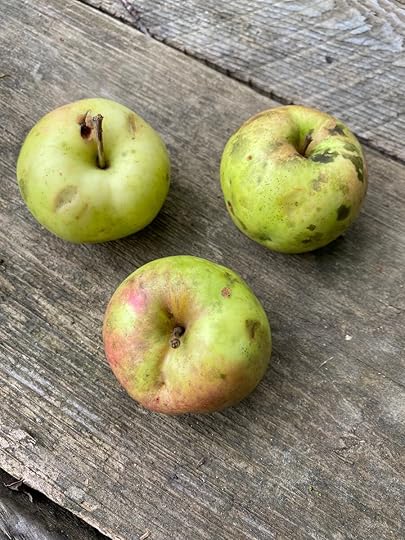
So many creative names! Here's the "Apple that grows in an old cellar-hole"
After farmers would harvest apples, they'd leave some for scavengers, mostly boys. This was called "wassailing" the trees and songs were written about it.
What is a crab apple that is really crabbed? "Crabbedest"
There was one type of crab apple that was called "Freeze-thaw", because that's how you ate it. It was too sour to eat before the first freeze.
So many creative names! Here's the "Apple that grows in an old cellar-hole"

August 10, 2023
Här kommer lite litterär fallfrukt.
Nu helgar vi #thoreaubackthursday genom att läsa hans essä från 1862. https://www.theatlantic.com/magazine/...
Stilen är klassisk Thoreau; botaniskt detaljerad med många referenser till antikens mytologi och så det finaste; hans mer udda, unika och många gånger moderna tankar och observationer. Move your ass and the rest will follow, tycks Thoreau mena:
"They must be eaten in the fields, when your system is all aglow with exercise [...] the wind rattles the bare boughs or rustles the few remaining leaves around. What is sour in the house a bracing walk makes sweet. Some of these apples might be labelled: 'To be eaten in the wind."
Nu helgar vi #thoreaubackthursday genom att läsa hans essä från 1862. https://www.theatlantic.com/magazine/...
Stilen är klassisk Thoreau; botaniskt detaljerad med många referenser till antikens mytologi och så det finaste; hans mer udda, unika och många gånger moderna tankar och observationer. Move your ass and the rest will follow, tycks Thoreau mena:
"They must be eaten in the fields, when your system is all aglow with exercise [...] the wind rattles the bare boughs or rustles the few remaining leaves around. What is sour in the house a bracing walk makes sweet. Some of these apples might be labelled: 'To be eaten in the wind."

September 29, 2024
A Loveletter to the Noblest of Fruits
This is a beautifully written work about apples. This fruit has been with humanity for so long and Thoreau provides an elegant summary of its history, appearance, versatility, hardiness, and enjoyment through the ages. It is a well cited document which takes into account the many different perspectives, cultures, and mythologies that have been influenced by our noblest of fruits, and relays these ideas in a joyful manner. This was a pleasure to read and now I think I will take a walk in the autumn air and bring along an apple to enjoy in the wind.
This is a beautifully written work about apples. This fruit has been with humanity for so long and Thoreau provides an elegant summary of its history, appearance, versatility, hardiness, and enjoyment through the ages. It is a well cited document which takes into account the many different perspectives, cultures, and mythologies that have been influenced by our noblest of fruits, and relays these ideas in a joyful manner. This was a pleasure to read and now I think I will take a walk in the autumn air and bring along an apple to enjoy in the wind.

December 31, 2020
I’ve been loving apples a lot lately; something about the smell of them reminds me of coming home from school - that fresh excitement and joy! Through Wild Apples, Thoreau had me meditate on apples in a uniquely profound, but still relatable and grounded way. What a light, sweet, and crisp treat!
“Though he gets out from time to time, and feels of them, and thinks they are all there, I see the stream of their evanescent and celestial qualities going to heaven from his cart, while the pulp and skin and core only are going to market.”
“Though he gets out from time to time, and feels of them, and thinks they are all there, I see the stream of their evanescent and celestial qualities going to heaven from his cart, while the pulp and skin and core only are going to market.”
January 19, 2024
Éste es el último libro que Thoreau escribió, cuando se encontraba en las puertad de la muerte, lo cual en un principio explica su brevedad.
Sobre el tema en sí, en este ensayo, Thoreau reflexiona sobre las semejanzas entre las manzanas con el ser humano. Es interesante los ejemplos que utiliza el autor. Además, como en cualquiera de sus obras, la escritura de Thoreau es cálida en lugar de seremoniosa, como muchos ensayistas.
Supongo que la obra quedó incompleta por su muerte, porque no hay una conclusión clara para el tema principal.
Sobre el tema en sí, en este ensayo, Thoreau reflexiona sobre las semejanzas entre las manzanas con el ser humano. Es interesante los ejemplos que utiliza el autor. Además, como en cualquiera de sus obras, la escritura de Thoreau es cálida en lugar de seremoniosa, como muchos ensayistas.
Supongo que la obra quedó incompleta por su muerte, porque no hay una conclusión clara para el tema principal.

November 10, 2020
Yabani Elmalar, Thoreau'nun medeniyetin içinde bulamadığı bir tadı arayıp bulmasıdır.
Elmanın efsanelerden günümüze insanla olan ilişkisini okuyacaksınız. Doğanın içindeki yabani elmaların yeryüzüne yayılması ve insanın bir çok hayvan türünün ondan faydalanması. Doğadan faydalanmaktan vazgeçemiyoruz o da armağanlarını sunmaktan vazgeçmiyor.
En güzel tatlar doğanın içinde henüz bulamadıklarımızda, diyor Henry David Thoreau.
Yabani olmayan elmaların tadını biliyoruz ya yabani elmaların tadı?
Elmanın efsanelerden günümüze insanla olan ilişkisini okuyacaksınız. Doğanın içindeki yabani elmaların yeryüzüne yayılması ve insanın bir çok hayvan türünün ondan faydalanması. Doğadan faydalanmaktan vazgeçemiyoruz o da armağanlarını sunmaktan vazgeçmiyor.
En güzel tatlar doğanın içinde henüz bulamadıklarımızda, diyor Henry David Thoreau.
Yabani olmayan elmaların tadını biliyoruz ya yabani elmaların tadı?
Displaying 1 - 30 of 63 reviews