

What do you think?

Painting and Experience in Fifteenth-Century Italy: A Primer in the Social History of Pictorial Style
Painting and Experience in Fifteenth Century Italy An introduction to 15th century Italian painting and the social history behind it, arguing that the two are interlinked and that the conditions of the time helped fashion distinctive elements in the painter's style.
Serving as both an introduction to fifteenth-century Italian painting and as a text on how to interpret social history from the style of pictures in a given historical period, this new edition to Baxandall's pre-eminent scholarly volume examines early Renaissance painting, and explains how the style of painting in any society reflects the visual skills and habits that evolve out of daily life. Renaissance painting, for example, mirrors the experience of such activities as preaching, dancing, and gauging barrels. The volume includes discussions of a wide variety of painters, including Filippo Lippi, Fra Angelico, Stefano di Giovanni, Sandro Botticelli, Masaccio, Luca Signorelli, Boccaccio, and countless others. Baxandall also defines and illustrates sixteen concepts used by a contemporary critic of painting, thereby assembling the basic equipment needed to explore fifteenth-century art.
Serving as both an introduction to fifteenth-century Italian painting and as a text on how to interpret social history from the style of pictures in a given historical period, this new edition to Baxandall's pre-eminent scholarly volume examines early Renaissance painting, and explains how the style of painting in any society reflects the visual skills and habits that evolve out of daily life. Renaissance painting, for example, mirrors the experience of such activities as preaching, dancing, and gauging barrels. The volume includes discussions of a wide variety of painters, including Filippo Lippi, Fra Angelico, Stefano di Giovanni, Sandro Botticelli, Masaccio, Luca Signorelli, Boccaccio, and countless others. Baxandall also defines and illustrates sixteen concepts used by a contemporary critic of painting, thereby assembling the basic equipment needed to explore fifteenth-century art.
200 pages, Paperback
First published January 1, 1972
Ratings & Reviews
Friends & Following
Create a free account to discover what your friends think of this book!
Community Reviews
Displaying 1 - 30 of 95 reviews

April 16, 2010
THE RULE OF THREE

This book has as its origins a series of lectures that Michael Baxandall (1933 – 2008) gave at the University of London during the 70s. That may explain that its three chapters do not seem, in a first reading, to follow a unified and continuous line of argument. And yet they do. And they also link in with Baxandall’s proposals in his slightly earlier Giotto and the Orators: Humanist Observers of Painting in Italy and the Discovery of Pictorial Composition. At the core of his writings there is a solid thought: the ‘look’ or ‘style’ of any particular painting is the product of its times – social, economic, and cultural.
In spite of the simplicity of this idea, Baxandall carved a break through. This little book changed the mind of many art historians and not just those of Renaissance specialists.
With a Marxist tint he posits the painting as a fossil of cultural life that testifies, amongst other things, that it was the result of a commercial agreement. For this transaction to take place in a particular way many other social, political and economic aspects were involved. Baxandall’s aim is to elucidate some of those aspects in the production of paintings in the Italian peninsula during the 15C, and how these paintings were understood at the time.
In Conditions of Trade, the first chapter or lecture, Baxandall examines signed agreements between patrons and craftsmen and traces how during that century there was a move away from valuing the materials employed towards assessing the skill or artistry (‘arte’) of the craftsman. The mercantile value of the painting was becoming less material and approaching the ineffable. In this process, this perceived immateriality was also the quality that helped the craftsmen, gradually, to fashion their own persona as artists.
In his second and longest chapter, The Period Eye, he explores how the paintings were lived or experienced. Quoting Boccaccio (a painting... can deceive the eyes of the beholder, making itself be taken for what it is not)--, Baxandall examines the notion of representation and proceeds to dislodge the schemes that the 15C viewer would have had in his mind when contemplating paintings.
But for us these paintings are not enough and Baxandall resorts to an ample use, as complementary fossils, of various kinds of texts: contracts, letters, accounts, textbooks, treatises, and sermons. Language is the other medium that could reveal the thinking process when looking at paintings, even if words also have to be interpreted. In his Giotto and Orators Baxandall found that the language that the Renaissance man had available when speaking of art was not only scant but also based on the classical tradition of rhetoric – i.e.: borrowed from the language on language. Pliny’s Natural History: A Selection, was the main vehicle of transmission from one usage to the other.
In the search for the Eye of the Period, we find a society in which individuals lived off merchandising, were Christians, and followed specific patterns of convivial behaviour. The degree of presence of these three cultural elements varied from individual to individual, but all had the three. A noble could be less agile with his mathematics, but he was a believer of Christ and displayed a highly polished level of politeness. A friar would have a sound theological knowledge, but had also been instructed in arithmetic and understood the meaning of gestures to be used in the pulpit. A merchant was a master in double-entry accounting, but was aware of God’s dislike of usury and realized the commercial value of good social manners.
Along the religious axis of this age paintings were endowed with a function: they had to instruct. To do so effectively, they had to be able to move the believer and serve her or him as an aid for remembering their dogma. The painter was the “professional visualizer” of holy stories and had to think of ways to engage his viewers, to help them empathize with the scenes. Texts recommended how the images could help in meditation, proposing tricks such as imagining the sacred scenes taking place in one’s city and including one’s acquaintances amongst the participating people. This implied that paintings could not become too particular and conflict with the inner minds of the beholders.
Some stock scenes were also taken as generic examples of specific virtues. The way they rendered the story had to exemplify that quality. The Visitation was an enactment of Benignity; Maternity scenes staged Laudability; and the Nativity was a complex setting in which Poverty, Humility and Joy were personated. Some themes, such as the Annunciation, were conceived as part of a complex narrative or “Angelic Colloquy” in which any of its various stages could be discerned: Merit (Meritatio), Disquiet (Conturbatio), Reflection (Cogitatio), Inquiry (Interrogatio), Submission (Humiliatio).
Fra Angelico's as Humiliatio.

Botticelli's as Conturbatio.

For social manners, or the second cultural axis, Baxandall has found several kinds of relevant texts, and in particular the books on dance can make our understanding swing: they taught how movement matched mood and could therefore represent the state of the mind. Bodies embodied the soul. Leonardo also wrote recommendations for painters advising them to study the gestures or body language of orators and dumb men. And an extraordinary achievement is found in Masaccio’s Expulsion. Adam is all Shame and Grief has the name of Eve.
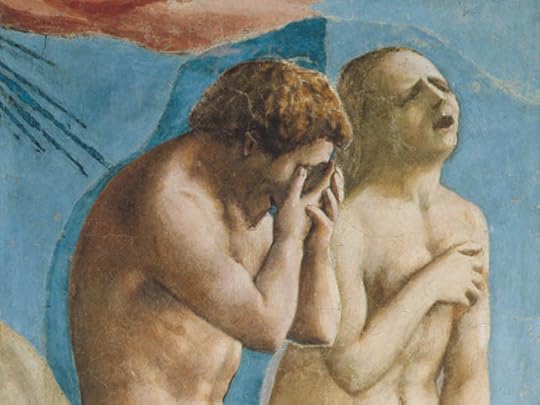
Some gestures have been lost to us making the interpretation of several paintings almost impossible for us. But Baxandall has decoded others by referring to a maiden’s handbook (Decor puellarum). For example the palm of a hand slightly raised with the fingers spread out in a timid fan is found very often as a sign of invitation. One such example is the well-known Primavera by Botticelli.

The third axis in the cultural texture is the relative importance of Arithmetic in the educational baggage in this period. To be able to calculate, to gauge with the eye, was a fundamental skill in a mercantile society, and this can be measured in the paintings. For this Baxandall turns to the educational system and textbooks. Not for nothing was the secondary school called Abaco and was centred on mathematics. The slant of these schools grew more acute ever since Leonardo Fibonacci (1179-1240) introduced in Europe the Hindu-Arabic system of numeric notation and his Liber Abaci. Even for those young men who wanted to become lawyers, a thorough grounding in the art of calculation was paramount for a city of merchants.
One of the most fascinating texts is the mathematical handbook for merchants written by none other than the painter Piero della Francesca, De Abaco. Forms in paintings could be easily decomposed in their basic geometric forms—cylinders, cones, and prisms--, by a 15C eye. This would help to ‘remember’ and to engage the viewer. The images of the symmetry-obsessed Piero, can easily become a game of identification of the geometric forms used.
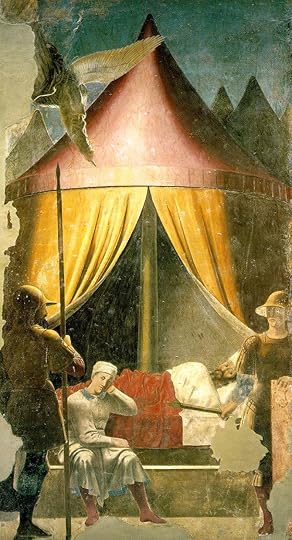
Key to the deployment of arithmetic was the Rule of Three, or Golden Rule and known in Florence as the Merchant’s Key. This simple and magic trick of relations was also popularized by Fibonacci (anybody here who likes spirals?), and is found in Leonardo’s writings. This easy-to-use rule is an example of the continuity between the practices of commercial culture and the looking at paintings.
With this last theme, Baxandall considers how the three axes met. If some narrative scenes could also be dramatizations of virtues, one could also allegorize mathematical relations and transform them into pious matter suitable for sermons. Harmonies of the spheres had already elevated music, and, as any reader of Dante knows, numbers could be the hidden framework of writings that helped mystical contemplation.
In his last chapter, Pictures and Categories, Baxandall picks up again arguments from his Giotto, when trying to find the language of painting. As artistry was replacing gold leaf and lapis lazuli, a language had to develop to refer to this newly valued quality. It also had to help in differentiating individuality and personal styles.
For this, Baxandall has found in an unlikely place, in the preface to the 1481 Commentary on Dante, by Cristoforo Landino (1424-1498), a fascinating pictorial guide. Landino was one of the perfect Humanists: Champion of the vernacular Italian, Neo-Platonic philosopher, Scholar at the University in Florence, translator of Pliny’s seminal work mentioned above, and Secretary to the Signoria, In this preface Landino coined a total of sixteen terms that referred to the various qualities identified in the way the paintings by Masaccio; Filippo Lippi; Andrea del Castagno and Fra Angelico were perceived by their contemporaries. Landino elaborated a vocabulary for the Renaissance ‘look’.
MASACCIO
He was an imitator of nature (imitatore della natura); knew how to render relief or three dimensions with light and shadow (rilievo); was pure (puro) in his forms and did not have recourse to frills; had a personal ease (facilità) when tackling difficult aspects; and was a master of perspective (prospectivo).

FRA FILIPPO LIPPI
A very different painter to Masaccio, Lippi showed a generous use of ornamentation (ornato and varietà); his compositions (compositione) were therefore admirable, and his use of colour (colorire) memorable.

ANDREA DEL CASTAGNO
This painter was closer to Masaccio and was an exponent of design (disegnatore), and also a lover of difficulties (amatore della difficultà), as his foreshortenings (scorci) showed. He would also respond promptly to pictorial challenges (prompto).

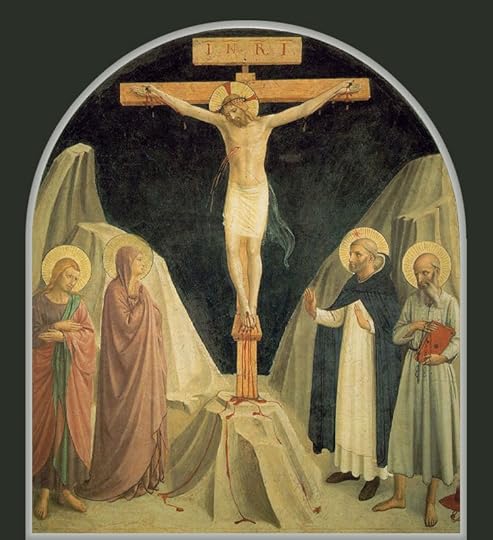
FRA ANGELICO
Although his name could be used as the adjective for his paintings, Landino identified a pleasantness (vezzoso) and ‘inspiring to devotion’ (devoto) as the qualities that this friar exhibited in his works.
If a certain social fabric wove the ‘look’ of its paintings, these have preserved for us the look of that social fabric. Through these paintings we can glimpse, if not fully see, that past social texture.

Read
June 10, 2015Before I started to type I had such a clear idea of what I would say.
I was attracted to this book by Kalliope's review. Her review was illustrated, a key condition for discussing a book about art, while mine is not.
Reading through Baxandall's book it was clear that it was a literary version of an oral work of art known to many a student: the lecture course. A lecture course, unlike my review, may also be illustrated. In the background of the sentences we might imagine the fiddling with the projector, a sheathe of ordered transparencies, the darkened lecture theatre.
Imagination, as it happens, is the theme of the course, an attempt to recreate how a fifteenth-century person, and let us pretend to a vague precision here: a man, the artist or patron and therefore either more educated (in both the sense of practical, experiential learning and formal schooling) wealthy or both than the average, in northern Italy - and most likely in Florence, might have experienced a fifteenth-century painting.
That vague precision constitutes my only (current) criticism . The title promises Italy, but the range of the sources Baxandall has to draw upon suggests to me that the question remains open that other people elsewhere in the peninsula may have had some different ideas. The main focus here is Florence and artists connected with it. Venice and Flanders exist in the consciousness of some of those who then discussed their contemporary art as places were things were done differently, one could find there works with qualities other than one might find in Florence.
To my mind the question of how did the fifteenth century man experience the fifteenth century picture is an absolutely valid and powerfully useful one, but then much of my own experience of art is that of the gallery wanderer. My need to confront my subjective approach with another but different subjective view leads me to respond well to this book. The pretence of an objective view that might try to cast the painting of one age in comparison to another suddenly looks false - no one is in competition with their future.
Helpfully this book leads me to appreciate that when I don't understand the art of my contemporaries that I am missing the main point - I am neither an artist nor a patron.
Finally the focus on the painting as a material object, that one could and did contractually define in terms of both the value of the materials and the value of the labour used in creating the painting (the more ultra-marine and personal input of the master the greater the value) reminds me of why Lisa Jardine's Worldly Goods felt so old fashioned - the basic argument had already been articulated.
I was attracted to this book by Kalliope's review. Her review was illustrated, a key condition for discussing a book about art, while mine is not.
Reading through Baxandall's book it was clear that it was a literary version of an oral work of art known to many a student: the lecture course. A lecture course, unlike my review, may also be illustrated. In the background of the sentences we might imagine the fiddling with the projector, a sheathe of ordered transparencies, the darkened lecture theatre.
Imagination, as it happens, is the theme of the course, an attempt to recreate how a fifteenth-century person, and let us pretend to a vague precision here: a man, the artist or patron and therefore either more educated (in both the sense of practical, experiential learning and formal schooling) wealthy or both than the average, in northern Italy - and most likely in Florence, might have experienced a fifteenth-century painting.
That vague precision constitutes my only (current) criticism . The title promises Italy, but the range of the sources Baxandall has to draw upon suggests to me that the question remains open that other people elsewhere in the peninsula may have had some different ideas. The main focus here is Florence and artists connected with it. Venice and Flanders exist in the consciousness of some of those who then discussed their contemporary art as places were things were done differently, one could find there works with qualities other than one might find in Florence.
To my mind the question of how did the fifteenth century man experience the fifteenth century picture is an absolutely valid and powerfully useful one, but then much of my own experience of art is that of the gallery wanderer. My need to confront my subjective approach with another but different subjective view leads me to respond well to this book. The pretence of an objective view that might try to cast the painting of one age in comparison to another suddenly looks false - no one is in competition with their future.
Helpfully this book leads me to appreciate that when I don't understand the art of my contemporaries that I am missing the main point - I am neither an artist nor a patron.
Finally the focus on the painting as a material object, that one could and did contractually define in terms of both the value of the materials and the value of the labour used in creating the painting (the more ultra-marine and personal input of the master the greater the value) reminds me of why Lisa Jardine's Worldly Goods felt so old fashioned - the basic argument had already been articulated.

January 4, 2019
This book should have had me impatient to revisit all Florence's churches and art galleries with renewed zeal but sadly it didn't quite do that for me. I found it interesting rather than exhilarating. It was perhaps too academic and intellectual for me. However I did appreciate how much mental energy the author brings to his subject and how important a few of his insights are in adding to our knowledge of the social fabric, the sensibility and artistic aims of the Quattrocento.
Baxandall wants to establish a better understanding of the relationship between the artist and his audience in its 15th century social context; to understand what the 15th century eye saw and looked for in art. He wants to magic our own eye back to become the eye of the Quattrocento. He begins by showing us how early Quattrocento works of art were essentially either propaganda posters for the Church or status symbols for their owners. Portraiture in the religious paintings deliberately kept generic as a means of not imparting too much humanity to the otherworldly Biblical characters. You couldn't paint an archangel who looked too much like the local butcher or anyone else you knew in daily life. These paintings had a severe instructive purpose and were not meant to bear too much reality. Private commissions, on the other hand, were evaluated less by their skilful artistry than by the quantity of precious pigments they contained, notably gold and lapis lazuli. We're then shown how these two motivational factors evolve through the century. The inspirations artists drew on to keep their visions recognisable to their audience. We all need to recognise something of the familiar in the art we behold. But the Quattrocento eye was recognising things we no longer do. These include the dances of the period and the system of mathematics most commonly taught. Eventually as the eye widened its scope for inspiration art for art's sake arrives, heralded by life-modelled portraiture and compositional ingenuity. I loved one of his final observations that Piero della Francesca tends to be a gauged kind of painting, Fra Angelico a preached sort of painting and Botticelli a danced sort of painting.
But if you want a much more detailed and intelligent and justly celebratory review than I'm capable of writing I suggest you take a look at Kalliope's brilliant analysis!
https://www.goodreads.com/review/show...
Baxandall wants to establish a better understanding of the relationship between the artist and his audience in its 15th century social context; to understand what the 15th century eye saw and looked for in art. He wants to magic our own eye back to become the eye of the Quattrocento. He begins by showing us how early Quattrocento works of art were essentially either propaganda posters for the Church or status symbols for their owners. Portraiture in the religious paintings deliberately kept generic as a means of not imparting too much humanity to the otherworldly Biblical characters. You couldn't paint an archangel who looked too much like the local butcher or anyone else you knew in daily life. These paintings had a severe instructive purpose and were not meant to bear too much reality. Private commissions, on the other hand, were evaluated less by their skilful artistry than by the quantity of precious pigments they contained, notably gold and lapis lazuli. We're then shown how these two motivational factors evolve through the century. The inspirations artists drew on to keep their visions recognisable to their audience. We all need to recognise something of the familiar in the art we behold. But the Quattrocento eye was recognising things we no longer do. These include the dances of the period and the system of mathematics most commonly taught. Eventually as the eye widened its scope for inspiration art for art's sake arrives, heralded by life-modelled portraiture and compositional ingenuity. I loved one of his final observations that Piero della Francesca tends to be a gauged kind of painting, Fra Angelico a preached sort of painting and Botticelli a danced sort of painting.
But if you want a much more detailed and intelligent and justly celebratory review than I'm capable of writing I suggest you take a look at Kalliope's brilliant analysis!
https://www.goodreads.com/review/show...

January 13, 2013
Despite the fact that this is an utterly brilliant and original -- and, indeed, an important -- book, I can understand why some have given it 4, or even a mere 3-stars.... there is something intangible... or unattainable... in Baxandall's analysis... as if he were trying to weave a tapestry...out of cotton candy... it dissolves at the touch... or perhaps it is that the evidence, as I suggested in my update, does not *fully* or conclusively complete or 'clinch' the questions asked...
Yet those questions themselves are so startlingly original and apt, and so precisely formulated... that this book reallly should be read by anyone who is interested, not just in Renaissance art, but in cultural history as such -- in the formation of Western man, in fact...
It is misleading, as I've said, to argue that Baxandall's is an attempt at the 'social history' of art, as is often done. That is not at all what he is up to. Rather, he is trying to put in focus the mentalité of the Quattrocentro by showing how patterns of vision, and habits of vision, were formed... and expressed... and he does this, in large part, by showing how a purely formalist analysis (and that should be stressed) can be developed by comparing the categories by which the Renaissance itself conceived its art to the categories used in Renaissance literary (i.e., verbal) analysis -- much of which goes back to the time of Quintillian.
So, the concluding section (for example) shows how the apparently vague and (at first sight) completely subjective terms which Cristoforo Landino and Leon Battista Alberti applied in their analyses of painters such as Masaccio and Fra Angelico - terms like 'puro', 'facilita', 'gratioso', 'ornato', 'colorire' (tone) and 'disegno' (line), 'prompto', 'vezzoso' (blithe), and even 'devoto' -- along with more precise and familiar terms, such as the 'imitatore della nature', 'rilievo', 'prospectivo', 'varieta', 'compositione', 'scorci' (foreshortening) -- ALL have precise and formalizable meanings that can be paralleled (and accounted for) by the formal categories used in 15th cen. sermons and rhetoric.
At any rate - this very short and suggestive book is, imo, a *must* (though not always an easy) read.
Yet those questions themselves are so startlingly original and apt, and so precisely formulated... that this book reallly should be read by anyone who is interested, not just in Renaissance art, but in cultural history as such -- in the formation of Western man, in fact...
It is misleading, as I've said, to argue that Baxandall's is an attempt at the 'social history' of art, as is often done. That is not at all what he is up to. Rather, he is trying to put in focus the mentalité of the Quattrocentro by showing how patterns of vision, and habits of vision, were formed... and expressed... and he does this, in large part, by showing how a purely formalist analysis (and that should be stressed) can be developed by comparing the categories by which the Renaissance itself conceived its art to the categories used in Renaissance literary (i.e., verbal) analysis -- much of which goes back to the time of Quintillian.
So, the concluding section (for example) shows how the apparently vague and (at first sight) completely subjective terms which Cristoforo Landino and Leon Battista Alberti applied in their analyses of painters such as Masaccio and Fra Angelico - terms like 'puro', 'facilita', 'gratioso', 'ornato', 'colorire' (tone) and 'disegno' (line), 'prompto', 'vezzoso' (blithe), and even 'devoto' -- along with more precise and familiar terms, such as the 'imitatore della nature', 'rilievo', 'prospectivo', 'varieta', 'compositione', 'scorci' (foreshortening) -- ALL have precise and formalizable meanings that can be paralleled (and accounted for) by the formal categories used in 15th cen. sermons and rhetoric.
At any rate - this very short and suggestive book is, imo, a *must* (though not always an easy) read.

June 21, 2022
"Het oog wordt genoemd de eerste van alle poorten
Door welke het Verstand kan leren en proeven.
Het Oor is de tweede, met het oplettend Woord
Dat onze geesten wapent en ook voedt"
- Feo Belcari
Een prachtige analyse over maatschappelijke praktijken en gebruiken die de studie naar schilderkunst kunnen scherpen. ✏
Must-read voor iedereen die ook maar iets van geschiedenis doet of zich kijkmethodes eigen wil maken + ik ben vrijwel zeker dat er een bachelorproef aankomt over Benedictijnse gebarentaal in de Nederlanden.
Door welke het Verstand kan leren en proeven.
Het Oor is de tweede, met het oplettend Woord
Dat onze geesten wapent en ook voedt"
- Feo Belcari
Een prachtige analyse over maatschappelijke praktijken en gebruiken die de studie naar schilderkunst kunnen scherpen. ✏
Must-read voor iedereen die ook maar iets van geschiedenis doet of zich kijkmethodes eigen wil maken + ik ben vrijwel zeker dat er een bachelorproef aankomt over Benedictijnse gebarentaal in de Nederlanden.

September 8, 2019
Painting and Experience is a fascinating book about Renaissance art where Baxandall attempts to get us into the mind of the artists and their patrons during this particularly effervescent period of art history. It is written in an accessible style and has a nice translation at the end of the qualities that were most important for artists of this period. I really enjoyed this book as it brought me a few new insights into some of my favorite artists.

September 13, 2024
Art history discovers the linguistic turn. Baxandall’s most original idea is of a public eye formed by visual practices. Yet, his main evidence is religious and aesthetic texts.

November 19, 2009
Baxandall demonstrates that art style (rather than merely content) is an appropriate and useful material for social history. He argues that "social facts" contribute to the development of "distinctive visual skills and habits."

August 18, 2025
El libro no se centra en analizar aisladamente la pintura en el Renacimiento (centrándose en el Quattrocento - siglo XV) si no que también se analiza como la sociedad es capaz de influir en la percepción del arte (es decir, a la manera en el que el arte es analizado y recibido por la sociedad) y la propia manera de crear arte.
Analiza las diversas técnicas que se desarrollan, como el fresco o el óleo que provocan un efecto realista y ayudan a transmitir el mensaje. Asimismo trata las temáticas (como podemos suponer suelen ser religiosas o escenas cotidianas del día a día), la perspectiva/composición y sobre todo aborda la temática de la sociedad (los contratos, las costumbres... y como esto influye en las obras). Me ha gustado mucho porque otra vez vemos que el arte en mayor o menor medida está ligado a la sociedad y a la época en la cual vivimos.
Es un libro sencillo, no tiene muchas complicaciones, el contenido del texto no está lleno de tecnicismos y los apartados no suelen ser muy largos. Asimismo nos proporciona muchas imágenes las cuales complementan el texto lo que es un punto a favor de las editoriales. Las cuatro estrellas se deben a que no he llegado a finalizar el libro (me quedaban algunos pequeños apartados del último capítulo debido a que lo leí para la universidad) y se me ha hecho bastante largo y un poco pesado al final (algunas cosas sobraban repetirlas ya que llegamos a la misma conclusión anteriormente).
Analiza las diversas técnicas que se desarrollan, como el fresco o el óleo que provocan un efecto realista y ayudan a transmitir el mensaje. Asimismo trata las temáticas (como podemos suponer suelen ser religiosas o escenas cotidianas del día a día), la perspectiva/composición y sobre todo aborda la temática de la sociedad (los contratos, las costumbres... y como esto influye en las obras). Me ha gustado mucho porque otra vez vemos que el arte en mayor o menor medida está ligado a la sociedad y a la época en la cual vivimos.
Es un libro sencillo, no tiene muchas complicaciones, el contenido del texto no está lleno de tecnicismos y los apartados no suelen ser muy largos. Asimismo nos proporciona muchas imágenes las cuales complementan el texto lo que es un punto a favor de las editoriales. Las cuatro estrellas se deben a que no he llegado a finalizar el libro (me quedaban algunos pequeños apartados del último capítulo debido a que lo leí para la universidad) y se me ha hecho bastante largo y un poco pesado al final (algunas cosas sobraban repetirlas ya que llegamos a la misma conclusión anteriormente).
November 3, 2024
I fear this is mansplaining at its finest

July 15, 2008
This is honestly one of the best books I have read on the subject of Renaissance Art, and should be considered a primer by anyone who is delving into the topic. It's a short and relatively digestible read, with a numbering system dividing all of the major points. Baxendall's methodology is an interesting mix of archival dependance and social history. The book is framed around a quotation describing several Italian artists during the Renaissance; in the beginning he presents the problem of correctly interpreting why these artists were respected. After laying a firm ground of how painting (and by extension, religion) was received and understood by the layperson, he explains the particular meaning of each of the adjectives used to describe the artists at the beginning. For anyone interested in understanding the Italian Renaissance, this book is an essential.
August 26, 2009
Really fun book -- I kept cracking up at some of the primary material, and Baxandall's deadpan critism of Renaissance culture -- eg., on the various ways to calculate volume: "It is a special intellectual world." Also invaluable for deconstructing the semiotics of Renaissance imagery and iconography, for situating the type and content of art created in its proper cultural milieu, and the commoditisation of art as a cultural exchange in the fifteenth century and beyond.

February 23, 2014
a must-read for an art history student, regardless of their area of focus.

May 31, 2026
Como estudiante, dejé registrado el nombre de Michael Baxandall para leerlo cuando tuviera tiempo. Ahora me percato de que fue un craso error no haber dejado todo para ir enseguida a sus páginas. Haberlo leído entonces me hubiera ahorrado la lectura de historiadores somníferos. En cambio, sus ideas deslumbrantes me hubieran enseñado el camino a una historiografía del Renacimiento más sustancial.
El libro es sorprendentemente simétrico. También es inesperado. Comienza describiendo documentos notariales y contratos que aterran al lector por su apariencia fastidiosamente judicial. Los documentos reflejan los requisitos que pedían para contratar a un pintor en el Renacimiento: específicamente, la importancia de que un pintor fuera “experimentado”. ¿Tema insulso? Quizás, pero, de todas maneras, el lector puede avanzar sin empachos por la pluma ligera de Baxandall. Al empezar la segunda parte, nos vamos dando cuenta de que el libro adquiere consistencia y, sobre todo, atractivo. Baxandall va mostrándonos pacientemente que muchos elementos que apreciamos en las pinturas formaban parte de la vida cotidiana. Los espectadores de las obras de arte no estaban descifrando qué diablos quiso comunicar un pintor, sino que todo —los gestos, las expresiones, las proporciones, los colores— eran un reflejo de las cosas que había en su vida cotidiana. Al final del libro, nos queda claro que los pintores “más experimentados” eran los que sabían incorporar lo convencional y lo cotidiano en sus obras.
No sólo es un libro brillante, sino que nos deja un aprendizaje: la realidad social nos ayuda a entender el arte, pero el arte también nos ayuda a entender la realidad social. En apenas un puñado de páginas, Baxandall hace mover nuestro pensamiento por sendas fascinantes. Por último, hay que decir que su selección de imágenes no tiene ningún desperdicio. Hay que leer a Baxandall.
El libro es sorprendentemente simétrico. También es inesperado. Comienza describiendo documentos notariales y contratos que aterran al lector por su apariencia fastidiosamente judicial. Los documentos reflejan los requisitos que pedían para contratar a un pintor en el Renacimiento: específicamente, la importancia de que un pintor fuera “experimentado”. ¿Tema insulso? Quizás, pero, de todas maneras, el lector puede avanzar sin empachos por la pluma ligera de Baxandall. Al empezar la segunda parte, nos vamos dando cuenta de que el libro adquiere consistencia y, sobre todo, atractivo. Baxandall va mostrándonos pacientemente que muchos elementos que apreciamos en las pinturas formaban parte de la vida cotidiana. Los espectadores de las obras de arte no estaban descifrando qué diablos quiso comunicar un pintor, sino que todo —los gestos, las expresiones, las proporciones, los colores— eran un reflejo de las cosas que había en su vida cotidiana. Al final del libro, nos queda claro que los pintores “más experimentados” eran los que sabían incorporar lo convencional y lo cotidiano en sus obras.
No sólo es un libro brillante, sino que nos deja un aprendizaje: la realidad social nos ayuda a entender el arte, pero el arte también nos ayuda a entender la realidad social. En apenas un puñado de páginas, Baxandall hace mover nuestro pensamiento por sendas fascinantes. Por último, hay que decir que su selección de imágenes no tiene ningún desperdicio. Hay que leer a Baxandall.

Read
June 24, 2026I read this book because Ignacio Unamuno (https://www.goodreads.com/user/show/1...) recommended it (and I hereby recommend reading his reviews because they’re outstanding). Also because, once again, it happened to be at my local public library. Why they have this book is anyone’s guess, because they have 0 books by Lacan and 0 books by Bourdieu, not just in my local library but in the entire state’s system. They do have a whole bunch of books on Sufism. The logic behind this selection is worthy of study, but that is neither here nor there.
They do have this book and what a lovely little book it is. A book I find hard to imagine would be printed now, with a million plates, many of them in color, all very carefully placed by some unacknowledged editor close to their mention in the text, so easily and readily accessible. Just a fine display of editing and layout, in addition to Baxandall’s engaging and brisk and searching writing.
I’m not all that interested in reading about film or art or even literature anymore (that was Ellison of a lifetime ago), but Ignacio’s review really piqued my interest. And, as I said, it happened to be at my library. I started reading it in between things I should be reading on Islam and discourse regarding minorities, etc. etc., like someone might read a novel, in bed, late at night and already tired. “I’ll read a few pages,” I said to myself, “before I fall asleep” and proceeded to read 50 of the 150 pages the book has all told. He starts at a place that would of course seduce me, which is the material relations between painters in the 15th century and their patrons and he comes at it from a history of thought sort of point of view, reflecting on how they understand art and artists was not like how we, Romantics still, do. Oh, this sort of Foucauldian archaeology of knowledge stuff always gets me going and this turned out to be less Foucauldian (thank goodness, really) and more history of art, but he had me from page one and I finished it in three sittings. An amazingly educational read. My mind was all electric. I feel smarter and more cultured just from having gone through it. I even feel the urge to brave the hordes of tourists to go to a museum and look at a painting. Although mentioning the hordes of tourists has dampened my enthusiasm somewhat.
They do have this book and what a lovely little book it is. A book I find hard to imagine would be printed now, with a million plates, many of them in color, all very carefully placed by some unacknowledged editor close to their mention in the text, so easily and readily accessible. Just a fine display of editing and layout, in addition to Baxandall’s engaging and brisk and searching writing.
I’m not all that interested in reading about film or art or even literature anymore (that was Ellison of a lifetime ago), but Ignacio’s review really piqued my interest. And, as I said, it happened to be at my library. I started reading it in between things I should be reading on Islam and discourse regarding minorities, etc. etc., like someone might read a novel, in bed, late at night and already tired. “I’ll read a few pages,” I said to myself, “before I fall asleep” and proceeded to read 50 of the 150 pages the book has all told. He starts at a place that would of course seduce me, which is the material relations between painters in the 15th century and their patrons and he comes at it from a history of thought sort of point of view, reflecting on how they understand art and artists was not like how we, Romantics still, do. Oh, this sort of Foucauldian archaeology of knowledge stuff always gets me going and this turned out to be less Foucauldian (thank goodness, really) and more history of art, but he had me from page one and I finished it in three sittings. An amazingly educational read. My mind was all electric. I feel smarter and more cultured just from having gone through it. I even feel the urge to brave the hordes of tourists to go to a museum and look at a painting. Although mentioning the hordes of tourists has dampened my enthusiasm somewhat.
January 10, 2023
"L'unico elemento generale su cui si deve insistere è che nel XV secolo la pittura era ancora troppo importante per essere lasciata ai pittori".
Uno spaccato lucido e molto interessante sul Quattrocento italiano, che passa dalla ricostruzione del mercato dell'arte e alla ricezione dei contemporanei dell'opera stessa.
Uno spaccato lucido e molto interessante sul Quattrocento italiano, che passa dalla ricostruzione del mercato dell'arte e alla ricezione dei contemporanei dell'opera stessa.
March 31, 2024
Este libro es una absoluta barbaridad. Es increíble a la hora de fuentes y de contenido. Es redondo, perfecto, pero finito. Volvería a leerlo desde el inicio millones de veces y la calidad de las obras elegidas es SUBLIME.

April 17, 2024
penoso tener que estar poniendo libros de clase pero anyways! empezó muy bien la introducción y el primer capítulo son súper interesantes pero el segundo y el tercero son un snoozefest i just didn’t care a bit

October 24, 2025
aka how to look at paintings like a church-going dancing business man

April 26, 2022
love me some istoria


February 11, 2020
No es una monografía, es una colección de conferencias. Algunas son muy buenas.
Baxandall no trata de presentar obras del Renacimiento, sino reconstruir las categorías y esquemas con las que fueron proyectadas y apreciadas. Para eso recurre a distintos materiales: los comentarios de Cristoforo Landino le dan pie para tratar algunos de los aspectos por los que se juzgaban las obras en el Quattrocento (ornato/adorno, facilitá/soltura, la oposición entre el trazo y el color, etc.); en otro capítulo, toma la arriesgada decisión de tratar de ver las obras del período desde el punto de vista de un tipo social (Baxandall rechaza el concepto weberiano de tipo ideal) muy específico: un hombre de negocios que va a la iglesia y es aficionado a las danzas. Baxandall argumenta que artefactos culturales que en principio no parecen tener nada que ver con la educación visual de la época como la bassa danza y la regla de tres pueden ser materiales pertinentes para entender como se apreciaban las pinturas en su contexto. Otro tema que me llamó la atención fue el de la tensión entre ostentación y ascetismo en la conferencias sobre los contratos entre artista y cliente. Una buena lectura, en resumen.
Baxandall no trata de presentar obras del Renacimiento, sino reconstruir las categorías y esquemas con las que fueron proyectadas y apreciadas. Para eso recurre a distintos materiales: los comentarios de Cristoforo Landino le dan pie para tratar algunos de los aspectos por los que se juzgaban las obras en el Quattrocento (ornato/adorno, facilitá/soltura, la oposición entre el trazo y el color, etc.); en otro capítulo, toma la arriesgada decisión de tratar de ver las obras del período desde el punto de vista de un tipo social (Baxandall rechaza el concepto weberiano de tipo ideal) muy específico: un hombre de negocios que va a la iglesia y es aficionado a las danzas. Baxandall argumenta que artefactos culturales que en principio no parecen tener nada que ver con la educación visual de la época como la bassa danza y la regla de tres pueden ser materiales pertinentes para entender como se apreciaban las pinturas en su contexto. Otro tema que me llamó la atención fue el de la tensión entre ostentación y ascetismo en la conferencias sobre los contratos entre artista y cliente. Una buena lectura, en resumen.

October 6, 2013
Excellent look at the business and painterly vocabulary of art in Quattrocento Italy--- how contracts between painter and patron worked, what the economics of paints and canvas and apprentices were like, and what stock gestures and poses said to an urban Italian audience. Baxandall also analyzes paintings in terms of their geometry, of how a mercantile audience taught geometry and gauging as part of daily life saw perspective, and of what the semiotics of background scenes and objects were. "Painting and Experience" brings the best of neo-Marxist analysis to art--- looking at material culture as a base for ideas, looking at the concrete objects behind aesthetics. Well-written, clear, with good examples...although the colour plates in my (yes, inexpensive paperbound) edition are of dubious quality... Very much worth reading for anyone looking at the history of art or at how to do history through material culture.

January 8, 2010
Like any devoted Renaissance historian, I don't go anywhere without my Baxandall.

February 14, 2017
A very interesting and helpful book, particularly for it's explanation and categorization of images of the Annunciation in Renaissance artwork.

May 15, 2023
In this erudite monograph on the social history of Quattrocento pictorial style, richly furnished with eighty-one black and white illustrations and four colour plates, and supported by original Latin and Italian references, Michael Baxandall brilliantly explores how fifteenth century Italians experienced painting, revealing not only the creation and function of this art, but also the mentality of both the artists and the clients who were its commissioners and purchasers, and how what they appreciated in these works was specific to the society and culture of their time.
Baxandall's approach is refreshingly free of abstractions and theorisations, being instead rooted in the study of individual paintings, in isolation or in relation to others of the same genre, and in contemporary works written about these. Structurally, he divides his book into three distinct parts: firstly, the 'Conditions of Trade', relating to how paintings came to be created, how they were appreciated materially, and how the skills involved were quantified in fifteenth century, mercantile and urban society; secondly, 'The Period Eye', which examines how what Baxandall calls Quattrocento man saw and valued these paintings stylistically and aesthetically within the prevailing cultural paradigm; and, finally, in 'Pictures and Categories', he examines and evaluates the paintings of four master artists in relation to the categories of artistic value elucidated by the Florentine humanist Cristoforo Landino, revealing not only how specific technical and aesthetic linguistic terms were applied by contemporaries to painting, but also how by examining how those terms were understood in the fifteenth century we can better understand their meaning, and what they meant to and what they can reveal about the Quattrocento, mercantile, urban culture within which they were created.
To begin, Baxandall examines some of the contracts entered into by clients - preferring this word to that of patrons as more representative of the mutually rewarding relation between commissioning merchant or corporation and artist - and painters, focusing on the materials agreed upon and the, less definable, skill levels expected. Regarding materials, he shows how lapis lazuli was highly prized for its blue pigment, how it came in differing levels of quality, and how these qualities were differently applied to symbolise differing meanings. Baxandall asserts that this is not simply a materialist process, while recognising that the riches of the materials, and indeed the skill level of the artist were in part representations of the wealth of the client, but related to how the use of particular colours and the skills of the artist would have been understood by the Quattrocento viewer. In the case of the blues from lapis lazuli, he shows how the highest standard of dye was used for the Virgin Mary and her robes, as a distinguishing sign of her purity and sanctity, and how in Lippi's 1455 'Adoration with the Holy Family and Saints', the blue of her garments is intentionally a finer and more expensive hue than that used for the robes of St Joseph. Similarly, contracts might specify how much the artist must spend in time and materials on particular elements of the painting, especially on representations of Christ and the Virgin. The point is that these specifics are not just about a commercial transaction, but also about the religious sensibilities and devotion of the client, who expected higher quality and greater skill for the holy figures not only as a sign of his faith, but also because of the religious worth intrinsic to their originals within the orthodox belief system of the client, his society, and the painter, which was particularly the case when the artist himself, like the Carmelite Fra Lippi and the Dominican Fra Angelico was himself religious.
At the heart of the book is Baxandall's theory of the Period Eye, by which he means the concept that art, in this case paintings of the Quattrocento - but this can be applied generally to all art history - is specific in time and place to its creation, and must be approached, if any true understanding of its meaning is to be attained, only through understanding how both the artists and the art's receptors experienced it at that time, in this case the fifteenth century, and in that space, northern Italy, and primarily Florence. For Baxandall, a painting cannot be understood as a text upon which a modern observer can impose her own, contemporary and ahistorical viewpoint, but as a spacio-temporally unique and discrete work than must be understood only within the context of its social, cultural, and historical period.
The overwhelming majority of Baxandall's paintings are religious, and this is intentional, because the predominant art of the period was of religious subjects for the very reason that fifteenth century Italy was a religious society and the paintings we see today were originally commissioned and created within a Christian society for the benefit of both clients and other viewers who expected to see traditional, late medieval, and orthodox stories, symbols, and meanings in the art they saw and to which both individually and socially they had been acculturated. However, he also discusses how secular practices affected pictorial representations, for example through the way dancing, a popular pastime within the mercantile community, and dancing manuals helped to form depictions of movement, and how these normative representations acted as coding, transmitting meaning to the viewer that he would appreciate through his experiences of civil life. In this way, if we are to appreciate and understand these works as contemporaries did, we must do so as the religious works they were intended to be and as representations of a mentality and style different from our own modern and post-modern conceptualisations. And so, Baxandall, moving on from the material, and grounding himself in the specifics of each artwork, attempts to introduce us to the Italian Renaissance artistic mentality not just as a necessity of historical study but also so as to more fully understand the paintings for what they are and what contemporaries thought and expected them to be, requiring us to conceive these through means of the mental refraction of the Period Eye.
In his final section, Baxandall examines the paintings within the linguistic terms contemporaries applied to them. What he seeks to do, using the introduction written by Cristoforo Landino (1424-1498) in his 1491 commentary on Dante's 'Comedia Divina' as his guide, is to determine what each term in its original Italian, often untranslatable into English, meant in the context to which it was applied, as understood by the literate, merchant class of the Quattrocento. By taking what Landino wrote about four artists - Masaccio (1401-1428), Fra Filippo Lippi (1406-1469), Andrea del Castagno (1411-1457), and Fra Angelico (13951455) - and the specific artistic meanings he applied to their work, Baxandall is able to distinguish what were the particular attributes of each painter that were appreciated by contemporaries, and thereby indirectly reveal the aesthetic sensibilities of the period. For Masaccio, Landino refers to his being an imitatore della natura (imitator of nature), expert in relievo (relief) and prospectivo (perspective), and having a puro (pure) style painted with facilita (ease), while for Lippi his attributes are the ornato (ornate), varieta (variety), and skill in compositione (composition) and colorire (colouring), and Castagno is appreciated as disegnatore (exponent of design) and amatore della difficulta (lover of difficulties) skilled in scorci (foreshortening) and prompto (the prompt), just as Fra Angelico is noted for vezzoso (the blithe) and devoto (the devout). However, as the difficulty of translating prompto and vezzoso reveals, these are period specific terms which the Quattrocento reader and observer would have understood in ways which we, with our different language and cultural norms are less capable, which is why to understand fifteenth century painting we must use the terms of the time, adopting the Period Eye as our means of interpretation. .
So, while this book is in its particulars a piece of art history written about a specific genre of the plastic arts in a defined time and place, it is also an invaluable historiographical study that explains how if we are to understand the past we must understand each period by the terms and through the values by which those who lived within and who formed the particular culture and society of the period under study understood it, and how we must not fall into the trap of assuming our linguistic formations and values can be ahistorically applied to an historical period which did not share these, for if we do, we are not so much describing or explaining objectively the period we are studying as subjectively formulating an ahistorical image of that period to suit our contemporary perceptions, thereby writing not about historical events and persons but about ourselves and our mental abstractions, constructing a discourse rather than a history.
Baxandall's book is not a work of art theory, seeking in the phenomenal a way to expose the essence of the noumenal, isolating a painting as an object from which a conception of the aesthetic can be abstracted, but instead an historical analysis of the practical experience engendered in fifteenth century viewers of paintings through their immediate perception and the concomitant cognition derived from their specific spacio-temporal environment, but without excessive historicising of either paintings or their creators and receptors. He is in effect attempting to objectify particular subjective experiences for their better historical understanding, but without imposing abstract value upon either the paintings or the experiences derived therefrom.
Equally, neither is this a history of the Italian Renaissance, or even of fifteenth Italian art - its object is intentionally more limited. It is instead a history of how one art form, painting, was experienced by the people who created, commissioned, and viewed pictures within their own historical period and cultural milieu, with the focus being upon the works themselves and what contemporaries thought about them. Baxandall does not examine the social, political, or intellectual history of the Quattrocento, and nor does he discuss the development of Italian thought during the century from Aristotlean late scholasticism, through the rediscovery of classical works in what George Holmes called the Florentine Enlightenment, and onto neo-Platonism and Greek metaphysics of the late century, because his purpose is to only focus upon the perception and cognition of these paintings as experienced by the educated, although not necessarily learned, men of the age, and he only references classical thought, primarily Pliny the Elder and Quintillian, where these writers informed that perception and the writings of commentators such as the artist Giovanni Santi (1435-1494) and Landino. The Renaissance was not merely a mimetic re-education in classical learning, but a fusion from the mentalités and sensibilities of the later medieval, religious, mercantile society, re-imagined through the reading of rediscovered classical texts in their original form. If Baxandall is unconcerned by the intellectual development and new ideas of the period that is not because they were not going on, but because they had not by 1500 permeated into popular modes of perception or writings of art appreciation, which as Landino shows, and Baxandall uses as the basis for his section on categorisation, remained primarily Aristotelean. This is not then a study of the Renaissance mind, but of one form of artistic experience as experienced by one sociocultural group of the Renaissance.
As an historiographical mini-masterpiece, 'Painting and Experience' serves today as an acute critique of (post)modern, formalist, and structuralist interpretations of historical artefacts, and a rejection of dialectical and teleological approaches to discrete historical events and the material goods that resulted therefrom, instead providing a perspicacious analysis of how the past must be understood in its own terms, and how the student cannot read the past as text, but instead must engage with the physical and documentary evidence through the eyes of contemporaries and within the context of the period in which they lived, and, as such, this slim volume provides an exemplar of what good history writing should be.
Baxandall's approach is refreshingly free of abstractions and theorisations, being instead rooted in the study of individual paintings, in isolation or in relation to others of the same genre, and in contemporary works written about these. Structurally, he divides his book into three distinct parts: firstly, the 'Conditions of Trade', relating to how paintings came to be created, how they were appreciated materially, and how the skills involved were quantified in fifteenth century, mercantile and urban society; secondly, 'The Period Eye', which examines how what Baxandall calls Quattrocento man saw and valued these paintings stylistically and aesthetically within the prevailing cultural paradigm; and, finally, in 'Pictures and Categories', he examines and evaluates the paintings of four master artists in relation to the categories of artistic value elucidated by the Florentine humanist Cristoforo Landino, revealing not only how specific technical and aesthetic linguistic terms were applied by contemporaries to painting, but also how by examining how those terms were understood in the fifteenth century we can better understand their meaning, and what they meant to and what they can reveal about the Quattrocento, mercantile, urban culture within which they were created.
To begin, Baxandall examines some of the contracts entered into by clients - preferring this word to that of patrons as more representative of the mutually rewarding relation between commissioning merchant or corporation and artist - and painters, focusing on the materials agreed upon and the, less definable, skill levels expected. Regarding materials, he shows how lapis lazuli was highly prized for its blue pigment, how it came in differing levels of quality, and how these qualities were differently applied to symbolise differing meanings. Baxandall asserts that this is not simply a materialist process, while recognising that the riches of the materials, and indeed the skill level of the artist were in part representations of the wealth of the client, but related to how the use of particular colours and the skills of the artist would have been understood by the Quattrocento viewer. In the case of the blues from lapis lazuli, he shows how the highest standard of dye was used for the Virgin Mary and her robes, as a distinguishing sign of her purity and sanctity, and how in Lippi's 1455 'Adoration with the Holy Family and Saints', the blue of her garments is intentionally a finer and more expensive hue than that used for the robes of St Joseph. Similarly, contracts might specify how much the artist must spend in time and materials on particular elements of the painting, especially on representations of Christ and the Virgin. The point is that these specifics are not just about a commercial transaction, but also about the religious sensibilities and devotion of the client, who expected higher quality and greater skill for the holy figures not only as a sign of his faith, but also because of the religious worth intrinsic to their originals within the orthodox belief system of the client, his society, and the painter, which was particularly the case when the artist himself, like the Carmelite Fra Lippi and the Dominican Fra Angelico was himself religious.
At the heart of the book is Baxandall's theory of the Period Eye, by which he means the concept that art, in this case paintings of the Quattrocento - but this can be applied generally to all art history - is specific in time and place to its creation, and must be approached, if any true understanding of its meaning is to be attained, only through understanding how both the artists and the art's receptors experienced it at that time, in this case the fifteenth century, and in that space, northern Italy, and primarily Florence. For Baxandall, a painting cannot be understood as a text upon which a modern observer can impose her own, contemporary and ahistorical viewpoint, but as a spacio-temporally unique and discrete work than must be understood only within the context of its social, cultural, and historical period.
The overwhelming majority of Baxandall's paintings are religious, and this is intentional, because the predominant art of the period was of religious subjects for the very reason that fifteenth century Italy was a religious society and the paintings we see today were originally commissioned and created within a Christian society for the benefit of both clients and other viewers who expected to see traditional, late medieval, and orthodox stories, symbols, and meanings in the art they saw and to which both individually and socially they had been acculturated. However, he also discusses how secular practices affected pictorial representations, for example through the way dancing, a popular pastime within the mercantile community, and dancing manuals helped to form depictions of movement, and how these normative representations acted as coding, transmitting meaning to the viewer that he would appreciate through his experiences of civil life. In this way, if we are to appreciate and understand these works as contemporaries did, we must do so as the religious works they were intended to be and as representations of a mentality and style different from our own modern and post-modern conceptualisations. And so, Baxandall, moving on from the material, and grounding himself in the specifics of each artwork, attempts to introduce us to the Italian Renaissance artistic mentality not just as a necessity of historical study but also so as to more fully understand the paintings for what they are and what contemporaries thought and expected them to be, requiring us to conceive these through means of the mental refraction of the Period Eye.
In his final section, Baxandall examines the paintings within the linguistic terms contemporaries applied to them. What he seeks to do, using the introduction written by Cristoforo Landino (1424-1498) in his 1491 commentary on Dante's 'Comedia Divina' as his guide, is to determine what each term in its original Italian, often untranslatable into English, meant in the context to which it was applied, as understood by the literate, merchant class of the Quattrocento. By taking what Landino wrote about four artists - Masaccio (1401-1428), Fra Filippo Lippi (1406-1469), Andrea del Castagno (1411-1457), and Fra Angelico (13951455) - and the specific artistic meanings he applied to their work, Baxandall is able to distinguish what were the particular attributes of each painter that were appreciated by contemporaries, and thereby indirectly reveal the aesthetic sensibilities of the period. For Masaccio, Landino refers to his being an imitatore della natura (imitator of nature), expert in relievo (relief) and prospectivo (perspective), and having a puro (pure) style painted with facilita (ease), while for Lippi his attributes are the ornato (ornate), varieta (variety), and skill in compositione (composition) and colorire (colouring), and Castagno is appreciated as disegnatore (exponent of design) and amatore della difficulta (lover of difficulties) skilled in scorci (foreshortening) and prompto (the prompt), just as Fra Angelico is noted for vezzoso (the blithe) and devoto (the devout). However, as the difficulty of translating prompto and vezzoso reveals, these are period specific terms which the Quattrocento reader and observer would have understood in ways which we, with our different language and cultural norms are less capable, which is why to understand fifteenth century painting we must use the terms of the time, adopting the Period Eye as our means of interpretation. .
So, while this book is in its particulars a piece of art history written about a specific genre of the plastic arts in a defined time and place, it is also an invaluable historiographical study that explains how if we are to understand the past we must understand each period by the terms and through the values by which those who lived within and who formed the particular culture and society of the period under study understood it, and how we must not fall into the trap of assuming our linguistic formations and values can be ahistorically applied to an historical period which did not share these, for if we do, we are not so much describing or explaining objectively the period we are studying as subjectively formulating an ahistorical image of that period to suit our contemporary perceptions, thereby writing not about historical events and persons but about ourselves and our mental abstractions, constructing a discourse rather than a history.
Baxandall's book is not a work of art theory, seeking in the phenomenal a way to expose the essence of the noumenal, isolating a painting as an object from which a conception of the aesthetic can be abstracted, but instead an historical analysis of the practical experience engendered in fifteenth century viewers of paintings through their immediate perception and the concomitant cognition derived from their specific spacio-temporal environment, but without excessive historicising of either paintings or their creators and receptors. He is in effect attempting to objectify particular subjective experiences for their better historical understanding, but without imposing abstract value upon either the paintings or the experiences derived therefrom.
Equally, neither is this a history of the Italian Renaissance, or even of fifteenth Italian art - its object is intentionally more limited. It is instead a history of how one art form, painting, was experienced by the people who created, commissioned, and viewed pictures within their own historical period and cultural milieu, with the focus being upon the works themselves and what contemporaries thought about them. Baxandall does not examine the social, political, or intellectual history of the Quattrocento, and nor does he discuss the development of Italian thought during the century from Aristotlean late scholasticism, through the rediscovery of classical works in what George Holmes called the Florentine Enlightenment, and onto neo-Platonism and Greek metaphysics of the late century, because his purpose is to only focus upon the perception and cognition of these paintings as experienced by the educated, although not necessarily learned, men of the age, and he only references classical thought, primarily Pliny the Elder and Quintillian, where these writers informed that perception and the writings of commentators such as the artist Giovanni Santi (1435-1494) and Landino. The Renaissance was not merely a mimetic re-education in classical learning, but a fusion from the mentalités and sensibilities of the later medieval, religious, mercantile society, re-imagined through the reading of rediscovered classical texts in their original form. If Baxandall is unconcerned by the intellectual development and new ideas of the period that is not because they were not going on, but because they had not by 1500 permeated into popular modes of perception or writings of art appreciation, which as Landino shows, and Baxandall uses as the basis for his section on categorisation, remained primarily Aristotelean. This is not then a study of the Renaissance mind, but of one form of artistic experience as experienced by one sociocultural group of the Renaissance.
As an historiographical mini-masterpiece, 'Painting and Experience' serves today as an acute critique of (post)modern, formalist, and structuralist interpretations of historical artefacts, and a rejection of dialectical and teleological approaches to discrete historical events and the material goods that resulted therefrom, instead providing a perspicacious analysis of how the past must be understood in its own terms, and how the student cannot read the past as text, but instead must engage with the physical and documentary evidence through the eyes of contemporaries and within the context of the period in which they lived, and, as such, this slim volume provides an exemplar of what good history writing should be.
February 1, 2023
This book is a widely admired “primer in the social history of pictorial style.” It is also widely considered a must-read for people interested in the social context of Italian Renaissance art.
After reading the book, I am glad I “bought” into those advertisements. The book is well-written and accessible to a general audience, although it does require some background knowledge of art history to appreciate it.
Baxandall’s key point seems to be that the way in which paintings were created and consumed during the Italian Renaissance was shaped by the social and economic conditions of the society in which they were produced. At first, this point comes across as utterly trivial. But Baxandall manages to turn a seeming triviality into an insightful journey through Italian Renaissance artistry (always with a focus on paintings).
One of the strengths of the book is Baxandall's use of primary sources, such as contract documents and apprenticeship records, to support his arguments. He also draws on a wide range of examples from different regions and periods in Italy, which helps to provide a comprehensive understanding of the subject.
For example, Baxandall argues that Annunciation paintings, like other religious paintings of the time, were not just works of art, but also had specific social and cultural functions. He suggests that many of these paintings were commissioned by wealthy patrons for private devotion, particularly for use in domestic settings such as private chapels or family altarpieces. Given this function, Annunciation paintings often included elements that were specific to the patron's social status and interests. Additionally, Baxandall suggests that Annunciation paintings were also created to serve as visual aids for the illiterate population, helping them to understand the story of the Annunciation through images.
Overall, this short book is considered an art history classic that has had a significant impact on the way art historians study and interpret paintings from the Renaissance period.
After reading the book, I am glad I “bought” into those advertisements. The book is well-written and accessible to a general audience, although it does require some background knowledge of art history to appreciate it.
Baxandall’s key point seems to be that the way in which paintings were created and consumed during the Italian Renaissance was shaped by the social and economic conditions of the society in which they were produced. At first, this point comes across as utterly trivial. But Baxandall manages to turn a seeming triviality into an insightful journey through Italian Renaissance artistry (always with a focus on paintings).
One of the strengths of the book is Baxandall's use of primary sources, such as contract documents and apprenticeship records, to support his arguments. He also draws on a wide range of examples from different regions and periods in Italy, which helps to provide a comprehensive understanding of the subject.
For example, Baxandall argues that Annunciation paintings, like other religious paintings of the time, were not just works of art, but also had specific social and cultural functions. He suggests that many of these paintings were commissioned by wealthy patrons for private devotion, particularly for use in domestic settings such as private chapels or family altarpieces. Given this function, Annunciation paintings often included elements that were specific to the patron's social status and interests. Additionally, Baxandall suggests that Annunciation paintings were also created to serve as visual aids for the illiterate population, helping them to understand the story of the Annunciation through images.
Overall, this short book is considered an art history classic that has had a significant impact on the way art historians study and interpret paintings from the Renaissance period.

March 31, 2018
This book completely changed the way I Will experience visual art, it taught me a lot about 15th century Italy and it made me smile. Here are a couple of quotes to give you a feel for why. "The first fifteenth century was a period of bespoke painting, however, and this book is about the customer's participation in it." (P.3). "..an expectation that the picture should tell a story in a clear way for the simple and an eye-catching way for the forgetful, and with full use of all the emotional resources of the sense of sight." (P.41). "He compliments the beholder's interior vision.... The best painting s often express their culture not just directly but complimentary, because it is by complimenting it that they are best designed to serve public need: the public does not need what it has already got." (P. 47, 48). The "polite, business-like and religious systems of discrimination" are all explained succinctly in chapter two and then with humor "it may be infected that the Quattrocento man invoked by the last chapter is just a church-going business man with a taste for dancing." (P.109). Finally, at the conclusion of his analysis of the Italian fifteenth century society through analysis of paintings (as important as written records):
The Eye is called the first of all the gates
Through which Intellect may learn and taste.
The Ear is second, with the attentive Word
That and and nourishes the Mind. (Feo Belcari, 1449)
Although I found Baxandall's words very nourishing indeed.
The Eye is called the first of all the gates
Through which Intellect may learn and taste.
The Ear is second, with the attentive Word
That and and nourishes the Mind. (Feo Belcari, 1449)
Although I found Baxandall's words very nourishing indeed.

October 19, 2020
Great textbook on the social history method of art history. In my Art History Methods class, "Social History of Art" was presented as the "Marxist" way of doing art history, and it's good, but essentially apolitical. I remain hopeful that there is a way to do a strictly formal analysis in some way that is communist. A large part of me--the part of me that wants to contribute to building communism by doing art criticism--feels as though achieving "right consciousness" is (at least) an important part of building revolution; but I also understand that this is a limited, perhaps armchair perspective that doesn't replace organizing, blah blah.
Anyway, this text was quite educational, very adeptly demonstrating the method while also imparting quite a lot of knowledge about the society and culture of the Quattrocento. After reading two very classic methodological textbooks that focus on the Renaissance (along with Principles of Art History), I feel an urge to move backwards in time and read something about Byzantium.
Anyway, this text was quite educational, very adeptly demonstrating the method while also imparting quite a lot of knowledge about the society and culture of the Quattrocento. After reading two very classic methodological textbooks that focus on the Renaissance (along with Principles of Art History), I feel an urge to move backwards in time and read something about Byzantium.

July 9, 2022
This is a book that I have read 3 or 4 times in as many decades. Every rereading prompts new revelations and nuances. Baxandall’s notion of the ‘period eye’ remains as exciting and fresh as when I first encountered it in the late 80s.
By revealing fifteenth-century paintings to be the deposit of economic, social and visual practices, he gives us a rare glimpse into the mindset and experience of the quattrocento ‘painter-paying class’, which he deftly describes as ‘the church-going dancing trader’.
The most illuminating passage is when he explains how secondary education for the middle classes classes was skewed towards commercial mathematics and applying the rule of three to gauge commodities - at a time when there were no standard containers. This ability to gauge a barrel and apply mercantile geometry was a facility of both painter and patron alike and helps explain the application and advancement of pictorial geometry and perspective in the early Renaissance.
By revealing fifteenth-century paintings to be the deposit of economic, social and visual practices, he gives us a rare glimpse into the mindset and experience of the quattrocento ‘painter-paying class’, which he deftly describes as ‘the church-going dancing trader’.
The most illuminating passage is when he explains how secondary education for the middle classes classes was skewed towards commercial mathematics and applying the rule of three to gauge commodities - at a time when there were no standard containers. This ability to gauge a barrel and apply mercantile geometry was a facility of both painter and patron alike and helps explain the application and advancement of pictorial geometry and perspective in the early Renaissance.
Displaying 1 - 30 of 95 reviews