Jump to ratings and reviews
Rate this book

The Sand Pebbles

Rate this book
Recommended reading as part of the Chief of Naval Operation's Professional Reading Program!
This now-classic novel by Richard McKenna enjoyed great critical acclaim and commercial success when it was first published in 1962. The winner of the coveted Harper Prize, it was on the New York Times bestseller list for seven months and was made into a popular motion picture that continues to be shown on television today.
Set in China on the eve of revolution, the book tells the story of an old U.S. Navy gunboat, the San Pablo , and her dedicated crew of "Sand Pebbles" on patrol in the far reaches of the Yangtze River to show the flag and protect American missionaries and businessmen from bandits. The plot revolves around a newcomer to the boat, machinist's mate Jake Holman, a maverick and loner who dramatically alters the lives of the crew and the people they have come to save. A faithful engine-room coolie and a pretty young missionary help Holman gain an appreciation of China and its people and discover a world of humanity and promise he has never known. It is a story of old loyalties versus new values, of violence and tenderness, tragedy and humor, and it engages the reader from the first line to the last. This new paperback edition includes in informative introduction by Robert Shenk, written for the Naval Institute's Classics of Naval Literature edition in 1984.

602 pages, Paperback

First published January 1, 1962

267 people are currently reading
1989 people want to read

About the author

Richard McKenna

68 books22 followers
RICHARD MCKENNA was born and raised in the small desert town of Mountain Home, Idaho. In 1931, at the age of eighteen, he enlisted in the United States Navy and served for ten years in Asia. Two of those years were on a Yangtze River gunboat. During this time he heard many firsthand accounts of the 1925-1927 Chinese Revolution which he put to use in The Sand Pebbles.

Mr. McKenna, a machinist's mate, served in World War II on a large troop transport operating on all oceans, and stayed on through the Korean War on a destroyer. In 1953 he retired from the Navy after twenty-two years of service and entered the University of North Carolina. He received his degree in English in 1956, married one of the university librarians, and settled down in Chapel Hill to become a writer. He wrote short stories for the Saturday Evening Post, Argosy and other magazines. The Sand Pebbles was his first novel.

Mr. McKenna died unexpectedly from a coronary in 1964.

Ratings & Reviews

What do you think?
Rate this book

Friends & Following

Create a free account to discover what your friends think of this book!

Community Reviews

5 stars
1,183 (46%)
4 stars
898 (35%)
3 stars
377 (14%)
2 stars
47 (1%)
1 star
17 (<1%)
Displaying 1 - 30 of 166 reviews
Profile Image for Matt.
1,053 reviews31.1k followers
July 27, 2018
My buddy Brad lives and works in China, teaching at an international school. He has for several years. Recently, in the midst of a post-second-child adventure-free period (I suppose childrearing is its own adventure), I decided to go visit him. I don’t know a great deal about the most populous country in the world, so when Brad asked what I wanted to do, I wrote him a simple email: “I want to see the Great Wall of China and then eat ALL THE DUMPLINGS.”

After my passport, the most important items I would bring across the globe were a selection of books to read. I spent much more time pondering the titles to lug from Omaha to Beijing than I did on my wardrobe (cargo shorts, cargo shorts, and more cargo shorts). During the process, it occurred to me that since I was going to China, and taking books with me, and since I knew little of the People’s Republic aside from the greatness of their walls, and the deliciousness of their dumplings, I should probably take a book on or about China.

A fast-tracked selection process winnowed my choices to two: John Keay’s China: A History; and Richard McKenna’s The Sand Pebbles.

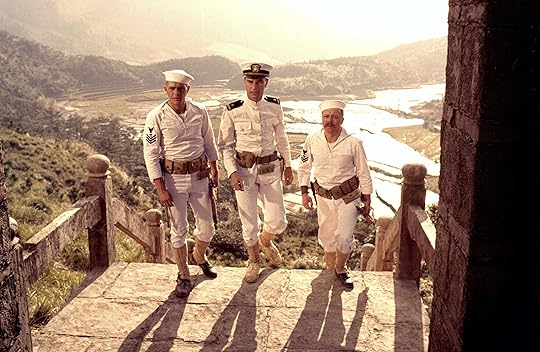
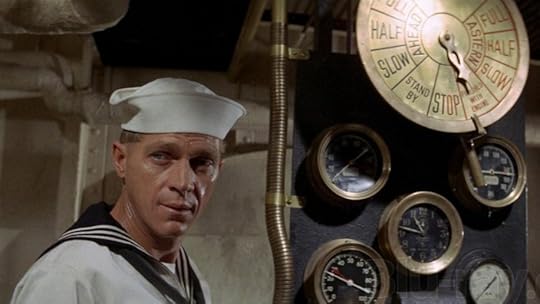
Keay’s book was the obvious choice. It’s the first thing that pops up when you search for “China history book.” The Sand Pebbles was the offbeat choice. Not about China, per se, but set in China. (And also the subject of an awesome movie starring Steve McQueen).

I could’ve flipped a coin, but instead I did the first sentence test. That is, I chose the book by the more come-hither-y first line.

Keay: “China’s economic resurgence in the post-Mao era has not been without its casualties.”

It didn’t exactly light my heart on fire, but it’s enough to get me to sentence number two. But first, I had to give The Sand Pebbles a quick test drive.

McKenna: “‘Hello, ship,’ Jake Holman said under his breath.”

Whoa, whoa, whoa. A man talking to a ship? Tell me more, McKenna.

“The ship was asleep and did not hear him.”

Wait? Now you’re anthropomorphizing the ship? You’ve hooked me.

That’s how I came to read The Sand Pebbles on my trip to China.

(In fairness to Keay, I’m sure his book is a very good overview on China. That’s the consensus, at least. Frankly, I’ll probably never get around to reading it, but it’ll always be on my shelf, a reminder of that time I didn't read it in China).

The Sand Pebbles tells the story of the San Pablo, a United States gunboat patrolling the riverways of China in the late 1920s, just as the country is beginning its descent into a Civil War between the loyalist Kuomintang and the Communist Party of China. Jake Holman, the man first seen talking to the San Pablo, is a new engineer aboard the gunboat. He is something of a maverick (which isn’t a surprise, considering he was played by Steve McQueen), with really high duty marks, but an inability to last very long with any single boat crew.

The story McKenna unspools is almost entirely episodic. There is not a single narrative through line, no accumulating plot. Instead, it’s just life aboard the San Pablo: friction between crew members; rebuilding the engine; going ashore to have drinks. All this, of course, is set against the backdrop of the growing civil unrest. And make no mistake, the essential plotlessness does not mean The Sand Pebbles isn’t going anywhere. It is, and its ending is an emotional gut-punch. But the path to that climax is as meandering as the rivers the San Pablo patrols.

In a book like this, where there is a string of mini-arcs, the characters are the most important thing. At first, McKenna’s dramatis personae read like types: the boat’s commander, Lt. Collins, the uptight martinet; Holman, the enlightened rogue, who can’t fit in the military because he’s smarter than everyone else; the sidekick, Burgoyne, a typical hail fellow well met, who falls in love with a Chinese woman; the coolie, Po-han, who gets taken under Holman’s wing; and the missionary woman Shirley, who helps present the anti-colonial side of the coin.

McKenna does not necessarily shatter these archetypes, but he certainly gives them depth. Almost every character, even the ones on the fringe, are given shading. McKenna’s third-person omniscient viewpoint allows him to enter the thoughts and minds of any character he wishes. Yes, Collins is a priggish disciplinarian, but he is also given scenes in which he ruminates on the hard choices and sacrifices that he’s made to earn his command. Holman is just an absolute nut, in a good way. He is a mass of puzzles and contradictions and even though he is the hero, he can be unlikeable. Yet by the end of the novel, you understand him so well that you know every offbeat choice he’s going to make. He is an amazing creation – absolutely fully realized.

McKenna served on a Yangtze River gunboat in the 1930s, and wrote this in 1962, before the age of political correctness. There was, then, the very real possibility of the racial stereotypes overshadowing the story, especially since the notion of coolies – Chinese men who labored at tasks thought to be “below” white men – doesn’t play very well in the 21st century.

To McKenna’s credit, I thought he did a really good job walking the tightrope – all the better since when he wrote this, he didn't know the tightrope would ever exist. There is racism, of course, both direct and indirect, but it comes from the characters, not the authorial voice. Holman, obviously, is the most enlightened one, believing that the engine room coolies can be made to understand the fundamental working of the engines, rather than just mimicking the motions of their white bosses.

It’d be disingenuous to say that Po-han is as fully developed as some of the other major characters, but McKenna gives him his due. He takes us to Po-han’s hutong, gives him a family, and credibly demonstrates the traditions and hierarchies of his life. As a whole, I thought McKenna did a good job of giving the coolies agency. Through the sailors’ eyes, they are little more than servants who speak hilariously pidgin English. But in the way they “squeeze” the ship, skimming from it in every way possible, McKenna actually shows them to be burgeoning capitalists on the make.

The Sand Pebbles is beautifully written. McKenna is good at the characterizations. He’s good at action (including the immolation of a priest, a dark mob scene, and some sharp gunfights). He is superb at creating the environment in which the story takes place. The San Pablo is rendered in exquisite detail, as are the Chinese port cities – with their narrow allies, close quarters, and near-indescribable smells – and the river itself.

The true flood came quietly in the night. It was a slow, steady rise of water with lazy back eddies and an actual slackening of the current, but it covered and carried away the stinking corpses along the foot of the embankment. It was Yangtze floodwater from the melting snow on the great mountains of Tibet, backing up the Siang and filling Tungting Lake for the summer. Silently, hour after hour, day and night, the broadening brown river swallowed sandbars and crept up the stone embankment fronting the city until the chanting water coolies had only a few steps to climb with their slopping pairs of tins.
Even the dialogue is good. And it introduced me to a new stand-in for the f-word: prong. As in “prong you!” or “prong your mother!” or “we’re pronged!”

This book is a classic. It is a great pronging book.
Profile Image for Brett C.
947 reviews230 followers
July 21, 2025
I thought this was great. The story followed a US Navy boat as it patroled the Yangtze River. It followed the real-world naval deterrent operations of the 1920s when Sailors were deployed to protect American citizens and also act as a show of force against the growing turmoil and civil unrest in China. The story was built around focusing on the individuals of the crew and the bigger surroundings of central China.

The book was well-written in my opinion. The boat crew, the boat, the river, and the onshore Chinese culture all acted as characters in my opinion. The author brought to life the Spartan military life and mundane military drills, individual human behavior, social interactions, and emotions of interpersonal relationships that we experience when in prolonged group environments.

The second aspect that got to me was the dichotomy. This was the beautiful prose that captured the sense of living abroad in Asia of the time: the beautiful picturesque landscape where violence could spring up, being a US service member far from home serving a mission you don't fully understand and the culture clash between American and Chinese.

The main character Holman (played by Steve McQueen in the movie) was refreshing to follow. He grew and developed as a character as the story progressed up through the very end. In fact, I personally have served with many Active Duty that had this initial mentality yet grew under strenuous conditions and came out better people.

Overall this was a great read. It was detail-oriented and focused like the engines in the boat boiler room yet broad and very aware just like the human spirit. I would recommend this and the 1966 film! Thanks!
Profile Image for Jan-Maat.
1,688 reviews2,505 followers
Read
May 17, 2019
We are familiar with the brash side of the USA Vaunting aloud, but racked with deep despair desperately asserting how brilliantly fantastical it and its mission to the world are, this however is a book from the other side of the USA, from the veteran who has come back from Imperial service overseas, gets a higher education and then writes this book, which isn't anti-american as such, but is anti-Imperalist, anti-colonial, and critical of class and racial hierarchies. Of course the men are only in the navy, serving in China in the 1920s, because there was no place for them in the country which they serve. Despite their unsuitability for civilian life in the USA, they are deemed fit for bullying and intimidating Chinese, or as it might be politely termed, protecting US interests in the far East.

To put all this across McKenna opens with a sailor, one Jake Holman, posted to a new ship, the San Pablo which bobs about on the Yangtze in 1920s China. Finding the ship at first sight a bit odd, he heads down below to the engine room, the place where he feels comfortable. Immediately then we have the famous Symbol alert, because down in the engine room Holman seeks in his first days on board to draw up a plan of the plant and trace the tubes and pipe work. So we have the quest to understand what it is all about, how things work and stand in relation to each other, unsurprisingly the ship and her engine themselves have meaning: the engines we learn were originally built by Chinese for the Spanish, the craft was Spanish but was taken as loot by the US after victory in the Spanish-American war she's worn out and decrepit, in the background a new fleet of modern gunboats is being constructed that at some point will be launched and more effectively project US power along the river, but what we see is that the US element on board is a top coat of personnel, indeed barely even that, because over the years the official crew has been supplemented by a shadow crew of Chinese who do all the work - stoking the boiler, cleaning, cooking, shaving the US sailors, tailoring uniforms etc, etc. Their presence is essential but unofficial, they make their money through charges to the crew and stealing stuff or appropriating a percentage of the stores. Eventually, this being a anti-colonialist parable - the Chinese leave and the crew fall apart. Imperialism isn't a simple top down down process, it involves symbiosis and collaborations on both sides, creating varieties of interdependencies. When the Chinese no longer play along and rip up the paper tiger, the crew are shown to have attained a fine degree of learnt helplessness - unshaven, dirty, they divide into gangs and fight over the last onions crying as they eat them like apples . It is, I guess not accidental that it was made into a film during the era of Vietnam, nor that the flag of the Kuomintang is described as a gear wheel throughout.

But I have to wonder how it was made into a film, because aside from symbols big as Moby Dick, gambolling through the water like a Yangtze river dolphin, a novel needs other stuff too it is generally thought, like a plot. Well this book doesn't really have a plot. Instead you have the ship and her crew doing Navy stuff while a certain situation unfolds, which leads reasonably enough to the kind of ending you might expect from an anti-colonial parable . Now I am going to have to explain 'Navy stuff' because I can sense eyes lighting up and a thought process going - 1920s China + US gunboat = Japanese spies and Bolshevik agents, battling warlords, opium dens, gun running, smuggling, people trafficking, adventure, then you'll run out grab the book, read a couple of hundred pages and start to curse me. Some of that stuff happens but not in an adventurous kind of way, by Navy Stuff I mean inspections followed by exercise on deck, doing repair work in the boiler room, sitting down in the mess for some chow, banter and chatter, the Captain's horror when contrary to regulations an enlisted man sits down opposite him wearing dungarees, so Navy stuff. On the back cover of this edition there is a quote from a New York Times review that this is a lusty, action packed tale I guess the reviewer was a person who got over excited when they saw a lawn mower and who was banned by court order from coming within thirty foot of a motor car because the central action of the novel is when Holman takes apart and rebuilds the ship's engine - this resolves a really irritating knocking sound .

Holman does this rebuilding with his Chinese mate, their physical similarity is stressed, Holman struggles to explain in a mixture of pigeon and play-acting how the engine works, but he himself is ignorant of the physics and formal mathematics involved - which the Lieutenant does understand. The work on the engines suggests a new paradigm, not domination and control backed up by violence but sharing, joint labour, and fraternity. The social position of Holman parallels that of the Chinese - falsely accused of bringing liquor to a school social event he is efficiently beaten up by the town's lawman and given a choice by the Judge between the Reform School and the Navy, and the navy at least will pay you...he is still driven by a longing to understand and have some control over his own life. Ditto we observe China, efficiently beaten up by the great powers, obliged to endure their jurisdiction and authority, and seeking to come to terms with the modern world and have some control over their own affairs. Holman is offered an out in the novel, a chance to be become a mechanic at a mission and redeem himself through good works but I do believe anyhow - let us remember history in the near future there will be an incident at the Marco Polo bridge and then later will come 1949 and all that, we know what is ahead of all these people and that has always been an integral part of reading this book which was written and published in the 1960s with a 1920s setting. This a cultural revolution book, a Mea Culpa to the Red Guards.

There are a couple of incidents that could have developed into a plot in the hands of a different writer, both involving sexual politics, as has been noted just because you have Black people and so on that doesn't make the category of White people uncontroversial or straight forward, the technically white US sailors barely qualify as such, their company is felt to be polluting to white women except in certain formal situations, and white Russians are also non-white, legally they are Chinese, Japanese get to be honorary whites, this racism lark is a lot of hard work once you get into it , Liberté, égalité, fraternité by contrast are concepts you can relax with . Socially then, marriage between a sailor and a white woman is impossible, while legally marriage between a sailor and a native person is equally impossible and since this is the 1920s the thought of homosexuality makes the Lieutenant shudder, therefore the results are frustration and prostitution and for some a nagging grey area like a hangover involving a vague boozy memory of a church and a priest with it the delicate question of what constitutes a marriage anyway?

I have a distinct memory of their being a battered paper back copy of this book on my Father's shelves when I was young though he was a book hoarder with an over great respect for books, personally I feel one needs to winnow books and separate the wheat from the chaff, but anyhow years later he didn't have a copy of this or The Red Sailor and moaned about it, however thanks to the magic of the internet, and the US Chief of Naval operations professional reading program, this one was at least easy to acquire. I noticed a couple of his stories were curiously similar to ones from the book - the Chinese shadow crew and a fight in which a little man beats a big man - in this book the one breaks the other's nose while in my father's version the nose got bitten off. Whether this means that Art mirrors life and all service on all warships is essentially a repetitive cycle in which almost everybody who has ever served has seen a little guy best a bigger one by doing something vicious to his nose, or if my father's reading supplemented his own memory in a creative way, or indeed that some stories are simply too big to be merely contained in books as we learn from Don Quixote

It is not a great book, for instance there is a scene when the Lieutenant sits down to have a conversation with the senior man of the Chinese shadow crew and both pointedly don't drink their tea. There are writers who can make you feel that undrunk cup of tea as an unbearable tension, McKenna can't, but you can see were he is going. Equally a lot of the formal stuff of the book, the Navy stuff is pretty boring to write about, but he makes it work in a 'you had to be there at the time' kind of way. It's the kind of book that might be objectively described as subjectively well-loved, rather than truly great. Judging by the other reviews it is not so cack-handed a parable as I have made it sound either, but every reader reads their own book into existence I suppose.
Profile Image for Joy D.
3,140 reviews331 followers
May 23, 2020
Published in 1962, The Sand Pebbles is book about the fictional U.S. Navy gunboat San Pablo, patrolling the rivers and ports of China in the 1920’s. As the story opens, protagonist Jake Holman is just arriving onboard. He is not a typical sailor – he resents the submission to authority and discipline required for military duty. He has been shuffled from one ship to another due to his attitude. He excels at maintaining the ship’s engines.

Holman, as an outsider, is not popular with the crew, but eventually makes a few loyal friends. He takes one of the Chinese laborers under his wing to teach him about engines. He helps another when the friend becomes involved with a local Chinese woman. Jake keeps in touch with a female Christian missionary and teacher he met on his way to his duty station. He forms genuine friendships for the first time in his life. He does not buy into the racist attitudes toward the Chinese and becomes a sympathetic character.

The first half of the book describes shipboard and shoreside life during the era of “gunboat diplomacy” and the second shows the changes brought about by the rise of Chinese Nationalism. Themes include identity, loyalty, courage, class, and power. It is a story of a country on the verge of revolution, and the impact on the forces that previously had the upper hand.

The author vividly portrays the time and place. The first half is relatively tame compared to the volatile second half. The characters are realistic, with strengths and flaws. Jake’s character is particularly well-formed. McKenna includes representatives of the many groups involved in this complex time. The climax is expertly constructed. The reader can sense the characters’ distress in dealing with torn loyalties and painful decisions. The story includes violence and tragedy, but also tenderness and compassion. It is Jake’s story but also provides insight into this period of China’s history. This was one of my grandfather’s favorite books.
699 reviews7 followers
October 16, 2014
In the Navy, stationed in Japan, I was waiting for a seat on a standby Air Force flight when it was announced that flight operations were shutting down for 24 hours for runway maintenance. I had time to kill but there was no lounge, no restaurant, no news stand and no one else around. At least there was a room with a cot available to me. I hadn't brought any reading matter but the day's newspaper since I always slept in flight. Pacing the enormous waiting room to give my hindquarters a break I'd noticed but passed by a seat with an abandoned book; The Sand Pebbles. I recalled that Steve McQueen starred in the movie but I hadn't seen it. The book was still there when I came out of the snooze room several hours later so I picked it up to check it out.

McKenna opens by elegantly showing the foundation of his main character. "Hello, ship," tells more about the man than a chapter of prose by other authors would have done. Jake Holman's ideal assignment would be an engine room with minimum human contact beyond engine orders from the bridge and timely delivery of parts and materials. This is a man who sees the world as an engine and deals with it accordingly, for good and for bad.

By locating the ship where he does, far upstream, McKenna is particularly effective in setting the stage for the inevitable culture clash and inescapable showdown. The normal operation of the ship must carry on while knotty political and personal puzzles defy resolution. As political tension escalates ashore rancor aboard does as well. Some of the San Pablo's crew are aware of their predicament but not of its depth and complexity. The American Navy and the Christian missionaries in the region are similarly, though distinctly, unwelcome. The rebellion aims to drive both groups out.

I've read descriptions calling The Sand Pebbles Shakespearean, slow, colonialist, esoteric, et al. If you're in search of a fast moving plot keep searching. If a protagonist you can identify with is your preference then be aware that this one is not likable but he is admirable. By the time I disembarked at Travis AFB in California I felt that I was meant to have read this book. Highly recommended!
Profile Image for David Putnam.
Author 20 books2,030 followers
April 3, 2019
Loved this book. Couldn't put it down. I don't know how I missed it for all these years. I can not believe McKenna has only one book. Sometimes when that happens its because the author puts his heart and soul into a masterpiece. I Think that's what happened this time. The use of metaphor, and simile, and fantastic character development makes this one a true winner. It was on the New York Times bestseller list for many months when it came out.
An interesting side note: This book is very historical as is The Winds of War (that I just reread after 30 years). Sand Pebbles talks about the rise of nationalism, the shift from a feudal Warlord system to a united national government. In the Winds of War which happens years after the time of The Sand Pebbles describes the rise of Adolph Hitler and what precipitated the war. In many ways both are similar. Strangely, it's not too difficult to draw parallels to what is happening in our world today.
David Putnam author of The Bruno Johnson series.
Profile Image for Sara.
Author 1 book941 followers
March 13, 2017
4.5 stars- rounded down.

It is China 1926. Chiang Kai Shek’s Kuomintang is on the rise and China is on the brink of eruption. Jake Holman is a sailor on the American gunship, San Pablo, and he and his shipmates will be at the center of the explosion, as the Chinese begin to expel foreign interests from their country.

Holman is a misfit. He loves and understands the engine, the machinery for which he is responsible on the ship, but he does not understand people very well and knows little or nothing of love. His feelings about the Chinese are not quite in line with his fellow seamen and he befriends and trains a coolie who helps him to see the Chinese as individuals rather than as a class of people to be exploited for labor or sex. He is more aware and more open than those around him, and that does not always serve him well in dealing with those he encounters.

Then there are the missionaries, and particularly Miss Eckert. If you have seen the movie made from this book (a wonderful thing starring the inimitable Steve McQueen), you will expect a more robust love story than you will get between these pages. The romantic angle works for the movie, but here McKenna seems to be making a much different point in having Miss Eckert as part of his tale. She is the unattainable dream and sometimes the motivating force for Holman, and even when he steeps himself in thoughts of her, she eludes him. For each of these men, trapped aboard a small ship in a world that they do not understand and of which they are truly not a part, there is something that pushes them through the frightening situation they are in, and for Holman it is Shirley Eckert.

There is a great deal of detail here about the workings of the engine, the daily lives of the crew and the onboard coolies, the marches and political dealings of the revolutionaries and the rules that operate between the powerful nations that seem to want to divide China between them and the Chinese who are its life’s blood. The details are never boring and always informative of the plot. Nothing is unnecessary or misplaced. I closed the book understanding much more about the era it addresses and the individual characters portrayed.

I have had this book sitting on my library shelf for a number of years, and I am so glad that I did not allow it to sit any longer. I gave a dollar for it on a bargain table...talk about getting your monies worth!
Profile Image for Aaliyah.
7 reviews13 followers
November 26, 2022
there is a poignancy to the plight of a sailor in war time. trapped in a hard vessel, trapped with emotion of the absurdness of chaos. The doomed love story of this novel makes it timeless. The ending makes it memorable. The movie is also good.
Profile Image for Rod.
109 reviews57 followers
October 7, 2019


The year is 1926; the place, Hunan Province, China, on the Yangtze River. Revolution is in the air, as the Kuomintang movement vies to free China from the unequal treaties from the Boxer Rebellion and from the pervasive presence of western gunboats patrolling the rivers, exercising what is known as “gunboat diplomacy.” Jake Holman is a ship’s engineer, a machinist’s mate beginning a stint on the U.S. gunship San Pablo, an iron-hulled, coal-burning relic of the Spanish-American war. The crew are nicknamed the "Sand Pebbles," thus providing the novel its name. The story centers around Holman—a classic rebellious military iconoclast in the vein of Prewitt from From Here to Eternity—but the view is wide-ranging, providing sympathetic yet unsentimental portrayals of both major and minor characters, from the lowliest engine coolie to the ship's officers, to the idealistic missionaries who often find themselves at odds with the Navy men. All viewpoints are represented, allowing the reader to decide who is right (everyone, at one point or another) and who is wrong (also everyone, at one point or another).

One review blurb on an old paperback edition said "It carries no pot of message: its purpose is simply to excite and entertain." Although it is exciting and entertaining, I couldn't find that blurb any further off the mark. This is a remarkably intelligent, thoughtful book that leaves the reader pondering it after the last page is turned.

This was McKenna’s first and—sadly—only novel, as he died shortly after its publication. A writer of great talent, he undoubtedly had more great novels in him had he lived.
Profile Image for Sweetwilliam.
175 reviews63 followers
June 26, 2023
It was a good movie and a very good book. I spent the winter watching classic war movies from the ‘60s and 70’s. When I read that the book for which this movie was based upon was recommended by the Chief of Naval Operations as part of the USN’s professional reading program, I was intrigued. I had to read it. It took a while, but at about the 150-page mark, I became hooked. I read about 200 pages during a flight over to Europe and I finished it after about the 2nd day of the Mediterranean that I was on.

The author, Richard McKenna, served on a US Navy gunboat on the Yangtze River in the early 30’s and wrote this book based on the sea stories from the old salts that he served with that lived through the revolution in the 20's. I was moved by the story of the Chinese coolie, Po-han and the Engineer, Jake Holman and how they developed a true friendship based on their love and mutual respect for the ship's boiler. Their love of the machine helped break through a caste system as old as humankind. What I’m trying to figure out is what are the lessons or “take-aways” that the Navy wants their personnel to learn from this book? Some are obvious. First, the Navy had unofficial personnel on board, sort of like contraband, doing the job of basic seaman. They were paying them with waste streams from the ship. When these coolies left the ship during the revolution, the crew could no longer run the ship effectively. Also, Lieutenant Collins wanted to transfer Jake Holman back out into the fleet because Holeman wanted to do the job that he was trained for. There were all sorts of examples of how not to run a ship.

The book was also a lens into China before it became a modern nation-state. I'm no fan of Mao or Chiang Kia Shek but this book was full of all kinds of embarrassing conduct toward China and the Chinese by the Western powers. I realize that many Americans had empathy for the Chinese, and we supported by donated to the missionaries. For example, we grew up by hearing at the dinner table "they're starving in China." I just never figured out how me eating Brussels sprouts and liver was going to help the children of China. I digress but read the book and realize that in the past 100 years, China has come a long way.

I loved the book.

Update: After writing this review I decided to watch the movie for probably the first time in over40 years. The movie started well but strayed way too much from the book. I take comfort to know that the author was not alive to see the butchery of his book.
Profile Image for Judy.
1,965 reviews461 followers
July 12, 2017


This very long but extremely interesting novel was the #9 bestseller in 1963. I have completed the bestseller portion of that year's list. Now I am on to the Award winners of the year, of which there are six.

The Sand Pebbles are a nickname for the crew of the San Pablo, an old US Navy gunboat whose job is to patrol the Yangtze River, show the US flag, and protect American missionaries and businessmen. The story covers the years 1925 to 1927. Chiang Kai Shek was in those years a fairly young Chinese communist fomenting a revolution to do away with the power of the ruling dynasty, the war lords, and the unequal treaties that foreign businesses benefited from in China.

Jake Holman, a machinist, as the central character, is a rebellious loner who loves machines more than people. He ended up in the Navy as an escape from incarceration in his poverty-stricken small hometown. He hates authority figures and has no use for military regulations and procedures but he excels at keeping the San Pablo's steam engines running.

This is a big sprawling book but McKenna does an excellent job of melding story lines, building characters both American and Chinese, and keeping the excitement and tension high. As the political scene heats up, the San Pablo and its crew face danger, ridicule and even heartbreak. Jake grows into a man who does find many kinds of people he can relate to and possibly a way to deal with life.

According to the Introduction, the research is accurate. I was glad I read that first because I knew very little about that period of Chinese history. Thanks to the novel and a bit of internet study, I now know much more. My husband says he remembers seeing the novel on his mother's bookshelves when he was a kid. A movie starring Steve McQueen as Jake Holman came out in 1966.

Sailors, whores, coolies, communists, missionaries, warlords and what a plot! One of the best of the 1963 bestsellers.
Profile Image for Ming Wei.
Author 20 books288 followers
December 24, 2020
Really well writen book, a USA boat patrolling on yangtze patrol in China during the 1920s, a service the USA conducted for quite a few years the purpose being that they were looking after their own interests in the regions, from trade, to church people that were stationed through China. This story is focused upon one boat, and follows their journey, from encounter with Chinese militaries and rebellions of that period. The 1920s were a changing time for China, many fractions fighting for domination of their lands, influencing the local Chinese people to dislike foreigners. this book is well written, very detailed, a fascinating storyline, adventure, war, changing political climate that is moving in a more brutal direction, rescue all mixed together, anybody who likes the movie will enjoy reading this book, no editorial errors in the book, nice book, a sort of "Sixth sense of happiness" on water. Well wotth reading, a classic, the author style pulls the reader deep into the book, you feel like you are on the boat, the chapters are of a nice length, wish there was more books and it was a series.
Profile Image for Chrisl.
607 reviews85 followers
February 23, 2019
This time through, I most appreciated how much McKenna revealed about bizarre gunboat diplomacy in China less than 100 years ago. Not at all mechanical myself, but enjoyed how Jake taught Po-Han the spiritual elements of missionaries and steam engines. Did not finish this time, because I knew what was coming.
Profile Image for Richard.
225 reviews49 followers
December 16, 2025
This is a story rich in historical relevance and in character development. It is centered on Jake Holman, Machinist's Mate 1st Class who is transferred to duty on a U.S. Navy gunboat during the early days of the violent Chinese Revolution in about 1926. He utters the novel's first words, "Hello, ship" as he sizes up the "San Pablo" at its dock. Holman is a very intelligent, industrious sailor who has a love of learning. He knows everything about the steam-powered engines in ships and wants to spend his career deep in the pits of a ship's engine room, where he can be in charge of his own little part of the Navy and not be bothered by the military's love of ceremony and spit-and-polish. This is one reason he is happy to move from the hubub of life in the Navy's large Pacific fleet to the slow life of summer cruises up and down the Yangtze River in a small, slow ship.

Events conspire to pierce Holman's bubble. He finds that the small command of the "San Pablo", nicknamed the "Sand Pebble" by its crew, is still subject to Navy protocol because its captain, Lt. Collins, is a by-the-book commander who insists on daily morning formations in dress whites; Holman chafes at spending time standing at attention while his engine room demands his attention. Worse, the regular Navy guys have virtually nothing to do except drill at battle stations according to the captain's whim. All of the boat's jobs have been taken over by coolies. They cook the food, cut hair, and swab the decks. Even the engine room is run by Chinese who run the spotless machinery according to learned imitation. Holman is appalled to see sailors living in this extravagance while the important mechanical tasks are run without strict supervision. This is exasperated by the realization that foreign nationals have permanent quarters on a U.S. Navy ship which could expect to find itself in battle with Chinese brigands on the river.

Richard McKenna writes about a world he is intimately familiar with. He was a top student in high school in Idaho where, as a young man, he kept the local library busy getting new books to keep ahead of his ravenous reading appetite. He joined the Navy to help support his family when the Great Depression cut his college plans short. He served a hitch on a Navy gunboat on the Yangtze Patrol in the 1930's, where he heard many first-hand accounts from old salts who had been on gunboats during the 1920's. He continued reading and taking correspondence courses available to sailors while becoming a machinist mate; he would serve for over twenty years, including World War II and Korea. Entering the University of North Carolina in 1953 at age 40, he excelled as a student while studying literature and science; he graduated Phi Beta Kappa. A short story he wrote, "King's Horsemen", about life on a Yangtze gunboat, became the foundation for "The Sand Pebbles", complete with the author's reverential respect for the workings of ships' engine rooms.

Reviewer's note: The historical period covered by "The Sand Pebbles" occurs during the 1925-1927 Chinese Revolution. Unrest had existed in China for several generations against the foreign governments which muscled into China in the nineteenth century to help themselves to the country's wealth while holding their behavior accountable to themselves. These imperialist interests represented Great Britain, France, Germany, Russia and the United States (am I missing anybody?) They operated out of treaty ports where they controlled the trade. Most used river boats, or gunboats, to patrol the major waterways to protect passenger and cargo commerce from warlords and bandits. The U.S. Navy relied heavily on three or four (depending on who you consult) Spanish-built wood vessels seized in the Phillippines during the Spanish-American war. The San Pablo is allegedly modeled after one, the "Villabobos." By the 1920's, these ships were antiques. They were lightly armed, with a single low-caliber deck gun as the sole permanent firepower, augmented by machine guns and other small arms wielded by the crew. Their aging engines were relatively weak, preventing the ships from sailing into the full length of the Yangtze. In the late 20's, after the events of this book, the Navy commissioned six new gunboats which replaced these relics. One of them, the "Luzon", would be the one Richard McKenna served on from 1939 until the beginning of World War II.

McKenna places Holman on a gunboat when things were getting dangerous along the Yangtze and in China's major cities. The author doesn't bore the reader with background information, letting the action speak for itself. However, it can be a little confusing to the non historian what is going on here: A powerful nationalist party, devoted to land reform and to expelling foreigners, had been formed under Sun Yat-Sen. His party, the Kuomintang (KMT), fomented unrest among students and workers, with assistance from the Stalinist communist bureaucracy in Russia. He would send his hand-picked successor, the future cold-war anti-communist stalwart, Chiang Kai-scheck to Russia in 1923 to strengthen the KMT's ties to Stalin and Trotsky. Chiang became KMT leader after Sun's death in 1925. The revolution began that year after British police gunned down twelve people striking a Japanese mill in Shanghai. Soon, Shanghai, Hong Kong and Canton would become paralyzed by general strikes. KMT military forces would be attacking warlords in the countryside in an effort to unify the country, while posing a serious threat to the military forces of the foreign occupiers. Communists within the KMT, headed by Mao Zedong, would grow increasingly mistrustful of Chiang's loyalty to their mutual goals, but for the duration of the three-year revolution they would be held within the KMT in order to comply with the wishes of their Kremlin sponsors, who continued to have faith in Chiang at this time. Enough history.

The main thing which made Holman a loner was his insistence on doing the right thing, even if it meant bucking the accepted norms. His sense of personal responsibility included his refusal to look the other way when standards were being ignored in a work area, such as when untrained coolies were opening and shutting valves in a ship's engine room. Lt. Collins would not allow him to train more sailors to assist him, but he did allow him to go ahead and choose a Chinese engine room laborer for this purpose. Holman chose the energetic and smart Po-han, and they engaged in a tutoring program, with the master machinist Holman patiently pointing out the proper function of every valve and the route of every pipe in the place. This began the unraveling of morale among the Sand Pebbles, as the crew was known. The head coolie of the ship already was highly agitated at Holman's assertion of authority over the engine room, including its coolie staff; now there would be widespread Chinese resentment of one of their own working so close with a foreigner. The ship's crew hated the idea of a coolie being granted the privilege of learning how a ship operated, and would dislike Holman for treating a Chinese as an equal.

Holman would have one friend on the ship besides Po-han. Frenchy Burgoyne worked with him in the engine room. Frenchy would become involved with a Chinese girl, Maily, whom he saved from being sold into prostitution. Holman's existential predicament would deepen as he witnessed the tragedy which would afflict the lives of these three individuals.

Another significant relationship would develop, between Holman and the new schoolteacher arrived in China, Shirley Eckert. Shirley would be traveling on the gunboat with Mr. Jameson to his China Light Mission. Jameson was as idealistic an individual as a missionary could be. He believed his mission did not need American naval protection, and he engaged in a bitter debate with Lt. Collins over this issue. Although at this time Holman, representing the rough and tumble sailor's world, would not be seen as a candidate for the affections of an educated lady like Shirley, they nevertheless become close friends in the short time available before she started her duties. She was immediately attracted by his thoughtful way of talking with her, and he started to question what his priorities were after seeing her perspective on life. The story unfolds to the point where nationalist forces threaten to overtake the region where China Light is located, and Lt. Collins mounts a mission to sail the ship to rescue the Americans there. Mr. Jameson and Shirley take the position their good deeds will make them safe from the approaching marauding Chinese forces; Holman makes a decision that could brand him as a deserter, if he lives; and the ensuing attack by the Chinese forces everyone to take drastic actions within a context of high suspense. This is not a book with a predictable or happy ending, making it the more engaging and realistic to read.

Holman is given a great last sentence at the end of the terrific 1966 Robert Wise-directed movie of "The Sand Pebbles", starring Steve McQueen, Candice Bergen, and Richard Crenna. Although these words appear at the end of the movie and do not occur in the book, they perfectly describe Holman's situation, when he says, "I was home - What happened? What the hell happened?"
Profile Image for Czarny Pies.
2,831 reviews1 follower
May 17, 2019
Porté à l'écran avec les légendaires Steve McQueen et Candice Bergen dans les rôles principaux, Sand Pebbles est un des plus grands romans d'amour de la littérature américaine. En même temps il contient un analyse minutieuse des relations entre les gens qui semble venir de la plume d'un sociologue français. En particulier, Sand Pebbles fait penser à "Prospero et Caliban" d'Octave Mannoni qui soutient la thèse que dans la situation coloniale les rapports sociaux sont réglés par un grand nombre de rites qui soutiennent le pouvoir du colonisateur sur le colonisé.
Les événements du roman se déroulent une année avant l'insurrection de Shanghai de 1927 décrite dans la "Condition humaine" d'André Malraux. Le protagoniste Jake Holman, un mécanicien de navires à vapeur se présente sur un bateau de la marine américaine qui patrouille le Yang-Tsé loin en amont de Shanghai. Il est surpris de constater que les repas sont préparés par des coolies chinois qui ne devaient pas être en principe sur un navire de la marine américaine. Il est outré quand il découvre que les chinois travaillent comme mécaniciens dans la salle de machines.
Holman se plaint auprès du capitaine. Il explique que les coolies ne sont pas nullement qualifiés. Il dit au capitaine que les opérations dans la salle de machines est une singerie. Le capitaine lui explique que toute l'entreprise impérialiste en Chine est une singerie. Dès que l'on change les pratiques traditionnelles, les Chinois verront que la puissance des pays impérialistes est une illusion et ils les chasseront de leurs pays. Le capitaine ordonne à Holman de se taire et de suivre les pratiques traditionnelles. La suite des choses va prouver que le capitaine a très bien analysé la situation.
Ensuite, le lecteur verra quel impact qu'ont les lois et les coutumes de la Chine coloniale sur l'amour entre les petits gens. Un marin tombe amoureux d'une chinoise mais il ne peut l'épouser car les lois interdisent les mariages entre les américains et les chinoises. Un autre marin tombe amoureux d’un russe. Cependant, parce les bolchéviques ont renversé le Tsar, elle n'a pas de passeport et devient une chinoise aux yeux des américains.
Le problème est un peu différent pour Holman qui tombe amoureux d'une jeune institutrice qui travaille dans une mission chrétienne. Les missionnaires ne permettent pas à leurs institutrices de fréquenter des marins parce que les marins soutiennent un régime qu'ils détestent. Les pays occidentaux ont chacun des ports où ils reçoivent les douanes et possèdent un monopole sur la vente d'opium. Les missionnaires sont de l'avis alors que les marins font partie d'une entreprise immorale qui exploite les chinois. Leurs attitudes semblent enlever tout espoir à Holman d'épouser l'institutrice.
À ce moment, Chiang Kaï-chek ayant pris conscience de la faiblesse des pouvoirs occidentaux déclenche la révolution anticipée par le capitaine. Ce qui va suivre est une hécatombe dans laquelle presque tous les personnages majeurs et mineurs du roman vont périr. L'histoire du sort tragique du protagoniste Jake Holman touche profondément le lecteur. Le portrait de l'époque historique est brillant. Sand Pebbles est un grand roman américain qui mérite d'être mieux connu.
Profile Image for Sallie Dunn.
894 reviews110 followers
December 12, 2024
⭐️⭐️⭐️⭐️.5

The Sand Pebbles is one of my favorite types of fiction. Set in 1926 on a gunboat on the Yangtze River in China, it’s the story of a loner, Jake Holman, who has joined the Navy, mostly because he is not sure what to do with his life. He has been trained as an engineer, and he loves his machinery more than he does his shipmates.

The author, Richard McKenna, served in the same capacity on a gunboat on the same river about 10 years after the setting for this novel. No wonder he can write the story so authentically.

In the bigger picture, this book is about American Imperialism and racism in the stated time frame. As the story progresses, Chiang Kai-shek is coming into power; he awakens a sense of nationalism in the Chinese people, which up to that time was never felt. Jake is different, because he treats the Chinese workers on the ship with respect, which makes him very suspect by his fellow crewmen. Some of the arcane rules of the era are hard to believe. An American serviceman could not marry a Chinese lady, he couldn’t find a preacher to perform the service, and if he married her anyway using “native” ceremonies, the American government refused to acknowledge his spouse or the marriage.

All in all, I enjoyed the plot, and learning more about that time in history.

The ATY Goodreads Challenge - 2024
Prompt # - a book related word to Boats, Beaches, Bars, Ballads or Jimmy Buffet
Profile Image for Checkman.
606 reviews75 followers
January 27, 2023
An interesting book written by a navy veteran who was stationed in China in the 1930's. He knew men who experienced the time period covered in the novel and I suspect that Jake Holman is based on the author himself.

Richard McKenna was a career Navy man who (after retiring from the Navy) went on to earn a college degree before dying at a young age in 1964. A gifted writer he had the ability to transport the reader to the time and place. He makes the setting come to life.

Like Holman the novel takes a neutral stance on the political situation in China during the 1920's. There is no condemnation of the U.S. military presence in China nor is there any adulation of the revolutionaries. It's simply a story of a man who prefers machines over people but finds himself in a situation where he is forced to deal with people. And people are messy and unpredictable. Unlike Holman's beloved engines.

Holman would prefer to stay out of all the drama, but events dictate otherwise. Like it or not he's pulled into the whole mess.

Both an adventure novel and a drama The Sand Pebbles is an easy read and one that has aged well.
Profile Image for David Lucero.
Author 6 books204 followers
December 15, 2016
I bought the book because I loved the movie! It's one of my favorites with Steve McQueen, Richard Attenborough, Richard Kenna, and many more actors who eventually became famous in later years. The script, musical score, scenery was beautiful, so I chose to read the book. I was not disappointed.

Thankfully, the movie followed the book closely.

It's during the Chinese revolution when The U.S. Navy operated deep inside China on small gunboats the size of a small freighter. It was a self-sustaining vessel with a crew of maybe 30. They reminded me of the early-day boats traveling up the Mississippi River. The crew get caught in the middle of the revolution, and the main character (as in the movie) falls in love with the daughter of a minister.

The author actually spent time on one of the gunboats during his service in the Navy. He writes in fine detail of the now-historical events that eventually launched him to fame as an author. Despite China being on the far side of the world, it was important to have our presence there and document events. I highly recommend this book. You will find insight on how the revolution effected millions of people, how a small band of Navy sailors lived, and what they went through. This is a book for those who like to read historical adventures with romance, with a touch of fiction which you know may have very well been true.

David Lucero, author
Profile Image for Brendan.
Author 7 books13 followers
March 21, 2012
This is one of those great, big, impossible-to-put-down works of historical fiction that is guaranteed to send any modern-day historical fiction writer into the dark pits of dispair that they have been born into the wrong era. Why??? Because McKenna got to write a big book full of color and fascinating characters and IDEAS!! My God! the the ideas he was allowed to play with! He writes about steam engineering in a way that compares to Robert Pirsig's "Zen and the Art of Motorcycle Maintenance" The other idea he deals with is CHINA!!

The Sand Pebbles is about a sailor, a machinist's mate, assigned to a gunboat patrolling on a tributary of the Yangsee River during the 1920s. The gunboat, the USS San Pablo is kind of a floating joke, an old boat acquired as a prize during the Spanish American war, rebuilt with a massive superstructure and an American Steam engine, it represents the furthest reach of American Imperialism in china. The crew live a fat life with almost all the work performed by Chinese Coolees. Needless to say, the get overtaken by events of history.

Richard McKenna was himself a China sailor on the Yangsee before the war and he was writing about the generation before him. He wrote one great novel and I don't think he lived long enough to see it made into a blockbuster movie starring Steve McQueen. the movie was great, but the novel was way better. I recommend this book, and the movie to nearly anyone I snaggle into a conversation
404 reviews6 followers
April 14, 2013
This is one of my favorite books ever. But what is it about? On the surface, it's about American sailors in China trying to do their job without interfering with the developing communist revolution. But you can't avoid the tidal wave of history, and get involved they do. There's forbidden love and dangerous love. There's the struggle to do what's right. There's the problem understanding the culture where you're living. It all leads to an exciting and sad conclusion. The writing is crisp and it's easy to immerse yourself here. I forgot I was reading and actually saw myself on the San Pablo in China.
4 reviews1 follower
March 14, 2008
Among the memorable openings of great novels: "It was the best of times, it was the worst of times",and "Call me Ishamle",add to them, "Hello ship." The Sand Pebbles is one of a few novels I reread every 5 years or so. Age and experience lent a new depth to my latest reading. Incidents from the plot I thought I had well remembered were different and therefore somewhat fresh. I saw the movie as a child before I read the novel so I have ready images of all the characters and action,and I knew how it ended. Obviously, this does not stop me from visiting the crew of the San Pablo now and again, in spite of the tragedy that unfolds for them.
I believe my military experience gives me a perspective of familiarity with the characters and the action a non veteran would not posses. I think I enjoyed the book more because of the subtle insights my experiences gave me, but there is no way a non vet would not enjoy this adventure.
The reader is provided an accurate discription of turn of the 20th centruy China. The minds eye fills with teeming peasants, dirty water, trash strewn bund, and the heart understands why the sailors there called it home.
Profile Image for Olethros.
2,724 reviews534 followers
May 18, 2016
-Menos valorada de lo que tal vez merecería.-

Género. Novela (no histórica porque aunque está muy bien localizada en los eventos de un tiempo y lugar concretos prefiere hacer ficción como eje central de su trama).

Lo que nos cuenta. En 1926 y en China, Jake Holman, maquinista de la armada estadounidense, es destinado a la cañonera USS San Pablo, una antigualla que data de la Guerra de los Bóxers pero que todavía presta servicio de patrulla en los afluentes más apartados y desconocidos del río Yangtsé. El país está en un momento muy tenso tanto por movimientos internos como por la actitud cada vez más hostil con los extranjeros en el país. El ambiente en el barco, entre los soldados norteamericanos y la tripulación local china, es un reflejo del problema en la nación. Libro también conocido como “Los granos de arena”, título mucho más ajustado al original.

¿Quiere saber más de este libro, sin spoilers? Visite:

http://librosdeolethros.blogspot.com....
Profile Image for David.
Author 1 book73 followers
April 23, 2025
Upon having seen the movie when it came out, I later read "Sand Pebbles" while in Pasadena, Texas, my home town. It made me a little more aware of the modern history of China. It would be good to read this book along with or after having read the following books that I have also reviewed: "The Good Earth" by Pearl S. Buck, "Report from a Chinese Village" by Jan Myrdal and perhaps even "Balzac and the Little Chinese Seamstress" by Dai Sijie.
Profile Image for Sean Smart.
163 reviews121 followers
August 8, 2013
A very good story - nearly as good as the classic Steve McQueen film.
Profile Image for Ruth.
4,713 reviews
July 23, 2011
c1962. Extraordinary book. It is very easy to read and the pace is maintained all the way. Probably because it was written initially to be serialised in a bimonthly magazine - the Saturday Evening Post. "Four things were important on a ship: bunk, locker, place at the mess table and the engine room. The engine room was most important, because it as Jake Holman's sanctuary from the saluting and standing at attention and saying sir that went with life on the topside. Monkey-on-a-stick life, he called that in his thoughts." That is just so descriptive of the motions of ratings on board a ship. This story has not dated at all and I was quite frightened by the descriptions of the Boxers. I did not realise that this book won the 1963 Harper Prize Novel Contest but it was surely well deserved. I agree with every word (if not the grammar) in the following statement: ""What I like about The Sand Pebbles," writes Elizabeth Janeway, one of the distinguished judges of the Harper Prize Novel Contest, "is its vitality and scope, its vivid sense of life and time and place; the way it gets outside people's minds and into what happened. McKenna has done a particular kind of thing and done it brilliantly-written about how the world works and done it as a novelist should, by recreating a bit of the world (a fresh bit) and showing us how it operates." Highly recommended.
Profile Image for James Henderson.
2,225 reviews159 followers
November 8, 2022
One of my favorite historical novels is The Leopard by a Sicilian Prince, Giuseppe Tomasi di Lampedusa, the last of his line. In 1957 he responded to a lifetime of loving books by taking up writing and telling a harsh, beautiful tale of self-destructive aristocrats in a self-destroying land. He died before knowing that The Leopard had a publisher, or that it would come to be regarded as Italy's finest novel and the best historical novel of this century.
In in similar fashion an American,Richard McKenna, after a thirty-year career as an enlisted man in the U.S. Navy working through ranks in engine rooms, often in gunboats in or near China, responded to his lifetime of loving books by taking up writing in the late 1950s. As a result his historical novel, The Sand Pebbles, has a depth of knowledge of real life in a real place that reminds me of Lampedusa's achievement. Set in China, the book tells the story of an old U.S. Navy gunboat, the San Pablo, and her dedicated crew of "Sand Pebbles" on patrol in the far reaches of the Yangtze River to show the flag and protect American missionaries and businessmen from bandits. I found the novel a great read when it was first published five decades ago and remember enjoying it immensely.
Profile Image for Marc Baldwin.
65 reviews2 followers
September 19, 2012
It seems like I give every book that I read four stars, and here's another one. I'd seen the movie (years ago) and was hoping that the book would provide a bit more background and character development. It didn't disappoint. There is so much more to the lead character, Jake Holman, then is touched on in the movie.

I also found the subject of "unequal treaties" in China in the 1920's to be an interesting parallel with the current situation in Afghanistan. They aren't the same thing, but some of the dialogue in the book between the missionaries and the U.S. Navy riverboat personnel could just as easily be overheard today in a Starbucks debate.

A long book, but I never reached a point where I couldn't wait for it to end. I didn't remember the ending, and because of that I easily remained engrossed in the book.
Profile Image for Bob Mayer.
Author 210 books47.9k followers
August 1, 2021
The novel delves more deeply into Chinese culture than the movie. The story of an outsider in a different world both small (San Pablo) and large (China).
Profile Image for L.G. Cullens.
Author 2 books96 followers
May 24, 2020
I read this book maybe back in the 70s. That I remember much of the story these many years later indicates it must have been interesting. I know there was also a movie based on the book, but don't recall how true to the book it was.
Profile Image for Calzean.
2,770 reviews1 follower
September 20, 2021
This one was a real surprise. I remember reading it as a teenager but had forgotten what a great story and what an interesting character Jake Holman was.
The book is about the fictional U.S. Navy gunboat San Pablo, patrolling the rivers and ports of China in the 1920s. Holman arrives as a replacement engineer but finds difficulty in fitting into the crew where local Chinese workers do most of the work and the crew is focused on military duties. Holman hates military duties and love playing with the engines.
The real story is Holman's empathy for the Chinese and their desire for independence which contradicts with his military role. As well there is his relationship with a young missionary and that with the thoughtful Captain of the ship. All of these elements combine into a fine period piece of anti-imperialism and China's history in the 1920s.
Displaying 1 - 30 of 166 reviews

Can't find what you're looking for?

Get help and learn more about the design.