Jump to ratings and reviews
Rate this book

The Prince of the Marshes: And Other Occupational Hazards of a Year in Iraq

Rate this book

In August 2003, at the age of thirty, Rory Stewart took a taxi from Jordan to Baghdad. A Farsi-speaking British diplomat, he was soon appointed deputy governor of Amarah and then Nasiriyah, provinces in the remote, impoverished marsh regions of southern Iraq. He spent the next eleven months negotiating hostage releases, holding elections, and splicing together some semblance of an infrastructure for a population of millions teetering on the brink of civil war.

The Prince of the Marshes tells the story of Stewart's year. As a participant, he takes us inside the occupation and beyond the Green Zone, introducing us to a colorful cast of Iraqis and revealing the complexity and fragility of a society we struggle to understand. By turns funny and harrowing, moving and incisive, this book amounts to a unique portrait of heroism and the tragedy that intervention inevitably courts in the modern age.

448 pages, Paperback

First published January 1, 2005

305 people are currently reading
2963 people want to read

About the author

Rory Stewart

35 books708 followers
Rory Stewart was born in Hong Kong and grew up in Malaysia. He served briefly as an officer in the British Army (the Black Watch), studied history and philosophy at Balliol College, Oxford and then joined the British Diplomatic Service. He worked in the British Embassy in Indonesia and then, in the wake of the Kosovo campaign, as the British Representative in Montenegro. In 2000 he took two years off and began walking from Turkey to Bangladesh. He covered 6000 miles on foot alone across Afghanistan, Pakistan, India and Nepal -- a journey described in The Places in Between.

In 2003, he became the coalition Deputy Governor of Maysan and Dhi Qar -- two provinces in the Marsh Arab region of Southern Iraq. He has written for a range of publications including the New York Times Magazine, the London Review of Books, the Sunday Times, the Guardian, the Financial Times and Granta. In 2004, he was awarded the Order of the British Empire and became a Fellow of the Carr Centre at Harvard University. In 2006 he moved to Kabul, where he established the Turquoise Mountain Foundation.

In 2010 he was elected as a Conservative member of the British Parliament. In 2014 was elected chair of the Defence Select Committee. He served under David Cameron as Minister for the Environment from 2015 to 2016. He served as a minister throughout Theresa May’s government as Minister of State for International Development, Minister of State for Africa and Minister of State for Prisons. He ultimately joined the Cabinet and National Security Council as Secretary of State for International Development. After May announced she would be stepping down, Stewart stood as a candidate to be Leader of the Conservative Party and Prime Minister of the United Kingdom in the 2019 leadership contest. His campaign was defined by his unorthodox use of social media and opposition to a no-deal Brexit. He stated at the beginning of his campaign that he would not serve under Boris Johnson and when Johnson became prime minister, in July 2019, Stewart resigned from the cabinet.

On 3 October 2019 Stewart announced he had resigned from the Conservative Party and that he would stand down as an MP at the next general election. He initially put himself up to be an independent candidate in the 2021 London mayoral election but withdrew on 6 May 2020 on the grounds of the election being postponed due to COVID-19, saying he could not maintain the campaign so long against the big budgets of the Labour and Conservative campaigns. In September 2020 he became a fellow at Yale University, teaching politics and international relations.

Ratings & Reviews

What do you think?
Rate this book

Friends & Following

Create a free account to discover what your friends think of this book!

Community Reviews

5 stars
1,053 (34%)
4 stars
1,398 (45%)
3 stars
550 (17%)
2 stars
85 (2%)
1 star
10 (<1%)
Displaying 1 - 30 of 315 reviews
Profile Image for Daren.
1,567 reviews4,571 followers
April 15, 2022
This is a fantastic book by Rory Stewart, but that doesn't make it easy to review...
I note this book is also published under the title The Prince of the Marshes: And Other Occupational Hazards of a Year in Iraq .

Stewart spent around a year in post-Saddam Iraq in 2003, where he served in the Coalition Provisional Authority as acting Governor, then Deputy Governorate Co-ordinator of Maysan (Southern Iraq, on the Iran border, part of which comprises the Marshes made famous by Wilfred Thesiger); he was then transferred to another province, Dhi Qar, to the south west of Maysan, where his title was again Deputy Governorate Co-ordinator.

What this book demonstrates very clearly is the impossible task set of the CPA. It becomes almost farcical the attempts at setting up an interim provincial council, then empower them to elect a governor and establish budgets to effectively be able to run the country after power was to be handed over.

Saddam's rule had been a hotbed of corruption. He had installed Baathist's into all key roles and oppressed violently all minorities, tribal people and well, basically, everyone. In the wake of Saddam's removal from power, Iraq society splintered into factions, all of who opposed each other. Stewart's key tasks were preparation of the province for elections (although it was deemed too early, and so an interim provisional council was to be formed to begin with); to funnel (huge amounts of) money into public works to reconstruct infrastructure (water & irrigation, electricity, civil works), schools, hospitals etc; to establish employment schemes and overarchingly, to promote peaceful and civil governance in the province. This was occurring simultaneously in each province.

In his role, Stewart took to engage with the Iraqi factions. He dealt with leaders one to one, he encouraged them to come to him with their complaints and he worked hard (often around the edges of policy and rules) to encourage their cooperation. Unfortunately for Stewart, he never gained the trust of the most powerful individual in the province - the Prince of the Marshes. In fact, more than that, this book becomes a catalogue of his ongoing battle to limit the influence of the Prince and the Princes efforts to undermine and create problems for Stewart, and perhaps the Coalition in general.

Other than the Prince and his Ma'dan (Marsh Arabs), the other factions included the Iran-backed Islamist groups (particularly the Badr organisations, the Sadrist movement (also Shi'a Muslims) and their militia's, businessmen, clerics and Sheiks. There were 54 political parties, twenty substantial tribes and a dozen leading religious figures in the province (Maysan). From these people, a provincial council of 40 needed to be established, and the Governor insisted on three women, and three religious minorities (a Christian, a Sunni and a Sabian). This was basically 4x7 setup - seven tribal sheiks, seven district mayors, seven religious readers (including the three minorities); seven political parties; and in addition other respected local figures who didn't fit any clear group.
Most opposed the majority of their fellow council members; many had threatened, or tried to kill each other. Almost all opposed the women members. Could they put aside their differences to make the council function? No is the answer, in many different ways, no.

Forgive me if I don't try and explain more. Rory Stewart does a fantastic job in telling his story, recreated from his diary. He has changed names and provided some anonymity to many people, but in his telling of his interactions he manages to separate and explain each person really well. To complicate things, many of the men contradict themselves - one day praising Rory the next accusing him of failing, or achieving nothing. The Iraqis mostly come across as wanting to further their personal power and wealth, and caring little for society as a whole. Tribal or political affiliations and family take precedence over a stable or equitable community.

While Stewart shares his frustrations and from time to time reacts to those who accuse him of favouritism, lack of fairness or suggest he has achieved nothing, what primarily comes across is that he achieved a huge amount despite the restrictions and resistance he encountered. This was a thankless and mostly hopeless task, and as we see towards the end the CPA end up walking away and their handover is almost a farce in some provinces.

Diplomacy is the name of the game, but while he gives the Italian military a well deserved serving for the way they failed to act (there is a specific time where the civilian authority are being relentlessly being attacked by the Sadrist militia with mortars and rpg's and the Italian Quick Response Team refuse to act against them. Politics takes the front seat with the Italians telling Baghdad one thing and Baghdad accusing Stewart of sensationalising the situation and making the Italians look bad), he is also critical of the slow progress the administration map out and is quick to explain when he disagrees with their decisions.

This book is well worth reading if only to see the futility of the Coalition plans in Iraq. To see why it is seemingly not possible to establish stability in war-torn places under recovery from a ruthless dictator and even now the situation in Iraq is best described as civil unrest.

There are times when Stewart's writing is very funny, other times it is poignant, mostly it demonstrates his willingness to make it work, to improve the situation for Iraqis and to provide equity, fairness and stability for them.

I know Rory Stewart moved into politics in Britain in 2009, and from a distance he seemed a successful politician. Objecting to Boris Johnson as PM he resigned. There are some minor scandals mentioned on Wikipedia, but nothing very out of the ordinary, so I would be interested in the thoughts of those of you in Britain as to whether he was as genuine as he comes across in this book.

In re-reading this review, I realise it is a bit all over the place. This is a complex book and while perfectly readable and understandable as you go through it, the Iraqi situation is really very complex, confusing and contradictory so it is hard to come away from the book with a logical overview or understanding, which is apparent from my efforts.

Those with any interest in Iraq, in politics and diplomacy, or who like a futile attempt at something should seek this book out.

4.5 stars, rounded up.
Profile Image for Trish.
1,422 reviews2,710 followers
July 14, 2010
I was unprepared for this book. It surprised me utterly. I didn't know what to expect, given the author's previous book, which was his walk through Afghanistan, called The Places in Between. To say I liked that earlier book does not quite describe my reaction--I was bowled over. I gave the book as a gift to several people and looked to see what else he'd done. I bought this one and put it aside, thinking it would be nice to read someday. When I stumbled upon his participation in some interviews in which he claimed his world view changed after "his experience in Iraq," I decided I had to read this RIGHT NOW. As with The Places In Between , I listened to the audiofile and read the hard copy to clarify and review.

Stewart had been at home in Scotland planting trees after his Afghan trek when the US entered Iraq. He was an ex-infantryman and ex-foreign service officer and was well connected enough to be somewhat known. He was still young: late 20s, early 30s. He wrote to Baghdad and the Powers That Be and offered his services helping to set up the new Iraqi government. He got no response. He took a taxi from Jordan to Baghdad and offered again. His offer was accepted, and he was sent to a province in the south--ostensibly to work as an assistant and with several others on reconstruction projects. No one else showed up for awhile, so he managed on his own.

He describes situations, individuals, conditions with a poet's eye and a truly sublime sense of the ridiculous. Even the photograghs he included are choice. In describing the clash of cultures that came with the occupation, something emerged that seems as obvious as 2000 years of human history: that only Iraqis can manage their country. We can help if they ask for our help, but the issues are so ancient, if you will, and culturally-specific, that really what we must do is avoid situations where we are fighting and occupying a foreign country with the idea that we can install a government that works.

Some books turn on a light and illuminate dark corners where confusion reigns. This book did that for me, on a human scale and in a humorous way. It is one man's experience in one province, but it enlightens and enlivens all other discussions of these issues because of its particulars. I did manage to find a discussion by Stewart and radio talk show host Christopher Lydon that likewise set me to musing for long hours. In this podcast, Stewart talks of his two books and his experiences in Iraq and Afghanistan, and what this means for foreign involvement in Islamic states. It is a terribly important debate for how we move ahead in the world, and it has made me want to see more of this very human, deeply interested and interesting individual.
Profile Image for Jamie Smith.
521 reviews113 followers
June 24, 2024
I had read Rory Stewart’s The Marches and The Places in Between, both of which I liked very much, and thought this one was going to be a travel book as well. I did not realize that it was an account of his year working as part of the Coalition Provisional Authority in Iraq in 2003 and 2004. I’m glad I read it, because it is an excellent though deeply depressing book. So many smart, talented, well intentioned people worked so hard trying to build a functioning state in the face of ignorance, corruption, tribalism, and religious fanaticism. Progress was painfully slow and quickly reversed, the Iraqis were resentful and deeply divided, and money was stolen or squandered by the tens of billions. For instance, “After a decade of sanctions, systems were ‘tied together with bits of string’; civil servants broke equipment so they could steal money provided by the Americans to mend it; the systems were too big to monitor for corruption.”

There is no question but that Saddam Husein was an evil man, who ruled by fear and force; his Iraq was a terrible place with nothing resembling the rule of law. The lessons of history, however, show that things can always be worse, and George Bush and his gang of idiot cronies took that bad situation and made it much, much worse.

The aims of the CPA were lofty: democracy, religious pluralism, honest representation, free press and free markets, but Iraq had no history of tolerance, pluralism, or free anything, and while there were some Iraqis who understood and appreciated the CPA goals, they were few in comparison to those whose only loyalty was to their tribe, their mullah, or their crime boss. The Iraqi leaders did not understand or respect democratic processes, but they understood violence and thuggery, and were prepared to use them at any time. They came to despise the Coalition military and civilian advisers, and actively participated in the violent insurrection that followed.

And so, it all came to naught, all that work, all that sacrifice, all that money. Fifteen years after Saddam’s overthrow the country is still fragmented, utterly corrupt, and riven by political and religious sectarianism. Nothing good was accomplished, but a great deal of long term evil was unleashed. As they say, the road to hell is paved with good intentions, and America’s good intentions in Iraq created a ten lane superhighway to perdition.

Each chapter of the book begins with a quotation, most of them from Machiavelli, and they are, indeed, so apposite to Stewart’s experiences that they could almost have been written specifically for the Iraq occupation. What they show is how timeless are Machiavelli’s insights, and I made a mental note that I need to re-read that old scoundrel.
Profile Image for Anna.
2,115 reviews1,018 followers
June 29, 2024
Until a friend's husband recommended it, I had no idea that the idiosyncratic Conservative MP Rory Stewart had written a book about the aftermath of the 2003 Iraq invasion. I was surprised to find it absolutely fascinating, insightful, and suffused with deadpan humour. It joins Imperial Life in the Emerald City: Inside Iraq's Green Zone and Generation Kill in the 'first hand accounts of how the coalition fucked up Iraq in 2003' canon, all of which I find compulsive to read. Indeed, I started writing this review a week ago and made the mistake of picking up Generation Kill for reference, then accidentally reread all 450 pages in one evening. Occupational Hazards isn't quite so addictive to read, but it's not far off. (Incidentally, US marine Nate Fick features in both.) Stewart's perspective as a former-military civilian very much aware of his neo-colonialist position is thoughtful and self-aware:

We were surrounded by half-forgotten history. I had met some people back home who still remembered British political officers who served in Iraq between 1916 and 1958. [...]
Our position reminded people of colonialism. But we were not colonial officers. Colonial officers in British India served for forty years, spoke the local languages fluently, and risked their lives and health, administering justice and collecting revenue in tiny, isolated districts, protected only by a small local levy. They often ruled indirectly, 'advising' local kings, tolerating the flaws in their administration and toppling them only if they seriously damaged the security of the state. They put a strong emphasis on local knowledge, courage, initiative, and probity, but they were ruthless in controlling dissent and wary of political change.

By contrast, our governments, like the United Nations, kept us on short contracts and prevented us from going into dangerous or isolated areas. They gave us little time or incentive to develop serious local expertise, and they considered indirect rule through local elites unacceptable. They had no long-term commitment to ruling the country. Their aim was to transfer power to an elected Iraqi government.


Stewart worked as governor then vice-governor of an Iraqi province for about a year, before a shorter stint in another province. He recounts events in considerable detail, based on a diary he kept. Notably, he attempted to understand the complex local politics and specific individuals involved, of which the Prince of the Marshes is probably the most prominent. Compared with other books I've read about the occupation period, Stewart gives a lot more attention to the Iraqis themselves both individually and collectively. This is to his credit, and the book does suggest that he tried to do his best for the Iraqi people within the shambolic Coalition Provisional Authority. He certainly doesn't give a positive impression of the American adminstration, for example at this conference in the Green Zone:

It appeared from all of this [powerpoint presentation] that we were being told that within the next seven months we should, among many other things, elect a transitional assembly, privatise state-owned enterprises, install electronic trading on the Baghdad stock exchange, reform the university curriculum, generate six thousand megawatts of electrical power, vet all the judges, and have thirty-two thousand Iraqi soldiers selected and trained in the new Civil Defence Corps and ensure that 90 per cent of Iraqis received terrestrial television broadcasts.
[...]
There was a silence and then a general said, "I'm sorry. Did I misunderstand you? Did you just say that you have briefed this plan to the highest levels in Washington without consulting any one of us around this table?"
Bremer cut in. "General, there has been an extensive consultation process - parts of this plan have been shown to people all over Iraq - all the relevant departments have been canvassed."
"Well, I sure as hell know that I haven't seen it," said the general. "Has anyone else seen it in this room? Any of my military colleagues?" Heads shook. "Any of the governors?" We civilians shook our heads. "You don't think you could have shown it to some of us?"
"We are showing it to you now."


This kind of stuff would be funny if it didn't have such a terrible body count. Although I strongly disagreed with the Iraq invasion and the march against it was my first time attending a big protest, I find books about on the topic fascinating. They tend to have interesting insights into the geopolitics of the War on Terror, as well as the mentality of its participants. (Is this war still technically going on? Wikipedia suggests yes, but I'd have to take a poll among historians.) Regardless of good intentions that Stewart and others may have had, the results for Iraq were disastrous. I found this moment particularly revealing, after an Iraqi governor had just been appointed and his new office ransacked:

It was ten months since the looting in Baghdad had badly damaged the reputation of the Coalition - a disaster that most commentators blamed on poor planning, insufficient troops, and bad command. In Amara, however, where we had planned, had months to prepare, and had many soldiers, well trained and experienced in crowd control from Northern Ireland, looting had occurred again partly because we thought property less important than life. And because we could not define the conditions under which we were prepared to kill Iraqis or have our own soldiers killed. Occupation is not a science but a deep art, which can only be learned through experience.

Finally, the governor came to the point. "And why did your soldiers not protect this building from the crowd? You send home my security force, dissolved the police line, and took responsibility for the building. How did you then let the crowd get in and steal everything?"
One of us replied, "Governor, maybe it is better that a little computer equipment gets stolen than that more people get killed."
And he then said, "What are you talking about? Would you let the mob go stampeding into your office and loot your computer equipment?" We had no answer. Of course, we would have shot anyone who tried to break into our compound. The governor left that meeting certain that we were not prepared to give him the level of protection we gave ourselves. And from then onwards any hope of co-operation was lost.


In the epilogue, Stewart reflects more generally on what his experience in Iraq taught him and comes to an evidence-based conclusion:

Nowhere in thirty years has there been such a concentration of foreign money, manpower, and determination as in in Iraq. Nowhere has their failure been more dramatic. And yet few convincing explanations of the mess have emerged, and no attractive solutions. Some things are now clear. Iraqis are the only people who can rebuild their nation. We cannot. We have done what good we can do. It is not our tactics but the very fact of our presence that is inflaming the situation. We cannot improve the situation because our institutions are fundamentally unsuited to nation-building: we do not have the personnel, the training, or the political culture to do it, nor the sympathy for local politics. We are too unpopular to be able to defeat the insurgency, stop a civil war, or create security. You cannot predict which policy will work but you must recognise when your policy has failed. In short, I can confidently assert that Iraqis are the only people with the moral authority, understanding, and skills to rebuild their nation. Beyond that I, like almost everyone else, would be guessing.

I have to respect this unequivocal admission of failure. Occupational Hazards is informative, compellingly-written, and well-titled account of the Iraq occupation on the ground.
Profile Image for Peter Tillman.
4,038 reviews476 followers
March 25, 2021
Interesting memoir by a young British diplomat, who was acting governor for a small province. He did good work, but the Coalition occupation didn’t work out. As you know, dear reader.

As always, read the header blurb first. Stewart writes well, and got on pretty well with the locals. But he ended up *very* frustrated. Recommended. Should be required reading for young diplomats!

Sample:
"In the evening [the Iraqi interim governor of Maysan province] asked me for fifty dollars to repair his windows, which had been destroyed in a recent demonstration. Although he was the governor, his salary was only four hundred and fifty dollars a month, and Baghdad had still not agreed to give the governors an independent budget.... For the sake of a tiny sum of money - a couple thousand dollars a month from the hundred billion we had spent on the invasion - we were alienating our key partner and successor."
Stewart paid the $50 out of his own pocket.
289 reviews6 followers
December 15, 2010
Prince of the Marshes. Rory Stewart is a certified crazy person. He proved this by walking across Asia, including Afghanistan. The Places In Between put his crazy in book form, and should be read by anyone going to Afghanistan (though why you would be going there for any reason other than a deployment is beyond me). Anyway, after writing The Places in Between, around 2003, he got bored. So he applied for a job in the British government, to work in Iraq. No one got back to him. So he took initiative. This is where the crazy part comes in. A sane person goes down to the office and does whatever British/Scottish upper crust folks do- try to meet someone, buy them a beer or a cup of tea or what have you. Rory Stewart, being a crazy person, hopped on a plane to Amman, then took a cab to Baghdad. Yes, you read that right. In mid-2003, Rory Stewart took a cab from Amman Jordan to Baghdad. The only surprise is that he didn't walk. I guess he was in a bit of a hurry. Or he figured he'd already walked it.

Anyway, once he showed up in Baghdad, he was given the job of provincial governor, presumably because he showed up in Baghdad. Because Stewart is a crazy person with an obvious affinity to crazy places, the book is filled with non-sequitors and a series of ludicrous happenings in a place where the only security (the Brits) could not speak the language. The audio book is read by Stewart himself and I think that really adds to the experience- you get to hear what upper-crust Scot crazy sounds like.

The end of Prince of the Marshes was relatively predictable- I don't think I'm spoiling it for anyone when I tell you that Rory Stewart did not bring lasting peace, love and unicorns to southern Iraq. He did spend a lot of time savaging the Italians in a way I don't think an American would feel comfortable doing publicly. Europeans are still entirely allowed to be ethnocentric, at least when it comes to other European nationalities. Suffice it to say the Italians don't do well. My favorite story was after they'd been mortared for 3 straight days and nights, begging for support frist from the Italians, and, failing that, Baghdad, Rory Stewart decided he was going to go to sleep anyway, since there isn't much to do when you're being mortared and don't have a reaction force of any kind. He went to bed. He said he was awakened by someone kicking a soccer ball against his door (and used the word 'soccer' oddly enough)- Thump thumpthump. Thump thumpthump. He was really pissed and raced outside to see who it was. There was no one there so he went back to bed. He heard it again. Thump thumpthump. He raced outside again, and this time there were people in the courtyard. Everyone was looking up. Circling above them, an AC-130 was making the noise. Thump thumpthump- that was the 40mm cannon. You see, an AC-130 was a brilliant American idea. They put the biggest guns they could think of into the side of a plane, one side, which then circles over a target without air defenses and pounds the hell out of them with a howitzer, a 40mm cannon and a few other little pleasures effectively giving an old ship's broadside worth of guns. They also have all manner of imaging, so, finding guys shooting mortars in what was by then an abandoned city was a piece of cake. And while mortars are great to screw with people who aren't moving, they're not worth a damn vs a plane, so it was just a turkey shoot. Problem solved- no more mortars. One plane. Read the book, it's a good time.
Profile Image for Tony.
255 reviews18 followers
August 12, 2019
Rory Stewart is a tutor to royalty, a spy, an aid worker, a long walker, and most recently an insurgent candidate for PM of the UK. This book, in easy prose, is Stewart's memoir of his year in Iraq working for the Coalition Provisional Authority (CPA) immediately after the invasion of Iraq. Every chapter begins with a quote from Machiavelli, T.E. Lawrence, or 4,000 year old Sumerian proverbs. Stewart weaves political theory (attempting to create a new constitution and implement it in remote provinces) into the mundane of daily life colliding with social revolution in post-Saddam Iraq. Stewart comes across as a compassionate leader willing to cajole but not compromise. Yet Stewart must face a constant tension--he possesses dictatorial powers on paper but has no ability to compel anyone in Iraq who's willing to die or kill for their own ends. Of course, he would become somewhat of a national hero for the UK looking for a hero out of the Iraq debacle. Stewart represents a new generation of Briton and this book will be a classic long into the future.
Profile Image for Harry Rutherford.
376 reviews106 followers
August 29, 2008
Occupational Hazards is Stewart's account of trying to administer Maysan province in southern Iraq. He's obviously an interesting character; to quote his author bio: 'After a brief period in the British army, he studied at Balliol College, Oxford, and then joined the Foreign Office, serving in Indonesia and Montenegro, Yugoslavia. From 2000 to 2002 he walked six thousand miles across Iraq, Afghanistan, Pakistan, India and Nepal. In 2003, he was posted to Iraq as CPA Deputy Governate Coordinator of the provinces of Maysan and later Dhi Qar.'

He explains that, after being away from the Foreign Office for some time, he approached them and asked to be sent to Iraq. He never quite says why; he clearly finds the work fascinating and loves the Middle East and central Asia (he has now returned to working on regeneration in Afghanistan, at the Turquoise Mountain Foundation); even so, there can't have been many people whose immediate reaction to the invasion of Iraq was to send off a CV and ask for a job. His reward was to be given the job as supreme civilian authority in Maysan.

The book is an account of his time trying to do that job; trying to set up some kind of administration, get reconstruction projects started, and prepare the province for handover to Iraqis. And the overwhelming impression is of chaos. The kind of broad brush stuff we're all now familiar with — Sunni vs. Shia, moderates vs. extremists — is just the tip of the iceberg. Apparently 54 new political parties appeared in Maysan in the immediate aftermath of the invasion. There were conflicts between different tribes; there seem to have been endless different clerics, all with their own supporters; the educated urban Iraqis looked down on the rural population. Stewart had to try to achieve some kind of balance of their competing claims while also favouring the kind of moderate, secular government that the CPA aspired to producing. He also had to deal with the central administration in Baghdad, which was disorganised, ideological and unhelpful; and with the local British Army commanders, who he theoretically outranked, but who had their own priorities and were not under his direct command.

He writes well, and the book is in turns depressing, funny and, mostly, interesting. I don't think I'm giving away the ending when I say that, despite some successes, he didn't manage to establish a model secular democracy in his chunk of Iraq. On the other hand, if you read the book hoping to understand why the occupation hasn't been more successful, it doesn't provide any simple answers. He recognises the reasonableness of many of the criticisms aimed at the administration: the failure to prevent the looting immediately after the invasion, the disbanding of the Iraqi army, the lack of planning generally. But his own feeling is that actually, even if all those thing had been done right, it still would not have been enough to create a peaceful, stable, democratic Iraq; that we overestimate our own powers if we think we can shape a country that way. And that we could never have planned for all the complexities anyway.
Profile Image for Martin.
346 reviews42 followers
April 18, 2008
I wish everyone would read “The Prince of the Marshes.” On the one hand it a fascinating read about a part of the world that is SO much in the news these days yet is also so utterly unknown to us (and unknowable, says Stewart). On the other, it is a clear-eyed, detailed description of the ground-level work in Iraq that DOESN’T show up on CNN.

The epilogue to the book – written in Kabul in 2007 – should be five pages of required reading for everyone, everywhere. I particularly enjoyed Stewart’s realistic assessment that people who criticize the pre-planning, the planning, and the execution of the war in Iraq “imply that the problem is that we sent the ‘B Team.’ And that somewhere else an ‘A Team’ exists, or that at least such a team might be created...” (398) The entire book lays painfully, at times comically, bare the notion that any kind of democracy could be established in Iraq. Any notion of creating a stable government in Iraq is a pitiful, absolutely insane notion. The cultures, languages, and experiences between both the US/Britain and Iraqis, as well as in many cases between the Iraqi people themselves, are so vastly different that it would be no more possible for humpback whales to run the Kentucky Derby. I don’t mean to imply anything by that other than – US and Iraq are real different. The people who live in Iraq are all very different people from different tribes, with different values, different forms of religious expression, different experiences of the past and different aspirations for the future. On a removed, rational level, one might think (I certainly have thought) that a nation like the US could go to another country, explain a better form of government, and, over time, with the proper resources, set that up. Well, this book completely and utterly destroys that notion, at least in this situation.

Stewart tells the story of his wildly convoluted dealings and efforts clearly and straightforwardly. He seems idealistic yet pragmatic in the same breath, and this balance and depth makes for fascinating reading. Stewart is PART of the “coalition of the willing.” This book is not titled “Fiasco” or “The Tragedy of Iraq” or anything. Almost the entire text of the book is relaying Stewart’s personal experiences and frustrations as a “deputy governorate coordinator”; it is a story that shows, rather than tells, how fundamentally impossible the task is, in Iraq. It is also, strangely, not a despairing book, nor does it really point any fingers. The essentially apolitical nature of the book makes it twice as interesting for me to read than some screed against the war, Bush, Cheney, Bremer, etc etc etc. We already get all that, at this point. Everybody knows. This book looks at the communities, the tribal leaders, the regular people in a remote part of the southern region of Iraq and how nightmarishly confusing and difficult it is for Stewart and his Western team to accomplish anything.

It’s depressing, and fascinating, and instructive, at the same time as it is, in some ways, the blackest of black comedies. Especially at this juncture in time in the US, I cannot recommend this book highly enough. Even if you just go to the bookstore and read the final 5 pages. Though if you are anything like me, once you read those final five pages, you’ll almost certainly buy the book and read the preceding 400. You won’t be disappointed.
Profile Image for Jack Houghton.
20 reviews
November 17, 2024
A great read. Can be overwhelming in parts due to the sheer number of Arab names, places and dates but Stewart's writing style is one of a kind. Makes a complicated history enjoyable and understandable, found myself engrossed at parts and genuinely emotionally entangled with the story. Would recommend, better then his other one imo
Profile Image for Helen McLaren.
20 reviews
November 30, 2024
3.5* This is an insightful and well-written account of the attempted nation building and transition after the Iraq war. It describes very well the huge complexities and tensions involved in dealing with political, religious and military factions all vying for power (and certainly the task comes across as impossible). The Western powers were determined to introduce their values and ideas into a society which was not receptive to them while simultaneously sometimes being held back by bureaucracy and failing to get basic, practical tasks done, and having to constantly dealing with different factions vying for power and creating violence and chaos. I was often impressed by the determination and the hard work of people working in Iraq in the team with Rory Stewart, though the incompetency and immorality of others was also evident. I marked it down only because similar events continued to happen and I was bored by the repetition and wasn't as engaged as it went on. It could be quite depressing and frustrating (though inevitably a book about this topic probably will be) and perhaps I wanted more answers than it gave. Overall, it is insightful if you are interested in learning about nation building attempts/the Iraq war/afterwards.
50 reviews
May 6, 2025
Rory Steward gives us a detailed insight into his time working for the Coalition Provisional Authority (CPA) during post-invaded Iraq. He was deputy Governor of Maysan, a south-east province comprising around 1 million people which contained many fractured political movements and militias. Maysan is known for its marshes and being the site where the oldest known civilisation, Sumer of Mesopotamia, was located. Bordering Iran, this area was a hotspot for Iran-backed militias and was heavily oppressed by Sadam.

Rory positively believed that the CPA could enforce western liberal values into a war-torn Iraq. He was enchanted at the idea of rebuilding infrastructure and then, after a year, handing over power to a select committee where Iraqis would live in a western liberal democracy. Rory does come round at the end and say that it was grossly mis-managed and the invasion should have never occurred. Post his time in Iraq he went back to Afghanistan and created the NGO turquoise mountain.

Interesting to note was a conversation between a local leader and Rory Steward. The leader asked Rory if their team could create a budget to start clearing land for landmines. Rory replied that the cost would be the same as building 10 schools, thus instantly killing the idea. This section showed the nature of the CPA. They are not here to empower and pass power, they are here to create statistics that can be highlighted in the news; always trying to legitimise their invasion.

The policy to invade was a forever transforming decree which resulted in the death of over a million people.
37 reviews3 followers
July 13, 2024
Unsurprisingly, the memoir of a British deputy governor of in southern Iraq during the time of the coalition invasion of Iraq proves a rather cheerless affair.

With an air of weary resignation it answers the question ‘Does intervention work?’ with a swift and assertive ‘No’, before following up with a hundred or so tales that illustrate the futility of trying to change culture to match your own. It’s a brutally candid account of how difficult it is for a centralised government to make an impact in a language and culture that is unlike their own (regardless of how noble their intentions are).

All that being said, I would recommend picking this up if you:

1. Have a morbid fascination in why the intervention in Iraq went so poorly.
2. Possess an interest in the history of Iraq, its numerous tribes, its cultural peculiarities, and long political history.
3. Have a masochistic desire to be frustrated by inter-coalition politics.
167 reviews
March 25, 2025
Thoroughly eye opening insight into the landscape of post-war Iraq that is almost unbelievable at points. The contrast of Machiavellian quotes with the on-the-ground experiences of Stewart highlights the ludicrosity of the understanding that Western governments had going in about Iraqi culture. It's difficult to not finish this book wondering about how on earth this could have been done better, and indeed, if it was worth it at all.

I think it's worth noting that the stories captured in this book really are extraordinary. I don't think I'd ever considered what being a diplomat in Iraq could feel like, but this book really does bring light to the struggle that those there must have experienced.

Really worth a read if you're interested in this period :)
Profile Image for Carol.
317 reviews
March 20, 2010
Steeped in politics in post war Iraq. It was interesting how provisional government was suppose to be set up. I don't think it is that way now. I think it has reverted to pre-invasion mentality and security. It all looked good on paper,but old dogs do not like new tricks. Iraq will always have tribal and religious differences. Do we really think we can change the structure of their every day lives. I think not. And should we even try to, again I think not. They will have to come to that decision themselves.
Profile Image for فلاح رحيم.
Author 27 books141 followers
February 13, 2018
This is an important testimony about the first year in Iraq after the American invasion from Stewart Rory, a later day British colonizer. It concentrates on Maysan and Naseryya and offers a detailed view of the difficulties people and their occupiers faced an arid ground burned by dictatorship for decades. Reading this book can reduce simplifications about what is going on in Iraq.
4 reviews2 followers
May 12, 2020
Ahead of an (ahem, significant) birthday, and locked down, I have decided to set myself a reading challenge: to read my unread books that, nonetheless and for whatever reason, mean the most to me. The objective is to arrive at that birthday (25 March 2021) leaner and fitter - due to separate exercise goals - and with less reading guilt. After that date, the neglected essentials of my reading pile having been sweated over, I shall be free to consume whatever trivial bonbons my heart shall desire.

I have given myself some leeway. I am not making myself finish In Search of Lost Time, nor am I going to tackle The Tale of Genji, nor Black Lamb and Grey Falcon. Those are for the next decade. And I am going to make use of audiobooks to some degree, although not too much because ultimately the attention I give to an audiobook is less than to a physical book.

I have started with Rory Stewart's 'Occupational Hazards'. His The Places in Between was probably the book I most loved over the last few years. I also admired his political actions in 2019; a time now seemingly so long ago.

It is hard to believe that it was a year ago that Stewart announced he was a candidate to succeed Theresa May as PM, that he seemed to be leading an insurgency against Boris Johnson for a time, until his somewhat crushing elimination in the third round on 19 June with 9% of Tory MPs votes. Following that defeat Stewart both resigned from the cabinet and declared he would organise an alternative parliament if Johnson attempted to prorogue Westminster in order to push through a hard Brexit. In that brief period he seemed to carry the torch not just for moderate conservatism, but even to seem - and please make allowances for the emotionalism of the time - a potential saviour of British liberal democracy.

What then happened was extraordinary. In late August the Prime Minister advised the Queen to prorogue parliament. A week before the prorogation was to take effect, Stewart and other rebels voted to take control of the parliamentary order paper, which they used to pass the so-called Benn Act - forcing Johnson to request an extension to the Brexit deadline. In retaliation Johnson deselected the rebels including Stewart as Tory candidates in a future election. The Supreme Court then ruled that the advice to prorogue parliament had been unlawful and of null effect. What might have happened next, with a majority in parliament opposing the prime minister, will never be known. The SNP and LibDems, and ultimately Corbyn's Labour, were goaded by Johnson and his advisor Cummings into a general election in which the 'Get Brexit Done' message delivered the Tory party - purged of nearly all its moderates - a landslide.

And so Brexit was 'done' on 31 January 2020, except that Britain remained subject to EU law under the terms of the Withdrawal Agreement. On that same date Italy confirmed it had cases of the new coronavirus which had spread from China, and suspended all flights between the two countries. Stewart by this time had announced that he was running to be Mayor of London. But last week Stewart withdrew from the campaign, his political career seemingly having succumbed to the twin disasters of Brexit and Coronavirus.

If you will excuse this long prelude: it is difficult now to approach Stewart in quite the same way as when his books were published, or even when I read 'The Places In Between' over the Christmas of 2017. Failure is an interesting theme to come to 'Occupational Hazards' being alive to. The occupation of Iraq was, everyone by now seems to have recognised (even those of us who supported it at the time), an unmitigated failure. To be at all credible, a book subtitled 'My Time Governing in Iraq' needs to lace that 'governing' with a heavy dose of irony. Stewart certainly does this - although I think only up to a point - as the book charts a course from his being vaguely a supporter of the Iraq project to being a strong sceptic of humanitarian intervention in general.

One of the most refreshing things about Stewart the politician is his honesty. To be more precise it is not quite honesty so much as candour, which involves both truthfulness and full disclosure. It is a quality which many strong writers have, or give the impression of having, and few politicians. Mostly this works very much to Stewart's advantage as a writer, but occasionally it jars. There are points in 'Occupational Hazards' where Stewart, in meetings with Iraqis, portrays himself ad libbing promises and guarantees merely to gain immediate political advantage, without necessarily having committed resources from the Coalition or having fully thought through the consequences.

It is true, I suppose, that it would be impossible to govern an occupied province without doing this to some degree. However, the impression given is not favourable, especially in conjunction with the quotations from Machiavelli which adorn the opening of many chapters. I wondered if some of Stewart's more recent political manoeuvres came from this part of his character. In August 2018 Stewart, then Prisons Minister, had said he would resign in a year if drugs and violence were not reduced in ten of the worst jails in England. What was needed, he said, was to get the basics right. But a year later Stewart had been International Development Secretary and was a backbencher. (In fairness and for what it's worth, 2019 Ministry of Justice figures show reductions in both areas, and he did resign - if for totally separate reasons)

If a modicum of improvisation is understandable when governing in such a tight spot, Stewart's less endearing characteristic would seem to be an awareness of his intellectual superiority, usually kept hidden under considerable politesse and bonhomie. The numerous scenes in which he corrects the work of his Arab translators bear witness to this, as do his interactions with Coalition bureaucrats in Baghdad - notably where he argues with such a character that doling out cash between provinces according to spurious figures in a spreadsheet would be erroneous. I nodded along, but noticed that Stewart loaded the dialogue in his own favour. Instead of presenting himself as part of a flailing occupation, Stewart is invariably telling us that he knows what is needed, i.e. to get the basics right. What goes wrong is the fault of others: naive or pig-headed Americans, cowardly Italians, dissembling Sadrists, Iranians. At the heart of the book seems to be a significant, if not fatal, failure of self-awareness. Put another way, there is a lack of awareness of his own complicity in failure.

Why is this? There is a revealing, and also perhaps concealing, passage at the opening of the book where Stewart explains why it fell to him to govern a province of Iraq. With some humility he suggests it may have been the unwillingness of Foreign Office staff to put themselves out there that led to his being offered the position of Deputy Governorate Coordinator for Maysan province. But he also points to his undoubted facility with languages, including Farsi (but not Arabic), his experiences walking across Islamic countries, and "someone joked about the fact" that his grandfather had moved to India and his father had "been a civil servant in British Malaya and worked in Asia for fifty years".

The truth - which Stewart provides more fully in his third book The Marches: A Borderland Journey Between England and Scotland is that his father was a colonial officer, later a senior figure in Mi6, and a key figure in counter-terrorism operations against Communist insurgents in the Malayan Emergency. In later life he was director of the Rubber Growers Association in Malaysia, responsible apparently for several thousand "policemen" guarding the rubber plantations. (It is strange, if accurately recorded, for an agricultural association to have police powers.) His grandfather too was a trader in Calcutta. Stewart's imagination in that book is clearly haunted by this imperial heritage, metaphors of which he sees in the Roman archeology that peppers the Anglo-Scottish border.

There is a sense in which Stewart seems to be laying claim to an ancestral expertise in imperial governing, but against which his falling short is painful even if he recognises that a reticent use of such techniques is morally appropriate. We are presented with his Iraqi subjects reminding him of this - they recall the excellent civil engineering done by British colonial administrators in the 1930s, and they beg the Coalition for harsh measures against disorderly elements. There is a scene in 'The Marches' where Stewart's father makes clear that the correct tactic in such a scenario would be overwhelming "shock and awe" tactics.

More human rights conscious, Stewart seems to concur with the gist of Rajiv Chandrasekaran's Imperial Life in the Emerald City that a more enlightened and rapid improvement of the security and public welfare situation within Iraq would have headed off the insurgency. But he also rails against humanitarian concern with female education when more immediate needs like electricity and sanitation are not accommodated. Get the basics right. The rule of law is another touchstone for Stewart; it was too for the British Empire, when it was backed by the barrel of a gun. I wondered if Stewart put calls for more traditional methods of imperial governing in the mouths of Iraqis because it was something he half-felt himself.

The book culminates - like a Western or an imperial yarn by Kipling - in the besiegement of Stewart's Nasiriyah compound by Sadrist militias. Mortar rounds are being fired with impunity into the compound. It is a matter of time before the militia creeps over the razor wire with intent to cut their throats, and there is no sign - despite Stewart's pleas to Baghdad over the radio - of the calvary arriving. Eventually it does, but by this point Stewart has had enough of Iraq.

He leaves, but returns to attend the handover of power to an elected Sadrist. The ceremony is held at the Ziggurat of Ur, and reminds Stewart of the ceremonial end of Empire in Hong Kong back in 1997. He is told by the new crop of British soldiers that they support the new Governor. Stewart tells them he was one of those who had mortared the Nasiriyah compound, and is a corrupt, Iranian-backed Islamist. They reply that it was the council Stewart had created who were corrupt. But in a final vignette he is told, on the way down from the ziggurat, by a leader of the men that had attached him: "Everyone in the province knows you and admires you. We know how hard you have worked. We wish you could stay. You are our hero."

Why then did they try to kill me, he asks. "Well, that was nothing personal."

So the book ends, in June 2004, on an ambiguous note partly of self-aggrandisation, reconciliation with an imperial heritage, and partly of Catch-22 absurdism. And in some sense the ironic perspective implied by the title has been achieved: an Iraqi has the last word and uses it to tell Stewart that this is not about you.

Later in 2004 Stewart would take up a human rights fellowship at Harvard. There he would become a professor in 2008, aged 35. A year later he quit America and academia to become an MP. Iraq during that period spiralled further into civil war. 'Occupational Hazards' was published in 2006, a year before the US troop surge. The war, if defined by many thousands of Coalition boots on the ground, ended in 2011, after eight years, but in truth civil conflict continues.

Is there a link between the failures this books relates, and the later Brexit crisis? Historians will point to the Iraq War as one of the stages in the British public's disillusionment with its political system. Appeals to reason made by eminent and reasonable individuals like Stewart gave way to the passionate intensity of national and, in the case of Iraq, religious identity. In both, too, imperial nostalgia may have played its part.

Stewart will no doubt be reflecting on this, and writing about his role in recent history. I wish him well, and hope he bounces back into public life soon.
This entire review has been hidden because of spoilers.
63 reviews
December 27, 2024
I'm not really sure what to write about this book - it's wonderfully written but boy it's pretty depressing. Rory offers a really valuable perspective on the US led Invasion of Iraq, with an 'on the ground' day-to-day approach that actually deals with the complex web of powerful local individuals. I also think I need to read more at an overview level of the invasion to understand better! He certainly does a good job of capturing at least some of the complexity of governing, and I valued his epilogue including a discussion of the deep hypocrisy of the entire invasion - lecturing Iraqis about the importance of legitimacy, accountability, and democracy in government as a foreign force inspired by colonial methodology.
Profile Image for Christopher Walker.
Author 27 books32 followers
March 11, 2023
Another excellent book by Rory Stewart, this recounts his time in Iraq helping to rebuild the nation after the coalition invasion of the early 2000s. He calls into question the logic behind the coalitions attempts to create in Iraq a modern democracy, suggesting that there was no concrete plan, no sense of achievable objectives, and no hope for success in this country that never invited invaders to come in and deal with Saddam in the first place.
40 reviews
May 16, 2025
Rory Stewart, at a similar age to me now, was faced with the impossible task of administering an Iraqi region as an occupying power. A book about an honest engagement under impossible conditions. A book without happy endings or exaggerated wisdom. The last sentence of the epilogue also bears witness to this: ‘we expect too much from epilogues.’
Profile Image for Vilmute Kocak.
295 reviews3 followers
January 16, 2021
Labai patiko knyga.Veiksmas vyksta Irake 2003m.Daug ką norėjo pakeisti Rory Stewartas,bet dėja padėtis beveik negerėjo. Knygą pirkau tikrai už juokingą kainą ,bet manau ji verta daugiau...
Profile Image for Matthew Coombes.
38 reviews
April 9, 2022
Super interesting and pretty honest account of his experience in Iraq. It is more suited as a autobiography of his time in Iraq, rather than a full breakdown into why nation building didn’t work in Iraq. Very good read regardless
2 reviews1 follower
July 10, 2023
this is very very well written and I now even like the weird smiley tory.
19 reviews
October 16, 2024
Briljant, känslomässig, upplysande och fick mig genuint att skratta ibland. Utan tvekan min book of the year enbart på grund av vilken underbar storyteller Rory Stewart är, utan att ens nämna vilket fascinerande ämne det är. Starkt rekommenderad.
Profile Image for William.
39 reviews10 followers
July 18, 2025
An insightful memoir about governing an Iraqi province following the toppling of Saddam’s regime. Stewart is a great author, I had much enjoyed his later book on his time as an MP in the UK’s House of Commons, and this book affirms how erudite he is.

There are no clear answers if you’re looking for a history of Iraq, but there is insight into why things happened the way they did. I’d definitely recommend, but it’s not the most light reading. 3.9/5 stars, rounded up
Profile Image for Charlie Andrews.
3 reviews
January 26, 2025
A brilliant account of the period immediately following the invasion of Iraq in Maysan and Dhi Qar.

Having heard Stewart speak about events of the book on the podcast and in other videos - I was satisfied with how it is portrayed in the book. Without glazing too hard, Rory is a fantastic writer and I was never bored while reading. If you’ve read any of his other books, you will enjoy this.

My only gripe is that for a book with “The Prince of the Marshes” in the title (at least in the American version), his part in the book is quite small. Regardless, Stewart does a wonderful job describing and getting us familiar with the various characters he encounters.

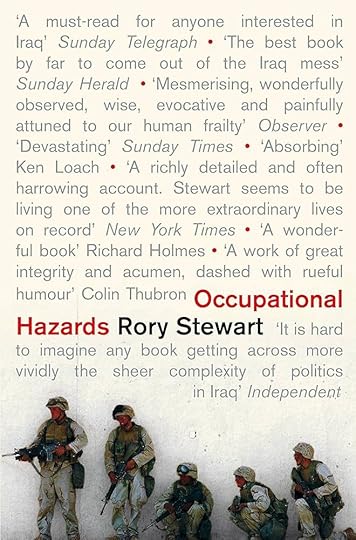
Cover: I liked the cover of my edition (Picador, 2007, UK), it details five soldiers on the bottom and a splurge of reviews surrounding the title. It's simple, it works, but I do prefer the American edition (pictured in above by goodreads) because I like the link to the marshes.


4/5 stars here, although 8/10 feels more appropriate.
Recommend.
This entire review has been hidden because of spoilers.
Profile Image for Rory Fox.
Author 9 books44 followers
July 5, 2021
Informative and, at times gripping, the story is told as a descriptive diary of events, rather than as an analysis or commentary on those events. That is fine, up to a point. But it leaves gaps in the reader’s understanding.

We never know why the author rushed to get his job in Iraq. Nor indeed why the coalition has invaded and fought a war. The author tells us several times that everyone thought it was about ‘oil.’ But what did he think?

One of the clearest themes of the book is chaos. We hear of unreliable translations, financial rules which needlessly offend cultural sensitivities. And sadly, the avoidable deaths caused because soldiers cannot issue instructions in languages which civilians understand.

In an epilogue the author reflects on the arrogance of the coalition enterprise. They tried to transform a dictatorship into a democracy within a year. They tried to change a centralised economy into a privatised free market, almost overnight. They disbanded the army and never managed to get the untrained terrified police force capable of dealing with militias.

The author is pessimistic about whether better planning could have solved all the problems. He notes that many of the problems were common to previous ‘nation building’ attempts, in Kosovo, Bosnia, and Afghanistan. Readers might wonder why the coalition repeated mistakes that they had already made in other countries.

Some mistakes were new and specific to the Iraq context, as there were complexities of tribal alliances. But again the reader is left to wonder how reasonably these issues could, and should have been anticipated and planned for.

The implications of the book raises serious questions about whether a war can be fought morally if there isn’t a coherent plan (with a reasonable prospect of success) for managing the post-war peace. But those kinds of questions go beyond the author’s post script reflections.

Although the tale is narrated clearly and poignantly, there are some occasionally puzzling elements. We hear that the author had so much money sent to him, that he literally didn’t know what to do with it all (19%). Then we hear that the $18.3 billion reconstruction fund wasn’t flowing to his province (50%). Finally we hear at the end of the book that ‘we were awash with money (98%). By the end I was unclear whether, and to what extent, financial problems were in fact a problem.

I also found the tone of the book disquieting in places. At one point the author mentions how he felt ‘constrained’ by the Geneva convention (9%). Is ‘constrained’ really the right word? He begins each chapter with quotes from Machiavelli which sometimes praise lying and manipulating the population. Is that really what coalition governance was intended to be? On another occasion he mentioned how the presence of journalists was a relevant factor in a decision about how violently to disperse a protest (68%). Really? It makes the ethics of governance seem like simply a matter of what people can pragmatically get away with. Maybe that’s how it was… or was it?

Overall, the book is certainly informative, but it had an unsettling undertone which left me with far more questions than answers.
Profile Image for Laurence.
7 reviews9 followers
November 3, 2012
Not a lot of books on recent Mideast history out there. I believe, because of the ongoing strife, that it's hard to write a compelling account and not have it come off as an anti-war screed.

Rory Stewart was the Scots deputy governor of a marsh Arab province in southern Iraq, for about a year shortly after the 2003 invasion. Stewart, educated and well-bred, is the main character in this gripping story of the attempt by the Coalition Provisional Authority to build a liberal democracy in Mesopotamia.

Stewart writes (and governed) with a pro-Colonial mindset. His humor, compassion, and right-mindedness however make it clear that it is not someone in a sentimental fog who is at work here, wishing for the Empire here again; but someone representative of many in the West who wish to bring liberal democracy to what they perceive as a backward nation.

Stewart was the boots on the ground for coalition civil affairs, and his writing of reaching out to the many sheikhs and factions is riveting. One of the most striking aspects of the book is the depiction of the ultra-refined Muslim code of etiquette and conduct, in language, behavior, and intellectual discourse; which Stewart needed to have a mastery of in order to carry out his mission. You can't help but root for Stewart as he slowly gains the respect of recalcitrant warlords and Iranian operatives.

The book also conveys the machinations and sentiment behind the Iraqi insurgency. Towards the end of the book Stewart describes his experience withstanding a prolonged attack on the coalition compound.

Also illuminating was Stewart's account of a trip to the Baghdad Green Zone to meet with Bremer, Petraeus, and other senior occupation leaders. We hear of his exploits with a Bosnian staffer wearing a mini-skirt in the Green Zone disco, and a careful appraisal of the attitudes of Westerner and Arab alike, wherever the story takes the reader.

Not a difficult read, but it helps if you're a policy wonk, or have at least some interest in politics.
Profile Image for Wilte.
1,156 reviews24 followers
June 16, 2025
Stewart worked for 14 months in Iraq for the Coalition Provisional Authority (CPA). First in the province of Maysan (in the South, at the border with Iran) and later in Dhi Qar, to the west of Maysan; the province which contains Ur.

The Italian military in Dhi Qar come out quite badly. But in the Epilogue Stewart concludes: The Italian policy of inaction had produced a better result because it had forced Iraqis to take responsibility for their own affairs.

Very insightful. Excellent writing.


Quotes:

"And what will be my mission — what will you assess me on at the end of the year?" Andy coughed and stubbed out his Benson and Hedges in one of the corrugated peach tins that served as an ashtray.
"If I can come back in a year's time and see that the province is rea sonably quiet and has not descended into anarchy and you are able to serve me some decent ice cream, I will be satisfied."

He [Bremer] concluded by reminding us that our objective was to create "a democratic Iraq where a government, elected on the basis of the con-stitution, respected human rights."
Back in Amara, I decided that I preferred Andy's mission: quiet and ice cream.

By the time that Ur's treasures were placed in a cramped and unin-formative display cabinet in the British Museum, the people surrounding the birthplace of writing were illiterate tribesmen.

equality, a hundred million dollars for democratization, and consultants who rebranded corruption, crime, and civil war as "governance capacity building,
" "security sector reform," and "conflict resolution."

We knew something about the region —Molly much more than me. But diplomats like us were normally based in a comfortable embassy com-pound, rarely managing anything more than a couple of embassy secretaries. We had been trained in an institutional culture that emphasized prudence, compromise, and careful drafting; not the bold executive decisions required to govern a semi-war zone.

She adjusted quickly even to the Marsh Arab dialect and because she carefully read Arabic publications, she found things that I missed —for ex-ample, that an Arab translator had inserted into a USAID-sponsored pamphlet on democracy, "Iran is the most perfect example of democracy in the world."

He had over a thousand soldiers, including his own infantry battal-ion, companies from two armored regiments, and a raft of military hardware including helicopters, which made him, as he often reminded me, the sheikh of "the biggest tribe in the province." Without his support I was powerless.

Almost every crime in the villages was tried and settled by the sheikhs; the police barely operated outside the capital and we could not afford unnecessary ene-mies. Even, therefore, when sheikhs were little more than small-time rural gangsters, setting up extortion rackets under the pretense of security or skimming from contracts, I generally paid them the respect they thought they deserved.

interpreter, to protect my feelings, translated, "You memorized some things and you forgot some things," but Abu Mustafas words were a fragment from a poem that begins, "Kul limen ye doi fi elmi felsafetan."
Tell him who claims to know philosophy
You memorized one thing but you missed so many things

On this occasion I knocked on the financial controller's door. He
glanced up irritably from the keyboard. "Yes?"
"Could I please have fifty dollars to fix the governor's window?"
"Does he not have a budget for that?"
"No," I replied, "under the 1968 law on municipalities..."

"Fifty dollars seems an awful lot for a window," he said. "Are you sure that's right?"
I went outside and found an Iraqi engineer and asked how much a window cost. "Thirty-five dollars," he said.
I walked back inside. "I have asked an Iraqi engineer. He said fity dollars is right for a window."
"Well, he's not having it now. The governor was very rude to us last week. Tell him he can have it next week." And he looked down again at the keyboard.
I walked back to my office, took fifty dollars from my own pocket and gave it to the governor. Riyadh pocketed it angrily.

In the evening I played Ping-Pong with the Iraqi deputy governor. (…) The deputy governor asked me if it was true that Danish citizens were being evacuated. I said it probably was. "In which case, I would like to be evacuated. I am a Danish citizen." I told him he was the deputy governor and he could not leave. He beat me at Ping-Pong.


MAY 12-14, 2004
Dusk came. Three hours passed. Shortly after nine I received another breezy e-mail from the chief of staff in Basra telling me the Italians were keeping him fully informed. He was delighted to discover from the Italians that things were "calm" and "quiet" across the province that night and hoped I was getting some rest. Things, he said, were much worse in Amara. I replied immediately that things were not particularly "calm" or "quiet." We had received twenty incoming mortar rounds at the CPA in the last two hours, six detonating within the perimeter. The last two had fallen within twenty meters of our building beside the cookhouse. The Quick Reaction Force had not moved yet. I concluded that I was sure, however, "the Italians are keeping you fully informed of the situation and their response to the threat."

When it was nearly dark, I suggested we walk down. Asad, who had been one of the leaders of the attack on our compound, said,
"We will all miss you. Everyone in the province knows you and admires you. We know how hard you have worked. We wish you could stay. You are our hero."
"What are you talking about, Asad why were you firing mortars and trying to kill me five weeks ago?"
"Ah, Seyyed Rory," he replied with a grin, "that was nothing personal."

Our very presence was a paradox. We emphasized that democracy was the only legitimate form of government, yet we were unelected foreigners. We knew that if locals ran things, they would feel a sense of ownership and responsibility, sustaining development, whereas foreigners would create parallel structures that undermined local capacity. Yet we administered the country directly.

The Italian policy of inaction had produced a better result because it had forced Iraqis to take responsibility for their own affairs.


Displaying 1 - 30 of 315 reviews

Can't find what you're looking for?

Get help and learn more about the design.