

What do you think?

War Trash
Ha Jin’s masterful new novel casts a searchlight into a forgotten corner of modern history, the experience of Chinese soldiers held in U.S. POW camps during the Korean War. In 1951 Yu Yuan, a scholarly and self-effacing clerical officer in Mao’s “volunteer” army, is taken prisoner south of the 38th Parallel. Because he speaks English, he soon becomes an intermediary between his compatriots and their American captors.With Yuan as guide, we are ushered into the secret world behind the barbed wire, a world where kindness alternates with blinding cruelty and one has infinitely more to fear from one’s fellow prisoners than from the guards. Vivid in its historical detail, profound in its imaginative empathy, War Trash is Ha Jin’s most ambitious book to date.
370 pages, Kindle Edition
First published January 1, 2004
About the author
Ha Jin
65 books865 followersHa Jin is the pen name of Jin Xuefei, a novelist, poet, short story writer, and Professor of English at Boston University.Ha Jin writes in English about China, a political decision post-Tiananmen Square.
Ha Jin grew up in mainland China and served in the People’s Liberation Army in his teens for five years. After leaving the army, he worked for three years at a railroad company in a remote northeastern city, Jiamusi, and then went to college in Harbin, majoring in English. He has published in English ten novels, four story collections, four volumes of poetry, a book of essays, and a biography of Li Bai. His novel Waiting won the National Book Award for Fiction, the PEN/Faulkner Award, and was a finalist for the Pulitzer Prize. Ha Jin is William Fairfield Warren Distinguished Professor in English and Creative Writing at Boston University, and he has been elected a fellow of the American Academy of Arts and Letters and the American Academy of Arts and Sciences. His writing has been translated into more than thirty languages. Ha Jin’s novel The Woman Back from Moscow was published by Other Press in 2023.
Ha Jin grew up in mainland China and served in the People’s Liberation Army in his teens for five years. After leaving the army, he worked for three years at a railroad company in a remote northeastern city, Jiamusi, and then went to college in Harbin, majoring in English. He has published in English ten novels, four story collections, four volumes of poetry, a book of essays, and a biography of Li Bai. His novel Waiting won the National Book Award for Fiction, the PEN/Faulkner Award, and was a finalist for the Pulitzer Prize. Ha Jin is William Fairfield Warren Distinguished Professor in English and Creative Writing at Boston University, and he has been elected a fellow of the American Academy of Arts and Letters and the American Academy of Arts and Sciences. His writing has been translated into more than thirty languages. Ha Jin’s novel The Woman Back from Moscow was published by Other Press in 2023.
Ratings & Reviews
Friends & Following
Create a free account to discover what your friends think of this book!
Community Reviews
Displaying 1 - 30 of 397 reviews

August 11, 2024
“An American plane flew slowly overhead and broadcast a message urging us to capitulate, promising to treat us humanely. An endearing female voice said in standard Mandarin: “Chinese soldiers, your leaders say that you volunteered to come to Korea, but in your hearts you know you didn't come here of your own free will. Your leaders stuck the name of the People's Volunteers on you and sent you here as cannon fodder for Stalin and Kim Il Sung. Now, you have no food or warm clothes, you dare not speak your minds and you cannot write home. Think about it, brothers, are you really volunteers?" - US Propaganda Message
"According to the teaching of the Bible, all the prisoners here are sinners, so we should be equal. Why are some inmates more privileged than others?" "Because most of you are Communists. To me and to my God, Communism is evil." "But most of us are not communists at all. We stay with them because we want to go home. As sons, we have our duty to parents. Some men are husbands and fathers, and ought to return to their families. For most of us there's no choice.” "Listen, I'm not just a clergyman but also a soldier. I came with both the book and the sword."- Confrontation between prisoner Yu Yuan and Father Woodworth
“The General stood up and said, "I’m not sure. Some of the awful things you mentioned I know might have happened, but some I don't think are true”. Colonel Choi asked Bell to sit down and said “We're Communists and won't treat you the way your men treat us. We respect your human dignity and will not insult and abuse you. As an American general you must have the courage to face the facts.” Bell nodded, sweat beading on his domed forehead.” - Conversation between a North Korean Colonel and the kidnapped US General Bell
“Beginning in December 1951, a series of revolts broke out inside the wire, culminating in battles between prisoners and entire guard battalions in which hundreds of POWs and a small number of UN troops lost their lives. Finally in May 1952 General Clarke, who had replaced Ridgway as the UN commander, ordered Operation Breakup, which over months crushed the revolt with tanks, gas, and bullets.” - From Encyclopedia Brittanica article “Battling over POWs”
“To be able to function in a war an officer was expected to view his men as abstract figures so that he could utilize and sacrifice them without any hesitation. The same abstraction was supposed to take place among the rank and file - to us every American serviceman must be a devil, to them every one of us must be a Red. When a general evaluates the outcome of a battle, he thinks in numbers - how many casualties the enemy has suffered in comparison with the losses of his own army. This is the crime of war, it reduces real human beings to abstract numbers.” - Yu Yuan, Chinese POW in ‘War Trash’
************
Han Jin is Chinese-American writer who came to the US in 1989 before the Tiananmen protests to complete his PhD at Brandeis, after joining the People’s Liberation Army from 1969 to 1975. Since then he has won the PEN/Faulkner award twice, once for this book, and the PEN/Hemingway once. ‘War Trash’ (2004) was shortlisted for a Pulitzer, written in English as his other works. His writing is clear and concise; he is also a widely published poet. It is a fictional memoir of a PLA soldier who fought in the Korean War as a ‘volunteer’, so as to not to provoke a direct war with the United States.
Narrator Yu Yuan was a student at the Huangpu Military Academy, relocated to Chendu when the Japanese drove the Nationalists west. After 1949 the school was taken over by the Communists who encouraged the cadets to remain. In a few months they were sent over the Yalu River and marched to the 38th parallel. On the way they ran out of food. Bombed from above and shelled from the ground they sustained severe losses. Following three months of guerrilla warfare and mostly starvation, Yu and seven others are captured by Americans in 1951 and brought to a US POW camp in Pusan.
Wounded by a shattered femur Yu lay in the sick ward for months. In pain he betrays his ability to speak English, after recovery he is sent to Koje Island penal colony. From ancient times to WWII prisoners were exiled there, now a complex housing Chinese and Korean communists run by Chiang Kai-shek Nationalists. Many of the men following indoctrination requested patriation to Taiwan, moving to better facilities from crowded tents and half rations of the communists. Propaganda wasn’t enough but anti-communist tattoos on their bodies would prevent their return to the mainland.
Beatings and torture weren’t beneath Chinese Nationalists and South Koreans, encouraged by the US, with hard labor replacing exercise. North Korean prisoners controlled their own compounds and weren’t allowed out. Yu has a sick old mother in Chendu and a fiancé he wants to return to so he chooses transport to China as 500 others also do. Threats and murders coerced holdouts to join the Nationalists. Although not a committed communist Yu refuses to go to Taiwan. He involves himself in a North Korean POW plot to kidnap Bell, a US General commander of the prison complex.
Bell signs a statement accepting responsibility, promising no more violence against inmates, and is released. The GI’s gas, burn and shoot the North Korean POWs killing hundreds. Yu is jailed as a war criminal, now disillusioned with the POW struggle. All 6000 Chinese communists are transported to Cheju Island into new barracks and compounds. Ha Jin focuses on UN allies abuse of communist captives, which may be a surprise or challenge in the views of some Western readers but are a verifiable fac. The euphemistically named ‘police action’ eventually would kill over five million people.
On National Day October 1 another uprising takes place with red banners and homemade weapons. Artillery, tear gas and machine guns subdue the prisoners, killing scores and Yu Yuan is doubtful of Commissar Pei’s leadership. The Chinese kidnap a Captain and Lieutenant in response to lies about the riot. Yu proves to be a better leader than those in charge. When the Communists betray him to the Americans in order to protect one of their own he joins a Nationalist group waiting for relocation to Taiwan. Unsurprisingly the book is banned in China and Ha Jin declared an American stooge.
Yu Yuan attends political sessions where the Communists are denounced for living off the Korean peasants, not supplied adequately with arms and expendable to the Soviets. All the prisoners had defected from the PLA. Books, music, theater and education and fraternities were allowed. By 1953 Chinese and North Korean prisoners numbered in the hundreds of thousands. A truce is signed and interviews held to persuade PLA expatriates back to China and not to Taiwan. The threat families will be persecuted if they don’t return or themselves if they do was realized as repatriates faced a life of disgrace.
The unusual aspects of this novel are to see things through PLA eyes, describe the experiences of a low level officer and explain both sides of political beliefs in the war. A search of the internet shows little about Chinese and Korean prisoner treatment in South Korea and an abundance of horror stories about the treatment of UN prisoners in North Korea, as one might expect. The commanders of the camp are drawn from real life historical figures. Ha Jin is unafraid to delve into the dark areas of war psychology and he reveals a complex and three dimensional portrait of the Korean POW conflict.
Yu writes his reminiscences in Atlanta at age 73 while he was visiting his daughter, realizing it may be his last visit. Across his belly is a POW tattoo “F**K US, modified from F**K COMMUNISM tattooed on him by the Nationalists. It served him well in China, but he worries about Americans seeing it. Efforts were made to plot movements of the PLA division and Korean War history. Ha is Director of a creative writing program at Boston University. ‘Waiting’ (1999) was his first breakthrough, winning the National Book and PEN/Faulkner awards, and it was shortlisted for a Pulitzer Prize as well.
"According to the teaching of the Bible, all the prisoners here are sinners, so we should be equal. Why are some inmates more privileged than others?" "Because most of you are Communists. To me and to my God, Communism is evil." "But most of us are not communists at all. We stay with them because we want to go home. As sons, we have our duty to parents. Some men are husbands and fathers, and ought to return to their families. For most of us there's no choice.” "Listen, I'm not just a clergyman but also a soldier. I came with both the book and the sword."- Confrontation between prisoner Yu Yuan and Father Woodworth
“The General stood up and said, "I’m not sure. Some of the awful things you mentioned I know might have happened, but some I don't think are true”. Colonel Choi asked Bell to sit down and said “We're Communists and won't treat you the way your men treat us. We respect your human dignity and will not insult and abuse you. As an American general you must have the courage to face the facts.” Bell nodded, sweat beading on his domed forehead.” - Conversation between a North Korean Colonel and the kidnapped US General Bell
“Beginning in December 1951, a series of revolts broke out inside the wire, culminating in battles between prisoners and entire guard battalions in which hundreds of POWs and a small number of UN troops lost their lives. Finally in May 1952 General Clarke, who had replaced Ridgway as the UN commander, ordered Operation Breakup, which over months crushed the revolt with tanks, gas, and bullets.” - From Encyclopedia Brittanica article “Battling over POWs”
“To be able to function in a war an officer was expected to view his men as abstract figures so that he could utilize and sacrifice them without any hesitation. The same abstraction was supposed to take place among the rank and file - to us every American serviceman must be a devil, to them every one of us must be a Red. When a general evaluates the outcome of a battle, he thinks in numbers - how many casualties the enemy has suffered in comparison with the losses of his own army. This is the crime of war, it reduces real human beings to abstract numbers.” - Yu Yuan, Chinese POW in ‘War Trash’
************
Han Jin is Chinese-American writer who came to the US in 1989 before the Tiananmen protests to complete his PhD at Brandeis, after joining the People’s Liberation Army from 1969 to 1975. Since then he has won the PEN/Faulkner award twice, once for this book, and the PEN/Hemingway once. ‘War Trash’ (2004) was shortlisted for a Pulitzer, written in English as his other works. His writing is clear and concise; he is also a widely published poet. It is a fictional memoir of a PLA soldier who fought in the Korean War as a ‘volunteer’, so as to not to provoke a direct war with the United States.
Narrator Yu Yuan was a student at the Huangpu Military Academy, relocated to Chendu when the Japanese drove the Nationalists west. After 1949 the school was taken over by the Communists who encouraged the cadets to remain. In a few months they were sent over the Yalu River and marched to the 38th parallel. On the way they ran out of food. Bombed from above and shelled from the ground they sustained severe losses. Following three months of guerrilla warfare and mostly starvation, Yu and seven others are captured by Americans in 1951 and brought to a US POW camp in Pusan.
Wounded by a shattered femur Yu lay in the sick ward for months. In pain he betrays his ability to speak English, after recovery he is sent to Koje Island penal colony. From ancient times to WWII prisoners were exiled there, now a complex housing Chinese and Korean communists run by Chiang Kai-shek Nationalists. Many of the men following indoctrination requested patriation to Taiwan, moving to better facilities from crowded tents and half rations of the communists. Propaganda wasn’t enough but anti-communist tattoos on their bodies would prevent their return to the mainland.
Beatings and torture weren’t beneath Chinese Nationalists and South Koreans, encouraged by the US, with hard labor replacing exercise. North Korean prisoners controlled their own compounds and weren’t allowed out. Yu has a sick old mother in Chendu and a fiancé he wants to return to so he chooses transport to China as 500 others also do. Threats and murders coerced holdouts to join the Nationalists. Although not a committed communist Yu refuses to go to Taiwan. He involves himself in a North Korean POW plot to kidnap Bell, a US General commander of the prison complex.
Bell signs a statement accepting responsibility, promising no more violence against inmates, and is released. The GI’s gas, burn and shoot the North Korean POWs killing hundreds. Yu is jailed as a war criminal, now disillusioned with the POW struggle. All 6000 Chinese communists are transported to Cheju Island into new barracks and compounds. Ha Jin focuses on UN allies abuse of communist captives, which may be a surprise or challenge in the views of some Western readers but are a verifiable fac. The euphemistically named ‘police action’ eventually would kill over five million people.
On National Day October 1 another uprising takes place with red banners and homemade weapons. Artillery, tear gas and machine guns subdue the prisoners, killing scores and Yu Yuan is doubtful of Commissar Pei’s leadership. The Chinese kidnap a Captain and Lieutenant in response to lies about the riot. Yu proves to be a better leader than those in charge. When the Communists betray him to the Americans in order to protect one of their own he joins a Nationalist group waiting for relocation to Taiwan. Unsurprisingly the book is banned in China and Ha Jin declared an American stooge.
Yu Yuan attends political sessions where the Communists are denounced for living off the Korean peasants, not supplied adequately with arms and expendable to the Soviets. All the prisoners had defected from the PLA. Books, music, theater and education and fraternities were allowed. By 1953 Chinese and North Korean prisoners numbered in the hundreds of thousands. A truce is signed and interviews held to persuade PLA expatriates back to China and not to Taiwan. The threat families will be persecuted if they don’t return or themselves if they do was realized as repatriates faced a life of disgrace.
The unusual aspects of this novel are to see things through PLA eyes, describe the experiences of a low level officer and explain both sides of political beliefs in the war. A search of the internet shows little about Chinese and Korean prisoner treatment in South Korea and an abundance of horror stories about the treatment of UN prisoners in North Korea, as one might expect. The commanders of the camp are drawn from real life historical figures. Ha Jin is unafraid to delve into the dark areas of war psychology and he reveals a complex and three dimensional portrait of the Korean POW conflict.
Yu writes his reminiscences in Atlanta at age 73 while he was visiting his daughter, realizing it may be his last visit. Across his belly is a POW tattoo “F**K US, modified from F**K COMMUNISM tattooed on him by the Nationalists. It served him well in China, but he worries about Americans seeing it. Efforts were made to plot movements of the PLA division and Korean War history. Ha is Director of a creative writing program at Boston University. ‘Waiting’ (1999) was his first breakthrough, winning the National Book and PEN/Faulkner awards, and it was shortlisted for a Pulitzer Prize as well.

April 6, 2021
A Chinese POW In Korea
Ha Jin's novel "War Trash" (2004) is cast in the form of memoir written by the 73 year old Yu Yuan recounting his experiences nearly 50 years earlier as a Chinese soldier and POW in Korea. The fictitious memoirist is a man of my own age. I could understand his desire to reflect on the momentous events of his younger life. A lifelong resident of mainland China, Yu writes his memoirs while visiting his daughter, her husband, and two grandchildren in Atlanta, Georgia. He notes that at his age he "won't be coming to the States again." He writes in English, a language he began to learn at the age of 14, and tells his story "in a documentary fashion to preserve historical accuracy." Yu regards his memoir as "the only gift a poor man like me can bequeath his American grandchildren."
Yu was a graduate of the Huangpu Military Academy in China and his student years overlapped the Nationalists and the Communists. He was sent to Korea as part of the Chinese invasion, leaving behind an aged mother and a fiancee. His unit was decimated by the Americans and Yu suffers a severe leg wound. He recovers the use of his leg thanks to the work of a American woman physician, Dr. Greene. Yu is then sent to a variety of prison camps. His memoir describes the harsh life of the camps with among other things the heavy tension between the nationalist and the communist Chinese and the interrelationship with their American captors. Yu is a bookish young man and his skills in English are put to use as an interpreter. He is pulled throughout by both the nationalists and the communists. Yu is not ideologically inclined and wants in his heart only to go home to take care of his mother and marry his sweetheart.
Ha Jin succeeds in giving the tone of a memoir to his novel. He gives an extensive bibliography of sources he consulted for information about the Korean War and about the treatment of POWs. While the depiction of the war is convincing, the focus is on Yu and on his detachment from the competing groups and from the brutality around him. Although not religious, Yu is shown as a reader of the Bible which he says improves his English. The only Biblical book mentioned by name is Ecclesiastes with its emphasis on change and on the shortness of human life.
Yu has two formative experiences which he wishes to explain to his grandchildren and which pervade his memoir. The first involves a tattoo which he received on his belly against his will from the nationalist Chinese. It consists of a standard four-letter American obscenity followed by a reference to communism, which later becomes changed for prudential reasons to keep the obscenity and to remove the letters in the word "Communists" with the exception of the "U" and the "S". Much of the memoir explains the story of the tattoo Yu has carried with him through life.
The second experience involves Yu's relationship with Dr. Greene, the American physician who cured his leg and whom he never sees again. Yu has kept the memory of Dr. Greene and it forms what he sees as the value of life and of his hopes for his young grandson. It is critical to the memoir and prevents Yu's understanding of life from descending into only existentialism or individuality. Yu reflects:
"I cannot explain in detail to my son and daughter -in-law why I often urge Bobby to think of becoming a doctor, because the story would involve too much horror and pain. In brief, this desire of mine has been bred by the wasted lives I saw in Korea and China. Doctors and nurses follow a different set of ethics, which enables them to transcend political nonsense and man-made enmity and to act with compassion and human decency."
"War Trash" has a thick, complex texture with many characters and places. It invites reflection and slow, careful reading. Yu writes at the conclusion of his memoir of his relationship to his captors and fellow POWs: "In the depths of my being, I have never been one of them. I have just written what I experienced." The book tells the story of a war and of a person.
Robin Friedman
Ha Jin's novel "War Trash" (2004) is cast in the form of memoir written by the 73 year old Yu Yuan recounting his experiences nearly 50 years earlier as a Chinese soldier and POW in Korea. The fictitious memoirist is a man of my own age. I could understand his desire to reflect on the momentous events of his younger life. A lifelong resident of mainland China, Yu writes his memoirs while visiting his daughter, her husband, and two grandchildren in Atlanta, Georgia. He notes that at his age he "won't be coming to the States again." He writes in English, a language he began to learn at the age of 14, and tells his story "in a documentary fashion to preserve historical accuracy." Yu regards his memoir as "the only gift a poor man like me can bequeath his American grandchildren."
Yu was a graduate of the Huangpu Military Academy in China and his student years overlapped the Nationalists and the Communists. He was sent to Korea as part of the Chinese invasion, leaving behind an aged mother and a fiancee. His unit was decimated by the Americans and Yu suffers a severe leg wound. He recovers the use of his leg thanks to the work of a American woman physician, Dr. Greene. Yu is then sent to a variety of prison camps. His memoir describes the harsh life of the camps with among other things the heavy tension between the nationalist and the communist Chinese and the interrelationship with their American captors. Yu is a bookish young man and his skills in English are put to use as an interpreter. He is pulled throughout by both the nationalists and the communists. Yu is not ideologically inclined and wants in his heart only to go home to take care of his mother and marry his sweetheart.
Ha Jin succeeds in giving the tone of a memoir to his novel. He gives an extensive bibliography of sources he consulted for information about the Korean War and about the treatment of POWs. While the depiction of the war is convincing, the focus is on Yu and on his detachment from the competing groups and from the brutality around him. Although not religious, Yu is shown as a reader of the Bible which he says improves his English. The only Biblical book mentioned by name is Ecclesiastes with its emphasis on change and on the shortness of human life.
Yu has two formative experiences which he wishes to explain to his grandchildren and which pervade his memoir. The first involves a tattoo which he received on his belly against his will from the nationalist Chinese. It consists of a standard four-letter American obscenity followed by a reference to communism, which later becomes changed for prudential reasons to keep the obscenity and to remove the letters in the word "Communists" with the exception of the "U" and the "S". Much of the memoir explains the story of the tattoo Yu has carried with him through life.
The second experience involves Yu's relationship with Dr. Greene, the American physician who cured his leg and whom he never sees again. Yu has kept the memory of Dr. Greene and it forms what he sees as the value of life and of his hopes for his young grandson. It is critical to the memoir and prevents Yu's understanding of life from descending into only existentialism or individuality. Yu reflects:
"I cannot explain in detail to my son and daughter -in-law why I often urge Bobby to think of becoming a doctor, because the story would involve too much horror and pain. In brief, this desire of mine has been bred by the wasted lives I saw in Korea and China. Doctors and nurses follow a different set of ethics, which enables them to transcend political nonsense and man-made enmity and to act with compassion and human decency."
"War Trash" has a thick, complex texture with many characters and places. It invites reflection and slow, careful reading. Yu writes at the conclusion of his memoir of his relationship to his captors and fellow POWs: "In the depths of my being, I have never been one of them. I have just written what I experienced." The book tells the story of a war and of a person.
Robin Friedman

June 25, 2021
Ha Jin is a remarkably subtle, effective writer, and this book works incredibly well on many levels. It’s a glimpse into an aspect of history I’d never seen documented in any way: the plight of Chinese POWs in the Korean War. The first-person narrator feels altogether authentic and human, and the drudgery, horror, and resilience he experiences rings completely true. My only quibble with the novel is that in Ha Jin’s effort to create what feels like a real-life moment-to-moment account, the dramatic tension eventually becomes a bit diffuse, and the final third doesn’t pack the sort of punch I was hoping for.
But I’m still very glad to have read it, and I highly recommend it as a case study in how to pull off verisimilitude in an extremely successful manner.
But I’m still very glad to have read it, and I highly recommend it as a case study in how to pull off verisimilitude in an extremely successful manner.

July 17, 2021

This was a good book about the Korean War seen from the point of view of a Chinese army regular caught behind the lines and imprisoned for years in American/South Korean POW camps. It is a harrowing story told from the point of view of a young officer who is in the middle of two wars - that between North and South Korea, but also that between the Chinese Communists under Mao and the Chinese Nationalists under Chang. The book is well-written and very well-researched and is an entertaining if somewhat terrifying read. The devotion to the Communist and Nationalist causes reaches religious fervor and we can see how this fervor would end up fomenting atrocities like the Cultural Revolution not long after.

April 16, 2025
Uzun süredir kitaplığımda okunmayı bekleyen bir kitaptı “Savaş Artığı”, pişman oldum. Savaş anlatılarına odaklanmakta genelde zorlanıyorum ama hem çok etkileyiciydi hem de anlatılanların içinde buluverdim kendimi okurken.
Askeri okuldan yeni mezun olmuş bir Çinlinin, Yu Yuan’ın yaşlı annesini ve nişanlısını ardında bırakarak Kore Savaşı’na gönderilmesiyle başlıyor hikaye. Kahramanımız, iyi derecede İngilizce bildiğinden generaller için çevirmenlik yapıyor genellikle ancak kısa süre sonra bir grup askerle beraber esir düşüyor. Çeşitli esir kamplarında yaşananları anlatıyor kitap kısaca. Aslında kendini ideolojik olarak ne milliyetçilere ya da Çan Kay Şek’e ne de komünizme ya da Mao’ya yakın hissediyor Yu Yuan; sadece annesi ve nişanlısına kavuşabilmek için Çin’e geri dönmeyi istiyor. Ama kaldığı kamplarda, milliyetçilerden ayrı komünistlerden ayrı eziyet görüyor. Yu Yuan’ın yaşadıkları ve gözlemledikleriyle de, savaşın gerçeklerini, insanın içinden nasıl bir canavar çıkarabileceğini, ideolojilerin güç ve otorite sahipleri tarafından birer piyon gibi gördükleri insanları kontrol edebilmek ve yönetebilmek için nasıl kullanıldığını gösteriyor yazar.
Hakikaten akla hayale gelmeyecek işkencelerden bahsediyor Ha Jin; insanın kanını donduran, okurken inanamadığı, gözünde canlandıramadığı olaylar anlatıyor. Üstelik, Kore Savaşı gazisi babasına ithaf ettiği kitabı gerçek olaylardan hareketle kaleme almış; kitaptaki karakterler kurgu ancak olaylar gerçek. Bu, anlatılanları daha da etkileyici kılıyor elbette.
Benim unutamayacağım sahneleri kafama kazıyan kitaplardan biri oldu kesinlikle. İlgilisine tavsiye ederim. Kore Savaşı’na dair Gümüş Aygır romanını da öneririm, onu da çok beğenmiştim.
Askeri okuldan yeni mezun olmuş bir Çinlinin, Yu Yuan’ın yaşlı annesini ve nişanlısını ardında bırakarak Kore Savaşı’na gönderilmesiyle başlıyor hikaye. Kahramanımız, iyi derecede İngilizce bildiğinden generaller için çevirmenlik yapıyor genellikle ancak kısa süre sonra bir grup askerle beraber esir düşüyor. Çeşitli esir kamplarında yaşananları anlatıyor kitap kısaca. Aslında kendini ideolojik olarak ne milliyetçilere ya da Çan Kay Şek’e ne de komünizme ya da Mao’ya yakın hissediyor Yu Yuan; sadece annesi ve nişanlısına kavuşabilmek için Çin’e geri dönmeyi istiyor. Ama kaldığı kamplarda, milliyetçilerden ayrı komünistlerden ayrı eziyet görüyor. Yu Yuan’ın yaşadıkları ve gözlemledikleriyle de, savaşın gerçeklerini, insanın içinden nasıl bir canavar çıkarabileceğini, ideolojilerin güç ve otorite sahipleri tarafından birer piyon gibi gördükleri insanları kontrol edebilmek ve yönetebilmek için nasıl kullanıldığını gösteriyor yazar.
Hakikaten akla hayale gelmeyecek işkencelerden bahsediyor Ha Jin; insanın kanını donduran, okurken inanamadığı, gözünde canlandıramadığı olaylar anlatıyor. Üstelik, Kore Savaşı gazisi babasına ithaf ettiği kitabı gerçek olaylardan hareketle kaleme almış; kitaptaki karakterler kurgu ancak olaylar gerçek. Bu, anlatılanları daha da etkileyici kılıyor elbette.
Benim unutamayacağım sahneleri kafama kazıyan kitaplardan biri oldu kesinlikle. İlgilisine tavsiye ederim. Kore Savaşı’na dair Gümüş Aygır romanını da öneririm, onu da çok beğenmiştim.

September 21, 2024
"We all felt ashamed of becoming POWs because we should have died rather than submit to capture. Many even believed our captivity had impaired our country's image. I often heard some men say they had 'smeared soot on Chairman Mao's face.' The guilt weighed heavily on their consciences."
"War Trash" is a fictional memoir written by Yu Yuan, a Chinese army officer who was sent to the Korean conflict in 1951. The Chinese feared that the American troops in Korea might eventually move north into China, so the Chinese army crossed the Yalu River into North Korea. Yu Yuan was captured and sent to a POW camp. He's an intelligent, likable young man with some English skills so he functioned as an unofficial interpreter. The book is based on some true stories about life in the POW camps. There was pressure and danger in the camps as the prisoners chose either to be repatriated to mainland China (Communists), or to Taiwan (pro-Nationalists) in 1953.
The book reads almost like non-fiction, and it's a depiction of how war brings out the inhumanity in people. "War Trash" is a harrowing read in some parts as it shows sadistic punishments and deprivations, as well as power plays between the different factions of prisoners. This was not an easy read because it is slow moving and there is so much cruelty, but it was a learning experience. I hadn't realized how POWs repatriated to mainland China were treated like criminals because they were captured and had not fought to the death. "War Trash" is a well-written book with an ethical protagonist, but some people might be bothered by the brutality.
"War Trash" is a fictional memoir written by Yu Yuan, a Chinese army officer who was sent to the Korean conflict in 1951. The Chinese feared that the American troops in Korea might eventually move north into China, so the Chinese army crossed the Yalu River into North Korea. Yu Yuan was captured and sent to a POW camp. He's an intelligent, likable young man with some English skills so he functioned as an unofficial interpreter. The book is based on some true stories about life in the POW camps. There was pressure and danger in the camps as the prisoners chose either to be repatriated to mainland China (Communists), or to Taiwan (pro-Nationalists) in 1953.
The book reads almost like non-fiction, and it's a depiction of how war brings out the inhumanity in people. "War Trash" is a harrowing read in some parts as it shows sadistic punishments and deprivations, as well as power plays between the different factions of prisoners. This was not an easy read because it is slow moving and there is so much cruelty, but it was a learning experience. I hadn't realized how POWs repatriated to mainland China were treated like criminals because they were captured and had not fought to the death. "War Trash" is a well-written book with an ethical protagonist, but some people might be bothered by the brutality.

October 16, 2025
Having read Waiting and mostly enjoyed it, I was expecting to like this more since it was about war and would presumably focus more on that and less on the existential nightmare of a relationship that is never allowed to begin. Unfortunately, I found this significantly less interesting, mostly because very little happens and secondly because Ha Jin's writing is very listless and dull, prosaic, matter of fact etc. It's not bad writing, it's just very perfunctory. It was easier to ignore with Waiting because that story had an intriguing dynamic but this is more straight-forward.
The book is about a young Chinese soldier, a 'volunteer' called Yu Yuan, who is fighting on behalf of the Chinese Communists in the Korean War. It's told from his later perspective as an elderly man now living in the USA writing his memoir. As a young man he left his mother and fiance behind and, understandably, had a strong desire to get back to them. It begins with his unit engaging the enemy sporadically but mostly it concerns their ceaseless marching towards various locations. Very early on in the book he and his unit are captured and placed in a series of prisoner of war camps where the book settles for the duration. This is essentially the meat and potatoes of the story, switching from a Nationalist camp to a Communist camp, and only the occasional distraction of intrigue here and there, such as escape attempts, religious leaders, his desire to improve his English, a dog named Blackie, a captured American general, and several (very well researched) forays into the finer details of the war. From that angle, it might appeal to people because I thought the military stuff was effectively done, meticulous even, and nicely realised. It was tempting to think this was indeed a personal memoir but Ja Hin wasn't even born until 1956 so hats off for researching and creating such a convincing world. The problem is I just didn't think it was ever that interesting.
Ultimately, Ha Jin's writing is very basic. I think I said the same when reviewing Waiting. It's just very functional and, as such, never develops into anything remotely challenging or exquisite, it's just there to do a job, move you along. You can dismiss this as deliberate (given that the fictional Yu Yuan is not a writer himself) but since this was also the case with Waiting, I think that might be generous. Overall, I was never that interested in the narrative and found his writing was simply too dry to bring any of it to life. It was fine, well researched (you could genuinely believe this was a real memoir), but not much more.
If you liked Waiting or are a fan of military novels then I'd recommend it.
The book is about a young Chinese soldier, a 'volunteer' called Yu Yuan, who is fighting on behalf of the Chinese Communists in the Korean War. It's told from his later perspective as an elderly man now living in the USA writing his memoir. As a young man he left his mother and fiance behind and, understandably, had a strong desire to get back to them. It begins with his unit engaging the enemy sporadically but mostly it concerns their ceaseless marching towards various locations. Very early on in the book he and his unit are captured and placed in a series of prisoner of war camps where the book settles for the duration. This is essentially the meat and potatoes of the story, switching from a Nationalist camp to a Communist camp, and only the occasional distraction of intrigue here and there, such as escape attempts, religious leaders, his desire to improve his English, a dog named Blackie, a captured American general, and several (very well researched) forays into the finer details of the war. From that angle, it might appeal to people because I thought the military stuff was effectively done, meticulous even, and nicely realised. It was tempting to think this was indeed a personal memoir but Ja Hin wasn't even born until 1956 so hats off for researching and creating such a convincing world. The problem is I just didn't think it was ever that interesting.
Ultimately, Ha Jin's writing is very basic. I think I said the same when reviewing Waiting. It's just very functional and, as such, never develops into anything remotely challenging or exquisite, it's just there to do a job, move you along. You can dismiss this as deliberate (given that the fictional Yu Yuan is not a writer himself) but since this was also the case with Waiting, I think that might be generous. Overall, I was never that interested in the narrative and found his writing was simply too dry to bring any of it to life. It was fine, well researched (you could genuinely believe this was a real memoir), but not much more.
If you liked Waiting or are a fan of military novels then I'd recommend it.
November 14, 2018
This novel is Ha Jin's exploration of the fate of Chinese soldiers captured in Korea. As in much recent Chinese fiction, Mao's regime comes across as cruelly incompetent and callous, sending under-supplied and trained men across the border. As soldiers and as prisoners of war, they are pawns for the greater good of what was then a new regime, sent into war as a gesture to international communism and once in U.S. custody, used as bargaining chips. This is a story about how a nation betrays its own soldiers, of how a country's leadership uses ideology and language against its own people. "War Trash" does not have the mythic resonance of Orwell but that is not its aim. Ha Jin's aim is not allegory but reality, not to show how a regime uses language to extinguish independence and the ability to think, but to show how men are made to suffer for believing in it.

March 13, 2017
Never before have I read fiction so meticulous as to send me verifying, multiple times, that it was not actually a memoir. A really incredible historic account of tragic, heartbreaking reality told through a tragic, heartbreaking story.

May 17, 2018
An excellent book by Ha Jin.
It is set in the background of the Korean War where the Chinese red army soldiers of the new communist government were sent to into battle against the US and UN forces in the Korean Peninsula.
The story unfolds as a memoir written by a former nationalist who was forced to join the communist army of China and who was later captured by the US army in North Korea.
It lays out his experience as a Chinese POW who goes through many obstacles and personal problems while struggling with his own identity, his loyalties and emotions.
His role as an interpreter who excels in English gives him access to a more wide range relationship and insight into to his own comrades in the prison and the US soldiers who presides over them.
The writing is SUPERB. This is my first book by Ha Jin and I loved his ability to wove his fictional characters within factual historical events that occurred during the Korean War.
Overall an excellent read.
It is set in the background of the Korean War where the Chinese red army soldiers of the new communist government were sent to into battle against the US and UN forces in the Korean Peninsula.
The story unfolds as a memoir written by a former nationalist who was forced to join the communist army of China and who was later captured by the US army in North Korea.
It lays out his experience as a Chinese POW who goes through many obstacles and personal problems while struggling with his own identity, his loyalties and emotions.
His role as an interpreter who excels in English gives him access to a more wide range relationship and insight into to his own comrades in the prison and the US soldiers who presides over them.
The writing is SUPERB. This is my first book by Ha Jin and I loved his ability to wove his fictional characters within factual historical events that occurred during the Korean War.
Overall an excellent read.
February 1, 2012
This book is the "memoir" of the experiences of Yu Yuan, former student at the Huangpu Military Academy, during the Korean War, most of which he spends imprisoned by the Americans. Actually, you might say "during the Chinese civil war", because the effects of that conflict are everywhere. You might even say "during the Cold War". Yuan initially believes the reason he was given for his division being sent to Korea, to prevent the Americans from invading China; he has been told that the Chinese soldiers are heroes. But he soon begins to feel more like a pawn than a hero. He's seeing that his superiors are playing a political game, and national and global interests are being pursued in which individuals have no worth.
In part, this novel gives a view of the Cold War as seen very partially by its obscure narrator. But it is also a character study, as Yuan grows increasingly isolated. He often retreats into introspection, and reads when he can get printed material. He does not want to join any party or "side", and could not if he wanted to, having been involuntarily involved with both sides of the civil war, and thus not trusted by either. Yuan quietly resists being mere "war trash", used and thrown away. He can speak good English and can recognize individual Americans, addressing them by name. This ability saves him and others several times. He navigates through the dangers of being in the middle of the great conflict by negotiating with other people as individuals. But ultimately, this can't entirely save him, because these other people are just as manipulated as he is.
In part, this novel gives a view of the Cold War as seen very partially by its obscure narrator. But it is also a character study, as Yuan grows increasingly isolated. He often retreats into introspection, and reads when he can get printed material. He does not want to join any party or "side", and could not if he wanted to, having been involuntarily involved with both sides of the civil war, and thus not trusted by either. Yuan quietly resists being mere "war trash", used and thrown away. He can speak good English and can recognize individual Americans, addressing them by name. This ability saves him and others several times. He navigates through the dangers of being in the middle of the great conflict by negotiating with other people as individuals. But ultimately, this can't entirely save him, because these other people are just as manipulated as he is.

April 23, 2018
I love books that take a well-known historical situation - in this case, the Korean War - and turn it on its ear by showing it from a completely unthought-of point-of-view. This novel tells the story of a Chinese POW in an American camp. Apolitical, he's caught between the new Maoist dogma of recently-Communist China, the defeated Nationalists from Taiwan and the Americans because of his position as translator and the shifting sands of competing powers which force him to choose sides when he only wants to see his mother and fiancée once again is anguishing. I could feel his suffering as he tried to find a way out of his dilemma. A gripping read for me.

August 21, 2021
War Trash by Ha Jin
This novel won the Pen/Faulkner in 2005
Overall this was an excellent narrated and compelling story about the Chinese protagonist Yu Yuan's experience fighting for the North in the Korean War, his subsequent capture and long stint as a POW in the American camp, his struggle to either accept Communism or denounce it and his ultimate repatriation to the mainland.
I was not in love with the pace of writing, it was at times a little slow and certainly could have been more dramatic. However, the story and the historical realism were top notch and the character development was solid. The latter part of the novel was more interesting than the beginning which is often the case in novels that have an interesting arc of muted drama.
There is a ton of history that was new to me especially regarding the Korean War prisoner transfer and repatriation process. The allegiance tests administered by both the democratic Taiwanese governments and Communist Chinese governments were real games of cat and mouse. Be careful which side you choose because you might be War Trash!
4 stars
This novel won the Pen/Faulkner in 2005
Overall this was an excellent narrated and compelling story about the Chinese protagonist Yu Yuan's experience fighting for the North in the Korean War, his subsequent capture and long stint as a POW in the American camp, his struggle to either accept Communism or denounce it and his ultimate repatriation to the mainland.
I was not in love with the pace of writing, it was at times a little slow and certainly could have been more dramatic. However, the story and the historical realism were top notch and the character development was solid. The latter part of the novel was more interesting than the beginning which is often the case in novels that have an interesting arc of muted drama.
There is a ton of history that was new to me especially regarding the Korean War prisoner transfer and repatriation process. The allegiance tests administered by both the democratic Taiwanese governments and Communist Chinese governments were real games of cat and mouse. Be careful which side you choose because you might be War Trash!
4 stars

September 23, 2008
This book is a ficitional account of a Chinese prisoner of the Korean War. Apparently things weren't all funny, serious, then funny/serious like the TV show MASH made them out to be. Yu Yuan, or whatever various false names he used throughout his inturnment was a Nationalist Chinese who was used like a pawn by the Communist regime that had taken over before the war. He was sent into Korea to keep the United States out of North Korea just so they would be that much further from mainland China.
At first the simplicity of the book bothered me, but I slowly realized that it reinforces the fact that it is written in the first person by a fictional man who was not an author, but rather just a person with a story to tell.
As it was fairly simple, the number of passages I highlighted were few and far between. Really just three things stuck out to me:
"That's true, I agreed. I never thought so many Chinese would be buried in Korea. His words conjured up the horrible image I hadn't been able to shake off-that the war was an enourmous furnace fed by the bodies of soldiers."
"The same abstraction was supposed to take place among the rank and file too - to us every American serviceman must be the devil, whereas to them, every one of us must be a Red. Without such obliteration of human particularities, how could one fight mercilessly?"
"The larger a victory is, the more people have been turned into numerals. This is the crime of war: it reduces real human beings to abstract numbers."
At first the simplicity of the book bothered me, but I slowly realized that it reinforces the fact that it is written in the first person by a fictional man who was not an author, but rather just a person with a story to tell.
As it was fairly simple, the number of passages I highlighted were few and far between. Really just three things stuck out to me:
"That's true, I agreed. I never thought so many Chinese would be buried in Korea. His words conjured up the horrible image I hadn't been able to shake off-that the war was an enourmous furnace fed by the bodies of soldiers."
"The same abstraction was supposed to take place among the rank and file too - to us every American serviceman must be the devil, whereas to them, every one of us must be a Red. Without such obliteration of human particularities, how could one fight mercilessly?"
"The larger a victory is, the more people have been turned into numerals. This is the crime of war: it reduces real human beings to abstract numbers."
September 5, 2008
So thank your lucky stars you were not a member of the Chinese Army around the time of the Korean War. As Douglas MacArthur plotted to invade Mainland China, Mao sent thousands of bodies to defend. But it was more like a mow-down then starve-off.
This PEN/Faulkner award-winning novel is the fictional memoir of Yu Yuan, a POW at several camps and a frequent pawn between the pro-Nationalists and the Communists. It's a dense read with some serious history and military strategy. The scale of human suffering is so immense, it almost becomes routine. A few times, my eyes glazed over as I read about yet another camp riot or food strike. But Jin is a master storyteller--I just requested his other PEN/Faulkner winner, Waiting, because this book was so inspiring.
Bonus: My knowledge of the Korean War was increased by 3000%. And I learned that Jin is only the third author to win two PEN/Faulkner awards, the others being Phillip Roth and John Edgar Wideman. Impressive. He earned it with this novel.
This PEN/Faulkner award-winning novel is the fictional memoir of Yu Yuan, a POW at several camps and a frequent pawn between the pro-Nationalists and the Communists. It's a dense read with some serious history and military strategy. The scale of human suffering is so immense, it almost becomes routine. A few times, my eyes glazed over as I read about yet another camp riot or food strike. But Jin is a master storyteller--I just requested his other PEN/Faulkner winner, Waiting, because this book was so inspiring.
Bonus: My knowledge of the Korean War was increased by 3000%. And I learned that Jin is only the third author to win two PEN/Faulkner awards, the others being Phillip Roth and John Edgar Wideman. Impressive. He earned it with this novel.
August 22, 2015
If you know nothing about the Korean War, you will learn quite a bit from the Chinese perspective. However, it is very difficult to connect with the narrator and I came away from the book feeling very detached.

August 12, 2012
How engaging should a novel about uniformly unpleasant experiences be? This novel is brief, and pretty much stripped down of psychology; instead, a series of things happen to the narrator, a PLA soldier during the Korean War who spends most of his time in Korean refugee camps divided between Communist and Chinese Nationalist soldiers and overseen by the American military. I found myself thinking of Defoe quite a bit: the narrator has also brief moments of agency, and is mostly just the victim of elaborately awful circumstances. (This lack of freedom within the narrative is literalized when he is forcibly tattooed with an anti-Communist slogan.) The narrative winds up being pretty relentlessly anti-Communist, I thought: over and over again, soldiers in the camps organize themselves into groups to persecute each other--and then, upon their eventual return to China, these groups are persecuted in return. In comparison to this, the novel is quite sympathetic to the American soldiers, whose political system--even as soldiers--allows them greater personal freedoms. As a whole, I found the novel, a series of events that happen to a mostly unreflective narrator, to be quite dry and distancing; on the other hand, that style is quite well-suited to the particularities of time and setting.

July 15, 2015
"War Trash" is a strange kind of book. It's written as the memoir of a fictional Chinese POW during the Korean War. In keeping with the fictional memoir format the writing is simplistic and straight forward. The narrator catalogs chronologically his experiences from enlistment to capture and on to release. Jin adheres to the formula well and captures the voice of the character, but this doesn't necessarily make for all that interesting reading. The reader will walk away with a good understanding of life in these prison camps, but you won't necessarily have felt anything or reflect all that deeply on the experiences. The topic is interesting and Jin is a capable enough writer, but he's too constrained by the formula he's set out to follow to make this book work.
October 2, 2020
Only when I finished the book did I realize (or remember) that this is fiction and not memoir. The story is very believable with its many details and is based on factual events. I like reading books that take me to another place and time, and this story certainly filled that bill -- a POW camp with Chinese prisoners during the Korean War.
There were a few middle chapters that dragged a little, but the story sped up toward the end when the main character had some big life decisions to make, and quickly. I definitely cared about the character and the outcome of his difficult life.
I see that the author has received many fiction awards, and I'd now like to read some of his short stories.
There were a few middle chapters that dragged a little, but the story sped up toward the end when the main character had some big life decisions to make, and quickly. I definitely cared about the character and the outcome of his difficult life.
I see that the author has received many fiction awards, and I'd now like to read some of his short stories.

March 7, 2016
Fantastic book. Interesting topic of a Chinese POW in American POW camps, but Ha Jin's writing and character development really made it come alive. Yuan is such a complex character who represents the Everyman in that he isn't driven in the war by strong political agenda, he is just a soldier, but he also stands out with his intellect and love of English. Intriguing plot and setting development as well.

May 17, 2019
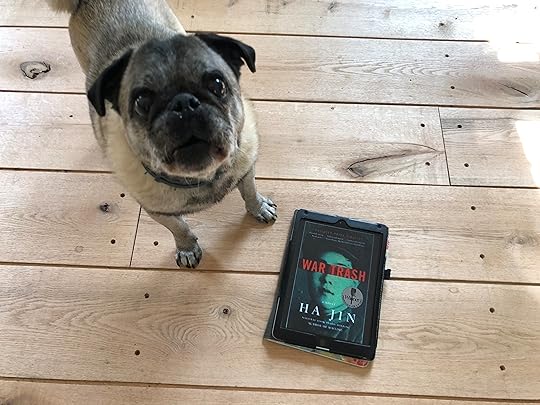
War Trash recounts the travails of Yu Yuan, a Chinese veteran of the Korean War. Yu, who had been a student in a military academy when the Communists took over the Chinese government, was viewed with some suspicion by his superiors since he might harbor Nationalist sympathies. Still, he was valuable because he could speak English so well.
Once in Korea, Yu’s division was ordered to march south. Against the superior firepower of the Americans, the Chinese division got separated. Yu and a handful of others survived, nearly starving, in the wilderness for weeks until they were captured as POWs.
First at a collection center then at a series of camps, Yu struggles to survive as the Communists and Nationalists viciously clash with the captors doing little to maintain order until it reaches a boiling point, and the U.S. military arrives with force if not skill and strategy.
Although Yu is repelled by the extremism demanded by both factions of the Chinese, he is at turns required to prove his loyalty to both for survival, and when the war ends, Yu’s struggles are far from over.
Ha Jin has written War Trash in the form of a memoir drafted by Yu Yuan. As a result the prose is, as Yu might describe it, “documentary-like,” richly descriptive and detailed but not elegant or beautiful. Slang words and phrases like “meanie,” “saving his own skin,” “popped off,” and “roped me in,” are jarring and seem out of place - yet, maybe they aren’t because Yu learned English in part through reading the Stars and Stripes and through conversing with guards. In short, the book is not what I’d call well-written, but I cannot conclude if that is deliberate to reflect Yu’s voice or if it is because Jin didn’t rise up to his usual standards. I’m going to give him the benefit of the doubt.
The story itself makes War Trash worth reading. Personally, I know little about the Korean War, and until reading War Trash, I knew nothing about the American-run POW camps. Jin outlines the inventiveness and determination of the prisoners but also the toll it took, as some slipped into depression or committed suicide. American men for the most part are represented as buffoons, saved by the strength of the military’s weaponry and equipment.
Chinese politics at the time serve as the backdrop. Only two years since the Communists seized power, the Nationalists, formerly in power and backed by the Americans, now ensconced in Taiwan, still believe they can triumph to win back the country. The Chinese POWs are pulled between these groups, fearing them both yet needing to form an alliance with one or the other. In the peace talks, the POWs became a bargaining chip. The Nationalists wanted to claim them to increase their ranks while the Communists wanted them to return to the mainland voluntarily to save face. Of course, Yu concludes that not just he and his fellow POWs but also many others affected and abandoned by the war effort are discarded and treated as war trash.
...aka darzy... | Twitter | Facebook | Instagram

May 21, 2026
A thrilling adventure as well as a condemning war novel, with an emphasis on the futility of ideology that neglects the basic wellbeing of humanity. Wow, that sounded incredibly pretentious. What I mean is: the main character encounters Chinese communists, American anti-communists, Chinese nationalist anti-communists, all of them want to use him for their own cause in some way (with an emphasis on the Chinese factions; the American POW camp is more of a terrifying backdrop than a substantial political influence) and none of them actually help him thrive. And in the end he finds that not only was it all for absolutely nothing, but made things worse for him after the war. It was nonstop intrigue and action, with palpable emotion and a clear perspective masterfully executed through a faux memoir lens. Come for the harrowing POW camp story, stay for the fiercely relatable main character who DOES NOT CARE who’s in charge, for the love of god please just let him go home to his mom.

November 16, 2013
We still hear of wars and rumors of wars, but the war against terrorism is making POW status increasingly complex. Islamic fundamentalists behead their captives on website ads, and the United States sweeps "illegal combatants" into an extralegal black hole from which no light - except for a few photos - can escape.
The diplomats meeting in Geneva in 1929 hoped to enshrine protections for prisoners of war, but despite their careful enumerations, the agreement they cobbled together couldn't anticipate the mutations of conflict or the ingenuity of political leaders. Even while another round of diplomats revised the Geneva Conventions amid the ashes of World War II, a new battle was burning on the Korean peninsula, throwing thousands of captured soldiers back into the old, vulnerable limbo.
Several fine journalists, notably Seymour Hersh, are pursuing the legal status of today's POWs, but Ha Jin began his haunting new novel, "War Trash," in 2000 when the issue carried none of its current charge. Told in the quiet voice of a Chinese officer imprisoned by the Americans in Korea, his story is a reminder that for many people snagged on the barbs of history, the fiery rhetoric of battle is merely an abstraction. All they really want, hanging precariously between the victors and the slain, is to get back to their families, to get on with their lives.
In a very brief introduction, the 73-year-old narrator, Yu Yuan, tells us that he's finally going to describe his years as a POW on the islands off the shores of Korea. "I'm going to do it in English," he writes, "in a documentary manner so as to preserve historical accuracy."
This is something of a stylistic sacrifice for an author who won the National Book Award in 1999 for "Waiting." Indeed, there's a muted quality to this narrative that would grow dull from a less talented writer, but here he holds our attention like a whisper. The slightly stilted, temperate tone runs all the way to the last word, and the cumulative effect is deeply moving.
Yuan portrays himself as a thoughtful young man in a culture of deadly, simplistic ideology. When he's a cadet in Chiang Kai-shek's military academy, he welcomes the revolution as a practical matter. "I felt grateful to the Communists, who seemed finally to have brought peace to our war-battered land," he says. "Then the situation changed."
The conflict in Korea seems so far away and he's part of such a poorly equipped division that the call to arms against the Americans surprises him. But, he writes, "I was obligated to go to the front and defend our country." To avoid direct confrontation with the United States, China cynically classifies these fighters as "volunteers." Yuan and his comrades are pumped full of terrifying propaganda about an American germ-warfare program and sent off to battle. Starving and hampered by their officers' deliberative style, they suffer shocking casualties in the mountains of North Korea, and so begins a tragic story of brief, hopeless military engagement followed by long, precarious imprisonment.
Yuan survives this ordeal largely because of his ability to speak English, which he learned as a teenager from an American missionary. Both his captors and his fellow prisoners find him a useful translator, and this role as a quasiofficial mediator perfectly matches his temperament. Though he's naive and idealistic, Yuan has none of the revolutionary zeal of his comrades. How much simpler, he thinks, to be a "genuine Communist, crazed and fanatic." He regards even those he loves or loathes from a strangely disinterested point of view.
But such independence can be a deadly quality in these polarized prison camps. Saddled with thousands of detainees, the Americans cannot quickly discriminate between those with Communist sympathies and those with Nationalist sympathies. Many of the prisoners are terrified of being repatriated to mainland China, where they signed statements promising to die in defense of their country. And many others know they could be tried as Communists in Taiwan.
While diplomats in Panmunjom dither over the prisoners' status, the camps devolve into war zones of coercion, retribution, and punishment between Nationalist and Communist prisoners. Through it all, Yuan struggles merely to survive so that he can return to care for his mother and marry his fiancée.
He takes us through two years of imprisonment, through moments of common decency and bloody skirmishes against the guards or between opposing groups of prisoners. For the most part, the American GIs are honorable and fair, but there are episodes of brutality when the fabric of law is rent by boredom or cruelty. Far more dangerous, though, are the partisan thugs inside the barbwire who are quick to punish suspected traitors or sacrifice their followers for petty gains.
Despite Yuan's claim to "a documentary manner," this is largely a story of quiet disillusionment, of learning to see that Mao regards him and his friends and millions of others as dispensable.
"The Communists treat every person just as a number," he realizes. "This is the crime of war: it reduces real human beings to abstract numbers."
Born in 1956, Jin missed the Korean War, but he lied about his age when he was 14 to join the People's Liberation Army in China, and this novel is steeped in the details of history as much as in the flavor of personal experience. In fact, the voice of "War Trash" is a rebuttal of its title. It's a timely story about discarded survivors whose lives are more complex and more pitiable than the ideology on either side would have us believe.
http://www.csmonitor.com/2004/1012/p1...
The diplomats meeting in Geneva in 1929 hoped to enshrine protections for prisoners of war, but despite their careful enumerations, the agreement they cobbled together couldn't anticipate the mutations of conflict or the ingenuity of political leaders. Even while another round of diplomats revised the Geneva Conventions amid the ashes of World War II, a new battle was burning on the Korean peninsula, throwing thousands of captured soldiers back into the old, vulnerable limbo.
Several fine journalists, notably Seymour Hersh, are pursuing the legal status of today's POWs, but Ha Jin began his haunting new novel, "War Trash," in 2000 when the issue carried none of its current charge. Told in the quiet voice of a Chinese officer imprisoned by the Americans in Korea, his story is a reminder that for many people snagged on the barbs of history, the fiery rhetoric of battle is merely an abstraction. All they really want, hanging precariously between the victors and the slain, is to get back to their families, to get on with their lives.
In a very brief introduction, the 73-year-old narrator, Yu Yuan, tells us that he's finally going to describe his years as a POW on the islands off the shores of Korea. "I'm going to do it in English," he writes, "in a documentary manner so as to preserve historical accuracy."
This is something of a stylistic sacrifice for an author who won the National Book Award in 1999 for "Waiting." Indeed, there's a muted quality to this narrative that would grow dull from a less talented writer, but here he holds our attention like a whisper. The slightly stilted, temperate tone runs all the way to the last word, and the cumulative effect is deeply moving.
Yuan portrays himself as a thoughtful young man in a culture of deadly, simplistic ideology. When he's a cadet in Chiang Kai-shek's military academy, he welcomes the revolution as a practical matter. "I felt grateful to the Communists, who seemed finally to have brought peace to our war-battered land," he says. "Then the situation changed."
The conflict in Korea seems so far away and he's part of such a poorly equipped division that the call to arms against the Americans surprises him. But, he writes, "I was obligated to go to the front and defend our country." To avoid direct confrontation with the United States, China cynically classifies these fighters as "volunteers." Yuan and his comrades are pumped full of terrifying propaganda about an American germ-warfare program and sent off to battle. Starving and hampered by their officers' deliberative style, they suffer shocking casualties in the mountains of North Korea, and so begins a tragic story of brief, hopeless military engagement followed by long, precarious imprisonment.
Yuan survives this ordeal largely because of his ability to speak English, which he learned as a teenager from an American missionary. Both his captors and his fellow prisoners find him a useful translator, and this role as a quasiofficial mediator perfectly matches his temperament. Though he's naive and idealistic, Yuan has none of the revolutionary zeal of his comrades. How much simpler, he thinks, to be a "genuine Communist, crazed and fanatic." He regards even those he loves or loathes from a strangely disinterested point of view.
But such independence can be a deadly quality in these polarized prison camps. Saddled with thousands of detainees, the Americans cannot quickly discriminate between those with Communist sympathies and those with Nationalist sympathies. Many of the prisoners are terrified of being repatriated to mainland China, where they signed statements promising to die in defense of their country. And many others know they could be tried as Communists in Taiwan.
While diplomats in Panmunjom dither over the prisoners' status, the camps devolve into war zones of coercion, retribution, and punishment between Nationalist and Communist prisoners. Through it all, Yuan struggles merely to survive so that he can return to care for his mother and marry his fiancée.
He takes us through two years of imprisonment, through moments of common decency and bloody skirmishes against the guards or between opposing groups of prisoners. For the most part, the American GIs are honorable and fair, but there are episodes of brutality when the fabric of law is rent by boredom or cruelty. Far more dangerous, though, are the partisan thugs inside the barbwire who are quick to punish suspected traitors or sacrifice their followers for petty gains.
Despite Yuan's claim to "a documentary manner," this is largely a story of quiet disillusionment, of learning to see that Mao regards him and his friends and millions of others as dispensable.
"The Communists treat every person just as a number," he realizes. "This is the crime of war: it reduces real human beings to abstract numbers."
Born in 1956, Jin missed the Korean War, but he lied about his age when he was 14 to join the People's Liberation Army in China, and this novel is steeped in the details of history as much as in the flavor of personal experience. In fact, the voice of "War Trash" is a rebuttal of its title. It's a timely story about discarded survivors whose lives are more complex and more pitiable than the ideology on either side would have us believe.
http://www.csmonitor.com/2004/1012/p1...
September 22, 2020
Read for my Literature of War, English course. Set during the Korean War from the perspective of Yu Yuan, a soldier forced to fight for the communist side, who wasn’t a communist but endured and survived driven by his determination to return home to his Mom and fiancé.

November 12, 2017
I learned a lot from this book, despite not enjoying it as immensely as it deserves.
War Trash is a historical fiction novel telling the story of a young Chinese soldier who is sent as a "volunteer" to fight on the North Korean side in the Korean War. He is taken captive and spends the majority of this book in various American POW camps.
What I found most interesting in this book is how Jin portrays the main character as a common man who doesn't have a zealous allegiance to either the Nationalist Chinese or the Communist Party. It was heartbreaking to read how he was constantly shifted from side to side in an effort to get back home to his aging mother and young fiancee. Overall, I learned a lot about the political situation in China at the time. You could really tell in this book that Jin has a strongly anti-Communist stance, which is evidenced by this book being not available in China.
While I respected this book and I learned a lot from it, the narrators dry story telling and the length of this book made it hard to read. I zipped through the first 150 pages, but I got bogged down in some of the mundane back and forth of prison camp life. I think this story being told from a simple character made for important story telling, it wasn't terribly exhilarating to read about a character who mostly just operates as a witness to the interesting conflicts and events.
Overall, I respect this work and it opened my eyes to the Korean conflict and its effect on China in a new way but I didn't love it.
War Trash is a historical fiction novel telling the story of a young Chinese soldier who is sent as a "volunteer" to fight on the North Korean side in the Korean War. He is taken captive and spends the majority of this book in various American POW camps.
What I found most interesting in this book is how Jin portrays the main character as a common man who doesn't have a zealous allegiance to either the Nationalist Chinese or the Communist Party. It was heartbreaking to read how he was constantly shifted from side to side in an effort to get back home to his aging mother and young fiancee. Overall, I learned a lot about the political situation in China at the time. You could really tell in this book that Jin has a strongly anti-Communist stance, which is evidenced by this book being not available in China.
While I respected this book and I learned a lot from it, the narrators dry story telling and the length of this book made it hard to read. I zipped through the first 150 pages, but I got bogged down in some of the mundane back and forth of prison camp life. I think this story being told from a simple character made for important story telling, it wasn't terribly exhilarating to read about a character who mostly just operates as a witness to the interesting conflicts and events.
Overall, I respect this work and it opened my eyes to the Korean conflict and its effect on China in a new way but I didn't love it.
August 3, 2023
It is a good book and worth the read.
I came across this book because I was watching an episode of MASH where the characters were speaking Korean and I was curious as to what they were saying. When I Googled the episode, a passing comment suggested to read the book, War Trash by Ha Jin. I perfunctorily googled the book to discover that despite being a Pulitzer Prize Finalist and winning the Pen/Faulkner award there is only one copy in rotation across all libraries in Vic, Aus (I may be wrong here but the only copy I could find was one through Kingston Library Services).
I'm sure there is a less conspiratorial reason for this but that is why I picked up this book and I am glad I did. Highly recommend.
I came across this book because I was watching an episode of MASH where the characters were speaking Korean and I was curious as to what they were saying. When I Googled the episode, a passing comment suggested to read the book, War Trash by Ha Jin. I perfunctorily googled the book to discover that despite being a Pulitzer Prize Finalist and winning the Pen/Faulkner award there is only one copy in rotation across all libraries in Vic, Aus (I may be wrong here but the only copy I could find was one through Kingston Library Services).
I'm sure there is a less conspiratorial reason for this but that is why I picked up this book and I am glad I did. Highly recommend.
November 25, 2017
An extraordinary novel based on true events that were completely unknown to me, despite my average knowledge of early communist China and the Korean War.

April 9, 2021
Excellent book by Ha Jin

December 13, 2018
As a memoir it would have been interesting. As a work of fiction, it is remarkable. He had me believing it was a memoir, then little inconsistencies, disconnects would pop up. My greatest difficulty with this is how much is real and how much is not. I have the same problem with 19th Wife. I would like to know which is true and which is not. Maintaining a healthy skepticism this does provide insights into the Korean War I've not had. I recommend it, but feel free to question any 'truth' which doesn't ring true.

December 24, 2014
I enjoyed reading one of Ha Jin's books when I was in high school and another later on in college. While I knew that this work would center around a part of life in China, I was surprised to learn that this book takes place during the Korean war. As an expat living in Korea, I always hear about this war from the view of the Americans, South Korea and the UN. Seeing the war from the point of view of a Chinese soldier made the book all that much more interesting.
Like the books that I've read before, Ha Jin's literary style is not obtuse at all, making the book an enjoyment, not a chore even though the store overall was quiet depressing. In addition to the other books that I read, the Chinese government isn't shown in a particularly pleasant light. After reading up on his Wikipedia page, I wasn't surprised that he emigrated to America after the Tiananmen Square protests of 1989.
It is clear that he did plenty of research about Korea during the Korean war. A lot of he writes about Korea in this book reflects what I have experiences living here and what I have read in books about Korean history.
It's been awhile since I've read Waiting and the Crazed. I think I need to revisit the books and find more of his other work that I haven't read yet.
Like the books that I've read before, Ha Jin's literary style is not obtuse at all, making the book an enjoyment, not a chore even though the store overall was quiet depressing. In addition to the other books that I read, the Chinese government isn't shown in a particularly pleasant light. After reading up on his Wikipedia page, I wasn't surprised that he emigrated to America after the Tiananmen Square protests of 1989.
It is clear that he did plenty of research about Korea during the Korean war. A lot of he writes about Korea in this book reflects what I have experiences living here and what I have read in books about Korean history.
It's been awhile since I've read Waiting and the Crazed. I think I need to revisit the books and find more of his other work that I haven't read yet.
Displaying 1 - 30 of 397 reviews