

What do you think?

Supreme (collected editions) #1
Supreme: The Story of the Year
Due to amnesia caused by a revision in time, comic book artist Ethan Crane, a.k.a. Supreme, fights to remember his past in flashbacks that range from the 1930s through the 1990s, with artwork reflecting the time periods he inhabits.
332 pages, Paperback
First published January 1, 2002
About the author
Alan Moore
1,630 books22.3k followersAlan Moore is an English writer most famous for his influential work in comics, including the acclaimed graphic novels Watchmen, V for Vendetta and From Hell. He has also written a novel, Voice of the Fire, and performs "workings" (one-off performance art/spoken word pieces) with The Moon and Serpent Grand Egyptian Theatre of Marvels, some of which have been released on CD.
As a comics writer, Moore is notable for being one of the first writers to apply literary and formalist sensibilities to the mainstream of the medium. As well as including challenging subject matter and adult themes, he brings a wide range of influences to his work, from the literary–authors such as William S. Burroughs, Thomas Pynchon, Robert Anton Wilson and Iain Sinclair; New Wave science fiction writers such as Michael Moorcock; horror writers such as Clive Barker; to the cinematic–filmmakers such as Nicolas Roeg. Influences within comics include Will Eisner, Harvey Kurtzman, Jack Kirby and Bryan Talbot.
As a comics writer, Moore is notable for being one of the first writers to apply literary and formalist sensibilities to the mainstream of the medium. As well as including challenging subject matter and adult themes, he brings a wide range of influences to his work, from the literary–authors such as William S. Burroughs, Thomas Pynchon, Robert Anton Wilson and Iain Sinclair; New Wave science fiction writers such as Michael Moorcock; horror writers such as Clive Barker; to the cinematic–filmmakers such as Nicolas Roeg. Influences within comics include Will Eisner, Harvey Kurtzman, Jack Kirby and Bryan Talbot.
Ratings & Reviews
Friends & Following
Create a free account to discover what your friends think of this book!
Community Reviews
Displaying 1 - 30 of 78 reviews

August 3, 2025
Alan Moore prende Superman, qui Supreme, e scrive una meraviglia che omaggia la storia del fumetto.
Sotto la penna di Alan Moore, il fumetto "Supreme" si trasforma da una violenta parodia a un sincero e appassionato tributo alla Silver Age dei supereroi. Invece di decostruire il genere, Moore lo celebra, esplorando con amore il mondo dei fumetti classici.
Il protagonista, Ethan Crane, è un artista che riscopre le sue avventure passate, permettendo a Moore di riflettere sulla natura stessa della narrazione. Il fumetto è una dichiarazione d'amore al genere supereroistico, piena di meraviglia e ottimismo, lontana dal cinismo di "Watchmen".
-------------------------
Alan Moore takes Superman, here Supreme, and writes a marvel that pays homage to the history of comics.
Under Alan Moore's pen, the comic "Supreme" transforms from a violent parody to a sincere and passionate tribute to the Silver Age of superheroes. Rather than deconstructing the genre, Moore celebrates it, lovingly exploring the world of classic comics.
The protagonist, Ethan Crane, is an artist rediscovering his past adventures, allowing Moore to reflect on the very nature of storytelling. The comic is a love letter to the superhero genre, full of wonder and optimism, far removed from the cynicism of "Watchmen."
Sotto la penna di Alan Moore, il fumetto "Supreme" si trasforma da una violenta parodia a un sincero e appassionato tributo alla Silver Age dei supereroi. Invece di decostruire il genere, Moore lo celebra, esplorando con amore il mondo dei fumetti classici.
Il protagonista, Ethan Crane, è un artista che riscopre le sue avventure passate, permettendo a Moore di riflettere sulla natura stessa della narrazione. Il fumetto è una dichiarazione d'amore al genere supereroistico, piena di meraviglia e ottimismo, lontana dal cinismo di "Watchmen".
-------------------------
Alan Moore takes Superman, here Supreme, and writes a marvel that pays homage to the history of comics.
Under Alan Moore's pen, the comic "Supreme" transforms from a violent parody to a sincere and passionate tribute to the Silver Age of superheroes. Rather than deconstructing the genre, Moore celebrates it, lovingly exploring the world of classic comics.
The protagonist, Ethan Crane, is an artist rediscovering his past adventures, allowing Moore to reflect on the very nature of storytelling. The comic is a love letter to the superhero genre, full of wonder and optimism, far removed from the cynicism of "Watchmen."

November 8, 2023
I've had my eye out for this for the better part of a decade and even had a couple dreams about finding it at a convention. When it popped up on ShopGoodwill a couple weeks ago, I put a pretty high bid on it and was relieved when I only had to pay $16 plus postage for it.
Like a lot of guys my age, I was a rube when Image Comics formed and started churning out books. I read 10-12 issues of Supreme and wasn't impressed. Eventually, Alan Moore got a writing gig on the book and thirty years later, I've finally read it.
Okay, so describing this without spoiling too much is going to be hard. Supreme has amnesia and finds himself in The Supremacy, a place outside of time where all the versions of Supreme go when there are Revisions in reality. Ethan Crane, Supreme's alter ego, is an artist working at Dazzle Comics. As he regains his memories, he relates the tales to Diana Dane, his co-worker and potential love interest as a villain's scheme slightly unfolds.
That doesn't make it sound that interesting but, boy howdy, it is. Supreme's tales are drawn in a 1950s style and the whole book is a very meta love letter to Superman. It's a very fun book and I don't see how anyone could think Alan Moore hates comics after reading this. It's quite clear that he loves comics, even all the goofy ass crap. Instead of trying to explain away all the Silver Age silliness, Moore unapologetically rolls around in it like a dog on something disgusting.
There are classic homages all over the place. Supreme started life as Kid Supreme so a lot of Silver Age Superboy stuff is there, like the robots, a Legion of Super Heroes homage, and a Supreme Hound. As he ages, we get Alan Moore's take on the old Justice League/Justice Society team ups, homages to the EC Comics, and even Moore's take on a very Spectre like character. Much like in 1963, he makes it feel like there's a whole box of comics out there I need to read.
I feel like I'm underselling this. It reminds me of All-Star Superman in some ways and feels like an extension of Whatever Happened to the Man of Tomorrow in others. This is one of those books I expect I'll discover something new every time I read it. There are references to all sorts of golden and silver age stories and I know some of them went right by me.
Five out of five stars.
Like a lot of guys my age, I was a rube when Image Comics formed and started churning out books. I read 10-12 issues of Supreme and wasn't impressed. Eventually, Alan Moore got a writing gig on the book and thirty years later, I've finally read it.
Okay, so describing this without spoiling too much is going to be hard. Supreme has amnesia and finds himself in The Supremacy, a place outside of time where all the versions of Supreme go when there are Revisions in reality. Ethan Crane, Supreme's alter ego, is an artist working at Dazzle Comics. As he regains his memories, he relates the tales to Diana Dane, his co-worker and potential love interest as a villain's scheme slightly unfolds.
That doesn't make it sound that interesting but, boy howdy, it is. Supreme's tales are drawn in a 1950s style and the whole book is a very meta love letter to Superman. It's a very fun book and I don't see how anyone could think Alan Moore hates comics after reading this. It's quite clear that he loves comics, even all the goofy ass crap. Instead of trying to explain away all the Silver Age silliness, Moore unapologetically rolls around in it like a dog on something disgusting.
There are classic homages all over the place. Supreme started life as Kid Supreme so a lot of Silver Age Superboy stuff is there, like the robots, a Legion of Super Heroes homage, and a Supreme Hound. As he ages, we get Alan Moore's take on the old Justice League/Justice Society team ups, homages to the EC Comics, and even Moore's take on a very Spectre like character. Much like in 1963, he makes it feel like there's a whole box of comics out there I need to read.
I feel like I'm underselling this. It reminds me of All-Star Superman in some ways and feels like an extension of Whatever Happened to the Man of Tomorrow in others. This is one of those books I expect I'll discover something new every time I read it. There are references to all sorts of golden and silver age stories and I know some of them went right by me.
Five out of five stars.

December 24, 2011
Holy shit! It's a bird! It's a plane! It's . . .

DC taking a dump on another idea by Alan Moore that could have easily been used to help their characters transcend the hokey golden age appeal they lost ages ago.
At least that's the way I see it.
If you look at a lot of Moore's early works, you'll see the parallels between DC's characters and those he uses in his own texts. Nite Owl and Batman, hell the whole of Watchmen and the Justice League. They aren't as thinly veiled as Supreme, and maybe it wasn't Moore's intention to initially write these stories using DC's characters, but I bet he would have been willing to bend a little before DC bent him over the desk against his will and used him as they pleased.
Or maybe I'm just a little perturbed that this comic isn't a Superman comic, because it would have brought the Superman franchise the depth it deserved. I can't help but feel that DC is responsible in some way.
This book isn't a parody. This is an in-depth exploration of the collective imagination of a readership and how the relationship between author and audience would be rendered in the fictional world if the dynamic could be encapsulated. It's a critique of the limitations of our seemingly perfect heroes and how they dodge modern problems that, despite their predominance in society, are constantly overlooked by the comic industry. And when they're not overlooked, you get one of three things, He-Man telling you not to let big people touch you in your private places, a token superhero of another race, or:
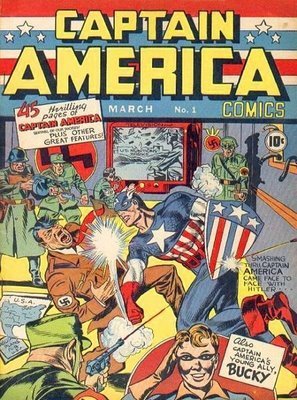
And thanks to Marvel, that's how the alliance won the war.
It doesn't take a brilliant mind to see that comic books are ill equipped to deal with real problems in the world. That's why they invented super villains whose greatest power is telling riddles about as difficult as the ones you find on a happy meal box.
Alan Moore touches down on all of that, develops his notion of the collective imagination and the author/audience relationship that you find in his other works like Promethea, and neatly packages it with the help of some great artwork that harkens back to the golden age of comics. That's why this is one of my favorite works by Moore.
DC taking a dump on another idea by Alan Moore that could have easily been used to help their characters transcend the hokey golden age appeal they lost ages ago.
At least that's the way I see it.
If you look at a lot of Moore's early works, you'll see the parallels between DC's characters and those he uses in his own texts. Nite Owl and Batman, hell the whole of Watchmen and the Justice League. They aren't as thinly veiled as Supreme, and maybe it wasn't Moore's intention to initially write these stories using DC's characters, but I bet he would have been willing to bend a little before DC bent him over the desk against his will and used him as they pleased.
Or maybe I'm just a little perturbed that this comic isn't a Superman comic, because it would have brought the Superman franchise the depth it deserved. I can't help but feel that DC is responsible in some way.
This book isn't a parody. This is an in-depth exploration of the collective imagination of a readership and how the relationship between author and audience would be rendered in the fictional world if the dynamic could be encapsulated. It's a critique of the limitations of our seemingly perfect heroes and how they dodge modern problems that, despite their predominance in society, are constantly overlooked by the comic industry. And when they're not overlooked, you get one of three things, He-Man telling you not to let big people touch you in your private places, a token superhero of another race, or:
And thanks to Marvel, that's how the alliance won the war.
It doesn't take a brilliant mind to see that comic books are ill equipped to deal with real problems in the world. That's why they invented super villains whose greatest power is telling riddles about as difficult as the ones you find on a happy meal box.
Alan Moore touches down on all of that, develops his notion of the collective imagination and the author/audience relationship that you find in his other works like Promethea, and neatly packages it with the help of some great artwork that harkens back to the golden age of comics. That's why this is one of my favorite works by Moore.

August 15, 2014
Supreme returns to Earth after an extended mission elsewhere. Alan Moore takes advantage of the shift in writers to have the character become aware of his own continuity and backstory revisions. By having Supreme revisit his origins, Moore is able to resculpt the character into a tribute to the classic Superman days of yore.
This is one of those books that I never get tired of rereading. Moore took a Superman clone and turned him into a loving homage to the real thing. He reintroduces concepts from the Golden and Silver Ages in ways that invigorate a standard 90's title … I assume. I admit that I'm not at all familiar with Supreme prior to Moore’s run on the title. Was it in need of invigoration?
Longtime comics fans will recognize references to myriad classic tales from various series. The story is also thoughtfully laid out, with many seemingly offhand references turning out to have great significance later on. I would go so far as to say that this is one of my favorite Moore books ever. Highly recommended!
This is one of those books that I never get tired of rereading. Moore took a Superman clone and turned him into a loving homage to the real thing. He reintroduces concepts from the Golden and Silver Ages in ways that invigorate a standard 90's title … I assume. I admit that I'm not at all familiar with Supreme prior to Moore’s run on the title. Was it in need of invigoration?
Longtime comics fans will recognize references to myriad classic tales from various series. The story is also thoughtfully laid out, with many seemingly offhand references turning out to have great significance later on. I would go so far as to say that this is one of my favorite Moore books ever. Highly recommended!

October 29, 2020
This is quite a read. It's about as meta as meta-fiction can get.
Alan Moore seems to be writing the ultimate homage to Superman of the 50s and 60s using the Supreme universe. It's quirky good fun packed with big ideas and clever inside references.
It's hard to tell if a reader could pick this up and enjoy it without having some experience of classic Superman stories. I suppose it is possible, but I also think the joy is the fan service to Superman comics.
The stories themselves rarely stand on their own. They depend on 60s and 70s style flashbacks done in the art style of the era. In fact, it's so thicky layered with meaning and messages that it's probably impossible to catch all of the inside-references in one read.
That said, it's dense reading. Like most of Alan Moore's work, you need to read carefully. His stories are packed on every page. At times, it can be exhausting, but it does reward you for sticking with it. You get your money's worth.
I read it as individual issues and now as a collected edition. It's better to read it as a collection, but most of the individual issues will read fine as self-contained stories.
Interesting surprise: Alan Moore can be very funny. It's all contextually relevant stuff that often pokes fun at cultural conventions. Plus, it's usually all fan service. It's the sort of wink-wink, nudge-nudge stuff you don't typically associate with Alan Moore.
If this was published by DC Comics as Superman stories, it would be legendary meta-fiction. Instead, it's a bit of fan trivia to pull out at parties. It's definitely worth a read, even if you have no connection with Superman....I mean, Supreme.
Alan Moore seems to be writing the ultimate homage to Superman of the 50s and 60s using the Supreme universe. It's quirky good fun packed with big ideas and clever inside references.
It's hard to tell if a reader could pick this up and enjoy it without having some experience of classic Superman stories. I suppose it is possible, but I also think the joy is the fan service to Superman comics.
The stories themselves rarely stand on their own. They depend on 60s and 70s style flashbacks done in the art style of the era. In fact, it's so thicky layered with meaning and messages that it's probably impossible to catch all of the inside-references in one read.
That said, it's dense reading. Like most of Alan Moore's work, you need to read carefully. His stories are packed on every page. At times, it can be exhausting, but it does reward you for sticking with it. You get your money's worth.
I read it as individual issues and now as a collected edition. It's better to read it as a collection, but most of the individual issues will read fine as self-contained stories.
Interesting surprise: Alan Moore can be very funny. It's all contextually relevant stuff that often pokes fun at cultural conventions. Plus, it's usually all fan service. It's the sort of wink-wink, nudge-nudge stuff you don't typically associate with Alan Moore.
If this was published by DC Comics as Superman stories, it would be legendary meta-fiction. Instead, it's a bit of fan trivia to pull out at parties. It's definitely worth a read, even if you have no connection with Superman....I mean, Supreme.

July 23, 2011
It's not fair to complain about this clever and lovingly-detailed reconstruction of the Superman myth -- I knew what I was getting into just glancing at the first few pages -- life's not fair. Alan Moore unleashes his nerdiest self here, demonstrating an intimate familiarity with dusty corners of the Superman universe. Naturally, Darius Dax is Lex Luthor, Diana Dane is Lois Lane, and supremium is kryptonite; but Moore's thinly-veiled references are rolling hundreds deep, so numerous that DC Comics' lawyers' mouths must have watered. Moore could've defended himself by claiming parody, but he'd have been lying. His aim with this story (besides collecting a paycheck) can be understood perfectly without irony goggles: to awaken the same wonder children felt in the mid-20th century upon encountering Superman comix for the first time, using the exact same set of symbols.
It's a game Moore is good at, and the structure he chooses -- alternating a framing sequence drawn in a 1990s Rob-Liefeld-esque style with flashback sequences drawn in various period styles -- is as fun as it is jarring. His skills as a storyteller, especially his ease with unexpected conceptual twists, are far beyond those of his Golden and Silver Age models. A theme emerges, too, regarding the power of nostalgia for good or ill, that distinguishes Supreme from ordinary comix for kids.
Here's a potential problem: Moore's adult concerns, camouflaged as they are, bleed from every page of the book. His disdain for the so-called "gritty" copycat comix that came up out of the woodwork after Swamp Thing and Watchmen . His anti-nuke, anti-racist 1960s liberalism. His sadness over the impossibility of simpler heroes. To have all of these feelings bubble up just under the surface of a superconventional superhero story seems masochistic at best, a waste of his time and talent at worst. There's pleasure -- Rick Veitch's period simulations stand out, as does Chris Sprouse's sensitive treatment of the romantic tension between Ethan Crane (Clark Kent) and Diana Dane -- but it's mixed with a desire for more Moore. His gift for natural speech is not well spent on lines such as, "So, were you impressed? Did you get any ideas about how to handle superheroes in Omniman or Warrior Woman ?" It's as if Moore wanted to test himself by shackling Rob Liefeld, Jim Lee, Todd McFarlane, and the entire bloated history of DC Comics to each of his limbs, to see if he could still fly. He can, but just barely.
It's a game Moore is good at, and the structure he chooses -- alternating a framing sequence drawn in a 1990s Rob-Liefeld-esque style with flashback sequences drawn in various period styles -- is as fun as it is jarring. His skills as a storyteller, especially his ease with unexpected conceptual twists, are far beyond those of his Golden and Silver Age models. A theme emerges, too, regarding the power of nostalgia for good or ill, that distinguishes Supreme from ordinary comix for kids.
Here's a potential problem: Moore's adult concerns, camouflaged as they are, bleed from every page of the book. His disdain for the so-called "gritty" copycat comix that came up out of the woodwork after Swamp Thing and Watchmen . His anti-nuke, anti-racist 1960s liberalism. His sadness over the impossibility of simpler heroes. To have all of these feelings bubble up just under the surface of a superconventional superhero story seems masochistic at best, a waste of his time and talent at worst. There's pleasure -- Rick Veitch's period simulations stand out, as does Chris Sprouse's sensitive treatment of the romantic tension between Ethan Crane (Clark Kent) and Diana Dane -- but it's mixed with a desire for more Moore. His gift for natural speech is not well spent on lines such as, "So, were you impressed? Did you get any ideas about how to handle superheroes in Omniman or Warrior Woman ?" It's as if Moore wanted to test himself by shackling Rob Liefeld, Jim Lee, Todd McFarlane, and the entire bloated history of DC Comics to each of his limbs, to see if he could still fly. He can, but just barely.

November 5, 2021
Supreme begins to piece together parts of his life after suffering amnesia and realizing the time has been "rebooted".
I was really excited to read this because Alan Moore is a master at comics and I'm a big fan of his work. And it's an interesting premise that Moore lays down, as he has the characters literally reacting to the fact that comic book writers "reboot" the characters and their histories from time to time. Here he shows us where those other manifestations go, how the characters change, and how things ultimately stay the same. And at the same time, the book is an homage to superman and the golden age of comic books in general. There are flashback sequences that are pretty much golden age stories, complete with art faithful to golden age aesthetics, and plots that reflect the same. It's an interesting dichotomy of how things have changed and evolved, as well as devolved.
To me, the book was tedious to read at times if I'm being honest. I did appreciate the golden age stuff, but at after a certain time, the jumping back in forth in - not only time, but also style of book - began to feel like a chore to read. I will say towards the end, Moore begins making connections and looping the beginning of the book with the end, and that makes it a lot more interesting. So was it worth it to get to this point? I would say so, as that aspect of the book made it much more palatable.
The art ranges from pretty good, to not at all good. The 90's aesthetic was in full force in this book, and it just looks bad. I really appreciated that towards the end of the book we got some artists that had a more contemporary style, as it made it easier on the eyes.
If you're a fan of the golden age of comics, this is a must read.
I was really excited to read this because Alan Moore is a master at comics and I'm a big fan of his work. And it's an interesting premise that Moore lays down, as he has the characters literally reacting to the fact that comic book writers "reboot" the characters and their histories from time to time. Here he shows us where those other manifestations go, how the characters change, and how things ultimately stay the same. And at the same time, the book is an homage to superman and the golden age of comic books in general. There are flashback sequences that are pretty much golden age stories, complete with art faithful to golden age aesthetics, and plots that reflect the same. It's an interesting dichotomy of how things have changed and evolved, as well as devolved.
To me, the book was tedious to read at times if I'm being honest. I did appreciate the golden age stuff, but at after a certain time, the jumping back in forth in - not only time, but also style of book - began to feel like a chore to read. I will say towards the end, Moore begins making connections and looping the beginning of the book with the end, and that makes it a lot more interesting. So was it worth it to get to this point? I would say so, as that aspect of the book made it much more palatable.
The art ranges from pretty good, to not at all good. The 90's aesthetic was in full force in this book, and it just looks bad. I really appreciated that towards the end of the book we got some artists that had a more contemporary style, as it made it easier on the eyes.
If you're a fan of the golden age of comics, this is a must read.

February 26, 2018
A tribute, or homage, to silver-age DC similar in spirit to the later All Star Superman.
Part of nearly every chapter is devoted to a spot-on parody of silver age Superman:
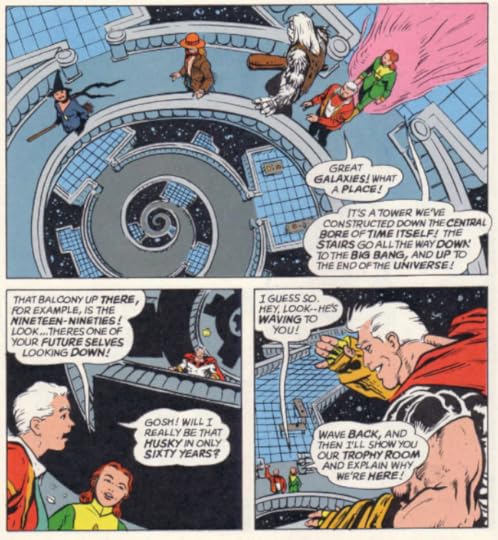
Compared to much of Alan Moore's other work, the disturbing is well relegated to the background here.
Worth seeking out (it is currently out-of-print). I was lucky to get a copy from the library.
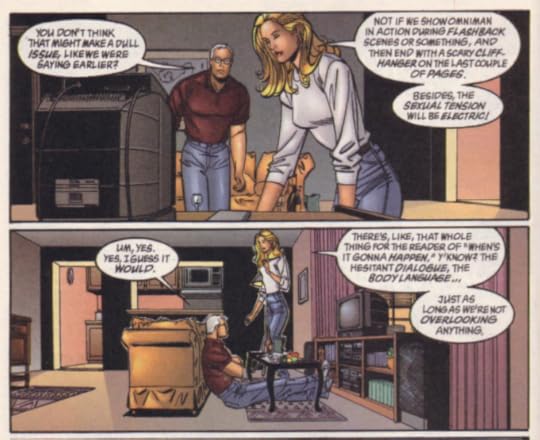
PS- this 'date' issue was very cute (Supreme's secret identity is as a comic book artist), but what struck me was how odd the 90s fashion looks today:
Part of nearly every chapter is devoted to a spot-on parody of silver age Superman:
Compared to much of Alan Moore's other work, the disturbing is well relegated to the background here.
Worth seeking out (it is currently out-of-print). I was lucky to get a copy from the library.
PS- this 'date' issue was very cute (Supreme's secret identity is as a comic book artist), but what struck me was how odd the 90s fashion looks today:

February 4, 2015
There are some people that will say that there was an era when super hero themed comic books didn't the characters and worlds created seriously enough (essentially the golden and silver ages) and a time when creators may have taken the material TOO seriously (namely the "Dark and Gritty" era that dominated the 80's).
With Alan Moore's take on Supreme he found a way to blend the more fantastic elements found in Superman comics of various eras - most noteably the silver age era with the shrunken cities, future worlds and super science villains - but presents it with a gravitas of a historian recounting the majesty of an ancient empire on paper.
It's difficult to describe some of these expertly woven tales without spoiling some aspect of the overall story (literally every thing happens for a reason though not to the point of distraction) so I'll just say that whether your somewhat of a comic book hero historian or a casual reader looking for a fun, layered, read this Supreme collection 9no pun intended) has something for you.
With Alan Moore's take on Supreme he found a way to blend the more fantastic elements found in Superman comics of various eras - most noteably the silver age era with the shrunken cities, future worlds and super science villains - but presents it with a gravitas of a historian recounting the majesty of an ancient empire on paper.
It's difficult to describe some of these expertly woven tales without spoiling some aspect of the overall story (literally every thing happens for a reason though not to the point of distraction) so I'll just say that whether your somewhat of a comic book hero historian or a casual reader looking for a fun, layered, read this Supreme collection 9no pun intended) has something for you.

May 11, 2010
I was pleasantly surprised by this graphic novel. Alan Moore was shooting for the “archetypical big guy superhero in a cape” and he succeeded. Supreme is the superhero’s superhero. Moore says this about what he was trying to do” What I want to do, is to do a really Supreme being. I see this as not being a retro book, not in the way 1963 was. What I’d like to do is to try to infuse this new ‘90’s model type superhero with all the imaginative power of the superheroes of the previous 50 years. To give it that sort of humor and grace and see if we can come up with some composite that’s viable for the next century.”
Supreme is a very smart, well thought out story line. I was totally engrossed in it. Even though the character is many different superheroes put together, the plot lines are original and it altogether makes an amazing graphic novel. Supreme, although drawn and simply presented to be a very simple being, is very complex and well thought out. Supreme is also a very strong character. Basically, Alan Moore hits one out of the park on this one. Joe Bennett/ Rick Vertich do a great job with the illustrations. The way Moore has the plot line from time period to time period also makes Supreme shine. I was so amped up about this; I shared it with as many of my family members that would look at it. They all agreed it was a different type of superhero, one that was fun and exciting for all the right reasons. Check it out give it a go; this one is just plain fun.
What are you reading today? Check us out and become our friend on Facebook. Go to Goodreads and become our friend there and suggest books for us to read and post on. You can also follow us on Twitter. Thanks for stopping by today; we will see you tomorrow. Have a great day.
Supreme is a very smart, well thought out story line. I was totally engrossed in it. Even though the character is many different superheroes put together, the plot lines are original and it altogether makes an amazing graphic novel. Supreme, although drawn and simply presented to be a very simple being, is very complex and well thought out. Supreme is also a very strong character. Basically, Alan Moore hits one out of the park on this one. Joe Bennett/ Rick Vertich do a great job with the illustrations. The way Moore has the plot line from time period to time period also makes Supreme shine. I was so amped up about this; I shared it with as many of my family members that would look at it. They all agreed it was a different type of superhero, one that was fun and exciting for all the right reasons. Check it out give it a go; this one is just plain fun.
What are you reading today? Check us out and become our friend on Facebook. Go to Goodreads and become our friend there and suggest books for us to read and post on. You can also follow us on Twitter. Thanks for stopping by today; we will see you tomorrow. Have a great day.

June 20, 2018
Reviewing all of Alan Moore's Supreme Run (Plus #63 and Fan-Edited #64)
Supreme is Alan Moore's attempt to atone for the Dark Age of deconstruction that occurred after Watchmen. During his reconstruction phase (followed up with by America's Best Comics), Moore essentially created a Grand Unified Theory for Superman, and by extension a superheroes multiverse cosmology/theology. It's an Afterlife/5th Dimension/Limbo for superheroes and makes everything canon, similar to hypertime. It's superbly metafictional, like comics should be (imo).
Superman most often works best as an archetype examining the character outside the confines of the corporate mandate (hence I think the character has only really shined in All-Star Superman, a few sporadic runs--and then in Elseworlds like Red Son). Moore intentionally does a bit of a campy, dated, winking through the 4th Wall take--because god, there was so much blood from Image to clean up.
This is a love letter to the Silver Age of comics, particuarly with Rick Veitch's "embellishments" and retro nostalgic renditions. Cute and aimed for all-ages doesn't necessarily mean "dumb" and so many readers and companies forget this.
Supreme is Alan Moore's attempt to atone for the Dark Age of deconstruction that occurred after Watchmen. During his reconstruction phase (followed up with by America's Best Comics), Moore essentially created a Grand Unified Theory for Superman, and by extension a superheroes multiverse cosmology/theology. It's an Afterlife/5th Dimension/Limbo for superheroes and makes everything canon, similar to hypertime. It's superbly metafictional, like comics should be (imo).
Superman most often works best as an archetype examining the character outside the confines of the corporate mandate (hence I think the character has only really shined in All-Star Superman, a few sporadic runs--and then in Elseworlds like Red Son). Moore intentionally does a bit of a campy, dated, winking through the 4th Wall take--because god, there was so much blood from Image to clean up.
This is a love letter to the Silver Age of comics, particuarly with Rick Veitch's "embellishments" and retro nostalgic renditions. Cute and aimed for all-ages doesn't necessarily mean "dumb" and so many readers and companies forget this.

October 5, 2007
Not surprisingly, Alan Moore has scripted several excellent metafictional texts. Among his best and least know example, Supreme: The Story of the Year re-creates Rob Liefeld's Superman ripoff. In his initial story, Moore introduces the Supremacy, a place outside of reality that serves as the home for all previously retconned1 versions and variants of Supreme. Intriguing characters such as Macrosupreme, Son of Supreme, Sister Supreme, Suprememarch, Supreme White, Supreme Gold, Sally Supreme, Scrappy Supreme, and even a Squeak the Supremouse litter the story landscape. As new each "revision” occurs, the then-current Supreme is “canceled from existence” and journeys to the Supremacy. Moore successfully uses this idea to re-envision the previously dull character, giving it relevancy as far more than just another Superman clone.

April 2, 2019
Alan Moore's re-invention of the Image Comics' super hero. So damn good. I really, really enjoyed this. Moore creates a great character with a rich history. Wow. So much better than Watchmen.

May 23, 2011
This is hands down my favorite comic story, although I have no idea how something so amazing came to be given the creators associated with it. Alan Moore had been absent from superhero comics for almost a decade before returning to write some of his worst stories ever published (Alan Moore's Complete WildC.A.T.s, Violator, Violator vs. Badrock). Rob Liefeld, a flashy comic artist turned publisher notorious for blowing deadlines left and right, had created an army of brainless comics for teenage boys. Liefeld somehow wooed Moore into taking over one of his most brainless titles, Supreme, a character that was created by simply asking "What if Superman were an enormous dickhead?". No one could have predicted that the results of this has-been author taking over the writing chores on a poorly selling Superman-ripoff book would become pure magic.
This is a comic story written for fans of comic books. The story reads like a history of comic books in America from WW2 to present (then the grim 90’s) and makes commentary on each of the major fads from those decades. Each issue contains flash-back scenes expertly drawn by Roarin’ Rick Veitch who is able to somewhat adapt his style to emulate the time period being represented, whether that be a lifeless 1940’s Golden Age superhero look, a 1950’s EC Comics horror/sci-fi title, or a psychedelic 1970’s cosmic story. The stories for the most part were done-in-ones, with elements bleeding over into following issues and culminating in the giant-sized final issue that tied everything together nicely. Think of it kind of like a season of Dr. Who from when Russell Davies was the head writer and it was still good. Each issue/episode is a self contained story, but contains seemingly inconsequential hints as to the major threat/villain that will plague our hero at the end.
This story is Alan Moore’s love-letter to Silver Age Superman, and ironically is the greatest Superman story ever told (even though it doesn’t feature anyone called Superman). Moore introduces his take of each of the key characters and plot devices that make up the essential Superman mythos as was first introduced under editor Mort Weisinger beginning in Action Comics 241. There is a Legion of Superheroes, Supergirl, Brainiac with his Bottled City of Kandor, Phantom Zone, Fortress of Solitude, Lex Luthor, Justice League of America and Justice Society, two versions of Bizarro, a Kryptonite Man, and a Krypto. The only element of Silver Age Superman omitted from Supreme’s roster that I can think of is a Streaky the Supercat.
The non-Veitch art is pretty much the standard Liefeld-imitation that was the standard in Liefeld's publications at the time, which falls somewhere between tolerable and pretty bad. Interestingly, neither Joe Bennett nor Mark Pajarillo, who each provided art for 3 issues of the "current" storyline did not get thier names on the spine of Checker's leatherbound edition while Chris Sprouse, who only provided art in one issue collected in this book, got second billing (even above Rick Veitch?!?).
I can’t help but think that part of Alan Moore’s motivation in writing the best Superman story ever for Rob Liefeld’s Image/Maximum/Awesome would be that it gave him one last chance to give DC Comics the finger (or whatever it is British people call it when they do their version of flipping the bird). Moore had left DC over a disagreement about royalties (specifically, a Watchmen pin set), and would go to great lengths to never work for DC (or Marvel) ever again (so far) in his career. By writing an amazing Superman story, but calling it “Supreme,” Moore is telling his ex-published “you could have had this, but you had to fuck it all up over a couple measly dollars.” Ironically, another future scuffle over Watchmen would later cause Moore to again completely leave mainstream comics when a producer on the Watchmen movie (incorrectly) claimed that Alan Moore gave his full blessing to their silver screen adaptation. Moore would go on to have his name removed from anything produced by DC or Marvel, and insist any meager royalties he might earn be instead paid to his co-creators. He’s just such a stubborn bastard. I love him.
...And yes, I am mostly writing this review just because the current top review is full of unsubstantiated conjecture and plain misinformation. My favorite comic story deserves better than that.
-----------------------------------------------
Rick Veitch provided an amazing array of art styles for the flashback sequences.

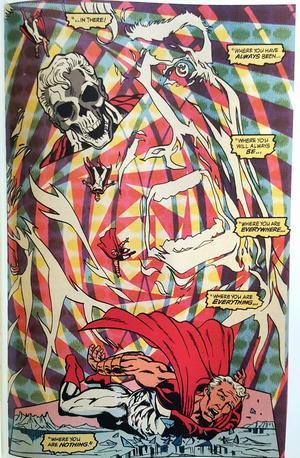

...but some of the current storyline art is garbage.
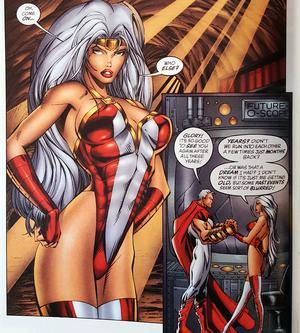
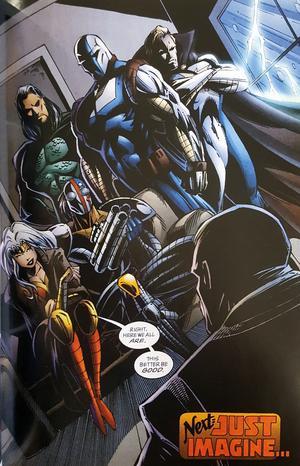
This is a comic story written for fans of comic books. The story reads like a history of comic books in America from WW2 to present (then the grim 90’s) and makes commentary on each of the major fads from those decades. Each issue contains flash-back scenes expertly drawn by Roarin’ Rick Veitch who is able to somewhat adapt his style to emulate the time period being represented, whether that be a lifeless 1940’s Golden Age superhero look, a 1950’s EC Comics horror/sci-fi title, or a psychedelic 1970’s cosmic story. The stories for the most part were done-in-ones, with elements bleeding over into following issues and culminating in the giant-sized final issue that tied everything together nicely. Think of it kind of like a season of Dr. Who from when Russell Davies was the head writer and it was still good. Each issue/episode is a self contained story, but contains seemingly inconsequential hints as to the major threat/villain that will plague our hero at the end.
This story is Alan Moore’s love-letter to Silver Age Superman, and ironically is the greatest Superman story ever told (even though it doesn’t feature anyone called Superman). Moore introduces his take of each of the key characters and plot devices that make up the essential Superman mythos as was first introduced under editor Mort Weisinger beginning in Action Comics 241. There is a Legion of Superheroes, Supergirl, Brainiac with his Bottled City of Kandor, Phantom Zone, Fortress of Solitude, Lex Luthor, Justice League of America and Justice Society, two versions of Bizarro, a Kryptonite Man, and a Krypto. The only element of Silver Age Superman omitted from Supreme’s roster that I can think of is a Streaky the Supercat.
The non-Veitch art is pretty much the standard Liefeld-imitation that was the standard in Liefeld's publications at the time, which falls somewhere between tolerable and pretty bad. Interestingly, neither Joe Bennett nor Mark Pajarillo, who each provided art for 3 issues of the "current" storyline did not get thier names on the spine of Checker's leatherbound edition while Chris Sprouse, who only provided art in one issue collected in this book, got second billing (even above Rick Veitch?!?).
I can’t help but think that part of Alan Moore’s motivation in writing the best Superman story ever for Rob Liefeld’s Image/Maximum/Awesome would be that it gave him one last chance to give DC Comics the finger (or whatever it is British people call it when they do their version of flipping the bird). Moore had left DC over a disagreement about royalties (specifically, a Watchmen pin set), and would go to great lengths to never work for DC (or Marvel) ever again (so far) in his career. By writing an amazing Superman story, but calling it “Supreme,” Moore is telling his ex-published “you could have had this, but you had to fuck it all up over a couple measly dollars.” Ironically, another future scuffle over Watchmen would later cause Moore to again completely leave mainstream comics when a producer on the Watchmen movie (incorrectly) claimed that Alan Moore gave his full blessing to their silver screen adaptation. Moore would go on to have his name removed from anything produced by DC or Marvel, and insist any meager royalties he might earn be instead paid to his co-creators. He’s just such a stubborn bastard. I love him.
...And yes, I am mostly writing this review just because the current top review is full of unsubstantiated conjecture and plain misinformation. My favorite comic story deserves better than that.
-----------------------------------------------
Rick Veitch provided an amazing array of art styles for the flashback sequences.
...but some of the current storyline art is garbage.
January 18, 2026
Moore playing with the Superman mythos, I love. Rick Veitch and his retro Silver Age style, I love. Joe Bennet’s art, not so great. If only they had published a volume with only Roarin’ Rick’s art, now that’d be great.

October 7, 2011
This isn't Watchmen, but it's certainly fun.
Whereas Watchmen was a playful and meandering narrative with some subtext concerning the essence of superheroism, Supreme is much more of a shallow, loose narrative, a superficial but enjoyable tale concerning a shitty Rob Liefeld character whom Moore ingeniously uses to parody Superman.
Like Moore and Veitch did to Marvel in Image's 1963 comic series, Supreme is basically an excuse for the two to parody/pay homage to DC's Golden and Silver Age comics, by means of comic book "flashbacks". They're show-off pieces, illustrating both's ability to mimic early comic book styles, and they add really nothing to the overall story of the modern Supreme in the 90's, but they're also the only reason I picked this book up in the first place. Indeed, whenever the comic slipped back into the "modern" era, with its crappy 90's bluejeans style I was just counting pages until the story slipped back to another fun flashback.
The flashback comics can be a little mean-spirited (it's easy for nerds to spoof the corniness of old comics while forgetting they were initially throwaway junk intended for children) but they are all spot-on impersonations of the weird, wonderful world of DC comics in all its various incantations, be it superhero or pun-ishing horror story. The characters and situations are delightfully peculiar and original while still being plainly knockoffs and parodies. Some old characters are even improved: Instead of Green Lantern, for example, there is a Golden Age character named Blackhand who uses a light on his chest to project shadow puppets it can control.
The over-arching story, that of a modern 90's Supreme in the "modern" 90's, is admittedly pretty fun too, despite my reservations concerning the stylized, fluid 90's art. Thankfully Moore doesn't spend too much time here trying to compare the so-called "gritty" 90's with the more kooky comic book world but instead basically messes around with every post-modern metaphysical paradox you can imagine, and some you cannot. This book will scramble your mind all over the place, which I for one find to be a fun procedure.
Ultimately there really isn't anything new to be found in Supreme: Moore (and Rick Veitch, who is simply outstanding here) is yet again showing he's a master at adapting comic book styles, which he manipulates to both elucidate and entertain. But there's a whole lot of fun to be found in these Pages Supreme, a lot of bang for your buck. It may not be high-brow literature but it's certainly high-brow pop art.
Whereas Watchmen was a playful and meandering narrative with some subtext concerning the essence of superheroism, Supreme is much more of a shallow, loose narrative, a superficial but enjoyable tale concerning a shitty Rob Liefeld character whom Moore ingeniously uses to parody Superman.
Like Moore and Veitch did to Marvel in Image's 1963 comic series, Supreme is basically an excuse for the two to parody/pay homage to DC's Golden and Silver Age comics, by means of comic book "flashbacks". They're show-off pieces, illustrating both's ability to mimic early comic book styles, and they add really nothing to the overall story of the modern Supreme in the 90's, but they're also the only reason I picked this book up in the first place. Indeed, whenever the comic slipped back into the "modern" era, with its crappy 90's bluejeans style I was just counting pages until the story slipped back to another fun flashback.
The flashback comics can be a little mean-spirited (it's easy for nerds to spoof the corniness of old comics while forgetting they were initially throwaway junk intended for children) but they are all spot-on impersonations of the weird, wonderful world of DC comics in all its various incantations, be it superhero or pun-ishing horror story. The characters and situations are delightfully peculiar and original while still being plainly knockoffs and parodies. Some old characters are even improved: Instead of Green Lantern, for example, there is a Golden Age character named Blackhand who uses a light on his chest to project shadow puppets it can control.
The over-arching story, that of a modern 90's Supreme in the "modern" 90's, is admittedly pretty fun too, despite my reservations concerning the stylized, fluid 90's art. Thankfully Moore doesn't spend too much time here trying to compare the so-called "gritty" 90's with the more kooky comic book world but instead basically messes around with every post-modern metaphysical paradox you can imagine, and some you cannot. This book will scramble your mind all over the place, which I for one find to be a fun procedure.
Ultimately there really isn't anything new to be found in Supreme: Moore (and Rick Veitch, who is simply outstanding here) is yet again showing he's a master at adapting comic book styles, which he manipulates to both elucidate and entertain. But there's a whole lot of fun to be found in these Pages Supreme, a lot of bang for your buck. It may not be high-brow literature but it's certainly high-brow pop art.

April 20, 2013
I've developed a theory about Alan Moore: The seeds of his work are always other peoples' ideas. Swamp Thing, Batman, et al are all pre-existing characters. The Watchmen characters were all based on the old Charlton heroes, with the climax famously being cribbed from an episode of Outer Limits. V For Vendetta is rooted in the Guy Fawkes story. The League of Extraordinary Gentleman and Lost Girls use famous children's literature characters. From Hell dramatizes one of the more famous Jack the Ripper theories. And here we have Supreme, which is a thinly veiled pastiche of (mostly) silver age Superman. This is by no means a criticism of Alan Moore (though others have used it as one). Years ago it was discovered that the main concept of Lolita was borrowed from an obscure short story Nabokov had read. But the brilliance of Lolita wasn't in that idea, it was in the delivery of it and artistry of Nabokov's writing. The same is true for Moore.
However, if you were going to make an argument for Moore as a reheater of cold ideas, Supreme would probably be your exhibit A. Because, for most of it, it alternates between mildly diverting stories of our protagonist in the present (drawn by the usual mediocre suspects of 90s Image) and flashbacks to older tales that humorously capture the tone of the various eras of comics they are parodying/paying homage to (all drawn by Rick Veitch, who is mind-bogglingly accurate in his ability to capture the look of each period). So these send-ups of classic Superman are incredibly on-point and often very funny, and you can't help but admire Moore and Veitch for being able to reproduce them so accurately, but at the same time they don't really feel like they're particularly impressive for any other reason (though if you're familiar with the source material, you will definitely get a few laughs).
But then we get to our climax, which so perfectly pulls all these flashbacks and non-flashbacks into one brilliant, perfect punch that it redeems the whole thing.
However, if you were going to make an argument for Moore as a reheater of cold ideas, Supreme would probably be your exhibit A. Because, for most of it, it alternates between mildly diverting stories of our protagonist in the present (drawn by the usual mediocre suspects of 90s Image) and flashbacks to older tales that humorously capture the tone of the various eras of comics they are parodying/paying homage to (all drawn by Rick Veitch, who is mind-bogglingly accurate in his ability to capture the look of each period). So these send-ups of classic Superman are incredibly on-point and often very funny, and you can't help but admire Moore and Veitch for being able to reproduce them so accurately, but at the same time they don't really feel like they're particularly impressive for any other reason (though if you're familiar with the source material, you will definitely get a few laughs).
But then we get to our climax, which so perfectly pulls all these flashbacks and non-flashbacks into one brilliant, perfect punch that it redeems the whole thing.

November 30, 2024
Just a fun, well-crafted, and clever story that was a nice little shift for comic book writing maestro Alan Moore.
Back in 1996, Moore decided to take up the offer to take over the writing duties of Rob Liefeld's "Supreme" character, one of the more blatant and half-baked Superman ripoffs ever. But what does Moore do? He uses the flagging Supreme title character to tell a bunch of the really joyous, creative Superman tales he had conceived in the 1980s but which DC editors had refused.
Moore ultimately ended up writing about 24 or so issues of Supreme, and this collection is the first dozen of them, comprising the "Story of the Year" arc. It's really entertaining, using flashbacks illustrated (by the brilliant Rick Veitch) in the style of the hokey comics of the 1950s and '60s. What might initially seem like flippant throwaways become, over the unfolding of the greater tale, key moments that build to the explosive final couple of issues.
Alan Moore's run on Supreme intentionally lacks the darkness, depth, and sophisticated literary techniques of his very best writing (Watchmen, From Hell, etc.). However, it still has the cleverness and craft of anything he's ever done. This is a great little collection to grab if you're in the mood for a more traditional superhero tale done right and in a way that's modern without being grim.
[July 2026 re-read] Read through this one again since I just tracked down the sequel collection, Supreme The Return. Story of the Year is still just as enjoyable to read. There are even a few rather touching, humane moments between some of these otherwise simple, textbook "superhero comic book" characters. This is a perfect collection for folks who are in the mood for a well-constructed tale by a master story craftsman, without any brooding, social commentary.
Back in 1996, Moore decided to take up the offer to take over the writing duties of Rob Liefeld's "Supreme" character, one of the more blatant and half-baked Superman ripoffs ever. But what does Moore do? He uses the flagging Supreme title character to tell a bunch of the really joyous, creative Superman tales he had conceived in the 1980s but which DC editors had refused.
Moore ultimately ended up writing about 24 or so issues of Supreme, and this collection is the first dozen of them, comprising the "Story of the Year" arc. It's really entertaining, using flashbacks illustrated (by the brilliant Rick Veitch) in the style of the hokey comics of the 1950s and '60s. What might initially seem like flippant throwaways become, over the unfolding of the greater tale, key moments that build to the explosive final couple of issues.
Alan Moore's run on Supreme intentionally lacks the darkness, depth, and sophisticated literary techniques of his very best writing (Watchmen, From Hell, etc.). However, it still has the cleverness and craft of anything he's ever done. This is a great little collection to grab if you're in the mood for a more traditional superhero tale done right and in a way that's modern without being grim.
[July 2026 re-read] Read through this one again since I just tracked down the sequel collection, Supreme The Return. Story of the Year is still just as enjoyable to read. There are even a few rather touching, humane moments between some of these otherwise simple, textbook "superhero comic book" characters. This is a perfect collection for folks who are in the mood for a well-constructed tale by a master story craftsman, without any brooding, social commentary.

November 7, 2007
I've got mixed feelings about this book. It is just about the only material I skipped from Alan Moore since I discovered his work during his run on Swamp Thing. I guess it was the horrible 90's Image style artwork by Joe Bennett, and the fact that Supreme was created by Rob Liefeld, that turned me off. But when I finally gave this collection a look, I was surprised to see the excellent flashback sequences drawn in classic styles by great artists like Rick Veitch and Chris Sprouse. That's what compelled me to buy the trade, and I'm glad I did. The writing is as sharp as Alan Moore has ever been. I agree with another reviewer that it is very much in the vein of Tom Strong. The problem here is that aside from the excellent flashbacks, drawn to resemble Mad, Tales From The Crypt and golden age superhero art, the rest of the art is really ugly. I almost get the feeling (and I've never heard anything that substantiates this idea) that Moore is playing a joke on the Image guys he was working with, gently calling them out for their excess of testosterone and lack of anatomical understanding by contrasting their look with echoes of classic illustration. Certainly that was the effect it had on me seeing the difference in approach. Also, although I've been knocking the 90's style art, I have to admit that at least there are some intricate backgrounds, something many Image comics from this era lack- due to the discovery of the gradiant sunburst fill!
When I was in the midst of this collection, I read a hysterical interview with Liefeld where he talks some shit about working with Alan Moore. It is funny; like Paulie Shore explaining why Shakespeare is stupid:
http://blogs.ocweekly.com/navelgazing...
When I was in the midst of this collection, I read a hysterical interview with Liefeld where he talks some shit about working with Alan Moore. It is funny; like Paulie Shore explaining why Shakespeare is stupid:
http://blogs.ocweekly.com/navelgazing...

August 15, 2012
Don't be fooled. This is by Alan Moore—yes, the same Alan Moore that wrote Watchmen—but you wouldn't know it from the work on display here. From the pen of almost anyone else, this might have eked out 2 stars, but Moore set a standard for himself early on that it is tough to live up to.
I could even forgive him if this was just some well-done, light-weight fun. (Not everything can be a serious literary meditation on the nature of ... blah, blah, blah.) Unfortunately, Supreme is neither well done nor fun.
For those eager to buy into the "literary genius with artistic integrity" narrative Moore peddles every time he's pissed at DC or some other publisher, take a look at this travesty. It shows that Moore is clearly "just" a comic book writer, quite often a good one, but just as capable of phoning it in and cashing in on his name as any of the numerous lesser-known hacks.
I could even forgive him if this was just some well-done, light-weight fun. (Not everything can be a serious literary meditation on the nature of ... blah, blah, blah.) Unfortunately, Supreme is neither well done nor fun.
For those eager to buy into the "literary genius with artistic integrity" narrative Moore peddles every time he's pissed at DC or some other publisher, take a look at this travesty. It shows that Moore is clearly "just" a comic book writer, quite often a good one, but just as capable of phoning it in and cashing in on his name as any of the numerous lesser-known hacks.

October 23, 2008
Once again, Alan Moore does a great job of reinventing the superhero comic. This time around, he has fun with the idea of continuity within comic series by inventing a thinly-veiled (and purposely so) stand-in for Superman. As the title suggest, the hero's name is Supreme, and one of his main concerns throughout the graphic novel is trying to figure out where all of his memories went and why so many of them contradict each other. Complementing Moore's writing, the artwork draws on styles from many eras, including the Golden Age art of early Superman comics and the Jack Kirby-esque art of the Silver Age. An intriguing read for comics enthusiasts.

September 2, 2011
En estos tiempos puede parecer repetitiva y forzada, pero hey, si lo parece es porque es la piedra angular de todo el genero revisionista de los superhéroes. Mas que perfección, Moore busca establecer, como en una tesis, los elementos esenciales mínimos del comic americano y su relación con su propia historia. Una calificación casi perfecta, si no fuera porque en su base no tiene argumento (el devenir es insignificante en contraste con la revisión de tópicos) y por el dibujo de Liefeld en algunas secciones, empaña el sorprendente oficio del titular Rick Veitch. A todas luces, indispensable.

May 16, 2021
1 / 5 for 'Supreme: Story Of The Year'
Another shitfest from Alan Moore. I have no idea why this talentless hack is so beloved?!
Some good art from half of the artists, but the story is your usual Moore rubbish.
Avoid.
1 / 5
Another shitfest from Alan Moore. I have no idea why this talentless hack is so beloved?!
Some good art from half of the artists, but the story is your usual Moore rubbish.
Avoid.
1 / 5

September 11, 2024
take everything i said about 1963 and multiply it and deepen its metatext and surface level enjoyment and humor and give it a proper ending...probably the first New Age comic coming from the guy who brought us the Dark Age...thank you Mr. Moore very cool!

December 30, 2010
I don't think I've read something by Mr. Moore that I haven't loved. This has to be one of the best superheroes-deconstructed stories I've read! A must read for superhero fans.

May 11, 2011
Alan Moore - writer
January 25, 2016
A good time. Superman's generally pretty boring; it's nice to see someone get someone mileage out of all that mythology.

October 6, 2016
alan moore saving the day !!!!! a real superheroe !!!!
July 20, 2014
An Alan Moore meta-on-meta pile driver on top of a heap of meta. I respect it, but what a slog.
September 4, 2020
Really good mid-period Moore here. Somehow, Moore walks a line between whimsical old school classic comics and wild meta deconstruction. And it works!
I'm struck by just how different this take on Superman (Oh, sorry, Supreme... who is totally not just an obvious stand in for Moore's take on Superman, right?) is from Moore's 80's superhero work, like Watchmen or especially, Marvelman/Miracleman. It's too bad more people who read the gritty, dark, deconstructionist 80's superhero work from Moore didn't go on to read his fun, clever, really quite AWESOME (pardon the pun) superhero work in the 90s and 00s.
In an interview, Moore said "I decided that I'd rather liked the old Superman, that I'd rather enjoyed that rich mythology and continuity, all those kinds of stupid but enduring elements, you know?" I'd have to agree with him. And Moore's Supreme is a great late twentieth century take on an old school Superman tale.
If someone actually reads this and would like to learn more about Moore's Supreme and other stories from Rob Liefeld's Awesome imprint, there's actually quite a bit and it's all really good! In addition to "The Supreme Story of the Year" which is his first story in this super hero universe and is the easiest to find, Moore also wrote about one more collection's worth of Supreme issues, a big SECRET CRISIS CROSSOVER, and a few issues covering other characters in the universe, like Glory and Youngblood. Check out the Forgotten Awesome blog for a lot of valuable info about Moore's Awesome Universe!
I'm struck by just how different this take on Superman (Oh, sorry, Supreme... who is totally not just an obvious stand in for Moore's take on Superman, right?) is from Moore's 80's superhero work, like Watchmen or especially, Marvelman/Miracleman. It's too bad more people who read the gritty, dark, deconstructionist 80's superhero work from Moore didn't go on to read his fun, clever, really quite AWESOME (pardon the pun) superhero work in the 90s and 00s.
In an interview, Moore said "I decided that I'd rather liked the old Superman, that I'd rather enjoyed that rich mythology and continuity, all those kinds of stupid but enduring elements, you know?" I'd have to agree with him. And Moore's Supreme is a great late twentieth century take on an old school Superman tale.
If someone actually reads this and would like to learn more about Moore's Supreme and other stories from Rob Liefeld's Awesome imprint, there's actually quite a bit and it's all really good! In addition to "The Supreme Story of the Year" which is his first story in this super hero universe and is the easiest to find, Moore also wrote about one more collection's worth of Supreme issues, a big SECRET CRISIS CROSSOVER, and a few issues covering other characters in the universe, like Glory and Youngblood. Check out the Forgotten Awesome blog for a lot of valuable info about Moore's Awesome Universe!
Displaying 1 - 30 of 78 reviews