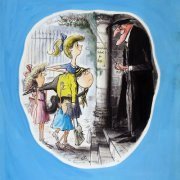
Alan Moore is an English writer most famous for his influential work in comics, including the acclaimed graphic novels Watchmen, V for Vendetta and From Hell. He has also written a novel, Voice of the Fire, and performs "workings" (one-off performance art/spoken word pieces) with The Moon and Serpent Grand Egyptian Theatre of Marvels, some of which have been released on CD.
As a comics writer, Moore is notable for being one of the first writers to apply literary and formalist sensibilities to the mainstream of the medium. As well as including challenging subject matter and adult themes, he brings a wide range of influences to his work, from the literary–authors such as William S. Burroughs, Thomas Pynchon, Robert Anton Wilson and Iain Sinclair; New Wave science fiction writers such as Michael Moorcock; horror writers such as Clive Barker; to the cinematic–filmmakers such as Nicolas Roeg. Influences within comics include Will Eisner, Harvey Kurtzman, Jack Kirby and Bryan Talbot.
6/17: This book is actually better than I remembered, and I think that it has aged better than some of the other titles in the ABC line. Rereading Top 10 through a modern lens, for example, made me realize that the series is kind of weirdly fixated on homosexuality, prostitution, incest, bestiality and pedophilia as different strains of "perversion" that Moore had clearly not sorted out at the time of its writing. These are problems that are actually rampant throughout the ABC line (and, I guess, through a lot of Moore's work), with Promethea as sort of overly ambitious proto-feminist mess and League of Extraordinary Gentlemen as the most obvious example of a title that starts out as an exploration of genre and ends as an exploration of, um, fucking.
Which is fine! But all the ABC titles eventually end up feeling like they're written by a horny old man who can't decide if he's a Free Love advocate, or if he's just angry with the reader because he's actually ashamed of himself. Basically every narrative decision across these books is dictated by who is, was, or will be raping or sodomizing someone else, and characters in these books are almost arbitrarily cast in a positive or negative light based on their reactions to various sexual scandals. It ends up feeling, I dunno -- like super Kevin-Smith-Chasing Amy-90s. Old men feeling weird about weiners and vajayjays.
That said, Tomorrow Stories is, at least somewhat, more focused on Moore flexing his considerable genre muscles. The sheer brevity of the anthology format means that there's no fluff where Moore can take his pants off. In particular, the Jack B Quick and Greyshirt stories are excellent, and the Cobweb stories are so two-dimensionally lascivious that they seem to actually accomplish the sort of innocent provocation that Moore fails at in other ABC titles. It doesn't hurt that the stories are all gorgeous, as is Splash Brannigan, which only has one entry in this volume.
The only dud is The First American, which has the least sense of identity, but seems to be a MAD magazine-esque satire in which Moore can strike out in all directions regarding his grumpy-old-man feelings about pop culture and comics in general. It's indulgent and sort of lazily pervy -- the one feature that seems to resemble the worst elements of other ABC titles.
Otherwise this is a great book, and much less cringeworthy than a lot of things Moore was writing during this time period.
5/15: Whoever says this book isn't up to par is obviously wrong about everything.
What do I need to say? A child genius who tries to force light to obey the local 30 mph speed-limit. A science hero so dreadful that even a meaningless relationship with a woman is probably beyond his grasp. A sensuous sleuth who specialises in not being entirely successful at anything other than arousing her chauffeuse. And her male counterpart, who at least has the whole Philip Marlowe thing down. And an animated ink-blot who wants to be friends with possibly the most curvaceous woman every committed to paper.
In other words, Alan Moore is at it again, this time in crazy nonsense mode. And it's great fun too.
It has it’s moments and some lines were spot on about the cliches of the superhero and noir genres. As we’ve seen time and again, this one is another of Moore’s criticisms in parody and satire form, of the comics industry.
The thing is, apart from specific parts, the stories of the first American and cobweb were awfully boring. 2/5 for Greyshirt and the completely absurd and surreal science boy, Jack Quick. Those two the most interesting of the bunch of tomorrow stories.
Like any anthology it's wildly uneven. Jack B. Quick is a wonderfully bizarre series about a boy genius and the havoc he causes for his parents and the small town he lives in. Like a really good kids book on acid. Greyshirt while a rip off of the Spirit is at least a fun rip off with a cool looking main character and very odd villains. First American tries to parody all those patriotic heroes of the GA, as well as popular culture but is too cynical and trying too hard to be funny. Cobweb is mostly lots of pin ups and oh so subtle hints of lesbianism between the heroine and her side kick with the occasional spoonful of plot.
I give Moore credit for trying something different, but it was only half successful attempt. With First American and Cobweb he had really written himself in a corner by the fourth issue. Would love to see more Jack stories though.
Finally finished this collection of collected stories. Each issue of Tomorrow Stories had multiple stories (1 for each hero).
Jack B. Quick the boy genius was pretty funny and always involved silly scientific topics like arresting light for breaking the speed limit and cats with butter on their backs that could never land on the ground.
Greyshirt the Holmes-esque vigilante was probably my least favorite. Usually very dark and no that cool.
First American was hilarious as a kind of superhero version of Homer Simpson.
Cobweb was okay but most of the stories really didn't do anything for me.
And in the end there was 1 Splash Brannigan story that was pretty funny but not great.
So overall this was pretty good but not really up to Moore's normal writing. Maybe it was the short format that hampered the stories and the fact that most of it was comedic.
There are some really interesting comics here, comics that are very intelligently created. Unfortunately, there's not much story here. There's also some strips that do not work at all for me, which is a common problem with anthologies.
An overall enjoyable, if a little frivolous, throwback to Silver Age comics anthologies that reads like a fun romp through Alan Moore's idea generation machine. This reminds me of his older work for 2000 A.D., in which he had to tell stories in very limited amounts of time, thus leading to comics that felt high-energy and a little wacky, though not quite as "Important" as his other work like Watchmen or V for Vendetta.
But, not only can everything not be Watchmen, everything shouldn't be Watchmen. And this collection of high-concept comics insanity, hit and miss as it is, is also just straight-up fun.
Each issue in this collection mostly features 4 recurring segments, though the final issue introduces a new character. They are:
Greyshirt: A hard-boiled detective tracking down criminals while also dealing with lots of big scientific ideas and non-linear narrative choices.
Jack B. Quick: A rural boy genius who constantly misappropriates scientific and theoretical ideas to create bonkers inventions that disrupt his small town.
Cobweb: An... ethereal lady... who... does a lot of different things? I have no idea what the premise of Cobweb is, which is probably why I liked this one the least.
The First American and U.S. Angel: An idiotic Captain America type and his teenage sidekick, who often find themselves in scrapes that blatantly satirize either American politics, the media, or comic books.
Splash Brannigan: Some sort of sentient ink man who is a hero that saves artists in the comic book industry, I guess? This one isn't super clear yet.
In my opinion, Jack B. Quick and First American are the obvious standouts, full of wonderful ideas and loaded with humor. I was disappointed when it became clear Jack B. Quick was being put on hold for a while after the 4th issue.
As I mentioned, I'm not a fan of Cobweb. At all. I truly have no idea what her deal is supposed to be, and Moore has done a pretty weak job making it clear what he's trying to say with her stories. With all the others being so clearly defined, this one really sticks out as the worst of the bunch.
Greyshirt is perfectly fine, though never quite making a mark. There's one Greyshirt story that involves telling a story throughout five decades as viewed through windows of the same building, which seems like a very cool idea, but the way Moore lays out the narrative makes it extremely hard to follow.
And then there's Splash Brannigan, who only gets a brief origin story at the end of this book. I have to say, I'm not excited about this character. It seems to be very directly commenting on inside-baseball comic book industry stuff, and I'm sorry, but I don't need to hear Moore gripe about his bosses via a boring, hacky character. Here's hoping it's more than that.
In any case, each story is so short that there's really no time to dwell on the bad ones. They're over in a hurry, and a more exciting one is always just around the corner. It's far from perfect (as all anthologies are), but it's still a clippy read that's worth a look if you're a big Alan Moore fan.
Norma Editorial continúa editando en nuestro país todo el material posible de las obras de Alan Moore bajo el sello de America´s Best Comics. Ya pudimos leer la genial maxiserie que es "Top 10" y, hace unos meses, vimos los finales de las series regulares de "Promethea" y "Tom Strong". Ahora le toca el turno a "Tomorrow Stories" que sale publicado en un formato similar al de las dos últimas colecciones que he nombrado.
El hecho de que Alan Moore hace en ABC lo que le viene en gana es algo largamente conocido. Cerró dos etapas muy buenas en dos colecciones tan complejas como fueron "Tom Strong" y "Promethea" pero, en 1999 continuó un poco más en los guiones de este sello editorial apostando, en esta ocasión, por una nueva fórmula, la de los relatos cortos de varios protagonistas diferentes que rellenarían números USA completos. En total, tenemos cinco miniseries que se desarrollan a lo largo de seis capítulos que se corresponden con los seis primeros números de la serie regular americana. Por supuesto, la variedad es lo que impera, aunque el toque de Moore está siempre presente tanto en la índole de las historias que se cuentan (su particular visión de la ciencia ficción, las connotaciones eróticas y sexuales de muchos personajes, la constante alusión a clásicos del cómic, etcétera), como en los personajes se pasean por las páginas de "Tomorrow Stories".
Rodeando todas las historias breves, hay una continuidad que se respeta hasta tal punto que, por cada capítulo hay tres o cuatro relatos de cada miniserie y, en un momento dado, se anuncia un cambio de miniserie para la que, incluso, hay un capítulo de interludio en el que, ni la anterior, ni la nueva aparecen. Además, como principal característica es que, cada miniserie tiene su propio dibujante, que se mantiene a lo largo de toda la andadura del personaje, variando cada artista su estilo según las exigencias del guión.
Comenzaremos conociendo a Jack B. Quick, un niño superdotado que vive en una granja al lado de uno de esos pueblos de campo tan característicos de Estados Unidos. Sin embargo, la actitud que muestran los personajes secundarios ante los inventos y avances científicos que se saca de la manga el chaval, es la mar de extraño. Todos los vecinos de Queerwater Creek ven con una completa naturalidad que Jack trastoque y juegue con las leyes de la física siempre que tenga una gran idea para mejorar la vida en su granja o en su pueblo, o para indagar acerca de una inquietud que le haya surgido. Dentro de cada historia, Moore siempre deja alguna perla, como pequeñas bromas sobre los padres de Jack, o la típica visita del chico al alcalde cada vez que hace una trastada que sume al pueblo en una crisis. A mí, sinceramente esta parte es la que más me ha gustado de todo el tomo, y se repiten muchas de las bromas habituales sobre el espacio-tiempo que mete Moore en sus colecciones "más serias". El cocreador de Jack B. Quick es Kevin Nowlan, con un estilo realista y sencillo, con composiciones de página muy clásicas que logra llegar al lector muy fácilmente.
En segundo lugar, tenemos a Greyshirt, un investigador privado en la ciudad de Indigo que colabora con la policía de dicha ciudad para capturar a los criminales. Greyshirt tiene un parecido razonable con "The Spirit" obra de Will Eisner, no sólo en su aspecto, sino también en la atmósfera que envuelve las acciones de este detective, aunque todo lo que tiene que ver con esta versión de Alan Moore es más oscuro que con el detective de Eisner. Sin lugar a dudas, las aventuras de Greyshirt me parecen lo mejor de todo este primer volumen, ya que Moore utiliza al personaje más que como el protagonista como una excusa para contar la historia que le toca contar en cada momento. Por ejemplo, hay un capítulo en el cual, cada viñeta de la página ocurre en un momento del tiempo diferente, y vamos comprobando cómo va avanzando la vida para unos personajes completamente secundarios que no aparecerán por estas páginas más que en ese capítulo. La aparición de Greyshirt no será más que el detonante para el final. A los láices tenemos a Rick Veitch, el cual contribuye en gran medida a que las aventuras de Greyshirt sean tan oscuras, además de que tiene un trabajo razonablemente complicado al tener que variar, en menor grado, su arte para adaptarse a cómo Moore desea contar la historia.
De una versión de "The Spirit", pasamos a la enésima versión del Capitán América que Alan Moore incluye en un cómic suyo. En este caso, el héroe nacional estadounidense recibe el nombre de The First American, y va acompañado de una sidekick llamada U.S.Angel, la cual dará lugar a infinidad de bromas acerca de la relación con su jefe y su cuestionable edad para combatir el crimen. Esta miniserie es la que menor grado de seriedad tiene de todas, pues ambos protagonistas se pasan el cómic haciendo comentarios que revelan que son conscientes de que son personajes de cómic, aludiendo al número de viñetas que quedan para el final de la historia, por ejemplo. Las amenazas contra las que luchan First American y U.S.Angel, son de lo más absurdo, desde el recurrido tema de los viajes en el tiempo que tanto le gusta a Moore, hasta ser ellos los encargados de protagonizar el especial navideño. En este caso, el dibujante es Jim Baikie, que sigue, más o menos, la línea marcada por el resto de los artistas que he comentado hasta ahora. Quizá un tanto más simplista aún que Nowlan, pero efectivo, al fin y al cabo en la realización de su tarea.
La obra más diferente de todas es la protagonizada por The Cobweb, una vigilante nocturna acompañada de una chófer que le hace las veces de ayudante en sus hazañas. Además, Moore echa mano de la forma de narración que utilizó en "Lost Girls" (aunque dejando a un lado el sexo explícito), haciendo que su, ahora ya, mujer (y dibujante también de "Lost Girls"), Melinda Gebbie, tenga que pasar de hacer un cómic clásico a utilizar técnicas poco habituales para narrar historias ocurridas en el pasado, o incluso ilustrar largos textos escritos por su marido. Siempre quedan evidentes las inclinaciones sexuales de The Cobweb y se da a entender una relación extra-profesional con Clarice, su ayudante. Dentro de todo, la mayor variedad de temáticas y de historias posible queda reservada para esta miniserie, aunque a mí, casi siempre, me ha aburrido en sobremanera.
Por último, tenemos la aparición del quinto personaje, que debutará en el último capítulo, Splash Brannigan, un loco héroe urbano con un absurdo origen, siguiendo la línea y la costumbre de Moore de incluir siempre algún personaje caricaturesco con respecto a los cómics, tanto clásicos como más actuales. Splash Brannigan es un superhéroe hecho de una tinta mágica que se encuentra con una dibujante novata en una editorial de cómic americana. El tono de esta miniserie es más bien humorístico, aunque hay poco que contar de ella, pues el único capítulo que se puede leer en este tomo tiene muy pocas páginas. Eso sí, en los dibujos, tenemos el estilo caricaturesco de Hilary Barta, que nos sirve para comprobar, desde el primer vistazo que se trata un cómic exagerado y humorístico más que de superhéroes.
En definitiva, una obra con el inconfundible toque de Alan Moore, se puede percibir desde el primer momento las características a las que nos tiene acostumbrados el Maestro del Noveno Arte. Sin embargo, el propio concepto del cómic hace que sea un tanto extraño leerlo, lo que no hace que te enganches desde el principio. Pasas un buen rato y es una lectura más bien casual. Me intriga ver por dónde irán los tiros en la segunda mitad de la serie (consta de 12 números USA).
I loved this. Some of Alan Moore's funniest writing is in the Jack B. Quick chapters. I also adored The Spirit inspired Greyshirt which is honestly beautiful. I thought Moore and Veitch did an incredible job at keeping Will Eisner's vibe. From delivering that sense of motion in the panels, to insanely fine tuned and experimental stories (the 4 stories one with each story of the building representing a different year was pulled off so well I was stunned), to others that just come down to being fun stories. Cobweb is very interesting and weird, I really like Melinda Gebbie's art. First American is so on the nose and funny and ridiculous. It's like everything else is showcasing what he loves about comics, and then the First American chapters are everything he wants to make fun of. He gets really unhinged in some parts that just add to the absurdity and comical nature.
This is the most standalone and "experimental" of the ABC Line, other than perhaps the very academic, Promethea.
Alan Moore solo writing an anthology (with four great artists) didn't make it past 12-issues. Anthologies are the creative lifeblood of comics, even if it's wildly uneven. But remember...Strange Days, 2000AD, CLiNT, Island, RAW, ZAP, Metal Hurlant, etc.
Regardless, this is someone ways one of the biggest treats of the ABC Universe. While it never quite reaches Tom Strong or Promethea quality, it's just creativity captured in a bottle.
I've read both volumes of this after taking ages to track them down, being a Moore completist, and not all of it was worth the quest. I quite like the story and art of the Jack B. Quick stories, a hyper intelligent small boy trapped in a middle America that couldn't possibly understand him or his grasp of quantum physics, but most of the rest is, sad to say, filler, and a waste of several good artists' time. And the truly sad thing is that two of the artists included are no longer with us
Excelente antologia, uma pequena demonstração da versatilidade narrativa do Sr Allan Moore aqui temos histórias cômicas, eróticas e aventurescas Confesso que a oscilação no nível de complexidade das tramas desconforta o leitor mais exigente por outro lado essa variedade de estilo é muito bom para quem curte apreciar as varias facetas da nona arte sob a batuta do mestre Moore.
Edición española actualmente descatalogada. Tomo 1 de 3, último en conseguir. Traduce varias historias cortas de Jack B. Quick, Greyshirt, The First American y Cobweb, y una de Splash Brannigan. Incluye introducción de Alan Moore: Buscando a Todd desesperadamente.
Comentarios mordaz, imagen distorsionada de lo que tenemos por "héroes", abusos sexuales y degeneración diaria de la sociedad por suplir sus vicios... bueno sí.
Hasta comentarios que haría el mismísimo Moore sobre como todo apesta, hasta él supongo(?)
antologia serial del Mr. Moore, no es tan revolucionaria, pero si es una forma de experimentacion, super entretenida, no busques tramas profundas o autopsias de la conciencia humana, solo alguien que disfruta ver sus personajes de ficcion haciebdo lo que mejor saben hacer.
This was actually a collection of stories you couldn't sit and read in one go. Each "comic" had it's own collection of short stories, most of which were very funny and as such needed to be picked up and read in short bursts. I have to admit one of my favourite stories was the one where the superheros had to take on Jerry Springer. The boy genius who was everyone's favourite didn't do much for me. Americana even as a paradoy is a bit annoying. But I loved the pulp adventures and it was lovely to see more artwork by Melinda Gebbie. I borrowed this from the library but will definitely have to get my own copy.
yep, he wrote 'em all. and mostly, they're sendups of the whole American superhero schtick. a lot of it is silly, snide, and very funny. don't knock it, that's Alan juggling time and quantum space, just for the fun of it: what a shame the setup didn't last. expect some notably original page and story design along the way. but seriously, the gorgeous series The Cobweb with Melinda Gebbie comes from a different realm entirely, with virtually no story but some sublime art drawing on totally different graphic traditions, and reinvents itself with every story. why don't they print these things on better paper, though? the original comics look a lot more spectacular.
Años después de haberlo arrancado de prestado y tiempo después de haberlo conseguido, finalmente leo las pocas páginas que me faltaban de este fulminante tomo antológico y compruebo que es una maravilla integral, donde la más floja de las historietas es entretenida (Splash) y la mejor de todas es sencillamente genial (la de Greyshirt del edificio). Lástima que todos esos personajes se los haya robado la casa editorial a Moore et al., porque habría sido lindo ver con qué salían sus amigos por su cuenta.
Worth a read for the second Greyshirt story alone. It tells the story of a building and its occupants over the period of 1939-1999. Using a single frame to depict both a story of the building and a seperate time (1999 for the 3rd floor, 1979 for the 2nd floor etc.) As ever, Moore shows us an innovative take on the comics medium.
Also recommended for many irreverent references to comics (DC/Marvel), to comics theory ("Scott McCloud said we'd all be interactive by now"), and even Moore's own work! ("I gave up a part in Promethea for this!").
This entire review has been hidden because of spoilers.
Like a lot of anthologies, it's got some good stuff and some weaker stuff. In particular, the Jack B Quick stories are very funny, and the "How Things Work Out" Greyshirt story is especially impressive (if a little reminiscent of Richard McGuire's "Here"). A lot of the super hero parodies seem like Moore's grabbing low hanging fruit, though. And the problem with these kinds of super short (usually 6 page) stories by any creator is I think they're a bit too brief to not feel kind of slight. That might be the reason I never got very into EC comics.
3.5 stars You can tell Alan Moore had fun with this one, like a lot of more comical books in the ABC range. Not every story hits but enough do to make it an enjoyable ride. Jack B Quick, the walking disaster child genius is the best of the vignettes. The Cobweb is a domineering heroine who is a mix of the amusing and erotic. Greyshirt is a modern take on the golden age superhero. And First American is a spoof of the all american superman cliche. Good light reading, not many writers can pull of the short story style but Alan Moore does it very well.
Kevin Nowlan's work here is okay. But every time I see his work I always wonder where the great work is. After all these years, why didn't he put some effort into a special project on the side that would be all his and blow us away. I think he could still do it if he put his mind to it.