

What do you think?

Geology Underfoot in Yosemite National Park
Few places in the nation rival Yosemite National Park for vertigo-inducing cliffs, plunging waterfalls, and stunning panoramic views of granite peaks. Many of the features that visitors find most tantalizing about Yosemite have unique and compelling geologic stories — tales that continue to unfold today in vivid, often destructive ways. While visiting more than twenty-seven amazing sites, you’ll discover why many of Yosemite’s domes shed rock shells like onion layers, what happens when a volcano erupts under a glacial lake, and why rocks seem to be almost continually tumbling from the region’s cliffs. With a multitude of colorful photos and illustrations, and prose tooled for the lay reader, Geology Underfoot in Yosemite National Park will help you read the landscape the way a geologist does.
The Geology Underfoot series encourages you to get out of your car for an up-close look at rocks and landforms. These books inform and enlighten, no matter how much — or how little — geology you already know. What’s more, they’re simply good reading, on-site or at home.
The Geology Underfoot series encourages you to get out of your car for an up-close look at rocks and landforms. These books inform and enlighten, no matter how much — or how little — geology you already know. What’s more, they’re simply good reading, on-site or at home.
- GenresNonfictionScienceGeology
312 pages, Paperback
First published May 15, 2010
Ratings & Reviews
Friends & Following
Create a free account to discover what your friends think of this book!
Community Reviews
Displaying 1 - 8 of 8 reviews

December 14, 2025
Having absolutely loved John McPhee’s stellar Basin and Range, I fell into the trap of confusing journalist-written books featuring geology and actual books about geology written about actual geologists.
And despite me trying really hard to keep the fine details of distinguishing quartz, orthoclase, plagioclase, biotite and hornblende; and El Capitan Granite vs Cathedral Peak Granite; and geology of climbing; and intricacy of all kinds of wonky rock folding, I had to come to peace with a sad realization that the depth of geology easily sails over my head (and I am terrible at metaphors, as a bonus realization) — but what will remain with me is the big picture of how geology shaped what we now know as the marvel that is Yosemite and its stark inorganic beauty.
In the simplest way possible, the story of Yosemite is all about granite and glaciers.
Rockfalls and rockslides, waterfalls and hanging valleys, magma flows, xenoliths and erratics and core stones, weathering and erosion, exfoliation joints, and all kinds of moraines. All this was equally fascinating and difficult, helped along by photos that tried to aid my confused brain in making sense of words that made me feel a bit too dense.
And yet I still don’t know who stole the missing half of Half Dome. (I kid, I kid, don’t throw any metamorphic stones at me). But, as the book cheekily states, “Half a Dome is Better Than None”.
Yosemite became one of my happy places after just one trip, and now I have slightly more understanding of what shaped this beauty. Even though there’s no chance of me ever really digging geology - although I do admit that geology rocks - I enjoyed it, and I’ll never look at El Capitan the same way again.
It’s incredibly fascinating how Yosemite went through neverending changes over hundreds of millions of years — and those geological time scales make you feel tiny and awed and respect all that granite, birthed in magma and carved by the relentless flow of glaciers. The more I learn and understand about Yosemite, the more I love it.
4 stars.
——————
Also posted on my blog.
And despite me trying really hard to keep the fine details of distinguishing quartz, orthoclase, plagioclase, biotite and hornblende; and El Capitan Granite vs Cathedral Peak Granite; and geology of climbing; and intricacy of all kinds of wonky rock folding, I had to come to peace with a sad realization that the depth of geology easily sails over my head (and I am terrible at metaphors, as a bonus realization) — but what will remain with me is the big picture of how geology shaped what we now know as the marvel that is Yosemite and its stark inorganic beauty.
In the simplest way possible, the story of Yosemite is all about granite and glaciers.
“If you stand on a high point in Yosemite National Park, virtually every nonliving thing that you can see is granite.”
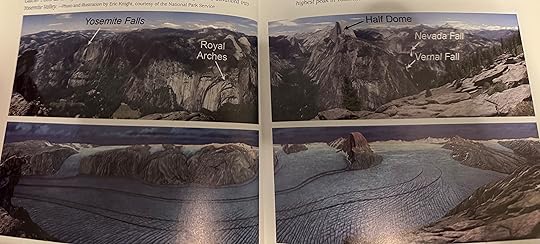
Rockfalls and rockslides, waterfalls and hanging valleys, magma flows, xenoliths and erratics and core stones, weathering and erosion, exfoliation joints, and all kinds of moraines. All this was equally fascinating and difficult, helped along by photos that tried to aid my confused brain in making sense of words that made me feel a bit too dense.
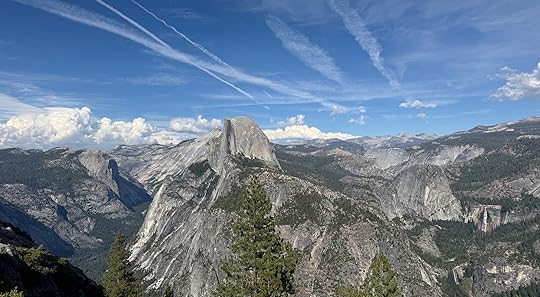
And yet I still don’t know who stole the missing half of Half Dome. (I kid, I kid, don’t throw any metamorphic stones at me). But, as the book cheekily states, “Half a Dome is Better Than None”.
Yosemite became one of my happy places after just one trip, and now I have slightly more understanding of what shaped this beauty. Even though there’s no chance of me ever really digging geology - although I do admit that geology rocks - I enjoyed it, and I’ll never look at El Capitan the same way again.

It’s incredibly fascinating how Yosemite went through neverending changes over hundreds of millions of years — and those geological time scales make you feel tiny and awed and respect all that granite, birthed in magma and carved by the relentless flow of glaciers. The more I learn and understand about Yosemite, the more I love it.
4 stars.
——————
Also posted on my blog.

February 4, 2022
My only complaint is that this wasn’t written two dozen years earlier (and that I’d have stumbled on it then).
This guidebook to the geology of Yosemite and it’s surrounding area would best be done as a decade-spanning series of roadtrips. The authors present a detailed introduction, and then 25 “vignettes” which explore one aspect of the story.
If you’re a wannabe geologist, mountain climber, or just someone who loves Yosemite and wants to know everything about it, buy this and start planning those trips.
In late January 2022, I was in Yosemite’s backcountry, snowshoeing and sleeping through frigid nights on the north rim. The snow meant I didn’t get to study the rocks as much as I could in the summer, but I still spotted tidbits the authors had discussed.
Vignette 3, “Pushed Off a Cliff”, is about how Yosemite Falls doesn’t come down where it used to. When I was traversing Indian Ridge, I could see to my west the watershed of Yosemite Creek, and the huge terminal moraine that had blocked the old channel was very visible. (I’m very disappointed I didn’t capture it in a photo.) It probably helped that I was there in the winter, since snow highlights topography quite well. The next day, as I headed towards Yosemite Falls trail for my exit back down into the valley, I could see the cascade coming down from that moraine.
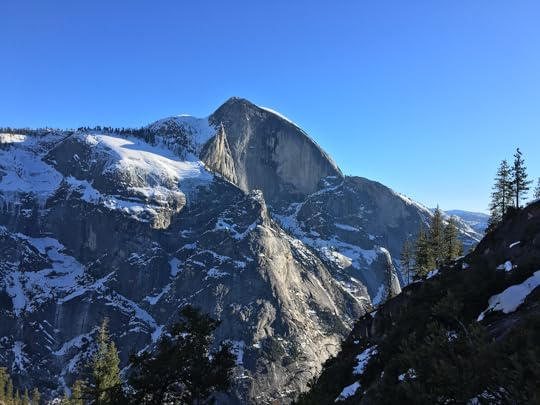
Elsewhere in the book, the authors dismiss the common conception that Half Dome is actually half of a dome — that the northern half had been sliced off by glaciation. Instead, the virtiginous north slope is due to a joint, which is a weak planar feature that naturally occurred in the cooling rock. When I was climbing Snow Creek trail and looking across Tenaya Canyon, the presence of Ahwiyah Point where that ‘missing’ half of the dome would have been makes the point. Any glacier capable of scouring half of Half Dome would have erased that quite substantial feature.
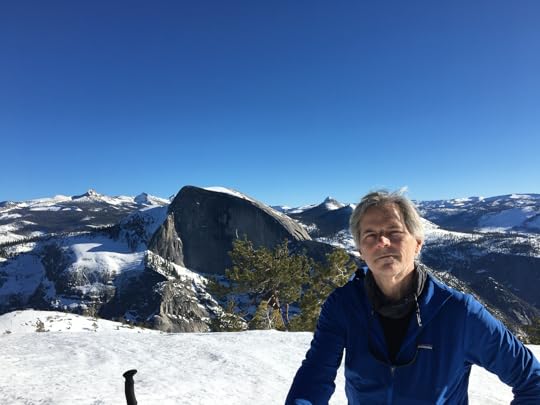
Here’s your reviewer above North Dome, with Half Dome glorying in the winter sunlight.
Visit Yosemite with this book in hand!
This guidebook to the geology of Yosemite and it’s surrounding area would best be done as a decade-spanning series of roadtrips. The authors present a detailed introduction, and then 25 “vignettes” which explore one aspect of the story.
If you’re a wannabe geologist, mountain climber, or just someone who loves Yosemite and wants to know everything about it, buy this and start planning those trips.
In late January 2022, I was in Yosemite’s backcountry, snowshoeing and sleeping through frigid nights on the north rim. The snow meant I didn’t get to study the rocks as much as I could in the summer, but I still spotted tidbits the authors had discussed.
Vignette 3, “Pushed Off a Cliff”, is about how Yosemite Falls doesn’t come down where it used to. When I was traversing Indian Ridge, I could see to my west the watershed of Yosemite Creek, and the huge terminal moraine that had blocked the old channel was very visible. (I’m very disappointed I didn’t capture it in a photo.) It probably helped that I was there in the winter, since snow highlights topography quite well. The next day, as I headed towards Yosemite Falls trail for my exit back down into the valley, I could see the cascade coming down from that moraine.
Elsewhere in the book, the authors dismiss the common conception that Half Dome is actually half of a dome — that the northern half had been sliced off by glaciation. Instead, the virtiginous north slope is due to a joint, which is a weak planar feature that naturally occurred in the cooling rock. When I was climbing Snow Creek trail and looking across Tenaya Canyon, the presence of Ahwiyah Point where that ‘missing’ half of the dome would have been makes the point. Any glacier capable of scouring half of Half Dome would have erased that quite substantial feature.
Here’s your reviewer above North Dome, with Half Dome glorying in the winter sunlight.
Visit Yosemite with this book in hand!

March 26, 2019
Easily one of the top 5 geology guides I have ever read, I would gladly recommend this even to people (like myself) who have no intention of tramping through all of Yosemite anytime soon.
Both authors are teaching professors, and their profession is clearly reflected in the choices they made while composing this book. The book contains an introduction followed by 25 chapters (called vignettes by the authors), each of which explores 1 main geologic idea. The key word here is one - and part of the brilliance of the authors is that instead of picking an area and then vomiting up science on the unsuspecting record, they clearly focus each chapter on 1 main feature and dedicate everything inside (maps, diagrams, photographs, evidence, explanations) to better fleshing that out. In the course of expounding upon each of these 25 features, the authors secretly teach the reader a diverse suite of geological topics - magmatic differentiation, metamorphic suites, glacial geomorphology, paleoclimatology, coastal geomorporholoy, plate tectonic movement, methods of dating, orogenic processes, among dozens of others.
A few other items of brilliance:
1. Recapitulation. The authors do not explain a concept once and expect you to remember it perfectly ever after. Rather, they use foreshadowing and repetition to great effect. My favorite example is "lag boulders" or "core stones".
Page 127 - "These boulders, called lag boulders because they are what's left behind after the smaller stuff has been carried away..."
Page 158: "Remnant rocks left behind as surrounding rock weathers and washes away are called lag boulders or core stones." This is the first time that lag boulder is identified with core stone.
Page 166: Glacial erratics are contrasted with "core stones that weathered in place"; again, repeating what the concept of a core stone means while also subtly substituting the more scientific name (core stone) for the more popular one (lag boulder).
Finally, on Page 230-233 the authors spend 4 pages explaining how core-stones actually form, helpfully illustrated with diagrams and photos.
To me, this demonstrates that the authors are skilled teachers. They understand that repetition and recapitulation are essential if you want an idea to become embedded in you audience's mind. In addition, it is practical for the reader to be reminded of how various processes work and what words mean, instead of having to flip through the book frantically searching for a one-line reference. (Although there is a glossary in the back).
2. Modern Research. The authors actually cite modern research on geology, such as Beryllium dating on surface rocks and recent theories about how different geologic features formed. What is really cool is that they actually have done their own research, which they helpfully mark out with the phrase "Your first/second author has . . . ". I think it is always cool to read about other people's research, and it adds a personal touch that the authors are so invested in this topic that they have dedicated field work to it.
3. Images. No scientific work can go without figures, but these authors went all out! Diagrams, timelines, illustrations of what the region looked like in the past, beautiful line graphs, and hundreds of photographs showing everything from tiny crystals to panoramic views from a mountaintop. Full color and glossy paper, this book is beautiful.
Both authors are teaching professors, and their profession is clearly reflected in the choices they made while composing this book. The book contains an introduction followed by 25 chapters (called vignettes by the authors), each of which explores 1 main geologic idea. The key word here is one - and part of the brilliance of the authors is that instead of picking an area and then vomiting up science on the unsuspecting record, they clearly focus each chapter on 1 main feature and dedicate everything inside (maps, diagrams, photographs, evidence, explanations) to better fleshing that out. In the course of expounding upon each of these 25 features, the authors secretly teach the reader a diverse suite of geological topics - magmatic differentiation, metamorphic suites, glacial geomorphology, paleoclimatology, coastal geomorporholoy, plate tectonic movement, methods of dating, orogenic processes, among dozens of others.
A few other items of brilliance:
1. Recapitulation. The authors do not explain a concept once and expect you to remember it perfectly ever after. Rather, they use foreshadowing and repetition to great effect. My favorite example is "lag boulders" or "core stones".
Page 127 - "These boulders, called lag boulders because they are what's left behind after the smaller stuff has been carried away..."
Page 158: "Remnant rocks left behind as surrounding rock weathers and washes away are called lag boulders or core stones." This is the first time that lag boulder is identified with core stone.
Page 166: Glacial erratics are contrasted with "core stones that weathered in place"; again, repeating what the concept of a core stone means while also subtly substituting the more scientific name (core stone) for the more popular one (lag boulder).
Finally, on Page 230-233 the authors spend 4 pages explaining how core-stones actually form, helpfully illustrated with diagrams and photos.
To me, this demonstrates that the authors are skilled teachers. They understand that repetition and recapitulation are essential if you want an idea to become embedded in you audience's mind. In addition, it is practical for the reader to be reminded of how various processes work and what words mean, instead of having to flip through the book frantically searching for a one-line reference. (Although there is a glossary in the back).
2. Modern Research. The authors actually cite modern research on geology, such as Beryllium dating on surface rocks and recent theories about how different geologic features formed. What is really cool is that they actually have done their own research, which they helpfully mark out with the phrase "Your first/second author has . . . ". I think it is always cool to read about other people's research, and it adds a personal touch that the authors are so invested in this topic that they have dedicated field work to it.
3. Images. No scientific work can go without figures, but these authors went all out! Diagrams, timelines, illustrations of what the region looked like in the past, beautiful line graphs, and hundreds of photographs showing everything from tiny crystals to panoramic views from a mountaintop. Full color and glossy paper, this book is beautiful.

September 10, 2015
Great follow up to our visit to Yosemite. Now I want to go back! Only read picture captions and graphs. The little text I did read was very well written but I was happy with skimming.
June 14, 2025
Thanks for a new perspective!
My parents took my sisters and me to Yosemite at least once a year. I’ve backpacked from Cherry and Kibbie lakes down the side of Yosemite Falls, and looked at Half Dome from the tops of the hills around my Bay Area childhood home. But I’ve driven past so many gems these 67 years, can’t wait to explore them thanks to these authors. Thank you so much!
My parents took my sisters and me to Yosemite at least once a year. I’ve backpacked from Cherry and Kibbie lakes down the side of Yosemite Falls, and looked at Half Dome from the tops of the hills around my Bay Area childhood home. But I’ve driven past so many gems these 67 years, can’t wait to explore them thanks to these authors. Thank you so much!

June 4, 2015
ever driven through Yosemite and wondered how a rock got to itscurrent place? This book will answer your questions in a way that is understandable to the non-geologist.
August 7, 2017
This is meant as a trail guide, but I read it cover to cover because it was entertaining enough. It was a lot funnier than I was expecting.
October 27, 2024
Loved reading about the glaciers. Vignettes about the Valley were interesting and informative. Read like a more entertaining HS textbook.
Displaying 1 - 8 of 8 reviews