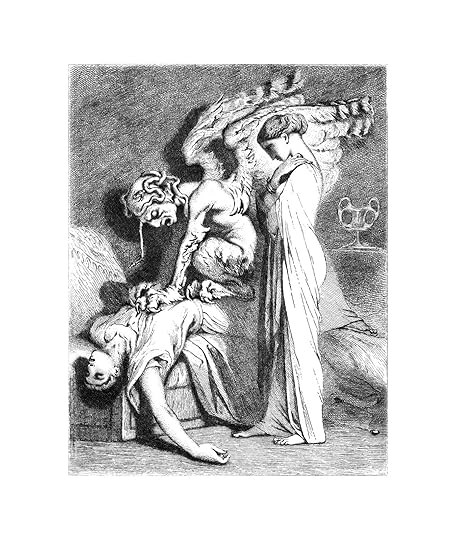
A copy of Fuseli's most famous painting hung in Sigmund Freud's office, and it's often been taken as an early precursor of that interest in dream-logic, and subconscious imagery, that later artists would latch on to at the turn of the twentieth century. But Fuseli wasn't thinking in those terms at all, and Nicholas Powell takes pains to stress that the painting's ‘ties with the past were far stronger than those with the future’. If Fuseli was anything, he was a neoclassicist (though perhaps not a very good one, which is what makes him interesting) and his models can be found in the Classical works he so revered: Giulio Romano's Sleeping Psyche, the Vatican Ariadne and so forth.
‘To regard this picture as a precocious example of nineteenth-century Romanticism, let alone of Surrealism, is to misunderstand it.’ Right enough. And yet, there's a reason those later artists would find The Nightmare so compelling. Fuseli's Sturm-und-Drang emotionalism was always in tension with his classical principles, and the overt sexuality of his swooning female subject, the demonic male figure squatting on her chest, and the connection of all this to an imagined dreamworld, I think shows more alignment with the coming Romantic sensibility than Powell allows, even if Fuseli himself was not fully aware of it.
It's partly for this reason that the painting has always raised so many unanswered questions – and still does, even after taking in Powell's learned analysis. He points out the extent to which The Nightmare has connections to Fuseli's other work representing sleeping or dreaming figures, but he doesn't stress what's perhaps more important, the extent to which it is wholly unlike his other stuff. It is, I think, almost the only painting Fuseli ever made which is not based on an explicit literary or historical source. (Even the few others that weren't pretended they were – like Ezzelin Bracciaferro, which was based on a medieval legend that Fuseli had invented himself.) Why? It also shows specific indications of being contemporary, with furniture and toiletries that are clearly Georgian; again, this is very unusual for Fuseli, who hated modern dress and anything that detracted from a picture's ‘timeless’, ‘universal’ appeal. He had never done it before and he never did it again; why this, why now?
Besides, the links with dream pictures are, perhaps, something of a red herring. Powell refers to a nightmare as ‘a particular type of bad dream’, but that is not what it meant in the eighteenth century. The sense of ‘bad dreams’ emerged with the Victorians; in Fuseli's time, ‘nightmare’ had the specific meaning of what we'd now call sleep paralysis. Johnson's Dictionary is pretty clear: ‘A morbid oppression in the night, resembling the pressure of weight upon the breast’, which is exactly what Fuseli is illustrating, courtesy of the many folktales concerning the phenomenon. Of course, Powell understands that this is the point of the painting, but the anachronistic link with ‘bad dreams’, while not irrelevant, does sometimes lead him down a blind alley.
I would also quibble with his assessment of Fuseli's sexual predilections, which he sketches in an otherwise excellent précis of the artist's career and interests. Powell notes the recurring presence in Fuseli's art of the ‘triumphant dominating female’, but he still concludes that ‘man triumphs in Fuseli's sexual fantasies and woman is submissive’. A lot more work has been done on Fuseli since this was published back in 1973, and most Fuseli experts now would, I think, turn this argument around: indeed many have speculated that his fantasies revolved precisely around dominant rather than submissive women. Probably Fuseli's instincts here, as elsewhere, were divided.
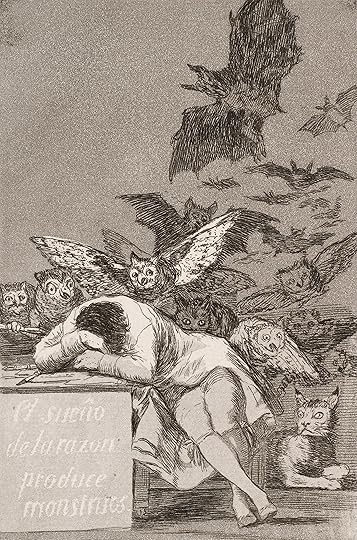
Still, although it's nearly fifty years old, this is still the best guide to one of art history's defining paintings. Powell's writing is clear and unfussy, his references are broad, and he has a couple of very useful appendices detailing the different versions Fuseli made and some of the innumerable caricatures that were made by cartoonists almost as soon as the painting appeared. He also writes illuminatingly of the influence it had on the generation of artists immediately following, from Tony Johannot to Goya's famous Sueño de la Razón.
A solid straightforward overview of Fuseli's best known work for art-interested amateurs (such as myself!). Especially enjoyed the eighteenth century take on the cause of dreams.