

What do you think?
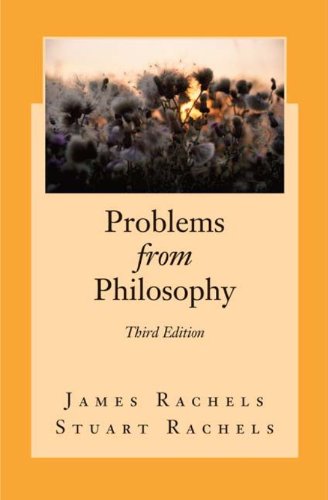
Problems from Philosophy
Problems from Philosophy is an introduction to philosophy which is organized around the great philosophical problems—the existence of God, the nature of the mind, human freedom, the limits of knowledge, and the truth about ethics. It begins by reflecting on the life of the first great philosopher, Socrates. Then it takes up the fundamental question of whether God exists. Next comes a discussion of death and the soul, which leads to a chapter about persons. The later chapters of the book are about whether objective knowledge is possible in science and ethics. Each chapter is self-contained and may be read independently of the others.Problems from Philosophy represents the final work of author and philosopher James Rachels. In it, he brings the same liveliness and clarity to the introduction of philosophy that he brings to his best-selling ethics text, The Elements of Moral Philosophy. The second and third edition have been revised by Rachels' son Stuart, who carefully has carefully refined his father's work to further strengthen its clarity and accessibility.
224 pages, Kindle Edition
Published January 18, 2011
About the author
James Rachels
64 books35 followersJames Rachels, the distinguished American moral philosopher, was born in Columbus, Georgia, and graduated from nearby Mercer University in 1962. He received his Ph.D. in 1967 from the University of North Carolina, Chapel Hill, studying under Professors W. D. Falk and E. M. Adams. He taught at the University of Richmond, New York University, the University of Miami, Duke University, and the University of Alabama at Birmingham, where he spent the last twenty-six years of his career. 1971 saw the publication of his groundbreaking anthology Moral Problems, which helped ignite the movement from teaching metaethics in American colleges to teaching concrete practical issues. Moral Problems sold 100,000 copies over three editions. In 1975, Rachels wrote "Active and Passive Euthanasia," arguing that the distinction so important in the law between killing and letting die has no rational basis. Originally appearing in the New England Journal of Medicine, this essay has been reprinted 300 times and is a staple of undergraduate education. The End of Life (1986) broadened and deepened these ideas. Created from Animals (1990) argued that a Darwinian world-view has widespread philosophical implications, including drastic implications for our treatment of nonhuman animals. Can Ethics Provide Answers? (1997) was Rachels' first collection of papers; The Legacy of Socrates (2007) was his second. Rachels' textbook, The Elements of Moral Philosophy, is currently the best-selling book in philosophy. Shortly before being diagnosed with cancer, Rachels finished Problems from Philosophy, an introduction to his subject, published posthumously.
Over his career, Rachels wrote 6 books and 86 essays, edited 7 books and gave about 275 professional lectures. His work has been translated into Dutch, Korean, Norwegian, Italian, Japanese, Indonesian, Spanish, Portuguese, Chinese, and Serbo-Croatian. He is widely admired as a stylist; his essays and books are remarkably free of jargon and clutter. A major theme in his work is that reason can resolve difficult moral issues. He has argued for moral vegetarianism and animal rights, for affirmative action (including quotas), for the humanitarian use of euthanasia, and for the idea that parents owe as much moral consideration to other people's children as to their own.
Over his career, Rachels wrote 6 books and 86 essays, edited 7 books and gave about 275 professional lectures. His work has been translated into Dutch, Korean, Norwegian, Italian, Japanese, Indonesian, Spanish, Portuguese, Chinese, and Serbo-Croatian. He is widely admired as a stylist; his essays and books are remarkably free of jargon and clutter. A major theme in his work is that reason can resolve difficult moral issues. He has argued for moral vegetarianism and animal rights, for affirmative action (including quotas), for the humanitarian use of euthanasia, and for the idea that parents owe as much moral consideration to other people's children as to their own.
Ratings & Reviews
Friends & Following
Create a free account to discover what your friends think of this book!
Community Reviews
Displaying 1 - 1 of 1 review

April 20, 2025
A Very Basic and Short Introduction into Philosophy.
This short text provides a very high level and feasible overview of the major branches of Philosophy. Although it's not mentioned explicitly, many chapters deal with a specific branch of philosophy such as Epistemology, Metaphysics, Ethics, etc. Other chapters touch upon some more granular topics that the general public, such as the question of free will, God's existence, materialism - dualism, Socrate's philosophy, etc. For this reason, the text is good for an erudite person without familiarity to these subjects, a young person that you'd want exposure to big questions, or any layperson really. I personally read the text over a decade ago as an undergrad, but perused it again now.
This short text provides a very high level and feasible overview of the major branches of Philosophy. Although it's not mentioned explicitly, many chapters deal with a specific branch of philosophy such as Epistemology, Metaphysics, Ethics, etc. Other chapters touch upon some more granular topics that the general public, such as the question of free will, God's existence, materialism - dualism, Socrate's philosophy, etc. For this reason, the text is good for an erudite person without familiarity to these subjects, a young person that you'd want exposure to big questions, or any layperson really. I personally read the text over a decade ago as an undergrad, but perused it again now.
Displaying 1 - 1 of 1 review