I wonder how long it took my late-grandparents to say, “Pearl Harbor feels like a long time ago.”
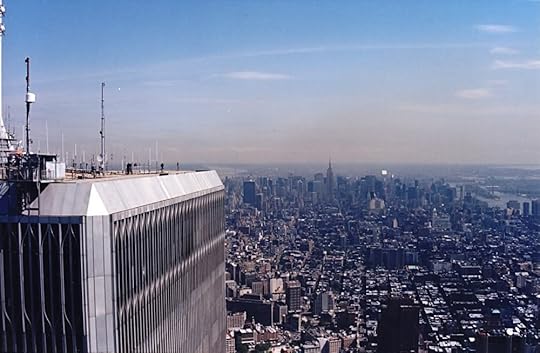
It’s been 14 years since the terrorist attacks of September 11, 2001, but it feels like a minute. I was 1,245 miles away from the World Trade Center when they were hit; I have no personal connection to the attacks at all; and yet I can remember that morning as though it’s been caught in amber.
I was in college that September morning. I woke up at 5:30 a.m., Central Standard Time, and was at the campus gym by 6:00 a.m. (Many things have changed in 14 years – going to the gym at 6 a.m. is one of them). After working out for an hour, I went to breakfast at the dining hall with my buddy Aaron. I ate granola mixed with Cheerios. Shortly after 7:46 a.m. local time, Aaron – who’d gone out to the lobby – came back into the dining hall to tell me an airplane had hit the World Trade Center. Being an insufferable know-it-all – that has not changed in 14 years, per my wife – I remember saying something about a B-25 bomber hitting the Empire State Building. My first thought, I suppose, was a Cessna that had veered off course.
I went out to the lobby with Aaron and watched the video of the North Tower billowing smoke like a chimney. It was an impossible, surreal sight, and I remember thinking How are they ever going to be able to fix that?
We were transfixed, and my business ethics class didn't start till 8:30 a.m., so I was watching when – at 8:03 a.m., CST – an airplane drove into the South Tower on live television. I recall not being sure what I was watching. Was this a replay of the first plane hitting the North Tower? Was it a secondary explosion? Based on the initial CNN anchor’s response, I wasn’t the only one. (I checked the archives. The CNN anchor thought it was a secondary explosion from the North Tower; he was soon replaced by Aaron Brown, a far more competent anchor). I watched for a few more minutes and then, I shamefully admit, I went to class. The world had just shook off its axis but I headed off to a useless lecture.
In my defense, I was a college student, and by definition, had my head pretty far up my own ass.
After the initial confusion – on CNN, it took another 15 minutes after the second plane before terrorism is mentioned – the story seemed to come together quickly. Planes had been hijacked and driven intentionally into the Twin Towers, the Pentagon, and a field in Pennsylvania.
Terry McDermott’s Perfect Soldiers, published in 2005, purports to tell the story of the nineteen men who came into the United States, boarded those four planes, and humbled an empire. It writes a big check. The subtitle promises to tell us “who they were” and “why they did it.” Alas, the book falls far short of that tease.
Perfect Soldiers actually starts reasonably well. The first third of the book is dedicated to the hijackers who carried out the deadliest terrorist attack in US history. Well, strike that. It is dedicated to one terrorist in particular, Mohammed Atta, the leader of the American cells. (Ziad Jarra, who had a serious girlfriend, is also given some space; that’s really all, however, when it comes to the actual on-the-ground terrorists).
This makes sense, in a way. When we think of the 9/11 hijackers we are really thinking about Atta. It is Atta, after all, who is emblematic of the existential dread left in the wake of the September 11 attacks. He stares out from an infamous headshot with dark, angry eyes and a grimly implacable expression. When surveillance catches him going through airport security, there is not a whit of hesitation in his demeanor. He marches off to doom with the insouciance of a businessman who knows the plane will wait. He emblemizes Dashiell Hammett’s “perfect soldier,” a man who “went where you sent him, stayed where you put him, and had no idea of his own to keep him from doing exactly what you told him.” (The Hammett quote is used as the book’s epigram). He is, quite frankly, frightening. Dedicated, focused, and suicidal.
Atta was Egyptian born, from a middle class family. He graduated from college and went to graduate school in Germany to study engineering. He grew more religious after arriving in Hamburg, and at a later point in the book, McDermott speculates that it was the vulnerability that comes with living in a strange land that drew Atta and others into the ambit of radical groups. Despite this speculation, Atta’s motivations remain frustratingly vague. (McDermott locates a lot of strings; frustratingly, he does not really pull at them).
In the days after 9/11, it became a fraught proposition to acknowledge the humanity of these men. They were monsters, and if you dared to give them humanlike qualities, you were apt to get shouted down. They were humans, of course. Awful, terrible, pathetic wastes, but bipedal hominids nonetheless. It’s bleakly interesting, with the passage of time, to read about Atta’s family, to see his graduation photos, and to conjecture at the deep psychological issues that made him act the way he did.
Despite the details McDermott provides, there are parts of the Atta story that aren’t even mentioned. For instance, there is the claim that Atta had a girlfriend while in the United States. This claim is controversial, but McDermott doesn’t even mention it. (In the book, Atta is portrayed as a pretty loathsome misogynist who couldn’t stand to be in the same room as a woman).
The middle third of Perfect Soldiers strays away from the hijackers to give a brisk recapitulation of al-Qaeda’s war against America. There is nothing particularly wrong with this section. McDermott is a very good writer. It’s just that this section felt like a digression from the book’s purported focus. A whole lot of names and entanglements are introduced without much space to let the information breathe. The ground covered in this part of Perfect Soldiers is better told in other books, such as Lawrence Wright’s The Looming Tower.
The final third of the book covers the conception and execution of the plot. This was the most disappointing section of Perfect Soldiers. It was rushed, diffuse, and strangely lacking in details. Instead of separating out the teams and spending some time introducing the other hijackers (other than Atta and Jarrah), McDermott provides a semi-vague, generalized portrait of the months and days leading to the attacks.
The reason I got this book is that I’d seen McDermott interviewed for a 9/11 documentary. In the interview, he makes clear that he uses the term “perfect soldiers” ironically. These guys weren’t an elite unit of unstoppable villains. They were bumblers. The terrorists drew attention to themselves with rude behavior; they had law enforcement contacts; and they made some odd decisions, including one by Atta that almost caused him to miss his flight. (This last is fleetingly mentioned in the book). They were also hypocrites. Some of them went to strip clubs. FBI agent Ali Soufan claims that Atta was a drunk, pounding shots a few nights before his rendezvous with the fires of hell.
McDermott barely mentions any of this. I can’t explain it, but it’s the reason this book ultimately disappointed me.
To some, it might seem unnecessary at best, unholy at worst, to attempt to understand men who could commandeer and airplane and fly it into a building. It’s such a momentous crime that it’s tempting to label it “evil” and move on. Obviously, that won’t stop people from trying, if the unending fascination with Hitler and Stalin is any indication. And “evil” is a concept, not an explanation.
Unfortunately, this book doesn’t really get us any closer to an answer (with the caveat that ultimately, there is no answer). It is well-reported, engagingly written, and yet strangely reticent to consider the motivations that McDermott claimed to be exploring. Instead, this is a hodgepodge of unearthed facts that is crying out for a better, more focused narrative, and deeper, more insightful analysis.