Two reporters tackle the Oklahoma City bombing, culling data from more than 300 interviews to recreate this compelling, terrifying true story in a genuine effort to bring closure the painful incident.
“[Timothy] McVeigh finally spotted the location he had chosen for the bomb – a drop-off point, several car lengths long, cut into the sidewalk on the north side of the [Alfred P. Murrah Federal Building]. Not one car was pulled up there when he arrived, and when he realized that fact, McVeigh breathed a sigh of relief. If the drop-off spots had been filled with cars, he’d decided, he would drive onto the sidewalk and crash his truck into the building. That would not be necessary now. As calmly as any delivery-truck driver making a routine drop-off, McVeigh parked right below the tinted windows of the America’s Kids Day Care Center on the second floor. McVeigh looked over his creation one last time. The fuses were still burning, the shorter of the two nearly complete. The vehicle was parked exactly where he wanted it, its back end facing the building. He grabbed his envelope full of antigovernment articles, locked up the truck, and walked away…” - Lou Michel and Dan Herbeck, American Terrorist: Timothy McVeigh & the Oklahoma City Bombing
It has been twenty-seven years since a bomb in a Ryder truck exploded outside the federal building in Oklahoma City, killing 168 men, women, and children. In those twenty-seven years, there have been many other catastrophes, with far higher casualties. Yet for some reason, this particular bombing in the heartland of America still feels raw to me.
Part of this has to do with the kids. Nineteen of the victims were in a daycare center just above ground zero. One of those dead children – one-year-old Baylee Alman – was photographed being carried from the rubble by Firefighter Chris Fields. In the picture, the red mess of Baylee’s skull is contrasted vividly with the dirty white socks on her tiny feet; the lifelessness of her body is contrasted with the tenderness in which it is held. It represents an iconic and undistilled portrait of hate’s gory aftermath.
Part of this has to do with the perpetrator.
Timothy James McVeigh was not an agent of a foreign government, or an international terrorist. Born outside Buffalo New York, raised in a solidly middle-class home, imbued with bland-All-American looks, he was a decorated war hero who’d put his life on the line for his country.
He was one of us.
Then he betrayed all that in an act of violence that cannot easily be traced to a single source, though it can be linked to tensions still simmering today.
Lou Michel and Dan Herbeck’s American Terrorist does not provide any good answers about McVeigh. But in their exclusive access to the mass murderer, they are at least able to present enough evidence so that some guesses may be ventured.
***
American Terrorist is not a typical entry in the true crime genre. It is, in fact, closer to a standard biography, following McVeigh from his childhood to his crime, then through his trial and imprisonment. Obviously, biographies of really bad people – Hitler, Stalin, Mao – are published all the time. McVeigh, however, isn’t really a world-historical figure. He is a nothing who made a bomb. Thus, when Michel and Herbeck lead us through a detailed recitation of his life, it’s a bit surreal.
In any event, the authors paint a picture of a Norman Rockwellian upbringing, stressing McVeigh’s hardworking father, the backyard pool, the neighborhood full of friends. They even call him “Tim,” laying it on uncomfortably thick.
The story tautens as McVeigh gets older, and Michel and Herbeck do a good job with McVeigh’s time as a soldier. While McVeigh claimed to be bothered by America’s involvement in the First Gulf War – believing the U.S. was somehow bullying Iraq, which had invaded Kuwait with the world’s fourth largest army – his life’s turning point clearly came when he washed out of a Special Forces assessment on the second day. This disappointment spurred him to leave the army – where he had thrived – and cast him out into the world, alone with his bitterness and delusions.
***
The road to Oklahoma City is American Terrorist’s strongest stretch. Michel and Herbeck follow McVeigh closely, as he nurtures his grievances, sketches out a plan, and then proceeds to carry it out to the end. Their coup is that McVeigh agreed to talk to them after his conviction, presenting his tale in his own words and without compensation, something that proved impossible with Lee Harvey Oswald or Mohammed Atta. It is detailed and chilling, and based on the endnotes, it seems like efforts were made to corroborate what he said.
Unlike most American tragedies since the Kennedy assassination, the Oklahoma City bombing has mostly avoided being obscured by conspiracy theories (though it was, of course, an actual conspiracy). This is partly a result of McVeigh’s lengthy confession. There are still a few people who believe in a Middle Eastern connection, which does not make sense, since an act of terror must be claimed to succeed. A more tenacious assertion is that McVeigh had accomplices beyond his indicted coconspirators. Michel and Herbeck argue strongly – and convincingly – against this, but ultimately much rests on the words of a remorseless bomber.
***
And that’s where American Terrorist sometimes feels badly off.
It is clear that Michel and Herbeck spent a lot of time with McVeigh, and it is natural that they began to feel some level of sympathy with him. Unfortunately, that sympathy is barely extended to his victims, who are given only brief recognition in a chapter inappropriately titled “Body Count.”
Published before McVeigh’s execution, their most outlandish claim is that upon his death, “he will become the final casualty of the bombing at Oklahoma City.” This lumping of perpetrator and victims is ghastly in and of itself, but it’s also entirely false. There are thousands of casualties of Oklahoma City who are still alive, nursing their wounds, mourning their losses. The “last casualty” will come when the last grieving parent or child, friend or brother or sister, niece or nephew or cousin, passes from this earth, many years from now.
More perniciously, Michel and Herbeck often act as McVeigh’s mouthpiece, espousing his ideology without any pushback. They accept his anti-tax, pro-gun, shock-at-Waco motivations, without any further examination, even though the unemployed McVeigh likely never paid taxes, was swimming in weaponry, and had no personal connection to the Branch Davidians. Meanwhile, important threads are identified, but never tugged. For instance, McVeigh’s white supremacist tendencies are raised, then dropped, because McVeigh himself claims he was not a racist. The problem, though, is that he was a racist, spouting slurs, reading The Turner Diaries, discriminating against black soldiers, and hanging out with white separatists.
***
American Terrorist came out just months before September 11, 2001 skewed our perceptions of terrorism. Nevertheless, it feels shockingly relevant, almost a criminal profile for a certain class of extremely dangerous predators. Specifically, McVeigh was a harbinger of the frustrated white male who never went to college; who had a spotty employment history; who had tortured relationships with women (despite his patently bogus stories, McVeigh likely died a virgin); who believed he was not being given what he was owed by a country that belonged to him; who greedily slurped up fringe ideologies about government, race, and the New World Order; who directed emotional fervor towards firearms; and who felt the only way to channel his disappointment and rage was to unleash it on everyone around him.
In the blank face of Timothy McVeigh, we can see Dylan Roof, we can see Brenton Tarrant, we can see Anders Breivik, and we can see Payton Gendron, who carried out his massacre at a Tops Friendly Market in Buffalo, not far from McVeigh’s old stomping grounds. Timothy McVeigh is gone, but there are many more McVeighs among us.
I have quite a few true crime books in my iPad collection shelf because I didn’t do my true crime commemoration project last year. Ok yes perhaps I just read the books and didn’t write any reviews. Regardless I cannot justify buying any new one until I read what I already have. So this is the first book on my iPad shelf to begin this new 2022 true crime project.
Earlier this month I read about a hometown hero (Sal Maglie: Baseball's Demon Barber). Yesterday I finished this book on our most notorious hometown neighbor. "Buffalo News" writer Lou Michel, used his geographical proximity to the home of Bill McVeigh, father of the Oklahoma bomber to bond with him. He teamed up with fellow journalist Dan Herblock and used this access to extensively interview Timothy McVeigh and research his life.
The book is free of the sensationalism that surrounds the extraordinary crime. In even tones they write of a normal childhood (though marred by bullies and his parents' divorce), a drifting period that included some college but mostly dead end security jobs (including the graveyard shift at the Buffalo Zoo), the Army/Desert Storm where his grudge against the government began followed by more drifting, his crime and his trial.
You see how the Iraq War built and destroyed McVeigh. He benefited from army training and the leadership opportunity. He made friends. He felt the founding fathers would never approve of the use of the US Army in a war of this type. He despaired at killing Iraqis which stands in contrast to his coldness towards his Oklahoma victims. From the high of combat experience he went to the dullness of civilian life, where his heroic skills were not marketable, appreciated or understood. He was back to low-wage dead end jobs and drifting. He had always had an anti-government streak, but the events at Waco stirred him to obsession.
There are glimpses of the gun show culture where anti-government pamphlets, books, T-shirts (some quite offensive) and bumper stickers are well received. Like McVeigh, many in this culture saw Ruby Ridge and Waco as harbingers of further government attacks on the people. McVeigh chose the Murrah building for his bombing attack because it housed the ATF and FBI, both responsible for Waco. In bombing on the Waco anniversary date he would send a message that people could rally around. He conceived it as the start of a second American Revolution.
There are detailed descriptions of how McVeigh exploited friendships to carry out his plan. Not only did he involve his hapless Army buddies, but had a successful gun show entrepreneur, who took McVeigh into his home and mentored him, robbed at gun point to finance the bombing.
McVeigh saw his trial as an illustration of his point about the government. It cost the tax payers over $78 million to kill him. The authors show how his ineffective team of lawyers took $20 million of it with the lead attorney traveling the world trying to find conspiracies and giving defense and jury selection jobs to his colleagues.
The authors show the devastation of the bombing and its impact on the people and their city. There is a good description of the McVeigh family and how they coped. In prison, McVeigh stretched current events to attempt to find some meaning or result in what he had done. He met the uni-bomber who considered McVeigh's method crude and ineffective, unlike his targeted bombing statements.
This is an excellent and thorough book. It is of interest to anyone interested in not just this terrorist act, but also the mind of someone who could and did focus on a terrorist plan and carry it out.
Very detailed reconstruction of the life of Oklahoma City Bomber Timothy McVeigh. I didn't feel like i needed to know every detail about his childhood and so forth but this is the thorough biographical reconstruction that the historical record seemed to demand. I can see why the victims of the bombing were irked, this was a somewhat sympathetic portrait in which the authors seemed to go out of their way to see what was better in him. McVeigh was, to be fair, a complex individual. His hatred for the government was borne out of the experience of the First Gulf War, in which he killed several people and began to feel that the endeavor he was part of was bullying and unjust. After returning back to a bleak working-class life in upstate New York, McVeigh was radicalized by anti-government libertarian, gun rights, and white nationalist literature. At that time it took the form of books like The Turner Diaries and certain magazines he subscribed to that had necessarily limited circulation. Today such information is much more freely available online.
McVeigh was extremely intelligent and committed. He had been socialized to violence by the war and essentially saw the bombing as a military operation targeting a government building. The government massacres at Ruby Ridge and Waco further enraged him. Following the OKC bombing the federal government did indeed start to backdown from such operations, with Bill Clinton even expressing deep regret for their outcomes. McVeigh was executed a few months before the 9/11 attacks and one can only wonder what he would've thought of it. The authors speculate he would have been supportive, so committed he was to the belief that the U.S. government had transformed into a mass murdering internationally bully. There are very few people in society like McVeigh who take their beliefs to the ultimate conclusion even if they share many of his views.
There is something very interesting about the fact that McVeigh developed these deeply held views at such a young age and brought things to such an extreme end. I'm planning to read Gore Vidal's analysis of his life and actions, as this book, despite meticulously reconstructing the facts of his life, was relatively short on analysis.
This is a gripping study of Timothy McVeigh – who orchestrated the bombing of the Murrah federal office building in Oklahoma City on April 19, 1995. 168 people died and several hundred were injured.
We are presented with a detailed background of Timothy McVeigh – his family, his upbringing in Pendleton, New York (near Buffalo), his friends, army service... and then the crucial months before he detonated the explosion in a large rental Ryder truck beside the Murrah Building. We are given the how, what, where and to an extent, the why, of this tragedy. We can never know exactly what motivated Timothy McVeigh to kill so many innocent people, but this book comes pretty close, in describing the pathways this young man followed that led to the devastation.
Timothy was about to turn 27 years of age when he did this. When he graduated from high school he was a normal kid with normal parents, even though they were divorced. He came from a middle class background and grew up in a nice neighborhood. He never succumbed to any kind of substance abuse, and until the fateful day he had never been arrested.
It was after high school that Timothy was having more and more trouble adjusting and “fitting in” – like finding a job that would lead to a career. He became a drifter and never had his own home. He was having trouble with authority – as in having a “boss”. Also he was more and more obsessed with guns and the rights of gun owners.
Page 203 (my book) To McVeigh, after all, carrying a gun was normal behavior. He thought it was strange that some people didn’t carry guns.
So here was a guy in his mid-twenties with no steady job and income, no girlfriend, who was driving across the U.S. and staying with assorted friends, mostly old army buddies. He was becoming increasingly fanatical – particularly about government. He was obsessed, believing that the government was constantly taking away the rights and freedoms of citizens. He was becoming more and more fringe – going to gun conventions, be-friending militia rights and survivalist advocates who all detested the U.S. government. McVeigh and others believed that the U.S. and the U.N. were on the verge of forming a world government that would exert global control and domination. To prevent this, the solution would be to arm yourself with stacks of guns and ammo – and food supplies as well.
The Waco disaster in 1993 pushed McVeigh over the edge – from talk to action. He wanted revenge for what the government agencies had done at Waco. In any conversations with friends or family the conversation would always turn to the government he hated so much. So he methodically planned this revenge - stealing and buying explosives – then storing them using a couple of friends to help him out (well explained in the book). He traveled the highways of America, built and maintained by the government he so detested, making contacts to gather all the necessary ingredients to set off his explosives.
When Timothy McVeigh was in his late teens he made himself very computer literate – and this was at the start of the internet boom in the late 1980’s. I couldn’t help wondering what would have happened if he had pursued a career in this expanding field at this stage of his life. Very possibly the Oklahoma bombing would not have occurred. It just seemed that McVeigh did not want a boss - or to belong to an organization. He did join the army – which admittedly does have a lot of bosses – but here McVeigh had large toys and guns to play with.
This book gives us an indelible portrait of Timothy McVeigh. We come away with a view of an obviously capable and intelligent individual – but someone who was also cold and detached from normal society – a prime example of a fanatic. He kept repeating, after the bombing, that he was not aware that there was a day-care centre in the Murrah Building – as if that justified his atrocity. He was so removed from everyday life that he did not realize that most office buildings have a day-care centre.
He was executed on June 11, 2001 - after this book was published.
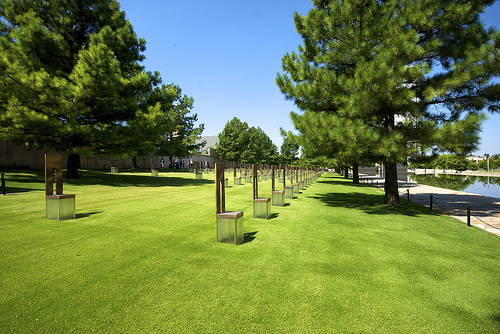
Below are two photos of the Oklahoma National Memorial. There are 168 chairs representing the people killed that day. The chairs are arranged in nine rows to represent the nine floors of the Murrah Building. Nineteen smaller chairs were made to represent the nineteen children killed. Each chair has a victims name.
Before 9/11, the worst terrorist attack in the United States was the truck bomb that destroyed the Alfred Murrah Federal Government building in Oklahoma City on April 19, 1995 that killed 168 innocent people. The crime was not perpetrated by foreign terrorists, but by an American - and a decorated war veteran.
"American Terrorist" is a great case study of the bomber, Timothy McVeigh, and his background and events that contributed to his act of mass murder. Even though McVeigh's act can never be justified, the authors of the book succeeded in trying to get as deep as possible inside McVeigh's mind and attempt to explain his motives. This they did by analyzing voluminous documents and conducting numerous interviews, including several with McVeigh himself inside prison, where they obtained his confession for the crime.
From the trauma of his parents' divorce, his experience in the first Gulf War, and the trigger that was the conflagration in Waco, Texas on April 19, 1993 - exactly two years before the Oklahoma City bombing - the book traces his path to infamy. This is a fascinating study of what otherwise would have been a decent, intelligent young man who was consumed by his paranoid assumptions about the society he was in, eventually leading him to kill 168 men, women, and children; injuring hundreds more, and causing so much anguish and pain to their families and to his own parents and friends.
The Oklahoma City bombing is one of the first major news events I can remember hearing about as a kid; although I couldn’t appreciate its brutality then, I knew from the look of horror on adults’ faces as they took in the scene that it was serious.The bomber, I was told, was crazy. This was an act of violence perpetuated by a crazy person. After reading American Terrorist, though, I’m more disturbed about the bombing than ever — because its perpetrator was so frighteningly normal, and went to his death believing he’d done the right thing. American Terrorist is the biography of Timothy McVeigh, an-All American boy broken by war and twisted by hate to become the monster he loathed and thought he was fighting.
Once expects, when reading the biography of someone like McVeigh, to find him pulling the limbs off lizards and throwing cats into ponds for laughs as a kid. That McVeigh isn’t here. We find instead a young man who loved guns but recoiled from hurting others, who learned to hate bullies and yearn to overcome them, like a superhero. In his early youth he worked as a security guard, lauded for his honesty and astonishingly mature professionalism. He looked at Star Trek the Next Generation and saw it in an ideal future: he admired Picard’s moral convictions, Data’s pure reason, and Geordi’s hypercompetence as an engineer. His own interests were diverse, from firearms to computers.
But McVeigh also had his fears, and as they grew older they would dominate him. McVeigh’s interest in guns immersed him in gun culture, and he absorbed its frequent conflicts with the government and grew to see it not as his friend, but more like a really awful neighbor — one who constantly filches your stuff and makes the very act of coexistence obnoxious. Despite this, McVeigh’s interest in firearms and desire for a mission in his life took him into the US Army, where he served with distinction despite his misgivings about US foreign policy, which he regarded as invasive. After being deployed in Iraq, his misgivings ripened into conviction: the US government was a bully, both to its own people and those around the world. When he returned home, he was a different man, sick and angry — and when the government managed to create two fiascos in six months, both of which involved besieging private property and then killing the people inside by purpose or accident, he decided there was only one thing to do: fight back. He was going to attack the government by finding a Federal building that housed ATF and FBI offices, and then blowing it up. He was inspired in part by The Turner Diaries, in which a revolutionary kicks off a war against an oppressive state by destroying the J. Edgar Hoover building. The book then follows McVeigh as he creates a plan and moves forward with it, then covers the trial. Interestingly, McVeigh had already been arrested when he became a person of interest in the case: his tagless getaway vehicle attracted the attention of a state trooper, who then arrested him for the misdemeanor of carrying a concealed weapon without an Oklahoma license.
What makes American Terrorist so disturbing is that McVeigh is a fairly likable and interesting guy for most of the book — even after the bombing, he was amiable to the marshals transporting him. So long as his rage against DC wasn’t activated, he seems to have made for fairly good company: Ted Kaczynski found him an engaging conversationalist, one of the few prisoners who was still interested in the world around him. Most striking to me was how McVeigh constantly groped for, but could not find, some purposeful meaning for his life outside of fighting the government — the security work he took pride in before going into the military seemed pointless afterward, and none of his flirtations with women never grew into a relationship. Perhaps with counseling after the war, he could have had created a constructive life for himself, instead of letting hatred for the government poison his soul and motivate him to enact the same behavior he decried from them — returning ‘dirty for dirty’.
Those interested in the psychology of terrorism will find NPR’s article on self-radicalization helpful.
Amazingly researched and very well-written. The writers take you deep into the twisted mind of a blind man who called himself a patriot, letting you thoroughly understand McVeigh's motivations without excusing him at all.
I’m very impressed with the research done on this awful person’s history and motive for the atrocious act he committed. Lou Michel and Dan Herbeck did an astounding job here. This is a must-read to gain insight into how domestic terrorists are fostered—sometimes within our own military.
Book Riot Read Harder challenge task # 2: A book of true crime.
I was really interested in the why more than anything else. What motivated someone to commit the deadliest domestic terror attack on U.S soil? From the book we learned that many factors contributed to McVeigh's mindset. He was a staunch advocate of gun rights, the second amendment, individual rights and freedoms and survivalism. After the Gulf War, he was possibly dealing with PTSD (though he was never diagnosed) and increasingly angered by U.S foreign policy and with the Clinton gun control policy (the Brady Bill and the Federal Assault Weapons Ban in 1993 and 1994 respectively). McVeigh later traveled across the country visiting gun shows and the sites of rumored government conspiracies such as Area 51. Finally, he was angry with the government for what happened at Ruby Ridge and Waco. A combination of these factors led to McVeigh's radicalization, yet, I can't help but feel that there are many people who hold anti-government beliefs but they don't cross that line and act on it. So what made McVeigh cross that line? Guess we'll never know.
I also felt that there were people around McVeigh who failed to alert authorities. While McVeigh insisted that he manipulated others into helping him and that no one else knew of his plans, i'm sure that someone, somewhere knew enough to tip the authorities off. They should've stepped up. They could've done something to prevent the bombing. This is where the saying, "if you see something, say something" applies.
This book definitely has relevance for us in 2018. See video about modern day militia groups. my link text
It's also interesting to note McVeigh's reaction to the book:
"Overall he was pleased," Nigh said, "though I think he was disappointed - not in the book, but in the treatment he received. I think he was disappointed because he felt there was a superficial treatment of his motive."
McVeigh told his lawyer there was an "omission of certain additional material" regarding his motives for the bombing, but Nigh would not elaborate on what that material was or whether McVeigh felt the authors or the editors were to blame.
What additional material are we talking about? I thought that this book was fair and presented McVeigh's humanity and cruelty. Dan Herbeck said it best in an interview about the book: We saw the human side of McVeigh, but it never changed our opinions about the crime he committed, which was cold, heartless and vicious.
Immaculately reported. An amazing biography from Tim McVeigh's beginning to the book's publication in 2001. Some of the details did not feel necessary and slowed the book down (could easily go from 400 pages to 350), but that doesn't want make me want to take a star away. It's just so good. Would recommend to anyone interested in the far-right, the rise of conspiracy theorists, domestic terrorism, or American history more broadly.
I read this expecting something like "Executioner's Song," since the authors interviewed the subject of their book if not extensively. (Gary Gilmore was the first man executed on the state level after the reinstatement of the death penalty and he stopped all appeals and accepted his execution. Timothy McVeigh was the first man on the federal level to do the same.)
However in "Executioner's Song" the subject's voice comes through loud and clear in this book it felt hidden behind the writer/narrator of the story. I wondered throughout most of the first part of the book, can I trust the authors to tell me the truth? Was this just written for profit? Are they going to reveal motive I wasn’t previously aware of? No, McVeigh was a soldier, he did what he did in retaliation for government overreach and the slaughter of the Branch Davidians two years prior, as well as the deaths at Ruby Ridge.
Evidence would indicate that the government thoroughly botched Ruby Ridge and the Waco stand-offs and their tactical dick-swinging cost the lives of innocent women and children. I also agree that the government gets away with atrocities and killing civilians domestically and abroad and then hides behind the mantle of collateral damage and national security. So, McVeigh certainly wasn’t wrong in feeling rage and indignation about the injustices he witnessed in battle and what occurred domestically, but that doesn’t justify his bombing a federal building. He was determined to make his statement and martyr himself to his cause, and he did that successfully. In his own profoundly warped way, he was a man of principle that he followed through the end of his life.
There is very little about the victims present in this narrative, they pop up a few times, but because the authors didn't spend time examining the victims' pain and suffering, so it wasn't fully present in the book, consequently McVeigh’s voice rings the loudest. The only exception was the brief mention of the horrific procedure of amputating Daina Bradley's leg while she was still conscious and screaming to free her from the rubble.
I feel like a need to read another book about what the victims' endured to get a fuller picture of the aftermath of the bombing and the horror that McVeigh unleashed.
We are always responding to history – Waco was, in part, a reaction to the mass suicide/murder at Jonestown, and OKC was a reaction to Waco, and the resolution of the Freeman stand-off was a reaction to OKC and Waco. Hopefully, maybe, we are getting better.
Although it was a three day, five hundred page reading marathon, it was worth the journey. American Terrorist is a meticulous and detailed account of Timothy McVeigh's bombing in Oklahoma. The Irish-Catholic All American boy was raised in upstate New York. Dad was a factory worker and mom a travel agent with a wandering eye. The couple's breakup was to have a long lasting impact on Tim. He repeatedly called his mother a slut and was closest to his grandfather Ed who taught him to hunt. At Fort Riley, Kansas, Timothy scored a perfect 1000 on a live fire competition and was on the front lines during Desert Storm. He “vaporized” two Iraqi soldiers from 2000 yards with a 25mm gun. While there, he earned a five medals and witnessed the horrors of war up close and personal. In February of 2001, two one thousand pound “smart bombs” killed women and children and friendly from an Apache helicopter fire killed two American soldiers. The Iraqis were blamed but a secret report later proved the coverup. He would later use the same military term, “collateral damage” in the Oklahoma bombing. McVeigh found little worth of his war heroics in seeking employment back home. He would work mostly as a security guard and also sold conspiracy theory t-shirts at gun shows across the U.S. He resumed a friendship with army buddies Terry Nichols and Michael Fortier and they mind melded after the Waco screw up by the government. They tested bombs in the desert and Nichols helped build the 7,000 pound one used in Oklahoma. After the explosion, a number on the Ryder truck axle was tracked to McVeigh. He was in a holding cell for driving without a license plate and carrying a loaded gun. His lawyer, Stephen Jones later penned a book insisting on a wide conspiracy by Arabs and Neo-Nazi's. McVeigh insisted to his last breath to being alone in the attack. The trial was a slam dunk and Timmy landed on death row at Super Max in Colorado where his unit also housed Theodore Kaczynski who got along well with his fellow bomber. An appendix contains an eleven page letter to the author about McVeigh by the Unabomber. McVeigh was transferred to Indiana for his date with lethal injection. It was there that he quoted Louis Brandeis's dissent on a wiretapping case involving bootleggers. Brandeis warned of allowing the law to violate privacy rights as a “dangerous step towards tyranny.” On June 11, 2001, McVeigh was executed after receiving Last Rites by a Catholic priest. American Terrorist is a great read.
I think "American Terrorist: Timothy McVeigh & the Oklahoma City Bombing" by Lou Michel and Dan Herbeck is an important book for Americans to read. It is very unbiased and straight-forward, and it helps explain just what happened to lead to the greatest domestic terrorism incident in our history. I think it will help the nation heal. As others have stated, it won't leave you with a feeling that McVeigh was a psychopath. That's the most disturbing part of the the entire book. He wasn't.
The book follows McVeigh's life all the way from his birth and innocuous childhood, through his military career, and to the fateful day when he placed a truck bomb outside the Oklahoma City Federal Building and murdered hundreds of people. It's an interesting journey. Following a regular guy who went way off the tracks and did such a horrible thing from beginning to finish is...sobering. I found the information about how he planned the bomb with Nichols the most interesting. It's hard to believe a regular guy could sit in his friend's house and plan it that way, but it makes sense.
I've recommended this book to friends, and they often recoil. "I don't want to read about that freak." I think people should read about that "freak" because there's no other way to begin the healing. Knowing what happened is the first step.
This book was constructed through interviews with McVeigh on death row and interviews with many other people involved who knew McVeigh. It's probably as close as we'll ever get to understanding what caused him to do what he did. It is well written. Although it will make you cringe and recoil at points because of the drastic nature of the events, I think it's an important book.
This book is historical. Michel clearly devoted himself to delivering McVeigh to the world. My only criticism is the occasional lack of objectivity when it came to McVeigh's motive and plan.
McVeigh said he wanted to be caught and put to death by the state, yet he was upset, claiming that he didn't get a fair trial. I don't understand how Michel, or anyone else, could accept both to be true.
Another area I found lacking journalistic objectivity is in Michel's assessment of Stephen Jones. There are too many unanswered questions to completely dismiss Jones as an incompetent attorney, and his theories outside the realm of possibility. Michel seemed to blindly side with McVeigh, a man who blames everyone else for his problems, when addressing Jones.
Despite Michel's occasional, yet painful, lack of objectivity, he still delivers insights into McVeigh that could only be topped by McVeigh himself. A perspective that, without this book, would have died in Terre Haute, Indiana on July 11th, 2001.
A clear view into the mind of a terrorist; who clearly wasn't.
If you haven't heard back in 1995: McVeigh, a dedicated marine, killed hundreds to "teach the government a lesson". What this book reveals is his thought process and what led him to believe that blowing up a building was that only way to get his message through. The fact that he only went to the building one other time and never walked inside reveals how little he actually thought about it.
According to the author and his interviews with McVeigh, he had no clue there was a nursery in the building in the very place he parked the truck. Had he walked in the building he would have known that and perhaps rethought his plan. Of course, had he bothered to research the building he would have discovered far more.
A good example of just how obsessed someone can become. So obsessed that they no longer think clearly.
The best researched book about Timothy McVeigh and the Oklahoma City bombing, which was overshadowed by the OJ Simpson trial in 1995. Timothy McVeigh himself didn’t seem like a bad person to just hang out with, as evidenced by the fact that he had several friends. However, despite not being physically unattractive, he seemed to struggle with his relationships with women. Other than a few ‘flings’, he was never in a relationship with a woman. Some might say it was because he did not have the best relationship with his mother, who was an overworked travel agent who reportedly had affairs with other men while married to his father. I also like that it’s written in a rather straightforward, journalistic style and doesn’t delve too much into sensationalization and conspiracy theories like some other books on Timothy McVeigh and the OKC bombing do.
I remember reading this one when I was on "injured reserve" from my job. We were all thinking that the future of threats to America would come from home-grown idiots like mcveigh....
This is the story of the Oklahoma City bombing of the Alfred P. Murrah Federal building on April 19th, 1995. It's a sickening story of mcveigh and his ability to coerce help to pull-off this horrific event.
I actually read it twice during my down-time, highlighting much of it. The authors scored, and were given access to interview this devil about the bombing. They were able to record his reasoning, which can be summed-up as a general hate for big-government.
A very intriguing look into the mindset of a "patriotic" murderer.
A biography of Timothy McVeigh starting from his birth, through to the Oklahoma City bombing and ending with him on death row. This book does obviously cover the bombing of the federal building and its victims but this is not its primary focus. Some may find it repulsive that McVeigh has had a book written that focuses primarily from his point of view and if I remember correctly that there was some issues when this book was published in 2001. I personally think this was a very good book and an interesting read about a young mans descent into paranoia and hated. A hatred so intense that he killed 168 people to satisfy it and in the end with no regrets.
My wife and I recently visited the Oklahoma City Memorial so, when I saw this in my local bookstore last Saturday, I had to pick it up. I really enjoyed the book and it provided a lot of good insight into the mind of Timothy McVeigh, who the authors interviewed for the book.
The book delves into Timothy's life, from a baby up until before his execution. It really is amazing how someone with so much promise - he was damn near Jack Bauer-esque in the Army - switched and became such an evil man.
I'm giving this 5 stars because it was so well-written and informative. Let me tell you, McVeigh was a pathetic excuse for a man and his own embarrassment and disappointment with his life led him to some kind of "hero" complex that he needed to do something to make a statement to the government. By killing innocents. I was almost uncomfortably embarrassed for him at times just how obviously insecure he was. Never underestimate what someone's wounded pride and twisted ideologies can motivate them to do.
Labeling someone as "insane" or "out of their mind" is a dangerous thing to do. It ignores the truth, and dehumanizes the person acting "abnormal." Dehumanizing Timothy McVeigh would be the easy way to cope with his horrific actions, but only the hard way, by trying to understand him, can we get to the truth. The authors of this book did a great job treating Timothy McVeigh as a human, and their book remains relevant today.
What was unsettling was the network of virulent anti-government individuals found throughout the gun sale conferences.
Also unsettling was how government actions at Ruby Ridge and Waco strengthened the resolve and paranoia among many that have vague concerns over the strength and reach of government security forces.
Great journalism here - the way reporters should be producing information and a concern of how few there are today compared to a decade ago.
Fantastic view of McVeigh. The authors were careful to stay as neutral as possible and they did a great job. I think the last part could be lopped off as the unabomber said he only casually observed McVeigh and never really interacted with him so its not a good insight, but the rest was really great!
Well written, easy read. Good overall portrayal of McVeigh and the whole case without glorifying him. Found his the info about his criminal defense interesting and baffling. Appreciated the author's attention to detail and the telling the story very professional and well done.
Skremmende lesning nå 25 år seinere: Timothy McVeigh var bare en helt vanlig amerikaner som likte våpen, hatet myndighetene og trodde litt for mye på konspirasjonsteorier - og som radikaliserte seg selv.
Den gang befant disse våpenelskende myndighetshatende konspirasjonsteoretikerne seg i randen av samfunnet, mens nå er de blitt mainstream...
I'm fascinated by the Oklahoma City bombing and I believe it deserves to be studied more. It was good reading this book while I was reading Between the World and Me. There is no doubt in my mind Timothy McVeigh was one of those people who thought of himself as white. It was interesting to read the Unabomber's account of him though.
I read this for a class on terrorism, not because I thought it would be a "good read." I thought it was written very well and is probably the best account out there of what happened and how it happened.
I enjoyed reading this book. Gave me a good insight of his mind set when he decided to do the bombing. This book describes the everything leading to the bombing, the arrest and the trial after the bombing. It was a good overview of his life.