Jump to ratings and reviews
Rate this book

Wars of the Roses #6

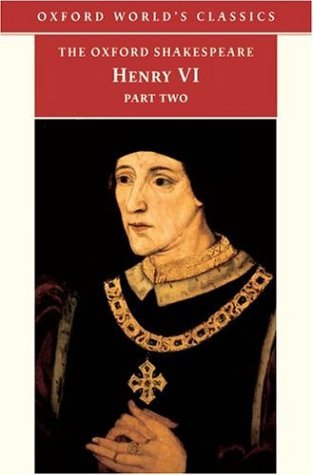
Henry VI, Part Two

Rate this book
Shakespeare's Henry VI plays dramatize contemporary as much as Elizabethan the struggle for power, the manoeuvres of politicians, social unrest, civil war. This edition draws on experience of the play in rehearsal and performance to focus on both its theatricality and contemporary relevance in a wide-ranging introduction and detailed commentary.

336 pages, Paperback

First published January 1, 1591

139 people are currently reading
5521 people want to read

About the author

William Shakespeare

27.4k books46.9k followers
William Shakespeare was an English playwright, poet, and actor. He is widely regarded as the greatest writer in the English language and the world's pre-eminent dramatist. He is often called England's national poet and the "Bard of Avon" (or simply "the Bard"). His extant works, including collaborations, consist of some 39 plays, 154 sonnets, three long narrative poems, and a few other verses, some of uncertain authorship. His plays have been translated into every major living language and are performed more often than those of any other playwright. Shakespeare remains arguably the most influential writer in the English language, and his works continue to be studied and reinterpreted.
Shakespeare was born and raised in Stratford-upon-Avon, Warwickshire. At the age of 18, he married Anne Hathaway, with whom he had three children: Susanna, and twins Hamnet and Judith. Sometime between 1585 and 1592, he began a successful career in London as an actor, writer, and part-owner ("sharer") of a playing company called the Lord Chamberlain's Men, later known as the King's Men after the ascension of King James VI and I of Scotland to the English throne. At age 49 (around 1613), he appears to have retired to Stratford, where he died three years later. Few records of Shakespeare's private life survive; this has stimulated considerable speculation about such matters as his physical appearance, his sexuality, his religious beliefs, and even certain fringe theories as to whether the works attributed to him were written by others.
Shakespeare produced most of his known works between 1589 and 1613. His early plays were primarily comedies and histories and are regarded as some of the best works produced in these genres. He then wrote mainly tragedies until 1608, among them Hamlet, Romeo and Juliet, Othello, King Lear, and Macbeth, all considered to be among the finest works in the English language. In the last phase of his life, he wrote tragicomedies (also known as romances) and collaborated with other playwrights.
Many of Shakespeare's plays were published in editions of varying quality and accuracy during his lifetime. However, in 1623, John Heminge and Henry Condell, two fellow actors and friends of Shakespeare's, published a more definitive text known as the First Folio, a posthumous collected edition of Shakespeare's dramatic works that includes 36 of his plays. Its Preface was a prescient poem by Ben Jonson, a former rival of Shakespeare, that hailed Shakespeare with the now famous epithet: "not of an age, but for all time".

Ratings & Reviews

What do you think?
Rate this book

Friends & Following

Create a free account to discover what your friends think of this book!

Community Reviews

5 stars
1,743 (21%)
4 stars
2,805 (34%)
3 stars
2,657 (32%)
2 stars
814 (9%)
1 star
229 (2%)
Displaying 1 - 30 of 671 reviews
Profile Image for Leonard Gaya.
Author 1 book1,172 followers
June 29, 2021
This one is episode 6 of Shakespeare’s massive historical drama cycle on the Plantagenet / Lancaster / York dynasty. Previously (Henry VI, Part 1), the English lords were trying to forcibly stifle the French rebellion led by a diabolical Joan of Arc, while, back in England, Gloucester and Winchester were pitched against each other and the War of the Roses was slowly brewing. This Part 2 is composed of two very different sections and storylines, sewn together into one single play.

The first part (from the beginning until the end of act III) could be titled “The downfall of Gloucester” (recommended to all Ned Stark’s fans). Henry VI is as yet too young to reign, so his uncle Humphrey, Duke of Gloucester, rules in his stead. This situation, of course, stirs the greediness of everyone around him. Winchester, Suffolk, York and the Queen (Margaret of Anjou) plot in every possible way to remove Gloucester, taking advantage of his weak spot: his ambitious wife Eleanor (who is a sort of Lady Macbeth). The whole conspiracy against Gloucester gives rise to a few exciting pieces of drama. For instance, York’s monologue (I, 1, 210 sqq.) heralds Richard III similar speech a couple of plays later. Another of his addresses (II, 2, 10 sqq.) is a different version of the royal family tree and can be compared with the one put forward by Mortimer in Part 1. Another still (III, 1, 331 sqq.) is a straight-out Machiavellian manifesto and, quite simply, a fantastic line. The whole thing, however, culminates in act III with a series of frenzied arguments which, in many cases, are borderline bombastic.

Meanwhile, the King comes across as a well-meaning but bumbling bigot. The eventual separation of his unfaithful Queen Margaret from the Duke of Suffolk (a sort of dark Tristan/Isolde affair) is perhaps intended to be emotional. Unfortunately, I confess that the pomposity and pathos of it all got a bit exhausting in the end.

The second part (acts IV and V) takes a very different turn. It starts with a sea battle and a band of pirates, and, soon after, Jack Cade’s topsy-turvy, down-and-out and blood-spattered rebellion. For the duration, Shakespeare set aside his iambic pentameter and wrote the whole thing in prose. There is something surprisingly familiar and modern about the description of this popular uprising. Cade is just as hysterical as the Pucelle in Part 1. Furthermore, his political programme sounds like insane pre-Marxist communism. I couldn’t help but think of today’s corybantic politicians when I read some of Cade’s lines (e.g. IV, 2, 61 sqq.) — by the way, he too has a line and a claim regarding the family tree (see IV, 2, 124 sqq.).

Nevertheless, it eventually goes tits-up, with a nightmarish carnival of rape, looting and butchery, until the flip-flopping people of London turn their back on him. The play closes with the epic battle of Saint Albans — the real starting point of the War of the Roses —, the death of Old Clifford (an echo of that of Young Talbot in the previous play), and the victory of the evil mastermind, the Duke of York. In short, an energetic and brilliant play.

Edit: The Hollow Crown: The Wars of the Roses 2016 TV adaptation of Henry VI, Parts 1 and 2 is a drastically rewritten and condensed version of Shakespeare's plays. Most of Talbot and all of Cade’s scenes have been removed from the plot, to focus on the Gloucester drama. In truth, Hugh Bonneville (best known for his role in Downton Abbey) offers a first-class performance. Sophie Okonedo, in the role of the treacherous French queen, is outstanding as well.

> Previous play in The War of the Roses: Henry VI, Part 1
> Next play: King Henry VI, Part 3
Profile Image for Bill Kerwin.
Author 2 books84.3k followers
December 8, 2019

Not quite as good as Henry VI, Part I--perhaps because by its very nature it possesses no beginning and no end. The first four acts, halfway between the political disputes of the "uncles" and the factional and dynastic struggles of the Wars of the Roses, are necessarily episodic and often seem formless. Shakespeare is learning his craft here, and he often over-relies on lengthy monologues and soliloquys to reveal character and motivation. There are good scenes here, often involving commoners and commonsense observations --Gloucester's debunking of a bogus miracle, Warwick's forensic analysis of Gloster's corpse, Jack Cade's ignorant vitality--but these virtues are overshadowed by the shallow, vituperative rhetoric.

Then, in Act Five, the Wars between York and Lancaster begin in earnest, and--with the arrival of the hunchbacked Gloster and his enemy Young Clifford--the verse takes on a new subtlety and intensity. This change is exciting--almost as if the genius of Shakespeare had first taken charge, right here, in the last act of this old play.
Profile Image for Darwin8u.
1,826 reviews9,031 followers
March 7, 2017
"Burn all the records of the realm. My mouth shall be the Parliament of England."
- Shakespeare, Henry VI, Part 2, Act IV.7

description

So, I liked Part 2 of Henry VI a lot better than Part 1. It still isn't Hamlet, but it is complicated, funny, twisted in parts. One of my favorite aspects of the play are the scenes with Queen Margaret and Suffolk. No. They aren't great people, but they are a great couple. Their parting is amazing and poetic. My other favorite part is, well, anything with Jack Cade/Sir John Mortimer (how can you not love a guy who knights himself?). He is one of those great populists in literature and history, belonging on the shelf next to Huey Long and Donald Trump. Dammit. I'm trying to avoid Trump by reading the classics and I come across Cade and the Butcher and all their anti-intellectual followers. Burn the accountants and kill all the lawyers. We march on Washington D.C. boys.

There were also several nice lines, specifically:

“The first thing we do, let's kill all the lawyers.”

"Let them obey that knows not how to rule.”

"Could I come near your beauty with my nails,
I could set my ten commandments in your face.”


"My shame will not be shifted with my sheet --"

"A staff is quickly found to beat a dog."

"So he be dead; for that is good conceit
Which mates him first that first intends deceit."


"For where thou art, there is the world itself,
With every several pleasure in the world;
And where thou art not, desolation."


"If I depart from thee, I cannot live.
And in thy sight to die, what were it else
But like a pleasant slumber in thy lap?"


"This way fall I to death."

"Because my book preferred me to the king,
And seeing ignorance is the curse of God,
Knowledge the wing wherewith we fly to heaven."
Profile Image for Bradley.
Author 9 books4,859 followers
February 9, 2017
This is a very uneven play, unfortunately. The first half attempts, mostly unsuccessfully, to justify and ramp up the enmity between the Lancaster line in Suffolk and the rage of York. It's mostly just scheming and jealousy and the blame game. York wanted to have his blood tied to the King while Suffolk (at least in the play, if not in actual fact, history,) was smitten with Queen Margaret, whom he unwisely pushed off to his king instead of just making her his own, with huge overtones of Lancelot and Gwennie.

And then Suffolk dies in sweet tune to the prophesy that the play begins with, and then the action and the interest picks up, turning a frankly boring escapade into a pretty awesome end.

So, yeah, I call the first half of this play weak. Weak, I say.

The second half, the parts where Jack Cade, care of York and his scheming and his soon forthcoming full attempt upon the Throne of England, brings all the blood and pillage and a truly immense amount of book burning upon the stage, with ignorant masses calling for the downfall of whatever bogeyman they can conjure out of smoke or just the smoke from Jack Cade's arse. Mind you, this is strictly historical, although he wasn't quite as villainous as portrayed here. I think Cade honestly wanted a populist rebellion, but when he let slip his control of the masses and let them pillage and rape and steal after being successful against the king's mismanaged forces, he lost all the honor he might have won in the day.

In the play, instead, we're treated to something quire gruesome with a number of heads on poles.

After that bit wrapped up, though, it was York's turn, bringing his army into Kent after it had been softened by Cade, and after a few reversals, he manages to win and see the king flee off to London and sets himself up as another king of England.

The action and the story and the cliffhanger is quite delicious, assuming you hadn't fallen asleep during the first parts of the play. Alas.

The broad outlines of what happened in history is pretty on target, but some motivations are ramped up or made from whole cloth to make the play more exciting. Can I blame it? Not really.

Warwick doesn't really feel as important in the play as he always felt in my readings of history, either. Or perhaps that's just because he really hasn't come into his own until Part 3. ;)

But as a side note, one thing I found rather delicious was the youthful and smartass future King Richard III being all valorous and quick of foot and mind amongst all his older brothers and his father. Hey look, it's a the young man who'll grow up to be a wretched monster! lol. Well, that's Shakespeare. History is full of supporters and detractors of Richard of York and where does the truth really lie?

I just wish this play had been more even in quality. Sigh.
Profile Image for E. G..
1,175 reviews796 followers
April 30, 2018
General Introduction
The Chronology of Shakespeare's Works
Introduction, by Michael Taylor
The Play in Performance
Further Reading


--The First Part of the Contention Betwixt the Two Famous Houses of York and Lancaster

An Account of the Text
Genealogical Tables
Commentary
Profile Image for Michael Finocchiaro.
Author 3 books6,250 followers
September 17, 2020
Another rather confusing and violent episode in the unfortunate career of Henry VI, Part 2 covers the beginning of his troubled marriage as well as the true start to the War of the Roses which will claim so many lives until the end of Richard III. Henry loses to York and flees the capital as the play ends. I found it maybe slightly more interesting than Part 1, but still rather confusing.

I like the couplet in which York declares war on Lancaster/Henry VI:
And force perforce I'll make him yield the crown
Whose bookish rule hath pulled fair England down.

Henry VI, Part 2, Act 1, scene i

Henry's marriage to Margarite has lost the possessions that England previously held there and for this York wants to punish him and claim the crown.

This episode was covered in Henry VI Part 1 and 2 in the BBC's Hollow Crown season 2 (they edited out several episodes including the popular rebellion). Well casted and beautifully shot, it is an excellent rendition of this rather confusing play.
Profile Image for Jaksen.
1,607 reviews90 followers
July 18, 2024
First off, there is so much to this play it's hard to remember it all, but it's a doozey.

There are nobles who hate other nobles, who snipe, bait and target each other. Some end up with their heads cut off for no real discernible reason. A really good guy is strangled in his bed. And the bishop, Winchester, who's okay but not a great guy, he's poisoned. The noble who sold out England and gave back to two huge territories to France, and also brought back Margaret of Anjou, a French princess, for King Henry VI to wed, AND who is having an affair with her, ends up with his head cut off by pirates. Later we see poor Queen Meg carting his head around. She's a bit upset.

There's also witchcraft and conjuring by Eleanor, the wife of the good Duke of Gloucester. (He's the guy who gets strangled in bed.) On top of ALL THIS, there's Richard of York plotting to be king and standing around watching all this nonsense go down. He's also abetting it and laughing at it and enjoying it all because every time a noble guy dies - who might be Richard's enemy - it's one more bowling pin tipped over in Richard's plans to bowl a strike - and be king!

(I looked up the genealogy charts for this time, all the descendants of King Alfred the Great who ruled back in 800-something. Both Richard of York and Henry VI descend from him and both have a pretty equal claim to the throne. It all depends on how you look at things.)

Meanwhile King Henry VI is a nice enough guy but he prays too much and is sort of too good. He forgives ANYBODY who is nice, really. He also believes ANYBODY who pledges their allegiance and says to the king, hey, sorry I screwed up, can we be friends again? Henry is a real doormat, but this also works two ways because...

If someone comes along and says Ho, there king, you need to arrest - fill-in-the-blank - because he's been heard to say or do something that isn't all that loyal, well then, Henry will believe this! He'll have 'fill-in-the-blank' taken away just on someone's say so! But then he'll whine a bit about how he feels that 'fill-in-the-blank' is really good and how he doubts himself and boy, is Henry a first class waffler. I wanted to slap him from here, 400 years after all this was written.

There is another 'meanwhile' going on, and that's trouble among the commoners. They're all riled up and mirror what's happening with the nobility. They love the king; they hate the king. They love Richard, who's supposed to be king - if you're a white rose-leaning Yorkist - and they distrust almost everyone who is learned or can read and write. (They actually kill a guy because he's 'learned.' This is the play with the famous line, 'First, kill all the lawyers.') John Cade is their leader and he's a first-class moron who kills anyone he just does ... not ... like.

By the way, this is an ongoing theme throughout history: fear and hatred of those who aren't necessarily richer than you are, but SMARTER than you are. If it were me, I'd be going around saying nope, nope, have no idea what a noun is, or a verb. Is that a name? Does Noun own the winery and Verb's his comely daughter?

Seriously, there is a passage where they curse anyone who knows what a noun or verb is. I am NOT kidding.

Well amidst all this turmoil a country needs a strong leader. One who can say, hey you nobles, knock it off, or hey, let's have a tournament and let the country folk burn off some steam. Also one who'll say nope, France, you cannot have Maine and Anjou back, it sets poor precedent. As well as a king who won't restore a man's titles and estates at the drop of a hat. (Henry actually does this in Henry VI Part 1, but it has repercussions through to this play.) This really shows Henry's inherent waffling because who restores someone who, 1. had a dad for a traitor, and 2. some of your best advisers are telling you WATCH OUT FOR HIM?

This is an entire play of arguing and backbiting. Betrayal and conspiracy. Beheadings and armed masses running around. Throw in some witchcraft, a tiny bit of humor, a spineless ruler, two women who are as bad as any deceitful man, and this is a play that must have had the crowds cheering.

Masterful. Loved it.
Profile Image for Trish.
2,380 reviews3,743 followers
September 3, 2016
My goodness, what did I just read?! Will, buddy, no. Just no.

This second part about King Henry VI starts with him getting married to Margaret of Anjou (who, by the way, was penniless but he wanted her nevertheless). In Shakespeare's play, she's the lover of Suffolk (not true but the rumour was spread in order to defame her since the English had a problem with a French queen).

Gloucester is the Lancaster's counterpart in parliament and thus to the queen, but through Suffolk Gloucester's wife is led to witchcraft, then arrested and exiled which is a scandal for her husband (diminishing his power).

Looong story short: there is lots and LOTS of intrigue at court, even more than in the previous part, only this time including a queen that refuses to be an adornment but gets very heavily involved in politics, culminating in Suffolk killing Gloucester (through assassins, historically not accurate but so much more effective in a play). Oh and in the play, Richard of York voices his claim on the throne at this point already, at least to some who swear him loyalty (also not true).
Seriously, this first half or so of the play was just hurtful!
Then however we get pirates! And for once I didn't care that much that it wasn't true because it was exciting. Harhar! ;P
York is sent to Ireland (supposedly to end a revolt but actually to be out of the way), but instructs an agent, Cade, to stage a rebellion - the rebellion really took place but it's highly unlikely that York had anything to do with it, he just wanted to benefit from it. The parts about the rebellion were wonderfully awash with blood and terror and I enjoyed it quite a bit. I mean, Shakespeare didn't have to change much here since Cade went from hero of the common folk to thieving and dishonourable betrayer all on his own which made him lose.
And then, suddenly, shit really hits the fan when York returns with an army. And this is where York would become unpopular with me if I didn't know the true historical facts because he declares himself another King of England in the play (after causing Henry VI to flee). The truth is that he never did that - instead he repeatedly (to the point of stupidity) kept silent about his claim and swore loyalty to the weakling king, pointing out that his grievance was with the king's "advisers".

At a certain point York promises to stop his campaign if his chief rival, Somerset, is imprisoned but he is betrayed (historically inaccurate again, it was not so much a planned betrayal as a string of unlucky coincidences coupled with Henry VI's weakness again) and thus declares his claim on the throne officially (not true at this point in time), prompting again a who-will-choose-which-rose scene.
However, thank goodness, all this build-up ends in a nice battle at St. Albans where Somerset is finally killed (he was like a cockroach, I sooo wanted him to finally die already) and Margaret flees with the king and the son of the now dead Somerset (it's just one damned Somerset after another, I swear)!

This was so hard to get through and I was very much tempted to just skim and skip to the better bits (I had been told they were there). But I persevered and the second half (actually a bit less) really was much better, having taken up considerably in pace. Still, just like the first part, this just couldn't convince me. Maybe it really has something to do with the fact that these two parts were written so early in Shakespeare's career and he yet had to hone his skill. I don't know. Regarded as one work, they really are important for the overview but the execution is somewhat lacking unfortunately.
Profile Image for Eylül Görmüş.
754 reviews4,601 followers
June 24, 2025
"Bir at! Bir at verin bana! Bir ata, krallığım feda!"

Shakespeare'in erken dönem eserlerinden olan bu dörtlemeyi sonunda tamamladım. Hikayeden kopmamak için hepsini peş peşe okudum, okumaya niyeti olan varsa öyle yapmasını öneririm zira çok sayıda karakter var ve arka arkaya okuyunca bile insan karıştırabiliyor, hele ki isimler tekrarlayınca.

Valla duygudan duyguya sürüklendim. İlk kitap olan VI. Henry I fena değildi, VI. Henry II epeyce iyiydi, VI. Henry III'ü sanırım "bitse de gitsek" duygusuyla yazmış Shakespeare, herkesin birbirini bıçakladığı fragmanlardan ibaret bir metin, tüm bunların sonunda vardığım III. Richard ise "iyi ki okumuşum hepsini" dedirtti zira Özdemir Nutku'nun önsözde söylediğine tamamen katılıyorum: "İnsana öyle geliyor ki, sanki Shakespeare, karakter yaratmada üstün yaratışın kilidini Richard'la açmıştır."

İngiltere'nin meşhur Güller Savaşı dönemini (1455-1485) anlatıyor bu dörtleme. York ve Lancaster ailelerinin bitmek bilmez bir taht kavgasına tutuştuğu, aileleri destekleyen lordların sürekli taraf değiştirmesiyle bir türlü bitmeyen ve sonunda da kimsenin kazanamadığı, Tudor hanedanının önünü açan o karanlık iç savaş yılları.

İlk üç kitap sanki III. Richard'a varmak için yazılmış gibi sahiden, zira ancak onu okurken "hah, işte şimdi Shakespeare okuyorum" duygusu geldi. Önceki üç kitapta yazarın alışık olduğumuz şiirli cümleleri ve insana dair incelikli gözlemleri maalesef pek yoktu. Fakat III. Richard'la beraber iktidar hırsını ve iktidar hedefinin yaratabileceği sonsuz suçlar zincirini öyle güzel anlatmış ki, ben tatmin oldum. Malum, Shakespeare'in çok zamansız yazdığı, bu nedenle hala çok okunduğu söylenir, öyle sahiden, insana içkin şeyleri çok keskin görüp aktarıyor; sahne değişiyor ama yazdıkları hala geçerliliğini koruyor. (O kadar ki - III. Richard'ın tahta çıktığı bölümde durmaksızın Kemal Kılıçdaroğlu'nu düşündüm, tabii keşke düşünmeseydim ama işte Türkiye siyaseti kitap okurken bile peşimizi bırakmıyor...)

Ezcümle, epey genç yaşında yazdığı için teknik açıdan sorunlu ve zayıf başlamış da olsa, finaliyle beni çok mutlu eden bir dörtleme oldu. Külliyatı tamamlama yolculuğum sürecek.
Profile Image for leynes.
1,316 reviews3,673 followers
July 1, 2019
Witch burning, several beheadings and a bloody civil war – buckle up, bitches, issa history play! I know that I committed a cardinal sin by reading Willie's Wars of the Roses completely out of order (heck, my reading order for just the three parts of Henry VI was completely messed up: 1 - 3 - 2) but suck it, losers, at least I did it! I read the eight damn plays, give me a break.
Can we outrun the heavens?
Overall, I have to say that Willie's history plays really grew on me over time and I also like the fact that the Wars of the Roses in particular really read like a modern historical fiction series. A lot of the characters play a big role through multiple of the plays and it's fun to follow them around and see their rise and fall. I grew particularly enamoured with Henry V, knowing about his struggle with his father in his youth made him a much more likeable and relatable king when it was finally his time to shine. When it comes to his son, Henry VI, however, I have to say that I just hate his guts. He is so stupid and annoying and I was just rooting for that bitch to die... Unfortunately for me, he is the one who got three fucking plays about his reign. Like, why?

Anyways, Henry VI, Part 2 picks up right where Part 1 left off. Henry is overjoyed as Suffolk (that nasty ass) hands the beautiful Margaret of Anjou to him to be his queen. Gloucester and Warwick (which I style "the uncles") are appalled at the political cost, since Anjou and Maine will now go back to France. York (that crazy ass) reveals to take the crown for himself (what a surprise).

What then ensued can be summed up in one word: meddling. Gloucester's wife Eleanor (aka my bae) dreams that she should be king (mood) and the queen conspires with her lover Suffolk to bring the Gloucesters down. Eleanor confides in spirits and witches... which ends badly for her when it is discovered, she is exiled and the witch is burned at the stake. Gloucester resigns in shame, however, that's not enough for our crazy Queen and together with York and Cardinal they agree to have Gloucester murdered. Henry, yet again, proves that he isn't fit to rule by being overwhelmed to the max, throwing a hissy fit because nobody listens to him and then proceeds to give York an army (the man is trying to usurp your throne, wake up, hun!) and faints at the slightest notion of blood. I cannot even.

Suffolk gets beheaded. Jack Cade (a random Irishman), urged on by York, orchestrates a peasant's uprising and starts invading London (you can't make that shit up) but the rebels are easily persuaded to lay their weapons down. York, having in the background worked on the support for his claim to the throne, comes to London to tell Henry that his rule is over. Even Salisbury and Warwick switch alliance to him because they finally have enough of Henry's shitty ruling. Henry and Margaret flee. The curtain closes.

Phew. I'm happy that I'm finally done following this weak king around. Henry VI is really a failure on every level. What I enjoyed most in this second part were definitely the two women, Margaret and Eleanor. Both of them were absolutely savages and even Lady Macbeth could never. Here are some gems from their speeches and accusations (all directed towards the men in their lives):

Eleanor about her husband:
Were I a man, a duke, and next of blood,
I would remove these tedious stumbling-blocks
And smooth my way upon their headless necks;


Margaret to her lover:
Fie, coward woman and soft-hearted wretch!
Hast thou not spirit to curse thine enemy?
I gotta love Willie for his female characters who feel like they could do so much more if only they were born men. Your time will come, ladies.
Profile Image for Elentarri.
2,056 reviews66 followers
May 10, 2024
Henry VI Part 2
Rating: 2 stars
Read: 10/05/2024

William Shakespeare's Henry VI is a series of three history plays, set during the lifetime of King Henry VI of England. Part 1 deals with the loss of England's French territories and the political machinations leading up to the Wars of the Roses, as the English political system is torn apart by personal squabbles and petty jealousy; Part 2 depicts the King's inability to quell the bickering of his nobles, and the inevitability of armed conflict; and Part 3 deals with the horrors of that conflict.

* yawn * I fell asleep somewhere near the beginning of listening to this and only woke up with a particularly noisy battle scene - so had to rewind and start again. Politics and more politics, betrayals, backstabbing etc. On the other hand, nearly everybody dies - usually in rather violent and gruesome ways. The play begins with the marriage of King Henry VI of England to Margaret of Anjou. Spineless, gullible and ineffective King Henry VI is incapable of reining in his nobles, easily manipulated by his devious wife, and does a lot of hand-wringing and praying while is nobles plot murder and rebellion. The play ends with Shakespeare's version of the first of the wars/battles between York and Lancaster at St Albans (1455), and various nobles in pursuit of Henry VI's company.

PLAY SUMMARY: https://www.shakespeare.org.uk/explor...
Profile Image for Trevor.
1,519 reviews24.7k followers
August 7, 2011
As bad a play as Part One is – this is great. This really is one of the best plays in the sequence. It quite literally has everything. Revolt, rebellion, the loss of France, a Lady MacBeth (but playing to a MacBeth that cannot be tempted by vaulting ambition – and then again maybe two Lady MacBeths for good measure), a good kinsman killed by traitors and depriving the King of advice, a good King suddenly under the sway of a group of very bad advisors, a Queen in love with someone other than the King and the Tea Party.

Well, when I say, The Tea Party, I mean the Fifteenth Century equivalent – the kinds of people who make countries ungovernable and are likely to burn books and people in the streets. Shakespeare’s dislike of anarchy is brought well and truly to the fore in this play.

Honestly, I don’t want to spoil this for you – but this is a must see play. The only problem is that I can’t remember it ever being performed – And the simple reason is because who is going to see the middle play of a three part series of plays? But look – this really is mind-blowing. It is quite a long play, but even so it just races along at a breath-taking speed and there are so many characters that make you want to shout at them and so many who come to a bad end – mostly of their own cause, but tragically not at times too – this is worth whatever pains are asked of you to see it, even those in sitting through part one. Part one does help this play to make sense, I guess, but this one shines where that one limped along.

If this play has a central theme it is that nature loathes a vacuum. Poor old Henry VI – he would have made a good priest, but he makes a dreadful Monarch.
18 reviews3 followers
June 19, 2009
The only things I knew about this play going in were 1) "First thing we do, let's kill all the lawyers!" and going hand in hand with this, 2) it's very, very bloody. As things turn out, as far as bloodiness goes it's not that bad - just a lot of heads on poles and many puns related to heads on poles. The sheer bloody-mindedness of the entire cast becomes a bit wearying after a while, but that's probably the point. I found myself struck by the relationship between Margaret and Henry, such as it is, and wish there were more of it - his persistent biblical quotations and her outrageous passions make for a very odd couple, and yet I believed Margaret when she said that though she might grieve for Suffolk, she would die for Henry.

Jack Cade in Act 4 was a breath of fresh air. The Arden commentator compared his usage to that of Talbot in Henry VI Part 1, but I think in his humor, vivacity and delight in anarchy, he has more in common with Jean Pucell. From a structural standpoint it seemed a little eccentric to limit Cade's appearance to Act 4, but I liked that we watch his rebellion rise and fall like a flash storm, as a kind of precursor to York's more devastating uprising in Act 5 Scene 1. How electrifying was the moment when York denied Henry as the true king; it might have been a bit contrived (why oh why is Margaret just sauntering along with Somerset if Henry gave orders to confine him to the Tower?) but the sheer dramatic force of the scene excuses the contrivances, having Henry knight Iden only to be knocked low himself.

The poetry isn't exemplary but I found it brisk and readable, like a good thriller should be.
Profile Image for Tim.
245 reviews119 followers
December 5, 2023
Shakespeare's second play and you can feel how his confidence is growing. Henry the sixth part one has been a commercial success which allows him to become more adventurous. Most conspicuously his gift for comedy emerges with the play's most compelling character, the outlandish revolutionary Jack Cade who is determined to hang anyone who can speak Latin. It's intriguing to wonder why duplicity and treachery fascinated the young Shakespeare so much, as if he has already identified that betrayal is a prerequisite for conflict and drama and thus key in bringing into sharper definition character and its power to create storylines and shape fate.
Profile Image for Linda ~ they got the mustard out! ~.
1,889 reviews140 followers
March 25, 2023
3.5 stars

Cliffhanger! Unless you know the history, of course. 😉

Not as much action as the previous part, but it does end with a bang. Henry is assailed by whine babies, discontent citizens, and a conniving wife. He's surrounded by conspiracies and traitors plotting against him. So, fun times, yeah?

The characters are many and I had trouble keeping them apart at times. If they weren't complaining about their lots in life, they were mostly likely faithful to Henry, lol. One could theorize this is Henry's punishment for burning God's messenger at the stake in the last part, if one were so inclined. 😉

There was also a lot of speechifying in this one. A LOT. And none of the speeches are particularly memorable or moving. Oh, and a random seance summoning a demon. 🤨 Yeah, so that happened. And I had to skip that part on Librivox because the person playing that part was so slow, obviously for effect, but the effect it had on me was to be annoyed at how slow he was going. I just read that part. And then it's summarized a couple of pages later. Really, dude?!

Onto the final part!
Profile Image for David Sarkies.
1,928 reviews381 followers
July 4, 2015
The civil war begins
10 August 2012

The reason it took me so long to read this play was because after I read it the first time I felt that I had to go back and read it again to at least do it justice. As we all know Shakespeare is not the easiest author to read and moreso, being a playwright, it is a lot more difficult. Plays are not the easiest forms of literature to read because they are designed to be acted, which is a shame because a lot of plays that I would like to see, which includes Shakespeare and Bernard Shaw among others, are simply not performed. This play is an example of one that generally is not performed, though I do understand that the BBC did produce pretty much all of them for television (though I must admit that I was not all that thrilled with the early BBC productions).

The play begins sometime after the conclusion of the first play, but has a rather odd ending. It sounds to me like the Queen saying to the King, 'come, let us go'. As such it did not come across as much of a cliff hanger, though it is very clear that by the end of the play the War of the Roses had begun. In essence this play is the beginning of the War of the Roses rather than background as the first play was, which leads me to accept that this play (and the following) were written prior to the first.

There is quite a lot in this play and once again it seems that Shakespeare may have overextended himself, which is probably why the play was split into two. We also need to remember that this was when he was still starting out as a playwright, however it is also believed that it was not so much Shakespeare's handywork, but a collaboration of a group of people from which Shakespeare simply ended up taking all the credit (which is not surprising since he has come down as one of England's, and indeed history's, greatest playwrights).

The first part of this play has a lot of political intrigue. Henry marries Margaret but is still under the regency of Gloucester who does not want to let go of the regency (much to the queen's annoyance). It comes across clearly that Henry is not a strong king, and he knows that, and I guess that is where his fatal flaw lies. The weakness of the king, and the tenuousness of his claim to the throne, is what leads England on the path of civil war. It is clear that there is a lot of anger towards Henry at him giving up English territories to France (which were technically rightfully France's in the first place). However, there is a discussion about his rightful claim to the throne and this dispute goes back to the reign of Richard II who was removed by Henry Bollingbroke (who went on to become Henry IV). As such York, who is a descendant of Richard II, believes that he is the rightful heir to the throne and seeing that the current king is weak he begins to make his move.

In this first part we also see a movement to get rid of Gloucester, who is actually quite a capable and influential regent, though we note that he willingly gives up his position in favour of the king. It is not the king that actually wants him to give it up but rather the queen, who is obviously annoyed that she is not married to the absolute ruler of the kingdom. It is also interesting that she has connections with Suffolk, who appears to be on the side of the Yorkists, though it is also clear that if the Yorkists were to win, then she would no longer to queen (apparently).

The way they remove Gloucester involves entrapping his wife with a group of occultists who summon a spirit to give them a glimpse of the future. This in a way echoes what will happen in Macbeth as the spirit promises her rulership, but in such a vague way that it is not clear what happens. Not surprisingly the spirit turns out quite deceitful, and Gloucester's wife is caught and executed for witchcraft, but that also goes to undermine Gloucester's position as he is arrested and exiled due to his wife's connections with necromancy. Needless to say he does not survive.

The second part of this play has the Yorkists sent off to crush a rebellion in Ireland, but before they go they begin another rebellion in England. A man named John Cade raises an army of commoners and successfully marches on London. This is clearly the Yorkists testing to waters to see whether the population will rally around the king. In essence Cade is a scapegoat because if he succeeds, then the Yorkists will no doubt move in, remove him, and build on his success. However if he fails (which ends up happening as the population, at the last opportunity, turn and rally around the king) then the Yorkists are forwardend.

I want to finish off by pointing out that this play has another of Shakespeare's relatively unknown, and rather amusing lines: first of all we must kill all of the lawyers. Much of the Cade scenes (which comprise all of act 4) are rather comical, but that is because we are seeing a lot of commoners here, who were generally seen as an ignorant and bumbling lot. However killing the lawyers during a rebellion is not surprising because they, through their fine sounding arguments, can cause a lot of problems for the new government. So, obviously, they need to be removed. Further, this rebellion echoes modern politics as while modern politics are no where near as violent as this period, when there is an attempted takeover there is always that act of testing the water. However, unlike those days, a failed coup (as happened with Paul Keating) can result in the person moving to the back bench, licking his wounds, and preparing for the next assault at the leadership.
Profile Image for Anastasija.
284 reviews25 followers
August 11, 2024
The Second Part of King Henry VI is bloodier than the first one. In this one, Shakespeare goes deeper into the Wars of the Roses, showing the power struggle that intensifies between the Lancasters and the Yorks. Once again, we can witness Shakespeare’s mastery of crafting complex plots and characters and implementing the themes of political intrigue, betrayal, and violence.
Profile Image for Laurel Hicks.
1,163 reviews124 followers
January 31, 2020
I love the Henry VI plays, especially with wacky, wicked Queen Margaret running through them. Poor Henry! I'm very fond of him, the man who would not be king:

Was ever king that joy’d an earthly throne
And could command no more content than I?
No sooner was I crept out of my cradle
But I was made a king, at nine months old.
Was never subject long’d to be a king
As I do long and wish to be a subject.
Profile Image for Maya Joelle.
633 reviews103 followers
Read
October 20, 2022
I haven't read Part I of this, so I didn't really know what was going on (this was also partially due to the fact that the plot does not particularly lend itself to being comprehended by its readers), and it ends very much in the middle of things, without closure. I'll probably end up reading Part III at some point this semester. Maybe Queen Margaret will stop carting around a dead man's head, but I doubt it.
Profile Image for Laura.
7,128 reviews606 followers
June 3, 2016
From BBC One:

After the Battle of St Albans, Plantagenet and the Yorkists ride to London to claim the throne. Henry negotiates to keep the crown for his lifetime but agrees to disinherit his son Prince Edward.
Margaret is outraged and attacks Plantagenet at his house, slaughtering the duke and his youngest son Edmund. Elder brothers Edward, George and Richard escape and swear to avenge the murders and destruction of their house.
The Yorkists are victorious at the Battle of Towton and Plantagenet's eldest son is crowned Edward IV. Henry VI is imprisoned in the tower and Margaret escapes to France with her son Prince Edward.
Warwick travels to the French court to find Edward a bride. Word arrives that Edward is already betrothed to Elizabeth Woodville. Humiliated, Warwick switches sides and joins the House of Lancaster. Together with Margaret and the French king, Warwick forms an alliance to place Henry back on the throne.
George, Edward IV's brother, also joins with Warwick after failing to secure a good marriage or advance at court, but returns to the Yorkist cause moments before the Battle of Tewkesbury. The Lancastrians are defeated and Warwick is killed.
In the aftermath of battle, Richard slays Prince Edward in front of a distraught Margaret. Richard returns to London and murders the former King Henry in his cell. The court of Edward IV congregates for the christening of a new heir to the throne. The Yorkist dynasty seems secure.


http://www.bbc.co.uk/iplayer/episode/...
Profile Image for Melora.
576 reviews168 followers
January 25, 2017
A step up from Henry VI Pt 1. This has all the rip-roaring action and, unlike Pt 1, this one has some entertaining characters. None of them are lovable or, even, truly memorable, but Margaret's sleazy manipulations of her sweet but dim husband, and Suffolk's lust and outrageous arrogance are pretty funny, and York's crafty ambition makes a nice foil for Henry's placid limpness. Richard is shaping up nicely, and I look forward to seeing more also of Warwick and Young Clifford in Part 3. The play's ending would be impossibly abrupt and unsatisfying if I were not planning to go immediately on to Pt. 3, but that was the case in Pt 1 as well. 3 1/2 stars, rounded up to 4.

*I should note that I am actually reading this in the Modern Library Edition,Henry VI: Parts I, II, and III, which has really excellent footnotes and directions. I decided to note my response to each play separately to allow for individual ratings.

_____________________________
Okay, update after the second time through. I read this first in June 2016. Rereading as part of the "Read all of Shakespeare in 2017" project I've signed on for, and this one, as with Part 1, is even better on a second reading.

I would like to revise my previous review by saying that I was wrong in saying that none of the characters are memorable. Don't know what I was thinking there, but Richard is certainly a memorable character, though his role in Part 2 is minimal, but so are Margaret, Suffolk, Gloucester, and Henry VI himself.

Before reading, I read the relevant chapter in Margaret Garber's Shakespeare After All, which I am finding marvelously helpful. I appreciated the historical background and pointers to places where Shakespeare departed from history, and also the guidance as to themes, parallelisms, etc. Henry, with his very plausible, if unfortunate, combination of courage, dignity, decency, and gullibility, is intriguing. If only his instincts were a little better (okay, a lot better) when it came to who to trust among his advisers he really might have been an okay sort of king. And poor old Gloucester -- let down by his king and his nutty wife. Henry's abandonment of him (in order to go off and have a good cry) really was his low moment. Thanks to Garber's commentary, this time I better appreciated the passion, warped and misguided as it was, between Margaret and Suffolk. They really deserved each other, and it was too bad that Suffolk had to saddle Henry (and England) with Margaret instead of somehow marrying her himself. The slimy demagogue, Cade, and his mob of mindlessly destructive peasants form a fine parallel to the greed and madness of the court. Part 2 necessarily has an unfinished feel (what with the "And Now for the Intermission" ending), but that's okay because I'll soon be on to Part 3!
Profile Image for Jim.
Author 12 books2,563 followers
December 5, 2016
Shakespeare's first or second play, depending on whom one believes, and possibly a collaboration with Christopher Marlowe, depending on whom one believes, is given the superb Arden Shakespeare treatment, with essays regarding the text, history, and provenance of the play, as well as the superb notation of words and lines of text for which the Arden series is famous. Henry VI Part II continues the saga of the War of the Roses, with flimsy Henry faced with blatant opposition from the pretender to the throne, the Duke of York, and surreptitious opposition from within his own house. This is the play containing the famous line, "The first thing we do, let's kill all the lawyers." Shakespeare's skill with poetry and prose is quite evident in this early work. Not as rich or as famous as many of his other plays, Henry VI Part II is nonetheless an interesting and intriguing work.
Profile Image for max theodore.
644 reviews216 followers
June 22, 2025
i definitely liked this better than part 1, but i still found it kind of boring, i think due to a lack of investment in the characters. i love what i’ve seen of henry and margaret, but i wish i could see more of them (and, honestly, less of york, with whom i sympathize but also the man is just out here openly kinning syndrome on the tl now huh). i think the henriad treated me too well, man. i think i got cocky. i can do the histories, i thought. i'm a pro at the histories, i thought

---

2025 reread: really considered knocking this to 2 stars for how fucking long that fourth act is. forget what i said about york york's fine what about jack fucking cade and his endless dudes. that said, the other play that had an interminable ensemble part like this was 2h4 which wasn't THAT much better,
Profile Image for Greg.
2,183 reviews17 followers
February 22, 2021
QUEEN: "Are you the butcher, Suffolk? Where's your knife?"
SUFFOLK: "I wear no knife to slaughter sleeping men..." Well, that response is sorta true, but it doesn't answer the Queen's question. And it reminds me much of the way some politicians talk/lie...but I'm not naming names. The madness for power here is vividly displayed and for that reason I liked Part 2 better than Part 1. (Although I don't think I'd like to watch the play as the stage floor had to be slick with red liquid.)
Profile Image for Alp Turgut.
430 reviews141 followers
October 10, 2020
York ve Lancester’lar arasındaki kavganın iyice kızıştığı, VI. Henry’nin iyice vasıflaştığı "Kral VI. Henry, Bölüm II", büyük İngiltere trajedisinin yankılarının duyulduğu bir oyun. Kraliçe Margaret’ın Somerset’le beraber Kral Henry’i zehirlemeye başladığı oyunda Kral Henry’nin amcası Gloucester’ı görevden alması ve üzerine Gloucester’ın Somerset’in adamları tarafından suikaste kurban gitmesi, artık aileler arasındaki ince çizginin kopmasına sebep oluyor. York’un John Cade’le İngiltere’nin kuzeyini yakıp yıkarak krala ciddi tehdit oluşturmaya başladığı hikayede politikanın ani ivme değişimlerine tanıklık ediyoruz. Oldukça hareketli ve ateşli bir anlatıma sahip olan ikinci bölümün en güzel tarafı ise oyunun finalinde Richard’ın olaylara dahil olması.

10.10.2020
Londra, Birleşik Krallık

Alp Turgut
Profile Image for Cameron Rhoads.
293 reviews3 followers
October 4, 2025
Physically read along with the three-hour unabridged performance on Arkangel audiobook.
Profile Image for Markus.
525 reviews25 followers
November 20, 2022
Lord Mortimer my himbo problematic fave
Displaying 1 - 30 of 671 reviews

Can't find what you're looking for?

Get help and learn more about the design.