Jump to ratings and reviews
Rate this book

Passage to Freedom: The Sugihara Story

Rate this book
In 1940, five-year-old Hiroki Sugihara, the eldest son of the Japanese consul to Lithuania, saw from the consulate window hundreds of Jewish refugees from Poland. They had come to Hiroki's father with a desperate request: Could consul Sugihara write visas for them to escape the Nazi threat?

The Japanese government denied Sugihara's repeated requests to issue the visas. Unable to ignore the plight of the refugees, he turned to his family. Together they made the crucial decision that saved thousands of lives.

Passage to Freedom, based on Hiroki Sugihara's own words, is one of the most important stories to emerge from the ruins of the Holocaust. It is the story of one man's remarkable courage, and the respect between a father and a son who shared the weight of witness and an amazing act of humanity.

32 pages, Paperback

First published January 1, 1997

18 people are currently reading
1073 people want to read

About the author

Ken Mochizuki

16 books14 followers

Ratings & Reviews

What do you think?
Rate this book

Friends & Following

Create a free account to discover what your friends think of this book!

Community Reviews

5 stars
411 (51%)
4 stars
262 (32%)
3 stars
90 (11%)
2 stars
19 (2%)
1 star
16 (2%)
Displaying 1 - 30 of 144 reviews
Profile Image for Jill.
2,294 reviews97 followers
March 4, 2017
If you ever doubt your faith in mankind, this true story will restore it for you.

Passage to Freedom tells the amazing story of Chiune Sugihara, who single-handedly saved thousands of Jews from the Nazis. His story was told by his son Hiroki to the author, based on Hiroki's recollections. Hiroki was five in 1940 when his father, Chiune Sugihara, who was the Japanese consul in Lithuania, was begged by Jewish refugees fleeing the Nazi onslaught for visas to escape. The Sugiharas were stationed in Kaunas, the temporary capital of Lithuania, situated between Germany and the Soviet Union. The Jews who came to them were from Poland. Ironically, the Lithuanian Jews were not allowed to leave, but at this time, in June, 1940, the Soviets agreed to let Polish Jews leave if they could get travel documents.

Chiune cabled his government for permission, but it was denied. He cabled twice more, and again his government said "absolutely not." But he could not say no to what was right. As the Japanese proverb said, “Even a hunter cannot kill a bird that comes to him for refuge.” He gathered his family together and explained to them:

"I have to do something. I may have to disobey my government, but if I don’t I will be disobeying God.”

As Ron Greene reports in a book on Chiune Sugihara:

For 29 days, from July 31 to August 28, 1940, Mr. and Mrs. Sugihara sat for endless hours writing and signing visas by hand. Hour after hour, day after day, for these three weeks, they wrote and signed visas. They wrote over 300 visas a day, which would normally be one month's worth of work for the consul. Yukiko also helped him register these visas. At the end of the day, she would massage his fatigued hands. He did not even stop to eat. His wife supplied him with sandwiches.” (VISAS FOR LIFE: The Remarkable Story of Chiune and Yukiko Sugihara by Ron Greene.)


As Passage to Freedom ends, the family is being transferred to Berlin. Even as the train pulled out, Chiune was still signed visas, handing the permission papers out through the windows of the train. Hiroki said, "Back then, I did not fully understand what the three of them [his mother, father, and aunt] had done, or why it was so important. I do now.”

An afterward by (the adult) Hiroki explains that following their departure, the family was imprisoned for 18 months in a Soviet internment camp, and thereafter, Chiune was asked to resign from diplomatic service. In the 1960’s, Chiune started hearing from people who called themselves “Sugihara survivors” and he received a “Righteous Among Nations” Award from the Holocaust organization in Israel. He was the first and only Asian to receive this honor.

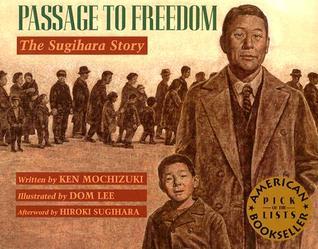
The sepia-toned illustrations by talented Dom Lee are excellent, and seem very realistic. Resembling photographs from the 1940’s, they were created by etching on beeswax applied to paper, and then painting over the etchings.

Evaluation: I cannot stress how inspirational this story is. As Hiroki says, “It is a story that proves that one person can make a difference.” And in fact, the book is dedicated not only to Chiune Sugihara and his family, but also “to all others who place the welfare of others before themselves.” Today, two generations later, it is estimated that there may be more than 40,000 who owe their lives to the Sugiharas.

Although I recommend this book for all ages, it would make an excellent introduction to the Holocaust for children. (There is nothing explicitly frightening here; just the acknowledgment that these people would die if not helped by the Sugiharas.)

Certainly more people would know about this story if Steven Spielberg made a movie about it! (Sugihara has been called “the Japanese Schindler.”) But PBS did make a documentary. You can watch an excerpt here. Even this 6 minute clip will affect you powerfully.
Profile Image for Sandra Bornstein.
Author 2 books18 followers
April 26, 2013
Righteous Gentiles are recognized at Yad Vashem in Jerusalem. These heroes risked their life as well as their family's during the dark days of the Holocaust. Passage to Freedom: The Sugihara Story, is one of the few picture books that documents this part of history. The back cover highlights both Jewish and Japanese culture by citing two prominent proverbs.

The Jewish proverb- "If you save the life of one person, it is as if you saved the world entire." Japanese Proverb- "Even a Hunter cannot kill a bird that comet so him for refuge."

The book includes an afterward by the son of the hero. Reading about the positive efforts of Righteous Gentiles provides a different perspective to the Holocaust. Sugihara had to decide whether he would follow his heart or follow his government's wishes. Few Holocaust era diplomats and leaders were willing to risk their job and their family's security. This book speaks directly to the choices that all people make. Standing up for what one believes is a character trait that should not be dismissed. This story raises many important questions that can be addressed at various age levels. I recommend that Sugihara's story be included in introductory discussions of the Holocaust.
36 reviews
March 8, 2010
There are so many heros whose stories go untold! I am so glad Hiroki Sugihara told the story of his father, Chiune Sugihara. It is a unique and heart-warming tale. The Sugihara family lived in the country of Lithuania. Chiune Sugihara was a diplomat representing the country of Japan. One day, hundreds of Jews from Poland who were fleeing from Nazi soldiers, appeared outside his front door. They desperately needed Chiune Sugihara to issue them visas so they could travel east through the Soviet Union and end up in Japan. Sugihara asked for permission from Japanese government. He repeatedly heard "no". Sugihara decided he must disobey his government. He issued as many visas as he could, saving as many as 10,000 Jewish refugees. His good deed did not go unpunished. He and his family spent 18 months in a Soviet internment camp and when he finally returned to Japan, Sugihara was asked to resign from diplomatic service. The incredible courage shown by this man is something I will never forget! I recommend this book for grades two and up.
5,870 reviews145 followers
May 19, 2020
Passage to Freedom: The Sugihara Story is a children's picture book written by Ken Mochizuki and illustrated by Dom Lee with an afterward from Hiroki Sugihara. It chronicles the political life of Chiune Sugihara, a vice-consul in Kaunas, Lithuania, as told from the perspective and based on the testimony of Hiroki Sugihara – the eldest of four sons.

May, at least in my part of the world is Asian Heritage Month, which I plan to read one children's book, particularly a biography, which pertains to the subject everyday this month. Therefore, I thought that this book would be apropos for today.

Chiune Sugihara was a Japanese government official who served as vice consul for the Japanese Empire in Kaunas, Lithuania. During the Second World War, Sugihara helped some six thousand Jews flee Europe by issuing transit visas to them so that they could travel through Japanese territory, risking his job and his family's lives.

Mochizuki's text is rather simplistic, straightforward, and informative. Told in first person perspective from Hiroki Sugihara, it depicts his family life in Lithuania and the Jewish refugees seeking visas to flee from the Nazis. An afterward written by Hiroki Sugihara continues his family's story after they left Lithuania and the impact his father's actions have become. Lee's sepia-toned illustrations, resembles photographs form that time period (1940s), was depicted extremely well as the semi-photorealism gave life to the touching narrative.

The premise of the book is rather straightforward. It recounts the story of Hiroki Sugihara's life in Lithuania during the Second World War, in particularly his observations of his father and the onslaught of Jewish refugees that escape the German occupation of Poland. He witness his father losing sleep over the crisis and defying his government to allow thousands upon thousands of Jewish refugee safe passage through Russia to Japan and from there to freedom.

All in all, Passage to Freedom: The Sugihara Story is a wonderful and heartfelt biography of a person who went against policy and followed his conscience, which made a difference in many peoples' lives. It also reinforce the notions that one person can change the world.
Profile Image for Sara J Wyatt.
200 reviews5 followers
May 24, 2022
You’d think it’s a children’s book by its appearance, but it’s not. It’s an everyone book. A picture book with beautiful, sepia-tone illustrations. And it contains a powerful, memorable story.

Narrated by his son, the Japanese diplomat in Lithuania during World War II signs paper after paper to save Jews from the Nazis. Hundreds and hundreds of papers, written by hand and written against the orders of his government, which said “no” three times to their pleas for help.

I’ve now read it to two of my middle school classes and recommended it to individual students. They have all agreed the book is important.
11 reviews
February 10, 2020
“Passage to Freedom the Sugihara Story” is a biography in the perspective of a young boy named Hiroki Sugihara recounting a story about his father’s heroic act. This book would be a perfect edition in any 3-5 classroom that would be sure to inspire students. One way this book can be implemented is to have students do a research project after reading about a heroic historical figure. This will give students the opportunity to choose someone who inspires them and learn historical facts along the way. This is also a good chance for students to practice reading and writing skills. A second idea is to have students conduct an interview of someone close in their life and write their own biography about them. This would be a good chance for students to get to know and feel inspired by someone close to them. They are also able to practice speaking and writing skills and interpersonal interactions that are sometimes forgotten in a world that relies heavily on technology.
This is a WOW book for me because it really showed the impact a brave act of kindness can have. Knowing this was a true story made it even more inspiring. It was written in such a beautiful and simple way that really highlighted the heroic acts of Hiroki’s father. It also is a great way for students to learn more about World War II and the horrific acts that came with it.
122 reviews
January 6, 2009
A Japanese diplomat, Chiune Sugihara based in Lithuania, is asked to issue visas to let Jewish refugees travel through Russia to Japan to escape the Nazis. He asks Japan for permission but is refused. He decides that his career security is not worth the greater good of saving as many people as he can. He writes until his arm and hand ache for many days. When his government transfers him to Berlin, he is still writing visas from the hotel room and on the way to the train. It is very unfortunate that Sighara’s story is not more well known. Not only does this show another side of Japanese participation in WWII, but the reader relates on a person to person level the struggle of doing the right thing and going along with the authority. The Afterword tells of the 18-month internment camp the family suffers and his firing from diplomatic service when he returns to Japan.
181 reviews10 followers
March 27, 2009
This is one of the most moving books I have read in a long time. It's just a picture book that is designed for children and the story is a nonfiction simple story. But the story and the message is a wonderful one for all of us.
14 reviews
Read
October 23, 2019
The book Passage to freedom was about a man and his family that could help many people with the Nazis. But he could not help everyone from the them.The crowd got bigger as time passed. He could not give all the people permission to pass throw the country art that time.But he made a way for all the people to get throw the country and get away from the Nazis.


I thought the book passage to freedom was OK. It was not my type of book that I like to read. It would be a good book for someone that wants to know more about the problems with Nazis and the Travis problems. And for someone that like drama and war.
Profile Image for Elizabeth.
2,031 reviews66 followers
December 22, 2024
Passage to Freedom tells the true story of Chiune Sugihara, a Japanese diplomat stationed in Lithuania during the beginning of WWII, who used his position to write hundreds of visas (without the consent of the Japanese government) to allow Jews to escape the Holocaust to safety. The story is told from the perspective of his son Hiroki Sugihara, who the author interviewed extensively for this book and who wrote the afterword. I was familiar with the story going in, and I think that it works especially well because of the child's perspective. The illustrations are gorgeous. It isn't an introduction to Holocaust history or literature for children, but it's an absolute asset to any children learning about the Holocaust for sure, especially when learning about those who did what was right. Recommended!
Profile Image for Laura.
2,064 reviews42 followers
May 14, 2011
Hiroki Sugihara's father was a Japanese consul to Lithuania at the beginning of World War II. Thousands of Polish Jewish refugees came to him, pleading for visas so they could escape the Nazis. Sugihara writes as many documents as possible, despite the Japanese government denying his request.

The artwork is beautiful and the story is well told. I do wonder, however, if the story is a little too advanced for the intended audience. This may work well as a read aloud in Grades 3 - 5 if students are learning about the Holocaust for the first time.

I'm left a little confused by the story. Weren't the Japanese and Germans allies? Wouldn't a lone consul face consequences for his actions? This nonfiction work tells the story of one event, one choice in a huge war. I can't help but wonder about the context and consequences.
Profile Image for Nicolewinter2011.
58 reviews
February 21, 2011
Illustrator: Dom Lee
Publisher: Lee and Low Books, Inc.
Year Published: 1997
Reading Level: Grades 3-9

Ken Mochizuki has written a children's picture book describing Hiroki Sugihara's story. Sugihara's family was a Japanese diplomat in Kaunas, Lithuania in 1940. He went against Japan to write visas for Lithuanian Jews to leave and go to Japan. He saved thousands of lives. Japan did not recognize Sugihara's efforts until decades later.

This book is a great picture book addition to a World War II study or character education/leadership/helping others in need/honor/heroes.
This entire review has been hidden because of spoilers.
2,618 reviews51 followers
June 18, 2013
1940, a japanese diplomat in lithuania starts writing visa for jewish refugees fleeing nazis in poland. he does so at great cost to himself and his family but saves the lives of 1000s of people. amazing story about a righteous gentile i'd not heard of.
2 reviews
October 26, 2009
I learn from this book that helping others also helps you....
Profile Image for Prabhat  sharma.
1,549 reviews23 followers
November 15, 2022
Passage to Freedom: The Sugihara Story (Paperback) by Ken Mochizuki, Illustrator- Dom Lee, Afterword by Hiroki Sugihara, Hindi language translation by Vidushak- Children’s Illustrated Colour Picture Book- The book narrates the story of Chiune Sugihara, a Japanese diplomat who was posted in Kaunas, Lithuania, Europe. He was able to speak 6-languages. Chiune Sugihara resided in Kaunas with his wife, her sister Setasuko, elder child Hiroki, his brothers Chiaki, Haruki. Barislav and one more person were his assistants. When Hiroki was 5-year of age, he and his father were standing in a shop. They found that a Jew boy wished to purchase some item but could not buy because he had no money. His father helped the child to buy what he wanted to buy. Next, the Jew family invited them for Jew festival Hanukkah. The year was 1940. World War II had started. Nazi Germany invaded Poland and captured the territory. Jewish residents were afraid for their lives. They ran with their families to Kaunas, Lithuania for a VISA to travel to Japan for their safety. Sugihara wrote to his embassy in Japan for permission to grant VISA to thousands to Polish refugees. Germany authorities refused permission. Sugihara wrote three letters, but the reply was refused. Sugihara questioned his family members what should be done in this situation. Their reply was in the affirmative. Sugihara issued VISA to all Jew refugees within his own handwriting. Soon German and Russian forces attacked Kaunas. Sugihara was asked to leave with is family for Berlin, Germany by train. Japanese authorities also permitted him to leave. He issued 300 visa per day. Thus, he issued about 6000 visas. He was sent to Russian jail for 18 months. After the war, he returned back to Japan. Here he was asked to submit his resignation from service. He resigned. He left his address with Israel Embassy in 1960. Soon letters for thanks started arriving from Jew survivors of the holocaust. They were known as "Sugihara survivors". In 1969, he was invited to Israel and was awarded Civilian award by Israel Government. Sugihara was born in Yotsu. In 1992, a statue was erected on a hill in his village which was named the Statue of Peace. Message from the book is One man’s effort can also make a difference. Coloured illustrations help the reader in relating to the story. I have read the Hindi language translation of this book.
15 reviews
March 13, 2021
"Passage to Freedom: Thee Sugihara Story" by Ken Mochizuki tells the story of the so-called "Japanese Schindler" that risked everything to help complete strangers, based on Hiroki Sugihara's firsthand account. In 1940 during the Holocaust, hundreds of Jews escaped from Poland into Lithuania in order to escape the Nazi's certain death and confinement. They gathered outside Chiune Sugihara's house in hopes of getting a visa signed by the Japanese consul to Lithuania. The visa allowed them to legally travel to Japan where they would then be able to safely disperse. However, Chiune had to get permission from his government in order to sign hundreds of visas, which they were not too keen to give. He is denied a total of three times, all while the Nazis are closing in around them. During this time, Hiroki is seeing the desperation and panic on all of these people's (especially children's) faces. When Chiune asks the advice of his family, Hiroki had already had his mind made up. He wanted his father to sign the visas. The rest of the family agrees, and Chiune sets out to sign as many as possible. This is hundreds and hundreds of visas from morning to night nonstop. The Sugihara's face the wrath of the Nazi's, as well as punishment from their own government for ignoring orders. For days this continues, until they are instructed to leave as it is no longer safe. Chiune is even signing visas and throwing them out of the window of the train that is taking them away. Hiroki sees all of this firsthand, even playing with the Jewish children, but doesn't fully grasp the full magnitude of his father's courage until he is older. The Sugihara's faced severe consequences for their actions, going to a concentration camp for over a year and losing political status. However, their actions did not go unnoticed as "Sugihara's Survivors" soon came out of hiding and contacted him with great appreciation. The simple illustrations gave the reader enough animation to use for imagination. There is nothing that I disliked about this story one bit. I would use this story to give a different perspective on the Holocaust that isn't as well known, but equally as important.
Profile Image for Zack Hodges.
444 reviews
March 9, 2025
"Passage to Freedom: The Sugihara Story" brilliantly captures the profound ripple effects of one diplomat's moral courage during World War II. Chiune Sugihara, stationed in Lithuania as Japan's consul, defied his government's directives by issuing thousands of handwritten transit visas to Jewish refugees fleeing Nazi persecution.

What elevates this narrative beyond mere historical account is its meditation on how ethical choices transcend their immediate circumstances. Sugihara's decision—made under immense pressure and with full awareness of potential consequences—illuminates how our moral stance in critical moments shapes both historical outcomes and future generations' understanding of courage.

This story resonates particularly in its illustration of how parental example becomes powerful inheritance. Sugihara's children witnessed their father's unwavering commitment to human dignity above political expediency—a legacy that extends beyond the estimated 6,000 lives saved to influence contemporary discussions about ethical responsibility during humanitarian crises.

This concise yet profound account reminds us that our choices in moments of moral testing create templates of possibility for those who follow. Sugihara's example continues to instruct and inspire, demonstrating how individual integrity, even at significant personal cost, establishes ethical parameters that outlive the individual and inform the moral imagination of generations to come.
15 reviews1 follower
October 22, 2019
Passage to Freedom is a book that describes the times of when the Jews were being hunted down by the Germans. Hiroki was a small boy who had been apart of a family that saved the Jews. He was a japenease and had a father who was apart of a type of government. One day he woke up abruptly and his life changed forever. There had been hundreds of people waiting in his yard to ask for help from his father so they could exit the country and stay safe before the Germans got to them. His father had to make the big decision to help them even though it could endanger his family. He was forever known by the Jews and society as a hero and life changer to the Jews.

This book was a very inspiring story and even better, it was true. It really makes me want to help and change our world like Chiune Sugihara did with the Jews. I would reccomend this book to a person who is intrested in World War 11, and the Nazis. This book is most likely for an older kid (middle schooler) so you can get the real message (to help others). Overall this book was amazing and really got the message out to show it takes a village to build a village. Meaning you have to work together to help make our world a better place.
Profile Image for Michelle  Tuite.
1,520 reviews17 followers
January 30, 2024
Reading 2024
Book 23: Passage to Freedom: The Sugihara Story and Baseball Saved Us by Ken Mochizuki

Two picture books I found after reading We Are Not Strangers. Going to review them together since they are by the same author and about 30 pages each.

Synopsis Passage to Freedom: In 1940, five-year-old Hiroki Sugihara, the eldest son of the Japanese consul to Lithuania, saw from the consulate window hundreds of Jewish refugees from Poland. They had come to Hiroki's father with a desperate request: Could consul Sugihara write visas for them to escape the Nazi threat?

Synopsis: Shorty and his family, along with thousands of Japanese Americans, are sent to an internment camp after the attack on Pearl Harbor. Fighting the heat and dust of the desert, Shorty and his father decide to build a baseball diamond and form a league in order to boost the spirits of the internees. Shorty quickly learns that he is playing not only to win, but to gain dignity and self-respect as well.

Review: The art is well done in both books. The Passage to Freedom was a better book for me, a richer story from the point of view of the child. 4⭐️. The Baseball story was good, but not as deep, 3.5⭐️.
49 reviews
Read
February 9, 2021
4th or 5th grade =
*Reflect upon criteria for citizenship & think critically about what makes a good citizen

*Write "citizen" on the board and ask students to define it & provide characteristics of a good citizen
*Read this book
*Ask students to keep word choices in mind as the book is read

*After reading, trace the travels of Sugihara on a map
*Ask if Sighura was a "good citizen" or not
----GC = one who will work to improve all the groups they belong to and to make the world a better place.
----Students may note that the words they came up with do not fit with Sighura's actions.. After all, he betrayed Japan after they told him 3x that he was not allowed to help Jewish fugitives.. He broke the law.

*Ask what other historical figures might have taken actions that do not fit with the literal definition of a good citizen.
----MLK, Mahatma Ghandi, Henry David Thoreau
*Ask, "Does this mean that Dr. King was a bad citizen?"

*Read the afterword of the book (extends on last page of the book)
*Ask, "What does this say about Sugihara?"
*Hopefully it will become apparent that citizenship is complicated.

*Maybe hold a debate?
Profile Image for Sonja.
608 reviews
November 4, 2018
I picked up this book at our local library's semi-annual book sale as I needed to build up my supply of children's books for my Little Free Library. While checking over the books, I put several aside as ones I wanted to read first. If you have young children, I would definitely recommend this book for kids from 5 on up. The true story is about a Japanese diplomat in Lithuania in 1940 who hand-wrote 300 plus visas and permission slips for Jews who were being persecuted by the Nazi's and were trying to get to Japan to escape certain death. Even tho the Japanese government said "no," the diplomat went ahead anyway to do the right thing and helped thousands of people to reach freedom. Great story!
1,448 reviews11 followers
June 2, 2019
A moving true story of a unique hero of the holocaust. The Japanese ambassador to Lithuania used his position to save thousands of Jewish refugees from certain death. After repeatedly asking his country permission to issue visas and being turned down, he put himself and his family at risk by disobeying and issuing the visas anyway, knowing that if he did not, those Jews faced certain death. Indeed, his actions were not without consequence, as the author’s note at the end explains. While the holocaust is always a heavy subject, this book is written from a child’s persoective, and the story told in a manner that is understandable and appropriate for all ages. It is a worthwhile book to add to studies of WWII at any age.
44 reviews
March 17, 2021
In this book we follow the life of a Japanese diplomat and his family in world war 2 as the Jews fled from Poland and were looking for passage to leave they needed a visa and he could write them. after serval attempts to get his government approval the family decide to write them anyways. He wrote 300 a day or more until he was absolutely forced out of Lithuania.

I really liked this book due to the fact that we see the real situation and choice this family had to make and that God was a main concern in that factor. I also love to see that he did not hold to tightly to his government but instead his faith. I would use this book to show the real struggles and choices people face in world war 2
12 reviews
October 21, 2019
This book is about a father who saved many lives by writing visas to all of the people. These people had run away from Germany to be safe. The Nazi´s were going to hurt or kill all of the people and soon would catch up to them. The father stayed up late every night and work hard all night to save people. This father had saved many life´s and was a hero.

I gave this book a 5 star because this book was very interesting. I liked some books that are history making! I also liked this book because of the fathers braveness. Even though he or his whole family could be caught and killed he wanted to save other people before him. ¨That I must think as if I were in someone else´s place.¨
24 reviews
June 20, 2018
Summary:This book is based on a true story about a Japanese government official who aided many Jews from fleeing the Holocaust and because of this he was going against official orders. He has helped so many Jewish people in the Holocaust.


Review: I thought this book was filled with important information that I could use for the Holocaust unit. I enjoyed reading this book because this text not only talks about the Holocaust but there were also people that tried to help the Jewish people during the Holocaust even government officials that went against their job orders.
Profile Image for Miss Leinbach .
120 reviews
June 10, 2021
biographical picture book with author's note (author is son of subject)
1-6

This a story that endures: a Japanese diplomatic in WWII must decide to obey his superiors or his conscience. He chooses his conscience and writes visa papers (by hand) for more than 30K Jews in Lithuania. Told from the point of view of one of his sons (the author) who was a young boy at the time. The author's note includes the story of the rest of his life and how he was eventually honored as a hero in Japan (despite disobeying his superiors).
Profile Image for Katy.
1,509 reviews6 followers
January 27, 2021
I read this wonderful story of a man who took the ultimate sacrifice to save the Jews in Poland at the beginning of Hitler's reign of terror in the late 1930s. Sugihari, a Japanese diplomat issued thousands of visas so the Jews could leave Poland. He did this while defying his country's orders, at the risk of his life, and the risk of his family.

What a POWERFUL story of courage and of doing what is the right thing!
Profile Image for Pat Salvatini.
739 reviews12 followers
January 1, 2023
The re-telling of the little known story of Japanese diplomat, Consul Chiune Sugihara. Refused permission by his government Sugihara defied those orders and hand wrote hundreds of visas to Jews in Lithuania saving thousands of lives before being reassigned to Berlin. Mochizuki and Lee skillfully mix a text that highlights bravery and heroism with sepia-toned images that set the mood of somber reflection.
Displaying 1 - 30 of 144 reviews

Can't find what you're looking for?

Get help and learn more about the design.