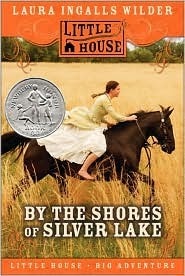
Quite a transitional and paradigm-shfiting book in the series—Laura grows out of childhood, the Ingalls family settles down, and for the first time, the world is unmistakably one of the 19th century—that seems like a beautiful silver pin holding together the three earlier and three later installments.*
Though my children begged me to read it last summer, right after Plum Creek, I held off because I wasn't sure how well they would respond to the different tone and circumstances of this volume. When we did finally begin, I was curious to see how they would react—Laura is now 13, much older than any of them, and assuming many adult responsibilities in the household; Mary is blind; Jack dies. Everything seems to have changed at the beginning of the book.
But my three children found, as I remember finding when I first read the book, enough to compensate for these sad or uncomfortable changes. Perhaps the real consolation is that, despite so many alterations, much more stays the same—Laura's zest for life, Pa's cheerful optimism, Ma's loving caution, the sisterly bond between Laura and Mary, a newer bond with Carrie, the music of the fiddle, the comfort of family life and the ability to make a home and cook excellent food whatever the odd living arrangements.
Everyone says that one of the main events of 19th-century America is the building of the railroad that linked east to west. You can hardly find a better dramatization of this watershed than Silver Lake. The story opens with the family riding a train for the first time, Pa is employed by the railroad commission, and the family lives for a few months in a railroad camp. Scarcely has the railroad been built, but east moves west, and those symbols of 19th-century civilization emerge: Laura encounters magazines and serialized stories, Pa teaches his daughters to dance, the Ingallses and their friends sing together—in parts!—with great enthusiasm, they have a prayer meeting when itinerant preachers visit, and they learn about the seminary for the blind that Mary ends up attending. It's fun to see how even on the yet-unsettled prairie with only one neighbor for 60 miles, the family begins to have much closer contact with the culture of the eastern states—far more than in the first two Little House books, and more even than in Plum Creek—a trend that will continue in the remaining books of the series.
In fact, it's this blend of emerging eastern culture and the wilder pioneer culture (each personified by one of Laura's parents) that makes the whole series so fascinating. There is a constant trend toward greater civilization, and that is the way that Ma always pulls the family, but there are many setbacks along the way as Pa changes his mind, the family loses prosperity, or the weather interferes. (The most surprising, though the most temporary, setback is in The Long Winter, which sees the Ingalls family, though settled in a town with a railroad, cut off from all civilization and reduced to lower standards of living than ever before by unremitting blizzards.)
Silver Lake is also transitional in that it sets the stage for Laura's adult life. She begins to ponder (with dread and eventual acceptance) the vocation as teacher that she will pursue in the following volumes. And I think the book also invites, very quietly, speculation about her eventual marriage. West and east seem to vie for her allegiance when she learns of the marriage of a 14-year-old friend of her cousin; she and Lena sing lots of romantic songs as they milk cows, and they discuss the idea of early marriage, raising the possibility that Laura and Lena might both end up as very young pioneer brides. But Ma again pulls Laura back into what feels like eastern sanity; we hear no more of Lena and her half-wild lifestyle. But by the end of the book a glimpse of Almonzo—and his horses—whispers of Laura's eventual marriage, three books later, that will take place at the much more civilized age of 19.
Altogether, Silver Lake strikes me as a wondrously rich book that maintains the threads of all earlier books while introducing some dazzling new threads. And it might be my favorite in the whole series—except I think that about every book I reread with my children. (I will have to content myself by declaring the whole Little House series my favorite series.)
* Here I exclude Farmer Boy from the set of earlier volumes, since it doesn't tell Laura's story. I always exclude The First Four Years from the later volumes, since it is so very inferior to the others: unrevised, posthumously published, and never meant, in the state it was left in, to be part of the series.