

What do you think?

Life, End of
This tour de force by a master of experimental novels finds the author reflecting on her old age and its effects on her writing. As she reflects on her own career, her experiments with narrative, and on the narrative she writes here, she ultimately reasserts herself and accepts the life behind her.
119 pages, Paperback
First published January 1, 2006
About the author
Christine Brooke-Rose
42 books108 followersChristine Frances Evelyn Brooke-Rose was a British writer and literary critic, known principally for her later, experimental novels. Born in Geneva and educated at Somerville College, Oxford and University College, London, she taught at the University of Paris, Vincennes, from 1968 to 1988 and lived for many years in the south of France.
She was married three times: to Rodney Bax, whom she met at Bletchley Park; to the poet Jerzy Pietrkiewicz; and briefly to Claude Brooke. She shared the James Tait Black Memorial Prize for fiction for Such (1966).
She was also known as a translator from French, in particular of works by Robbe-Grillet.
NYT obituary.
She was married three times: to Rodney Bax, whom she met at Bletchley Park; to the poet Jerzy Pietrkiewicz; and briefly to Claude Brooke. She shared the James Tait Black Memorial Prize for fiction for Such (1966).
She was also known as a translator from French, in particular of works by Robbe-Grillet.
NYT obituary.
Ratings & Reviews
Friends & Following
Create a free account to discover what your friends think of this book!
Community Reviews
Displaying 1 - 18 of 18 reviews

March 22, 2020
Life, End of
It’s a bit ironic that as I have read this the Covid 19 pandemic has taken hold: it was entirely coincidental. This is Brooke-Rose’s final novel, semi-autobiographical about a writer struggling with the limitations of old age and changing relationships with those around her. The novel is very much bound by the physical limitations of the body as it begins to stop working. I haven’t read much be Brooke-Rose. I sort of enjoyed Textermination, but my thoughts at the time I think were a little over enthusiastic and subsequent reflection has somewhat adjusted them. That being said Brooke-Rose certainly has a way with words and she plays quite effectively with the language of the illnesses of older age: polyneuritis, Zimmer frame and cardio-vascular.
However I did have some problems with the throwaway comments and judgements. Like this one when talking about the struggles with eyesight fading her character has:
“Oh of course blindness is nothing, thousands of people are blind, even children. But are there many both blind and very lame? The two don’t go together. A blind person needs legs to learn from touching walls and furniture; a lame person needs at least one eye to guide the zimmer or the wheelchair. The two together mean total dependence, even guiding a fork to the lips or tea to the cup.”
This is quite a negative approach to disability and at odds with the strengths based approach that social work takes today.
There are better bits. The descriptions of trying to complete ablutions at a sink when one can barely stand. Some reflections on American imperialism (The Unilateral States of America). Cardiovascular problems becoming a play on Vasco da Gama: de Harmer, then Charmer, Qualmer, Alarmer and so on. The narrator splits everyone into two groups T.F.s (True Friends) and O.P.s (Other People). Inevitably the O changes into other, otiose, obstreperous, obsolete, over-sensitive, obtuse, obdurate, oxymoronic and so on. There is lots of this punning, so of it multilingual, some of it very funny: on discovering an eye can have an infarction “How can the eye have a heart-attack? Because it loves, it loves”. And then the end of the novel with the punning about Descartes:
“Dehors before the cart, after all. A cruising mind, as against the mere word-play fun. Meanwhile: Les jeux de maux sont faits”
Parts of this were good and hit the spot, other bits really irritated me, so a mixed bag.
It’s a bit ironic that as I have read this the Covid 19 pandemic has taken hold: it was entirely coincidental. This is Brooke-Rose’s final novel, semi-autobiographical about a writer struggling with the limitations of old age and changing relationships with those around her. The novel is very much bound by the physical limitations of the body as it begins to stop working. I haven’t read much be Brooke-Rose. I sort of enjoyed Textermination, but my thoughts at the time I think were a little over enthusiastic and subsequent reflection has somewhat adjusted them. That being said Brooke-Rose certainly has a way with words and she plays quite effectively with the language of the illnesses of older age: polyneuritis, Zimmer frame and cardio-vascular.
However I did have some problems with the throwaway comments and judgements. Like this one when talking about the struggles with eyesight fading her character has:
“Oh of course blindness is nothing, thousands of people are blind, even children. But are there many both blind and very lame? The two don’t go together. A blind person needs legs to learn from touching walls and furniture; a lame person needs at least one eye to guide the zimmer or the wheelchair. The two together mean total dependence, even guiding a fork to the lips or tea to the cup.”
This is quite a negative approach to disability and at odds with the strengths based approach that social work takes today.
There are better bits. The descriptions of trying to complete ablutions at a sink when one can barely stand. Some reflections on American imperialism (The Unilateral States of America). Cardiovascular problems becoming a play on Vasco da Gama: de Harmer, then Charmer, Qualmer, Alarmer and so on. The narrator splits everyone into two groups T.F.s (True Friends) and O.P.s (Other People). Inevitably the O changes into other, otiose, obstreperous, obsolete, over-sensitive, obtuse, obdurate, oxymoronic and so on. There is lots of this punning, so of it multilingual, some of it very funny: on discovering an eye can have an infarction “How can the eye have a heart-attack? Because it loves, it loves”. And then the end of the novel with the punning about Descartes:
“Dehors before the cart, after all. A cruising mind, as against the mere word-play fun. Meanwhile: Les jeux de maux sont faits”
Parts of this were good and hit the spot, other bits really irritated me, so a mixed bag.

Read
January 9, 2014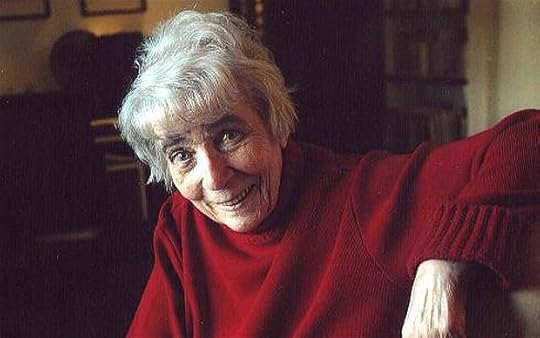
Christine Frances Evelyn Brooke-Rose (1923 – 2012)
Painfully jerking, like a babe learning to walk, stagger, jerk, plonk, old age a mirror of childhood but childhood not for one second reflected in the present-bound, floor-bound eyes. The child trips towards its mother, the old towards Mother Nature, looking into a glass darkly.
Life, End Of (2006) is the fourth of the markedly unusual novels by Christine Brooke-Rose I have read to this point - even her entry into the science fiction genre, Xorandor, startled me mightily with its choice of protagonists (two children and a sentient mass from outer space with remarkable powers and an all-overriding motherly instinct for its offspring) and its sudden segue to the nuclear threat to life on our green and blue and brown little globe - and while the other three were very clever in quite non-standard ways and often amusing, Life, End Of is the first to appeal to more than my intellect.
The first person narrator is a physically failing but mentally acute octogenarian writer with unmistakable similarities with Brooke-Rose herself.(*) With unblinking gaze and unwavering voice she tells us about the increasingly significant compromises, adjustments and, yes, surrenders that must ensue as the human body reaches the end of its energies.
Standing, on its own, without support somewhere, causes a tidal wave of nothingness in the head and a limping rush to the nearest armchair or bed. That means that nothing, nothing at all, no action or gesture, can now be done with two hands, if standing. That's a lot of gestures to unlearn.
And a little later:
So life becomes a gradual learning of new physical impossibilities and a slow reorganisation of every daily movement around them. The shrinking of all activity to such movements is step by step accepted, as is the swift dismantling of a lifetime’s independence. The small activities left become trebly precious. And astonishingly those ailments are not accompanied by clinical depression. Serenity remains. All the more so for joyful solitude. Closing in on oneself, it’s called, and foolish, wicked, unhealthy, weak-minded, self-centred. But how to avoid that if others do the enclosing? That withdrawal is then the last tiny freedom, the last small piece of autonomy.
But, please, do not deduce from these quotes that there is only telling and no showing in this text. Space is limited here and I must get as directly to the point as possible.
The narrator is fortunate enough that only minor memory lapses plague her but is otherwise sharp of mind, though for her "Writing is over. At an end. Like life." (**) Nevertheless, intellectual pleasures are still possible, just different from before, since now she can read and think "Without the obligation to remember reorganise adapt apply analyse for an exam, a review, a class, a seminar, a conference paper, a book." And when her "glaucomous eyes grow squintilly weary of reading all day," there is the thinking, which crisscrosses all the world and more in (nearly) free association, pulling the reader with it and dropping memorable phrases like "the organised amnesia of modern schooling" or this cri de coeur of all embittered old professors: "But then, he is not a teacher, who has to attract like an actor and simplify like a teleprof."
Oh, how the narrator loves words, loves to take them apart and put them back together again, to stretch and bend them. This has long been part of Brooke-Rose's particular art, but here such play as
At any rate this gland is where Descartes places the soul, thus putting de cart before dehors.
also serves as a kind of intellectual comedic relief, for both the author and the reader, from the sadness engendered by the manifold constraints holding the narrator in their grasp, which grows ever and ever tighter. Les jeux de maux sont faits.
Life, End Of speaks at least as much to my heart as to my mind, because my parents are both in that stage of final adjustment, reduction, regret and resignation; my father crossed 90 a few years ago and my mother is in her mid 80's and disappearing in the quicksand of Alzheimer's disease. And, yes, I, too, feel the gravitational pull of time to a degree that hardly permits further temporizing. But I think Life, End Of would have spoken almost as strongly to my younger selves. Perhaps it will to you, too.
(*) The relation between the author and narrator in this text is addressed in a typically clever metafictional manner embedded in a discussion of the theory of narration that also indicated the literary experiment carried out by said author in said text...
(**) Not quite, as it turns out for our author/narrator.

August 18, 2013
The final work of this innovative firecracker is a “dying diary, undated because the sense of time is lost.” A fictional form making use of the pronounless or I-less narrator is adopted in the style of her early novels, a grammar constraint that became a signature of her work, although the I-narrator (who?) does surface briefly for one last cryptic hurrah. On a surface level, this book is a series of short chapters completed by a woman in her eighties having a difficult time of living for her death, besieged by mobility and burning-foot problems, only finding the space to write in the few comfortable positions left to her. The reader unfamiliar with CB-R would not necessarily make the clear autobiographical links as students of her life and work might, so the conversations and digressions in here remain defiantly fictional, although the I-less-ness is much harder to accept as this is clearly Christine Brooke-Rose’s dying diary. She refused to identify herself as The Author, right until the end. A short work showing the exuberance, wit and, skill was still in flight as her body deteriorated, Life, End of is sadder for its abrupt drop-off and wistfully final content. But that’s life. End of.

July 4, 2013
'Decybernisation? Degenetisation? But no, the correct euphemism now is post-, new and therefore better: post-human for instance, heard the other day. But that will at once be confused with posthumous, as of course it should be, human becoming humus.' - 64Christine Brooke-Rose is either author or narrator or character or all three of this here book at the end of a line of books at the end of a line of years of her life. And odd it is that I have chosen it to be the beginning of my journey with her, but cest-la-vie, and I happily amble into what-did-I-expect: which is something quite difficult. From reputation.
But it's not. It's meditative and playful, but not really difficult, that is, after my eyes adjusted to her very particularly homegrown vocabulary of not-always-explained looping words: O.P.s, pillars of fire, T.F.s, Polly, etc. But then also it seemed very familiar, the made-up words, the blurring of fiction and autobiography, the looking back at a life, put me very much in mind of Helene Cixous's book which I recently fell in love with.
Then again, any comparison to HC would not be fair, as I am quite smitten with her (interestingly, HC has a blurb for CBR's Omnibus at the end of this book).
The other thing it put me in mind of was Beckett, his characters who sit in a state of vegetative decay, unable to move, with their minds slowly rotting away at obsessive thoughts. Here, though, is a critical difference. The author/narrator/character still has a young brain, it's only the body that's decayed. There is none of Beckett's bleak minimalism either. In a way, her version is more real, and thus maybe more scary.
All these streaking snippets of facts occur only because of long familiarity, long love of language and its bones and flesh, and how it grows from Primitive Human to Old High Human to Middle High Human to Modern Low Inhuman. - 13In this confined state, she thinks about the impotence of [r]age (and the consequences of annulment), the looping images in the media, the political situation around the world, globalization, her friends, her past apartments, languages, narrative conventions, and of course her physical condition. She also imagines faces on the rocks that sit outside her window, and hallucinates old dwelling-places, as would probably happen if you stay in the same place for too long.
Writing that out, it seems like a hodge-podge of topics, but it all fit in surprisingly well. She has a way of coming back to themes over again and expanding on them, and going deeper into them. I like her voice and I like her intellect, so I will definitely read more of her books in the future.

Read
December 8, 2013Life, End of. Who am I? You? To her? We readers are Other People. No, most likely True Friend. But the Reviewer? There’s reason to believe him OP. Stacking words upon the already said. Upon the saying itself. Covering over. Better, simply ignoring and passing over. That’s what the OP does. There is little time left. And I should speak too? No just read. Opinion People with their talking over and on top of. Who’s crotchety here? You probably know all the crotchety old men with all their crotchety old books, their last books. I know that Gaddis guy did one. Collapsing and decaying. It comes. Just let me tell you, Life, End of has its rights but more it has its obligation upon you, True Friend, Reader. Sympathy, empathy? Gelassenheit, better.

August 20, 2013
http://www.youtube.com/watch?v=q7DBoi...
http://www.youtube.com/watch?v=OcIMvl...
http://www.youtube.com/watch?v=g65oWF...
http://www.youtube.com/watch?v=uqGgeN...
http://www.youtube.com/watch?v=dsv8Pw...
http://www.youtube.com/watch?v=-DF5a9...
Rest in peace, Rose of all. Les jeux de maux de mots ne sont pas encore faits.
http://www.youtube.com/watch?v=OcIMvl...
http://www.youtube.com/watch?v=g65oWF...
http://www.youtube.com/watch?v=uqGgeN...
http://www.youtube.com/watch?v=dsv8Pw...
http://www.youtube.com/watch?v=-DF5a9...
Rest in peace, Rose of all. Les jeux de maux de mots ne sont pas encore faits.

Read
July 28, 2016A Relation between Theory and Machinic Imagination
This is Brooke-Rose's last book. Reviewers routinely remark on the differences between it and her earlier, more experimental novels. What matters, I think, is what it reveals about the psychology of the narrators in the other books: their forms of attention and their preferred subjects. Those traits are hers aside from her concerns with linguistics or the postmodern novel (as in Thru), and also aside from the chosen subjects and narratives of those earlier books.
Brooke-Rose's narrator (at first implicitly, later more carelessly and openly, the author herself) is full of the concerns that can be found in other books written during the authors' last years. She complains, as Gaddis, Howard Brodkey, and many others have, about the specifics of her medical condition, her burning feet, her fluctuating blood pressure, her strategies for keeping her balance. Not all of this is specific to this book: she has often had an intense preoccupation with the observable and describable quirks of the body and its appearances. The confusing double reflection that sometimes appears in a car's rear-view mirror, which recurs throughout the novel Thru, is an example: it's a minute, exacting physical description of a particular part of the body (eyes and eyebrows).
This sort of attention seems empirically exacting, and I think she wants it taken that way; but it is better described as compulsively machinic: it's closer to an autistic presentation than a realist novelist's delight in detail. She thinks of the body as a sort of machine, susceptible to exacting perspectival and formal description: our bodies are humorous, quirky things, comprised of detachable parts and pieces, each of which needs to be put into precise prose. There is little, in Brooke-Rose, of the body's gestalt, its motion or elegance: rather it's a construction of pieces, an ultimately unpleasant, tenuously constructed machine.
The narrator (author) like to report on conversations and encounters from a certain distance, as if the author and narrator wasn't fully present. When she's fully present -- when the texture and objects of conversation return -- it's often a matter of facts and figures. She is interested in verifiable information, reports, summaries, things that she can use to solve questions she has, or things that fill in details she hadn't known. Other than that she's skeptical of friends and their motives and uses, and in general she keeps away from people in different ways, sometimes by simply cutting them off.
I'm trying, in the compass of a few paragraphs, to sketch a picture of Brooke-Rose the author, as well as her narrators: like her other novels, Life, End of is dry because it is skeptical of human contact; scientific because it fears everything inexact, including emotions; and cold or unpersuaded when it comes to the body. She thrives on theories, texts, references, links, lists, catalogs, inquiries, problems and solutions, puzzles. She loves dissecting, listing, analyzing, diagramming, parsing. (This is especially clear in Thru, which revels in, and supposedly critiques, some French poststructuralist theory.) That personality drives her work, and gives it both its power and its obstinate love of fragmentation.
Nathan "N.R." Gaddis's review on Goodreads has the following lines, riffing on Brooke-Rose's repeated use of "T.F.," meaning True Friend, and "O.P.," which might mean Other People, or Opinionated People:
"Opinion People with their talking over and on top of. Who’s crotchety here? You probably know all the crotchety old men with all their crotchety old books, their last books. I know that Gaddis guy did one. Collapsing and decaying. It comes. Just let me tell you, Life, End of has its rights but more it has its obligation upon you, True Friend, Reader. Sympathy, empathy? Gelassenheit, better."
Gelassenheit, usually translated "releasement," is one of the late Heidegger's invented words. It means, roughly, the capacity to let people and things exist in their mode of being. Personally, I don't find much of Heidegger's nearly mystical, abstract acceptance in Life, End of: I find anger and dissatisfaction, tempered by physical and mental inability. There is, often, a lack of both sympathy and empathy, but it's because the narrator's at the end of her tether, not because she finds a way to accept what is.
This is Brooke-Rose's last book. Reviewers routinely remark on the differences between it and her earlier, more experimental novels. What matters, I think, is what it reveals about the psychology of the narrators in the other books: their forms of attention and their preferred subjects. Those traits are hers aside from her concerns with linguistics or the postmodern novel (as in Thru), and also aside from the chosen subjects and narratives of those earlier books.
Brooke-Rose's narrator (at first implicitly, later more carelessly and openly, the author herself) is full of the concerns that can be found in other books written during the authors' last years. She complains, as Gaddis, Howard Brodkey, and many others have, about the specifics of her medical condition, her burning feet, her fluctuating blood pressure, her strategies for keeping her balance. Not all of this is specific to this book: she has often had an intense preoccupation with the observable and describable quirks of the body and its appearances. The confusing double reflection that sometimes appears in a car's rear-view mirror, which recurs throughout the novel Thru, is an example: it's a minute, exacting physical description of a particular part of the body (eyes and eyebrows).
This sort of attention seems empirically exacting, and I think she wants it taken that way; but it is better described as compulsively machinic: it's closer to an autistic presentation than a realist novelist's delight in detail. She thinks of the body as a sort of machine, susceptible to exacting perspectival and formal description: our bodies are humorous, quirky things, comprised of detachable parts and pieces, each of which needs to be put into precise prose. There is little, in Brooke-Rose, of the body's gestalt, its motion or elegance: rather it's a construction of pieces, an ultimately unpleasant, tenuously constructed machine.
The narrator (author) like to report on conversations and encounters from a certain distance, as if the author and narrator wasn't fully present. When she's fully present -- when the texture and objects of conversation return -- it's often a matter of facts and figures. She is interested in verifiable information, reports, summaries, things that she can use to solve questions she has, or things that fill in details she hadn't known. Other than that she's skeptical of friends and their motives and uses, and in general she keeps away from people in different ways, sometimes by simply cutting them off.
I'm trying, in the compass of a few paragraphs, to sketch a picture of Brooke-Rose the author, as well as her narrators: like her other novels, Life, End of is dry because it is skeptical of human contact; scientific because it fears everything inexact, including emotions; and cold or unpersuaded when it comes to the body. She thrives on theories, texts, references, links, lists, catalogs, inquiries, problems and solutions, puzzles. She loves dissecting, listing, analyzing, diagramming, parsing. (This is especially clear in Thru, which revels in, and supposedly critiques, some French poststructuralist theory.) That personality drives her work, and gives it both its power and its obstinate love of fragmentation.
Nathan "N.R." Gaddis's review on Goodreads has the following lines, riffing on Brooke-Rose's repeated use of "T.F.," meaning True Friend, and "O.P.," which might mean Other People, or Opinionated People:
"Opinion People with their talking over and on top of. Who’s crotchety here? You probably know all the crotchety old men with all their crotchety old books, their last books. I know that Gaddis guy did one. Collapsing and decaying. It comes. Just let me tell you, Life, End of has its rights but more it has its obligation upon you, True Friend, Reader. Sympathy, empathy? Gelassenheit, better."
Gelassenheit, usually translated "releasement," is one of the late Heidegger's invented words. It means, roughly, the capacity to let people and things exist in their mode of being. Personally, I don't find much of Heidegger's nearly mystical, abstract acceptance in Life, End of: I find anger and dissatisfaction, tempered by physical and mental inability. There is, often, a lack of both sympathy and empathy, but it's because the narrator's at the end of her tether, not because she finds a way to accept what is.

September 25, 2025
This was Brooke-Rose's final "novel". I put the word in quotes because it is very obviously based on the author herself. The narrator/author is an octogenarian writer who is suffering with mobility issues. As time progresses other health issues present themselves.
Meanwhile she ruminates on the the role of author vs narrator. How her age and health issues put up a barrier between her and what she calls O.P. (Other People - altjough she also uses it for other groups) and TF's (True Friends).
Although this could have ended up sounding miserable Brook-Rose injects her usual wit (when required to use a Zimmer frame she converts it into a noun and talks about zimming from room to room) and erudition
She should be much better known
Meanwhile she ruminates on the the role of author vs narrator. How her age and health issues put up a barrier between her and what she calls O.P. (Other People - altjough she also uses it for other groups) and TF's (True Friends).
Although this could have ended up sounding miserable Brook-Rose injects her usual wit (when required to use a Zimmer frame she converts it into a noun and talks about zimming from room to room) and erudition
She should be much better known

May 13, 2017
I feel bad if this was your first CB-R... or even your 10th. You did yourself an extreme disservice. This book plays off her ENTIRE body of work, especially her lit crit/theory.
Having read her entire oeuvre (save for two Pound works I'm currently starting) in order, covering over 50 years of output, this end to the journey feels like losing a best friend.
You'll be hard pressed to find a more well-rounded literary genius from the past century...especially female. Only Woolf eclipses CB-R in my rankings of 'female greatness,' and even then it's close.
If you're not reading CB-R, you're doing it wrong. Read this book. But please, read it last...
Having read her entire oeuvre (save for two Pound works I'm currently starting) in order, covering over 50 years of output, this end to the journey feels like losing a best friend.
You'll be hard pressed to find a more well-rounded literary genius from the past century...especially female. Only Woolf eclipses CB-R in my rankings of 'female greatness,' and even then it's close.
If you're not reading CB-R, you're doing it wrong. Read this book. But please, read it last...

Read
July 2, 2013Fundamentally, this is a text about decrepitude. The protagonist is a who suffers pain, disability, declining capacity and "access," and social alienation, as a result of advancing age.
It is also a sort of literary style-exercise.
To me it seemed most effective when it actually communicated. Yes, the preceding sentence is a complete thought.
I got a good initial impression of the book. I kind of liked its linguistic quirks, and I liked that it revealed--in its own way--some of the inner workings of the protagonist's mind in the midst of the degradation of having one's body break down.
The book, its style, its repetitiveness, and the fact that it only deigned to communicate occasionally, soon became tedious despite the book's short length. One might argue that the tediousness was intended as a part of its communication, but actually I would be hesitant to accept that argument. First of all, because the protagonist does not seem to feel the discomfort of the tedium which she (spoilers be damned) inflicts on the reader. But also, secondly, because the author herself, within the text of the book, seems willing to disdain intent as legitimate defense.
There are poignant moments, and interesting revelations of a particular character of thought... but I'm sorry to say that there also seems to be a sparsity of wit. The author's play with novel-form--and her exposition of ideas relating to novel-form--appears to be exactly what she claims it is: a well-worn habit that she's not quite ready to abandon in her old age, though she knows she's mainly doing it to pass her time, without any ambition to craft a masterwork out of it.
One cannot know, just from reading this book, to what extent the character, or the novel's characterless voice, is a reflection of its author, either in biographical details or in obsessions, opinions, etc. The author flirts with this distinction, reminding us that this could very well be like her, or very different from her... who knows. It's not necessary to know. I react to "her" upon the terms defined within the book, or the assumptions of the form, without needing to distinguish a fiction from a non-fiction.
Part of her "play" is in the form of inconsistency, which in itself makes one wonder a bit. For instance, she seems to write mostly fragments for a good while, creating "sentences" which may have several adjective clauses or prepositional phrases, but omitting a subject or independent clause with predicate. But by the time you notice that, she's not doing it anymore. When she's finished telling you in one chapter a bit of the reasons why she might avoid traditional direct dialog, she immediately launches the next chapter with a dialog which is identical to all traditional dialog except merely for the omission of quotation marks... and of tags to indicate the speakers. She also promises a sort of I-less narration just to follow up by inserting an I... and then dropping it again. Okay, this has its share of fun, I guess, but... well...
"She" understands a bit about how a particular elder in a particular condition can alienate herself and be alienated, as a result of various concerns including overblown anxieties and very modest, sincere, and rational worries which are under-appreciated by other people. (The O.P. which she returns to constantly, though it's a term that undergoes metamorphosis in our understanding of her use in context). Anyway, when she communicates THIS, she's doing something that has meaning and which authors rarely do communicate... maybe none has communicated it in this particular way. So this is a value within the book. I, unfortunately, felt I only got a little bit of this, so what impact the book had was, again, spare.
I'm sorry to say that some of the observations and ideas that were expressed within the book, whether by the way of dialogues alluded to, or personless musings, seemed kind of shallow and commonplace. This includes ideas on the comparison of languages, such as suggesting French and highly inflected languages are "difficult" to learn, and elegant--an idea which a linguist would identify as patently absurd, by the way. And then metaphors for life which don't really show much insight... a room with doors and stairs, so many openings just like life with its exits and entrances... hmmm... And then, I just can't help feeling that "Polly new-writis" is kinda silly without being funny, and puts the author on par with whoever came up with that terrible Public Enemy album name "Muse Sick-N-Hour Mess Age." Or is she just impersonating an elder suffering from Witzelsucht?
But I don't want to rain too hard on this parade. The book was certainly not run-of-the-mill, it had its unique quality, and helped me understand a perspective I might not have otherwise pondered. Its strengths made it worth a go, even if I was never entirely won over.
It is also a sort of literary style-exercise.
To me it seemed most effective when it actually communicated. Yes, the preceding sentence is a complete thought.
I got a good initial impression of the book. I kind of liked its linguistic quirks, and I liked that it revealed--in its own way--some of the inner workings of the protagonist's mind in the midst of the degradation of having one's body break down.
The book, its style, its repetitiveness, and the fact that it only deigned to communicate occasionally, soon became tedious despite the book's short length. One might argue that the tediousness was intended as a part of its communication, but actually I would be hesitant to accept that argument. First of all, because the protagonist does not seem to feel the discomfort of the tedium which she (spoilers be damned) inflicts on the reader. But also, secondly, because the author herself, within the text of the book, seems willing to disdain intent as legitimate defense.
There are poignant moments, and interesting revelations of a particular character of thought... but I'm sorry to say that there also seems to be a sparsity of wit. The author's play with novel-form--and her exposition of ideas relating to novel-form--appears to be exactly what she claims it is: a well-worn habit that she's not quite ready to abandon in her old age, though she knows she's mainly doing it to pass her time, without any ambition to craft a masterwork out of it.
One cannot know, just from reading this book, to what extent the character, or the novel's characterless voice, is a reflection of its author, either in biographical details or in obsessions, opinions, etc. The author flirts with this distinction, reminding us that this could very well be like her, or very different from her... who knows. It's not necessary to know. I react to "her" upon the terms defined within the book, or the assumptions of the form, without needing to distinguish a fiction from a non-fiction.
Part of her "play" is in the form of inconsistency, which in itself makes one wonder a bit. For instance, she seems to write mostly fragments for a good while, creating "sentences" which may have several adjective clauses or prepositional phrases, but omitting a subject or independent clause with predicate. But by the time you notice that, she's not doing it anymore. When she's finished telling you in one chapter a bit of the reasons why she might avoid traditional direct dialog, she immediately launches the next chapter with a dialog which is identical to all traditional dialog except merely for the omission of quotation marks... and of tags to indicate the speakers. She also promises a sort of I-less narration just to follow up by inserting an I... and then dropping it again. Okay, this has its share of fun, I guess, but... well...
"She" understands a bit about how a particular elder in a particular condition can alienate herself and be alienated, as a result of various concerns including overblown anxieties and very modest, sincere, and rational worries which are under-appreciated by other people. (The O.P. which she returns to constantly, though it's a term that undergoes metamorphosis in our understanding of her use in context). Anyway, when she communicates THIS, she's doing something that has meaning and which authors rarely do communicate... maybe none has communicated it in this particular way. So this is a value within the book. I, unfortunately, felt I only got a little bit of this, so what impact the book had was, again, spare.
I'm sorry to say that some of the observations and ideas that were expressed within the book, whether by the way of dialogues alluded to, or personless musings, seemed kind of shallow and commonplace. This includes ideas on the comparison of languages, such as suggesting French and highly inflected languages are "difficult" to learn, and elegant--an idea which a linguist would identify as patently absurd, by the way. And then metaphors for life which don't really show much insight... a room with doors and stairs, so many openings just like life with its exits and entrances... hmmm... And then, I just can't help feeling that "Polly new-writis" is kinda silly without being funny, and puts the author on par with whoever came up with that terrible Public Enemy album name "Muse Sick-N-Hour Mess Age." Or is she just impersonating an elder suffering from Witzelsucht?
But I don't want to rain too hard on this parade. The book was certainly not run-of-the-mill, it had its unique quality, and helped me understand a perspective I might not have otherwise pondered. Its strengths made it worth a go, even if I was never entirely won over.

December 26, 2025
"Painfully jerking, like a babe learning to walk, stagger, jerk, plonk, old age a mirror of childhood but childhood not for one second reflected in the present-bound, floor-bound eyes. The child trips towards its mother, the old towards Mother Nature, looking into a glass darkly."
A critical theorist in the twilight of her life reflects on the increasingly distressful experience of living through advanced age.
A critical theorist in the twilight of her life reflects on the increasingly distressful experience of living through advanced age.
Read
August 8, 2023Harder to read this time, not for the usual reasons that Brooke-Rose is challenging but for the simple fact that I am closer to being among the Old Persons. Like Remake, this novel is more personal than usual for Brooke-Rose (though it still enjoys playfulness re the "how" of storytelling as opposed to the simple "whatness" of events). Interesting (and occasionally disturbing) meditations on long-term friendships and on the role of the younger generation(s). Completes for me a review of the dozen "experimental" Brooke-Rose novels that make up the bulk of her fictional output, from 1964-2006. I have, at last, read all of them.

June 23, 2013
(tries not to weep)

April 24, 2015
A dying diary of an 80 year old literary scholar who has her own literary view on everything in life and her death process is of course not an exception...

September 13, 2023
Les jeux de maux sont faits
--Christine Brooke-Rose Life, End of (2006)
Il eût peut-être mieux valu souffrir . . .
There is still life in Talleyrand's (facetious) dictum, which remains -- not for nothing (and despite asseverations to the contrary) -- the cynical contemporary sprichwort (saying): “It would perhaps have been better to have suffered,.
The first bite in Talleyrand's phrase rests in its subjunctive tense. The speaker, of course, places himself outside the cage in which suffering does its en-nobling work. (In Ishmael Reed's phrase, "It looks
(One imagines the limit in which the sense of Talleyrand's saying is sincere -- as was once the case for certain sects -- an experience of finding your so-called wealth of suffering suddenly vested as a fresh deposit of currency in your account. The flagellant, after a day of work, returns to a home-cooked meal and his hairshirt. Suffering is, of course, obliterated under this scheme, in which it becomes indistinguishable from making merit, and yet remains suffering nonetheless. Here one imagines certain academic texts -- those doctoral theses having limped to publication -- which find themselves suddenly assigned as textbooks (which seem (intended!) to bore their undergraduate readers to death), as if the greater suffering that went into the text's composition conferred a greater merit. One imagines certain old aphorisms, in a timely reversal, might torture this sensibility. 'No man so rich [in suffering] has entered the kingdom of heaven [with his doctrines intact] who -- having turned to slurry -- has actually passed through the eye of a needle.')
Talleyrand's second bite lies in his irony. Of course the consummate diplomat doesn't mean it. Not that he doesn't think it better to suffer, but that he must maintain (as an incognito) the notion that he has suffered all. In Calasso's reading, Talleyrand's irony -- his ostensible hypocrisy -- is part of the "douceur" which remains his condition of possibility. In theory, it would seem possible to be deadly serious, suffering the while, and yet giving all the world the impression one is merely playing (word) games. (In Kierkegaard's phrase, "Religiousness B," in its secular instantiation.) Of course, this is not so uncommon as to be unique in Talleyrand.
Many such ones have been annihilated, and are giving no sign that such a thing has happened. Albeit one rarely find them writing books. Chateaubriand's Memoirs From Beyond the Grave (1830) would appear one such contemporary instance, but its title is frankly a misnomer. Indeed, the author continuously enhances his sufferings for rhetorical effect. He hardly gives evidence that he has gone down to death except by the fact that his memoirs have been purchased for posthumous publication. (In this text, we read about Talleyrand the accusation that, "He put his signature to events, he wasn’t doing them.” This urge to “do,” Calasso remarks, "has been remarked as something that Chateaubriand shares with his detested Napoleon," and is certainly evidence that one is reading from the papers of one still living.)
The representation of what is actually interminable, tortuous (read: torture-us) disease -- has perhaps never found its way to the page. Such suffering (as one observes in practice) is actually annihilating. This is perhaps why Life, End of (2006) seems so remarkable. Its representation of disease is true-to-life. (NHYA class IV heart failure -- and its attendant claudication -- is exhausting, and sufficient in and of itself for hospice enrollment.) One does not find such people writing. Merely living like that is work enough. And yet we found ourselves reading it account, as if our author has been un-obliterated from beyond the pale of terminal disease. Properly, one could perhaps call such a text a "memoir from beyond the grave," in the sense that it represents the dying process and yet, in its lively impression of pursuing word games, gives no sign. And in fact writing the symptom has always proposed its problems for literature that seem to be solved here. One is thinking less in the Lacanian sense, and more in Kierkegaard's problematic of representing, in an aesthetic mode, the quotidian experience of something that only takes place in duration. Attempts to thrust straight through, i.e. the sentimental efforts of those who find themselves acutely ill -- as if experience were a substitute for those years of effort by dint of which one becomes a writer overnight -- these have their realization in the pieces which line the hallways of the cancer ward. (These too are a great help: A reminder that dying is worth it -- if only to get away (read: getaway) from bad art.)
The elegant solution on display in this text is that its "incognito" is both the condition of its production and the guarantor that it will abide. Life, End of (2006), even in its representation of pain, seems to maintain its antagonism with the "earnest Neume", the lapse of speech in the presence of the divine (or extreme pain), which, per Rousseau, can only be expressed as the pure vowel sound. Against the Neume, we have the word game. The motto of this text, as it continues its word games, seems to be, "Il eût peut-être mieux valu souffrir," which is at the same time an endorsement of suffering, which it places outside itself as an object for appraisal, and a disavowal made in its ironic mode (read: admission). As one might maintain Talleyrand's phrase in tension without settling to either side, so the text appears to express a similar antagonism between the facts of its expression and its form of play: The opinions of the intelligent-aged -- supporting detail spinning out into plurality (read: catalog) and interlarded with the pessimisms (read: stupidity) of late-adulthood and its symptom -- these have their counterpoint in word games that write every line fresh, discount its conclusions, and seem to have their source somewhere outside the text. There remains tension here, insofar as the one suffering such things, it seems, could not possibly have written it with such lucidity (read: ludic-ity), and such hypocrisy -- unless one were oneself (exceptionally) a Talleyrand -- and belied by the fact our author has done so. (Meanwhile, the representation of duration itself seems to be attempted in the accounting, for mere amusement, of the observations gathered in several hundred hours watching shadows play on a dry stone wall.) In making "literary" what could not be otherwise represented at all, one should let this tension lie. (Albeit one remarks of our narrator, that while she has "the sickness unto death," she is still, in the contemporary phrase, "sick with it".)

July 18, 2024
An autobiographical chronicle of the author nearing death spiced up with a subtle flavour of Brooke-Rose experimentalism. Perfect combination for a little novella.
October 21, 2025
Some fascinating ideas, clear depictions of the pain of aging wrapped up in obscurity.

August 1, 2014
“[…] the three most precious gifts have become have become deprivations, soon to be reached: reading, writing, and independence.”There is a fallacy that most readers have in that they like to impose an author’s biography onto the author’s writing, especially when the work does in fact feel autobiographical. This is, for the most part, discouraged, and yet, it’s all too easy to fall into this trap.
Christine Brooke-Rose is fully aware of this fallacy, and exploits it to great effect in this book. The reader is presented with a nameless narrator. The woman is 80 (roughly the age of CBR, if you assume she started writing this in 2003), she served in World War II, she was married to a Polish poet, and wrote “a very brief autobiography written only to find out whether this renewed Narrative Sentence in an I-less present can work in autobio” (which is this very book).
So, it feels like we’re reading something very much narrated by CBR. But all the facts don’t necessarily add up – for instance, if she’s writing in 2003 then she would have separated from Jerzy Pietrkiewicz 35 years earlier (1968), not the 33 years referenced in the book. Again, she’s aware of this, and as the book progresses the narrator and the author begin to converse, and through the conversation the author becomes a character in the book, separate from the narrator.
The author places himself inside the character. The author is a she. It so happens that the author here is very close to the character, even over-identifying with the two pillars of fire for feet and legs that jerk flinch wince and stagger but with the brain so far intact. And having fun with words and sentences as usual, each word and each sentence creating the next. But does the author have to fall? And could she write if she does?So the appearance of autobiography is false, but barely – there is overlap between the nameless narrator and CBR. And, as the book progress, going against her own words, CBR herself – or at least “the author” – steps into the narrative and supplants the character.
This does make things difficult for this author. Who always prefers to invent, who is never the main character in a book.
“The author collapses, into the character again, scattering the reader.”And, when the author herself steps in, she makes a direct reference to Jerzy Pietrkiewicz, and this time the seperation is the correct 35 years, so you can be damn well sure that she knows what she is doing throughout.
I’m going to be clear, this is a heartbreaking book for those that are fans of Christine Brooke-Rose. The details of her diseases, of the difficulty in writing and in typing, are all painful to read. Even with the non-autobiographical-character-as-CBR-stand-in sections, the reader cannot help but see CBR in every word.
You have to understand that the author writes every sentence in the book, whether representing a landscape or words from a character.This is, for the most part, a fitting last work. Not only due to the moment where CBR herself steps into the narrative, but because we, as readers, get to see her – at 80 – still linguistically spry, still oh so clever, still playing with the form and structure of a narrative and still trying to experiment with what is possible. Maybe the jokes and play-on-words are not as sharp as they have been in the past, maybe the brevity of the book is disappointing – if only because there is nothing after it – but it’s still a reminder of who CBR was as a writer, as an experimenter, and as a (mostly unheralded, mostly unrecognized) literary force.
That’s obvious
Not always. And not to everyone
Goodbye CBR – at 89 you had an amazing run, but it’s still sad to say goodbye.
Displaying 1 - 18 of 18 reviews